Home Blogs MIM Material Selection Notes Martensitic Stainless Steel for MIM MIM Material Selection Notes Quick answer: Martensitic stainless steel is a heat-treatable stainless steel family used in MIM when small, complex parts need hardness, wear resistance and mechanical strength together with moderate corrosion performance. It should not be selected by maximum hardness alone. Engineers …
MIM Material Selection Notes
Quick answer: Martensitic stainless steel is a heat-treatable stainless steel family used in MIM when small, complex parts need hardness, wear resistance and mechanical strength together with moderate corrosion performance. It should not be selected by maximum hardness alone. Engineers must also review corrosion exposure, impact and toughness needs, grade and feedstock availability, sintering response, heat-treatment movement, critical dimensions and the inspection plan. MIM 420 is commonly reviewed for a more balanced hardness, corrosion and toughness direction, while MIM 440C is reviewed when higher hardness and wear resistance dominate. Final selection must be made against the drawing, operating environment and functional failure mode.
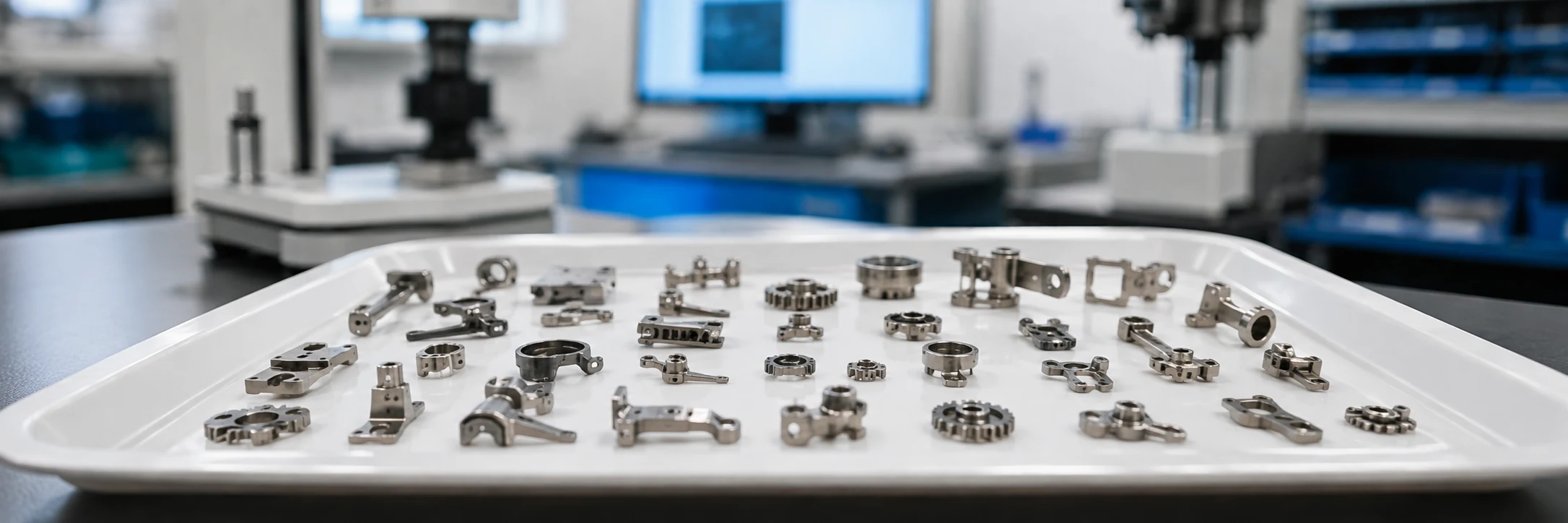
Engineering takeaway: Material selection should connect component geometry, microstructure, heat treatment and the required inspection route.
What Is Martensitic Stainless Steel in MIM?
Martensitic stainless steels are chromium-containing stainless alloys that can develop a hardened martensitic structure through an appropriate thermal route. Their value in MIM is the combination of heat-treatment response and the ability to form small, intricate components through injection molding before debinding and sintering.
This material family is most useful when the component needs more than corrosion resistance alone. Contact surfaces, repeated sliding, local wear, compressive loading or retention features may create a genuine need for higher hardness. Increasing hardness, however, can reduce toughness and make distortion control, surface condition and dimensional verification more important.
When It Is Worth Reviewing
- Small, complex parts with wear or contact surfaces
- Components that need post-sintering hardening
- Features that would be expensive to machine individually
- Production volumes that can justify dedicated tooling
- Applications where moderate stainless behavior is still required
When Another Material May Be Better
- Severe corrosion exposure is the dominant requirement
- High ductility or impact toughness is more important than hardness
- The part is large, geometrically simple or required only in low volume
- The drawing cannot accommodate sintering and heat-treatment movement
- The hardness requirement is not functionally necessary
For a broader material-family overview, see stainless steel for MIM . Grade selection should then be narrowed according to the component function, environment and required final condition.
Composition, Feedstock and Metallurgical Characteristics
Chromium supports stainless behavior, while carbon contributes to hardening potential. The finished result does not depend on nominal chemistry alone. Prepared feedstock, molding consistency, debinding, sintering atmosphere, carbon control and subsequent heat treatment all influence the final material condition.
The Metal Injection Molding Association lists 420 and 440 series materials within the ferritic and martensitic stainless steel family available for MIM, while also advising users to confirm actual alloy or substitute availability with the selected supplier. MIMA Materials Range
ASTM B883-24, the Standard Specification for Metal Injection Molded (MIM) Materials, includes MIM-420 and MIM-440 as martensitic stainless steel compositions. The standard confirms these as established ferrous MIM material designations, but the actual grade, condition and project requirements still need to be defined for the component. ASTM B883-24

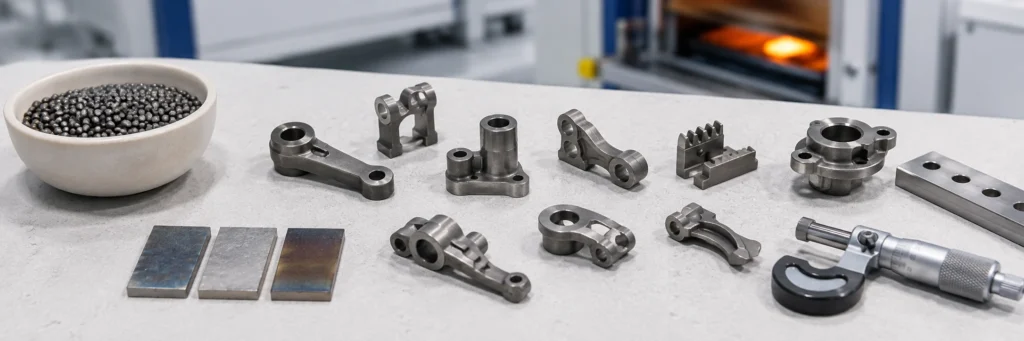
Engineering takeaway: Feedstock appearance alone cannot confirm whether the material is MIM 420, MIM 440C or another stainless steel grade.
Material and Process Review Reference
| Material or Process Variable | Why It Matters | Engineering Review Action |
|---|---|---|
| Alloy chemistry | Chromium, carbon and grade-specific additions influence hardenability, corrosion behavior, toughness and wear response. | Confirm the actual grade and final condition instead of specifying only “martensitic stainless steel.” |
| Prepared feedstock | Feedstock must match the intended alloy route and can differ from the modified materials used in individual research studies. | Confirm grade availability and the production feedstock route before final tooling release. |
| Debinding, sintering atmosphere and carbon control | These variables influence density, porosity, shrinkage, surface decarburization, microstructure and the condition entering heat treatment. | Review the complete thermal route together with critical dimensions and support strategy rather than treating nominal chemistry as the only input. |
| Heat treatment | Develops the required hardened condition but can also change size, flatness, residual stress and toughness. | Define the functional hardness target and dimensional acceptance plan together. |
| Surface condition and secondary operations | Surface condition can affect corrosion response, appearance, contact behavior and final fit. | Clarify whether polishing, passivation, coating, machining or another secondary operation is required. |
A published investigation of MIM 420 examined samples processed in graphite and molybdenum-lined furnaces and reported differences in surface decarburization, microstructure and hardness response. The study supports a practical RFQ rule: material chemistry, furnace environment and heat treatment must be reviewed as one process route. Study-specific feedstock chemistry should not be transferred directly to an unrelated production RFQ. Review the MIM 420 study .
Key engineering point: A datasheet can describe a material, but it does not determine whether the complete MIM route will meet a particular drawing. Geometry, thermal movement, inspection datums and the final hardness condition still require project-specific review.
Hardness, Wear Resistance, Strength and Corrosion Trade-Offs
Martensitic stainless steel is usually selected because hardness and wear behavior matter to the component function. The highest attainable hardness is not automatically the best specification. A more aggressive hardened condition may increase dimensional-control difficulty, reduce impact tolerance or create an unnecessary processing and inspection burden.
| Project Requirement | Why Martensitic Stainless May Fit | What Must Still Be Checked |
|---|---|---|
| Sliding or repeated contact | Heat-treated hardness can improve resistance to local wear. | Contact stress, lubrication, surface finish and counterface material. |
| Small retaining or locking feature | Strength and hardness may support edge or feature durability. | Impact loading, notch sensitivity and heat-treatment distortion. |
| Corrosive operating environment | Provides stainless behavior beyond many low-alloy steels. | Actual chemicals, moisture, temperature, cleaning cycle and surface condition. |
| Tight dimensional relationship | MIM can consolidate complex geometry into one component. | Sintering shrinkage, post-heat-treatment movement, datums and secondary sizing. |
| High-volume complex geometry | MIM may reduce repeated machining and assembly operations. | Tooling economics, annual volume, gate location and feature feasibility. |
The material choice should start with the functional failure mode: wear, deformation, corrosion, fracture, dimensional drift or surface damage. Specifying hardness without identifying the failure mode can drive the project toward an unnecessarily aggressive material condition.
When wear is the primary failure mode, review the broader selection factors for wear-resistant MIM materials before fixing a specific grade.
Heat Treatment and Hardness Development
Martensitic stainless steel reaches its intended properties through a controlled hardening and tempering route selected for the actual alloy and component geometry. The thermal cycle must be treated as part of the manufacturing plan, not as an isolated finishing step added after dimensional decisions are complete.
| Review Stage | Engineering Question | Potential Problem if Ignored |
|---|---|---|
| Sintered condition | Is density and geometry suitable for the planned heat-treatment route? | Property variation, dimensional instability or inconsistent surface condition. |
| Hardening route | What final hardness and functional performance are actually required? | Over-specification, brittleness or unnecessary process cost. |
| Tempering condition | How should hardness and toughness be balanced? | High hardness without adequate functional toughness. |
| Dimensional control | Which dimensions must be checked before and after heat treatment? | Critical features moving outside the drawing requirement. |
| Final inspection | Where and how will hardness and dimensions be verified? | A nominal specification with no practical acceptance method. |
Thin sections, asymmetric mass distribution, long unsupported features and sharp transitions can respond differently during thermal processing. For critical dimensions, the project team may need to plan tooling compensation, sintering support, sizing, machining or a specific inspection sequence rather than relying on a single final measurement.
Engineers evaluating a wider range of hardenable materials can also review heat-treatable MIM materials .
Why Martensitic Stainless Steel Is Used for MIM Components
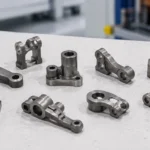
MIM is most relevant when a part combines complex shape, small dimensions, repeatable production volume and material-performance requirements that would otherwise require extensive machining or assembly. Martensitic stainless steels add a useful hardening route for components with wear surfaces, retaining features, local contact stress or durability requirements.

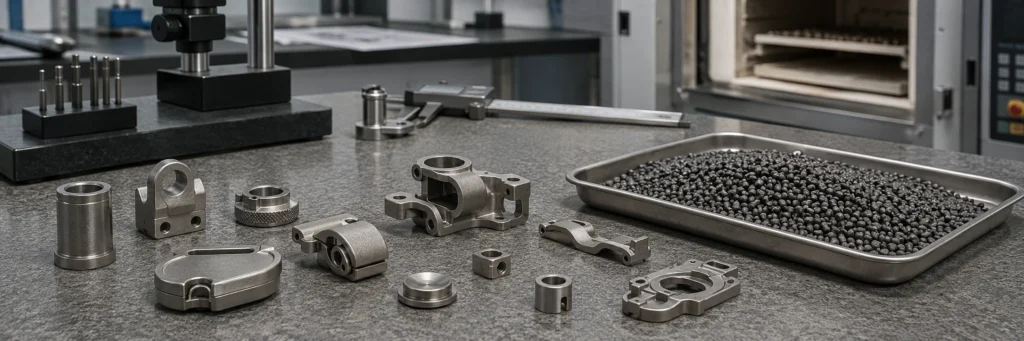
Engineering takeaway: The illustration supports the geometry and part-consolidation discussion; it does not verify a specific alloy grade or depict a confirmed XTMIM production batch.
Application Archetypes and Review Priorities
| Component Archetype | Why Martensitic Stainless May Be Reviewed | Critical Review Questions |
|---|---|---|
| Locking, retaining or articulation components | Local contact edges and repeated movement may require hardness and mechanical durability. | Is impact toughness important? Which surfaces carry load? Can the geometry tolerate heat-treatment movement? |
| Guides, datums, tabs and sliding-contact features | Wear resistance and dimensional stability may be more important than high ductility. | What is the counterface material, lubrication condition, surface finish and permitted wear? |
| Small medical-device mechanism components | MIM can consolidate compact geometry while a martensitic grade provides a hardenable material route. | What corrosion, cleaning, biocompatibility, surface and regulatory requirements apply to the actual project? |
| Precision frames and support components | Strength, stiffness and compact integrated features may support part consolidation. | Which flatness, runout and datum relationships must remain stable through sintering and heat treatment? |
| Wear-sensitive industrial mechanism parts | Higher hardness may improve contact durability where repeated machining would otherwise be required. | Is MIM volume commercially justified? Which surfaces require secondary sizing, machining or finishing? |
Public MIMA case studies document MIM 420 in compact medical-device mechanism parts and precision frames, and 440C in industrial printer datums and support tabs. These examples demonstrate possible application directions; they do not establish automatic suitability for another drawing or operating environment. Review the association examples for endoscopic device parts , a MIM 420 compression frame and 440C printer datums and tabs .
Representative Engineering Scenario
A small actuator component may include a contact edge, a cross-hole, a thin arm and a locating surface. The drawing initially specifies only “martensitic stainless steel” and a high hardness target.
Problem: The specification does not identify whether wear, corrosion, compressive strength or edge retention is the real functional need.
Likely cause: Material selection was made from a general datasheet before reviewing geometry, heat-treatment movement and the inspection datum strategy.
Engineering handling: Confirm the operating environment, contact condition, required toughness, actual critical dimensions, preferred grade and final inspection method before tooling release. The team can then decide whether the feature should remain as-molded, be sized after sintering or receive a secondary operation after heat treatment.
This type of review is more useful than selecting an alloy from hardness alone. The project decision should connect material, geometry, process route and acceptance method.
Choosing a Martensitic Stainless Steel Grade for MIM
Grade selection should begin with the component’s functional priority rather than with a direct search for the hardest available martensitic grade. MIM 420 and MIM 440C are two common review directions within this material family: 420 is generally considered when hardness, corrosion behavior and toughness need a more balanced response, while 440C is reviewed when higher hardness and wear resistance carry greater weight. Geometry, impact risk and thermal movement can change that decision.

Engineering takeaway: Grade selection should follow the component’s hardness, wear, toughness, corrosion and dimensional priorities rather than a preference for the highest possible hardness.
| Selection Factor | MIM 420 Review Direction | MIM 440C Review Direction |
|---|---|---|
| Primary performance priority | Balanced hardness, corrosion behavior and toughness. | Higher hardness and wear resistance carry greater weight. |
| Wear demand | Moderate wear or contact requirements. | More demanding wear or edge-retention conditions. |
| Toughness sensitivity | Often the first direction to review when a more balanced response is needed. | Requires closer review where impact, thin sections or stress concentrations exist. |
| Dimensional risk | Heat-treatment movement still requires planning. | Final condition may require tighter control of thermal processing and inspection. |
Use the detailed material pages for MIM 420 stainless steel and MIM 440C stainless steel when grade-specific properties are required. For a dedicated head-to-head choice, use the 420 vs 440C stainless steel comparison .
Process and Quality Risks to Review Before Tooling
This section focuses on what can go wrong during the material and thermal route. The objective is to identify the failure mechanism before tooling so the process plan can address it instead of relying on final inspection to detect it later.
| Potential Risk | Likely Engineering Cause | Review or Prevention Action |
|---|---|---|
| Hardness response outside the functional need | Material condition, section thickness or thermal-route variation. | Define the required final condition and review whether the selected route can achieve it without unnecessary brittleness or process burden. |
| Heat-treatment distortion | Asymmetric geometry, residual stress or unsupported thin features. | Review support, sizing, machining allowance and the sequence of thermal and dimensional-control operations. |
| Unexpected brittleness | Hardness specified without sufficient toughness consideration. | Connect the hardened condition to impact, bending and stress-concentration risks. |
| Corrosion performance below expectation | Environment, surface condition or grade choice not fully defined. | Review the actual exposure conditions and whether another grade or surface route is more appropriate. |
| Dimensional mismatch after processing | Sintering shrinkage and heat-treatment movement evaluated as separate problems. | Build one dimensional-control strategy covering tooling compensation, sintering support, sizing and any post-treatment correction. |
Inspection Planning for Martensitic Stainless Steel MIM Parts
Inspection answers a different question from process-risk review: how will the finished part be verified against its functional requirements? The acceptance plan should connect each critical characteristic to a defined measurement stage, datum or test method instead of checking every part characteristic with the same routine.
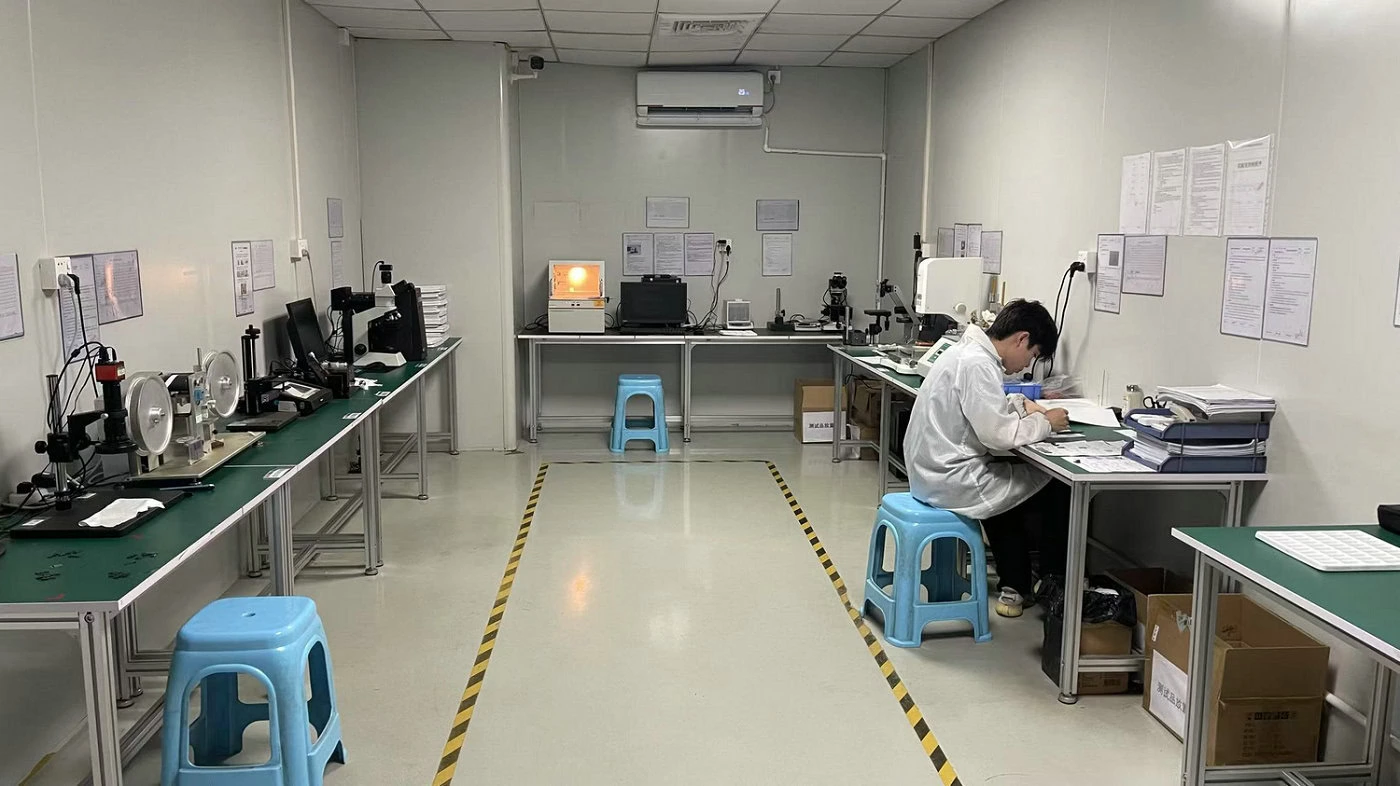
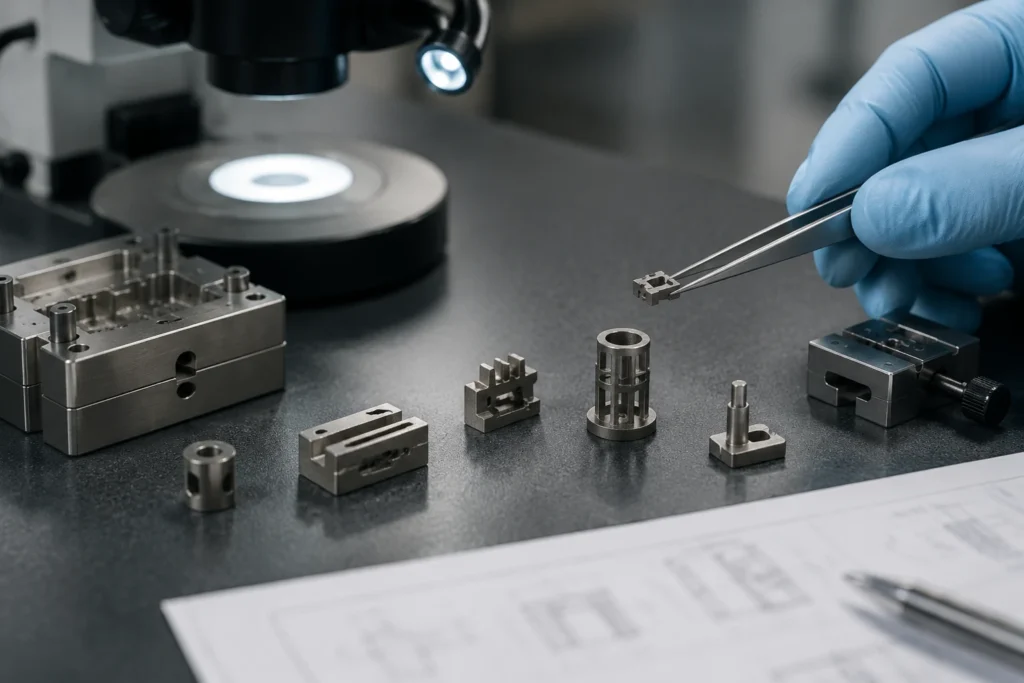
Engineering takeaway: Inspection scope should be defined by the drawing, functional risks and required material condition rather than inferred from a generic grade name.
| Inspection Item | What It Verifies | Acceptance Planning |
|---|---|---|
| Hardness / final material condition | Confirms that the intended hardened condition was achieved. | Define the relevant measurement location, method and reporting requirement where hardness is functionally critical. |
| Critical dimensions and datums | Verifies final geometry after shrinkage, sizing and thermal processing. | Identify CTQ features, functional datums and the stage at which final acceptance is measured. |
| Flatness or runout | Checks shape stability on thermally sensitive functional surfaces. | Define the functional surface, datum relationship and acceptance limit. |
| Surface condition | Verifies the specified contact, appearance or corrosion-related finish. | Match the check to the required as-sintered, polished, passivated, coated or machined condition. |
| Density or internal condition, when required | Supports material and process consistency where the function justifies it. | Add this validation only when the drawing, qualification plan or functional risk requires it. |
What to Include in a Martensitic Stainless Steel MIM RFQ
The RFQ section should answer one practical question: what information must the supplier receive to review material suitability, tooling feasibility and the final acceptance route? Send the inputs that define function and manufacturing risk; detailed inspection methods can then be agreed during engineering review.
| RFQ Input | Why the Engineering Team Needs It |
|---|---|
| 2D drawing and 3D model | Provides geometry, tolerances, datums, undercuts and tooling-direction information for feasibility review. |
| Requested grade or performance target | Clarifies whether the project requires a specific alloy, a hardness range or a broader functional material outcome. |
| Operating environment and functional loading | Shows whether corrosion, wear, impact, bending, compression or edge retention is driving material selection. |
| Critical dimensions, CTQs and functional datums | Identifies the features that must survive sintering, heat treatment, sizing and any secondary operation. |
| Annual volume and program life | Helps determine whether dedicated MIM tooling and process development are commercially appropriate. |
| Surface and secondary-operation requirements | Clarifies machining, polishing, coating, passivation, assembly or other final-condition requirements. |
The MIM RFQ Preparation Guide provides the broader project-information checklist for supplier review.
Frequently Asked Questions
What makes martensitic stainless steel different from austenitic stainless steel?
Martensitic stainless steel can be hardened through heat treatment and is usually selected when hardness, wear resistance and mechanical strength are important. Austenitic stainless steels are generally chosen for stronger corrosion resistance, ductility and non-hardening behavior. The correct family depends on the component function and environment.
Is martensitic stainless steel suitable for every corrosive environment?
No. Martensitic stainless steel provides stainless behavior, but corrosion exposure still needs to be reviewed against the specific grade, surface condition, chemicals, moisture, temperature and cleaning process. A more corrosion-resistant material family may be preferable when corrosion is the dominant failure risk.
Does a higher hardness specification always improve a MIM component?
No. Higher hardness can improve wear resistance, but it may reduce toughness, increase distortion sensitivity and create additional inspection requirements. The hardness target should be linked to an actual functional need such as wear, contact stress or edge durability.
How should engineers choose between MIM 420 and MIM 440C?
MIM 420 is generally reviewed for a more balanced combination of hardness, corrosion behavior and toughness. MIM 440C is reviewed when higher hardness and wear resistance are more important. Geometry, impact risk, thermal movement and the final inspection plan must also be considered.
Is martensitic stainless steel magnetic?
Martensitic stainless steels are generally ferromagnetic because of their microstructure. Magnetic response should not be used as the only method for confirming a specific grade, material condition or finished-part performance. Where magnetic behavior is functionally important, define the required test condition and acceptance method in the drawing or RFQ. Worldstainless provides an overview of stainless steel magnetic properties .
What information should be sent for a martensitic stainless steel MIM review?
Send the 2D drawing, 3D model, material or performance requirement, hardness expectation, operating environment, loading or wear condition, critical dimensions, annual volume and any required secondary operations or surface treatments.
Technical References
- ASTM B883-24 — Standard Specification for Metal Injection Molded (MIM) Materials . Ferrous MIM material specification that includes MIM-420 and MIM-440 as martensitic stainless steel compositions.
- Metal Injection Molding Association — Materials Range . MIM material families, 420 and 440 series availability direction and supplier availability guidance.
- PIM International — A Microstructural Investigation of 420 Martensitic Stainless Steel Processed by MIM . Technical research covering feedstock chemistry, furnace environment, decarburization, microstructure and heat-treatment response.
- Nickel Institute — Design Guidelines for the Selection and Use of Stainless Steels . General engineering guidance for stainless steel family selection and property trade-offs.
- Worldstainless — Mechanical and Physical Properties of Stainless Steel . Reference overview covering magnetic behavior across stainless steel families.
Review Your Martensitic Stainless Steel MIM Project
Share the drawing, material target, hardness requirement, operating environment and expected volume. The engineering review can then focus on grade selection, MIM feasibility, thermal-process risks, critical dimensions and the required inspection route.