MIM Materials · Material Properties
Wear-Resistant MIM Materials
This guide explains how to review wear resistant MIM materials by the real contact condition, not by a material name alone. The most suitable route depends on wear mode, mating material, surface finish, load, lubrication, heat treatment response, and dimensional stability after sintering.
Quick answer: Wear-resistant MIM materials are selected by matching material family, hardness response, microstructure, surface condition, contact geometry, mating material, motion type, lubrication, corrosion exposure, and inspection requirements. High hardness can help, but it does not automatically solve sliding wear, abrasive wear, edge contact, or wear combined with tight tolerance requirements.
Core conclusion: Wear-resistant MIM materials should be selected by reviewing the complete contact condition, not by hardness alone.
What Makes a MIM Material Wear-Resistant?
Wear resistance in metal injection molding is a system-level material decision. Hardness matters, but it is only one part of the review. The same material can behave differently depending on surface condition, heat treatment, mating material, load, motion type, lubrication, and whether the wear is sliding, abrasive, contact-based, or combined with corrosion.
Hardness Is Only One Factor
A higher-hardness material may improve wear behavior in some applications, but hardness alone does not confirm suitability. If the contact area is too narrow, the surface is too rough, or the mating material is too aggressive, a hard material can still perform poorly.
For a dedicated hardness discussion, review high-hardness MIM materials; this page focuses on wear behavior as a broader engineering condition.
Contact Condition Controls the Decision
Sliding contact, abrasive particles, local edge loading, dry contact, and corrosive service can each point to a different material route. The RFQ should identify the actual wear surface, the mating material, and whether the contact is lubricated, dry, intermittent, or continuous.
MIM Process Control Still Matters
Feedstock consistency, injection molding stability, debinding, sintering shrinkage, heat treatment, and final inspection affect whether the selected material can maintain the required functional surface in production.
Do Not Chase Maximum Hardness by Default
In a wear-critical MIM project, the hardest available material is not always the safest choice. A very hard material may increase finishing difficulty, edge sensitivity, or cost. A balanced material with controlled heat treatment, better surface finish, and stable functional geometry may perform better in the actual part.

Core conclusion: A hard MIM material is not automatically wear-resistant unless the contact condition is suitable.
Where Wear-Resistant MIM Materials Fit Best
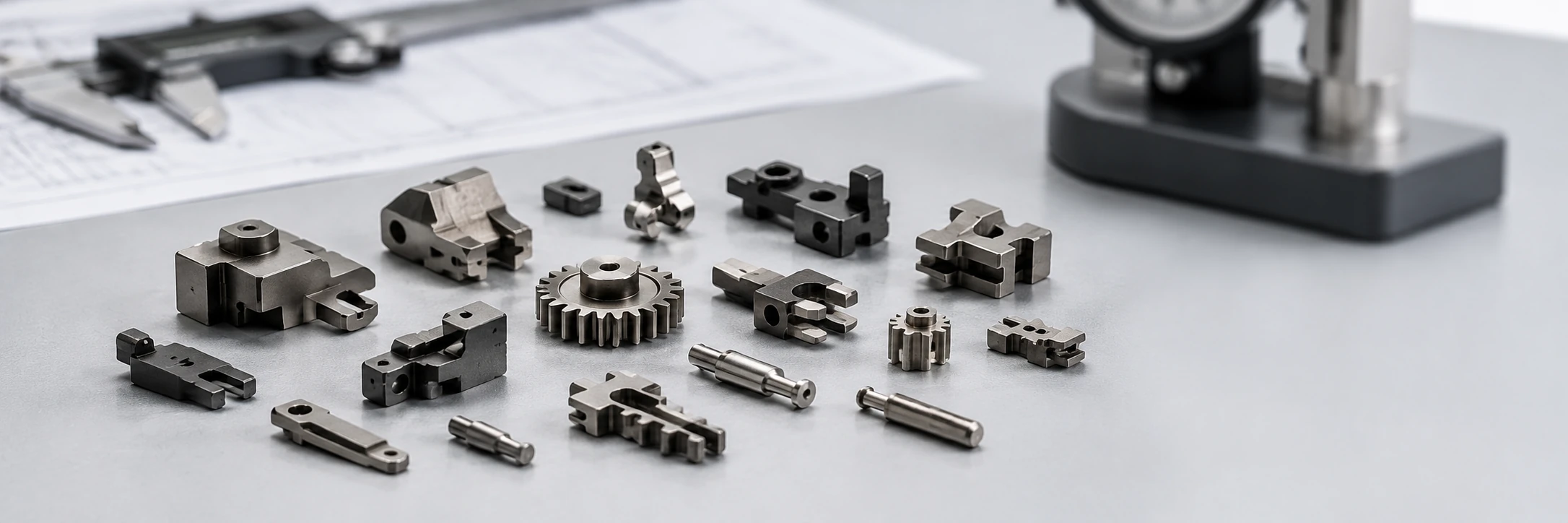
Wear-resistant MIM materials are most relevant when the part is small, geometrically complex, and produced in repeat volume. The best candidates often have narrow contact surfaces, sliding faces, small pins, latches, miniature gears, locking elements, or precision features that are difficult to machine economically from solid stock.
Good-Fit Conditions
- Small complex metal parts with functional contact surfaces
- Sliding, rotating, locking, or local contact features
- Repeat production where tooling can be justified
- Applications that need both geometry and material performance
- Parts where secondary operations can be planned before tooling
Potential Stop Signals
- Large simple geometry better suited to machining, casting, or another process
- Unknown wear mode, undefined mating material, or unclear service condition
- Extensive post-sintering machining on most functional surfaces
- Severe wear condition without a practical validation route
- Material route not compatible with MIM feedstock and sintering
Boundary note: This page focuses on material selection for wear resistance. For part examples and application-level routing, use the separate wear-resistant MIM parts page.
Selection Logic Before Choosing a Specific Grade
A practical wear-resistant MIM material review should move from application condition to material family, then to grade, heat treatment, surface finishing, and inspection. Choosing a grade first can lead to a material that looks strong on paper but does not match the real contact surface.
For broader material comparison before narrowing the wear route, review the MIM material selection guide.
| Review Step | Engineering Question | Why It Matters | Output Before Tooling |
|---|---|---|---|
| Wear mode | Is the contact sliding, abrasive, edge-loaded, corrosive, or mixed? | Different wear modes require different material and surface strategies. | Dominant wear condition identified |
| Contact geometry | Where is the functional wear surface, and how large is the contact area? | Small contact areas can concentrate load and accelerate wear. | Critical wear surfaces marked on drawing |
| Material family | Is the part better suited to stainless, low-alloy steel, carbide, tungsten alloy, or a treated route? | The material family defines the balance of hardness, corrosion resistance, toughness, density, and cost. | Shortlisted material route |
| Secondary operation | Will heat treatment, finishing, coating, sizing, or machining be required? | Post-processing can improve function but may affect tolerance and cost. | Process route reviewed |
| Inspection method | How will the wear-critical surface be verified? | Functional surfaces may require targeted inspection beyond general dimensions. | Inspection requirement defined |
Material Families Commonly Reviewed for Wear-Resistant MIM Parts
The material family should be selected before narrowing to a specific MIM grade. Stainless steels, heat-treatable low-alloy steels, cemented carbides, tungsten alloys, and surface-treated routes each serve different wear, corrosion, density, toughness, finishing, and cost requirements.
| Material Direction | Where It May Fit | Main Benefit | Main Risk | Confirm Before RFQ |
|---|---|---|---|---|
| 420 stainless steel | Small stainless wear components, sliding or locking features | Hardenable stainless option | May not be enough for severe abrasive wear | Wear surface, hardness target, corrosion exposure |
| 440C stainless steel | Higher-hardness stainless wear components | Strong hardness and wear potential | More demanding processing and finishing review | Heat treatment, edge geometry, inspection method |
| 17-4 PH stainless steel | Balanced strength, hardness, and corrosion needs | Useful balance for structural contact parts | Not always the highest wear route | Strength versus wear priority, heat treatment route |
| 4605 low alloy steel, 4140, or 4340 | Heat-treatable mechanical wear components | Cost-sensitive hardenable route for controlled environments | Limited corrosion resistance without protection | Environment, heat treatment, coating need |
| Cemented carbide MIM / CCIM | Severe abrasive or localized wear | High wear-resistance potential | Cost, brittleness, geometry, finishing difficulty | Contact geometry, wall thickness, functional surface |
| MIM tungsten alloys | High-density or special contact requirements | Density and special performance potential | Not suitable for every wear case | Density need, cost, geometry, finishing |
How to Use This Table
This table should be treated as a starting point, not a final material recommendation. A part with sliding wear may still need corrosion resistance. A hard stainless route may still need finishing. A carbide route may be technically attractive but unsuitable if the geometry is thin, the cost target is low, or the functional surface cannot be inspected reliably.
When wear resistance must be balanced with structural strength, heat-treatment response, corrosion exposure, and cost, compare the broader MIM low alloy steel material options before selecting a specific grade.

Core conclusion: Wear-resistant MIM material selection should compare material families before narrowing to a specific grade.
Match the Material to the Wear Mode
A wear-resistant material should be selected according to the dominant wear mode. If the wear mode is not known, the material choice becomes guesswork. Sliding wear, abrasive wear, edge loading, wear plus corrosion, and wear plus tight tolerance each require a different review path.
| Wear Mode | Typical Review Direction | What Can Go Wrong | RFQ Information Needed |
|---|---|---|---|
| Sliding wear | Hardenable stainless, heat-treated alloy steel, surface-finished route | Wrong mating material or rough surface increases wear | Mating material, load, motion type, lubrication |
| Abrasive wear | Harder stainless, carbide, tungsten-based route | Material may be too brittle, too costly, or unsuitable for geometry | Abrasive source, contact surface, particle exposure |
| Edge or contact wear | Balanced hardness and toughness | Thin edge chips or contact pressure concentrates | Edge geometry, contact width, load direction |
| Wear plus corrosion | Stainless route or protected alloy steel | Hard material corrodes or surface treatment is not suitable | Environment, cleaning media, moisture exposure |
| Wear plus tight tolerance | Material plus secondary operation plan | Heat treatment or coating changes functional dimensions | Critical dimensions, inspection method, tolerance target |
When the Wear Mode Is Unknown
If the wear mode is unclear, do not finalize the material grade too early. First identify the contact surface, mating part, load direction, motion type, lubrication condition, operating environment, and whether the failure concern is material loss, surface scoring, edge damage, dimensional change, or corrosion-assisted wear.

Core conclusion: A wear-resistant MIM material should be chosen according to the actual wear mechanism and operating contact.
Heat Treatment, Surface Finishing, and Secondary Operations
Heat treatment, surface finishing, and secondary operations can improve hardness, friction behavior, surface quality, and functional fit. They can also add distortion risk, cost, lead time, and inspection requirements. For wear-critical MIM parts, these steps should be reviewed before tooling.
Heat Treatment
MIM heat treatment can improve hardness and strength for suitable stainless or low-alloy material routes. The risk is dimensional change, especially when the wear surface is narrow or tolerance-sensitive.
Surface Finishing
Surface finishing for MIM parts can reduce friction, improve surface consistency, or prepare the part for coating. It should be reviewed against geometry, access, masking, and tolerance impact.
Post-Sintering Machining
Some wear-critical surfaces may need post-sintering machining, sizing, grinding, or local finishing. If too many surfaces require machining, the project may lose part of the near-net-shape advantage.
| Operation | Possible Benefit | Engineering Risk | Review Point |
|---|---|---|---|
| Heat treatment | Higher hardness or strength | Distortion, dimensional change | Confirm critical dimensions after treatment |
| Polishing / finishing | Lower friction, smoother contact | Hard-to-reach surfaces may vary | Confirm accessible functional surfaces |
| PVD / coating | Improved surface behavior for selected cases | Thickness, masking, adhesion, geometry limits | Confirm coating zone and tolerance effect |
| Sizing | Better dimensional control | Additional tooling and process step | Confirm volume and tolerance need |
| Post-sintering machining | Accurate functional surface | Higher cost and lead time | Confirm whether MIM still offers value |

Core conclusion: Secondary operations should be reviewed before tooling when the wear surface affects fit, friction, or lifetime.
Design and Process Risks for Wear-Resistant MIM Materials
Wear-resistant material selection can increase design and process risk if the part is not reviewed early. Harder materials may be more difficult to finish. Thin contact edges may be more sensitive to chipping or distortion. Heat treatment can change dimensions. Inspection may require more than a general dimensional check.
Hard Materials Can Increase Secondary Operation Risk
Harder material routes may reduce machining flexibility and increase the importance of near-net-shape design. If the drawing includes tight tolerances on multiple wear surfaces, additional sizing, machining, or inspection may be required.
Thin Edges Need Early Contact Review
Wear surfaces often appear on edges, ramps, pins, locking faces, or sliding features. Material hardness cannot compensate for poor contact geometry. Radius, contact width, wall thickness, and load direction should be reviewed together.
Sintering and Heat Treatment Affect Fit
MIM parts shrink during sintering, and some material routes require later heat treatment. For wear-critical parts, small dimensional changes can alter contact pressure, alignment, or surface fit.
Inspection Must Target Functional Surfaces
General dimensions may not be enough if the functional surface needs controlled flatness, roundness, roughness, hardness, coating zone, or local geometry. The RFQ should identify which surfaces are functional.
Design Review Checklist
- Which surface actually wears during use?
- Is the wear sliding, abrasive, impact-assisted, or combined with corrosion?
- What is the mating material and surface condition?
- What are the contact pressure and load direction?
- Is the contact lubricated or dry?
- What hardness, surface finish, coating, or inspection requirement is expected?
- Which dimensions must remain stable after sintering, heat treatment, or coating?
Composite Field Scenario for Engineering Training
A small locking component has a narrow sliding contact surface. The project team is comparing martensitic stainless steel, heat-treatable low-alloy steel, and a harder special material route. The first review question is not only which material is harder. The team must confirm the mating material, contact load, motion frequency, lubrication, corrosion exposure, edge geometry, target hardness, surface finish, and whether post-sintering machining is acceptable.
If corrosion exposure is moderate, a hardened stainless route may be more suitable than a low-alloy steel. If cost is critical and the environment is controlled, a heat-treated low-alloy route may be reviewed. If abrasive contact is severe, a carbide or tungsten-based direction may be considered, but only after checking geometry, cost, finishing, and inspection feasibility.
RFQ Information Needed for Wear-Resistant MIM Material Review
A useful RFQ for wear-resistant MIM materials should include more than a material name. The supplier needs to understand the wear surface, mating material, load, motion, lubrication, environment, tolerance, finishing expectations, and expected annual volume.

Core conclusion: Clear wear-condition information helps select a more suitable MIM material route before tooling.
| RFQ Input | Why It Matters |
|---|---|
| 2D drawing and 3D model | Allows geometry, tolerance, and tooling review |
| Critical wear surface | Identifies where material performance matters |
| Wear mode | Guides material family selection |
| Mating material | Affects friction and contact behavior |
| Load and motion type | Influences surface pressure and wear risk |
| Lubrication condition | Changes sliding wear behavior |
| Corrosion or temperature exposure | Affects material family choice |
| Target hardness or strength | Guides heat treatment and grade selection |
| Surface finish or coating requirement | Affects secondary operations and tolerance |
| Annual volume | Affects tooling, process route, and cost review |
| Inspection requirement | Ensures functional surfaces can be verified |
Minimum RFQ Package for Faster Review
At minimum, submit the drawing, 3D model if available, critical wear surfaces, mating material, motion type, load direction, lubrication condition, expected environment, target hardness or surface finish, annual volume, and any known inspection requirement. If the material is not fixed, describe the wear problem rather than forcing a grade name too early.
Need a material route for a wear-critical MIM part?
Send the drawing, wear surface notes, mating material, load condition, motion type, lubrication information, finishing expectations, and expected annual volume. XTMIM can review whether a stainless steel, heat-treatable low-alloy steel, cemented carbide, tungsten alloy, or surface-treated route is more suitable for the project.
FAQs About Wear-Resistant MIM Materials
Are wear-resistant MIM materials the same as high-hardness MIM materials?
No. High hardness can improve wear behavior in some applications, but wear resistance also depends on wear mode, mating material, lubrication, surface finish, contact geometry, and environment. A material that is very hard may still be unsuitable if it is too brittle, difficult to finish, or not compatible with the operating condition.
Which MIM stainless steels are commonly reviewed for wear resistance?
Martensitic stainless steels such as 420 and 440C are commonly reviewed when higher hardness and moderate corrosion resistance are needed. 17-4 PH stainless steel may be reviewed when the project needs a balance of strength, hardness, and corrosion resistance rather than maximum wear performance.
Can low-alloy steel MIM materials be used for wear-resistant parts?
Yes, heat-treatable low-alloy steels may be reviewed for wear-resistant mechanical parts when corrosion exposure is limited and cost control is important. The project team should confirm heat treatment, dimensional stability, surface protection, and inspection requirements before selecting this route.
When should cemented carbide or tungsten alloy be considered?
Cemented carbide or tungsten-based routes may be considered when abrasive wear, high density, or severe localized contact is more important than general stainless behavior. These routes require careful review of geometry, cost, brittleness risk, finishing, and inspection feasibility.
Does heat treatment improve wear resistance in MIM parts?
Heat treatment can improve hardness and strength for suitable material families, but it may also create distortion or dimensional change. For wear-critical parts, the key question is whether the heat-treated part still meets functional geometry and inspection requirements.
What information should I provide for wear-resistant MIM material selection?
Provide drawings, critical wear surfaces, mating material, load, motion type, lubrication condition, environment, target hardness, surface finish, coating expectation, annual volume, and inspection requirements. This allows the material and process route to be reviewed before tooling.
Technical note: This page uses qualitative engineering guidance only. No hardness values, wear-life claims, test results, or external technical references are added without confirmed project-specific sources. Material selection for wear-critical MIM parts should be validated against the actual contact condition, drawing requirements, secondary operation plan, and inspection method.