Heat treatment can be used for many MIM parts after sintering, but it is not a default step for every metal injection molded component. For engineers reviewing hardness, wear resistance, strength, magnetic behavior, or final fit, the key decision is whether the as-sintered condition is enough or whether a controlled post-sintering thermal route is needed. That decision depends on material grade, geometry, sintering route, critical dimensions, inspection timing, and application conditions.
Some final properties can already be influenced during MIM sintering through atmosphere, temperature profile, cooling conditions, carbon control, and material-specific process settings. Separate heat treatment is reviewed when the standard route cannot meet the final functional requirement without creating unacceptable dimensional, surface, or inspection risks.
Can MIM Parts Be Heat Treated After Sintering?
Yes, many MIM parts can be heat treated after sintering, but the feasibility is material-dependent and application-dependent. Some stainless steels, low-alloy steels, tool-steel-like materials, and soft magnetic alloys may require thermal route review when hardness, strength, wear resistance, magnetic behavior, or dimensional stability is important. Other MIM parts may perform adequately in the as-sintered condition and may not need a separate heat treatment step.
A common mistake is to treat heat treatment as a universal upgrade. It is not. Heat treatment cannot compensate for poor material selection, severe sintering distortion, cracks, low density, unrealistic tolerances, or unsuitable part design. From a design review perspective, heat treatment should be considered together with the complete metal injection molding process: feedstock selection, injection molding, debinding, sintering shrinkage, secondary operations, and final inspection.
| Question | Engineering Answer |
|---|---|
| Can MIM parts be heat treated? | Yes, depending on the material grade and final application requirement. |
| Is heat treatment always required after MIM sintering? | No. Many MIM parts are used in the as-sintered condition. |
| What can heat treatment improve? | Hardness, strength, wear resistance, magnetic behavior, stress condition, or selected functional properties. |
| What is the main risk? | Dimensional movement, distortion, hardness variation, surface condition change, and inspection sequence conflict. |
| What should be reviewed first? | Material grade, drawing requirements, target hardness, critical dimensions, surface requirements, and application conditions. |
Heat Treatment Decision Summary
| Decision Point | Practical Engineering Judgment |
|---|---|
| Use heat treatment when | The as-sintered condition cannot meet hardness, wear, strength, magnetic, or stability requirements and the material supports a suitable thermal route. |
| Avoid treating it as a fix when | The real issue is wrong material selection, poor DFM, severe sintering distortion, cracks, density problems, or unrealistic tolerance expectations. |
| Review before tooling when | Heat treatment may affect shrinkage compensation, final fit, hardness test location, machining sequence, surface finishing, or final inspection timing. |
Where Heat Treatment Fits in the MIM Process
Heat treatment belongs after sintering as a selected secondary operation. It should not be confused with the main MIM forming process. The core MIM route normally follows this sequence:
Feedstock → Injection Molding → Green Part Handling → Debinding → Sintering → As-Sintered Review → Secondary Operations → Final Inspection
Heat treatment is reviewed after the as-sintered condition is understood. At this stage, the part has already gone through sintering shrinkage and densification. The engineering team can evaluate whether the part meets the required material performance or whether a separate thermal process is needed.
Heat treatment also has a different purpose from other MIM secondary operations after sintering. If the problem is a hole, thread, datum face, or precision fit feature, the correct topic may be machining. If the problem is surface appearance, corrosion behavior, coating readiness, or roughness, the correct topic may be surface finishing for MIM parts. If the requirement is hardness, strength, wear resistance, magnetic behavior, or stress condition, heat treatment may be reviewed.
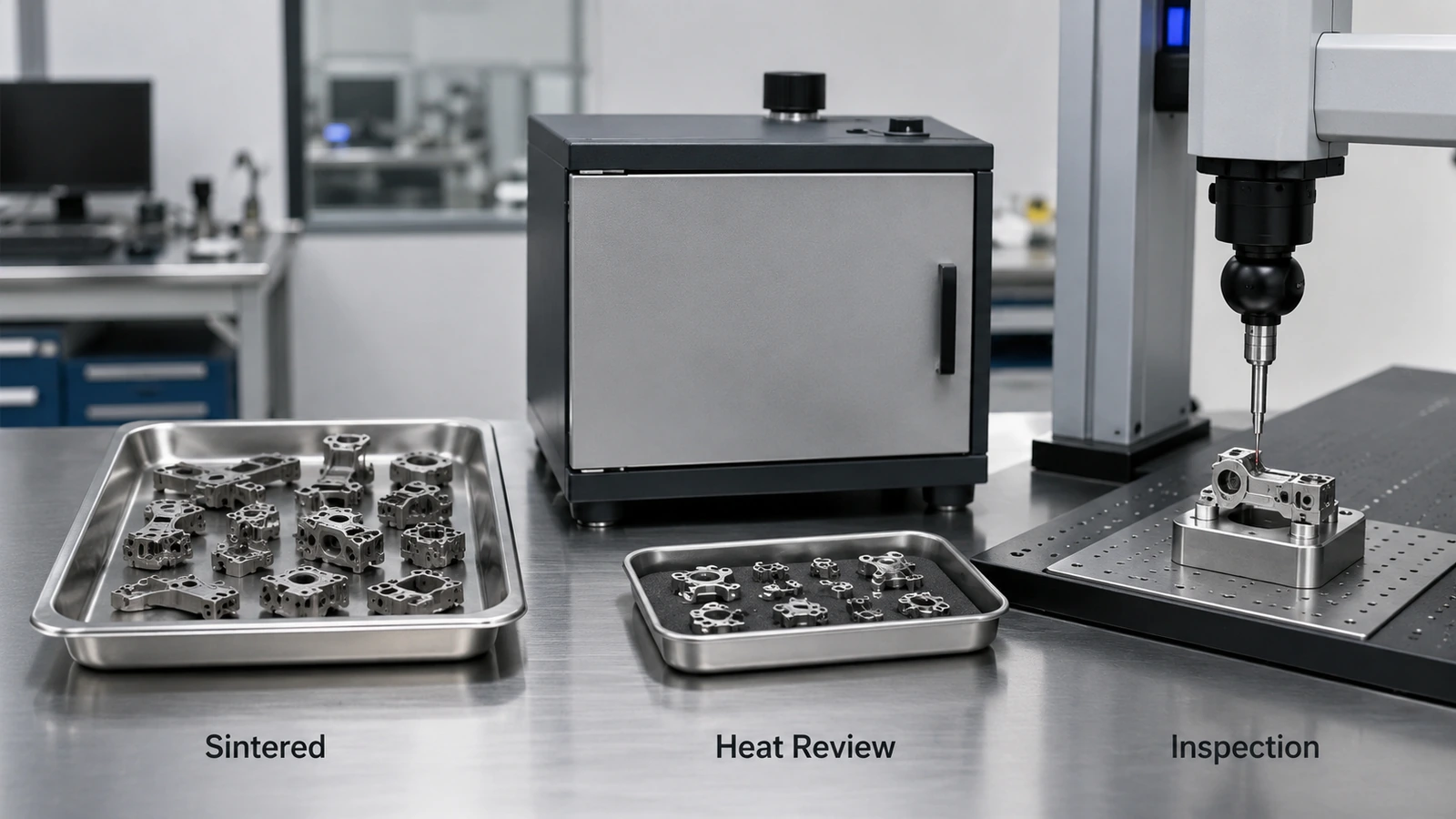
When Is Heat Treatment Needed for MIM Parts?
Heat treatment is reviewed when the as-sintered MIM part cannot fully satisfy the final functional requirement. The requirement may come from the drawing, application environment, mating part, wear condition, load direction, magnetic function, or inspection specification. In production, the decision also affects cost, sequence planning, supplier coordination, and final acceptance checks.
When hardness must be increased
Some MIM parts require a defined hardness range because they contact mating surfaces, resist localized wear, or carry repeated mechanical load. A useful RFQ should define the hardness range, test method, test location, and whether hardness is a functional requirement or a reference value.
When wear resistance affects part life
Wear resistance may be important for small gears, locking components, sliding parts, hinges, latches, tools, or mechanical engagement features. Heat treatment may help in suitable materials, but material change, surface hardening, coating, polishing, or design adjustment may sometimes be more appropriate.
When strength or toughness must be controlled
For load-bearing MIM parts, heat treatment may be reviewed to improve strength or adjust the hardness-toughness balance. However, strength is not controlled by heat treatment alone. It also depends on material chemistry, sintered density, microstructure, part geometry, section thickness, and defect control.
When magnetic behavior must be reviewed
Soft magnetic MIM materials may require careful thermal route evaluation because magnetic performance can be sensitive to material composition, sintering atmosphere, residual impurities, and final thermal history.
| Requirement | Why Heat Treatment May Be Reviewed | RFQ Input Needed |
|---|---|---|
| Higher hardness | As-sintered condition may not meet contact or wear requirements. | Target hardness range, material grade, test method. |
| Wear resistance | Sliding, locking, gear, or friction surfaces may need improved performance. | Wear mode, mating material, lubrication condition. |
| Strength requirement | Load-bearing features may require material route review. | Load condition, critical dimensions, safety requirement. |
| Magnetic behavior | Soft magnetic parts may need controlled thermal history. | Magnetic property target, application, test method. |
| Dimensional stability | Thermal exposure may affect fit-sensitive features. | Flatness, roundness, hole position, assembly tolerance. |
When hardness or strength is important, users may also review high-hardness MIM materials and high-strength MIM materials before finalizing the material route.
Sintering-Cycle Property Control vs Separate Heat Treatment
The real engineering question is not always whether to add heat treatment. In MIM production, some final properties can already be influenced during the sintering cycle. Atmosphere, temperature profile, cooling condition, carbon control, material chemistry, and furnace route may affect density, microstructure, strength behavior, corrosion response, and magnetic performance.
Separate heat treatment is reviewed when the standard sintering route cannot reliably meet the specified property target. This is why a drawing note such as “heat treatment required” is not enough for quotation. The supplier needs to understand what the heat treatment is expected to achieve, how it affects final dimensions, and how the result will be verified.
| Route | Main Control Area | When It May Be Enough | When Separate Heat Treatment Is Reviewed |
|---|---|---|---|
| Sintering-cycle control | Density, microstructure, atmosphere-related behavior, partial strength behavior. | Standard MIM property requirements. | Specific hardness, wear, strength, or magnetic targets are required. |
| Aging / precipitation treatment | Strength and hardness in selected materials. | Material supports aging response. | Drawing specifies final property target. |
| Hardening and tempering | Hardness, toughness, wear balance. | Hardenable steels. | Wear or load requirement exceeds as-sintered condition. |
| Stress relief | Stability after thermal or mechanical exposure. | Moderate stability needs. | Flatness, roundness, or functional fit is sensitive. |
| Surface hardening / nitriding | Surface wear behavior. | Selected steels and functional surfaces. | Surface wear matters more than bulk hardness. |
Cost, Sequence, and Inspection Impact
| Impact Area | Why It Should Be Reviewed Early | RFQ / Production Consideration |
|---|---|---|
| Cost and lead time | Separate heat treatment may add handling, partner coordination, fixture planning, and inspection steps. | Confirm whether the requirement is functional, drawing-specified, or open for engineering review. |
| Process sequence | Machining, sizing, surface finishing, and final inspection may need to be planned before or after heat treatment. | Identify features that must remain accurate after the final thermal process. |
| Acceptance checks | Hardness and dimensional checks must match the final condition of the part. | Define hardness method, test location, critical dimensions, and final inspection timing. |
In production, this usually becomes a route decision. If the part only needs standard mechanical performance, a stable sintering route may be sufficient. If the part needs a specific hardness range, controlled wear behavior, or a magnetic test result, a separate thermal process or functional post-treatment may need to be evaluated. The MIM material selection guide can help users compare material routes before requesting a quote.
Which MIM Materials Commonly Need Heat Treatment Review?
Different MIM materials respond differently to thermal processing. This page should not replace material-specific pages, but engineers should understand which material groups commonly require heat treatment review.
A common mistake is to choose a material first and then ask heat treatment to solve all property problems later. From a manufacturability perspective, material selection and heat treatment review should happen together. If hardness, corrosion resistance, magnetic response, wear resistance, or strength is critical, these requirements should be included before tooling review.
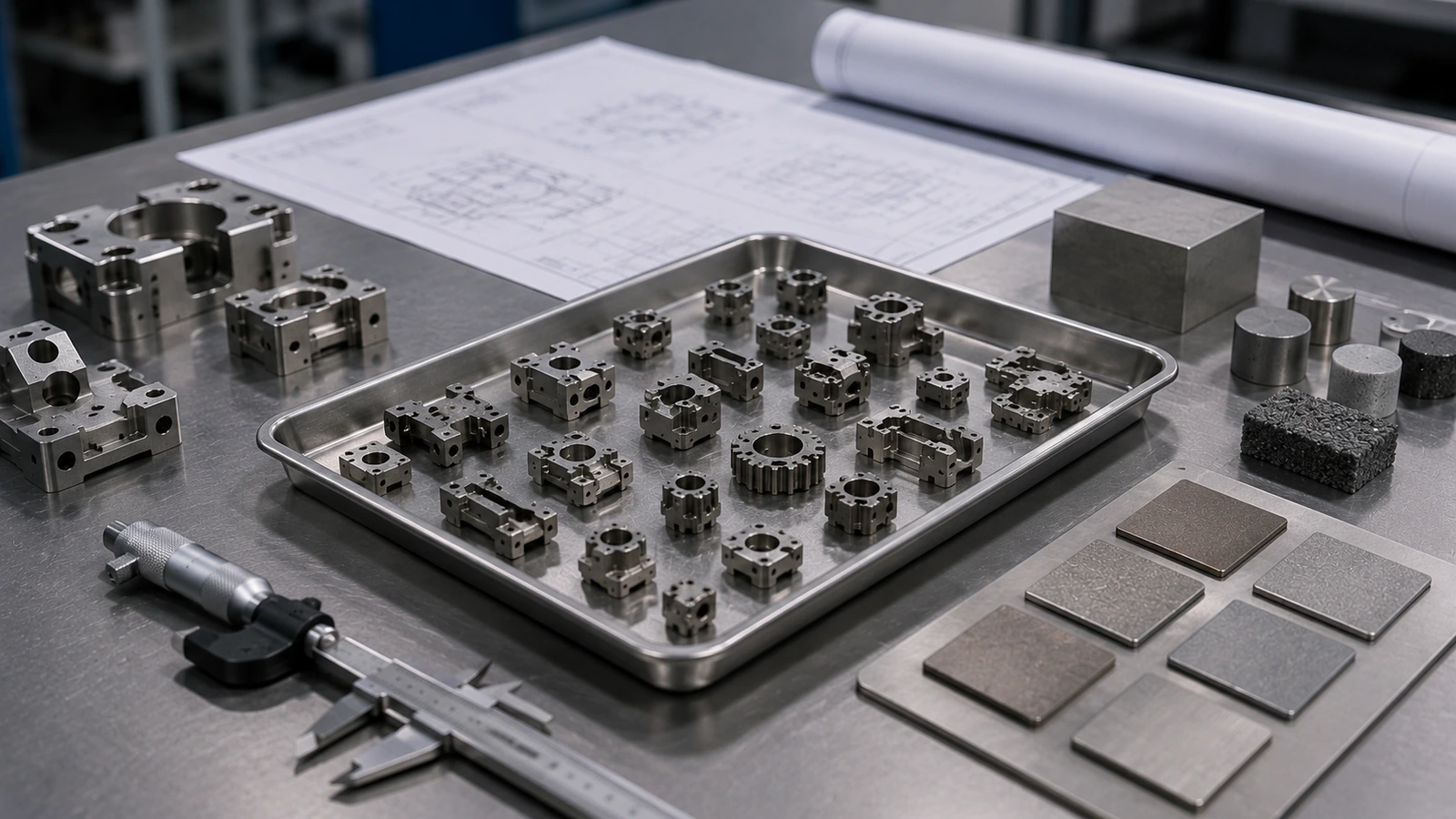
| Material Group | Heat Treatment Relevance | Main Engineering Concern | Material Detail Page |
|---|---|---|---|
| 17-4PH stainless steel | Aging or precipitation-hardening route may be reviewed. | Strength, hardness, corrosion balance, dimensional stability. | 17-4PH stainless steel MIM material |
| 420 stainless steel | Hardness and wear resistance may be important. | Heat treatment response, corrosion behavior, final hardness. | 420 stainless steel MIM material |
| 440C stainless steel | High hardness and wear behavior may be reviewed. | Hardness, brittleness risk, finishing sequence. | 440C stainless steel MIM material |
| 4140 low-alloy steel | Heat treatment is often application-driven. | Strength, toughness, wear, dimensional movement. | 4140 low-alloy steel MIM material |
| 4340 low-alloy steel | Strength and toughness applications may need review. | Hardenability, distortion, inspection timing. | 4340 low-alloy steel MIM material |
| 4605 low-alloy steel | Strength and wear applications may need review. | Carbon control, final strength, inspection method. | 4605 low-alloy steel MIM material |
| Soft magnetic materials | Thermal route may affect magnetic behavior. | Magnetic performance, atmosphere control, test requirement. | soft magnetic MIM materials |
Common Heat Treatment and Functional Post-Treatment Routes for MIM Parts
MIM heat treatment should be discussed by purpose, not by generic process names. The supplier needs to know what property must be achieved and what risk must be controlled.
Aging or precipitation hardening
Aging or precipitation hardening may be reviewed for selected precipitation-hardening alloys when strength and hardness must be improved after sintering. The route must match the material system.
Hardening and tempering
Hardening and tempering may be used for suitable hardenable steels when the project requires a hardness-toughness balance, wear resistance, or load-bearing capability.
Stress relief
Stress relief may be considered when thermal or mechanical history could affect dimensional stability. It is not a repair method for cracks, severe sintering distortion, or poor DFM.
Surface hardening and nitriding
Surface hardening or nitriding may be reviewed for selected steel materials and wear applications. These routes are project-dependent because material, surface condition, masking requirement, dimensional tolerance, and partner-supported process routes must be confirmed before production planning.
| Route | Typical Purpose | Suitable Situation | Boundary |
|---|---|---|---|
| Aging / precipitation hardening | Improve strength and hardness. | Selected precipitation-hardening alloys. | Must match material system. |
| Hardening and tempering | Balance hardness, toughness, and wear. | Hardenable steels. | May affect final dimensions. |
| Stress relief | Improve dimensional stability. | Thin, flat, or fit-sensitive parts. | Not a fix for poor sintering. |
| Surface hardening | Improve contact or wear surface. | Functional wear surfaces. | Requires surface and dimension review. |
| Nitriding | Improve surface wear behavior. | Selected steels, project-dependent. | Usually project-dependent or partner-supported. |
| Magnetic thermal treatment | Adjust magnetic behavior. | Soft magnetic MIM parts. | Requires magnetic test requirement. |
What Dimensional Risks Should Be Checked After Heat Treatment?
Heat treatment can change part dimensions. The amount and direction of movement depend on material, geometry, thermal route, support condition, section thickness, and previous process history. For MIM parts, this matters because the part has already gone through sintering shrinkage before heat treatment. Any additional thermal exposure may affect final fit.
Critical dimensions should be reviewed before quotation. Final inspection should normally be defined after the last thermal process when the heat treatment can affect part function. This is especially important for parts with tight holes, threads, datum surfaces, thin walls, flat sections, mating faces, roundness requirements, or assembly features.
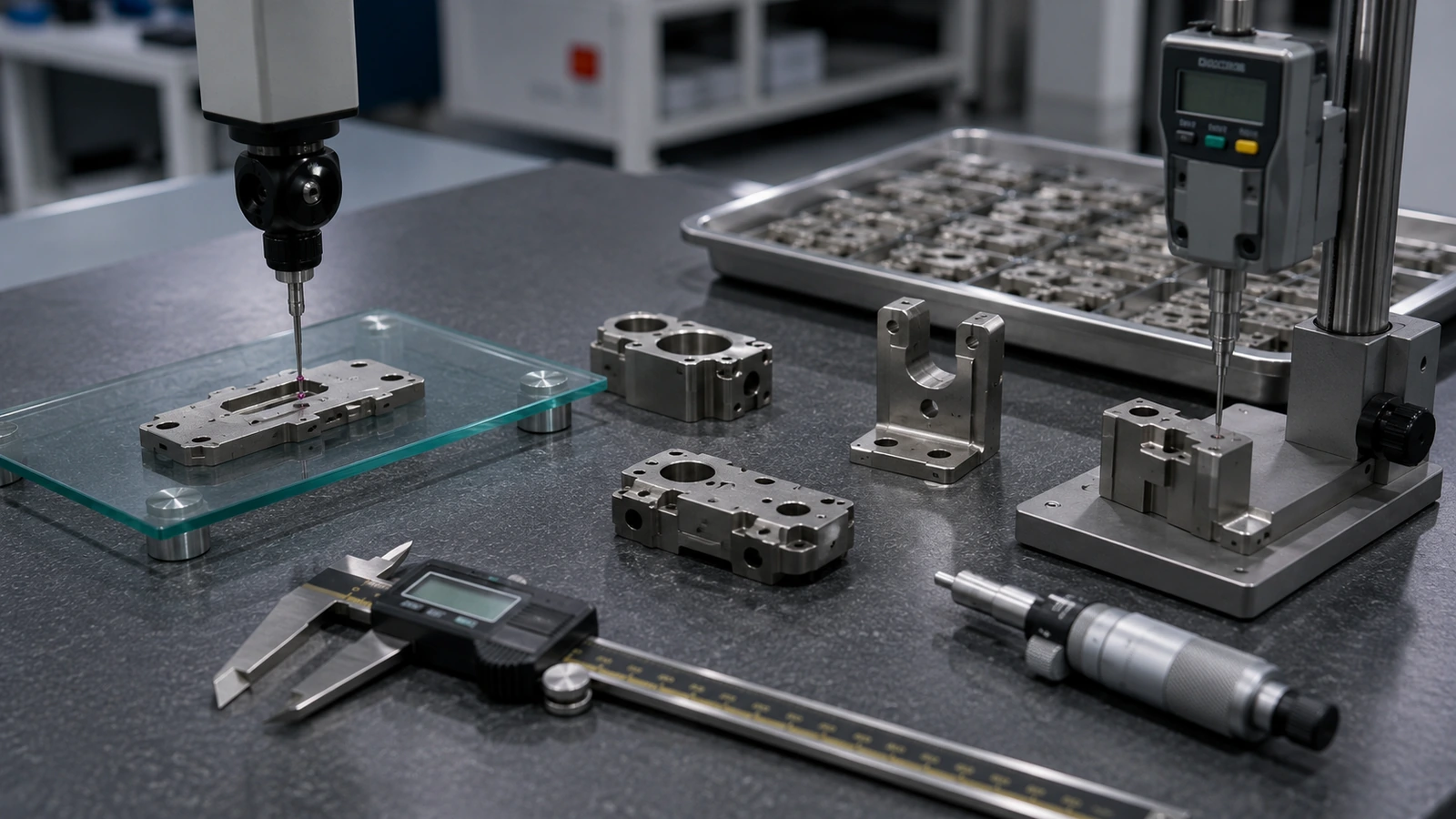
| Risk | Why It Matters | How It Should Be Reviewed |
|---|---|---|
| Dimensional shift | Final fit may change after thermal exposure. | Identify critical dimensions before quotation. |
| Flatness change | Thin or wide parts may move during heating or cooling. | Review geometry and support strategy. |
| Hole or roundness movement | Mating features may be affected. | Define final inspection after heat treatment. |
| Hardness variation | Section thickness and material route may affect consistency. | Confirm target range and test location. |
| Surface condition change | Oxidation, discoloration, or surface change may affect finishing. | Coordinate with surface finishing route. |
| Sequence conflict | Machining or finishing may need to happen before or after heat treatment. | Confirm process sequence before production. |
For fit-sensitive parts, users should connect heat treatment review with inspection and testing for MIM parts and MIM quality control before production planning.
- What problem occurred
- A small MIM locking component passed initial dimensional inspection after sintering but failed assembly after heat treatment because a functional slot and mating face shifted slightly.
- Why it happened
- The RFQ focused on hardness but did not clearly define which dimensions were critical after final thermal exposure.
- What the real system cause was
- The process sequence treated heat treatment as a simple property improvement step, while final fit was still being judged from pre-heat-treatment measurements.
- How it was corrected
- The critical slot width, mating face position, and final hardness location were defined before production. Final inspection was moved to after heat treatment.
- How to prevent recurrence
- For heat-treated MIM parts, drawings should identify critical dimensions, final inspection timing, hardness test location, and whether machining or sizing is needed before or after heat treatment.
When Heat Treatment Should Not Be Used as a Fix
Heat treatment can improve selected material properties, but it should not be used as a shortcut to compensate for upstream problems. If the material, geometry, sintering route, or tolerance strategy is wrong, heat treatment may increase risk instead of solving it.
| Problem | Why Heat Treatment Is Not the Right Fix | Better Review Direction |
|---|---|---|
| Wrong material selection | Heat treatment cannot create properties the alloy cannot support. | Material selection review. |
| Severe sintering distortion | Additional thermal exposure may increase movement. | Sintering distortion review. |
| Cracks after debinding or sintering | Cracks usually indicate upstream process, binder removal, geometry, or support risk. | Debinding and sintering review. |
| Low density or internal defects | Heat treatment cannot reliably compensate for poor densification. | Process control and material review. |
| Unrealistic tolerance target | Heat treatment may add dimensional variation. | Tolerance and inspection review. |
| Surface appearance issue | Heat treatment is not surface finishing. | Surface finishing review. |
| Wear failure | The correct route may be material change, coating, surface hardening, or design adjustment. | Material + surface route review. |
If the geometry, tolerance strategy, wall condition, or DFM assumption is the real cause of the problem, the part should be reviewed against MIM design guidelines before treating heat treatment as the correction route.
- What problem occurred
- A project requested a very high final hardness on a small MIM component while selecting a stainless material mainly for corrosion resistance.
- Why it happened
- The project treated hardness as a post-treatment requirement instead of a material selection requirement.
- What the real system cause was
- The selected alloy did not match the combined requirement for corrosion resistance, hardness, wear behavior, and dimensional stability.
- How it was corrected
- The material was reviewed again with the application, mating surface, wear mode, and corrosion environment. A more suitable material and secondary operation route were selected before tooling.
- How to prevent recurrence
- Hardness, corrosion behavior, wear condition, and dimensional risk should be reviewed together at the RFQ stage. Heat treatment should not be expected to turn an unsuitable material into the correct material.
When the correct route is uncertain, XTMIM recommends a project-level MIM engineering review before tooling or production planning.
Heat Treatment vs Surface Finishing, Machining, and Sizing
Heat treatment is only one type of secondary operation. MIM projects often require multiple post-sintering decisions, but the functions should not be mixed.
If the problem is surface appearance, corrosion behavior, coating preparation, or roughness, the correct topic is surface finishing. If the problem is a hole, thread, datum face, or precision mating feature, the correct topic is post-sintering machining for MIM parts. If the issue is flatness, profile, or dimensional calibration in selected parts, the correct topic is sizing and dimensional calibration for MIM parts. If the requirement is hardness, strength, wear resistance, magnetic behavior, or stress condition, then heat treatment may be reviewed.
| User Requirement | More Likely Review Path |
|---|---|
| Improve hardness | Heat treatment or material change. |
| Improve wear surface | Heat treatment, surface hardening, coating, or material change. |
| Improve cosmetic appearance | Surface finishing. |
| Add a tight thread | Post-sintering machining. |
| Improve flatness | Sizing / calibration or design review. |
| Improve corrosion behavior | Material selection, passivation, coating, or surface finishing. |
| Confirm final fit after thermal exposure | Heat treatment + inspection sequence review. |
What XTMIM Reviews Before Recommending Heat Treatment
Before recommending heat treatment for a MIM part, XTMIM reviews the requirement as an engineering route decision. The goal is not to add more processing steps, but to determine whether the part can meet functional requirements with a stable and inspectable manufacturing plan.
In practice, heat treatment review should happen before tooling when the requirement affects shrinkage compensation, functional dimensions, surface sequence, or final inspection. If the requirement is added after tooling or trial production, process changes may be more expensive and less predictable.
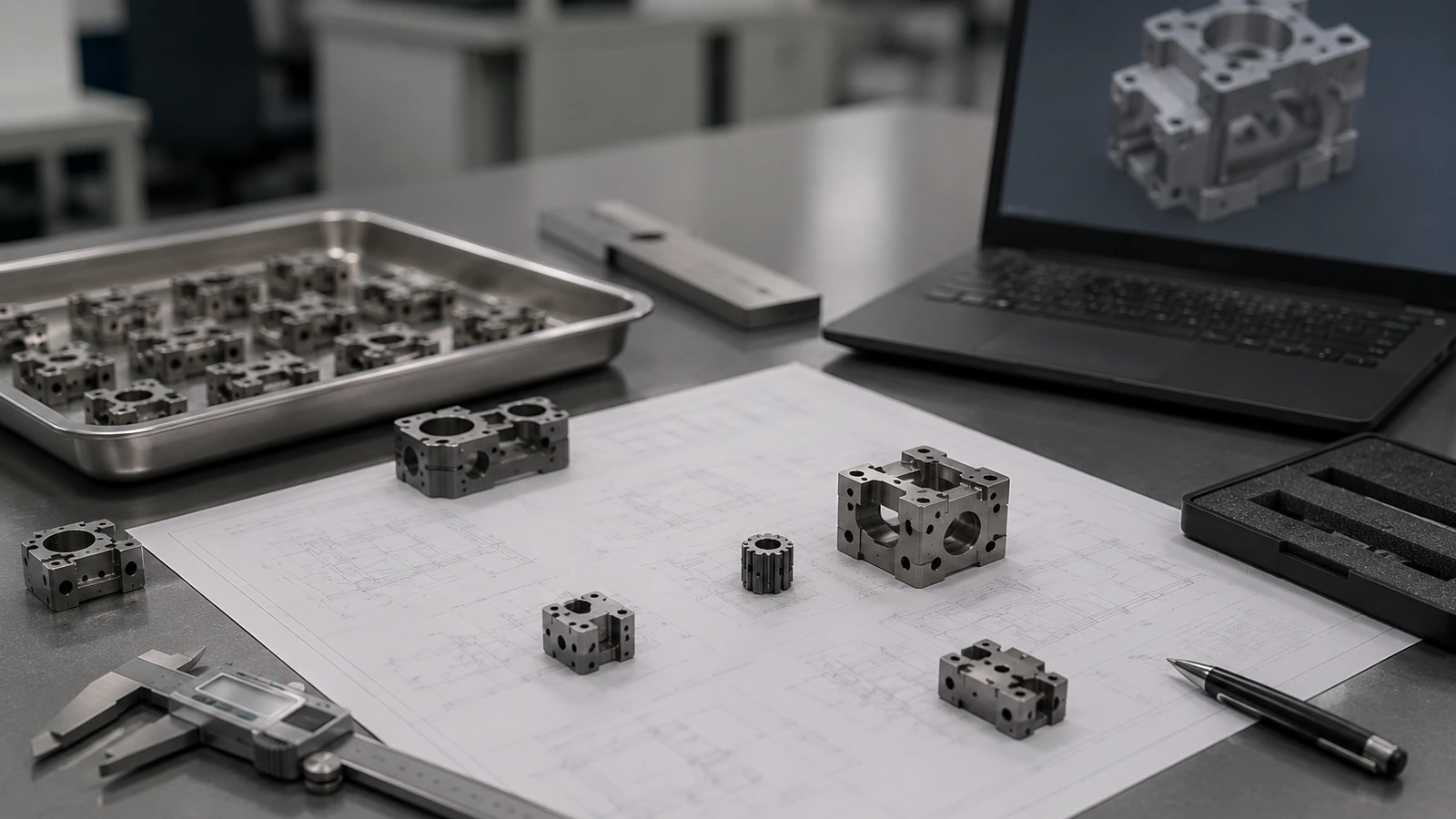
| Review Item | Why It Matters |
|---|---|
| Material grade | Determines whether the material responds to the intended thermal route. |
| Target hardness | Prevents vague “harder” requirements. |
| Strength or wear requirement | Helps decide material route, heat treatment route, or surface route. |
| Critical dimensions | Determines final inspection timing and sequence risk. |
| Surface requirement | Avoids conflict with finishing, coating, plating, cleaning, or oxidation risk. |
| Geometry | Thin walls, flat sections, holes, and fit features may move after heat treatment. |
| Annual volume | Affects process stability, cost review, and partner coordination. |
| Inspection method | Confirms how hardness, dimensions, or magnetic behavior will be verified. |
Users preparing project information can also refer to the MIM material selection checklist and the MIM RFQ preparation guide before sending drawings.
RFQ Checklist for Heat-Treated MIM Parts
For heat-treated MIM parts, the RFQ should include more than a drawing and target price. The more clearly the functional requirement is defined, the more accurately the supplier can review the material, sintering route, heat treatment route, dimensional risk, and inspection plan.
Please provide the following when available:
- 2D drawing with tolerances and critical dimensions.
- 3D CAD model.
- Material grade or equivalent material requirement.
- Target hardness range and preferred test method.
- Strength, wear, or magnetic requirement.
- Critical holes, slots, datum faces, mating surfaces, or assembly dimensions.
- Surface finishing, coating, passivation, plating, or cleaning requirement.
- Application environment, including load, wear, corrosion, temperature, or magnetic condition.
- Mating material or contact condition.
- Estimated annual volume.
- Required inspection method and acceptance criteria.
- Whether heat treatment is specified by the drawing or open for engineering review.
FAQ About Heat Treatment for MIM Parts
Can all MIM parts be heat treated?
No. Many MIM parts can be heat treated, but the decision depends on the material grade, geometry, required hardness, strength, wear behavior, magnetic requirement, and dimensional tolerance. Some parts perform well in the as-sintered condition and do not need separate heat treatment.
Is heat treatment always required after MIM sintering?
No. Heat treatment is a selected secondary operation, not a default MIM process step. It is reviewed when the as-sintered condition cannot meet the required hardness, strength, wear resistance, magnetic behavior, or dimensional stability.
Can MIM parts be hardened after sintering?
Some MIM parts made from suitable hardenable materials can be hardened or heat treated after sintering. The final route must match the alloy system, part geometry, target hardness, inspection method, and application requirement.
Does heat treatment change MIM part dimensions?
It can. Thermal exposure may affect dimensions, flatness, roundness, hole position, or functional fit. For parts with critical tolerances, final inspection should be planned after the last thermal process.
Should machining be done before or after heat treatment?
It depends on the material, hardness target, critical features, and inspection plan. Some features may need machining after heat treatment to maintain final fit, while other operations may be done before heat treatment. The sequence should be reviewed before production.
Can heat treatment improve wear resistance of MIM parts?
Yes, in suitable materials and applications. However, wear resistance may also depend on material selection, surface condition, mating material, lubrication, surface hardening, coating, or design. Heat treatment should be reviewed as part of the full wear system.
What information should I provide for a heat-treated MIM part RFQ?
Provide the 2D drawing, 3D model, material grade, target hardness, critical dimensions, surface requirement, application environment, mating part information, estimated annual volume, and inspection requirements.
Are heat-treated MIM parts the same as heat-resistant MIM parts?
No. Heat-treated MIM parts are parts that receive a post-sintering thermal process to adjust hardness, strength, wear resistance, magnetic behavior, or stability. Heat-resistant MIM parts are selected for high-temperature service conditions and should be reviewed through material selection, oxidation resistance, thermal exposure, and application requirements. For high-temperature service applications, review heat-resistant MIM parts separately.
Review Heat Treatment Requirements Before Tooling or Production
For MIM parts with hardness, strength, wear resistance, magnetic behavior, or dimensional stability requirements, send your drawing and project details before tooling or production planning. XTMIM can review the material grade, sintering route, heat treatment requirement, dimensional risk, surface sequence, and final inspection plan.
- 2D drawing and 3D CAD model
- Material grade or equivalent requirement
- Target hardness or functional property requirement
- Critical dimensions and tolerances
- Surface finishing or coating requirements
- Application environment and mating parts
- Annual volume and inspection requirements
Heat treatment and property verification for MIM parts should be reviewed with relevant material specifications, supplier process capability, and project-specific inspection requirements. Industry references can guide evaluation, but they should not replace part-level engineering review.
Hardness method, test location, acceptance range, and heat treatment condition should be confirmed from the customer drawing, material specification, and project-specific inspection plan.
- MPIF — Metal Injection Molding process information: useful for understanding MIM process boundaries from feedstock through sintering and finishing.
- MIMA — Secondary operations with MIM: relevant to machining, sizing, grinding, HIP, and heat treatment as secondary operations.
- ASM International — Heat Treating references: useful for general metallurgy background on hardening, tempering, and property modification.
- ASTM E92: relevant when Vickers or Knoop hardness verification is specified for metallic parts.
- ISO 6508-1: relevant when Rockwell hardness testing is specified in a drawing or inspection plan.