
MIM Material Comparison
A MIM-focused comparison for hardness, wear resistance, corrosion behavior, heat treatment, dimensional control, and RFQ decisions.
Quick answer: For MIM parts, 420 stainless steel is usually the more balanced option when the project needs moderate-to-high hardness, reasonable toughness, corrosion resistance, and easier post-sintering control. 440C stainless steel is more suitable when the application puts stronger priority on high hardness, wear resistance, and edge retention. The trade-off is that 440C usually requires stricter review of heat treatment, dimensional stability, grinding allowance, and final inspection.
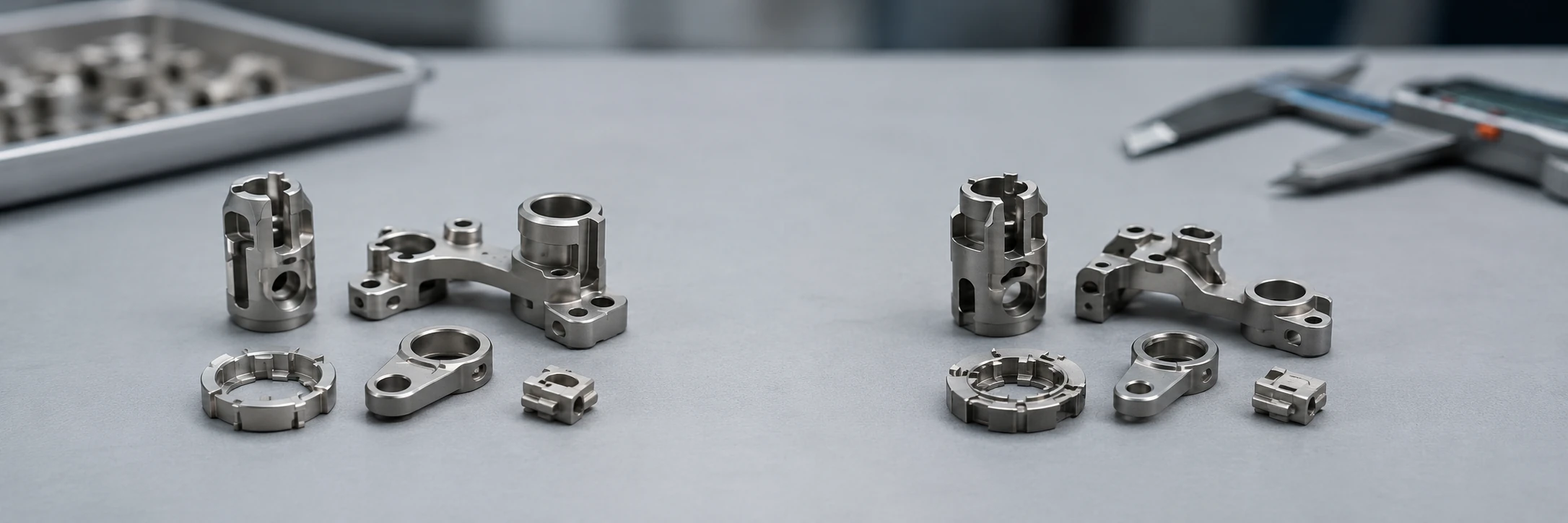
Core conclusion: The material choice depends on both performance requirements and MIM process control, not material name alone.
420 vs 440C Stainless Steel: Quick MIM Selection Answer
For general steel selection, the difference may look simple: 440C is often reviewed as the higher-hardness, higher-wear-resistance grade, while 420 is often selected for a more balanced combination of hardness, corrosion resistance, and manufacturability. In MIM, however, the decision is not based on material name alone.
Choose 420 when balance matters
420 stainless steel is often the more practical MIM route when the part needs useful hardness, reasonable toughness, corrosion resistance, and less demanding post-sintering control.
Choose 440C when wear is the main driver
440C stainless steel is usually reviewed when the part needs higher hardness, stronger wear resistance, or improved edge retention on a contact surface.
Review first when geometry is sensitive
Thin walls, small holes, sharp functional edges, strict flatness, and post-hardening dimensions should be reviewed before confirming either material route.
Production review perspective
In a MIM project, the material decision should be made together with geometry, shrinkage strategy, heat treatment, finishing allowance, and inspection requirements. A higher-hardness material is valuable only when the part can still meet the drawing after sintering, hardening, and secondary operations.
Key Differences Between 420 and 440C Stainless Steel in MIM
420 and 440C are both martensitic stainless steels, which means they can be hardened by heat treatment. This makes them different from common austenitic stainless steels such as 304 or 316L, where corrosion resistance and ductility are often more important than hardenability. In MIM projects, 420 and 440C are usually considered when the part needs hardness, wear resistance, contact strength, or a functional edge.
The main difference is that 440C is usually reviewed as a higher-carbon stainless steel route for higher hardness and stronger wear resistance after heat treatment. 420 is also hardenable, but it is normally considered a more balanced route when the part must combine hardness, corrosion resistance, manufacturability, and secondary operation control. For more background on each individual grade, review the XTMIM pages for 420 stainless steel and 440C stainless steel.
Technical source note: Public material technical data from Carpenter Technology supports the general grade direction used on this page: 420 stainless steel is a hardenable martensitic stainless grade, while 440C stainless steel is positioned for very high hardness after heat treatment. For MIM projects, these references should be used as grade-level background only; final selection still depends on drawing review, heat treatment route, finishing, and inspection.
| Review Factor | 420 Stainless Steel | 440C Stainless Steel | MIM Selection Meaning |
|---|---|---|---|
| Hardness potential | High after heat treatment, but usually lower than 440C | Very high after heat treatment | 440C is stronger for high wear and edge retention requirements. |
| Wear resistance | Good for many functional MIM parts | Higher wear resistance | 440C is often reviewed for higher-contact or sliding wear surfaces. |
| Toughness balance | Usually more forgiving | Lower toughness margin when very hard | 420 may be safer for thin, impact-sensitive, or geometry-sensitive features. |
| Corrosion behavior | Depends on heat treatment, finish, and environment | Also depends on heat treatment, finish, and environment | Neither should be treated as automatically corrosion-proof. |
| Processing sensitivity | Usually easier to balance | Usually more demanding | 440C needs more careful process and heat treatment review. |
| Secondary operations | Generally easier to review | Grinding or polishing may need more control | 440C can add inspection and finishing complexity. |
Do not select by hardness alone
A datasheet-level material comparison can help define the starting direction, but it does not replace drawing review. MIM selection must connect material behavior with tooling compensation, sintering shrinkage, heat treatment, finishing allowance, and final inspection. The final recommendation may change if the part has thin edges, unsupported features, tight holes, or cosmetic surfaces.

Core conclusion: 440C usually favors wear performance, while 420 often supports a more balanced MIM route.
How MIM Processing Changes the 420 vs 440C Decision
MIM changes the material decision because the part is not machined from wrought bar stock. The process starts with prepared metal powder feedstock, followed by injection molding, green part handling, debinding, sintering shrinkage control, possible heat treatment, secondary operations, and final inspection. Each step can influence the final part geometry, density, surface condition, and dimensional repeatability.
For 420 stainless steel, the review often focuses on achieving a stable balance between hardness, dimensional control, corrosion exposure, and secondary operation needs. For 440C stainless steel, the review usually becomes more demanding because the project may require higher hardness and wear performance after heat treatment. That can increase attention to distortion, grinding allowance, brittle edge risk, and final inspection.
Feedstock and molding stability
The project should first confirm whether the selected MIM feedstock is available and suitable for the part geometry. Small holes, thin walls, ribs, undercuts, and contact surfaces can behave differently during injection and sintering.
Debinding and sintering sensitivity
Debinding and sintering influence shrinkage, density, surface condition, and distortion. The material route should be reviewed together with the final geometry and inspection plan.
Shrinkage and dimensional repeatability
Tooling compensation can be designed, but it cannot remove all risks from uneven wall thickness, long slender features, unsupported shapes, or unbalanced mass distribution.
Heat treatment after sintering
Both 420 and 440C may require heat treatment to reach the intended hardness. The drawing should define target hardness, test location, and critical dimensions after hardening.
| MIM Review Point | Why It Matters | What Can Go Wrong | What to Confirm Before RFQ | Inspection Focus |
|---|---|---|---|---|
| Feedstock availability | Material route affects sampling and production feasibility. | Material choice may increase lead time or limit route options. | Target material, annual volume, and whether an alternative grade is acceptable. | Material identity and incoming feedstock consistency. |
| Injection molding | Thin walls, ribs, holes, and contact surfaces may be difficult to fill uniformly. | Short fill, weld lines, weak features, or uneven green part quality. | 3D model, wall thickness, gate-sensitive surfaces, and appearance areas. | Green part visual condition and feature completeness. |
| Sintering shrinkage | MIM parts shrink during sintering and require tooling compensation. | Hole shift, flatness change, local distortion, or out-of-tolerance features. | Critical dimensions, datum, tolerance class, and inspection priority. | Post-sintering dimensions, flatness, hole position, and surface condition. |
| Heat treatment | Hardness depends on heat treatment, but heat treatment may affect dimensions. | Distortion, local hardness variation, chipping risk, or extra finishing needs. | Target hardness, test location, functional surface, and acceptable distortion. | Hardness, functional dimensions, visual edges, and wear surfaces. |
| Secondary operations | Grinding, polishing, passivation, PVD, or sizing may change final cost and risk. | Additional cost, longer process route, surface variation, or dimensional change. | Surface finish, cosmetic requirement, coating need, and post-process tolerance. | Surface roughness, coating appearance, dimension after finishing, and fit. |
If the part needs detailed post-sintering hardening review, use the MIM heat treatment page as the process reference. For polishing, passivation, PVD, or other finishing needs, review surface finishing for MIM parts.

Core conclusion: The same stainless steel comparison changes when shrinkage, heat treatment, and dimensional repeatability are included.
Hardness, Wear Resistance, and Edge Retention
When users search for 420 vs 440C stainless steel, they often care about hardness and wear resistance. In general, 440C is the stronger candidate when high hardness and edge retention are the main goals. This is why it is often associated with bearing-like surfaces, cutting-related components, and wear-resistant applications. 420 can still be hardened, but it is usually selected when the project needs a more balanced combination of hardness, corrosion resistance, manufacturability, and toughness.
Technical source note: Carpenter Technology material data supports the broad hardness direction used here: its 440C technical data describes a very high hardness route after heat treatment, while its 420 technical data supports 420 as a hardenable martensitic stainless grade. This does not mean every MIM part will reach the same result; final hardness, dimensional stability, and surface quality depend on the project-specific process route.
For MIM parts, the question should not be “Which grade is harder?” The better question is: “What hardness is required at the functional surface, and can the part still meet dimensional and quality requirements after heat treatment?” If the part has a small wear surface, 440C may be appropriate. If the part has thin features, a complex shape, or impact loading, 420 may be easier to control.
Functional surface review checklist
- Define whether the part has a wear surface, cutting-related edge, sliding contact, or bearing-like contact area.
- Confirm whether the functional surface is molded near-net shape, machined, ground, polished, or coated after sintering.
- Specify the hardness target and test location instead of only requesting “high hardness.”
- Review whether local geometry can tolerate hardening, grinding allowance, and final inspection.
- Confirm whether edge retention, corrosion exposure, dimensional control, or cost is the leading requirement.
Engineering review note
A cutting edge, small contact tooth, sliding surface, or wear pad can benefit from higher hardness. However, high hardness can also reduce tolerance for impact, chipping, or distortion. In MIM projects, edge performance is usually a combination of material, heat treatment, geometry, surface finish, and inspection method.

Core conclusion: 440C may favor edge retention, but 420 may be easier to balance for thin or complex MIM geometry.
Corrosion Resistance and Surface Finishing Considerations
420 and 440C are stainless steels, but neither should be described as corrosion-proof. Corrosion behavior depends on the chemical environment, heat treatment condition, surface roughness, cleaning method, finishing route, and whether the part will be exposed to moisture, sweat, mild chemicals, chloride, or repeated handling.
In many MIM projects, corrosion resistance must be reviewed together with surface finishing. A polished, passivated, or coated part may behave differently from an as-sintered surface. If the application requires cosmetic appearance, reduced surface roughness, or improved contact behavior, the team may need to review polishing, passivation, PVD, or other finishing options. These steps may affect cost, lead time, inspection criteria, and dimensional control.
The RFQ should include the actual use environment. A vague request such as “stainless steel with high hardness” is not enough for reliable material selection. The project should clarify whether the part is used in dry wear, hand-contact environments, outdoor exposure, cleaning cycles, mild corrosion, or contact with other materials.
Corrosion review boundary
If corrosion resistance is the leading requirement, the project should not compare only 420 and 440C. The team should also review whether a different stainless steel family, a finishing route, or a coating strategy is more appropriate. 420 and 440C can be useful when hardness matters, but corrosion-sensitive applications need environment details before material confirmation.
Dimensional Stability, Heat Treatment, and Post-Sintering Risk
Dimensional stability is one of the most important differences between a simple steel comparison and a MIM project comparison. 420 and 440C are both hardenable materials, but the final part is affected by sintering shrinkage, heat treatment, and secondary operations. If a drawing contains tight hole positions, flatness requirements, thin edges, small contact surfaces, or datum-critical geometry, the material choice should be reviewed before tooling.
Heat treatment can improve hardness, but it can also create distortion risk. This does not mean the material is unsuitable. It means the project should define what must be controlled after heat treatment. For example, a wear surface may be more important than a non-critical outer contour. A hole may need MIM sizing or post-sintering machining. A flat surface may need grinding allowance. A small edge may need special inspection to check chipping, deformation, or surface damage.
Before tooling, confirm these items
- Which dimensions are critical after heat treatment
- Whether hardness is measured on a surface or cross-section
- Whether grinding or polishing is required after hardening
- Whether the part has thin or unsupported features
- Whether final inspection includes hardness, dimension, surface, and visual checks
- Whether the acceptable risk is different for prototype and mass production
| Drawing Feature | Why It Matters for 420 / 440C | Review Action |
|---|---|---|
| Small holes | Hole position and diameter may change after sintering and heat treatment. | Identify whether sizing, machining, or special inspection is required. |
| Thin contact edges | Higher hardness may improve wear but can increase edge sensitivity. | Confirm edge geometry, finishing method, and inspection acceptance. |
| Flat bearing or sliding surfaces | Flatness may be affected by shrinkage and post-hardening distortion. | Define flatness requirement and grinding allowance before tooling. |
| Cosmetic exposed surfaces | Surface finish and corrosion behavior depend on process route and finishing. | Confirm polishing, passivation, PVD, or visual inspection needs. |
| Assembly datum surfaces | Datum shift can affect fit even when general dimensions look acceptable. | Mark datum-critical dimensions clearly in the drawing package. |
420 vs 440C Stainless Steel for Scissors, Cutting Components, and Wear Parts
For scissors and cutting-related components, 440C is usually considered when edge retention and wear resistance are the top priorities. Its higher hardenability makes it attractive for hardened contact edges and wear surfaces. However, in MIM production, a “scissors” search intent should be translated into engineering requirements: edge geometry, thickness, load direction, corrosion exposure, finishing method, and post-heat-treatment inspection.
420 may still be a better MIM choice when the component is small, complex, thin, or not purely judged by edge retention. For example, if the part needs several small holes, clips, ribs, or mounting features, 420 may provide a more practical balance between hardness, manufacturability, toughness, and secondary operation cost.
The material name alone does not define cutting performance. A MIM cutting component should be reviewed by drawing. If the functional edge must be very sharp, it may need post-sintering grinding. If the edge is molded near-net shape, the design should allow for shrinkage, finishing, and inspection.
How to translate “scissors” into MIM engineering requirements
Instead of asking only whether 420 or 440C is better for scissors, define the actual part function. A MIM supplier needs to know whether the part requires a true cutting edge, a wear-contact surface, a pivot feature, a spring-contact area, or a cosmetic stainless surface. Each function may lead to a different material, heat treatment, finishing, and inspection plan.
Decision Table: When to Choose 420 or 440C for MIM Parts
The following table should be used as a starting point for engineering review. Final selection should still depend on the drawing, application environment, heat treatment route, finishing requirement, and inspection plan.
| Project Condition | Choose 420 Stainless Steel When... | Choose 440C Stainless Steel When... | Review Before Deciding |
|---|---|---|---|
| Hardness | Moderate-to-high hardness is enough. | Higher hardness is a key requirement. | Define target hardness range and test location. |
| Wear resistance | Wear is present but not the only priority. | Wear resistance is the main design driver. | Confirm contact type, load, and sliding condition. |
| Edge retention | Functional edge is not extremely demanding. | Edge retention is critical. | Confirm whether the edge is molded, ground, or finished. |
| Toughness | Thin or impact-sensitive features matter. | The design can tolerate a lower toughness margin. | Review local stress and edge geometry. |
| Dimensional control | Tight dimensions and balanced manufacturability matter. | Higher performance justifies tighter process control. | Identify critical dimensions after heat treatment. |
| Corrosion exposure | Mild corrosion and finishing can be managed. | Wear is more important than maximum corrosion resistance. | Confirm actual environment and surface finish. |
| Cost and lead time | Process simplicity matters. | Extra finishing and inspection are acceptable. | Compare total project cost, not only material cost. |
When neither route should be confirmed yet
Do not confirm 420 or 440C if the drawing does not define the functional surface, target hardness, corrosion exposure, critical dimensions, or finishing route. Also avoid locking the material too early when the part has thin walls, long unsupported features, very small holes, or strict post-hardening tolerances. In these cases, the first step should be drawing review, not immediate material confirmation.
Ask for engineering review when geometry is sensitive
A project should ask for engineering review when the drawing includes thin walls, long unsupported features, very small holes, sharp functional edges, strict flatness, tight post-heat-treatment tolerances, or a hard-to-inspect wear surface. These conditions can change the material choice even when the initial performance target points to 440C.
RFQ Information Needed Before Comparing 420 and 440C
To compare 420 and 440C correctly, the RFQ should include more than a material name. The most useful inputs are the 2D drawing, 3D model, expected annual volume, target hardness, application environment, functional surfaces, surface finishing requirements, and inspection priorities. If the drawing is missing hardness range, critical dimensions, or finishing notes, the supplier may not be able to compare the two materials accurately.
Send these drawing inputs
- 2D drawing with tolerances, datum, and critical dimensions
- 3D model for geometry and tooling review
- Material target: 420, 440C, or open to engineering recommendation
- Expected annual volume and production stage
Send these functional requirements
- Target hardness range and test location, if known
- Wear surface, cutting edge, sliding surface, or contact area
- Corrosion environment, cleaning method, or handling condition
- Surface finish requirement, such as polishing, passivation, PVD, or grinding
| RFQ Input | Why XTMIM Needs It | How It Affects 420 vs 440C Review |
|---|---|---|
| 2D drawing and 3D model | To review geometry, tooling feasibility, shrinkage risk, and inspection requirements. | Complex geometry may favor a more balanced material route or require secondary operations. |
| Hardness target | To understand whether hardness is functional, cosmetic, or only a preference. | Higher hardness may support 440C, but only if distortion and inspection risks are acceptable. |
| Wear or contact surface | To identify the surface that actually drives material selection. | Localized wear may require 440C or finishing; general structural use may not. |
| Corrosion environment | To avoid choosing a hardenable stainless grade without understanding exposure conditions. | Environment may change finishing needs or require another stainless route. |
| Surface finish and post-process needs | To estimate grinding, polishing, passivation, PVD, or inspection requirements. | Secondary operations may change the practical cost and feasibility of 440C. |
| Annual volume | To evaluate tooling value, process control effort, and production stability requirements. | Higher volume can justify more controlled processing if the material benefit is real. |
If the project is still in early development, it is safer to state the function first rather than forcing the material decision. For example, “the part needs wear resistance on this contact surface and corrosion resistance during handling” is more useful than simply writing “use 440C.” A MIM material review can then compare whether 420, 440C, or another stainless steel route is more appropriate. For a broader document checklist, review the RFQ preparation guide.

Core conclusion: Material selection becomes more reliable when function, geometry, finishing, and inspection requirements are submitted together.
Related MIM Material Pages
This page is a focused comparison between 420 and 440C. For broader material routing, review the MIM material comparison page. For grade-specific details, review the individual pages for 420 stainless steel and 440C stainless steel.
FAQ About 420 vs 440C Stainless Steel in MIM
Is 440C always better than 420 stainless steel for MIM parts?
No. 440C can offer higher hardness and stronger wear resistance, but it is not automatically better for every MIM part. If the part has thin sections, tight dimensions, impact exposure, or cost-sensitive production requirements, 420 may be easier to balance.
Which is better for MIM scissors or cutting components, 420 or 440C?
440C is usually preferred when edge retention and wear resistance are the main priorities. 420 may be more practical when the part also needs better manufacturability, dimensional control, or a more balanced toughness and corrosion profile.
Is 420 stainless steel easier to process by MIM than 440C?
In many projects, 420 is easier to review as a balanced hardenable stainless steel. 440C can be suitable, but it usually needs more careful review of heat treatment, distortion, grinding allowance, and final inspection.
Can 420 and 440C both be heat treated after MIM sintering?
Yes, both materials can be reviewed for post-sintering heat treatment. The project should define the target hardness, test location, critical dimensions, and acceptable distortion before confirming the material route.
Which material has better corrosion resistance, 420 or 440C?
The answer depends on heat treatment condition, surface roughness, finishing route, and use environment. Neither material should be selected only by the term “stainless.” For corrosion-sensitive applications, the RFQ should include the expected environment and surface finish requirement.
What should I send before choosing 420 or 440C for a MIM project?
Send the 2D drawing, 3D model, target hardness, functional wear or cutting surfaces, corrosion environment, required surface finish, annual volume, and inspection requirements. These details allow the supplier to compare material performance and process risk together.
Material Review Note
This page provides engineering selection guidance for MIM material review. Final material selection should be confirmed by drawing requirements, target hardness, heat treatment condition, functional surfaces, corrosion environment, and inspection method. The page does not claim guaranteed hardness, guaranteed corrosion resistance, or certified performance for every application.
Public material references can help define general grade positioning, but MIM project results depend on feedstock route, tooling compensation, sintering behavior, heat treatment, finishing, and inspection. The final project route should be confirmed through supplier review rather than copied directly from wrought-material assumptions.
Technical References
The following external references may help engineering and sourcing teams review material terminology and grade-level background information. They are provided as technical context and do not imply certification, approval, or endorsement of any specific XTMIM project.
- Carpenter Technology 420 Stainless Technical Data — Reference for 420 stainless steel grade background and hardenable martensitic stainless steel context.
- Carpenter Technology 440C Stainless Technical Data — Reference for 440C stainless steel grade background and high-hardness martensitic stainless steel context.
Compare 420 and 440C Before Tooling
If you are comparing 420 and 440C stainless steel for a MIM part, send your drawing, 3D model, hardness target, wear surface, corrosion environment, and annual volume for review. XTMIM can help evaluate whether 420, 440C, or another MIM stainless steel route is more suitable before tooling.
For best review accuracy, include the 2D drawing, 3D file, hardness target, surface finish requirement, critical dimensions, and annual volume.