Home / Blogs / MIM Material Selection Notes / How Chromium Affects MIM Low-Alloy Steel MIM Material Selection Notes Quick Answer Chromium primarily improves hardenability and heat-treatment response in MIM low-alloy steel; it does not by itself define final hardness, strength, wear life or toughness. In MIM, carbon balance, prepared-feedstock chemistry, debinding and sintering conditions, …
MIM Material Selection Notes
Quick Answer
Chromium primarily improves hardenability and heat-treatment response in MIM low-alloy steel; it does not by itself define final hardness, strength, wear life or toughness. In MIM, carbon balance, prepared-feedstock chemistry, debinding and sintering conditions, density, pore condition, section thickness, cooling, tempering and post-treatment dimensional movement all affect the result. MIM 4140 is a Cr-Mo route; MIM 4340 is a Ni-Cr-Mo route; MIM 4605 is a heat-treatable comparison route rather than a primary chromium-bearing grade. Select the route from the component’s dominant failure mode, final material condition, corrosion environment, feedstock availability and inspection plan, and state whether required properties apply as-sintered, after heat treatment or after all secondary operations.
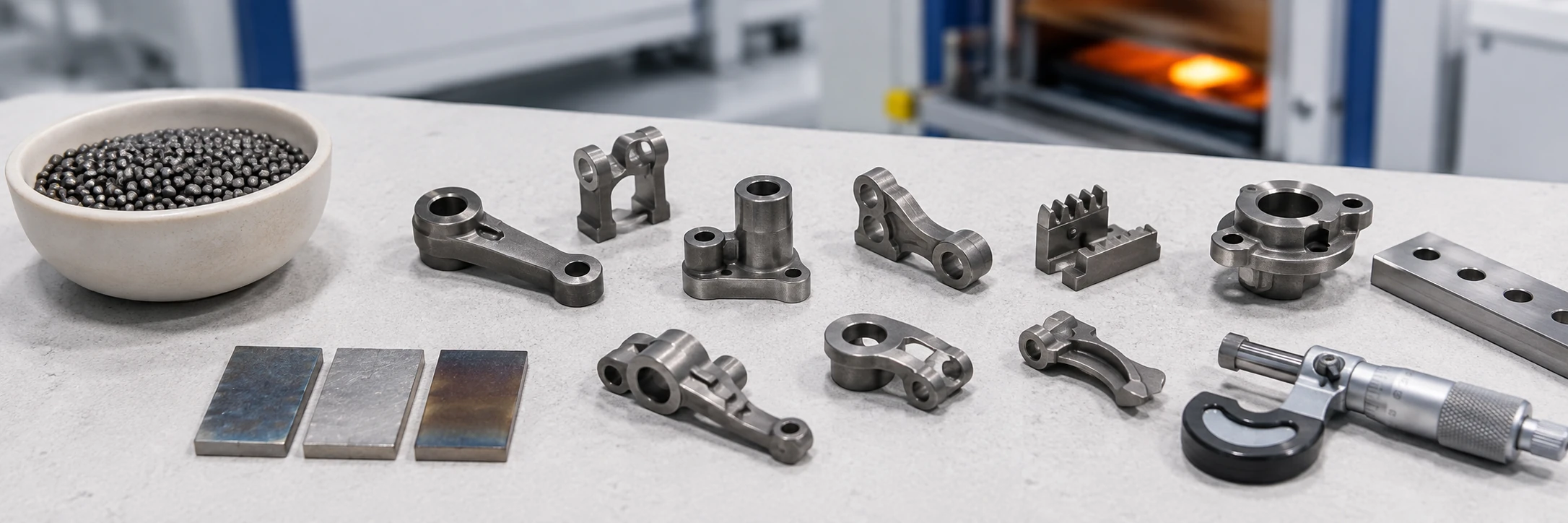
Engineering takeaway: Chromium content is only one part of the decision; feedstock, sintering, heat treatment, geometry and inspection requirements must be reviewed together.
On This Page
- What chromium does in MIM low-alloy steel
- Hardenability versus hardness
- Strength, wear resistance and toughness
- Why MIM processing changes material response
- 4140, 4340 and 4605 selection logic
- Why chromium-bearing low-alloy steel is not stainless
- Fit and non-fit boundaries
- Representative engineering scenario
- RFQ inputs for material review
- Frequently asked questions
What Does Chromium Do in MIM Low-Alloy Steel?
Chromium changes how low-alloy steel responds to heat treatment, but the useful result depends on the complete alloy, part geometry and manufacturing route.
In MIM low-alloy steel, chromium is used mainly to support hardenability: the ability to form a hardened microstructure through a required section during controlled cooling. This is important when a component must carry load or resist wear beyond a thin surface layer.
Chromium does not work alone. Carbon controls much of the attainable hardness; molybdenum supports hardenability and tempering response; nickel can support toughness and through-section performance. Grain condition, austenitizing practice, cooling rate and section thickness also affect the result. ASM therefore treats hardenability as a combined effect of chemistry, carbon and austenite condition rather than the contribution of one element in isolation.[3]
For small MIM parts, “through a required section” still needs a drawing-based definition. A compact component can contain a thin arm beside a heavy boss, a wear face next to a bore, or a local tooth root with a different cooling and stress condition. The alloy may have adequate nominal hardenability while one feature remains controlled by geometry, heat flow or stress concentration. This is why a useful review identifies the functional cross-section rather than treating the complete part as one uniform block of steel.
Key engineering point: Do not ask only how much chromium the grade contains. Define the functional section, dominant failure mode, final material condition, dimensional limits and verification method.
Functional Requirement, Chromium Contribution and Verification
The following matrix combines the alloying effect with the likely failure mode and the evidence needed in the finished component.
| Functional requirement or risk | Possible chromium-bearing contribution | Other controlling variables | RFQ and verification requirement |
|---|---|---|---|
| Hardness through a critical section | Supports hardenability and hardened-structure formation | Carbon condition, section thickness, cooling and tempering | Final hardness range, test scale, location and material condition |
| Repeated contact or sliding wear | Can support a hard, wear-oriented microstructure | Counterface, lubrication, contact stress, finish and alignment | Wear surface, mating material, duty cycle and acceptance method |
| Permanent deformation under load | Can support a stronger heat-treated condition | Density, pore structure, load path, geometry and tempering | Required final property and part, coupon or functional test |
| Impact at a thin or notched feature | May form part of a balanced alloy system | Nickel, tempering, stress concentration and surface condition | Critical feature, unacceptable failure mode and toughness evidence |
| Corrosive service | Low-alloy chromium is not stainless passivation | Environment, coating, maintenance and acceptable corrosion | Exposure description, finish requirement and corrosion criterion |
A more highly alloyed route may improve hardenability but can also increase material constraints, heat-treatment complexity, machining difficulty or distortion risk. The preferred route is the one that satisfies the finished-part requirement with manageable manufacturing and validation risk.
Hardenability Is Not the Same as Hardness
The terms are related, but they describe different material characteristics and require different RFQ information.
Hardenability describes the ability to form a hardened microstructure through a section under defined heat-treatment conditions. Hardness is a measured property of the final condition at a specified location and under a specified test method.
A steel with good hardenability may be tempered to a moderate final hardness. A small part made from a simpler steel may show high surface hardness without the same through-section response. Carbon, alloy content and austenite grain condition are among the factors governing hardenability, so the grade name alone cannot define the finished result.[3]
| Review item | Hardenability | Final hardness |
|---|---|---|
| What it describes | Ability to form a hardened structure through a section | Measured indentation resistance in the final condition |
| Main variables | Chemistry, carbon, grain condition, cooling severity and section size | Carbon, microstructure, quenching, tempering and test location |
| Common mistake | Treating it as a guaranteed hardness value | Ignoring where and when the value is measured |
| RFQ question | Which critical section needs a hardened response? | What range, method, location and final condition are required? |
Write the Requirement in the Final Material Condition
A commercially useful hardness note identifies the final treatment state, range, test method, location and acceptance stage.
| Weak requirement | Why it is incomplete | Engineering-ready direction |
|---|---|---|
| Material: 4140 | Does not define the final condition or acceptance property | State whether the grade is mandatory, then define final properties separately |
| Hardness: high | No range, method, location or treatment state | State the range, test scale, location and final inspection stage |
| Through hardened | No critical section or required depth is defined | Identify the functional section and minimum acceptable result |
| No distortion allowed | No measurable dimensional limit or correction route | Define post-treatment tolerances, datums and permitted sizing or machining |

Engineering takeaway: Hardenability describes the ability to form a hardened structure through a section; hardness is a measured result in the final material condition.
Section Thickness and Cooling Response
Small MIM parts can still contain thin walls, heavy bosses and abrupt transitions that cool and move differently. Before tooling, identify:
- the surface or section where hardness matters;
- the hardness test location and final inspection stage;
- critical dimensions measured after heat treatment;
- whether sizing or finishing is permitted.
Without these definitions, suppliers can quote the same grade while evaluating different material conditions and acceptance plans.
How Chromium Influences Strength, Wear Resistance and Toughness
Chromium can support a heat-treatable structure, but strength, wear and toughness must be balanced against the component’s dominant failure mode.
Chromium can support hardened-structure formation and a useful tempering range, but final strength still depends on carbon, the complete alloy system, sintered density, pore condition and heat treatment. The drawing should distinguish as-sintered, heat-treated and final post-processed requirements instead of treating the grade name as a guaranteed property condition.
For wear, hardness is only one variable. Abrasive wear, adhesive wear, sliding or rolling contact fatigue, fretting and poor-lubrication damage can favor different combinations of bulk hardness, surface condition, toughness, finish and dimensional control. Define the actual wear mechanism, counterface, contact stress and lubrication before using hardness as the selection shortcut.
Toughness remains the main counterweight to a harder condition. Thin arms, notches, abrupt section changes and shock-loaded features can become more failure-sensitive even when a hardness target is achieved. Tempering, geometry changes, local finishing and inspection strategy may therefore matter as much as increasing alloy content.
Decision rule: Select the heat-treated condition against the dominant failure mode. Do not maximize hardness unless the component, geometry and service load actually justify it.
Why MIM Processing Changes the Final Material Response
A nominal alloy designation does not capture prepared-feedstock availability, carbon control, sintered condition or post-treatment dimensional risk.
MIM low-alloy steel is produced from fine metal powder and binder through molding, debinding and sintering rather than from bar or forging stock. ASTM B883 provides the ferrous MIM specification framework and includes MIM-4140 and MIM-4605 compositions.[1] MIMA lists 4140, 4340 and 4605 among MIM low-alloy steel routes while advising designers to confirm actual material availability with the supplier.[2]
A wrought-steel datasheet can help establish an alloy direction, but it should not be copied into a MIM drawing as a guaranteed part result. Powder route, sintered condition, section geometry and the supplier’s heat-treatment path determine which properties can be verified on the actual component. Where a standard coupon and the part have different section thickness or pore condition, the qualification plan should state which result controls acceptance.

Engineering takeaway: A nominal alloy designation does not replace control of carbon balance, debinding, sintering density and post-sintering treatment.
Feedstock Chemistry and Availability
The nominal grade is only a starting point. A project also needs confirmed prepared-feedstock availability, controlled chemistry and a workable processing window. XTMIM purchases prepared feedstock rather than producing it in-house, so the review should confirm:
- availability of a mature feedstock and any minimum-order constraint;
- whether the nominal chemistry matches the functional requirement;
- whether a qualified MIM-standard alternative is more practical;
- material lead time and the supplier’s process experience.
Debinding, Sintering and Carbon Balance
Binder removal, furnace atmosphere and sintering conditions can change the final carbon condition of heat-treatable low-alloy steel. ASM has reported that controlling furnace carbon potential can reduce carbon variation and decarburization-related nonconformance in MIM parts.[6] Carbon condition affects hardness potential, transformation response, the strength–toughness balance and batch consistency.
Density, Porosity and Heat-Treatment Response
The final part must be evaluated in its actual sintered and heat-treated condition. Density, pore distribution and local defects can influence mechanical consistency and the response of critical sections. The validation plan should therefore match the actual failure mode rather than assume that nominal alloy chemistry or density alone predicts part performance.
For static loading, density can be one process-control indicator, but it does not describe pore location, pore shape or a local defect at a critical feature. Fatigue, impact and highly stressed tooth-root applications may need evidence closer to the failure mode, such as part-level functional testing, section review or a justified mechanical test plan.
Connect Process Variables to Production Evidence
| Process variable | Potential part effect | Useful qualification evidence | RFQ decision |
|---|---|---|---|
| Prepared-feedstock chemistry and availability | Substitution risk, lead time and chemistry control | Proposed grade, material route and supply assumptions | Mandatory grade or approved functional alternative? |
| Debinding and furnace carbon balance | Hardness response and batch consistency | Controlled process route and final-condition verification | Which final property and inspection stage matter? |
| Sintered density and pore condition | Strength, fatigue, impact and local consistency | Density, mechanical or functional testing justified by risk | Which failure mode must the evidence address? |
| Thermal support and geometry | Distortion and local dimensional movement | Post-treatment dimensional report and datum strategy | Which dimensions are accepted after treatment? |
| Sizing or machining | Recovered tolerance and added cost | Defined secondary operation and final inspection plan | Which features may be corrected? |
Dimensional Change After Heat Treatment
Separate dimensions controlled after sintering from those accepted after MIM heat treatment. Critical features may require post-treatment inspection, sizing or machining, while noncritical dimensions can retain a wider process range. This classification affects tooling compensation, fixture strategy, inspection sequence, cost and lead time.
4140, 4340 and 4605: What Role Does Chromium Actually Play?
The three materials belong to the broader heat-treatable MIM materials selection space, but they use different alloy-system strategies.
ASM classifies chromium–molybdenum, nickel–chromium–molybdenum and nickel–molybdenum steels as different low-alloy steel groups.[4] In MIM, the alloy-system label must also be checked against the material specification and the feedstock route that is actually available.
MIM Alloy-System Reality Check
| Material route | Chromium role | MIM reference status | Engineering meaning |
|---|---|---|---|
| MIM 4140 | Cr-Mo; direct chromium-bearing route | Included in the ASTM B883 ferrous MIM framework and listed by MIMA[1][2] | Useful when a chromium-bearing heat-treatable route is justified; confirm prepared-feedstock availability and final condition. |
| MIM 4340 | Ni-Cr-Mo; chromium works with nickel and molybdenum | Listed by MIMA; actual feedstock route still requires supplier confirmation[2] | Review when toughness and through-section response justify the more highly alloyed route. |
| MIM 4605 | Not a primary chromium-bearing route | Included in the ASTM B883 ferrous MIM framework and listed by MIMA[1][2] | Use as a heat-treatable comparison route when the functional requirement does not require chromium specifically. |

Engineering takeaway: 4140, 4340 and 4605 should be compared through their alloy systems, availability and project requirements—not through appearance alone.
Material-availability rule: “Available as MIM” does not mean every supplier uses the same feedstock route or qualification history. Confirm the proposed prepared feedstock, final treatment condition and acceptance evidence before freezing the drawing material note.
4140 as a Chromium–Molybdenum Route
MIM 4140 is relevant when a Cr-Mo route is preferred for a heat-treated balance of strength, hardness and wear. Do not select it only because the existing machined part uses wrought 4140; confirm the prepared feedstock, final condition, geometry risk and inspection requirements.
4340 as a Nickel–Chromium–Molybdenum Route
MIM 4340 may be reviewed when toughness and through-section response need greater emphasis. The additional alloying should solve a defined functional problem, because it can also increase material, heat-treatment or validation constraints.
Why 4605 Is a Comparison Route
MIM 4605 is a heat-treatable low-alloy steel route, not the main chromium-bearing example. Compare it on functional performance, availability, dimensional control and validation risk; a project seeking heat-treatable MIM strength does not automatically require a chromium-bearing grade.
Chromium-Bearing Low-Alloy Steel Is Not Stainless Steel
Chromium can serve different functions depending on the alloy system and its concentration.
Chromium-bearing low-alloy steel should not be treated as stainless steel. In the alloys discussed here, chromium is used mainly for hardenability and mechanical response. Worldstainless identifies stainless steels as corrosion-resistant steels containing at least 10.5% chromium and explains that corrosion resistance is the property distinguishing stainless steel from most conventional steels.[5]
A chromium-bearing low-alloy steel may still require coating, plating, oil or corrosion inhibitor, controlled storage or service limits. If chemical exposure, marine conditions, food contact, persistent humidity or corrosion life dominates the requirement, compare stainless steel for MIM instead of assuming that chromium in a low-alloy grade provides stainless-level protection.
Boundary rule: Use chromium-bearing low-alloy steel for its heat-treatment and mechanical role. Treat corrosion resistance as a separate requirement that may change the material family.
When Chromium-Bearing MIM Low-Alloy Steel Fits—and When It Does Not
The material direction is strongest when geometry-driven MIM value and heat-treated mechanical performance are both clearly required.
Keep a chromium-bearing low-alloy steel route in consideration when the part already justifies MIM for geometry and production volume, and the dominant requirement is a heat-treatable combination of strength, hardness or wear response.
- Review carefully when severe impact, thin or notched features, abrupt section changes, uncertain prepared-feedstock availability or very tight post-heat-treatment dimensions dominate the risk.
- Change material direction when corrosion resistance is the primary requirement or another material family better matches the service environment.
- Change process direction when the part is large and simple, tooling economics are weak, or extensive machining would remain after MIM.
Scope note: This article evaluates the chromium-bearing material route. Broader MIM process suitability should be decided separately from alloy chemistry.
Representative Engineering Scenario: Compact Drive Component
A compact scenario shows why material, geometry, heat treatment and final inspection must be reviewed together.
Consider a compact drive component with local teeth, a thin pivot feature, one critical bore and a wear face. It sees repeated contact, moderate torsion and occasional shock loading. A chromium-bearing route may be reasonable, but hardness alone cannot determine the grade.
- Which section actually requires the hardened condition?
- Could the target hardness make the thin pivot feature too impact-sensitive?
- Which dimensions must be accepted after heat treatment?
- Is a chromium-bearing grade mandatory, or may a qualified MIM alternative be proposed?
- Does the service environment require stainless steel or a protective finish?
The answer may point to 4140, 4340, 4605 or another route, but it may also change tempering, geometry, sizing, local machining or surface treatment. The engineering output should be a material-and-validation plan for the actual component, not a grade selected from a generic property table.
What to Specify Before Requesting a MIM Material Review
Provide enough information for the supplier to evaluate material, geometry, treatment, validation and commercial feasibility together.
For this material review, provide the inputs that change alloy choice, final condition or validation risk. The full commercial package can remain in the RFQ workflow; this page only needs the material-critical information.
Part and Functional Inputs
- 2D drawing and 3D model, with critical sections and post-treatment dimensions identified
- Static, cyclic, torsional, impact or contact loading
- Wear mechanism, mating material and lubrication where relevant
- Current material and whether the grade itself is mandatory
Final Condition and Validation Inputs
- Required hardness or other final property, test method and location
- Heat-treatment condition and any permitted sizing or machining
- Corrosion exposure and surface-treatment requirement
- Annual volume, feedstock constraints and prototype or first-article validation needs
A useful supplier response should identify the proposed material route, prepared-feedstock assumptions, final supply condition, remaining geometry or treatment risks, and the evidence required before production release.

Engineering takeaway: The supplier needs project-specific inputs before recommending a chromium-bearing or alternative MIM low-alloy steel route.
Frequently Asked Questions
These answers clarify the most common material-selection misunderstandings before an RFQ or drawing review.
What does chromium do in low-alloy steel?
Chromium mainly supports hardenability and heat-treatment response in many low-alloy steel systems. It can also contribute to strength and wear-oriented microstructures, but the final result depends on carbon, other alloying elements, section size, cooling and tempering.
Does more chromium always make steel harder?
No. Chromium content does not directly define final hardness. Hardness depends on the complete chemistry, transformed microstructure and heat-treatment condition. Chromium may improve hardenability without requiring the part to be used at the maximum obtainable hardness.
Is chromium alloy steel the same as stainless steel?
No. Chromium-bearing low-alloy steels normally use chromium primarily for mechanical and heat-treatment effects. Stainless steels contain sufficient chromium to develop corrosion resistance through a passive surface condition.
Is MIM 4605 a chromium alloy steel?
MIM 4605 belongs to the heat-treatable low-alloy steel family, but it should not be used as the main example of a chromium-bearing grade. It is better treated as a comparison route alongside Cr-Mo and Ni-Cr-Mo materials.
Technical References
The following external references support material terminology, MIM alloy classification and engineering review. They do not replace supplier-specific validation for the actual component.
- ASTM B883-24: Standard Specification for Metal Injection Molded Materials — Ferrous MIM material scope, terminology and specification framework.
- Metal Injection Molding Association: Materials Range — MIM material families, low-alloy steel routes and material-availability guidance.
- ASM: Hardness and Hardenability of Steels — Hardenability terminology and the effects of chemistry, carbon and grain condition.
- ASM: Classification of Carbon and Low-Alloy Steels — Classification of Cr-Mo, Ni-Cr-Mo and Ni-Mo alloy systems.
- Worldstainless: Introduction to Stainless Steels — Chromium threshold and corrosion-resistance context for stainless steel.
- ASM: Carbon Control During Sintering Improves Quality of MIM Parts — Furnace carbon-potential control and carbon-consistency considerations.
Review the Material Route Against the Actual Component
XTMIM reviews prepared-feedstock availability, part geometry, debinding and sintering feasibility, heat-treatment condition, dimensional risk, secondary operations and final inspection against the actual drawing. Send the 2D drawing and 3D model with annual volume, load and wear conditions, target final hardness, corrosion environment and critical post-treatment dimensions so 4140, 4340, 4605 or another route can be reviewed against the real component rather than chromium content alone.