
Wie MIM-Konstruktionsentscheidungen die Kosten vor dem Werkzeugbau beeinflussen
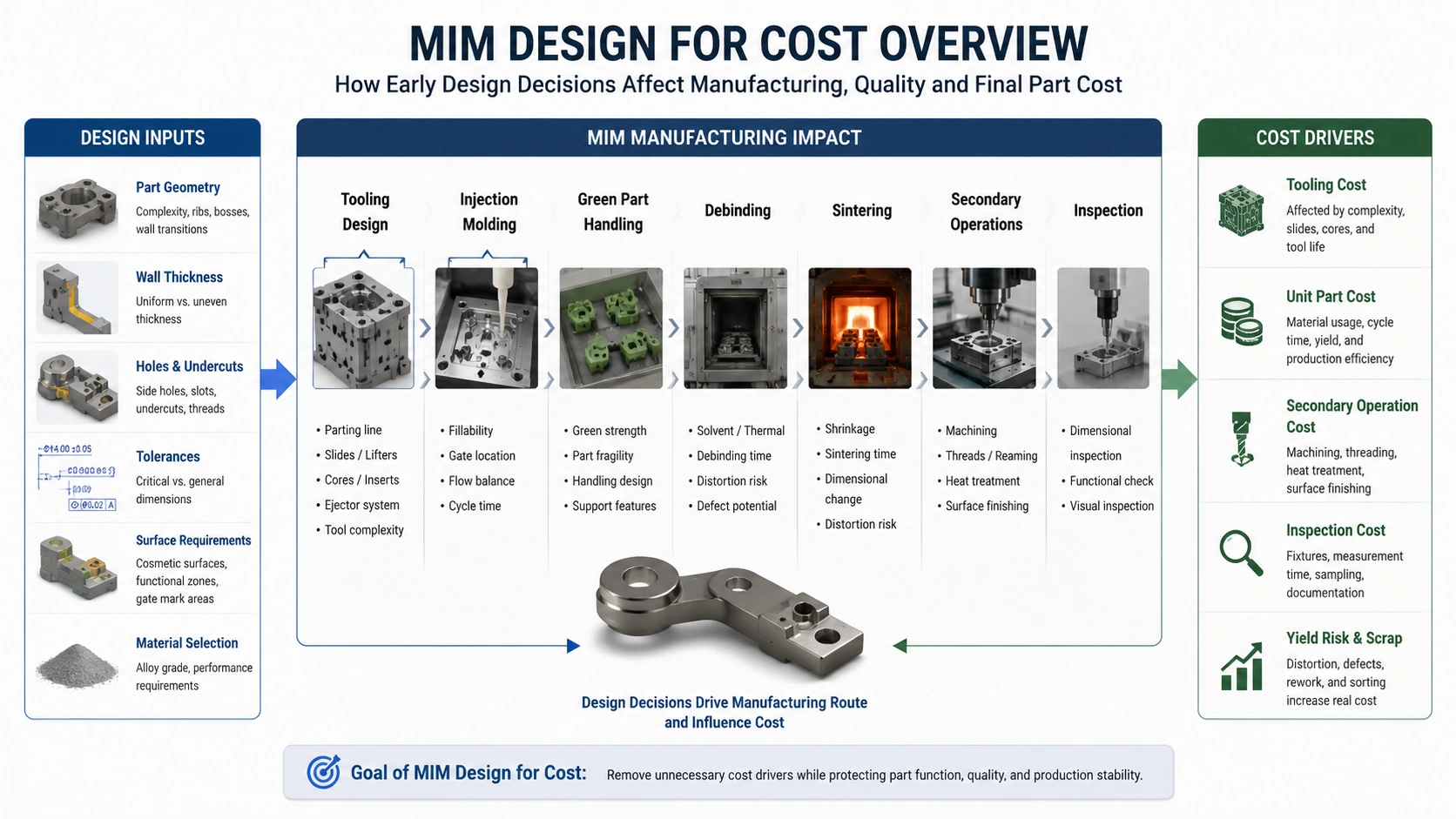
MIM Design for Cost ist eine Überprüfung vor dem Werkzeugbau, die vermeidbare Kostentreiber eliminiert, ohne die Teilefunktion zu schwächen oder Produktionsrisiken zu schaffen. Die Überprüfung konzentriert sich darauf, wie Geometrie, Wandstärke, Werkzeugbewegungen, Einschränkungen bei Anschnitt und Trennlinie, Toleranzstrategie, Sinterstützen, Nachbearbeitung, Inspektionsaufwand und erwartetes Volumen die Werkzeug- und Stückkosten beeinflussen. Ein kleines Merkmal kann teuer werden, wenn es einen Schieber, eine Nachbearbeitung, eine spezielle Inspektion oder eine schwierige Sinterstütze erfordert. Umgekehrt sollte nützliche Komplexität beibehalten werden, wenn sie Bearbeitung oder Montage ersetzt. Das Ziel ist nicht das niedrigste Angebot oder die minimale Spezifikation. Es ist ein kosteneffizientes MIM-Design, das kritische Abmessungen, funktionale Oberflächen, Montage-Schnittstellen, Materialleistung und Produktionsstabilität schützt, bevor Werkzeugstahl geschnitten wird.
Was Design for Cost im MIM bedeutet
Design for Cost ist nicht dasselbe wie die Bitte um ein niedrigeres Angebot
Ein häufiger Fehler ist, die Kostenreduzierung bei MIM als Einkaufsverhandlung zu betrachten. Aus technischer Sicht liegt die größere Chance normalerweise, bevor das Angebot finalisiert wird. Wenn die Zeichnung bereits unnötig enge Toleranzen, vermeidbare Werkzeugaktionen, undefinierte sichtbare Oberflächen, schwer zu unterstützende Überhänge und Merkmale enthält, die eine Nachbearbeitung nach dem Sintern erfordern, hat der Lieferant nur begrenzten Spielraum zur Kostensenkung, ohne das Produktionsrisiko zu erhöhen.
Design for Cost bei MIM sollte mit einer strukturierten Überprüfung der Teilegeometrie, der funktionalen Anforderungen, der kritischen Abmessungen, des Materialbedarfs, der Oberflächenanforderungen und des erwarteten Produktionsvolumens beginnen. Diese Seite gehört zum MIM-Konstruktionsleitfaden und konzentriert sich darauf, wie Designentscheidungen die Kosten vor dem Werkzeugbau beeinflussen. Für eine umfassendere projektbezogene Kostenaufschlüsselung siehe den Leitfaden zu den Kosten im Metallpulverspritzguss.
Bei MIM werden die Kosten oft vor Beginn des Werkzeugbaus festgelegt
MIM verwendet feines Metallpulver, das mit einem Binder zu Feedstock vermischt wird, gefolgt von Spritzgießen, Handhabung des Grünteils, Entbindern, Sinterschwindung und Endkontrolle. Da das Werkzeug mit Schwindungskompensation konstruiert werden muss und das gesinterte Teil möglicherweise noch Nachbearbeitungen erfordert, sind viele Kostenentscheidungen bereits getroffen, bevor das erste Serienbauteil hergestellt wird.
Wenn beispielsweise ein seitliches Merkmal senkrecht zur Werkzeugöffnung steht, benötigt das Werkzeug möglicherweise einen Schieber- oder Kernmechanismus. Wenn eine sichtbare Fläche nicht klar definiert ist, muss der Werkzeugkonstrukteur möglicherweise Grate, Trennlinien und Auswerfermarken in zu vielen Bereichen vermeiden. Wenn jede Abmessung als kritisch markiert ist, erhöht sich der Prüfaufwand, und der Lieferant muss möglicherweise Bearbeitung, Kalibrierung oder spezielle Prüfvorrichtungen anbieten, die sonst nicht erforderlich wären.
Das richtige Ziel ist kosteneffiziente Herstellbarkeit, nicht minimale Spezifikation
Kosteneffizientes MIM-Design bedeutet nicht, alle komplexen Merkmale zu entfernen. MIM wird oft gewählt, weil es kleine, komplexe, hochdichte Metallteile herstellen kann, die sonst CNC-Bearbeitung, Montage, Schweißen oder mehrere Umformschritte erfordern würden. Ein Merkmal, das komplex erscheint, kann wirtschaftlich gerechtfertigt sein, wenn es eine Nachbearbeitung eliminiert oder Montagekomponenten reduziert.
Das richtige Ziel ist die Beseitigung unnötiger Kosten, nicht notwendiger Funktionen. Eine gute Design-for-Cost-Prüfung schützt tragende Bereiche, präzise Kontaktflächen, Positionierungsmerkmale, Gewindeschnittstellen, Verschleißflächen und montagekritische Abmessungen. Sie identifiziert auch nicht-kritische Bereiche, in denen Geometrie, Toleranz, Oberflächenbeschaffenheit oder Inspektionsanforderungen vereinfacht werden können, ohne die funktionale Absicht zu ändern.
Welche Designentscheidungen erhöhen normalerweise die Kosten von MIM-Teilen?
Dicke massive Abschnitte und ungleichmäßige Wandübergänge
Dicke massive Abschnitte können die Kosten auf verschiedene Weise erhöhen. Sie verbrauchen mehr Material, erfordern möglicherweise längere Entbinderungs- und Sinterkontrollen und können das Risiko von Schwindungsvariationen oder Verzug erhöhen. Das Problem ist nicht nur die Menge an Metallpulver. Das eigentliche Kostenrisiko liegt in der Prozessinstabilität während der Binderentfernung, des Hochtemperatursinterns und der endgültigen Maßkontrolle.
Bei einem MIM-Teil muss das Feedstock die Kavität füllen, der Binder muss entfernt werden und das Teil muss während des Sintervorgangs kontrolliert schrumpfen. Wenn ein Bereich viel dicker ist als ein anderer, wird das Prozessfenster schwieriger. Dicke Abschnitte erfordern möglicherweise auch Kernbohrungen, Abschnittsreduzierungen oder Geometrieänderungen, um die Gleichmäßigkeit zu verbessern. Für tiefere Geometrieregeln siehe MIM-Wanddickendesign.
Seitliche Löcher, Schlitze und Rückzugselemente
Seitliche Löcher, Schlitze, interne Profile und Rückzugselemente sind nicht automatisch schlecht. Sie sind oft der Grund, warum ein Konstrukteur MIM überhaupt in Betracht zieht. Sie können jedoch die Werkzeugkosten erhöhen, wenn sie Schieber, Kernstifte, Auswerfer, Einsätze oder spezielle Teilungslinienanordnungen erfordern.
Aus Sicht der Designprüfung sollte die erste Frage sein, ob die Merkmalsrichtung mit der Öffnungsrichtung des Werkzeugs ausgerichtet werden kann. Wenn nicht, sollten die Kosten durch die Funktion gerechtfertigt sein. Eine Seitenbewegung, die CNC-Bohrungen oder die Montage ersetzt, kann sich lohnen. Eine Seitenbewegung, die nur für ein geringfügiges nicht-funktionales Detail hinzugefügt wird, sollte überprüft werden. Für anwendungsbezogene Anleitungen siehe Löcher, Schlitze und Rückzugselemente im MIM-Design.
Sichtbare Oberflächen, die die Anordnung von Anguss, Teilungslinie oder Auswerfer einschränken
Undefinierte Anforderungen an sichtbare Oberflächen können die MIM-Kosten leise erhöhen. Wenn der Lieferant nicht weiß, welche Flächen sichtbar, funktional oder kundenorientiert sind, muss der Werkzeugkonstrukteur möglicherweise Anguss-, Auswerfer- und Teilungslinienmarkierungen über zu viele Bereiche vermeiden. Dies kann die Angussplatzierung weniger effizient machen, die Werkzeugkomplexität erhöhen oder Markierungen in weniger sichtbare, aber funktionalere Bereiche verschieben.
Ein besserer Ansatz ist die klare Definition sichtbarer Oberflächenbereiche. Die Zeichnung oder das 3D-Modell sollte sichtbare Flächen, Kontaktflächen, versteckte Flächen, akzeptable Bereiche für Angussmarkierungen, akzeptable Bereiche für Teilungslinien und Flächen für Auswerferkontakt identifizieren. Wenn die Angussplatzierung ein Hauptanliegen ist, überprüfen Sie MIM-Angussdesign.
Enge Toleranzen bei nicht kritischen Abmessungen
Eine enge Toleranz ist einer der häufigsten versteckten Kostentreiber im MIM-Verfahren. Einige Abmessungen sind entscheidend für Montage, Ausrichtung, Bewegung oder Kontaktleistung. Diese sollten klar kontrolliert werden. Wenn jedoch enge Toleranzen für jede Abmessung angewendet werden, kann das Projekt zusätzliche Inspektion, höhere Ausschusskontrolle, Bearbeitungszugaben, Kalibrierung oder Nachbearbeitung erfordern.
Eine kosteneffiziente Zeichnung trennt funktionskritische Abmessungen von allgemeinen Abmessungen. Der Lieferant kann dann die Prozesskontrolle und Inspektion auf die Abmessungen konzentrieren, die die Leistung wirklich beeinflussen. Informationen zur Toleranzstrategie und Prozessfähigkeitsgrenzen finden Sie unter MIM-Toleranzen.
Gewinde, Präzisionsbohrungen und präzise Kontaktflächen
Einige Merkmale sind von Anfang an besser als nachträglich bearbeitete Merkmale konzipiert. Innengewinde, Präzisionsbohrungen, Lagersitze, Kontaktflächen und sehr enge Passungen sind als vollständig gesinterte Merkmale möglicherweise nicht wirtschaftlich. Wenn der Bedarf an Bearbeitung erst nach der Bemusterung entdeckt wird, kann das Projekt Neugestaltung, zusätzliche Vorrichtungen, längere Lieferzeiten und Kostenänderungen mit sich bringen.
Geringes Jahresvolumen mit komplexer Werkzeugstruktur
MIM wird in der Regel attraktiver, wenn das Teil klein, komplex und in nennenswerten Stückzahlen gefertigt wird. Ist das Jahresvolumen zu gering, ist ein komplexes Werkzeug möglicherweise nicht wirtschaftlich zu rechtfertigen. In diesem Fall können CNC-Bearbeitung, additive Fertigung aus Metall, Gussverfahren oder andere Routen für die frühe Entwicklungsphase oder die Kleinserienfertigung geeigneter sein. Für eine projektbezogene Überprüfung der Werkzeugkostenamortisation, des Produktionsvolumens, der Nachbearbeitungen und der Stückkostenlogik nutzen Sie die Leitfaden zu den Kosten im Metallpulverspritzguss vor der Freigabe der Ausschreibung (RFQ).
MIM Design Kostentreiber-Matrix
Die folgende Matrix kann während der frühen Zeichnungsprüfung verwendet werden. Sie ersetzt keine lieferantenspezifische DFM-Prüfung, hilft aber Ingenieuren zu identifizieren, welche Designentscheidungen wahrscheinlich Werkzeugkosten, Stückkosten, Nachbearbeitungen, Inspektionsaufwand oder Ertragsrisiken vor der Angebotsanfrage beeinflussen.
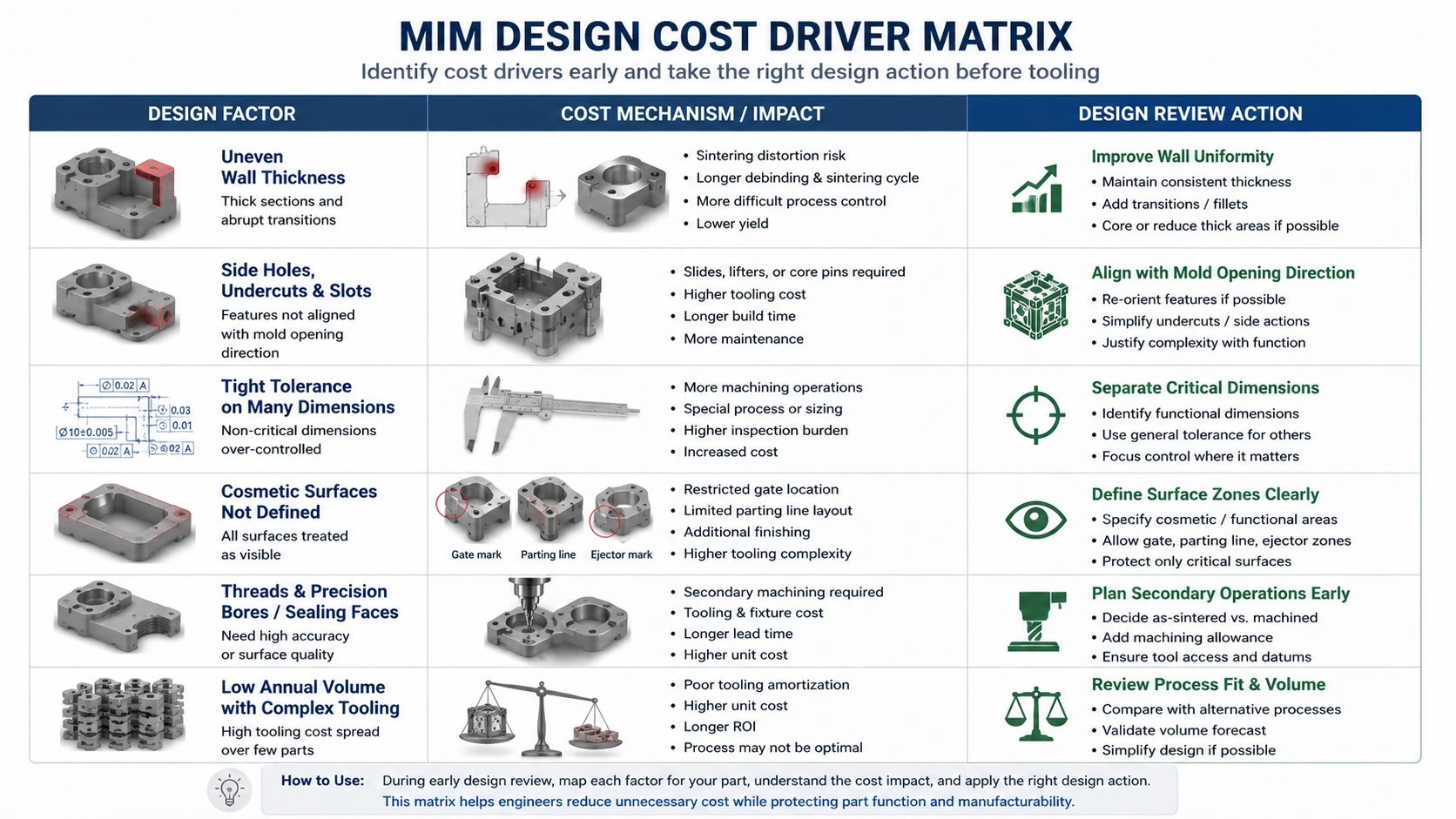
| Kostentreiber | Designentscheidung | Kostenrisiko | Verwandter Leitfaden | Prüfmaßnahme |
|---|---|---|---|---|
| Ungleichmäßige Wandstärke | Gleichmäßige Wandstärken, sanfte Übergänge und Kernbildung in Bereichen mit ausreichender Funktion. | Befüllung, Entbinderung, Sintern und Schwindungssteuerung werden weniger stabil. | Wanddickenauslegung | Wandgleichmäßigkeit verbessern oder dicke Bereiche vor der Werkzeugerstellung prüfen. |
| Massiver dicker Querschnitt | Rippen, Taschen oder interne Reduzierung nur dort verwenden, wo Festigkeit und Lastpfad erhalten bleiben. | Höherer Materialverbrauch, längere Prozesskontrolle, Schwindungsabweichungen und Verzugsrisiko. | Wanddickenauslegung | Kernbildung oder Querschnittsreduzierung erst nach Prüfung der mechanischen Funktion hinzufügen. |
| Seitenlöcher oder Rückzugselemente | Löcher, Schlitze und Rückzugdetails nach Möglichkeit in Richtung der Werkzeugöffnung ausrichten. | Schieber, Einsätze, Kernmechanismen, Gratkontrolle und Werkzeugwartung können die Kosten erhöhen. | Löcher, Schlitze und Hinterschnitte | Seitenbewegungen nur beibehalten, wenn sie Bearbeitung, Montage oder wesentliche Funktionen ersetzen. |
| Werkzeugkomplexität | Überprüfen Sie Trennlinie, Einsätze, Auswerferbereich, Schieber und geschützte Oberflächen vor dem Werkzeugdesign. | Werkzeugkosten, Abmusterungskorrektur, Wartung und Lieferzeit können steigen. | MIM-Werkzeugdesign | Vereinfachen Sie nicht-funktionale Details und bestätigen Sie frühzeitig funktionale Werkzeuganforderungen. |
| Eingeschränkte sichtbare Oberflächen | Definieren Sie sichtbare, funktionale, versteckte und akzeptable Markierungszonen. | Anguss, Trennlinie und Auswerferlayout werden eingeschränkt und können Nacharbeit oder Oberflächenbearbeitungskosten verursachen. | Angussdesign | Schützen Sie nur die Oberflächen, die Funktion, Aussehen oder Kundenanforderungen wirklich beeinflussen. |
| Enge Toleranz bei vielen Abmessungen | Trennen Sie kritische Funktionsabmessungen von allgemeinen Abmessungen. | Bearbeitung, Prüfvorrichtungen, Sortierung, Kalibrierung und Nacharbeit können die Kosten erhöhen. | MIM-Toleranzen | Reservieren Sie enge Toleranzen für Montage-, Bewegungs-, Kontakt- oder Bezugsmaß-bezogene Abmessungen. |
| Präzisionsgewinde, Bohrungen und Kontaktflächen | Entscheiden Sie vor der Werkzeugerstellung über gesinterte oder nachbearbeitete Merkmale. | Späte Bearbeitungsentscheidungen können Werkzeugwechsel, Neukonstruktionen und zusätzliche Vorlaufzeiten verursachen. | DFM für MIM | Planen Sie Bearbeitungszugaben, Zugänglichkeit, Bezugsstrategie und Prüfverfahren in der RFQ-Phase. |
| Nicht unterstützte ebene Flächen | Prüfen Sie vor der Werkzeugerstellung Ebenheit, Auflageflächen, Sinterausrichtung und Kontaktpunkte der Halterungen. | Sinterschwindung, Kosten für Halterungen, Sortierung und Nacharbeit können steigen. | Sinterunterstützungen | Fügen Sie Auflageflächen hinzu oder passen Sie die Geometrie an, wo Ebenheit und Dimensionsstabilität dies erfordern. |
| Schwindungsempfindliche kritische Abmessungen | Identifizieren Sie kritische Abmessungen, die von Werkzeugkompensation und Sinterstabilität abhängen. | Werkzeugkorrektur, Musteriteration und Nacharbeit an Abmessungen können steigen. | Schwindungsausgleich | Bestätigen Sie kritische Bezugspunkte, Messgrundlagen und Korrekturstrategien vor der Freigabe des Werkzeugs. |
| Hochkostenmaterial zu früh ausgewählt | Passen Sie die Legierungsauswahl an die Anforderungen hinsichtlich Belastung, Verschleiß, Korrosion, Temperatur, Magnetismus oder Kundenanforderungen an. | Feedstock-Kosten, Sinterverhalten, Wärmebehandlung, Oberflächenbehandlung und Inspektion können sich ändern. | Materialauswahl und MIM-Qualität | Verwenden Sie das Material mit dem geringsten Risiko, das die funktionalen und kundenspezifischen Anforderungen erfüllt. |
| Geringes Volumen mit komplexem Werkzeug | Vergleichen Sie das erwartete Jahresvolumen mit der Werkzeugkomplexität und der Produktionslebensdauer. | Werkzeugkosten können auf zu wenige Teile verteilt werden, was MIM weniger wirtschaftlich macht. | MIM-Kostenleitfaden | Bestätigen Sie, ob MIM, CNC, Guss oder ein anderer Prozess vor dem Werkzeugbau besser geeignet ist. |
Wie man MIM-Kosten senkt, ohne das Teil zu schwächen

Komplexe Merkmale beibehalten, wo sie Bearbeitung oder Montage ersetzen
Ein komplexes MIM-Merkmal kann kosteneffektiv sein, wenn es einen teureren Prozessschritt ersetzt. Beispielsweise kann eine integrierte Rippe, ein Haken, ein Schlitz, eine Buchse oder ein internes Profil die CNC-Bearbeitung, Schweißung oder Montage reduzieren. Das Entfernen dieses Merkmals kann die Werkzeugkomplexität verringern, aber die Gesamtkosten des Produkts erhöhen, wenn das Merkmal später durch einen anderen Prozess hinzugefügt werden muss.
Die Designprüfung sollte identifizieren, welche komplexen Merkmale einen Mehrwert schaffen. Diese Merkmale sollten geschützt werden. Die Kostenreduzierungsbemühungen sollten sich auf unnötige Komplexität konzentrieren, nicht auf die Merkmale, die MIM rechtfertigen.
Nur unnötige Komplexität entfernen, nicht funktionale Geometrie
Nicht alle Merkmale haben den gleichen Wert. Eine Positionierbuchse kann entscheidend sein. Eine dekorative Innenkante möglicherweise nicht. Eine präzise Kontaktfläche erfordert möglicherweise eine strenge Kontrolle. Eine versteckte, nicht kontaktierende Fläche möglicherweise nicht. Eine Design-for-Cost-Prüfung sollte Merkmale nach Funktion klassifizieren, bevor Änderungen vorgenommen werden.
Diese Merkmale schützen
- Kritische funktionale Merkmale
- Montage- und Ausrichtungsmerkmale
- Lasttragende Merkmale
- Präzise Kontaktflächen
- Verschleißflächen
Diese Kostentreiber überprüfen
- Nicht-kritische Massengeometrie
- Unnötige Seitenaktionen
- Übermäßige Einschränkungen der sichtbaren Oberfläche
- Zu enge allgemeine Abmessungen
- Ungeplante Nachbearbeitungsmerkmale
Verwenden Sie Kernbohrungen, um dicke Abschnitte zu reduzieren, wenn die Funktion dies zulässt
Kernbohrungen können Materialverbrauch reduzieren, Wandgleichmäßigkeit verbessern und Prozessrisiken bei dicken Abschnitten verringern. Sie sollten jedoch nicht blind angewendet werden. Das Entfernen von Material aus tragenden Bereichen, präzisen Kontaktflächen, Gewindestützbereichen oder hochbelasteten Übergängen kann mechanische Risiken bergen. Der richtige Ansatz ist, den Lastpfad, die Montagefunktion und die Sinterstabilität gemeinsam zu prüfen.
Vereinfachen Sie Werkzeugbewegungen, wenn die Merkmalsrichtung angepasst werden kann
Einige teure Werkzeugbewegungen können vermieden werden, indem die Merkmalsrichtung angepasst, ein Loch in einen Schlitz geändert, eine Aussparung modifiziert oder ein nicht funktionsfähiges Rückziehmerkmal neu gestaltet wird. Das bedeutet nicht, dass jedes Seitenmerkmal entfernt werden sollte. Es bedeutet, dass jede Seitenaktion einen Grund haben sollte. Für werkzeugspezifische Bewertungen siehe MIM-Werkzeugkonstruktion.
Trennen Sie kritische Abmessungen von allgemeinen Abmessungen
Eine Zeichnung, die zu viele Abmessungen als kritisch kennzeichnet, kann zu unnötigen Inspektionen und Nachbearbeitungen führen. Eine kosteneffiziente MIM-Zeichnung sollte Abmessungen identifizieren, die Montage, Bewegung, Präzisionskontakt, Festigkeit, Aussehen und allgemeine Passform steuern. Dies hilft dem Lieferanten, die richtige Prozessroute anzubieten und verhindert, dass das Projekt für Präzision bezahlt, wo Präzision die Funktion nicht verbessert.
Entwerfen Sie mehr Merkmale als gesintert, wenn die Anwendung dies zulässt
Gesinterte Merkmale sind oft kosteneffizienter als nachbearbeitete Merkmale, aber nur, wenn die erforderliche Toleranz, Oberflächenbeschaffenheit und funktionale Leistung für die Geometrie und das Material realistisch sind. Merkmale, die Lagerkontakt, enge Gleitpassung, kontrollierte Gewindeeingriffe oder präzise Bezugspunkte erfordern, müssen möglicherweise dennoch bearbeitet werden.
Toleranz, Bearbeitung und Inspektion: Wo die Kosten schnell steigen

Als-gesinterte Toleranz ist nicht dasselbe wie bearbeitete Toleranz
MIM kann hochdichte, komplexe Metallteile herstellen, aber der Prozess beinhaltet Entbinderung und Sinterschwindung. Da Schwindungskompensation, Materialverhalten, Geometrie, Stützstrukturen und Ofensteuerung die Endabmessungen beeinflussen, sollte die als-gesinterte Toleranz anders behandelt werden als die bearbeitete Toleranz.
Ein häufiger Fehler ist die Anwendung von CNC-ähnlichen Erwartungen auf alle MIM-Abmessungen. Dies kann das Angebot unnötig verteuern oder technisch unrealistisch machen. Kritische Abmessungen sollten frühzeitig besprochen werden, damit der Lieferant entscheiden kann, ob sie durch Werkzeugkompensation, Sinterstützen, Kalibrierung, Bearbeitung oder Inspektionsstrategie kontrolliert werden sollen.
Enge Toleranzen sollten für funktionale Abmessungen reserviert sein
Enge Toleranzen sind wertvoll, wenn sie die Funktion schützen. Sie werden verschwenderisch, wenn sie auf nicht-funktionale Oberflächen oder Referenzabmessungen angewendet werden. Beispiele für Abmessungen, die eine engere Kontrolle rechtfertigen könnten, sind Montage-Schnittstellen, Lager- oder Drehpunkte, Positionierungsbezugsflächen, Bewegungssteuerungsmerkmale und Oberflächen, die mit Gegenstücken in Kontakt kommen.
Inspektionskosten steigen, wenn jede Abmessung kritisch wird
Inspektion ist nicht kostenlos. Wenn jede Abmessung als kritisch behandelt wird, benötigt der Lieferant möglicherweise mehr Vorrichtungen, mehr Messzeit, mehr Dokumentation oder mehr Sortierung. Dies erhöht die Kosten und kann die Lieferung verlangsamen. Ein klarer Inspektionsplan sollte sich auf die Merkmale konzentrieren, die Funktion, Montage oder Qualitätsrisiken beeinflussen. Für weitere Details, siehe wie Teileabmessungen die endgültige MIM-Teilequalität beeinflussen.
Sekundäre Bearbeitung sollte geplant und nicht erst nach der Bemusterung entdeckt werden
Sekundäre Operationen sind kein Problem, wenn sie richtig geplant sind. Sie werden zu einem Kostenproblem, wenn sie spät entdeckt werden. Wenn eine Bohrung, ein Gewinde, eine Ebenheitsanforderung, eine präzise Kontaktfläche oder eine präzise Bezugsfläche eine Bearbeitung erfordert, sollte das Teil genügend Designspielraum und Zugang für die Operation aufweisen.
Material- und Oberflächenanforderungen können die tatsächlichen Kosten beeinflussen
Das Material sollte nach Funktion ausgewählt werden, nicht nur nach maximaler Festigkeit
Die Materialauswahl beeinflusst mehr als nur den Materialpreis. Bei MIM kann die gewählte Legierung die Verfügbarkeit des Feedstocks, das Sinterverhalten, die Wärmebehandlung, die Korrosionsbeständigkeit, die Härte, das magnetische Ansprechverhalten, die Oberflächenbearbeitung und die Prüfanforderungen beeinflussen. Die Wahl eines höherwertigen Materials als für die Anwendung erforderlich, kann die Kosten erhöhen, ohne den Produktwert zu verbessern.
Die richtige Materialprüfung beginnt mit den Anwendungsbedingungen: Belastung, Verschleiß, Korrosionsbelastung, Temperatureinwirkung, magnetische Anforderung, Anforderung an sichtbare Oberflächen, Anforderung an Nachbehandlung und Kundenmaterialanforderung. Für qualitätsbezogene Auswirkungen, die sich auf das Material konzentrieren, prüfen Sie Materialauswahl und MIM-Teilequalität.
Oberflächenanforderungen können die Wahl von Anschnitt, Trennlinie und Nachbearbeitung einschränken
Oberflächenanforderungen sollten frühzeitig definiert werden. Wenn eine Zeichnung einen hohen visuellen Standard für alle Oberflächen erfordert, hat der Werkzeugkonstrukteur möglicherweise weniger Optionen für die Anschnittplatzierung, die Auswerferposition und das Trennlinienlayout. Zusätzliche Oberflächenbearbeitung kann ebenfalls erforderlich sein.
Ein besserer Ansatz ist die Definition von Oberflächenzonen: Funktionsfläche, sichtbare Fläche, versteckte Fläche, zulässiger Bereich für Anschnittmarkierungen, zulässiger Bereich für Auswerfermarkierungen, zulässiger Bereich für Trennlinien und Oberflächen, die Polieren, Beschichten, Galvanisieren oder Bearbeiten erfordern. Dies gibt dem Werkzeugteam genügend Freiheit, die wichtigen Flächen zu schützen, ohne das gesamte Teil übermäßig zu bearbeiten.

Typisches Design-for-Cost-Szenario 1: Zu breit angewendete enge Toleranzen
Offenlegung des Szenarios: Die folgenden repräsentativen Szenarien kombinieren gängige Muster, die bei der Überprüfung von MIM-Zeichnungen, Angeboten und Werkzeugen angetroffen werden. Es handelt sich um technische Beispiele und nicht um einzelne XTMIM-Kundenfallstudien.
Welches Problem aufgetreten ist
Ein kleines MIM-Mechanikteil wurde mit unerwartet hohen Stückkosten angeboten. Die Zeichnung wies viele Außenabmessungen, interne Taschen und berührungslose Oberflächen mit engen Toleranzen auf. Nur zwei Abmessungen waren für die Montage tatsächlich kritisch.
Warum es passiert ist
Das Designteam hatte ein für CNC-Bearbeitung erstelltes Zeichnungsformat wiederverwendet. Die Toleranzen wurden als Standardzeichnungsgewohnheit angewendet, anstatt basierend auf MIM-Funktion, Montage oder Inspektionsanforderungen.
Was die eigentliche Systemursache war
Das Problem war nicht nur der Toleranzwert. Die eigentliche Ursache im System war eine fehlende Toleranzklassifizierung. Der Lieferant musste davon ausgehen, dass viele Maße kritisch waren, was den Inspektionsaufwand erhöhte und eine Nachbearbeitung wahrscheinlicher machte.
Wie es korrigiert wurde
Die Zeichnung wurde Merkmal für Merkmal überprüft. Montagekritische Maße wurden eng gehalten. Nicht berührte und verdeckte Oberflächen wurden auf angemessenere allgemeine Anforderungen gelockert. Der Inspektionsplan wurde vereinfacht, um sich auf funktionale Maße zu konzentrieren.
So verhindern Sie ein erneutes Auftreten
Klassifizieren Sie vor der Angebotsanfrage jede enge Toleranz als funktional, montagebezogen, oberflächenbezogen, inspektionsbezogen oder nicht kritisch. Wenn der Grund für die Toleranz nicht erklärt werden kann, sollte sie überprüft werden.
Typisches Design-for-Cost-Szenario 2: Seitenmerkmal hinzugefügt ohne Werkzeugüberprüfung
Welches Problem aufgetreten ist
Ein Seitenmerkmal wurde während einer späten Designrevision zu einem kompakten MIM-Teil hinzugefügt. Die Kosten erhöhten sich, da das Merkmal eine Seitenbewegung im Werkzeug erforderte. Das Projektteam erwartete nur eine geringe Kostenänderung, da das Merkmal einfach aussah.
Warum es passiert ist
Die Richtung des Merkmals wurde nicht in Bezug auf die Werkzeugöffnungrichtung überprüft. Das Designteam konzentrierte sich auf die Form des Merkmals, aber nicht darauf, wie das Merkmal geformt werden würde.
Was die eigentliche Systemursache war
Das eigentliche Problem war die Werkzeugaktion, nicht die Größe des Merkmals. Ein Seitenmerkmal kann Schieber, Kerne, Wartungsanforderungen, Probleme bei der Gratkontrolle und Komplexität im Werkzeugdesign hinzufügen.
Wie es korrigiert wurde
Die Funktion des Merkmals wurde überprüft. Eine überarbeitete Geometrie richtete das Merkmal an einer günstigeren Werkzeugrichtung aus. Wo das Seitenmerkmal nicht eliminiert werden konnte, wurden die Kosten gerechtfertigt, da es einen separaten Bearbeitungsvorgang ersetzte.
So verhindern Sie ein erneutes Auftreten
Überprüfen Sie während der frühen Designprüfung, ob jedes Loch, jeder Schlitz und jedes Rückwärtsziehmerkmal in der Werkzeugöffnungsrichtung geformt werden kann. Entscheiden Sie andernfalls, ob die zusätzlichen Werkzeugkosten durch die Funktion oder durch den Wegfall eines Sekundärvorgangs gerechtfertigt sind. Überprüfen Sie für damit verbundene Qualitätsrisiken wie das Werkzeugdesign die MIM-Qualität beeinflusst.
Wenn Kostenreduzierung zu einem Fertigungs- oder Funktionsrisiko wird
Kostenreduzierung sollte niemals von der Funktion getrennt werden. Einige kostensparende Ideen schaffen höhere Risiken als die Kosten, die sie einsparen. Bevor eine Designänderung akzeptiert wird, überprüfen Sie die Teilefunktion, die Gegenstücke, das Materialverhalten, den Toleranzstapel, die Inspektionsmethode und das Produktionsvolumen.
| Kostensenkungsidee | Warum es riskant sein kann | Was zuerst geprüft werden sollte |
|---|---|---|
| Alle Toleranzen lockern | Montage, präziser Kontakt oder Bewegung können fehlschlagen. | Funktionskritische Maße |
| Material aus dicken Bereichen entfernen | Festigkeit oder Steifigkeit können reduziert werden. | Lastpfad und Spannungskonzentration |
| Jegliche Sekundärbearbeitung vermeiden | Gewinde, Bohrungen oder präzise Kontaktflächen erfüllen möglicherweise nicht die Funktion. | Funktionsflächen und Gegenstücke |
| Umstellung auf ein kostengünstigeres Material | Korrosions-, Verschleiß-, Hitze- oder magnetische Leistung kann beeinträchtigt werden. | Anwendungsumgebung |
| Schieberposition nur aus optischen Gründen ändern | Füllbalance oder Schweißnahtrisiko kann steigen. | Angusslage und Fließweg |
| Stützstrukturen für das Sintern entfernen | Planheit oder Verzug kann instabil werden. | Sinterausrichtung und Stützflächen |
| Inspektionsanforderungen zu stark reduzieren | Defekte können die Montage oder den Kundeneinsatz erreichen. | Kritische Inspektionspunkte |
Checkliste für Design-for-Cost vor der RFQ
Bereiten Sie vor dem Absenden einer MIM-Anfrage (RFQ) genügend Informationen vor, damit der Lieferant sowohl die Herstellbarkeit als auch die Kostentreiber bewerten kann. Eine nützliche Design-for-Cost-Prüfung erfordert in der Regel mehr als nur ein 3D-Modell, da die Geometrie allein keine Materialanforderungen, Inspektionsprioritäten, Jahresvolumen, Oberflächenerwartungen oder den Grund für enge Abmessungen erklärt.

Was Ingenieure vor der Freigabe von Zeichnungen prüfen sollten
- Wurden funktionale und nicht-funktionale Maße getrennt?
- Sind kritische Oberflächen klar identifiziert?
- Sind sichtbare Oberflächen nur dort definiert, wo sie benötigt werden?
- Wurden dicke Bereiche, scharfe Übergänge und freitragende Spannweiten geprüft?
- Wurden seitliche Bohrungen, Schlitze und Rückzugselemente in Bezug auf die Werkzeugöffnung geprüft?
- Sind Gewinde, Bohrungen, präzise Flächen und Passungen für den gesinterten oder bearbeiteten Zustand geplant?
- Basieren die Materialanforderungen auf realen Anwendungsbedingungen?
- Sind die Anforderungen an die Oberflächenbeschaffenheit klar definiert?
- Sind Prüfpunkte mit der tatsächlichen Funktion verknüpft?
Was Einkaufsteams für ein aussagekräftiges Angebot senden sollten
- 2D-Zeichnung
- 3D-CAD-Datei
- Materialanforderung oder Anwendungsumgebung
- Kritische Abmessungen und Toleranzhinweise
- Oberflächenbeschaffenheit und Anforderungen an sichtbare Oberflächen
- Erwartete Jahresstückzahl
- Ziel-Produktionslebensdauer
- Informationen zum Gegenstück oder zur Baugruppe
- Anforderungen an Nachbehandlungen
- Prüfanforderungen
- Aktueller Prozess, falls eine Umstellung von CNC, Guss, Stanzen oder einer anderen Methode erfolgt
Ein MIM-Lieferant sollte prüfen, ob das Teil gespritzt, als Grünling gehandhabt, entbindert, gesintert, gestützt, inspiziert und konsistent gefertigt werden kann. Die Prüfung sollte auch aufzeigen, wo Kosten reduziert werden können, ohne die Funktion zu ändern. Für eine strukturiertere Vorbereitung nutzen Sie die MIM-DFM-Konstruktionscheckliste und den MIM-Toleranz- und Schwindungs-Checkliste.
FAQs zu MIM Design for Cost
Was versteht man unter Design for Cost beim Metallpulverspritzguss?
Design for Cost im MIM ist der Prozess der Überprüfung von Bauteilgeometrie, Toleranzen, Material, Oberflächenanforderungen, Werkzeugkomplexität, Sekundäroperationen und Prüfanforderungen vor der Werkzeuginvestition. Ziel ist es, unnötige Kostentreiber zu eliminieren, während die Bauteilfunktion, Montage, Qualität und Produktionsstabilität erhalten bleiben.
Ist diese Seite mit einem allgemeinen MIM-Kostenleitfaden identisch?
Nein. Diese Seite konzentriert sich auf konstruktive Entscheidungen, die die Kosten vor dem Werkzeugbau beeinflussen, wie Wandstärke, Werkzeugaktionen, Toleranzstrategie, Sinterunterstützung, Zerspanung, Prüfung und Ausbeuterisiko. Ein allgemeiner MIM-Kostenleitfaden deckt in der Regel eine breitere Preisstruktur, Werkzeugamortisation, Produktionsvolumen, Materialkosten und Prozessvergleiche ab.
Welche Konstruktionsmerkmale erhöhen in der Regel die Kosten von MIM-Teilen?
Zu den typischen Kostentreibern gehören dicke massive Abschnitte, ungleichmäßige Wandübergänge, Seitenlöcher, Hinterschneidungen, enge Toleranzen an unkritischen Abmessungen, undefinierte Sichtflächen, Präzisionsgewinde, Präzisionsbohrungen sowie Merkmale, die eine Nachbearbeitung erfordern. Diese Merkmale können zwar notwendig sein, sollten jedoch vor dem Werkzeugbau überprüft werden.
Kostet ein komplexeres MIM-Teil immer mehr?
Nicht immer. MIM wird oft gewählt, weil es komplexe Metallteile wirtschaftlich in Serie herstellen kann. Ein komplexes Merkmal kann die Gesamtkosten senken, wenn es CNC-Bearbeitung, Schweißen oder Montage ersetzt. Die entscheidende Frage ist, ob die Komplexität einen funktionalen Mehrwert bietet oder nur das Werkzeugrisiko und Prozessrisiko erhöht.
Können enge Toleranzen die MIM-Kosten erhöhen?
Ja. Enge Toleranzen können die Kosten erhöhen, wenn sie Bearbeitung, Kalibrieren, zusätzliche Prüfung, spezielle Vorrichtungen oder strengere Prozesskontrolle erfordern. Eine kosteneffiziente MIM-Zeichnung sollte funktionskritische Maße von allgemeinen Maßen trennen.
Wann sollte die spanende Nachbearbeitung für ein MIM-Teil eingeplant werden?
Sekundäre Zerspanung sollte eingeplant werden, wenn Merkmale wie Gewinde, Präzisionsbohrungen, präzise Kontaktflächen, Lagerflächen oder enge Bezugsflächen im Sinterzustand nicht wirtschaftlich beherrschbar sind. Die Planung dieser Operationen vor dem Werkzeugbau hilft, spätere Neukonstruktionen und unerwartete Kostenänderungen zu vermeiden.
Welche Informationen sollte ich für eine MIM-Design-for-Cost-Prüfung senden?
Senden Sie die 2D-Zeichnung, die 3D-CAD-Datei, die Materialanforderung, den Anwendungshintergrund, die kritischen Maße, die Oberflächengüteanforderungen, die erwartete Jahresstückzahl, die Prüfanforderungen, die Nachbehandlungserfordernisse sowie alle aktuellen Kosten- oder Fertigungsbedenken.
Kann ein MIM-Lieferant Kosten senken, ohne die Funktion des Bauteils zu verändern?
In vielen Fällen ja. Die Kosten können oft gesenkt werden, indem kritische Maße präzisiert, sichtbare Oberflächenbereiche definiert, nicht funktionale Merkmale vereinfacht, Bearbeitung nur dort vorgesehen, wo nötig, oder die Wanddickengleichmäßigkeit verbessert wird. Endgültige Änderungen sollten stets durch eine projektspezifische DFM-Prüfung bestätigt werden.
Reichen Sie Ihre Zeichnung zur kostenoptimierten Konstruktionsprüfung ein
Wenn Ihr MIM-Teil eine komplexe Geometrie, enge Toleranzen, seitliche Merkmale, sichtbare Oberflächenanforderungen, zusätzliche Bearbeitungsbedarf, Risiko von Verzug beim Sintern oder Kostendruck vor der Werkzeugerstellung aufweist, kann XTMIM das Design unter Kosten- und Fertigungsgesichtspunkten prüfen.
Bitte senden Sie 2D-Zeichnungen, 3D-CAD-Dateien, Materialanforderungen, Toleranzanforderungen, Anforderungen an die Oberflächenbeschaffenheit, geschätztes Jahresvolumen, Anwendungsdetails, erforderliche Nachbearbeitungen und Inspektionsanforderungen.
Unser Ingenieurteam prüft, welche Konstruktionsmerkmale die Werkzeugkosten, die Stückkosten, das Ausfallrisiko, die Nachbearbeitungen, den Inspektionsaufwand und die Maßhaltigkeit vor der Formenfreigabe, Mustererprobung oder Produktionsplanung beeinflussen können.
Reichen Sie Ihre Zeichnung zur kostenoptimierten Konstruktionsprüfung einTechnische Prüfung durch das XTMIM-Engineering-Team
Dieser Artikel wurde aus der Perspektive des Metallpulverspritzguss-Engineerings erstellt und überprüft. Die Überprüfung konzentriert sich auf Prozesstauglichkeit, Materialauswahl, DFM-Logik, Werkzeugrisiken, Sinterschwindungsverhalten, Planung von Nachbearbeitungen, Toleranzstrategie, Inspektionsanforderungen und Produktionsmachbarkeit.
Endgültige Kosten, Toleranzfähigkeiten, Materialeignung und Produktionsmachbarkeit sollten immer durch projektspezifische Zeichnungsprüfung, Materialprüfung und Lieferanten-DFM-Bewertung bestätigt werden. Diese Seite bietet keine Festpreise, garantierten Toleranzwerte oder allgemeine Kostensenkungsprozentsätze.
Normen und technische Referenzen
Die fertigungsgerechte Kostenprüfung sollte sich nicht allein auf Standards stützen, aber relevante technische Referenzen können die Materialauswahl, die Prozess-Fit-Bewertung und Design-Diskussionen unterstützen. Diese Referenzen unterstützen allgemeine Design-, Material- und Prozess-Eignungsdiskussionen; sie sollten nicht als feste Kostenstandards behandelt werden. Endgültige Anforderungen sollten der Projektspezifikation, der Kundenzeichnung, den genehmigten Materialdaten und den anwendbaren formalen Standards folgen.
- MIMA — Komplexe Designs mit MIM: relevant für Schieber, Kerne, Werkzeugkomplexität und Designprüfung mit einem MIM-Teilehersteller.
- MPIF Standard 35-MIM — Werkstoffnormen für metallpulverspritzgegossene Teile: relevant für die Materialbezeichnung und die Überprüfung der Materialkategorie, nicht als Ersatz für eine projektspezifische Kostenprüfung.
- EPMA — Übersicht über den Metallpulverspritzguss: relevant für die Prozess-Fit-Diskussion für komplex geformte Teile in Stückzahlen.
- PIM International — MIM & CIM Leitfaden für Designer und Endanwender: relevant für Kostenfaktoren einschließlich Material, Bauteilgröße, Werkzeugkomplexität, Zykluszeit, Entbindern und Sintern.