
MIM Materials Engineering Guide
Choose MIM Materials by Required Performance, Not Only Alloy Name
MIM material selection should start with what the part must do in service, not only with a familiar alloy name. A small gear, medical instrument component, magnetic actuator part, watch hardware, electronic connector, or locking mechanism may all be suitable for metal injection molding, but each application places different demands on corrosion resistance, strength, hardness, wear behavior, magnetic response, heat exposure, dimensional stability, or biocompatibility.
In MIM, final material properties are shaped by the material grade and the manufacturing route together. Powder quality, feedstock consistency, debinding, sintering density, residual porosity, heat treatment, surface condition, and inspection method can all affect part performance. This page helps engineers and sourcing teams compare common MIM material properties by application requirement, select candidate material families, and decide when a project-level material review is needed before tooling.
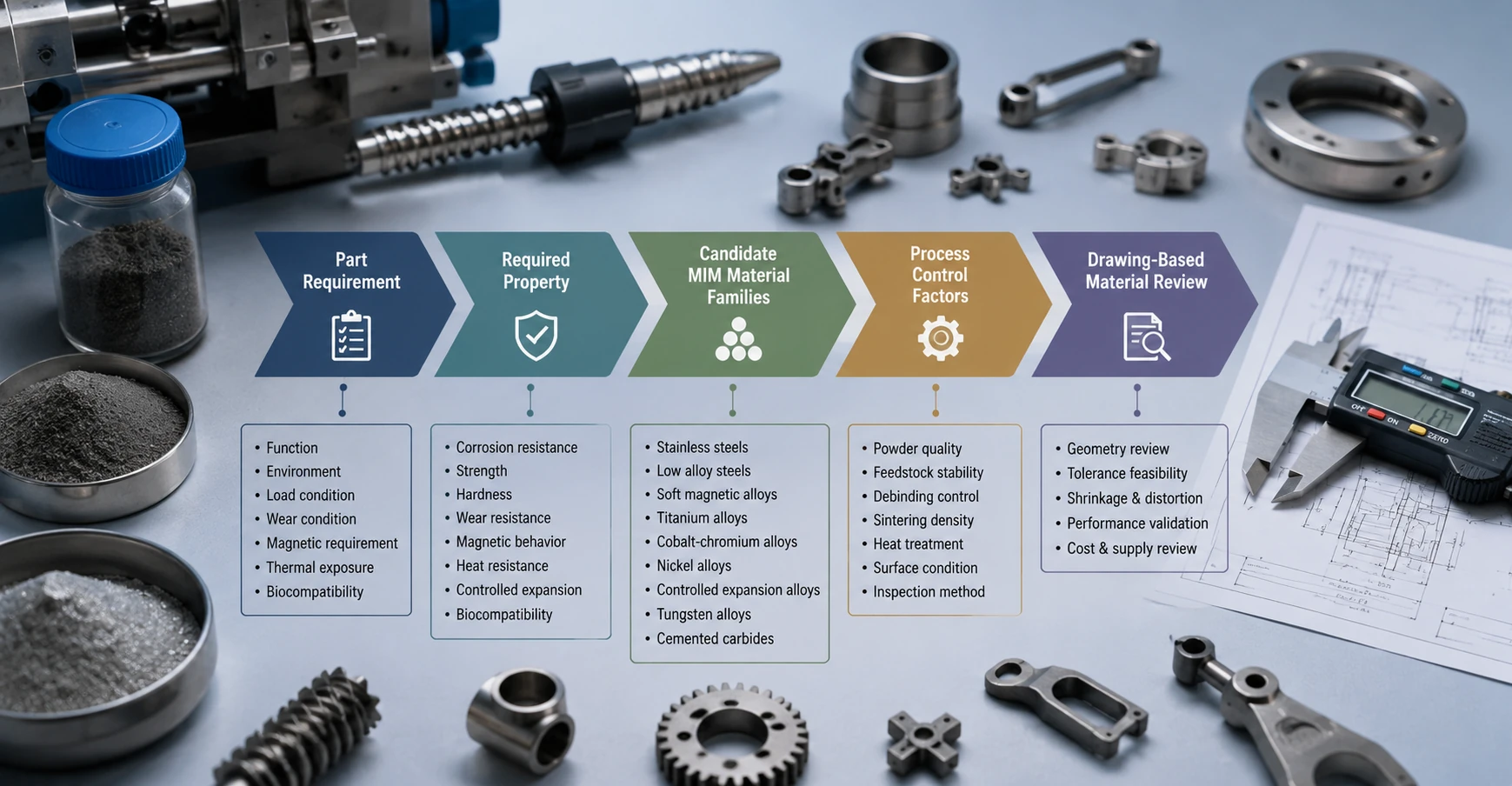
The purpose of this page is not to repeat a complete material list, but to help engineers move from functional requirement to candidate MIM material direction.
What Are MIM Material Properties?
MIM material properties are the measurable performance characteristics of metal injection molded parts, including sintered density, tensile strength, yield strength, elongation, hardness, wear resistance, corrosion resistance, magnetic behavior, thermal expansion, heat resistance, and heat treatment response. These properties are not determined by alloy name alone.
For metal injection molding, final properties depend on the material grade, fine metal powder, binder system, feedstock consistency, debinding control, sintering density, residual porosity, heat treatment, surface condition, part geometry, and inspection method. For tooling decisions, the safest approach is to confirm the target property together with the drawing, service environment, critical dimensions, surface requirements, and expected production volume.
Technische Zusammenfassung
When this page is useful
Use this page when your drawing has a performance requirement but the material has not been confirmed. It is most useful for early material screening before tooling, RFQ preparation, or conversion from CNC, casting, stamping, die casting, or conventional PM.
When a material table is not enough
Do not approve a MIM material from a web table alone if the part has tight tolerances, high load, wear contact, corrosion exposure, magnetic requirements, heat treatment, medical contact, or regulatory requirements.
Main engineering risk
The same nominal alloy can perform differently if sintered density, residual porosity, carbon/oxygen control, heat treatment, surface finish, or inspection method is not aligned with the application.
Empfohlener nächster Schritt
Confirm material suitability through drawing-based review, including geometry, critical dimensions, application environment, target properties, post-processing, inspection method, and estimated production volume.
Choose MIM Materials by Required Performance, Not Only Alloy Name
A common mistake in early MIM project discussions is starting with a familiar alloy name and assuming the result will match machined bar stock, casting, or wrought material. In practice, the alloy grade is only the starting point.
1. Material family
Stainless steel, low alloy steel, soft magnetic alloy, titanium alloy, cobalt-chromium alloy, nickel alloy, controlled expansion alloy, tungsten alloy, or cemented carbide.
2. Required part performance
Corrosion resistance, tensile strength, hardness, wear resistance, magnetic response, heat resistance, thermal expansion control, or biocompatibility.
3. MIM process condition
Sintered density, heat treatment, surface finishing, dimensional tolerance, critical features, and inspection requirements.
This matters because two parts made from the same nominal material may not behave the same if one requires high density, post-sintering heat treatment, tight flatness, passivation, magnetic performance, or controlled surface finish. Material properties should therefore be reviewed together with the drawing, application environment, critical dimensions, and functional requirements.
MIMA’s material range shows that MIM can cover many alloy families, including stainless steels, low alloy steels, magnetic alloys, nickel alloys, titanium alloys, controlled expansion alloys, and other special materials. However, alloy availability and final suitability still need supplier-level confirmation through project review.
Typical MIM Property Data Engineers Usually Verify
Search users often look for a direct MIM material property table. For early screening, engineers usually compare the following property items before selecting a candidate material. Exact values should come from the applicable material standard, supplier datasheet, test report, and project-specific validation rather than from a generic web table alone.
| Property Data to Verify | Warum das wichtig ist | Übliche Werkstoffrichtung | Project Review Caution |
|---|---|---|---|
| Sinterdichte | Density influences strength, corrosion behavior, magnetic response, sealing performance, and dimensional stability. | All MIM material families | Confirm density requirement and whether porosity affects function, corrosion, wear, or sealing. |
| Tensile strength and yield strength | These values help screen load-bearing parts, brackets, levers, gears, and locking components. | 17-4 PH, 4605, 4140, 4340, Fe-Ni alloys | Review geometry, stress concentration, heat treatment, and load direction before tooling. |
| Elongation and toughness | These properties affect crack resistance, assembly safety, impact risk, and tolerance to local stress. | Stainless steels, low alloy steels, titanium alloys | Very high hardness or strength may reduce ductility; thin sections and sharp corners need DFM review. |
| Härte | Hardness helps screen wear edges, locking surfaces, indentation resistance, and contact features. | 420, 440C, 17-4 PH, tool steels, cemented carbides | Hardness alone does not define wear resistance; surface finish, contact load, and counterface matter. |
| Korrosionsbeständigkeit | Corrosion behavior affects humid, sweat-exposed, chemically exposed, medical, and outdoor applications. | 316L, 304, 17-4 PH, titanium alloys, cobalt-chromium alloys, nickel alloys | Review surface roughness, residual porosity, passivation, cleaning, and actual exposure condition. |
| Magnetisches Verhalten | Magnetic properties affect sensors, actuators, shielding features, magnetic cores, and electromechanical assemblies. | Fe-3Si, Fe-50Ni, Fe-50Co, selected magnetic stainless steels | Density, heat treatment, section thickness, and geometry may affect magnetic response. |
| Thermal expansion or heat resistance | Thermal behavior matters for electronic packages, glass-to-metal sealing, hot environments, and thermal cycling. | Invar, Kovar, nickel alloys, cobalt alloys, heat-resistant stainless steels | Controlled expansion and heat resistance are different requirements; define service temperature and assembly condition. |
| Wärmebehandlungsverhalten | Heat treatment can improve strength or hardness after sintering. | 17-4 PH, 420, 440C, 4605, 4140, 4340 | Heat treatment can also affect dimensions, flatness, distortion, and inspection results. |
| Surface finish and post-processing condition | Surface condition affects friction, corrosion, appearance, cleaning, coating adhesion, and user-contact performance. | All MIM material families | Define whether the part is as-sintered, polished, passivated, coated, machined, or heat treated before acceptance. |
MIM Material Property Selection Matrix
The table below gives an engineering starting point for selecting MIM materials by performance requirement. It should not replace a project datasheet, formal standard, or application-specific validation.

Use this matrix as a screening tool. Final material selection should be confirmed by drawing review, application environment, process capability, and inspection requirements.
| Leistungsanforderung | Materials to Evaluate First | Typical MIM Applications | Engineering Caution | Suggested Next Step |
|---|---|---|---|---|
| Korrosionsbeständigkeit | 316L, 304, 17-4 PH, titanium alloys, cobalt-chromium alloys, nickel alloys | Medical instruments, consumer electronics, watch parts, humid or sweat-exposed components | Corrosion resistance depends on material grade, surface condition, passivation, sintering quality, and service environment. | Review corrosion requirement and compare with MIM 316L, MIM 304, and special alloys. |
| Hohe Festigkeit | 17-4 PH, 4605, 4140, 4340, Fe-Ni alloys | Gears, brackets, levers, locking parts, small load-bearing components | Strength is affected by density, heat treatment, section thickness, and stress concentration. | Bewerten MIM 17-4 PH oder MIM 4605 depending on corrosion and strength priorities. |
| Hohe Härte | 420, 440C, Werkzeugstähle, Hartmetalle | Lock parts, wear edges, cutting or contact features, precision mechanical parts | Hardness may reduce ductility and increase cracking or brittleness risk. | Compare MIM 420 und MIM 440C with the real contact condition. |
| Verschleißfestigkeit | 420, 440C, tool steels, cemented carbides, cobalt-chromium alloys | Small gears, sliding parts, friction contact parts, latch components | Wear resistance is not only hardness; load, counterface, lubrication, and surface finish matter. | Define the wear mode before choosing a grade or post-treatment. |
| Magnetisches Verhalten | Fe-3Si, Fe-50Ni, Fe-50Co, 430L and other magnetic alloys | Sensors, actuators, magnetic cores, shielding parts, electronic mechanisms | Magnetic performance can be affected by density, heat treatment, chemistry, and geometry. | Überprüfen Sie die weichmagnetische MIM-Werkstoffe family. |
| Kontrollierte Ausdehnung | Invar, Kovar and related controlled expansion alloys | Glass-to-metal sealing, electronics, optical and precision assemblies | CTE matching and service temperature are more important than strength alone. | Prüfen Sie controlled expansion MIM alloys. |
| Biokompatibilität | 316L, titanium alloys, cobalt-chromium alloys | Surgical tools, dental parts, medical instrument components, wearable contact parts | Do not assume implant suitability without formal material, regulatory, cleaning, surface, and application validation. | Review standards, cleaning, surface condition, and application risk before tooling. |
| Hitzebeständigkeit | Heat-resistant stainless steels, nickel alloys, cobalt alloys | Hot environment components, thermal cycling parts, oxidation-exposed parts | Heat resistance is different from heat treatability; service temperature must be reviewed. | Confirm actual operating temperature, oxidation exposure, and thermal cycling condition. |
| Heat treatability | 17-4 PH, 420, 440C, 4605, 4140, 4340 | Strength or hardness tuning after sintering | Heat treatment can change dimensions, hardness, strength, and distortion risk. | Review tolerance risk together with MIM-Sintern and post-sintering operations. |
How Key MIM Material Properties Affect Part Performance
Korrosionsbeständigkeit
Corrosion resistance is often associated with stainless steel, but it should be reviewed as an application requirement rather than a material label. For example, 316L is commonly evaluated for corrosion resistance, 17-4 PH may be selected when strength is also important, and titanium or cobalt-chromium alloys may be considered for selected medical or high-performance environments.
From a design review perspective, corrosion resistance depends on more than chromium or alloy content. Surface roughness, residual porosity, passivation, cleaning process, sintering atmosphere, and actual exposure conditions may all affect performance. A part exposed to sweat, cleaning chemicals, humidity, salt spray, sterilization, or body-contact conditions should not be approved only by looking at a general material table.
For MIM stainless steel and other corrosion-resistant materials, the as-sintered surface, polishing level, passivation route, trapped contamination, and post-treatment condition should be reviewed because surface condition can change the practical corrosion result even when the nominal alloy grade is unchanged.
Strength and Load Capacity
High strength MIM materials are usually considered for small parts that must carry load, resist deformation, or maintain function under repeated mechanical stress. Common candidates include precipitation-hardening stainless steels such as 17-4 PH and low alloy steels such as 4605, 4140, or 4340, depending on the required strength, hardness, toughness, and heat treatment condition.
The real engineering issue is not only tensile strength. The drawing should also be checked for wall thickness, sharp corners, holes near loaded areas, thin arms, impact risk, stress concentration, gate position, sintering support, and post-sintering distortion. If the part is a gear, lever, bracket, latch, or load-bearing mechanism, the material selection should be reviewed together with geometry and expected load direction.
Hardness and Edge Stability
High hardness may be required for contact surfaces, locking features, edges, sliding interfaces, or small mechanical parts that must resist indentation. MIM materials such as 420, 440C, tool steels, or cemented carbides may be evaluated depending on the application.
However, hardness alone does not make a part suitable. Very high hardness can reduce ductility, increase brittleness risk, and make dimensional correction or secondary machining more difficult. If a part contains thin sections, sharp transitions, small holes, or impact-loaded features, the hardness target should be reviewed before tooling.
Wear Resistance Under Sliding or Contact Load
Wear resistance should not be treated as the same thing as hardness. A hard material may still fail if the contact load, counterface material, lubrication, surface finish, or operating environment is not suitable.
For MIM parts, wear resistance is especially relevant for small gears, sliding links, latch parts, rotating features, small shafts, mechanical locking elements, and precision contact surfaces. Material selection may include martensitic stainless steels, tool steels, cobalt-based alloys, or cemented carbides, but the final recommendation should depend on the wear mode.
- Is the wear abrasive, adhesive, sliding, impact, or rolling contact?
- Is lubrication available?
- What is the counterface material?
- Is corrosion also present?
- Is the contact surface as-sintered, polished, coated, or machined?
- Is hardness more important than toughness?
Magnetic Performance
Magnetic MIM materials are selected for parts that require controlled magnetic response, such as actuator components, sensor parts, magnetic cores, shielding features, or small electromechanical mechanisms. Soft magnetic alloys such as Fe-3Si, Fe-50Ni, and Fe-50Co may be considered when magnetic performance is the main functional requirement.
This topic should be separated from general soft magnetic material family pages. A material family page explains the alloy group. A magnetic performance page should explain how magnetic properties affect the part’s function. For magnetic MIM parts, density, chemistry, heat treatment, section thickness, and final geometry may influence performance.
Controlled Thermal Expansion
Controlled expansion alloys such as Invar and Kovar are not selected because they are general-purpose strong materials. They are selected when dimensional behavior under temperature change is critical.
Typical use cases include electronic packages, sealing components, optical assemblies, glass-to-metal or ceramic-to-metal interfaces, and precision parts where coefficient of thermal expansion matters. The key review point is not only whether the alloy can be MIM processed, but whether the final part can meet the thermal expansion requirement after sintering, heat treatment, and finishing.
Biocompatibility and Medical Contact
Biocompatible MIM materials may be considered for selected medical instruments, dental components, surgical tools, wearable contact parts, and other regulated applications. Common material candidates may include 316L, titanium alloys, and cobalt-chromium alloys, depending on the required mechanical, corrosion, surface, and regulatory conditions.
Medical-contact material selection should include surface chemistry, cleaning route, residual contamination risk, surface roughness, passivation or finishing condition, and the intended regulatory pathway. A material name alone is not enough to define medical suitability.
Heat Resistance
Heat-resistant MIM materials should be evaluated when the part operates in elevated temperature, thermal cycling, oxidation exposure, or other hot service conditions. Depending on the application, candidates may include heat-resistant stainless steels, nickel alloys, or cobalt alloys.
Heat resistance should not be confused with heat treatability. A heat-resistant material is selected for service performance under temperature exposure. A heat-treatable material is selected because its properties can be modified after sintering.
Heat Treatment Response
Heat-treatable MIM materials are often selected when strength, hardness, or mechanical performance must be adjusted after sintering. Examples include 17-4 PH, 420, 440C, 4605, 4140, and 4340.
The engineering concern is that heat treatment may also affect dimensions, flatness, hardness distribution, and distortion risk. For parts with tight tolerances, thin walls, long arms, or critical mating surfaces, the heat treatment plan should be reviewed before tooling rather than after the first production run.
Common MIM Material Families and Their Property Strengths
Edelstähle
MIM stainless steels are widely used because they provide a useful balance of corrosion resistance, strength, hardness options, and appearance. Austenitic grades such as 304 and 316L are often considered for corrosion resistance. Martensitic grades such as 420 and 440C are usually considered when hardness and wear resistance are more important. Precipitation-hardening stainless steels such as 17-4 PH are often evaluated when strength and corrosion resistance are both required.
Niedriglegierte Stähle
Low alloy steels are often evaluated when high strength, heat treatment response, and cost-effective mechanical performance are important. MIM 4605, 4140, 4340, Fe-2Ni, Fe-4Ni, and Fe-8Ni may be relevant depending on strength, toughness, hardness, and application requirements. These materials are generally not selected as the first option for corrosion resistance unless surface protection or post-treatment is part of the design.
Weichmagnetische Legierungen
Soft magnetic MIM materials are used when the part must support magnetic flux, switching response, actuation, or shielding. Fe-3Si, Fe-50Ni, and Fe-50Co are examples of magnetic material directions that may be considered. Magnetic performance should be reviewed as a functional requirement, not as a cosmetic or general material property.
Titanlegierungen
Titanium and Ti-6Al-4V may be evaluated when low density, corrosion resistance, strength-to-weight ratio, or selected medical and high-performance applications are important. Titanium MIM requires careful process control and should not be treated as a simple substitute for stainless steel.
Kobalt-Chrom-Legierungen
Cobalt-chromium alloys may be considered for wear resistance, corrosion resistance, strength, and selected medical or dental-related applications. They are not usually first-choice general-purpose materials because cost, processing difficulty, and application requirements must be justified.
Nickellegierungen
Nickel alloys may be evaluated for corrosion resistance, heat resistance, oxidation resistance, or demanding operating environments. They are more application-specific than common stainless steels and should be reviewed based on the service condition.
Legierungen mit kontrollierter Ausdehnung
Controlled expansion alloys such as Invar and Kovar are selected when thermal expansion behavior is critical. These materials are mainly relevant for precision assemblies, electronic packages, optical systems, and sealing-related applications.
Tungsten Alloys and Cemented Carbides
Tungsten alloys and cemented carbides may be considered when density, wear resistance, hardness, or high-performance contact behavior is required. These materials are more specialized and should be reviewed against cost, tooling, sintering, finishing, and application constraints.
For a broader material structure, return to the MIM-Werkstoffzentrale. For step-by-step project selection logic, continue to the MIM-Materialauswahl-Leitfaden.
Why MIM Properties Can Differ From Wrought or Machined Materials
MIM is not the same manufacturing route as CNC machining from bar stock. Even when the alloy name is similar, the production route is different.
In MIM, fine metal powder is mixed with binder to form feedstock. The feedstock is injection molded, debound, and sintered. During sintering, the part shrinks significantly and develops its final density, microstructure, and mechanical behavior.

This is why a material datasheet is useful for initial screening, but critical projects still need drawing-based and application-based validation.
Sintered density matters
Higher density generally supports better strength, corrosion resistance, magnetic behavior, and dimensional stability.
Residual porosity may affect performance
Porosity can influence strength, fatigue, corrosion response, sealing performance, and surface behavior.
Sintering atmosphere affects material condition
Carbon, oxygen, nitrogen, and other process-related factors may influence final properties.
Heat treatment may change dimensions
Strength and hardness can improve, but distortion or size change must be considered.
Surface condition affects corrosion and wear
As-sintered, polished, passivated, coated, or machined surfaces may behave differently.
Geometry affects performance
Thin walls, sharp corners, holes, slots, and long unsupported sections can increase risk even when the material itself is suitable.
EPMA describes MIM as a technology for producing complex shaped parts in high quantities, using fine powders and sintering to achieve high density. This is exactly why material selection must be connected to part geometry and application requirements, not only alloy names.
Testing and Validation Methods for MIM Material Properties
Material property selection is only useful when the verification method is clear. Before tooling or production approval, define which property must be tested, which condition the part must be in, and whether the acceptance criteria come from a standard, customer specification, supplier datasheet, or project-specific validation plan.
| Property Requirement | Typische Prüfmethode | What to Confirm Before Testing | Engineering Risk If Ignored |
|---|---|---|---|
| Strength and elongation | Tensile test or customer-specified mechanical test | Material condition, heat treatment state, specimen method, and whether testing applies to a standard coupon or actual part geometry. | A part may appear suitable from nominal material data but fail because the real geometry has stress concentration or insufficient section thickness. |
| Härte | Rockwell, Vickers, microhardness, or customer-specified hardness check | Surface condition, heat treatment state, test location, section thickness, and whether the surface is polished or as-sintered. | Hardness may vary by heat treatment, surface condition, or measurement location, leading to inconsistent acceptance results. |
| Dichte und Porosität | Density check, metallographic review, or supplier-defined density verification | Target density, porosity sensitivity, sealing requirement, corrosion exposure, and whether pores affect the functional surface. | Residual porosity may reduce strength, corrosion performance, magnetic behavior, or sealing reliability. |
| Korrosionsbeständigkeit | Salt spray, immersion test, passivation verification, customer exposure test, or application-specific corrosion test | Environment, surface finish, cleaning process, passivation condition, and actual chemical exposure. | A grade that works in a mild environment may fail under sweat, chloride, cleaning chemical, sterilization, or outdoor exposure. |
| Verschleißfestigkeit | Application wear test, friction test, mating component test, or customer-specific life test | Contact load, counterface material, lubrication, surface finish, wear mode, and operating cycle. | A high-hardness material may still wear quickly if the contact system is not reviewed. |
| Magnetische Eigenschaften | Permeability, coercivity, magnetic response, or customer-defined magnetic function test | Material family, density, heat treatment, part geometry, magnetic path, and operating condition. | The part may meet dimensional requirements but fail the actuator, sensor, shielding, or magnetic circuit function. |
| Thermal expansion or heat resistance | CTE test, thermal cycling test, oxidation exposure test, or service temperature validation | Operating temperature, assembly material, sealing requirement, and thermal cycling condition. | Incorrect material selection can cause mismatch, leakage, cracking, distortion, or assembly failure under temperature change. |
| Oberflächenbeschaffenheit | Roughness check, visual inspection, coating adhesion check, passivation check, or cleanliness verification | Cosmetic requirement, friction requirement, corrosion exposure, coating process, and cleaning requirement. | Surface condition can change corrosion, wear, user-contact behavior, coating performance, and assembly fit. |
For regulated, safety-critical, high-load, corrosion-exposed, magnetic, or medical-contact projects, testing should be planned before tooling. This avoids approving a material from a name or datasheet while leaving the actual acceptance method undefined.
How to Review MIM Material Suitability Before Tooling
Before confirming a MIM material, the project should be reviewed from both material and manufacturing perspectives. The key question is not simply “Can this alloy be molded?” but whether the material, geometry, shrinkage behavior, heat treatment, surface condition, and inspection method can meet the functional requirement at the expected production volume.
| Prüfbereich | Was zu prüfen ist | Warum das wichtig ist |
|---|---|---|
| Working environment | Humidity, sweat, salt, chemicals, cleaning agents, high temperature, oxidation, sterilization, body contact, or magnetic fields | The same material may behave differently in different service environments. |
| Mechanical load | Static load, impact load, fatigue risk, bending, torque, vibration, and assembly stress | The material must match the actual load path, not only nominal tensile strength. |
| Verschleiß- oder Kontaktbedingung | Wear mode, surface finish, lubrication, hardness, counterface, and contact pressure | Hardness alone does not define wear resistance. |
| Korrosionsbelastung | Consumer electronics, medical instruments, outdoor hardware, marine exposure, or cleaning chemical contact | “Corrosion resistant” can mean very different things depending on the environment. |
| Magnetic requirement | Target function, operating condition, assembly role, and testing expectation | A magnetic shielding part, sensor part, actuator part, and magnetic core may require different review criteria. |
| Wärmeeinwirkung | Service temperature, thermal cycling, oxidation exposure, and heat-treatment requirement | Service heat resistance and heat treatability are different engineering questions. |
| Kritische Maße | Functional dimensions, mating surfaces, GD&T, post-treatment risk, and inspection method | Heat treatment or finishing may affect dimensions that are critical to assembly. |
| Oberflächenbeschaffenheit | Appearance, friction, corrosion resistance, cleaning, coating adhesion, and user-contact performance | Surface condition can change both functional and cosmetic performance. |
| Standards or regulatory requirements | Medical, aerospace, automotive, electrical, or customer-specific requirements | The MIM supplier should not guess the compliance target from the drawing alone. |
Szenario mit zusammengesetzten Feldern für die technische Schulung
The following scenario is a composite example used for engineering training. It does not describe a named customer, a specific order, or confidential production data.
Welches Problem aufgetreten ist
A small locking component was initially specified only as “hardened stainless steel.” The part needed edge stability, corrosion resistance, and repeated contact performance, but the drawing did not define the service environment, wear mode, heat treatment condition, or critical contact surface.
Warum es passiert ist
The early material discussion focused on hardness instead of the complete functional requirement. The project team treated hardness and wear resistance as the same requirement, and did not review whether post-sintering heat treatment could affect flatness and mating dimensions.
Was die eigentliche Systemursache war
The issue was not only material grade selection. It involved material family, heat treatment response, sintering distortion risk, contact geometry, surface finish, and inspection plan. The drawing package was not complete enough for a safe tooling decision.
Wie es korrigiert und verhindert wurde
The material review was changed from grade-first to performance-first. The team clarified contact load, corrosion exposure, hardness target, mating surface, critical dimensions, and inspection method before confirming the material direction. Similar projects should define wear mode, heat treatment condition, and tolerance risk before tooling.
What to Provide for a MIM Material Selection Review
To evaluate the right MIM material, provide more than a material name. A useful RFQ or engineering review package should include the part geometry, performance target, application condition, and quality requirement.

A complete project package helps identify material risk, tooling risk, heat-treatment risk, tolerance feasibility, and inspection requirements before tooling investment.
Project files
- 2D-Zeichnung mit Toleranzen
- 3D-CAD-Datei
- Preferred material, if already selected
- Required property, if material is not yet selected
Application requirements
- Anwendungsumgebung
- Load, wear, corrosion, magnetic, thermal, or biocompatibility requirement
- Critical dimensions and mating surfaces
- Oberflächengüte oder Beschichtungsanforderung
Production information
- Heat treatment requirement, if known
- Erwartete Jahresstückzahl
- Prototype and production schedule
- Existing process, if converting from CNC, casting, die casting, stamping, or PM
Inspection expectations
- Kritische Maße
- Mechanical property targets
- Hardness, corrosion, magnetic, or surface requirements
- Inspection or testing requirement
For early projects, it is acceptable if the material is not yet finalized. The more important question is what the part must do in service. A drawing-based material review can help identify whether stainless steel, low alloy steel, titanium, cobalt-chromium, nickel alloy, magnetic alloy, controlled expansion alloy, tungsten alloy, or cemented carbide should be evaluated first.
Need a Material Selection Review for a MIM Part?
Send your drawing, 3D file, application environment, performance requirement, critical dimensions, surface finish requirement, and estimated annual volume. XTMIM can review material suitability together with tooling feasibility, sintering shrinkage, heat-treatment risk, tolerance requirements, secondary operations, and inspection needs before production planning.
FAQ: MIM Material Properties
Welche MIM-Materialeigenschaften vergleichen Ingenieure am häufigsten?
Ingenieure vergleichen üblicherweise Sinterdichte, Zugfestigkeit, Streckgrenze, Dehnung, Härte, Verschleißfestigkeit, Korrosionsbeständigkeit, magnetisches Verhalten, Wärmebehandlungsverhalten, Wärmeausdehnung und Oberflächenbeschaffenheit. Die wichtigste Eigenschaft hängt von der Funktion und dem Einsatzumfeld des Bauteils ab.
Was beeinflusst die endgültigen Eigenschaften von MIM-Teilen?
Die endgültigen Eigenschaften von MIM-Teilen werden durch die Legierungssorte, die Pulverqualität, die Feedstock-Konsistenz, die Entbinderungskontrolle, die Sinterdichte, die Restporosität, die Wärmebehandlung, den Oberflächenzustand, die Teilegeometrie und die Prüfmethode beeinflusst. Daher sollte die Werkstoffauswahl gemeinsam mit der Zeichnung und dem Einsatzumfeld geprüft werden.
Ist MIM 316L immer die beste Wahl für Korrosionsbeständigkeit?
Die 316L wird zwar häufig auf Korrosionsbeständigkeit geprüft, ist aber nicht automatisch das beste Material für jede Umgebung. Die endgültige Wahl hängt von der Korrosionsbelastung, den Festigkeitsanforderungen, der Oberflächengüte, dem Reinigungsprozess, dem Passivierungszustand und der Anwendungsumgebung ab.
Was ist der Unterschied zwischen hochharten und verschleißfesten MIM-Werkstoffen?
Hohe Härte ist eine Materialeigenschaft. Verschleißfestigkeit ist ein Anwendungsergebnis. Die Verschleißfestigkeit hängt von Härte, Oberflächengüte, Belastung, Schmierung, Gegenmaterial, Kontaktdruck und Betriebsumgebung ab.
Können MIM-Werkstoffe wärmebehandelt werden?
Ja, einige MIM-Werkstoffe können wärmebehandelt werden, um Festigkeit, Härte oder mechanische Eigenschaften zu verbessern. Die Wärmebehandlung kann jedoch auch Maße, Ebenheit, Verzug und Prüfergebnisse beeinflussen, daher sollte sie vor dem Werkzeugbau überprüft werden.
Sind die Eigenschaften von MIM-Teilen mit denen von Walzwerkstoffen vergleichbar?
Sie können für einige Anwendungen vergleichbar sein, sollten aber nicht als identisch angenommen werden. MIM verwendet feines Metallpulver, Binder, Spritzgießen, Entbindern und Sintern. Die endgültigen Eigenschaften hängen von der Sinterdichte, Restporosität, Wärmebehandlung, Oberflächenbeschaffenheit, Geometrie und Prozesskontrolle ab.
Welche MIM-Werkstoffe eignen sich für magnetische Bauteile?
Weichmagnetische Legierungen wie Fe-3Si, Fe-50Ni und Fe-50Co können für magnetische MIM-Teile in Betracht gezogen werden. Die richtige Werkstoffauswahl hängt von der geforderten magnetischen Funktion, der Bauteilgeometrie, der Wärmebehandlung, der Dichte und der Prüfmethode ab.
Kann MIM für medizinische Werkstoffe verwendet werden?
MIM kann für ausgewählte medizinische Instrumente, Zahnteile, chirurgische Werkzeuge und einige regulierte Anwendungen eingesetzt werden, abhängig vom Material und den Validierungsanforderungen. Für Implantate oder regulierte medizinische Anwendungen müssen formale Normen, Prüfungen, Reinigung, Oberflächenbeschaffenheit und regulatorische Anforderungen bestätigt werden.
Wann sollte ich vermeiden, ein MIM-Material allein anhand einer Tabelle zu bestätigen?
Eine Materialtabelle reicht nicht aus, wenn das Bauteil enge Toleranzen, hohe Belastung, Verschleißkontakt, Korrosionseinwirkung, medizinischen Kontakt, magnetische Anforderungen, Wärmebehandlung, spezielle Oberflächenbearbeitung oder regulierte Anwendungsanforderungen aufweist. In diesen Fällen sollte die Materialauswahl anhand der Zeichnung und der Einsatzbedingungen überprüft werden.
Welche Informationen sollte ich bereitstellen, bevor ich eine MIM-Materialempfehlung anfordere?
Reichen Sie eine Zeichnung, eine 3D-Datei, die geforderten Leistungsmerkmale, die Anwendungsumgebung, kritische Maße, die Anforderungen an die Oberflächengüte, die erwartete Jahresstückzahl sowie alle bekannten Anforderungen an Festigkeit, Härte, Korrosionsbeständigkeit, magnetische Eigenschaften, thermische Eigenschaften oder regulatorische Vorgaben ein.
Normenhinweis
MIM material selection should be checked against recognized material standards, supplier datasheets, application requirements, and project-specific validation. MPIF Standard 35-MIM is commonly used as a reference for materials used in metal injection molded parts, but final project requirements should be confirmed against the applicable standard edition, customer specification, and supplier material data.
ASTM B883-24 is directly relevant to ferrous MIM material discussions because it covers metal injection molded materials produced from metal powders and binders through injection, debinding, and sintering, with or without subsequent heat treatment. For projects involving MIM stainless steels and low alloy steels, it can be used as one of the standards to review together with customer specifications and supplier datasheets.
For medical or regulated applications, broad material names are not enough. ASTM F2885 addresses metal injection molded Ti-6Al-4V components for surgical implant applications, which illustrates why regulated MIM projects require formal standard review rather than generic material claims. Project teams should verify the applicable standard, regulatory pathway, cleaning requirement, surface condition, and validation plan before production approval.
Technische Referenzen
- MIMA — Materials Range for Metal Injection Molding
- MPIF — Standard 35-MIM Materials Standards for Metal Injection Molded Parts
- ASTM B883-24 — Standard Specification for Metal Injection Molded Materials
- EPMA — Übersicht über den Metallpulverspritzguss
- FDA Recognized Consensus Standards — ASTM F2885-17 entry