見積もりを取得

以下のフォームにご記入いただくと、専門チームによるパーソナライズされたコンサルティングを受けられます。.

MIM Industries and Applications for Precision Metal Parts

MIM Industries & Applications

MIM Industries for High-Value Precision Metal Parts

Metal Injection Molding is used when an industry needs small, complex, high-strength metal parts that can justify tooling, feedstock control, debinding, sintering shrinkage compensation, and final inspection.

The best MIM applications are not defined by industry name alone. They are defined by geometry, material requirements, production volume, tolerance strategy, and whether MIM can reduce machining, assembly, or feature-forming cost without creating unacceptable dimensional or quality risk.

For sourcing managers, product engineers, and OEM project teams, this page helps screen whether a project in medical devices, robotics, aerospace, EV systems, wearable devices, electronics, automotive precision assemblies, or industrial automation should move into drawing-based MIM review.

High-value precision MIM parts arranged for medical robotics aerospace EV wearable electronics and automotive application review
High-value MIM applications focus on small, complex, precision metal parts where material selection, shrinkage control, and inspection planning matter before tooling.

Which Industries Use MIM for High-Precision Metal Parts?

MIM is commonly used in medical devices, robotics and automation, aerospace, EV and new energy systems, wearable devices, consumer electronics, automotive precision components, and precision instruments. These industries often need compact metal parts with thin walls, holes, slots, undercuts, small functional features, corrosion resistance, wear resistance, magnetic behavior, or appearance requirements.

The key decision is not whether an industry appears on a MIM application list. The key decision is whether the part can pass a process review covering feedstock, injection molding, green part handling, debinding, sintering shrinkage, tooling compensation, secondary operations, and final inspection. For the manufacturing route behind these decisions, review the 金属射出成形プロセス.

MIM Is Suitable Only When the Part, Material, Tolerance, and Volume Fit

A common mistake is to ask, “Is my industry suitable for MIM?” The more useful question is, “Does my part have the geometry, material, tolerance, and volume profile that makes MIM practical?” MIM uses fine metal powder mixed with binder to create feedstock. The feedstock is injection molded into a green part, debound to remove binder, and sintered to densify the metal. During this route, small decisions such as gate location, wall balance, green part handling, sintering support, and critical dimension planning can determine whether the project is stable in production.

A medical, aerospace, EV, or robotics project is not automatically a good MIM project. If the part is too large, too simple, too low in volume, or every functional surface requires tight machining, MIM may still be the wrong route.

MIM industry fit filter comparing strong conditional and poor fit projects for small complex precision metal parts
MIM is most suitable when compact size, complex geometry, stable volume, and material requirements justify tooling and sintering control.
核心的な結論:

A good MIM project is defined by part features and production logic, not by a broad industry label.

Fit Level Typical Project Situation 工学的理由
Strong Fit Small complex metal parts with stable annual volume MIM can mold complex features and reduce machining or assembly steps when tooling cost is supported by production demand.
Strong Fit CNC cost is high because of many small features MIM may consolidate holes, slots, curved forms, thin features, and small structural details into one molded geometry.
Conditional Fit Medical, aerospace, EV, or robotic parts with strict validation Feasibility depends on material choice, documentation expectations, surface requirements, secondary operations, and inspection planning.
Conditional Fit Tight tolerance parts with several critical dimensions Some dimensions may be suitable as-sintered, while holes, sealing surfaces, bearing seats, or assembly interfaces may need sizing or machining.
不適 Large simple parts or low-cost commodity hardware Stamping, casting, CNC, die casting, or conventional PM may be more practical when geometry is simple or price pressure is the only driver.

MIM Industries vs MIM Applications: How This Hub Is Different

This page is an industry hub. It organizes MIM opportunities by the customer’s market, such as medical devices, robotics, aerospace, EV systems, wearable devices, electronics, automotive precision components, and industrial automation. Its job is to help users quickly identify whether their industry contains high-value MIM opportunities and then move toward a drawing-based review.

This Page

MIM産業

Focuses on market segments and buyer context: medical, robotics, aerospace, EV, wearables, electronics, automotive precision parts, and automation.

Separate Topic

MIM用途

Should focus on functional use cases and part applications: hinges, gears, sensor parts, soft magnetic parts, wear-resistant parts, structural brackets, and compact mechanisms.

Internal Link Logic

No Content Conflict

Industry pages explain where MIM is used. Application pages explain what the part does and why the geometry, material, tolerance, or production logic fits MIM.

SEO boundary: This hub should not repeat the full content of a future MIM Applications page. It should link users from industry intent into part-level, function-level, and material-level review paths.

Before Tooling, Review the MIM Risks That Often Decide Feasibility

In a high-value industry project, the early review should not stop at “Can the part be molded?” A more useful review checks whether the part can survive molding, green part handling, debinding, sintering shrinkage, finishing, and inspection without creating unstable yield or hidden cost.

形状

Wall Balance and Feature Thickness

Very thin sections, abrupt thickness changes, deep blind features, and unsupported details can increase short shot, cracking, debinding stress, or sintering distortion risk.

金型

Gate, Parting Line, and Mold Release

Gate marks, parting lines, ejector locations, and undercut strategy should be reviewed before tooling, especially for wearable, medical, and consumer electronics parts.

焼結

Shrinkage and Support Strategy

MIM parts shrink during sintering. Critical dimensions, flatness, roundness, and long unsupported features should be planned around tooling compensation and sintering support.

材料

Material and Heat Treatment Path

Stainless steel, low alloy steel, tool steel, soft magnetic materials, titanium, and Co-Cr each require different process and verification thinking.

Secondary Ops

Machining and Finishing Allocation

Not every critical surface should be expected to come directly from sintering. Functional holes, sealing areas, bearing seats, or cosmetic surfaces may require secondary operations.

検査

Critical Dimension Separation

Separate functional dimensions from general dimensions before RFQ. This helps avoid over-controlling non-critical areas while missing the features that actually affect assembly or performance.

High-Value MIM Industry Application Matrix

MIM is used across many markets, but not all markets are equally valuable for a precision manufacturing website. For XTMIM, this hub should deliberately emphasize sectors where engineering review, material selection, miniaturization, strength, surface quality, and validation matter more than low-cost hardware pricing.

High-value MIM industry matrix for medical robotics aerospace EV wearable electronics automotive precision and industrial automation applications
The infographic makes the MIM industry architecture clear while avoiding low-value commodity sectors.
核心的な結論:

The strongest MIM industries are those where precision, miniaturization, material performance, and repeatable production create real engineering value.

業界 代表的なMIM部品 Why MIM Fits 一般的な材料方向 エンジニアリングレビューの重点
医療機器 Surgical jaws, endoscopic tool parts, dental brackets, orthodontic components, small instrument mechanisms Small size, corrosion resistance, complex geometry, precision assembly 316L, 17-4PH, Co-Cr, titanium in qualified cases Surface finish, cleaning, traceability, material suitability, critical dimensions
Robotics & Automation Micro gears, gripper fingers, compact actuator parts, sensor housings, miniature transmission components Integrated geometry, repeatable motion, compact strength Stainless steel, low alloy steel, soft magnetic materials Wear, fatigue, assembly fit, functional motion, repeatability
航空宇宙 Small latches, miniature brackets, mechanism links, precision fittings, lightweight structural inserts Complex shape, material value, weight and geometry efficiency Stainless steel, titanium, nickel alloys in selected cases Validation, material control, risk level, inspection plan
EV & New Energy Sensor housings, soft magnetic cores, compact locking parts, positioning parts, small connector-related metal parts Miniaturization, stable volume, functional integration Stainless steel, soft magnetic alloys, corrosion-resistant alloys Magnetic behavior, corrosion, thermal and mechanical loading
ウェアラブルデバイス Watch hinges, clasp components, compact structural links, small decorative metal parts, precision pivot elements Small size, strength, corrosion resistance, cosmetic requirements 316L, 17-4PH, titanium in selected cases Surface finish, skin-contact material review, assembly tolerance
民生用電子機器 Phone hinge parts, camera mechanism parts, connector shells, micro structural brackets, compact internal metal supports High-volume small parts, thin features, complex shapes Stainless steel, magnetic alloys, selected special alloys Thin-wall molding, cosmetic surface, assembly fit
Automotive Precision Components Sensor components, actuator levers, turbocharger-related small parts, transmission mechanism parts, precision locking elements High volume, repeatability, strength, feature integration Low alloy steel, stainless steel, soft magnetic materials Dimensional stability, wear, fatigue, validation
Precision Instruments & Industrial Automation Positioning elements, small wear parts, instrument mechanisms, compact couplings, miniature mechanical links Precision, compact design, repeatable production Stainless steel, tool steel, low alloy steel Hardness, wear, surface, inspection strategy

For material-driven project decisions, review MIM材料. For part-type navigation, review MIM部品.

Priority MIM Industry Pages for High-Value Applications

This hub should not become a long encyclopedia of every possible MIM market. Its main purpose is to route users toward industries where XTMIM can demonstrate engineering value: precision, miniaturization, material selection, tolerance planning, secondary operations, and inspection review.

医療

Medical Device MIM Parts

Best for selected surgical tool components, dental parts, small mechanisms, and corrosion-resistant precision parts that need material and surface review.

ロボティクス

Robotics & Automation MIM Parts

Useful for compact motion parts, gripper elements, miniature transmission parts, and sensor-related components requiring repeatability.

航空宇宙

航空宇宙用MIM部品

Suitable only for selected small, complex components when material qualification, validation, and application risk are reviewed before tooling.

EV & Energy

EV & New Energy MIM Parts

Relevant for compact sensor housings, soft magnetic parts, corrosion-resistant components, and small functional parts in stable production.

ウェアラブル

Wearable Device MIM Parts

Supports small hinges, watch-related components, structural parts, and appearance-sensitive parts requiring surface and assembly control.

エレクトロニクス

家電用MIM部品

Useful for compact hinges, connector-related metal parts, camera mechanism parts, and small internal structures with high-volume demand.

自動車

Automotive Precision MIM Components

Should focus on sensors, actuators, EV-related parts, transmission mechanisms, and precision functional components rather than generic vehicle hardware.

自動化

Precision Instruments & Industrial Automation

A stronger category than generic industrial tools because it emphasizes precision, wear resistance, assembly fit, and inspection strategy.

Industry Problems That Often Lead Engineers to Consider MIM

Many qualified MIM inquiries do not start with “Which industry uses MIM?” They start with a manufacturing problem: CNC is too expensive, the part is too small, assembly requires too many pieces, or material performance must be maintained in a compact design.

Engineering Problem MIMが有効な理由 What Must Be Reviewed
CNC machining cost is too high MIM can form many features directly in the mold. Tooling cost, production volume, critical machined surfaces
Part is too small or complex for efficient machining Injection molding can form miniature geometry. Wall thickness, gate location, debinding path, sintering support
Assembly requires too many small parts MIM may consolidate features into one component. Functional interfaces, tolerance stack, mold release
Corrosion resistance is required Stainless steel or selected alloys may be suitable. Material grade, surface finish, passivation, service environment
Wear resistance is required Tool steel or heat-treated materials may be considered. Hardness target, distortion risk, secondary operations
Magnetic performance is required Soft magnetic MIM materials may be useful. Magnetic properties, heat treatment, geometry, testing method
Appearance matters MIM can support compact metal designs. Gate marks, parting line, polishing, surface finishing, cosmetic inspection

For early geometry review, see the MIM設計ガイド. If the project involves finishing, sizing, heat treatment, or precision machining after sintering, review MIM二次加工.

Composite Field Scenario: CNC to MIM Conversion in a Wearable Device Hinge

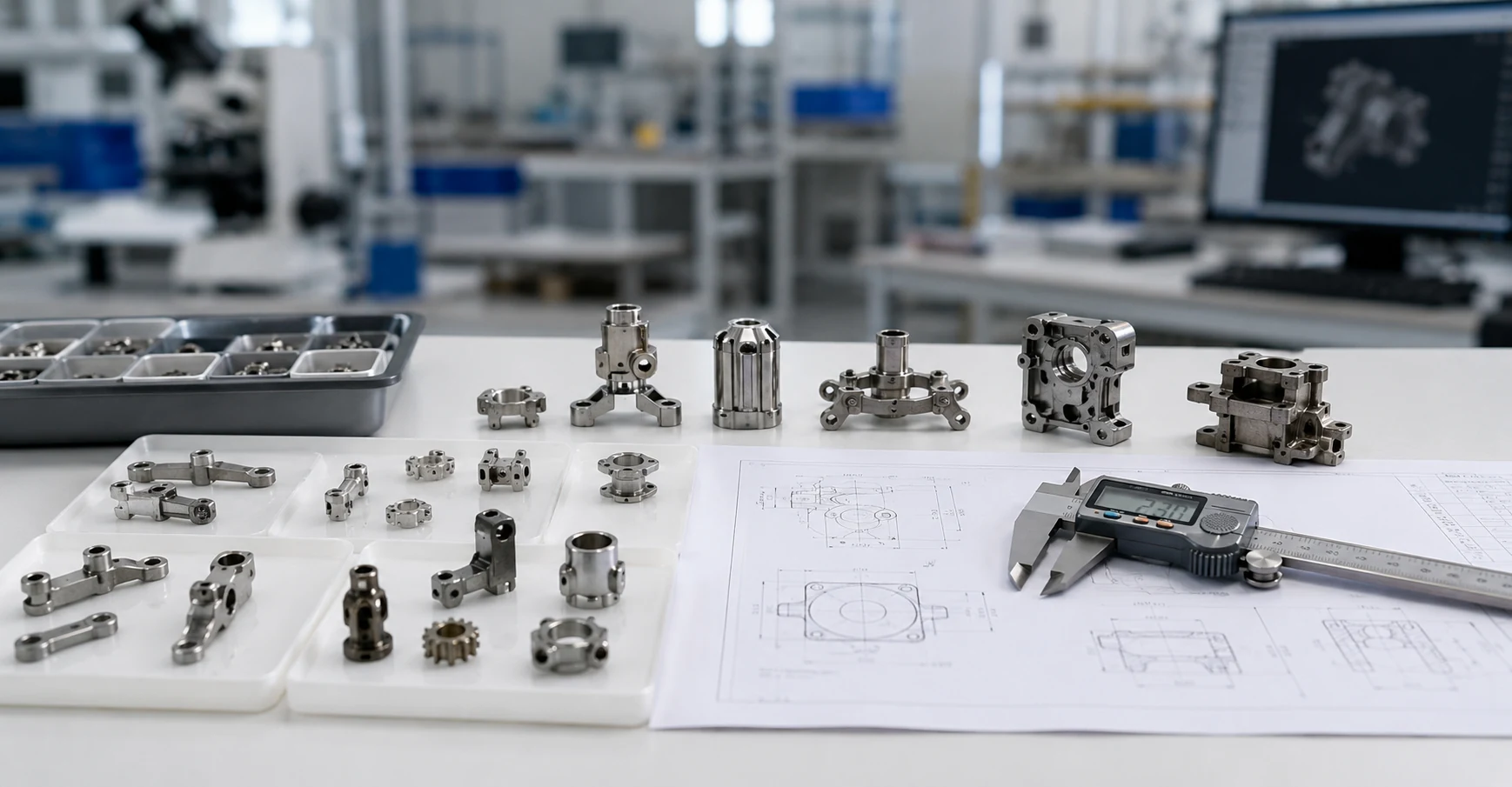
Engineering review of a wearable device hinge for CNC to MIM conversion with technical drawing caliper and precision metal parts
CNC-to-MIM conversion requires DFM review of geometry, gate location, shrinkage risk, cosmetic surfaces, and secondary machining needs.
核心的な結論:

A CNC-friendly part is not automatically MIM-friendly; the design must be reviewed for molding, debinding, sintering, and final inspection.

エンジニアリングトレーニングのための複合フィールドシナリオ

A wearable device hinge component was originally designed for CNC machining. The part included a small pivot feature, a curved external profile, and several compact internal structures. CNC cost increased because multiple features required repeated setups, so the customer wanted to evaluate MIM for production.

発生した問題 CNC cost and machining time increased because of compact internal features, multiple setups, and material removal from a small precision blank.
発生理由 The geometry was designed around machining access, not mold flow, gate location, shrinkage control, green part strength, or sintering support.
System cause The real issue was not only machining cost. CNC-friendly geometry was being treated as if it were automatically MIM-friendly.
修正方法 The design was reviewed for wall balance, visible surfaces, internal radius, gate location, critical features, and post-sintering machining areas.
再発防止方法 Separate cosmetic surfaces, functional dimensions, non-critical features, and secondary operation areas before tooling.

If your project is moving from machining to molding, compare the manufacturing route through MIMとCNC加工の比較 before treating MIM as a simple cost-reduction shortcut.

When MIM Is Not the Right Industry Solution

MIM is valuable, but it is not the right answer for every industry or every metal part. A supplier page is more useful when it explains when not to use the process. This is especially important for projects where the inquiry is driven mainly by commodity price rather than part complexity, functional integration, or material performance.

不適

Large or Simple Parts

Large brackets, simple blocks, flat plates, and parts with simple turning or stamping features are often better suited to other processes.

不適

Low-Volume Prototype Only

If the design changes frequently, MIM tooling should usually wait until geometry, material, and functional requirements are stable.

不適

Commodity Hardware Pricing

Generic locks, ordinary valves, common fasteners, sewing-machine parts, bicycle hardware, and basic hand tool components often attract price-driven inquiries rather than engineering-driven projects.

慎重に評価

Ultra-Tight Machined Surfaces

If every surface requires tight machined tolerance, MIM may still need secondary machining and may not deliver the expected cost advantage.

慎重に評価

Unclear Material Requirement

Material selection should not be based only on industry name. Corrosion, strength, magnetic behavior, wear, and heat treatment must be reviewed.

慎重に評価

Undefined Critical Dimensions

Without clear functional dimensions, it is difficult to plan shrinkage control, sizing, machining, or final inspection.

What to Send for a MIM Industry Application Review

A useful MIM inquiry should give the engineering team enough information to review process suitability before discussing tooling or production. Better project information helps confirm whether the part is a strong MIM fit, a conditional fit, or a poor fit before unnecessary tooling cost is created.

2D図面
Dimensions, tolerances, surface notes, and critical features.
3D CADファイル
Geometry, moldability, shrinkage review, and tooling direction.
材料要件
Feedstock, sintering, heat treatment, corrosion, strength, and magnetic review.
Application industry
Quality, validation, surface, and inspection expectations.
重要寸法
Functional dimensions separated from general dimensions.
年間数量
Whether tooling and MIM production are practical.
表面仕上げ要件
Gate location, polishing, finishing, and inspection planning.
現在の製造プロセス
CNC-to-MIM, casting-to-MIM, stamping-to-MIM, or PM-to-MIM conversion context.
MIM application review workflow showing drawing CAD material critical dimensions volume and engineering feedback before tooling
A useful MIM review starts with drawings, CAD files, material requirements, critical dimensions, surface needs, volume, and application background.
核心的な結論:

The better the project information, the more accurately the supplier can review MIM suitability before tooling.

規格および技術参考に関する注記

MIM material selection should not be based only on a general industry label. MPIF規格35-MIM is relevant because it covers common materials used in metal injection molding and provides explanatory notes and definitions for MIM material specification.

The EPMA overview of Metal Injection Moulding is relevant because it explains MIM’s fit for high-quantity complex shapes and its cost boundary when conventional pressing and sintering can make the part more easily.

The MIMA “What is MIM?” resource provides association-level context for MIM markets, while PIM International’s process overview is useful for understanding feedstock preparation, injection moulding, binder removal, and sintering.

These references support material and process discussion. They do not replace project-specific DFM review, material data confirmation, supplier capability review, or agreement on critical dimensions and inspection requirements.

FAQ: MIM Industries and Applications

What industries use Metal Injection Molding?

Metal Injection Molding is used in industries that need small, complex, high-strength metal parts in repeatable production. High-value applications are often found in medical devices, robotics, aerospace, EV and new energy systems, wearable devices, consumer electronics, automotive precision components, and precision instruments.

Is MIM suitable for medical device parts?

MIM can be suitable for selected medical device parts such as surgical tool components, dental parts, small instrument mechanisms, and precision metal features. Medical applications require careful review of material suitability, surface finish, cleaning, traceability, critical dimensions, and post-processing requirements before tooling.

Can MIM replace CNC machining?

MIM can replace CNC machining when the part is small, complex, and needed in stable production volumes. It is especially useful when CNC requires multiple setups or removes too much material. Some critical holes, mating surfaces, or tight-tolerance features may still require secondary machining.

Why should low-cost hardware applications not be the focus of a MIM industry page?

Generic locks, ordinary valves, common fasteners, bicycle parts, sewing-machine parts, and basic hardware may technically use metal components, but many of these projects are price-driven and may be better served by stamping, casting, CNC, or conventional PM.

What information is needed for a MIM application review?

A useful MIM review should include a 2D drawing, 3D CAD file, material requirement, application background, critical dimensions, tolerance notes, surface finish requirement, estimated annual volume, and current manufacturing process if the part is being converted from CNC, casting, stamping, or PM.

When is MIM not the right process?

MIM is usually not the right choice for large simple parts, very low-volume prototypes, commodity hardware, flat stamped parts, simple turned parts, or components where every functional surface requires ultra-tight machining. CNC machining, stamping, casting, die casting, or conventional PM may be more practical in those cases.

XTMIMエンジニアリングチームによるレビュー済み

This page was prepared and reviewed from the perspective of MIM process suitability, material selection, DFM review, tooling risk, green part handling, debinding stability, sintering shrinkage control, tolerance strategy, secondary operation planning, and inspection requirements. The goal is to help sourcing managers, engineers, and OEM/ODM project teams evaluate whether a high-value industry application is a practical fit for Metal Injection Molding before tooling or RFQ.

This content does not replace project-specific engineering review. Final feasibility depends on drawing details, material requirements, critical dimensions, surface expectations, application environment, annual volume, and supplier-specific process capability.

Need to Check Whether Your Industry Project Fits MIM?

If your project involves small complex metal parts for medical devices, robotics, aerospace, EV systems, wearable devices, consumer electronics, automotive precision assemblies, or industrial automation, XTMIM can review whether Metal Injection Molding is technically practical before tooling.

If your part is currently made by CNC machining, casting, stamping, or conventional powder metallurgy, please send the current drawing, material, and estimated annual volume. XTMIM can help check whether MIM can reduce machining steps, consolidate features, improve repeatability, or avoid unnecessary process conversion risk.

Please send your 2D drawing, 3D CAD file, material requirement, critical dimensions, surface finish requirement, application background, estimated annual volume, and current manufacturing process if the part is being converted from CNC, casting, stamping, or PM.

The review can help clarify process suitability, material direction, tooling risk, sintering distortion risk, secondary operation needs, and inspection strategy before production planning.