
Initial suitability: Heat-resistant أجزاء MIM are reasonable candidates for a small, complex, repeat-production part only if the service conditions, material and MIM route, critical dimensions, and qualification plan are compatible. If the grade or hot-service requirements are unconfirmed, hold the tooling decision and request a drawing-based feasibility review.
What Heat Exposure Conditions Must MIM Parts Withstand?
A heat-resistant MIM part is defined by its operating environment, not simply by an alloy grade. A small sensor housing, retaining clip, or compact connector may face heat, vibration, or repeated expansion while also holding critical mating dimensions. Record the operating conditions before selecting an alloy or manufacturing process.
Operating Temperature, Peak Temperature, and Exposure Duration
Specify continuous operating temperature, peak temperature, peak exposure duration, cumulative time at temperature, and expected duty life. State whether peak exposure lasts seconds, minutes, or hours; the maximum temperature without duration cannot establish suitability. The same temperature can drive different choices for a brief exposure and a continuously loaded retainer. Melting point is not an allowable service-temperature rating: time, oxidation, mechanical performance, and acceptance limits still matter.
Thermal Cycling, Atmosphere, and Mechanical Load
Record the cycle frequency and temperature change, whether the component is restrained by a mating part, its exposure to air, exhaust gas, steam, or corrosive media, and any sustained or repeated load. A free-standing cover and a loaded retaining feature can respond very differently even when exposed to the same temperature.
| Service or Interface Condition | أهميته لمراجعة MIM |
|---|---|
| درجة حرارة التشغيل المستمرة | يساعد في فحص عائلة المواد وخطر الخدمة طويل الأمد. |
| درجة الحرارة القصوى | Changes the assessment of strength retention, oxidation, and required safety margin. |
| الدورة الحرارية | يمكن أن تؤثر على الاستقرار البعدي، خطر التشقق، ملاءمة التجميع، وحالة السطح. |
| الجو | الهواء، الغاز، الرطوبة، غاز الاحتراق، أو الوسائط المسببة للتآكل يمكن أن تغير اختيار المادة. |
| الحمل عند درجة الحرارة | تعتمد قوة درجات الحرارة العالية، الزحف، وخطر الإجهاد الناتج عن الكسر على الحمل والوقت وهندسة الجزء. |
| متطلبات السطح | الطلاء، التلميع، التشغيل الآلي، التخميل، أو أسطح الختم قد تؤثر على الأبعاد النهائية. |
| Mating assembly | Clearance, constraints, and expansion mismatch with adjacent parts may govern functional performance. |
Before material selection: A drawing plus an alloy name is not sufficient. The part's atmosphere, duration, load, functional dimensions, and thermal cycling are necessary engineering inputs. Heat resistance also differs from post-sintering heat treatment and from high thermal conductivity for heat sinks.
Which Materials Are Suitable for Heat-Resistant MIM Parts?
Select a مادة MIM against actual service conditions. Oxidizing gas, sustained hot load, sliding contact, differential thermal expansion, service duration, and cost can each change the preferred alloy and processing route.
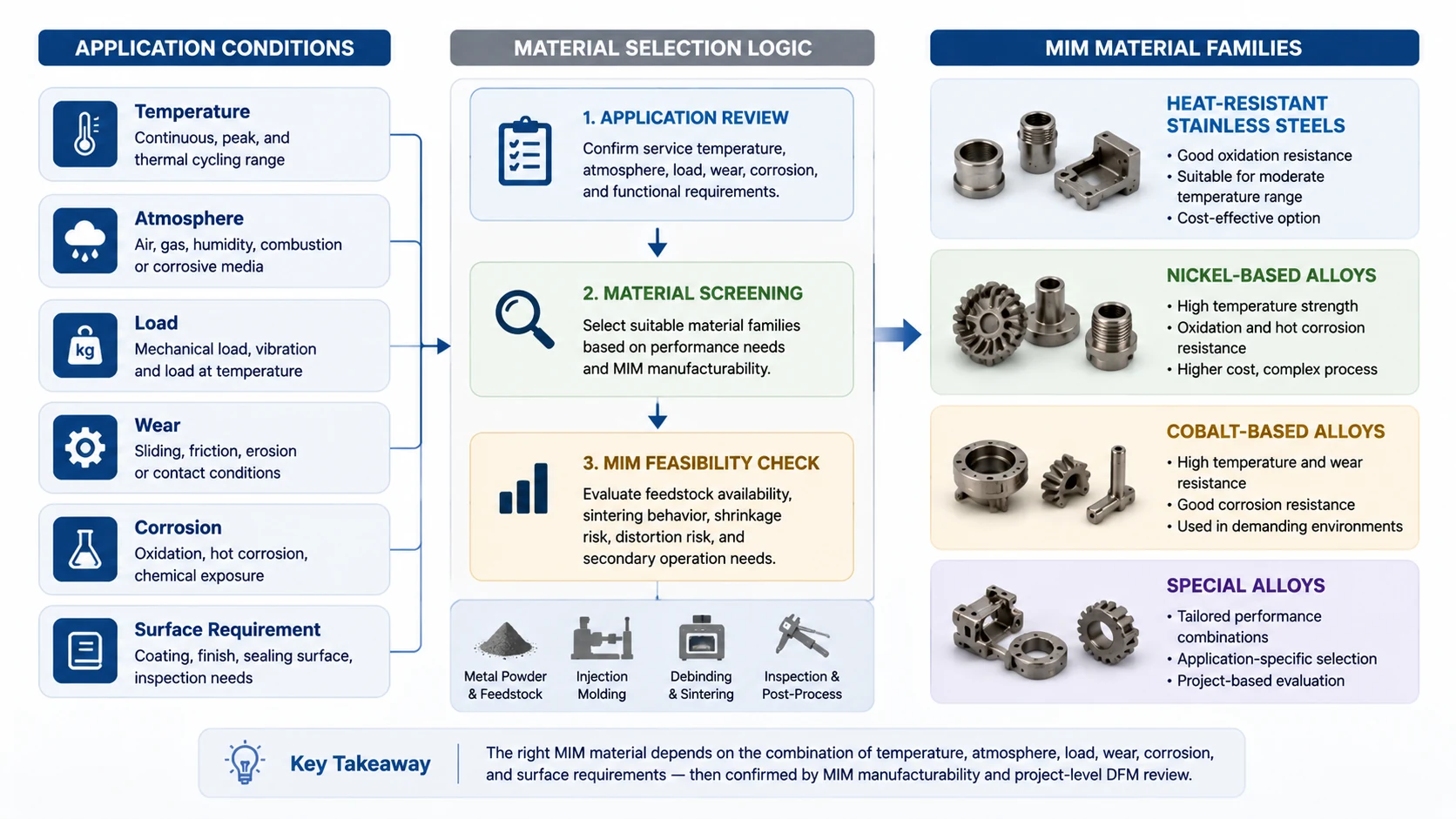
Material screening: Alloy families are starting points. Grade-specific temperature limits and mechanical properties require supporting data and a confirmed MIM production route.
Material Selection Based on Temperature, Load, and Atmosphere
Load at temperature: If a pin, clip, or bracket carries sustained force, strength retention and time-dependent deformation may matter more than room-temperature hardness. Air or process gas: oxidation and hot corrosion can govern surface life. Constrained assemblies: expansion mismatch with mating materials can control clearance and stress. Contact: sliding or fretting may add wear requirements beyond heat resistance.
Heat-Resistant Stainless Steels and Special Alloy Options
Stainless steels: Some grades may balance corrosion or oxidation resistance with established MIM manufacturing routes for heat-exposed assemblies. Grade and material condition matter: a stainless steel chosen for room-temperature corrosion resistance is not automatically suitable for sustained load at elevated temperature.
Nickel-based alloys: Selected grades may be investigated where hot-gas exposure, oxidation, or high-temperature mechanical properties are demanding. Published MIM studies, including research on Alloy 718, establish that some routes have been investigated; they do not establish that every nickel alloy, geometry, or supplier is production-qualified.
Cobalt-based or other special alloys: These may be relevant when heat, wear, corrosion, and mechanical loading overlap. Their MIM availability and economic feasibility are project-specific; they should not be presented as standard stocked XTMIM options without confirmation.
الموافقة على المواد: Datasheets help screen grades but do not guarantee the performance of a finished MIM component at temperature. Confirm material condition, production route, and service-specific validation before approving the grade.
Can the Required Material Be Reliably Manufactured by MIM?
Availability as bar stock, casting stock, or additive-manufacturing powder does not establish that a heat-resistant alloy is available as qualified MIM feedstock. The supplier must establish a compatible process route before tooling decisions are made.
Feedstock Availability and Sintering Feasibility
Confirm the actual powder and feedstock source, binder system, debinding compatibility, sintering atmosphere and temperature control, expected density or microstructure, and possible secondary treatment. A published MIM trial demonstrates a possible process route for the tested conditions; it does not qualify the same alloy for a different factory, geometry, or production scale.
Material Route Maturity and Production Readiness
| Review gate | Question to resolve | Outcome before tooling |
|---|---|---|
| متطلبات المواد | Is the specified grade or an approved alternative needed for actual service conditions? | Confirm material specification and acceptance properties. |
| مسار المادة الخام | Is suitable MIM powder/feedstock available, rather than only CNC stock or AM powder? | Confirm supply and process compatibility; otherwise hold. |
| إزالة المادة الرابطة والتلبيد | Is the process window viable for the alloy and proposed geometry? | Identify furnace/atmosphere needs and distortion or property risks. |
| Production evidence | Has the actual supplier qualified the route at relevant part and batch conditions? | Proceed, plan validation trials, or reject an unsupported route. |
إن نظرة عامة على عملية MIM covers injection, debinding, and sintering. For heat-exposed components, confirm both that the alloy can be processed and that the finished material condition can meet the drawing and service requirements. Successful room-temperature dimensional inspection alone does not qualify high-temperature performance.
Schunk reported commercial production of IN713LC compressor stator vanes for the Rolls-Royce Pearl 15 engine following several years of process development. Its published account describes furnace investment, density improvement, process repeatability, and dimensional verification; the compressor operating context includes temperatures up to 700°C. Establishing this route required documented process and component controls beyond obtaining alloy powder. Source: PIM International's Schunk factory profile. Those conditions and capabilities apply to Schunk, not XTMIM.
IN713LC turbocharger-wheel trial: process feasibility is not production readiness
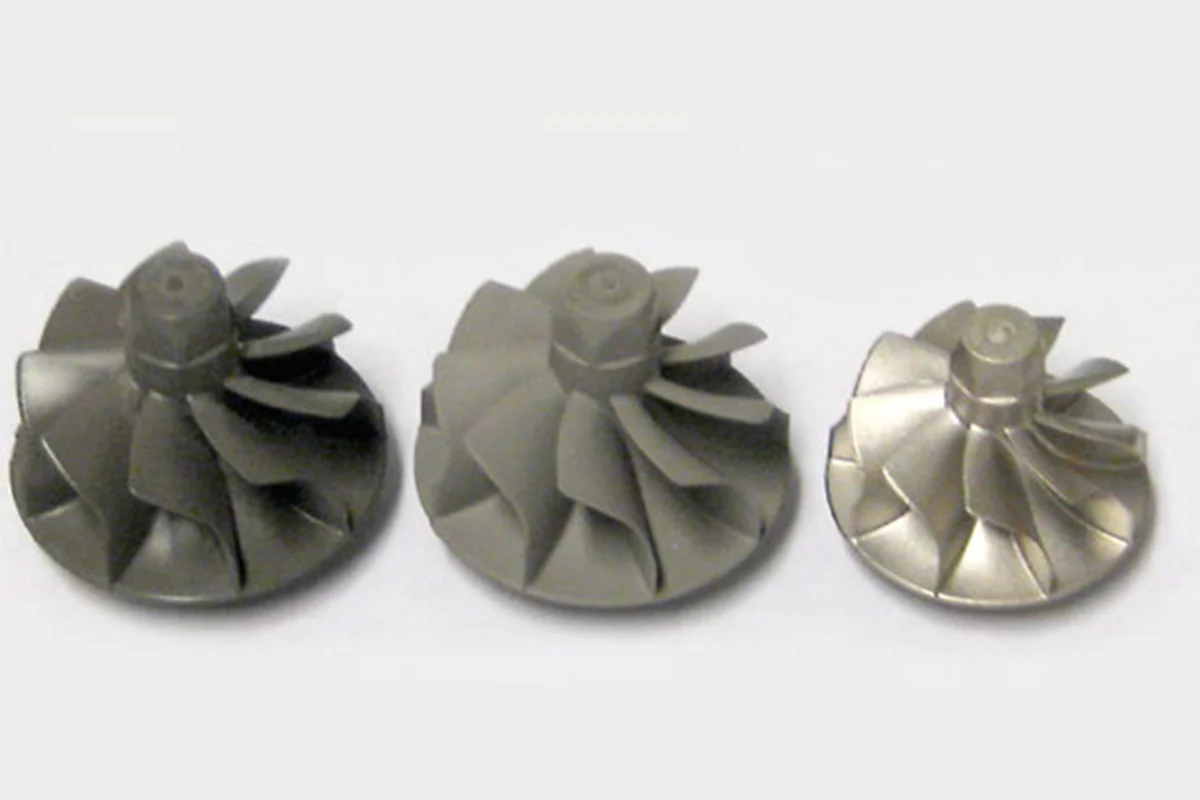
Schunk documented nickel-based IN713LC turbocharger turbine-wheel prototypes at green, debound, and sintered stages. This demonstrates development work through the MIM process, not verified automotive serial production of the photographed wheel.
Before production tooling: Confirm powder and feedstock supply, furnace and debinding compatibility, densification stability, as-sintered dimensions, and required finished material properties. A successful prototype is not enough to approve production tooling.
IN713LC MIM turbine-wheel trial parts at green, debound and sintered stages; a published Schunk research example.
Photo reference: PART-096. المصدر: PIM International — IN713LC MIM turbine-wheel development. Courtesy Schunk via PIM International. The pictured component is a prototype; it is not an XTMIM part or a claimed series-production project.
XTMIM material availability: Published nickel- or cobalt-alloy MIM projects do not establish XTMIM production readiness for those grades. Confirm the proposed alloy, sintering route, and available inspection or test capabilities during the project review.
When Is MIM the Right Choice for Heat-Resistant Metal Parts?
MIM is worth comparing with alternative processes when a part is small, has intricate three-dimensional details, and will be produced repeatedly. For heat-exposed parts, the benefit of near-net-shape molding must also outweigh any added material, sintering, tooling, and validation complexity.
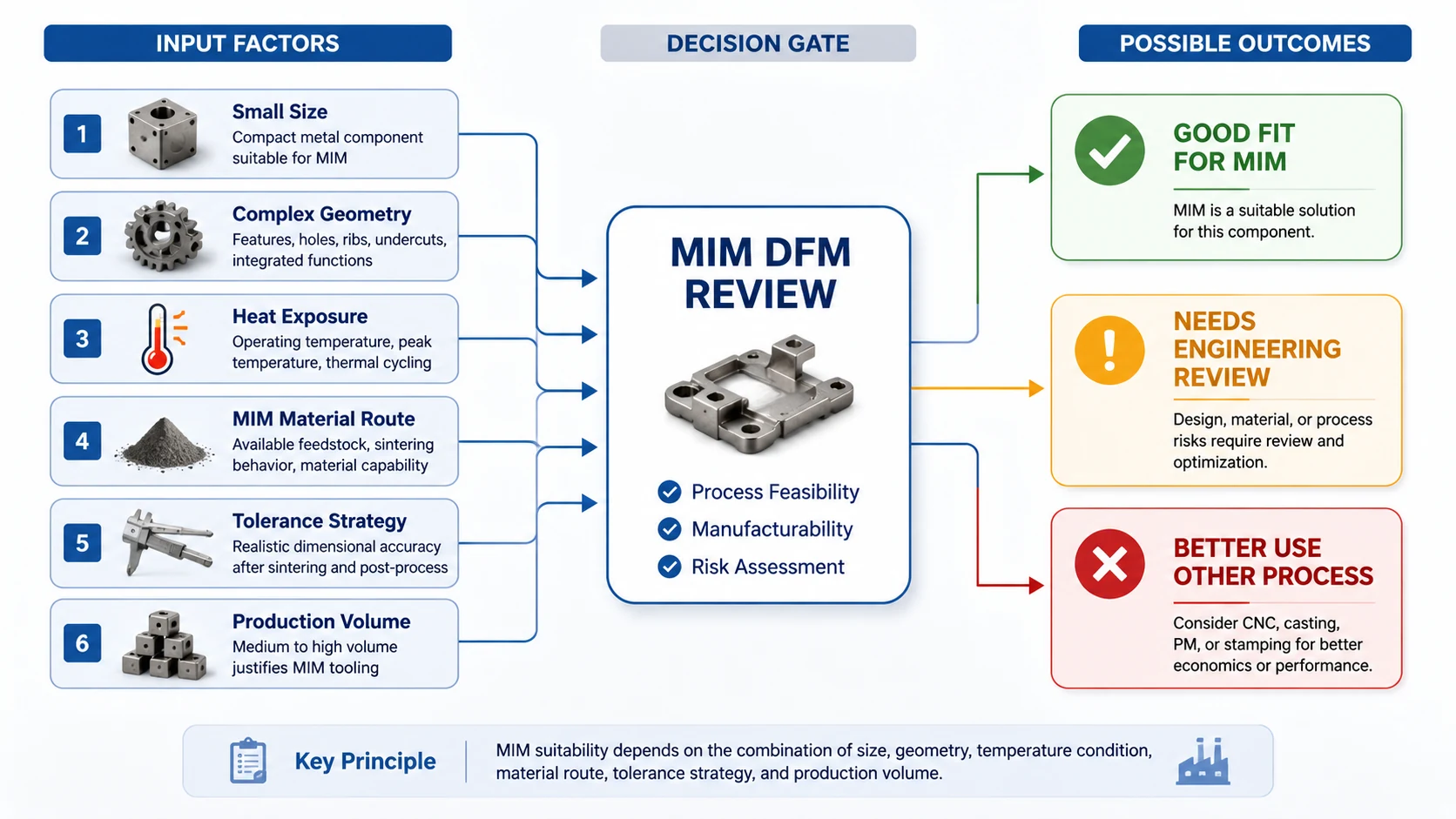
Further review: If the material route or a critical service requirement remains unverified, defer tooling even when geometry and expected volume favor MIM.
Suitable Part Geometries and Typical Heat-Resistant Components
For the component families below, MIM suitability depends on the combination of service conditions, functional geometry, and production risks:
أغلفة حساسات درجات الحرارة العالية والأكمام الواقية
قد تحتاج أغلفة الحساسات الصغيرة والأكمام وأجسام الحماية إلى ثبات حراري ومقاومة للتآكل وهندسة مدمجة وواجهات تجميع دقيقة. يمكن النظر في MIM عندما يتضمن الجزء فتحات صغيرة أو ميزات داخلية أو جدران رقيقة أو أكتاف تحديد المواقع أو أشكال قد تكون بطيئة في التصنيع بشكل متكرر.
يجب أن تركز المراجعة على توافق المواد ومخاطر قولبة الجدران الرقيقة والانكماش حول الميزات الداخلية وأسطح الختم أو التجميع ومتطلبات التصنيع بعد التلبيد.
الأقواس والمشابك والمثبتات المعرضة للحرارة
غالبًا ما تجمع الأقواس والمشابك والمثبتات المستخدمة بالقرب من التجميعات الساخنة بين التموضع الميكانيكي والدوران الحراري المتكرر. قد تكون تقنية MIM مفيدة عندما يكون الجزء معقدًا جدًا للختم ولكنه صغير جدًا ومفصل بحيث لا يكون الصب فعالاً من حيث التكلفة.
تشمل المخاطر الرئيسية تشوه التلبيد، وتركيز الإجهاد عند الزوايا الحادة، والزحف تحت الحمل، وتغيرات ملاءمة التجميع بعد المعالجة الحرارية أو التشطيب السطحي.
أجزاء MIM الصغيرة المتعلقة بالصمامات
قد تشمل الأجزاء الصغيرة المتعلقة بالصمامات أجسامًا مضغوطة للتحكم في التدفق، ومقاعد صغيرة، وميزات توجيه، ومثبتات، أو مكونات متعلقة بالتشغيل. يمكن النظر في تقنية MIM عندما يكون التصميم ذو ميزات صغيرة معقدة وطلب إنتاج متكرر.
إذا كان جزء الصمام يحتوي على سطح إغلاق حرج، فيجب أن تحدد مراجعة DFM ما إذا كانت الهندسة الملبدة كافية أم أن التشغيل الآلي أو التجليخ أو الصقل أو غيرها من العمليات الثانوية مطلوبة.
موصلات مقاومة للحرارة وأجهزة ربط
تحتاج بعض أجزاء الموصلات وأدوات الربط المصنعة بتقنية MIM إلى مقاومة الحرارة لأنها تقع بالقرب من المحركات، أو البطاريات، أو مناطق العادم، أو المواقد، أو السخانات، أو المعدات الصناعية.
يجب أن تتحقق مراجعة التصميم من التمدد الحراري، وخلوص التجميع، والتواء المقاطع الرقيقة، والأسطح المتزاوجة، وما إذا كان الجزء يحمل حمولة عند درجة الحرارة.
أعمدة صغيرة، دبابيس، وميزات قفل في التجميعات الحرارية
صغيرة أعمدة ودبابيس, ، قد تتعرض أذرع التوجيه، المزاليج، وميزات القفل للحرارة، الاحتكاك، والحمل. يمكن أن تساعد تقنية MIM عندما لا يكون الشكل مجرد دبوس مخرطة بسيط ويتضمن أسطحًا مسطحة، أخاديد، رؤوس، تفاصيل شبيهة بالتروس، أو ملفات قفل.
نقاط المراجعة الرئيسية هي الاستقامة بعد التلبيد، مقاومة التآكل عند درجة الحرارة، التشغيل الآلي المحلي على أسطح المحامل، المعالجة الحرارية، الصلادة، وتراكم التفاوتات في التجميع.
أجزاء صغيرة في الشاحن التوربيني، العادم، ومنطقة الغاز الساخن
Small parts near turbochargers, exhaust systems, or hot gas flows can face combined oxidation, thermal cycling, vibration, and fatigue loads. Candidate geometries require material-specific and part-specific qualification.
إذا كان الجزء ينتمي إلى منصة مركبة أو نظام مرتبط بالمحرك، فيجب أيضًا مراجعته تحت أجزاء MIM للسيارات.
HK30 turbocharger vanes in a high-volume MIM application
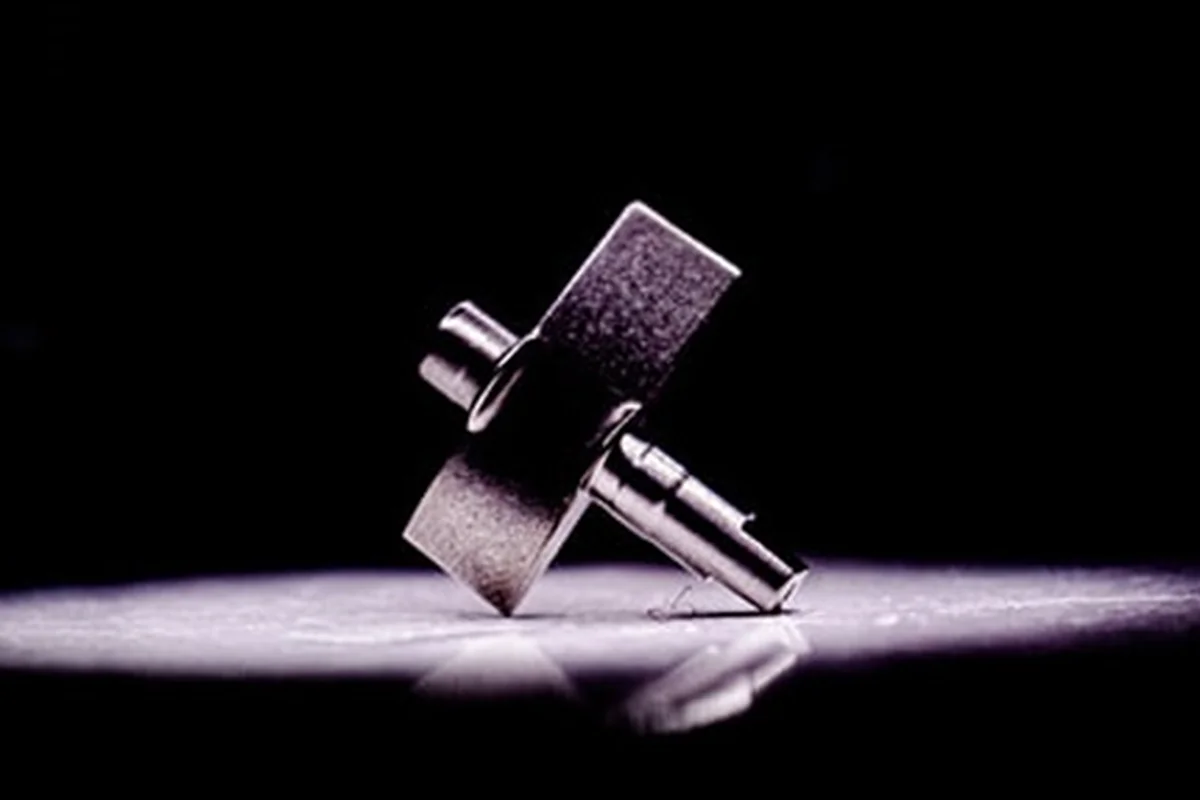
AFT reported producing more than 183 million MIM turbocharger vanes by October 2022. Its disclosed design requirement included operation at 600–800°C, and the reported vane material was HK30 steel. These values belong to AFT's specified application, not to all HK30 parts or XTMIM projects.
تأثير التصميم: Curved vanes with integral shafts and locating features may favor MIM at high repeat volumes, provided the alloy, hot-gas conditions, critical interfaces, and durability are qualified. AFT's reported temperature requirement cannot be assigned to a different design without testing.
Turbocharger vane geometry: curved blade and integrated shaft features in a heat-exposed MIM application.
Photo reference: PART-006. المصدر: PIM International — AFT turbocharger vanes. The archived photograph resembles the application category; its identity as the exact AFT-reported component has not been independently established. This is not XTMIM production evidence.
Production Volume, Tooling Cost, and Manufacturing Economics
Evaluate tooling against expected repeat orders, possible design revisions, material cost, production yield, and any required machining or finishing. A part with integrated slots, bosses, or many small machining features may justify tooling at sufficient repeat volume; a simple low-quantity part may not. A CNC prototype can verify fit or geometry before MIM investment, but it cannot by itself validate the properties or shrinkage behavior of the final MIM material and route.
| عامل المراجعة | مناسب لتقنية MIM | يتطلب الحذر |
|---|---|---|
| حجم القطعة | مكونات معدنية صغيرة ومضغوطة | أجزاء كبيرة ذات مخاطر عالية لتشوه التلبيد |
| الهندسة | فتحات معقدة، ثقوب، أضلاع، ميزات دقيقة، تجاويف سفلية، أو وظائف متكاملة | سماكة جدار غير متساوية جدًا، أقسام طويلة غير مدعومة، أو خيارات موقع بوابة سيئة |
| حجم الإنتاج | إنتاج متكرر من متوسط إلى عالي الحجم | حجم منخفض جدًا حيث يصعب تبرير تكلفة القالب |
| متطلبات المواد | The required grade has a demonstrated or confirmable MIM feedstock and sintering route | مادة بدون مسار مستقر للمسحوق، المادة الرابطة، مادة التغذية، إزالة المادة الرابطة، أو التلبيد |
| التعرض للحرارة | بيئة محكومة بدرجة حرارة عالية أو دورات حرارية ضمن قدرة المادة | متطلبات زحف، إجهاد، تآكل حراري، أو اهتزاز شديدة طويلة الأمد بدون بيانات تحقق |
| التسامح | استراتيجية تفاوتات MIM معقولة مع عمليات ثانوية انتقائية إذا لزم الأمر | توقعات تفاوتات غير واقعية مباشرة بعد التلبيد |
| استبدال العملية | تكلفة CNC عالية لأن الجزء يحتوي على العديد من الميزات الصغيرة | هندسة بسيطة يمكن لـ CNC أو الختم أو الصب أو المساحيق المعدنية إنتاجها بتكلفة أقل |
When CNC, Casting, Stamping, or Conventional PM May Be Better
Production volume does not override technical feasibility. Simple turned pieces may favor CNC; flat sheet clips or shields may favor stamping; larger shapes may favor casting; and conventional pressed PM may be more economical for simple compaction-friendly geometries. For a broader comparison, visit MIM vs other manufacturing processes.
| العملية | أفضل عندما | قيود الأجزاء الصغيرة المقاومة للحرارة |
|---|---|---|
| MIM | أجزاء صغيرة، معقدة، قابلة للتكرار ذات تفاصيل دقيقة وحجم متوسط إلى مرتفع | يجب مراجعة تكلفة القالب، انكماش التلبيد، استقرار إزالة المادة الرابطة، والتشوه |
| التصنيع باستخدام الحاسب الآلي (CNC) | حجم منخفض، شكل هندسي بسيط، تصنيع آلي محلي ضيق جدًا، تقييم النموذج الأولي | يمكن أن ترتفع التكلفة بسرعة للتفاصيل الصغيرة المعقدة في السبائك المقاومة للحرارة |
| الصب | أشكال أكبر مقاومة للحرارة أو أجزاء حيث يكون شكل الصب مقبولاً | قد تتطلب ميزات الدقة الصغيرة تصنيعًا آليًا؛ يجب مراجعة حدود السطح والتفاوتات المسموحة |
| الميتالورجيا التقليدية للمساحيق | أشكال مضغوطة بسيطة نسبيًا مع إنتاج حساس للتكلفة | الهندسة أكثر محدودية من MIM بسبب هيمنة اتجاه الضغط وقيود الكبس |
| الختم | مشابك أو دروع أو أقواس من الصفائح الرقيقة | غير مناسبة للأجزاء ثلاثية الأبعاد الصلبة المعقدة ذات الرؤوس أو الميزات الداخلية أو التفاصيل المتكاملة |
Do not choose MIM by default for parts that are too large or simple, require an unqualified alloy route, have unsupported extreme service-life requirements, or require a specific wrought, forged, single-crystal, or directionally solidified microstructure. High thermal conductivity alone may favor a separate heat-sink process. If basic service or production data are missing, request a feasibility review before committing to tooling.
نتيجة القرار: Go when the service material, geometry, repeat volume, tolerance strategy, and qualification route align; Further review when validation or process qualification is still needed; No-go when another process better fits the project constraints.
What Design and Sintering Risks Must Be Reviewed Before Tooling?
Before tooling, determine whether molding, green-part handling, debinding, and sintering can preserve the required functional geometry. The greatest concerns are often local shape changes and critical interfaces, rather than the nominal outer dimensions alone.
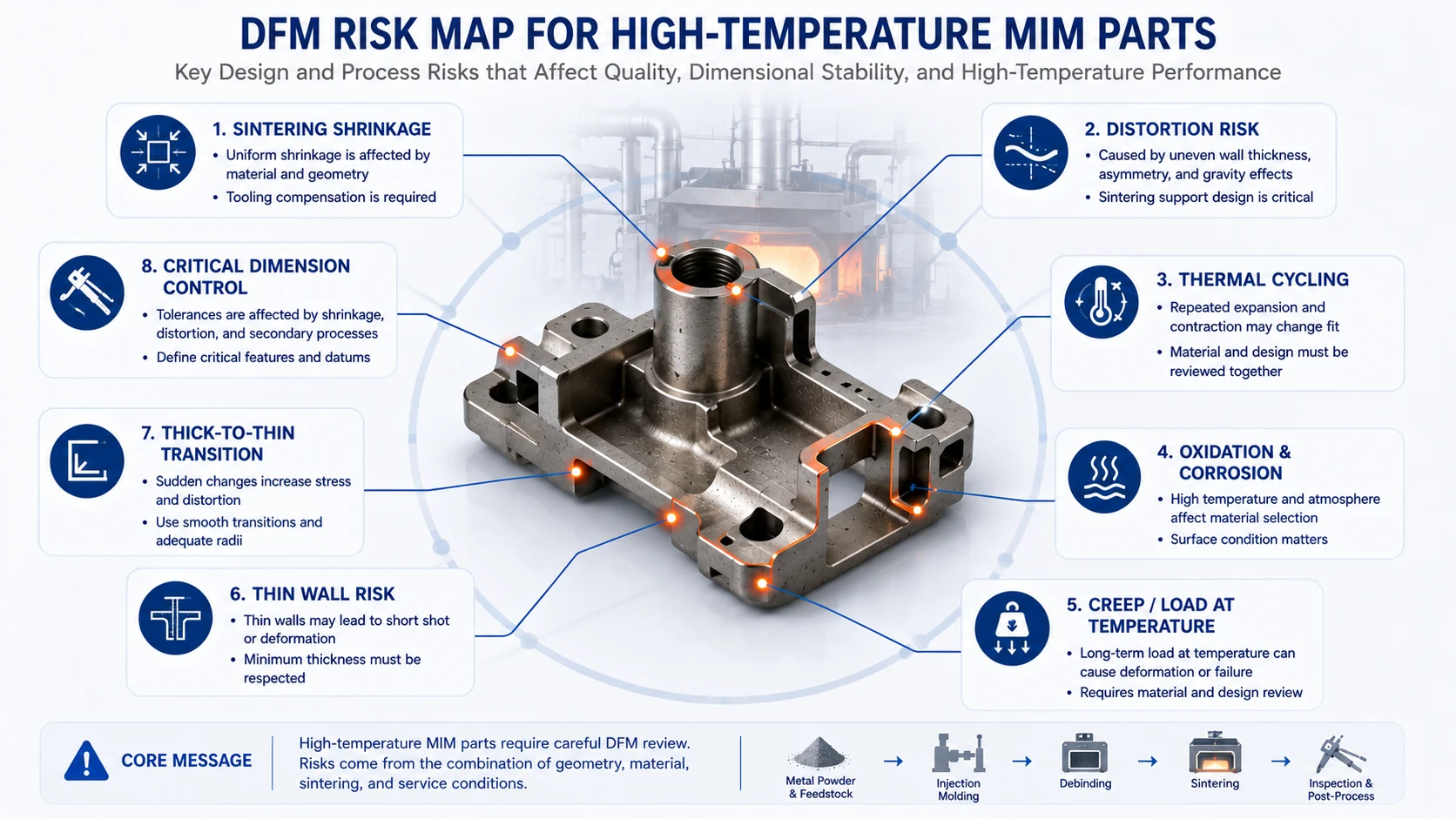
Two different risk groups: Molding and sintering control the manufactured geometry. Thermal cycling, oxidation, and hot loading require separate evaluation against service requirements.
Wall Thickness, Geometry, and Sintering Distortion
MIM parts shrink during sintering. Tooling shrinkage allowances depend on feedstock, material, part distribution, support, and furnace behavior. Asymmetric mass, thick-to-thin transitions, extended unsupported arms, large flat areas, and thin walls around openings can amplify nonuniform shrinkage or distortion. Thin sections may also create filling and handling challenges before sintering.
- Identify unsupported arms, slender pins, ribs, slots, and critical openings.
- Review wall-thickness transitions, gate options, handling, and sintering support.
- Separate dimensional requirements needed for assembly from noncritical cosmetic areas.
Critical Tolerances, Supports, and Secondary Machining
A functional sealing face, bearing diameter, locating shoulder, or tightly fitted hole may need post-sintering machining, sizing, grinding, or targeted inspection. The drawing review should distinguish achievable as-sintered dimensions from features needing secondary operations; the acceptable route depends on actual grade, geometry, and production trials. For detail, see توجيه تصميم MIM و تشوه التلبيد.
Thin retainer arms with unequal section thickness
المشكلة: In a hypothetical compact retainer with thin arms joined to a heavier central body, the arms could deviate after sintering and compromise assembly fit.
Potential causes: Uneven geometry, insufficient sintering support, and functional tolerances that leave no realistic allowance for process variation.
الاستجابة الهندسية: Review transitions and support orientation, distinguish critical datum surfaces, and plan targeted post-sintering inspection or machining where necessary. The support and tolerance strategy would need confirmation in tooling review.
17-4PH vane actuator levers: support bridges and critical slots
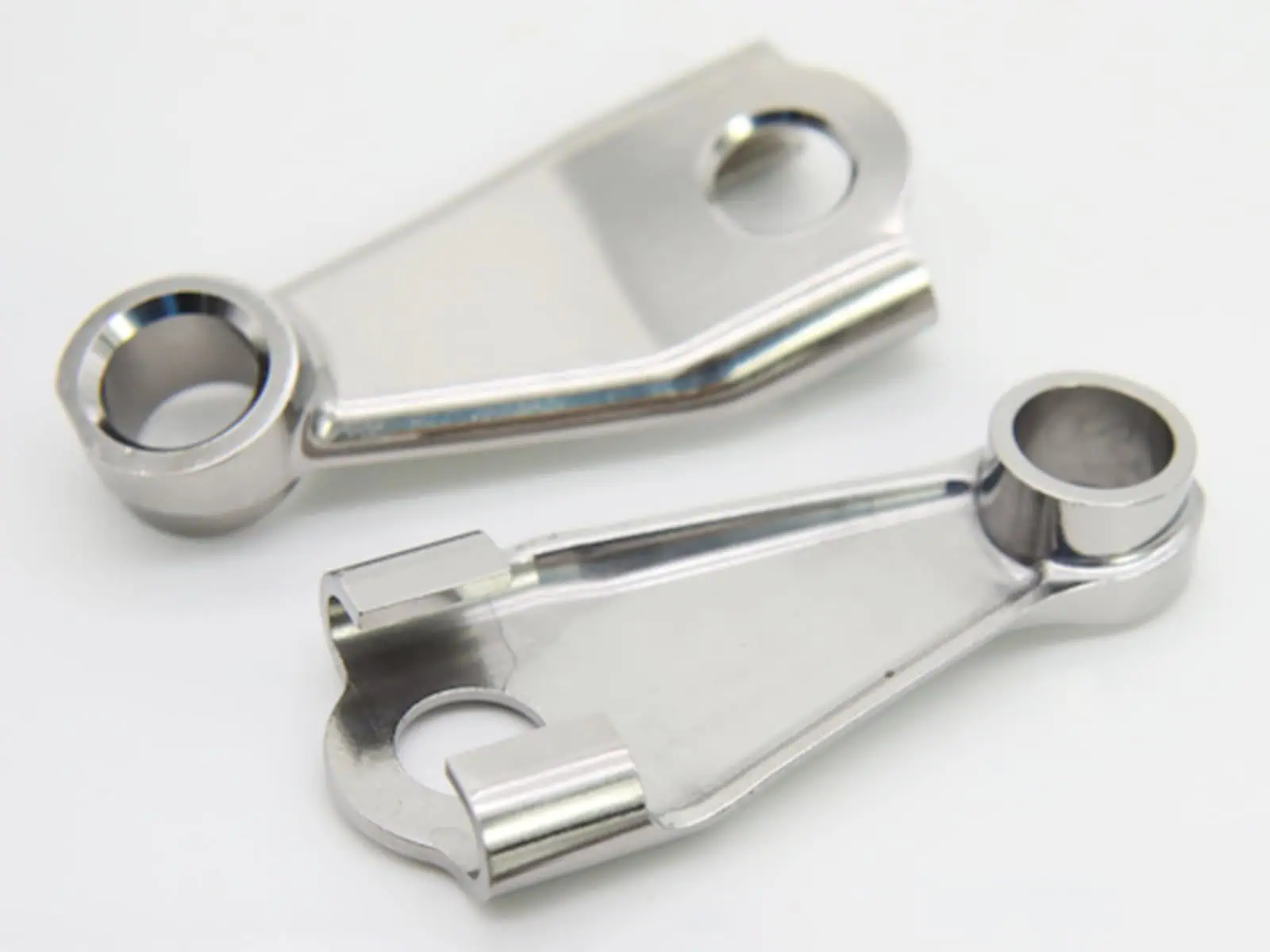
ARC produced 17-4PH MIM turboprop-engine vane actuator levers using a support bridge to preserve slot geometry and special trays during debinding and sintering. ARC reports selective machining and HIP to satisfy its part-specific density requirement. Those measures were designed for that case; they are not standard requirements for every MIM part.
Tooling review: Identify functional slots, unsupported thin arms, location datums, and surfaces requiring post-sintering machining. Agree how temporary supports will be removed and which finished dimensions and properties will be inspected.
17-4PH MIM lever actuators with functional bores and elongated arms for turboprop variable-vane control.
Photo reference: PART-045. المصدر: ARC Group Worldwide — 2020 industry recognition. Third-party award case also documented by MPIF (2020). These are ARC project parts, not XTMIM samples.
What Can Affect Heat-Resistant MIM Parts During High-Temperature Service?
A part that passes room-temperature dimensional inspection can still lose function after repeated heating, cooling, or sustained hot loading. In-service performance therefore needs its own assessment using the operating temperature, exposure time, cycle history, and load.
الدورة الحرارية والثبات البعدي
Repeated heating and cooling may alter clearances or create stress where dissimilar materials or constrained features interact. In a vane-like component with slender extensions and a heavier hub, the mounting restraint and mismatch in thermal expansion can concentrate stress. This is a design-risk example, not a claim of a recorded component failure.
For a mating assembly, confirm the counterpart material, initial clearance, temperature range, expected cycle count, and the functional checks required after exposure. Do not assume that dimensional acceptance immediately after sintering establishes hot-service stability.
Oxidation, Creep, Wear, and Load-Related Risks
Oxidation and hot corrosion: air, exhaust gas, steam, or aggressive media can degrade exposed surfaces depending on the alloy and duration. Creep and stress relaxation: sustained load at temperature may gradually alter dimensions or retention force. التآكل: a loaded sliding pin may require different material and surface criteria from an unloaded heat shield, even if both are described as heat-resistant.
For small أعمدة ودبابيس or contact features, review load, mating material, sliding motion, hardness, and wear risk alongside temperature. Where wear is the primary concern, the related أجزاء MIM مقاومة للاهتراء page covers that distinct selection question.
| Service concern | Potential effect on function | Design or qualification question |
|---|---|---|
| Repeated thermal cycles | Loss of fit, stress concentration, deformation | What clearance and cycling acceptance criteria apply? |
| Hot load over time | Creep, stress relaxation, reduced retention | What load, duration, and allowable displacement are specified? |
| Oxidizing/corrosive atmosphere | Surface degradation or lost section | Is the alloy condition and exposure duration qualified? |
| Hot sliding contact | Wear or seizure of functional surfaces | What mating material, motion, and wear limit apply? |
Motorsport exhaust parts: manufacturing stages do not substitute for hot-service validation

Mimest documented 316L MIM motorsport exhaust components in green, as-sintered, and finished conditions, including the difficulty of maintaining tubular geometry through debinding and sintering. The reported application illustrates both manufacturing capability and a specialized production decision; it does لا establish a universal safe service temperature for 316L.
Inspection implication: Assess as-sintered geometry, finished-part dimensions, and the customer's hot-service qualification requirements separately. Ask for inspection of distortion-prone tubular interfaces and the actual temperature/atmosphere/load conditions. The published account also notes that later versions used a different process, illustrating why route selection is project-specific.
316L MIM motorsport exhaust components shown as green, as-sintered and finished parts.
Photo reference: PART-120. المصدر: PIM International, September 2010 — Mimest case study. Third-party publication photograph of a Mimest case. It is not XTMIM manufacturing evidence and does not itself prove high-temperature service life.
How Should Heat-Resistant MIM Parts Be Inspected and Validated?
Acceptance criteria should trace back to the risks identified in drawing review. General MIM inspection establishes whether parts meet manufacturing specifications; separate application qualification may be needed to demonstrate their behavior at temperature. The appropriate checks depend on the part and contract, not on a fixed list of tests.
Dimensional, Material, and Manufacturing Quality Checks
Confirm specified material grade and condition, functional dimensions, hole and slot location, flatness or straightness, mating faces, cracks, surface defects, and any approved post-treatment changes. Feedstock consistency, green-part handling, debinding, and sintering can influence density and dimensional repeatability. Agree on process controls where they affect the part's acceptance criteria.
Application-Specific Thermal and Functional Testing
For projects with thermal cycles, sustained hot loads, or chemical exposure, align the qualification plan to the operating envelope defined at the start of the review. Examples of established methods include ASTM E21 (elevated-temperature tensile testing), ASTM E139 (creep/stress rupture)، و ASTM E228 (linear thermal expansion). They are method references, not mandatory tests for every MIM part or evidence that XTMIM performs all tests in-house.
| متطلبات المشروع | Risk to verify | Possible review or test | أساس القبول |
|---|---|---|---|
| Critical assembly dimensions | Distortion or process variation | Drawing-based dimensional and visual inspection | Approved 2D drawing and inspection plan |
| Repeated hot/cold operation | Loss of fit, cracking, movement | Customer-defined thermal cycling and post-cycle function checks | Specified cycle profile and functional limits |
| Sustained load at temperature | Creep or stress relaxation | Suitable elevated-temperature mechanical evaluation if required | Design load, exposure time, and displacement limit |
| Expansion-sensitive interfaces | Clearance or stress mismatch | Material expansion data and assembly validation | Assembly temperature range and allowable fit change |
| Hot or aggressive gas exposure | Oxidation, corrosion, surface damage | Exposure and surface-condition assessment as agreed | Agreed environmental and cosmetic/functional criteria |
Evidence for production approval: Photographs can show component geometry, while published applications show what another manufacturer has produced. Supplier process records are needed to assess the chosen production route. Qualification requires test results tied to the specified alloy condition, component design, and operating requirements.
Who validates what? Supplier inspection and customer application qualification should be agreed before production. Test scope, responsibility, sample size, laboratory, and acceptance limits require project-specific confirmation. Do not infer a service-life guarantee from a routine dimensional check.
What Should You Provide for a Heat-Resistant MIM Drawing Review?
A useful feasibility request combines drawings and commercial requirements with the same high-temperature service conditions used for the engineering decision. Missing service data often prevents a meaningful material, tooling, or quotation conclusion.
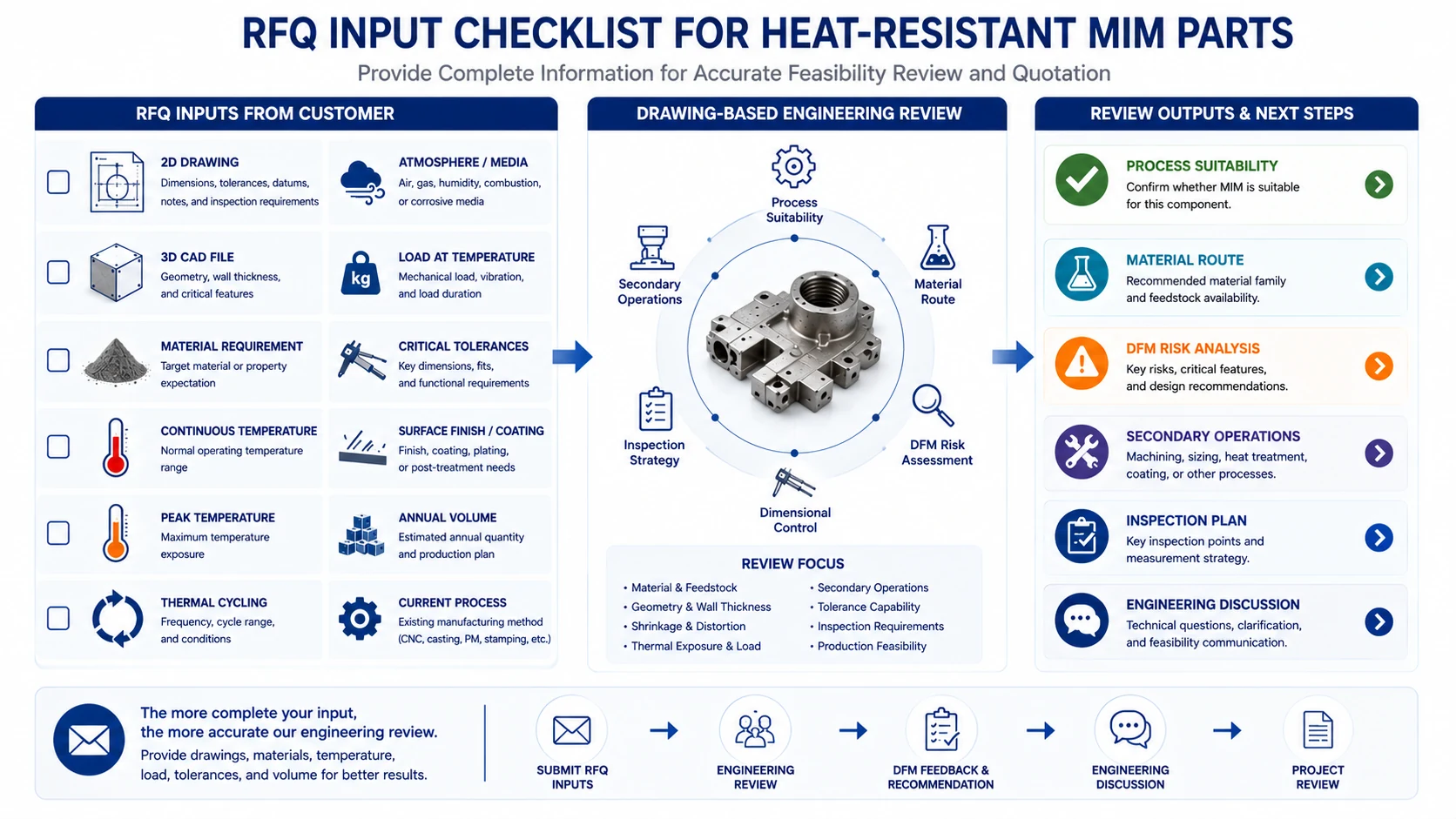
Unknown requirements: Mark them as pending on the RFQ so the supplier can separate confirmed specifications from items requiring testing or clarification.
Required Drawings, Service Conditions, and Production Details
| المدخلات المطلوبة | لماذا هو مهم |
|---|---|
| الرسم ثنائي الأبعاد | يحدد التفاوتات، المساند، الأبعاد الحرجة، ومتطلبات الفحص. |
| ملف CAD ثلاثي الأبعاد | يساعد في تقييم الهندسة، سمك الجدار، قابلية القولبة، ودعم التلبيد. |
| متطلبات المواد | يبدأ فحص مسار المواد ومراجعة جدوى مادة التغذية. |
| درجة حرارة التشغيل المستمرة | يدعم مراجعة التطبيق طويل الأمد. |
| درجة الحرارة القصوى | يساعد في تقييم مخاطر المادة، الأكسدة، السطح، وهامش الأمان. |
| حالة التدوير الحراري | يساعد في تقييم الاستقرار البعدي والمخاوف المتعلقة بالإجهاد. |
| الغلاف الجوي أو الوسط | يؤثر على الأكسدة، التآكل، واختيار المادة. |
| الحمل عند درجة الحرارة | مهم للقوة، والزحف، ومراجعة الإجهاد. |
| الأبعاد الحرجة | يساعد في تحديد ما قد يحتاج إلى تشغيل ثانوي، أو تحجيم، أو فحص أكثر دقة. |
| متطلبات التشطيب السطحي أو الطلاء | يمكن أن يؤثر على الأبعاد النهائية والوظيفة. |
| الكمية السنوية | يحدد ما إذا كانت أدوات MIM معقولة تجارياً. |
| العملية الحالية | يساعد في مقارنة MIM مع CNC، والصب، وPM، والختم. |
| مشكلة فشل معروفة | يساعد في تركيز المراجعة الهندسية قبل التصنيع. |
What the Engineering Review Should Confirm Before Tooling
The supplier's review should screen alloy/feedstock availability, moldability and sintering, critical dimensions, post-sintering operations, inspection or application validation, and tooling economics. The outcome should be explicit: proceed with MIM feasibility and quotation; request more data or qualification trials; or consider an alternative manufacturing process.
Before sending the drawing: Mark critical functional dimensions, continuous and peak temperatures, loaded or sliding contacts, and target annual volume. These details are needed to assess the process and quote on more than geometry alone.
طلب مراجعة رسم لأجزاء MIM مقاومة للحرارة
If your small metal component has demanding heat exposure and a defined drawing, submit the application data for a realistic material, DFM, production-route, and tooling assessment. Feasibility and available processes will be confirmed project by project.
Minimum review package:
- رسم ثنائي الأبعاد ونموذج ثلاثي الأبعاد
- Required grade or target properties
- Continuous, peak, and cycling temperatures
- Atmosphere, load, and mating conditions
- Critical fits, surface requirements, and annual volume