
MIM Low Alloy Steel Materials for High-Strength Precision Parts
MIM low alloy steels are usually selected when a small, complex metal part needs higher strength, hardness, wear resistance, or heat-treatment response than many general-purpose stainless steel options can provide. In metal injection molding, these materials are processed from fine metal powder and binder feedstock through injection molding, debinding, sintering shrinkage, and often heat treatment. They are commonly reviewed for gears, locking parts, shafts, pins, levers, hinges, rotating mechanisms, and compact load-bearing components where geometry, miniaturization, and production volume make conventional CNC machining inefficient. The key decision is not only whether a low alloy steel grade sounds strong, but whether the selected grade, heat treatment condition, geometry, critical dimensions, and inspection plan can remain stable from tooling to production.
Low alloy steel is not normally the first choice when corrosion resistance, biocompatibility, soft magnetic performance, or extreme high-temperature resistance is the main design requirement. In those cases, stainless steel, titanium alloy, cobalt-chromium alloy, soft magnetic material, nickel alloy, or another MIM material family may be more suitable.
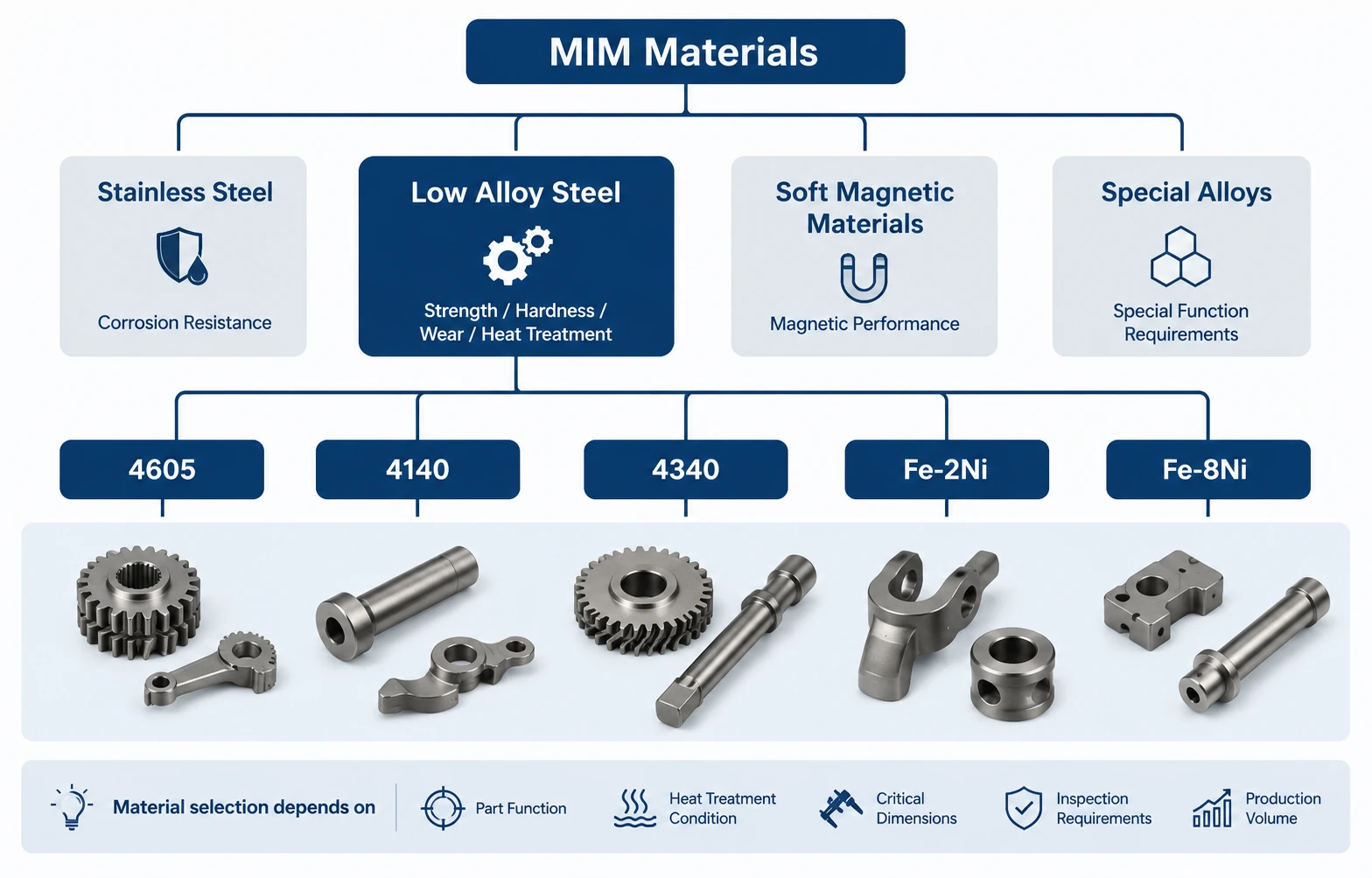
Is Low Alloy Steel the Right MIM Material for Your Part?
Low alloy steel becomes a strong candidate when the part is expected to carry load, resist wear, withstand repeated mechanical contact, or reach a specified hardness after heat treatment. From a design review perspective, the question is not simply whether this material can be molded. The real question is whether the material, geometry, heat treatment condition, tooling compensation, sintering support, and inspection requirements can work together in stable production.
Low alloy steel may be a good fit when the part has:
- compact geometry with functional mechanical loading;
- small gears, teeth, hooks, latches, locking faces, or rotating features;
- strength or hardness requirements that cannot be met by soft or non-hardenable materials;
- wear surfaces that may benefit from heat treatment or post-sintering finishing;
- production volume high enough to justify MIM tooling;
- geometry that would require excessive CNC machining time if made from bar stock.
Low alloy steel may not be the best starting point when:
- corrosion resistance is the primary design requirement;
- the part is exposed to marine, food-contact, chemical, or medical environments;
- soft magnetic response is the main performance target;
- the design needs biocompatibility-driven materials;
- the part is large, simple, and not geometry-driven;
- the project may be better suited to CNC machining, casting, forging, stamping, or PM pressing.
Where Low Alloy Steel Fits in the MIM Material System
In the MIM material family, low alloy steels sit between general ferrous materials and more specialized alloy systems. They are different from MIM stainless steels, which are usually selected for corrosion resistance; different from 軟磁性MIM材料, which are selected for magnetic response; and different from titanium or cobalt-chromium alloys, which are often reviewed for weight, corrosion, or biocompatibility requirements.
The Metal Injection Molding Association lists low-alloy steels as a common MIM alloy family and includes materials such as 4140, 4340, 4605, Fe2%Ni, and Fe8%Ni in its MIM materials range. MIMA also notes that material availability should be confirmed with the supplier because powder chemistry, particle characteristics, and feedstock availability affect which alloys can be produced through MIM.
For corrosion resistance
まずは MIM stainless steel materials such as 304, 316L, 420, 440C, or 17-4 PH, depending on the required balance of corrosion resistance, hardness, and strength.
For magnetic response
Review soft magnetic materials such as Fe-3Si, Fe-50Ni, or Fe-50Co instead of placing these materials under low alloy steel.
For special requirements
Review 特殊MIM合金 when the project requires titanium, cobalt-chromium, controlled expansion alloys, tungsten alloys, or cemented carbides.
MIM Low Alloy Steel Grade Selector
The table below gives a practical starting point for early material screening. It should not be used as a final material specification. Final selection should be confirmed through drawing review, MIM feedstock availability, sintering route, heat treatment condition, critical dimensions, and testing requirements.

| MIM Low Alloy Steel Grade | Best Reviewed When the Part Needs | Main Engineering Value | 推奨される次のステップ |
|---|---|---|---|
| MIM 4605 | High strength, hardness, and wear resistance in compact structural parts. | Common low alloy steel option for functional MIM components; often reviewed with heat treatment. | Review the dedicated MIM 4605 material page. |
| MIM 4140 | Balanced strength and toughness in a familiar Cr-Mo engineering steel family. | Useful when customers already specify 4140-type performance or equivalent material logic. | Review the dedicated MIM 4140 material page. |
| MIM 4340 | Higher hardenability or tougher load-bearing behavior than basic low alloy steel options. | Suitable for more demanding strength and toughness discussions. | Review the dedicated MIM 4340 material page. |
| Fe-2Ni | Moderate strength with ductility balance in an Fe-Ni material route. | Useful when the project requires an Fe-Ni option rather than a Cr-Mo steel. | Review the Fe-2Ni material page. |
| Fe-4Ni | An intermediate Fe-Ni option when the project needs a balance between Fe-2Ni and higher nickel content options. | Useful for project-specific Fe-Ni comparison when strength, ductility, and material availability must be reviewed together. | Review the Fe-4Ni material page. |
| Fe-8Ni | Fe-Ni structural material option with a different strength and ductility balance. | Useful for project-specific comparison with Fe-2Ni, Fe-4Ni, or 4605-type materials. | Review the Fe-8Ni material page. |
| Project-specific Fe-Ni options | A customer has a defined material requirement or equivalent grade target. | Requires confirmation of feedstock, sintering condition, heat treatment condition, and testing method. | Submit the drawing for material review. |
Which Grade Should You Review First?
For early-stage material screening, it is useful to start from the part function rather than from the grade name. A common mistake is to choose low alloy steel only because it sounds strong. In production, the better question is whether the grade can meet the required mechanical properties after sintering and heat treatment while maintaining the required dimensions, flatness, surface condition, and inspection criteria.
| If Your Part Mainly Needs... | Start the Review With... | 理由 |
|---|---|---|
| General high-strength structural performance | MIM 4605 | Common MIM low alloy steel candidate for structural and wear-related parts. |
| Familiar Cr-Mo engineering steel logic | MIM 4140 | Useful when the design team already understands 4140-type material behavior. |
| Higher hardenability or tougher load-bearing use | MIM 4340 | Better starting point for demanding strength and toughness discussions. |
| Fe-Ni strength and ductility balance | Fe-2Ni, Fe-4Ni, or Fe-8Ni | Useful when the material path is based on Fe-Ni rather than Cr-Mo steel, and the nickel level needs project-specific review. |
| 耐食性 | MIMステンレス鋼 | Low alloy steel is not primarily selected for corrosion resistance. |
| 磁気応答 | 軟磁性MIM材料 | Magnetic performance should be reviewed under the correct material family. |
| High hardness or wear-related material screening | High-hardness MIM materials または wear-resistant MIM materials | The property page can compare low alloy steel with tool steel, cemented carbide, or other routes. |
Material Availability, Feedstock, and Project-Specific Confirmation
MIM material selection is not the same as choosing a conventional wrought steel from a catalog. The selected alloy must be available as a suitable MIM feedstock, processed through injection molding, green part handling, debinding, and sintering, and then evaluated under the correct post-sintering or heat-treated condition.
Before specifying a low alloy steel for MIM, the project team should confirm:
- whether the required grade or a suitable substitute feedstock is available;
- whether the part geometry is suitable for injection molding and sintering shrinkage control;
- whether the mechanical requirement is based on as-sintered or heat-treated condition;
- whether critical dimensions are measured before or after heat treatment;
- whether secondary machining, sizing, or finishing is required;
- whether the inspection method matches the actual function of the part.
Material Condition and Acceptance Items for MIM Low Alloy Steel
For low alloy steel MIM parts, the final specification should define the material condition, not only the grade name. A part used in as-sintered condition, quenched and tempered condition, or case-hardened condition may require different acceptance items, inspection timing, and dimensional review. This is one of the most important points to clarify before tooling.
| 材料状態 | What Changes | What to Specify | Inspection Risk |
|---|---|---|---|
| As-sintered | Properties depend mainly on material chemistry, sintered density, carbon control, and sintering atmosphere. | Grade, density expectation, critical dimensions, mechanical requirement, and surface condition. | Do not assume wrought steel values. Confirm the property range using MIM-specific material data and sample validation. |
| Quenched and tempered | Hardness, strength, and wear resistance may improve, but dimensional shift and distortion risk may increase. | Hardness target, tempering condition, critical dimensions after heat treatment, and final inspection sequence. | Dimensions that are functional after assembly should usually be verified after heat treatment, not only after sintering. |
| Case-hardened or surface-hardened | Surface wear resistance may improve while the core behavior remains different from through-hardened material. | Wear surface location, target case depth if required, surface hardness, mating material, and distortion allowance. | Thin walls, sharp edges, holes, and asymmetric geometry should be reviewed carefully before applying surface hardening. |
| Post-sintering machined | Critical holes, threads, sealing faces, or datum surfaces may be corrected after sintering or after heat treatment. | Machining allowance, datum strategy, inspection datum, and which features remain as-molded. | Unclear machining timing can create mismatch between drawing tolerances, heat treatment distortion, and final assembly fit. |
Why Heat Treatment Condition Matters More Than the Grade Name
For many MIM low alloy steel parts, the final engineering performance depends heavily on heat treatment. The same grade name can represent different performance levels depending on whether the part is used in as-sintered condition, quenched and tempered condition, or another project-specific treatment condition.

From a production perspective, heat treatment can improve hardness, strength, and wear resistance, but it may also introduce distortion, dimensional change, surface condition changes, or new inspection requirements. For small precision MIM parts, the key issue is not only whether the material can be hardened, but whether the part can still meet functional dimensions after heat treatment.
Review before tooling
- hardness target and acceptable hardness range;
- toughness or impact requirement;
- wear surface location;
- critical dimensions after heat treatment;
- risk of warpage or distortion.
Review after samples
- hardness check method and location;
- flatness, roundness, and functional fit;
- surface condition after heat treatment;
- whether post-heat-treatment machining is required;
- fit with mating components.
For high-strength MIM low alloy steel parts, heat treatment should be discussed before tooling, not after samples fail to meet the application requirement. Related property-driven pages include high-strength MIM materials, heat-treatable MIM materials, ,および high-hardness MIM materials.
Applications Best Suited to MIM Low Alloy Steel
Low alloy steel is most useful when the part is both mechanically functional and geometrically suitable for MIM. The strongest applications are not defined only by industry, but by the function of the part.

| Application Type | Why Low Alloy Steel May Fit | Key Review Point |
|---|---|---|
| Small gears and transmission parts | Need wear resistance, strength, and stable tooth geometry. | Tooth geometry, shrinkage control, hardness, and post-sintering inspection. |
| Locking parts and latches | Require repeated engagement, load-bearing faces, and edge durability. | Contact faces, local stress, wear marks, and heat treatment condition. |
| Shafts, pins, and levers | Need a balance of strength, toughness, and dimensional consistency. | Straightness, roundness, critical diameters, and secondary finishing. |
| Hinges and rotating parts | Require wear resistance and stable movement after assembly. | Hole accuracy, mating surfaces, friction, and surface finish. |
| Structural brackets and carriers | Need strength in compact geometry. | Wall thickness, ribs, fillets, sintering support, and flatness. |
| Industrial mechanism parts | Need functional performance at production volume. | Load direction, assembly fit, failure mode, and inspection plan. |
Low alloy steel is not automatically suitable for every structural part. Large, simple, low-complexity parts may be better made by CNC machining, forging, casting, PM pressing, or stamping. MIM is strongest when geometry, miniaturization, part consolidation, and production volume justify the tooling route.
DFM and Manufacturing Risks to Review Before Tooling
Low alloy steel MIM projects should be reviewed early because strength-driven parts often have tight functional requirements. A drawing may look simple, but the combination of high hardness, small features, shrinkage, and post-treatment dimensions can create production risk.
| リスク領域 | 重要性 | What to Review Before Tooling |
|---|---|---|
| Carbon control | Affects hardness, strength, and heat treatment response. | Material specification, sintering atmosphere, and final test method. |
| 焼結変形 | Load-bearing parts often have functional geometry. | Wall thickness balance, support strategy, flatness, and symmetry. |
| Heat treatment distortion | Quench and temper processes can change dimensions. | Critical dimensions after heat treatment and inspection sequence. |
| Density and residual porosity | Influence mechanical performance and fatigue behavior. | Density requirement, test samples, acceptance criteria, and risk areas. |
| Wear surface performance | Contact surfaces may need hardness or finishing control. | Surface finish, hardness requirement, and mating material. |
| Secondary machining | Some holes, threads, sealing faces, or datum surfaces may still require machining. | Machining allowance, datum strategy, and cost impact. |
| Surface oxidation or decarburization | Can affect appearance and performance. | Furnace atmosphere, cleaning, coating, and surface inspection. |
| Assembly fit | Strong parts still fail if mating geometry is unstable. | Mating part tolerance, functional gauge, and sample validation. |
The best time to identify these risks is before mold design. Once tooling is built, changes to shrinkage compensation, parting line, gate position, support strategy, or heat-treatment allowance become more expensive. Related process pages include MIM焼結 および MIM二次加工.
Heat-Treated Locking Part With Dimensional Shift
発生した問題: a compact locking part met the target hardness after heat treatment, but the functional slot and pin-hole relationship shifted enough to create assembly friction.
発生理由: the initial material discussion focused on grade and hardness, while the post-heat-treatment inspection condition was not defined clearly before tooling.
真のシステム原因: heat treatment distortion, part geometry asymmetry, and the absence of a final functional gauge created a mismatch between material performance and assembly performance.
修正方法: the critical dimensions were reclassified as post-heat-treatment dimensions, the fixture and inspection sequence were adjusted, and selected contact areas were reviewed for secondary finishing allowance.
再発防止策: before tooling, confirm hardness target, heat treatment route, dimensional datum, final inspection timing, mating part tolerance, and whether any post-treatment machining or sizing is required.
When Another MIM Material Family May Be Better
Low alloy steel is an important MIM material family, but it is not the default answer for every metal part. In many projects, another material family should be reviewed first.
| Primary Requirement | Better Material Path to Review |
|---|---|
| 耐食性 | 304, 316L, 420, 440C, or 17-4 PH stainless steel, depending on strength and environment. |
| Strength plus corrosion resistance | 17-4 PHステンレス鋼 may be more relevant than low alloy steel. |
| Soft magnetic response | Fe-3Si, Fe-50Ni, Fe-50Co, or other soft magnetic MIM materials. |
| 生体適合性 | Titanium alloys or cobalt-chromium alloys under 特殊MIM合金. |
| 熱膨張制御 | Kovar, Invar, or other controlled expansion alloys. |
| Extreme wear resistance | Tool steel, cemented carbide, or other specialized materials. |
| Simple large geometry | CNC machining, casting, forging, stamping, or PM pressing may be more economical. |
For deeper comparison, future material comparison pages can evaluate topics such as 17-4 PH vs MIM 4605, 4605 vs 4140, and 4140 vs 4340. This page should keep the comparison short and guide users to the right material path.
What to Provide for Low Alloy Steel Material Selection Review
For a useful material review, a supplier needs more than a part name and a target grade. The more complete the project information, the more accurately the engineering team can judge whether low alloy steel, stainless steel, or another MIM material is the better path.

Recommended technical files
- 2D drawing with tolerances;
- 3D model if available;
- target material or equivalent material;
- required hardness, strength, or wear performance;
- heat treatment requirement;
- critical dimensions and functional surfaces.
Recommended project background
- surface finish, coating, or appearance requirement;
- mating parts and assembly function;
- load direction, wear condition, or failure concern;
- estimated annual volume;
- prototype and production schedule;
- inspection or PPAP requirement if applicable.
For early projects, the material does not need to be finalized before contacting XTMIM. A practical approach is to submit the drawing and explain the application environment, then review whether 4605, 4140, 4340, Fe-Ni steel, stainless steel, or another MIM material family is more appropriate.
Need to Confirm Whether Low Alloy Steel Is Suitable for Your MIM Part?
If your part requires high strength, hardness, wear resistance, or heat-treatment response, send your drawing, 3D CAD file if available, target material, tolerance requirements, critical dimensions, surface requirement, application load, and estimated annual volume to XTMIM for material and DFM review. Please identify whether critical dimensions and hardness targets apply before or after heat treatment.
Our engineering team can review whether MIM low alloy steel is suitable, which grade should be evaluated first, and what tooling, injection molding, debinding, sintering, heat treatment, secondary operation, or inspection risks should be confirmed before production.
FAQ About MIM Low Alloy Steel Materials
What is MIM low alloy steel used for?
MIM low alloy steel is used for small, complex metal parts that need strength, hardness, wear resistance, or heat-treatment response. Typical examples include small gears, locking parts, shafts, pins, levers, hinges, rotating parts, and compact load-bearing mechanism components.
Can MIM low alloy steel be heat treated?
Many MIM low alloy steel parts can be reviewed for heat treatment, depending on the grade, chemistry, density, sintering condition, and application requirement. Heat treatment can improve hardness and strength, but it may also introduce distortion or require post-treatment inspection.
How do I choose between MIM 4605, 4140, and 4340?
Start from the part function. MIM 4605 is often reviewed for high-strength structural and wear-related parts. MIM 4140 is useful when a Cr-Mo engineering steel family is preferred. MIM 4340 may be reviewed when higher hardenability or tougher load-bearing performance is needed. The final choice should be confirmed through drawing review, heat treatment condition, and testing requirements.
What is the difference between as-sintered and heat-treated MIM low alloy steel?
As-sintered MIM low alloy steel is evaluated after sintering without an additional hardening step. Heat-treated material is processed further to improve hardness, strength, or wear resistance, but heat treatment may also change dimensions or increase distortion risk. The drawing should state whether hardness and critical dimensions apply before or after heat treatment.
Should I choose MIM 4605 or 17-4 PH stainless steel?
Choose MIM 4605 when strength, hardness, wear resistance, and heat-treatment response are the main requirements and corrosion resistance is not the primary concern. Review 17-4 PH stainless steel when the part needs a combination of strength and better corrosion resistance. The final decision should be based on application environment, heat treatment, dimensions, and inspection requirements.
Is low alloy steel better than stainless steel for MIM?
Not always. Low alloy steel is usually selected for strength, hardness, wear resistance, or heat-treatment response. Stainless steel is normally better when corrosion resistance is the primary requirement. If the part needs both strength and corrosion resistance, 17-4 PH stainless steel may be worth reviewing.
Is MIM 4605 the same as conventional 4605 steel?
No. The grade name may be similar, but MIM 4605 is produced through metal injection molding, including feedstock preparation, injection molding, debinding, sintering, and possible heat treatment. Properties and acceptance criteria should be specified for the MIM process route, not assumed directly from wrought or machined steel data.
What information should I provide before choosing a low alloy steel grade?
Provide the drawing, 3D model if available, target material, hardness or strength requirement, heat treatment requirement, critical dimensions, surface requirement, application load, mating part information, and estimated annual volume. This allows the supplier to review material suitability before tooling.
規格および技術参考資料
Material names, performance expectations, and acceptance criteria for MIM low alloy steel parts should be confirmed using project-specific specifications, supplier data, and relevant standards. The MIMA Materials Range provides a useful reference for MIM material families and material availability considerations.
MPIF規格35-MIM is described by MPIF as covering common materials used in metal injection molding, with explanatory notes and definitions. MIMA also provides technical information about Standard 35 for Metal Injection Molded Parts.
ASTM B883 covers ferrous metal injection molded materials made by mixing metal powders with binders, injection molding, debinding, and sintering, with or without subsequent heat treatment. It is especially relevant when discussing ferrous MIM material families such as low alloy steel grades.
ISO 22068:2012 specifies requirements for chemical composition and mechanical and physical properties of sintered metal injection-moulded materials and is intended for components made by the MIM process. It should not be treated as a general specification for wrought steel, press-and-sinter PM parts, or non-MIM manufacturing routes.
These standards should be used as technical references during material discussion, not as a replacement for part-specific DFM review, material datasheets, sample testing, or agreed inspection requirements.