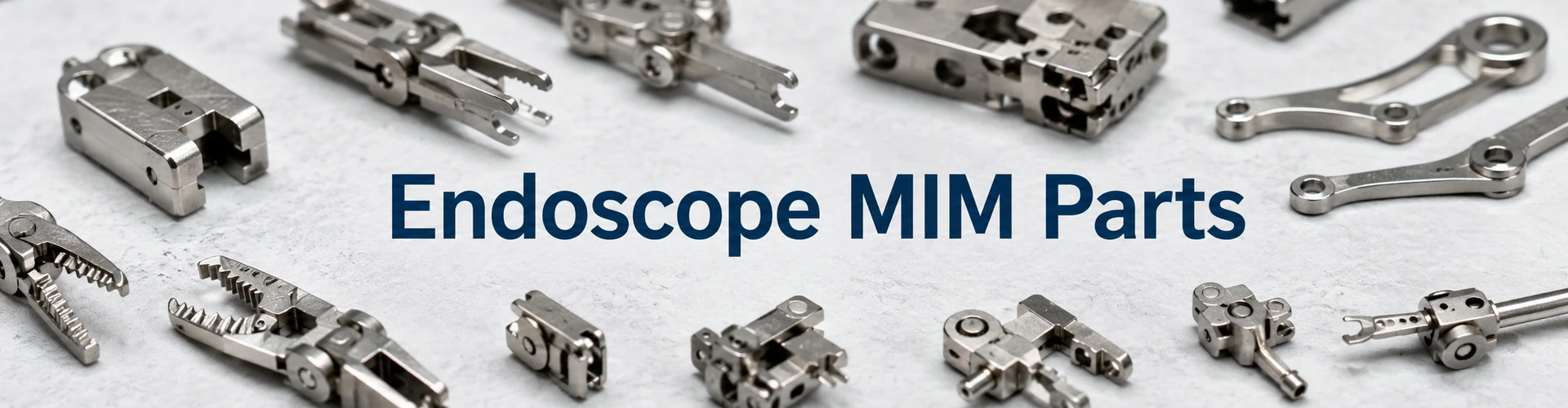
내시경 MIM 부품: 구성 요소 및 DFM 검토

Endoscope MIM parts including small jaws, articulation links, drive blocks, guide-channel components and pivot-feature parts for engineering review

의료용 MIM 부품

XTMIM supports custom endoscope-related MIM components based on customer drawings, including small jaws, biopsy forceps components, articulation links, compact drive blocks, guide-channel components, locking parts and pivot-feature parts. This page first shows what types of endoscope MIM parts can be reviewed for custom production, including representative structures, material directions, surface finish needs and RFQ inputs. The engineering section then explains why these parts may fit MIM, where the manufacturing risks are, and what should be checked before tooling, trial production or volume planning.

빠른 답변: Endoscope MIM parts are small precision metal components used inside endoscopic or minimally invasive device mechanisms. They are usually reviewed for MIM when the part combines compact size, complex three-dimensional geometry, thin sections, small holes, slots, guide features, mating surfaces or functional edges. This page focuses on component-level MIM manufacturability and RFQ review, not endoscopy market trends, complete endoscope systems or medical device certification.

Parts we can review

Small jaws, biopsy forceps components, articulation links, drive blocks, guide parts and pivot-feature components.

Customization basis

Custom production starts from 2D drawings, 3D CAD, material notes, CTQ dimensions and application requirements.

재료 방향

Candidate stainless steels may include 17-4 PH, 420, 316L or 440C depending on function and validation needs.

RFQ focus

Geometry, tolerance, surface finish, edge condition, secondary operations, annual volume and inspection strategy.

Manufacturing and regulatory boundary: XTMIM can review component-level MIM manufacturability, material feasibility, DFM risk, secondary operations and inspection planning. Final medical device approval, biological evaluation, cleaning validation, sterilization validation, labeling and regulatory submission remain the responsibility of the device owner or qualified medical device manufacturer.

Endoscope MIM Parts We Can Support

XTMIM reviews custom endoscope MIM components at the part level. The typical scope includes small mechanism parts used in grasping, biopsy, articulation, motion transfer, guide-channel and pivot assemblies. These are not complete endoscope systems or branded replacement parts. They are custom precision metal components manufactured according to customer drawings and engineering requirements.

Small jaws 생검 겸자 부품 관절 연결 링크 구동 블록 Knife guides Guide-channel parts 잠금 부품 피벗 기능 부품
Typical small endoscope MIM components including jaw-like parts, thin links, compact drive blocks, guide-channel parts and pivot features
Typical endoscope MIM component groups include small jaws, thin links, compact drive blocks, guide-channel components and pivot features.
핵심 결론:

This image defines the page scope: small complex metal mechanism components, not complete endoscope systems, branded repair parts or general medical accessories.

Typical Endoscope MIM Component Groups

The table below summarizes the component groups most often reviewed for endoscope-related MIM projects. It is intended as a part-display module for product engineers and sourcing teams before they enter detailed DFM review.

부품 그룹 Representative Parts Typical Structure 일반적인 재료 방향 맞춤형 검토 초점
Grasper and biopsy components Small jaws, cup components, forceps heads Teeth, thin lips, cup geometry, pivot holes 420, 17-4 PH or 316L depending on function Jaw alignment, burr control, edge condition, paired inspection
Articulation components Links, connectors, lock bars Thin arms, small holes, slots, compact link geometry 17-4 PH or 420 candidates Sintering distortion, hole position, load direction, fatigue-sensitive zones
Drive and locking parts Drive blocks, lock blocks, sliders Guide slots, shoulders, contact faces, compact block features 17-4 PH, 420 or other stainless steel candidates Slot accuracy, wear zones, mating surfaces, secondary machining need
가이드 채널 부품 Knife guides, guide blocks, channel supports Narrow channels, contact edges, guide surfaces 420 or 440C candidates where hardness is important Edge finish, slot control, burr limits, inspection access
피벗 기능 부품 Small pivot parts, pin-interface components, rotating features Small holes, bosses, circular interfaces, alignment features Stainless steel candidates based on load and corrosion needs Hole roundness, pin fit, reaming allowance, functional gauge planning

A MIMA endoscopic device parts case study documents MIM articulation lock bars, articulation connectors, articulation drive blocks and knife guides using stainless steel MIM materials such as 17-4 and 420. This supports the real application basis for endoscope MIM components, although each commercial project still requires drawing-level review.

대표 구조 및 맞춤 기능

Endoscope MIM parts are usually selected for review because the structure is too compact or complex for efficient full machining. The part name alone is not enough. XTMIM reviews the actual geometry, functional surfaces, mating requirements and expected production route.

Small Jaws and Cup Features

Used in grasping or biopsy-related mechanisms. Review points include thin lips, teeth, cup geometry, jaw closing alignment, pivot holes and burr-sensitive edges.

Thin Articulation Links

Used for motion transfer in compact mechanisms. Review points include thin arms, hole patterns, load direction, shrinkage movement and sintering support strategy.

Compact Drive Blocks

Used to transfer force or motion. Review points include guide slots, shoulders, contact surfaces, secondary machining allowance and wear-related material selection.

Guide-Channel Features

Used to guide small moving parts or cutting-path elements. Review points include slot width, edge condition, surface finish, burr control and inspection access.

Pivot Holes and Pin Interfaces

Used for rotation or assembly alignment. Review points include hole roundness, pin fit, datum strategy, reaming need and functional gauge planning.

Locking and Contact Features

Used in compact locking, sliding or positioning functions. Review points include parting line location, gate mark position, contact wear and surface finishing route.

Custom part boundary: These structures are reviewed as manufacturable metal components, not as finished medical device functions. The final device owner should define use conditions, validation requirements, cleaning expectations and regulatory boundaries.

Material and Surface Finish Options for Endoscope MIM Components

Material selection for endoscope MIM parts should start from component function, not from a generic “medical grade” label. A drive block may be strength-driven, a guide component may be wear-driven, while a corrosion-focused component may require a different stainless steel direction. Detailed material data belongs to dedicated material pages; this section only gives selection direction for endoscope-related component RFQs.

Material selection visual for endoscope MIM components based on strength, hardness, corrosion resistance and wear requirements
Endoscope MIM material selection should match component function, not a generic medical label.
핵심 결론:

A drive block may be strength-driven, a guide component may need wear and hardness review, while a corrosion-focused small component may require a different stainless steel choice.

For broader material comparison, review MIM 재료MIM stainless steel material options.

Material selection caveat: The materials below are candidate options, not fixed recommendations for every endoscope component. Final selection should consider load direction, hardness target, corrosion exposure, mating parts, edge condition, heat treatment, surface finishing, customer specification and device-level validation requirements.

요구 사항 Candidate Material Direction 일반적인 검토 포인트 Related Material Page
Strength-driven links or blocks 17-4 PH 스테인리스강 Heat treatment, dimensional change, corrosion expectation and distortion risk 17-4 PH MIM stainless steel
Hardness or contact surfaces 420 스테인리스강 Edge stability, wear, corrosion trade-off and finishing route 420 MIM stainless steel
Corrosion-focused components 316L 스테인리스강 Lower hardness, wear limitation, ductility and corrosion exposure 316L MIM stainless steel
Higher wear or hardness needs 440C 스테인리스강 Brittleness risk, edge chipping, sliding contact and corrosion review 440C MIM stainless steel

Common Surface Finish and Post-Processing Directions

Surface finish and post-processing should be defined according to the component function. MIM can form the complex base geometry, but selected surfaces may still require secondary operations to meet assembly, motion, edge or corrosion requirements.

요구 사항 가능한 작업 When It May Be Needed
Pivot hole fit Reaming, drilling or sizing When hole roundness, position or pin fit is critical to movement
Jaw or guide edge condition Deburring, polishing or edge control When edges contact mating parts, grip surfaces or guide movement
Corrosion-focused surfaces Passivation or surface cleaning route When customer specifications require corrosion-related surface treatment
Strength or hardness adjustment Heat treatment where suitable When the selected material and part geometry allow heat treatment review

Application Direction and Custom Project Fit

Endoscope MIM components may be reviewed for different mechanism directions. The application background helps the engineering team understand whether the component is load-bearing, wear-sensitive, corrosion-sensitive, edge-sensitive or mainly used for positioning and motion transfer.

Grasping and biopsy mechanisms

Small jaws, cup components and biopsy forceps-related parts where jaw alignment, edge condition and pivot fit matter.

Articulation and bending mechanisms

Thin links, connectors and compact movement-transfer parts where distortion, hole position and support strategy matter.

Drive and locking mechanisms

Drive blocks, lock blocks and sliders where slots, contact surfaces, wear and secondary machining may need review.

Guide or cutting-path support

Guide components and knife guide features where slot width, edge control, burr limits and finish requirements matter.

For broader medical component categories, review the medical MIM parts overview. For requirement-based pages, see high-precision MIM part requirements, wear-resistant MIM part reviewcorrosion-resistant MIM part review.

Send Drawings for Endoscope MIM Part Review

If your endoscope component includes small jaws, biopsy forceps features, articulation links, drive blocks, guide channels, pivot holes, thin arms, narrow slots or functional edges, XTMIM can review the drawing for MIM manufacturability before tooling.

Please provide 2D drawings, 3D CAD files, material requirements, CTQ dimensions, tolerance requirements, surface finish expectations, edge or burr requirements, mating part information, estimated annual volume and application background.

Why These Endoscope Components May Fit MIM

MIM is useful for endoscopic device components when the part combines small size with geometric complexity. The process starts with fine metal powder mixed with binder to form feedstock. The feedstock is injection molded, the green part is handled carefully, the binder is removed through debinding, and the part is sintered to reach final density and dimensions. Because the molded part shrinks during sintering, the tool must compensate for shrinkage, and critical dimensions must be reviewed before tooling.

The 금속 사출 성형(MIM)의 EPMA 개요 describes MIM as a process for complex-shaped parts in high quantities and explains why the route becomes less attractive when a part can be made economically by simpler powder metallurgy or machining routes. This matters for endoscope components because MIM should be selected for geometry and production logic, not simply because the part is small.

소형 복합 형상

Endoscope components often include small holes and pivot interfaces, thin arms and link sections, cup-shaped jaw geometry, guide slots, internal channels, small teeth, compact three-dimensional surfaces and integrated locating or locking features. A common mistake is to judge only the outer size of the part. From a design review perspective, the real issue is whether internal features, thin regions, parting line, gate location and sintering support strategy can be controlled together.

Repeatable Production After Tooling

MIM becomes more attractive when the design is stable and the annual demand can justify tooling. Once the tooling, feedstock, debinding, sintering and inspection route are validated, the process can support repeatable production of complex small parts.

This does not mean every endoscope part should be made by MIM. If the part is still in early prototype iteration, or if only a few pieces are needed, CNC machining or other prototype methods may be more practical before committing to MIM tooling.

Reduced Machining for Difficult Features

MIM can reduce machining when the part contains complex molded features that can be formed near-net shape. Examples include small jaw profiles, integrated link shapes, compact drive blocks or guide features. However, critical holes, slots, sharp edges or contact surfaces may still require secondary machining, sizing, polishing, deburring or inspection fixtures.

Engineering question: The correct question is not “Can MIM avoid all machining?” The better question is which features can be molded reliably, which features must be corrected after sintering, and whether the combined route still improves cost, repeatability or design freedom compared with full machining.

When MIM Becomes a Better Fit Than CNC or Stamping

MIM may be a better fit when the geometry is too complex for economical CNC machining, multiple machined features can be integrated into one molded component, part size is small enough for MIM economics, production volume supports tooling investment, the material is available as a suitable MIM feedstock, and critical features can be controlled by a combined tooling, sintering and inspection strategy.

MIM may not be the best first choice if the part is large, simple, low-volume, frequently changing, or defined by ultra-tight dimensions that would require extensive post-machining.

금형 제작 전 DFM 리스크

Endoscope MIM components should be reviewed before tooling because small design choices can affect mold filling, debinding stability, sintering shrinkage, distortion, burr formation and inspection repeatability. For a broader review route, see the MIM DFM review before tooling.

DFM review visual showing thin arms, pivot holes, guide slots and gate areas on small endoscope MIM mechanism components
Thin arms, pivot holes, guide slots and gate areas should be reviewed before MIM tooling.
핵심 결론:

Feature-level review is essential because the overall part size does not guarantee stable molding, debinding, sintering or final assembly fit.

Thin Arms and Long Slender Features

Thin arms are common in articulation links and small mechanical connectors. The risk is not only breakage; the larger issue is dimensional movement during debinding and sintering. Thin features may bend, twist or shrink unevenly if the geometry is not balanced.

  • Minimum wall section and transition areas.
  • Gate position and flow path.
  • Support direction during sintering.
  • Fixture or setter requirement.
  • Inspection datum strategy.
  • Whether the feature is load-bearing or only locating.

Small Holes, Slots and Pivot Interfaces

Small holes and slots are common in jaws, links, drive blocks and pivot features. They may be molded, machined, reamed or finished depending on tolerance and function. For additional design guidance, review MIM holes, slots and undercuts.

형상 Typical Risk 금형 제작 전 검토
Small pivot hole Shrinkage variation, roundness, assembly fit Hole size, datum, reaming allowance
Narrow slot Width variation, distortion, burrs Slot function, secondary machining need
Long guide channel Warpage, contact inconsistency Support strategy, material, finishing
Cross-hole Tooling complexity, flash risk Mold action, parting line, inspection access
Paired hole pattern Misalignment during assembly Datum scheme, functional gauge possibility

Teeth, Edges and Cup-Shaped Features

Teeth and cup-shaped features are common in grasper jaws and biopsy forceps components. These features affect function, but they also create molding and finishing challenges. The drawing should clarify whether the edge is used for cutting, gripping, alignment or clearance. Each function leads to a different manufacturing review.

Undercuts, Parting Lines and Gate Location

Undercuts, parting lines and gate location influence mold complexity and visible or functional surface quality. In endoscope parts, a gate mark or parting line should not be placed on a critical sliding surface, jaw contact edge, pivot interface or sealing-related surface without review.

소결 지지 및 변형 위험

Sintering distortion is one of the most important risks in thin endoscope MIM components. Because the part shrinks during sintering, thin arms, asymmetric features and uneven mass distribution may cause dimensional movement. The review should consider how the part will be oriented and supported during sintering, not only how it will be molded. For more geometry-specific review, see MIM 소결 지지대.

Tolerance, CTQ and Inspection Review

Endoscope MIM components often fail not because the general shape is impossible, but because the critical dimensions are not separated from non-critical dimensions. A good drawing should identify which dimensions control motion, alignment, mating, gripping, blade guidance or inspection acceptance. For general process capability boundaries, see MIM 공차.

Inspection scene with small MIM endoscope mechanism components, technical drawing outlines and measurement equipment for tolerance review
Critical holes, slots, edges and mating surfaces should be reviewed before tooling and RFQ.
핵심 결론:

Endoscope MIM part inquiries should be based on drawings, critical dimensions and inspection requirements, not only part names.

Critical Dimensions Are Usually Assembly-Driven

Critical dimensions may include pivot hole position, jaw spacing, slot width, mating surface flatness, pin fit, guide channel width or paired component alignment. These dimensions should be reviewed against the actual assembly function.

CTQ Feature 중요성 엔지니어링 검토
Pivot hole position Controls motion, alignment and pin fit Datum strategy, reaming need, functional gauge or CMM inspection
Jaw closing alignment Affects gripping, sampling or closing function Paired inspection, edge finishing and mating part review
Slot width Controls guide or drive fit As-sintered capability versus secondary machining
Contact surface Affects wear and motion transfer Material, finishing, flatness and surface inspection
Burr-sensitive edge Affects mating, movement, cleaning-related design or functional edge condition Burr limit, polishing route, visual criteria and drawing clarity

Edge Radius, Burr Control and Contact Surfaces

Endoscope components may include functional edges, gripping teeth, guide surfaces or sliding interfaces. The drawing should define whether the edge must be sharp, broken, polished, radiused or burr-free within a functional limit. A vague note such as “no burr” is often not enough. The buyer should specify where burrs matter most, what surfaces contact mating parts, and whether polishing or passivation is expected.

Surface Finish and Cleaning-Related Geometry

For medical device components, surface condition can affect assembly, motion, cleaning-related design considerations and device-level validation. The MIM component supplier can review surface finish feasibility, but final cleaning and sterilization requirements should be confirmed by the device owner.

Secondary Machining, Finishing and Post-Processing

Some endoscope MIM parts can use as-sintered features for non-critical geometry, while selected functional areas may require secondary machining or finishing. This does not mean the part is unsuitable for MIM. In many projects, the most practical route is to use MIM for the complex base geometry and apply secondary operations only to CTQ features.

Feature or Requirement 가능한 후가공 Reason for Review
Precision pivot hole Reaming, drilling or sizing Improves fit control when as-sintered tolerance is not enough
Guide slot or drive slot Machining, sizing or controlled finishing Supports movement accuracy and mating part clearance
Jaw edge or cup edge Deburring, polishing or edge radius control Reduces burr risk and improves functional edge consistency
Contact surface Polishing, lapping or selected machining Improves contact behavior, motion stability or wear-related surfaces
Corrosion-related surface requirement Passivation or customer-specified cleaning process Should follow customer specification and device-level validation needs
Strength or hardness requirement Heat treatment where suitable Must be reviewed with material, geometry, distortion and final inspection

When MIM May Not Be Suitable for Endoscope Components

MIM is not always the correct route. A credible project review should identify unsuitable cases early, before tooling cost is committed.

Very Low Annual Volume

If the project only requires a few prototypes or uncertain early-stage samples, CNC machining, additive manufacturing or manual fabrication may be more practical for the first design iteration. MIM becomes stronger when the design is stable and production volume can support tooling.

Oversized or Simple Machined Components

If the endoscope component is large, simple, flat or easily machined, MIM may add unnecessary tooling cost and process complexity. Simpler shapes may not justify MIM economics.

Extremely Tight Features That Require Full Machining

If most of the part’s important surfaces require precision machining after sintering, MIM may not create enough value. In those cases, a machined route or a hybrid manufacturing strategy should be reviewed.

Uncontrolled Thin Sections or Sharp Internal Corners

Very thin unsupported arms, sharp internal corners, abrupt wall transitions and narrow fragile edges can create molding, debinding and sintering problems. These features may still be possible, but they should be reviewed and modified before tooling.

Composite Engineering Review Scenario: Guide Slot Control

발생한 문제: A guide component concept included a narrow guide slot with a functional edge, but the drawing did not clearly separate guide width, edge condition and burr requirement.

발생 원인: The design team assumed the slot could be molded to final functional condition without secondary finishing.

실제 시스템적 원인: The slot was both a molded feature and a functional guide surface. The edge requirement, wear expectation and inspection method were not defined early.

수정 방법: The review classified the slot as a critical-to-function feature, added secondary finishing allowance, clarified edge condition and selected a material route based on contact and wear expectations.

재발 방지 방법: For guide-channel components, slot function, edge condition, burr allowance, material hardness and post-sintering finishing should be reviewed together before tooling.

Endoscope MIM Part RFQ and Drawing Review Checklist

A strong RFQ package helps the engineering team review manufacturability before tooling instead of discovering problems during trial production.

What to Provide for a DFM Review

RFQ 입력 중요성
2D 도면 Defines dimensions, tolerances, material and notes.
3D CAD 파일 Helps evaluate geometry, tooling, gate and shrinkage.
재료 요구사항 Guides feedstock and heat treatment review.
Critical-to-quality dimensions Separates pivot holes, slot width, jaw alignment, mating faces and burr-sensitive edges from general dimensions.
공차 요구사항 Helps identify as-sintered features versus features that may need secondary machining.
표면 마감 요구사항 Affects polishing, deburring and inspection route.
Edge or burr requirement Important for jaws, guide surfaces and contact features.
결합 부품 정보 Helps review assembly fit, motion, pivot clearance and contact surfaces.
연간 물량 MIM 금형이 경제적으로 타당한지 여부를 결정합니다.
적용 배경 Helps identify load, wear, corrosion or cleaning concerns.
프로토타입 또는 양산 단계 Affects process recommendation and risk level.

What XTMIM Engineers Will Check

  • Whether the geometry is suitable for MIM.
  • Whether wall thickness and transitions are reasonable.
  • Whether holes, slots and undercuts are moldable or need secondary operations.
  • Where gates and parting lines may be placed.
  • Whether sintering support may affect critical dimensions.
  • Whether the material is suitable for the function.
  • Which dimensions should be inspected as critical-to-function.
  • Whether secondary machining, polishing, passivation or heat treatment may be required.

Typical Questions Before Tooling

  • Which dimensions control assembly?
  • Which edges are functional?
  • Which surfaces contact moving parts?
  • Is the component reusable or single-use?
  • Is the part in prototype validation or production planning?
  • Are there cleaning, passivation or surface requirements?
  • What annual quantity is expected?
  • Are mating parts available for review?

Request an Endoscope MIM Component Review

If your endoscope component includes small jaws, articulation links, drive blocks, guide components, pivot holes, thin arms, narrow slots or functional edges, send your drawing package for a MIM manufacturability review.

Please provide 2D drawings, 3D CAD files, material requirements, tolerance requirements, CTQ dimensions, surface finish expectations, edge or burr requirements, mating part information, estimated annual volume and application background. XTMIM engineers can review MIM suitability, tooling risk, sintering distortion risk, material options, secondary machining needs, inspection strategy and open issues before tooling, trial production or production planning.

Medical Device Compliance and Validation Boundary

Endoscope MIM parts should be discussed carefully because they may be used in medical devices, but the MIM component itself is not the same as a finished, validated medical device.

FDA guidance on reprocessing reusable medical devices focuses on the formulation and scientific validation of reprocessing instructions for reusable devices. This supports the point that cleaning, disinfection, sterilization and labeling validation belong to the device-level development and regulatory process, not to a generic component page.

XTMIM Reviews Component Manufacturability, Not Complete Device Approval

XTMIM can review whether a metal part is suitable for MIM based on geometry, material, tolerance, secondary operations, surface finishing and inspection. XTMIM should not claim that an endoscope component is automatically approved for medical use.

Biocompatibility, Cleaning and Sterilization Need Device-Level Validation

FDA guidance on ISO 10993-1 biological evaluation explains the use of biological evaluation within a risk management process to support medical device applications. This means material and biological safety evaluation must be handled in the context of the final device, body contact, duration, processing and intended use.

What Buyers Should Confirm Before Production

  • Material requirement and applicable standard.
  • Whether the part contacts tissue, fluid, instrument channels or other device elements.
  • Cleaning, sterilization or passivation expectations.
  • Critical dimensions and inspection plan.
  • Traceability and documentation needs.
  • Whether the component is prototype, validation build or production part.

표준 및 기술 참고 사항

The external references used on this page support topic scope and engineering boundaries. They do not replace project-specific drawings, material specifications, customer requirements, medical device risk management or formal regulatory review.

Reference Why It Is Relevant Here How It Should Be Used
MIMA Endoscopic Device Parts Case Study Documents real endoscopic device components made by metal injection molding, including articulation and guide components. Supports application relevance, not a universal material choice, performance guarantee or medical approval claim.
EPMA 금속 사출 성형 개요 Explains MIM as a route for small complex parts and clarifies selection boundaries versus simpler routes. Supports process selection logic and “when not to use MIM” decisions.
FDA Reprocessing Medical Devices Guidance Clarifies that cleaning and reprocessing validation are device-level responsibilities. Supports cautious language around reusable device validation and labeling; it is not a component-level certification claim.
FDA ISO 10993-1 Biological Evaluation Guidance Explains biological evaluation within a medical device risk management process. Supports the boundary that biocompatibility claims must be handled at device level.

For production projects, the applicable material standards, inspection methods, surface finishing requirements, traceability needs and regulatory documents should be confirmed by the device owner and qualified regulatory or quality teams before tooling or production approval.

FAQ: Endoscope MIM Parts

MIM을 내시경 그리퍼 죠에 사용할 수 있나요?

네, 내시경 그라스퍼 죠 부품에 작은 치형, 컵 형상, 피벗 홀, 곡면 또는 가공이 어려운 일체형 피처가 포함된 경우 MIM을 고려할 수 있습니다. 주요 검토 사항은 죠 정렬, 모서리 상태, 버 제어, 재료 선정, 그리고 중요한 홀이나 접촉면에 2차 가공이 필요한지 여부입니다.

내시경 부품 중 MIM에 적합한 일반적인 부품은 무엇인가요?

일반적인 적용 부위로는 그리퍼 조, 생검 겸자 부품, 관절 링크, 관절 커넥터, 구동 블록, 가이드 부품, 잠금 부품 및 소형 피벗 피처가 있습니다. 적용 가능성은 형상, 벽 두께, 공차, 재료, 생산 수량 및 검사 요구 사항에 따라 결정됩니다.

내시경 MIM 부품에는 어떤 스테인리스강이 사용되나요?

가능한 스테인리스강으로는 부품 기능에 따라 17-4 PH, 420, 316L 및 440C가 있습니다. 17-4 PH는 강도 중심 부품, 420은 경도 또는 접촉 기능, 316L은 내식성 중심 부품, 440C는 더 높은 경도 또는 내마모성 요구 사항에 대해 검토될 수 있습니다. 최종 재료 선택은 도면, 적용 분야 및 장치 수준 요구 사항을 따라야 합니다.

MIM으로 피벗 홀과 슬롯에 정밀 공차를 달성할 수 있나요?

MIM은 작은 구멍과 슬롯을 생산할 수 있지만, 정밀한 기능 공차를 위해서는 2차 가공, 리밍, 사이징 또는 특수 검사가 필요할 수 있습니다. 피벗 구멍, 가이드 슬롯 및 결합면은 금형 제작 전에 기능상 중요한 치수로 지정되어야 합니다.

내시경 MIM 부품에 2차 가공이 필요한가요?

일부 내시경 MIM 부품은 비핵심 형상에 대해 소결 상태 그대로 사용할 수 있지만, 핵심 구멍, 슬롯, 가이드 표면, 접촉면 또는 모서리는 2차 가공이나 마감이 필요할 수 있습니다. 가장 좋은 방법은 소결 후 제어해야 할 형상을 정의하는 것입니다.

MIM은 소량의 내시경 프로토타입에 적합한가요?

MIM은 일반적으로 금형이 필요하기 때문에 초소량 프로토타입에는 첫 번째 선택이 아닙니다. 초기 설계 반복 단계에서는 CNC 가공이나 적층 제조가 더 실용적일 수 있습니다. MIM은 설계가 안정화되고 생산량이 금형 투자를 뒷받침할 때 더 적합해집니다.

의료기기 유효성 검증 및 생체적합성 시험은 누가 담당합니까?

기기 소유자 또는 적격 의료기기 제조사는 최종 기기 수준의 유효성 검증, 생체적합성 평가, 세척 검증, 멸균 검증 및 규제 제출 요건에 대한 책임이 있습니다. XTMIM은 부품 수준의 MIM 제조성 검토, 재료 타당성 검토 및 검사 계획을 지원할 수 있습니다.

XTMIM은 내시경 MIM 부품에 대한 의료기기 인증을 제공하나요?

아니요. XTMIM은 부품 제조 검토, MIM 공정 타당성, 재료 타당성, 후가공 계획 및 검사 검토를 지원합니다. 최종 의료기기 인증, 규제 제출, 생물학적 평가, 세척 밸리데이션 및 멸균 밸리데이션은 기기 소유자 또는 적격 의료기기 제조업체가 처리해야 합니다.

내시경 MIM 부품 견적을 위해 어떤 정보를 제공해야 하나요?

2D 도면, 3D CAD 파일, 재료 요구사항, 중요 치수, 공차 요구사항, 표면 마감 조건, 모서리 및 버 조건, 결합 부품 정보, 연간 생산량 및 적용 배경을 제공해 주십시오. 이를 통해 엔지니어링 팀이 MIM 적합성, 금형 리스크, 후가공 및 검사 요구사항을 검토할 수 있습니다.

XTMIM 엔지니어링 팀 검토

This article was prepared for engineers, sourcing teams and project managers evaluating endoscope MIM components. The review focus includes MIM process suitability, material selection, DFM risk, tooling feasibility, green part handling, debinding and sintering distortion risk, tolerance strategy, surface and edge requirements, secondary operation planning and inspection requirements.

XTMIM does not use this page to claim complete medical device approval, sterilization validation or regulatory certification. Final device-level validation, biocompatibility evaluation and regulatory submission requirements should be confirmed by the medical device owner or qualified regulatory team.