
Which Watch Case Components Can Be Evaluated for MIM Manufacturing?
A middle case, bezel or case back can be assessed for MIM as an individual metal component. Its geometry, dimensions, surface finish and mating interfaces determine whether tooling and sintering are practical. Each type of custom watch case component introduces different engineering checks.
| 부품 | 기능 | What engineering must review |
|---|---|---|
| Case body / middle case | Forms the main metal housing and may integrate lugs, side guards and openings. | Wall transitions, integrated geometry, gate and parting-line positions, shrinkage behavior and machining allowance. |
| Bezel component | Provides the visible front ring or a functional mounting feature. | Edge quality, profile and flatness, cosmetic zones, polish access and coating preparation. |
| Case back | Closes or interfaces with the rear of the case assembly. | Gasket groove, seat flatness, thread or snap-fit features, surface finish and sealing-related machining. |
| Integrated lug / crown / pusher area | Provides strap attachment or side control interfaces within a case body. | Hole location, local strength, tool access, sintering distortion, pin fit and post-machining strategy. |
Case structures require closer attention to cosmetic surfaces, lug alignment and the interfaces for crystals, crowns and case backs. For buckles, clasps and strap hardware, see the broader MIM 시계 부품 개요를 참조하십시오.
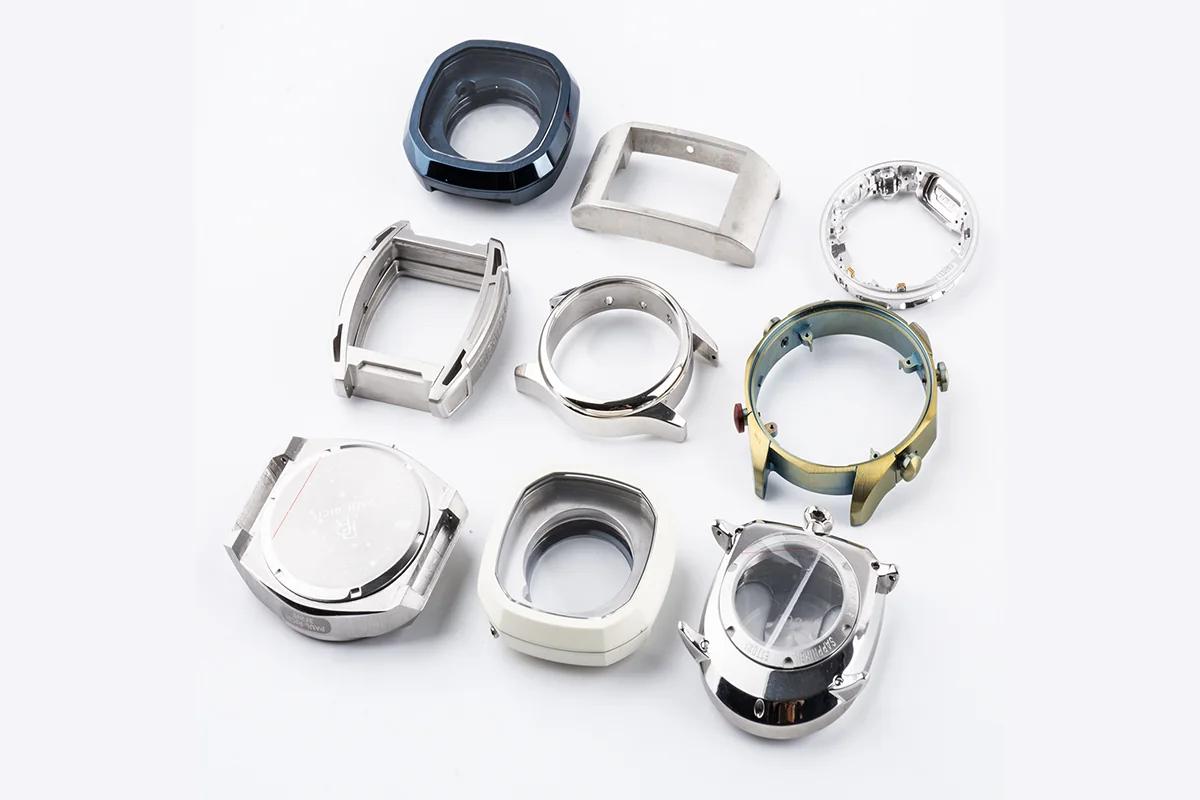
The supplier gallery shows square and round stainless-steel case structures and different finishing routes. The useful distinction is between the shape made by MIM and the polished, blasted or PVD-coated appearance achieved afterwards.
For an equivalent customer drawing: check integrated lugs, side openings, visible edges and which interfaces need final machining. Confirm the alloy and finishing sequence from production records; appearance alone cannot establish how the part was made.
When Is MIM the Right Manufacturing Route for Watch Case Parts?
MIM becomes attractive when it can form useful case geometry that would otherwise require substantial stock removal or multiple machining setups, and the production plan can absorb the mold investment. The decision depends on geometry, size, material, design maturity, cosmetic requirements, secondary operations and annual volume together—not on part complexity or a low quoted unit price alone.
| Design and project situation | 평가를 위한 경로 | Why / what to confirm |
|---|---|---|
| Compact case middle with integrated lugs, curved walls, guards or difficult side features; stable repeat orders | MIM 적합 부품 | Check mold release, feedstock, shrinkage control, surface zones and full cost after finishing. |
| Simple body, prototype quantity, frequently changing dimensions or unresolved assembly layout | CNC 우선 | Machining avoids early tooling commitment and is easier to revise during development. |
| Moldable main housing with precision lug holes, crown bores, threads or sealing seats | MIM + CNC review | Separate near-net-shape geometry from final functional datums and specify machining allowance. |
| Thin, relatively flat decorative geometry or a large simple housing | 대안 비교 | Stamping, casting or machining may be more practical depending on geometry and quantity. |
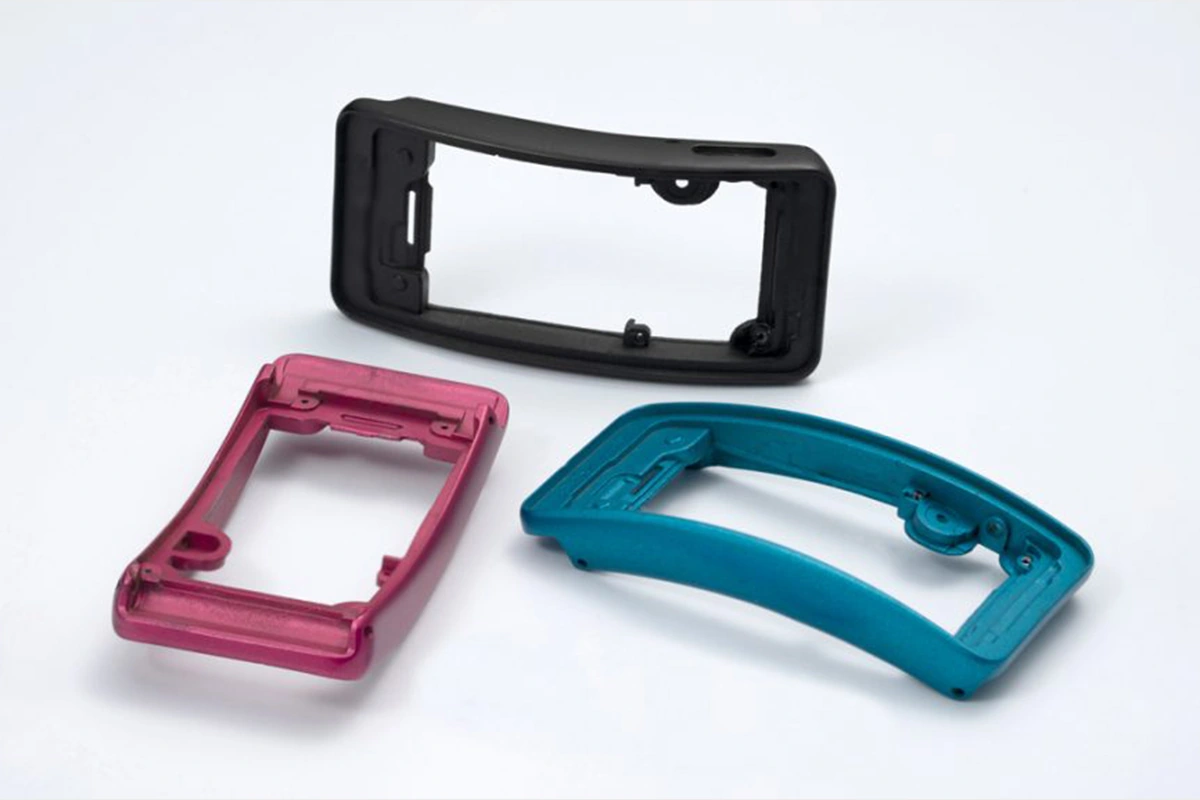
Hangzhou Sino-MIM Technology Group (SMTG) received a 2024 MPIF Design Excellence Award of Distinction for an aluminium-alloy smartwatch case. The published case highlights thin, complex profiles requiring high-flow feedstock and fast injection molding, followed by manual polishing of curved surfaces and colour anodising.
제조 시사점: The molded housing still required manual polishing and anodising to meet its appearance target. A similar design should be assessed for both forming complexity and finishing work before MIM is selected; the award does not qualify aluminium MIM production at XTMIM.
For a case middle with integrated lugs and side features, MIM could replace several machining setups; the benefit depends on whether those features can be released from the tool, survive sintering and meet final assembly requirements. If most visible or mating surfaces still require extensive CNC work, molding may offer less economic advantage. Compare the delivered and accepted part: tooling amortization, molding, debinding, sintering, machining, finishing, inspection and expected production volume—not just the as-sintered unit price.
Which Watch Case Design Features Need DFM Review Before Tooling?
A case can look simple in a product rendering but combine thin walls, thicker bosses, side holes and high-visibility surfaces that respond differently during molding and sintering. The design-for-manufacturing review should identify the features likely to cause distortion, poor tool release, surface marks or costly rework 이전에 the mold is ordered.
Wall Thickness, Integrated Lugs, and Mold Release
Large differences between a thin case wall and a heavy lug root or crown guard can complicate feedstock filling and uniform binder removal and sintering. Abrupt transitions should be checked for local distortion risk, while undercuts, deep recesses and side openings require an achievable parting-line, core or secondary-machining plan.
Cosmetic faces add a second constraint. Gate vestiges and parting-line traces should not be placed casually on a prominent bezel or polished case flank. The engineering review needs a map of visible and hidden zones so mold design, finishing access and the customer’s appearance expectations remain compatible.
Sintering Distortion and Tooling Compensation
MIM parts undergo substantial sintering shrinkage; the exact compensation depends on alloy, feedstock, part geometry, orientation and the validated process. Asymmetric lugs, thin rims and interrupted wall sections may shift relative to the intended CAD geometry. A single nominal shrinkage factor does not eliminate local distortion, so the mold plan also considers datum location, sintering supports, trial feedback and critical machining stock.
Illustrative engineering example (not a documented XTMIM project): Consider a middle case with a thick body and narrow integrated lugs. If local distortion moves the lug-hole axes during sintering, the strap pin may bind even when the outer case looks acceptable. Before tooling, mark the pin-hole center relationship and assembly datum on the drawing, assess whether the holes can remain as-sintered, and—if necessary—reserve stock and tool access for final drilling or reaming. Confirm the result with mating-pin or functional-gauge checks on the finished sample.
이 MIM DFM 가이드 covers further considerations for walls, mold release and tool design.
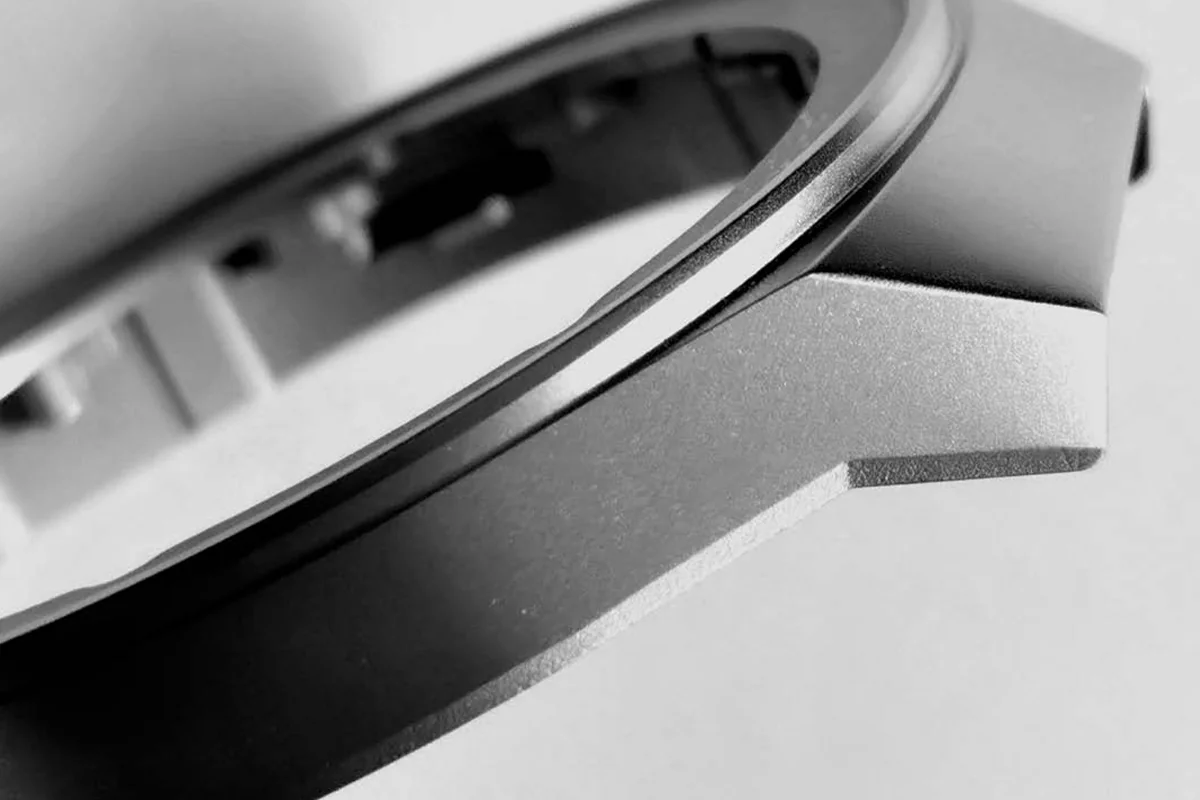
In its December 2020 technical report, ElementPlus describes pilot-scale testing of Ti-6Al-4V MIM smartwatch housings. The report indicates that many complex structural features were molded, while a limited number of stricter-tolerance areas still needed CNC machining after sintering.
Implication for case design: Keep moldable geometry separate from the final assembly datums, provide machining access where tighter tolerances are required, and check the sintered condition during trials. ElementPlus documents a development route; titanium MIM availability at XTMIM requires separate confirmation.
How Are Critical Dimensions and Sealing Interfaces Planned?
Not every watch case dimension needs the same manufacturing route or acceptance criterion. A decorative contour and a gasket land may look equally important on a CAD model, but only one may determine sealing contact. Separate assembly-critical characteristics from reference and cosmetic dimensions; for each critical feature, state its mating part, datum, target tolerance, finish condition and inspection stage on the drawing.
Crown, Pusher, and Lug Hole Alignment
Side bores and strap pin holes may need precise diameters, center distances, coaxiality or positional relationships to neighboring parts. A molded pilot feature is not always the final functional hole. Depending on accessibility and drawing requirements, drilling, reaming or CNC finishing can establish the final dimension from a controlled datum. Specify the mating pin, crown or pusher geometry and the allowable assembly clearance rather than assigning an unexplained tight tolerance to every feature.
Case-Back, Crystal, and Sealing Interfaces
Gasket seats, crystal lands, threaded interfaces and case-back contact faces can require controlled geometry and surface condition. Evaluate flatness, groove profile, relative position, machining access and cleanliness after finishing. Whether these surfaces need cutting or another operation must be determined by the design and process capability—not assumed from the material grade.
| 형상 | 주요 리스크 | Possible control route |
|---|---|---|
| Outer cosmetic case contour | Distortion or visible surface variation | Part profile inspection and an agreed finish / appearance reference. |
| Lug pin holes | Strap pin interference or poor alignment | Datum-based position check, functional gauge and machining review where needed. |
| Crown and pusher bores | Fit, operating clearance and interface alignment | Inspect actual mating requirements; allow controlled boring or reaming if justified. |
| Case-back and crystal interfaces | Fit, flatness, sealing geometry or roughness | Review precision finishing and dimensional / profile inspection to the drawing. |
Read the dedicated MIM 공차 guidance for general dimensional considerations. Final watch case capability must still be established against the actual drawing and process route.
How Should Materials and Finishes Be Specified for Watch Case Parts?
Material and appearance cannot be specified independently. A case alloy must satisfy its functional environment, while the surface finish must be achievable on the actual base condition after sintering and any machining. XTMIM can review material and finish directions, but the approved alloy, available MIM feedstock, achievable appearance and manufacturing route are project-specific.
Material Requirements and Manufacturing Feasibility
Begin with service conditions: exposure to sweat or moisture, required corrosion resistance, mechanical loads at lugs or fasteners, intended weight, cosmetic requirements and any applicable skin-contact specifications. These determine which material families merit review; a familiar alloy name alone does not prove it is suitable for MIM or for a particular watch case.
| 후보 재료 방향 | Why a buyer might consider it | 확인해야 할 사항 |
|---|---|---|
| 304 스테인리스강 | General corrosion and appearance requirements in selected components. | Actual service exposure, feedstock/process availability and target polishing or coating. |
| 316L 스테인리스강 | Corrosion-sensitive or high-visibility watch case applications. | Finish target, corrosion acceptance, surface preparation and specified material condition. |
| 17-4 PH 스테인리스강 | Selected structural features where strength is a stronger driver. | Heat treatment, corrosion trade-offs, magnetic behavior and dimensional response. |
| 티타늄 합금 | A lower-mass option in some watch case concepts. | Separate feasibility review for MIM feedstock, processing atmosphere, oxygen control, cost and finishing; do not assume routine production availability. |
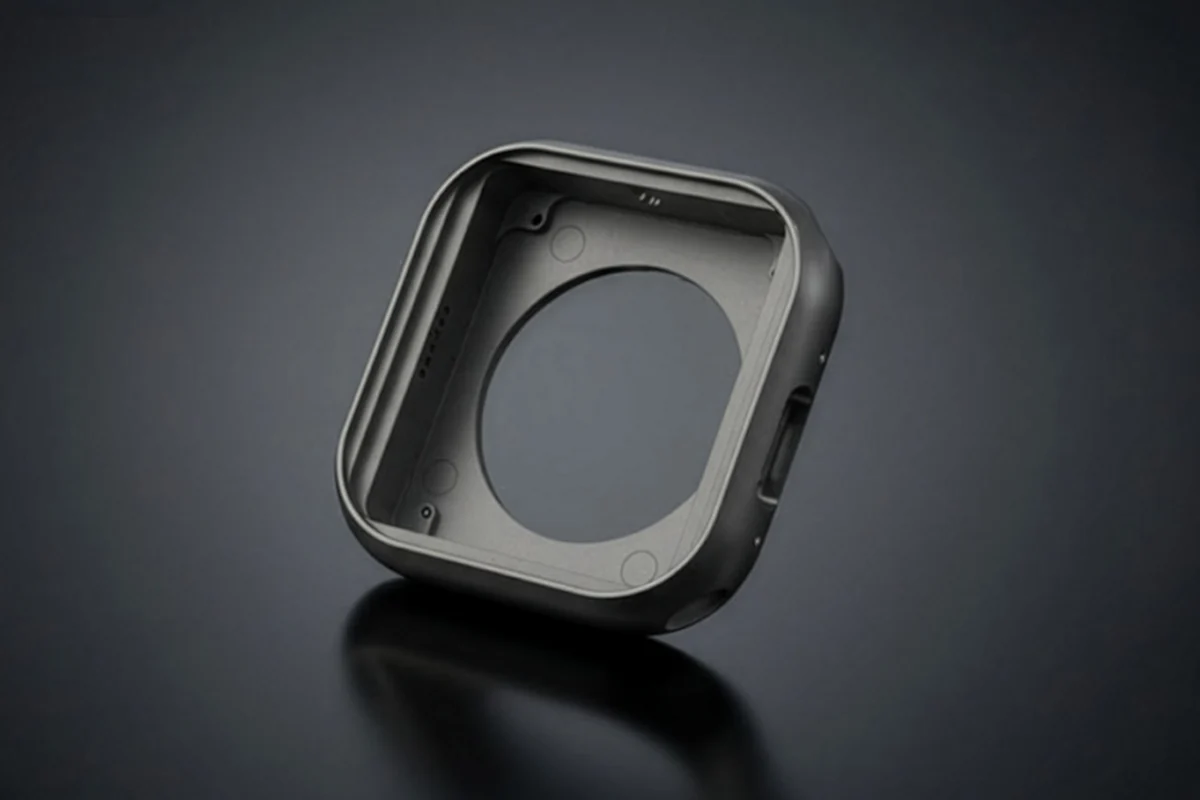
A 2026 PIM International feature identifies a titanium MIM wearable-device case made by MTIG. The example confirms that titanium MIM has been used for a wearable housing. The published example does 해당 산업의 모든 부품에 MIM을 사용해야 한다는 것을 identify the exact titanium grade or verify that the same process is available at XTMIM.
For titanium case development: Confirm alloy composition, suitable feedstock, sintering atmosphere and oxygen control, dimensional requirements, finishing method and order volume before tooling. The alloy grade must be confirmed from technical documentation rather than appearance alone.
These are candidate materials for engineering review, not a list of stocked or qualified XTMIM watch-case alloys. Requirements for chemical composition, skin contact, corrosion resistance or coating performance must be tied to a material specification and acceptance method before quotation. Material properties and comparisons are covered in MIM 재료; process availability is confirmed for each project.
Surface Finish, Cosmetic Zones, and Coating Readiness
A polished, brushed or coated case is judged on visible edges and surfaces as much as on dimensional inspection. Define A-surfaces, permitted gate/parting-line zones, appearance inspection lighting, gloss or texture references and allowable defects before tooling. Deep recesses and sharp edges may limit consistent polishing or coating access.
Gold, rose-gold and black describe cosmetic finish targets, not base-metal grades. Color and appearance depend on the alloy substrate, polishing quality, edge condition, pretreatment and coating route. Agree on an approved physical finish sample, the visible inspection zones and any required coating tests before committing to repeated production; appearance approval alone does not establish durability.
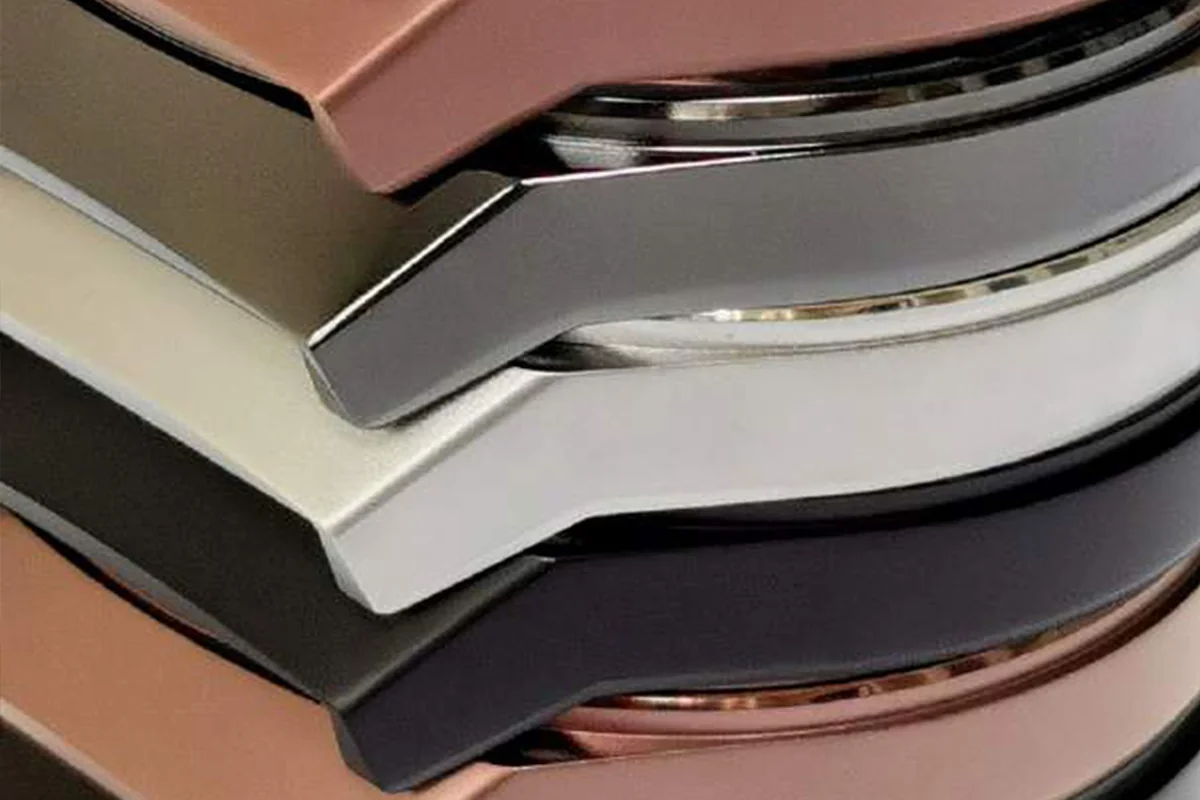
ElementPlus shows several finishes on titanium MIM watch-case housings. Each finish needs its own substrate-preparation and acceptance review; matching a color does not establish coating adhesion, wear resistance or repeatability. The reported variants do not establish XTMIM finishing capability.
Before approving a finish: Establish a physical appearance master, mark the A-surfaces, agree on viewing conditions, and specify any required adhesion, wear, corrosion or environmental tests. Final inspection must follow all intended finishing operations.
How Are Watch Case Samples and Production Requirements Validated?
Passing an initial visual check is not the same as demonstrating production readiness. Watch case parts may require dimensional approval, mating-part assembly, cosmetic acceptance and repeatability checks after molding, sintering, CNC work and coating. The drawing and purchase specifications should define the measurements and acceptance conditions for each part.
First-Sample Dimensional and Appearance Approval
The first-sample plan should identify which characteristics are inspected as-sintered and which are measured after finishing. Typical checkpoints include case-body profile, lug-hole alignment, crown or pusher dimensions, gasket interfaces and visible surface defects. Where assembly function is critical, the customer's mating components or functional gauges can expose a problem that basic dimensional checks miss.
Record the approved material specification, planned operations, measured critical characteristics, mating-part fit and approved appearance reference. Separate as-sintered inspection 과 final inspection after CNC and finishing so an acceptable intermediate part is not mistaken for an acceptable delivered part. Any deviation should trigger a documented decision on design changes, tool compensation, machining or finishing before production release.
Production Consistency and Inspection Planning
After first-sample acceptance, repeatability still needs a control plan. Identify the characteristics most sensitive to sintering variation, machining setup and appearance finishing; then assign the relevant in-process and final inspections. Record how deviations will be contained and reviewed. Inspection frequency, acceptance sampling and any functional tests should follow the actual drawing, part risk and contractual requirements, rather than a fixed inspection schedule for all designs.
| Review gate | What is confirmed | Decision before proceeding |
|---|---|---|
| Drawing and DFM release | Toolable geometry, critical dimensions, material and finishing plan. | Are risk features and planned post-operations agreed? |
| First-sample approval | Dimensions, mating fit, appearance and deviations after all required operations. | Is the approved sample representative of the proposed production route? |
| Production control setup | Inspection features, process checkpoints, appearance master and nonconformance response. | Can the relevant characteristics be monitored consistently? |
| Batch acceptance | Specified inspections and agreed visual/functional criteria for delivered parts. | Does the lot meet the contract and drawing acceptance requirements? |
1 — Functional approval: Does the measured component fit the customer's actual pin, crown, crystal, gasket or case-back interface, not just match nominal CAD dimensions?
2 — Cosmetic approval: Is an approved physical sample tied to surface zoning, viewing conditions and the agreed polishing/coating route?
3 — Repeatability plan: Which characteristics are most sensitive to sintering, machining location or surface finishing, and how will those characteristics be checked at the required production stage?
Link these approvals to the released drawing and inspection plan so later batches are checked against the same dimensional and cosmetic requirements.
What Is Needed for a Watch Case DFM Review and RFQ?
To obtain a meaningful watch case manufacturing assessment, send more than a photo or a material name. The drawing should identify what must be formed, what must fit or seal, which surfaces control appearance and how many acceptable parts are needed. These inputs let engineering distinguish MIM feasibility, CNC-only needs and any combined-process quotation.
| 제공할 사항 | How it supports the engineering review |
|---|---|
| 2D 도면 및 3D CAD | Establish geometry, datums, critical tolerances, wall transitions and manufacturing access. |
| 재료 및 성능 요구 사항 | Check practical alloy choices, feedstock/process availability, corrosion or structural constraints. |
| Mating-part and assembly data | Review lug pins, crown/pusher interfaces, crystal or case-back seats and any required functional test. |
| Finish and cosmetic-zone reference | Plan gate location, preparation, polishing/coating work and appearance acceptance criteria. |
| Estimated batch size and annual demand | Assess tooling economics, process selection and likely post-processing workload. |
| Project stage, schedule and existing sample | Distinguish concept/prototype work from design-frozen production, and compare a physical sample or approved photos where available. |
The next engineering decision is whether the available information supports MIM DFM, a CNC prototype, or a hybrid process review. XTMIM can then identify unresolved features, confirm which material and finish trials are required, and define the inputs for a tooling and delivered-part quotation. A drawing review does not itself approve performance, production capability or a complete watch assembly.