견적 요청

전문가 팀의 맞춤형 컨설팅을 받으려면 아래 양식을 작성해 주세요.

MIM Gears for Small Precision Metal Parts

MIM Parts · Gear Manufacturing Review

MIM Gears for Small Precision Metal Transmission Parts

Metal injection molded gears are worth reviewing when the gear is small, complex, production-volume, and difficult to manufacture economically by machining or conventional powder metallurgy. They are not the right route for every gear. Large gears, very low-volume prototypes, simple PM-suitable spur gears, and gears that require grinding-level tooth accuracy may be better made by CNC machining, hobbing, grinding, or powder compaction. For design engineers, the real question is whether the tooth geometry, bore alignment, material, load, shrinkage behavior, inspection method, and annual volume make MIM technically reasonable before tooling. Continue reading if your gear includes micro teeth, internal features, integrated hubs, gear shafts, compact transmission geometry, or machining access problems that need an early manufacturability review.

From a design review perspective, the issue is not only “Can 금속 사출 성형(MIM) form the gear?” but “Will the molded, debound, sintered, and inspected gear meet the functional requirement after shrinkage, distortion, material selection, and any local secondary machining are considered?”

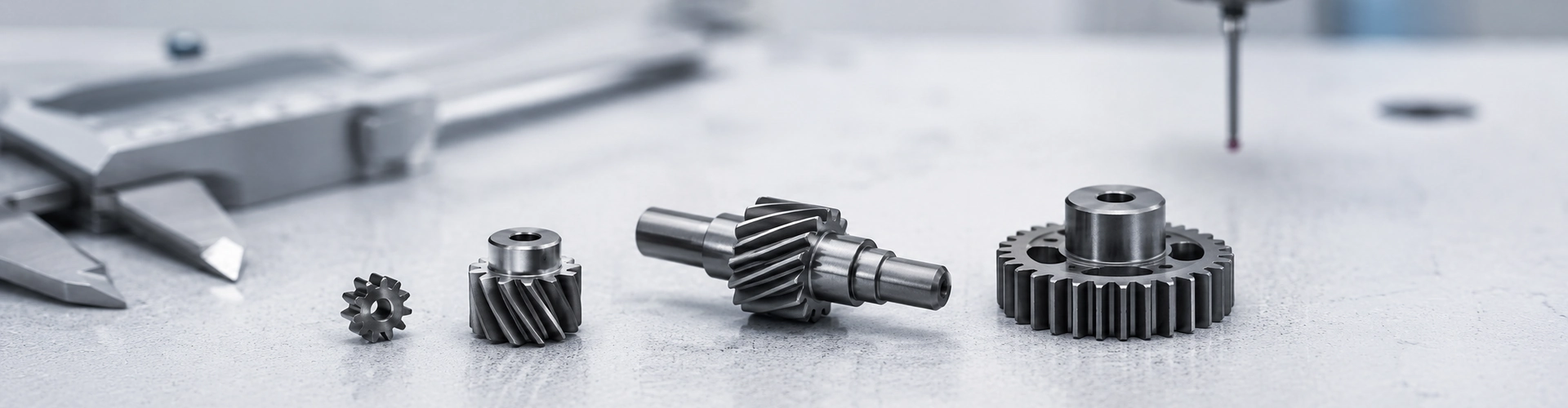
Small precision MIM gear parts for manufacturability review, including micro gears and integrated gear shafts
Small precision MIM gear parts for manufacturing review.

핵심 결론: MIM gear review should focus on compact, complex, production-volume parts rather than treating every metal gear as a MIM candidate.

MIM에 적합

  • Micro gears and miniature gear parts
  • Integrated gear shafts and complex hubs
  • Small internal gears or compact transmission features
  • Medium to high production-volume metal gears

신중히 검토

  • Helical gears and worm gear parts
  • High-load or wear-sensitive gears
  • Tight bore-to-tooth concentricity
  • Gears requiring heat treatment or local machining

Usually Not First Choice

  • Large gears or heavy-duty drivetrain gears
  • 매우 소량의 프로토타입
  • Simple regular PM-suitable gears
  • Gears requiring full grinding-level tooth finishing

When Are Gears Suitable for Metal Injection Molding?

A gear becomes a stronger MIM candidate when the part combines small size, complex geometry, production volume, and material requirements that make conventional machining inefficient. In practice, MIM is most often reviewed for compact metal gears with integrated hubs, small shafts, internal features, fine teeth, non-standard bores, stepped geometry, or complex side features.

A common mistake is to assume that any metal gear can be converted to MIM. That is not accurate. MIM starts with fine metal powder mixed with binder to create feedstock. The feedstock is injection molded, the green part is handled and debound, and the brown part is sintered to high density. During sintering, the part shrinks, so gear tooth form, bore position, concentricity, support method, and distortion risk must be reviewed before tooling. For broader structural rules, use this page together with the MIM 설계 가이드.

Gear Condition Why It Supports MIM Review
Small or miniature size Small gear parts can be difficult and costly to machine repeatedly, especially when they include fine teeth, compact hubs, or small functional bores.
Complex 3D features MIM can integrate teeth, hubs, shafts, holes, retention shapes, and functional details into one metal component when tooling and shrinkage behavior are feasible.
중대량 생산 MIM tooling cost can be justified when the design is stable and the projected production volume supports tool amortization.
Difficult machining access Fine teeth, internal forms, compact bores, and side features may increase machining time, fixturing complexity, inspection difficulty, and scrap risk.
Need for dense metal properties MIM can produce dense metal parts when material selection, debinding, sintering, and inspection are controlled for the application requirement.
Assembly reduction opportunity MIM may combine a gear, shaft, hub, and retention feature into one component, reducing pins, keys, press-fit operations, or small assembly steps.

엔지니어링 규칙: MIM should be selected because it solves a geometry, volume, integration, or machining-access problem—not simply because the part is a metal gear.

MIM Gears vs PM Gears vs Machined Gears: Which Process Fits?

The real manufacturing decision is often between MIM, 분말 야금, and machining. PM should not be treated as a weaker version of MIM. PM can be better when the gear is relatively regular, cost-sensitive, high-volume, and suitable for axial powder compaction. Machining can be better when the gear is large, low-volume, still changing in design, or requires tooth finishing accuracy that depends on hobbing, shaping, or grinding. For a broader process-level comparison between powder compaction and MIM feedstock molding, review the MIM vs PM process comparison.

Decision map comparing MIM gears, PM gears, and machined gears by geometry complexity, production volume, tooling economics, and accuracy requirements
MIM vs PM vs CNC gear manufacturing decision map.

핵심 결론: The correct gear process depends on geometry, production volume, tooth accuracy, tooling economics, and the level of functional risk—not only on the material being metal.

의사 결정 요소 MIM 기어 PM Gears CNC / Machined Gears
최적 적합 Small, complex, production-volume gears Regular, high-volume, cost-sensitive gears Prototypes, low-volume gears, large gears, high-accuracy gears
형상 Complex 3D features, internal forms, small teeth, integrated shafts, compact hubs Axial compaction-friendly shapes with relatively regular geometry Flexible geometry, but cost rises with small features, complex fixturing, and tight inspection needs
체적 Medium to high volume after design stabilization High volume with strong cost pressure Low to medium volume, prototypes, or changing designs
금형 Higher tooling investment, justified by complexity, repeatability, and volume Often economical for compactable regular shapes No MIM tooling, but higher unit machining cost for complex miniature features
Accuracy strategy Tooling compensation, sintering control, inspection, and local machining if needed Compaction, sintering, sizing, coining, repressing, and inspection Turning, milling, hobbing, shaping, grinding, and post-machining inspection
Typical examples Micro gears, integrated gear shafts, compact helical gear parts, small internal gear features Regular spur gears, oil-impregnated gears, simple structural gears High-accuracy gears, large gears, prototypes, frequently revised parts
Not ideal for Large gears, low volume, ultra-high tooth finishing requirements Complex 3D features, undercuts, and non-compactable forms High-volume tiny complex gears where machining time and inspection cost are excessive

MIM Gear Types Commonly Reviewed for Production

This section helps users route a gear project into the right subcategory. The goal is not to turn this gear overview page into a deep page for every gear type. More specific projects can be routed by gear type, such as micro gears, helical gears, worm gear parts, internal gears, or integrated gear shafts, when the drawing and application background show that a focused engineering review is needed.

MIM gear type suitability map showing micro gears, integrated gear shafts, helical gears, internal gears, worm gear parts, and complex spur gears
MIM gear type suitability map.

핵심 결론: The strongest MIM gear candidates usually combine small size, complex geometry, and functional integration.

마이크로 기어

Micro gears are strong MIM candidates when the part is small, metal, complex, and required in production volume. Fine teeth, small bores, miniature shafts, compact transmission layouts, and limited machining access can make conventional machining costly or unstable.

Before tooling, the project should review tooth size, bore-to-tooth concentricity, inspection method, material, and whether any local finishing is needed after sintering.

Integrated Gear Shafts

Integrated gear shafts are valuable MIM candidates when the project can reduce separate machining, assembly, pins, keys, or press-fit operations. The main engineering issue is the relationship between gear teeth, shaft straightness, concentricity, and local finishing strategy.

Compare related MIM shafts and pins

헬리컬 기어

Helical gears can be reviewed for MIM when the tooth geometry, size, and production volume justify tooling complexity. Compared with simple spur gears, helical gears introduce concerns such as helix angle, thrust direction, tooling movement, sintering distortion, and inspection.

Internal Gears

Small internal gears may be suitable for MIM when internal teeth, compact housing features, or difficult machining access make conventional cutting less efficient. The key risks are internal tooth filling, distortion, inspection access, and tooth-to-bore alignment.

Worm Gear Parts

Worm gear parts and worm-wheel-related geometries can be attractive MIM candidates when the part includes small size, complex helical-like geometry, sliding contact, integrated shafts, or difficult machining access. Wear, lubrication, hardness, and mating part condition should be reviewed early.

Review wear-resistant MIM parts

Small Spur Gears with Complex Hubs

Small spur gears can be MIM candidates, but only under the right conditions. A simple, regular spur gear may be more economical by PM or machining. MIM becomes more relevant when the spur gear includes a complex hub, special bore, integrated shaft, side feature, or assembly-reduction opportunity.

When MIM Is Not the Best Manufacturing Route for Gears

A strong MIM review should also explain when MIM is not the best choice. This is especially important for gears because tooth accuracy, load, noise, heat treatment, and finishing requirements may override the apparent benefit of near-net-shape molding. If the functional requirement depends on final tooth grinding, MIM may only replace the blank-forming step, not the full gear finishing route.

Gear Condition MIM이 적합하지 않을 수 있는 이유 Better Route to Review
Large gear size Sintering shrinkage and distortion risk increase with part size, uneven mass, and unsupported geometry. CNC, hobbing, casting plus machining, or forged/machined route depending on load
Very low volume Tooling cost is difficult to justify when the design is not stable or the production demand is small. CNC 가공
Simple regular gear PM may be more economical if the shape is suitable for axial powder compaction and does not require complex 3D features. PM
Ultra-high tooth accuracy Final accuracy may depend on hobbing, grinding, or dedicated tooth finishing operations. Hobbing, grinding, precision machining
Frequently revised design MIM tooling changes can be expensive after the mold is built. CNC prototype or staged design validation
Heavy-duty safety-critical gear Fatigue, heat treatment, wear, validation, and application-specific testing may dominate the process decision. Project-specific process review
Fully ground tooth surfaces The near-net-shape benefit of MIM may be reduced if the critical functional surfaces still require full machining. Machining or grinding

Gear Accuracy, Load, and DFM Risks Before Tooling

Gear parts require a stricter review than many simple structural MIM components. A gear is not only judged by external shape. It must mesh, rotate, transfer load, manage wear, and fit mating parts. A gear may look moldable in CAD but still create problems if tooth profile, pitch behavior, runout, bore alignment, heat treatment response, and inspection requirements are not defined before tooling.

MIM gear DFM risk map showing tooth shrinkage, bore concentricity, root strength, parting line, sintering distortion, and secondary machining allowance areas
MIM gear DFM risk map before tooling.

핵심 결론: A gear may be moldable but still fail functionally if tooth accuracy, bore alignment, load, and sintering behavior are not reviewed before tooling.

Tooth Accuracy Is Not Only a Molding Issue

Tooth accuracy depends on mold design, feedstock behavior, filling stability, green part handling, debinding, sintering shrinkage, part support, and final inspection. If the gear has a specified tooth tolerance, backlash target, or runout limit, those requirements should be included in the RFQ package.

Load, Wear, Noise, and Mating Conditions

A small MIM gear may pass dimensional inspection but still fail if the mating gear, lubrication, load direction, tooth contact, or hardness requirement is not considered. Noise-sensitive gears need additional caution because small tooth and runout changes can affect motion feel.

Tooth Profile Shrinkage and Compensation

MIM gears experience shrinkage during sintering. Tooling must compensate for this shrinkage, but compensation becomes more difficult when teeth are small, walls are thin, hubs are asymmetric, or mass distribution is uneven.

Bore-to-Tooth Concentricity

Bore-to-tooth concentricity is often more important than a single bore diameter value. When concentricity is critical, the drawing should define the datum structure, bore tolerance, runout requirement, and inspection method.

Tooth Root Strength

Tooth root strength is influenced by material, heat treatment, tooth geometry, root radius, density, surface condition, and loading direction. For load-bearing gears, review the tooth root, hub, bore, and integrated features together.

Secondary Machining Strategy

The goal of MIM is not always zero machining. A better goal is to reduce unnecessary machining while using local secondary operations for bores, datum faces, bearing interfaces, shaft seats, or critical assembly surfaces.

Composite Field Scenario for Engineering Training: Bore Runout After Sintering

발생한 문제: A compact MIM gear assembled onto a shaft, but rotation showed uneven motion and inconsistent backlash during functional checking.

발생 원인: The original drawing emphasized tooth shape and bore diameter but did not clearly define bore-to-tooth concentricity, datum structure, or runout requirement.

실제 시스템적 원인: The gear was reviewed as a molded shape rather than as a rotating functional part. Sintering shrinkage, local mass distribution, datum selection, and post-sintering inspection were not linked early enough.

수정 방법: The drawing was updated to define functional datums, runout requirements, and inspection method. A local post-sintering bore finishing strategy was reviewed for the most critical interface.

재발 방지 방법: Before tooling, define the functional axis, mating shaft condition, tooth-to-bore relationship, acceptable runout, and whether the bore should be molded net-shape or finished after sintering.

Material and Heat Treatment Review for MIM Gears

MIM gear material selection should be driven by load, wear, corrosion exposure, mating part condition, heat treatment response, and inspection requirements. It should not be selected only by generic hardness or strength expectations. For broader material family selection, review the MIM 재료 허브를 방문하십시오.

요구 사항 Material Review Question
내마모성 Does the gear need hardness, surface control, lubrication, or mating material review?
내식성 Is the gear exposed to humidity, cleaning agents, medical environments, or outdoor conditions?
Strength Is torque load, tooth root stress, or impact resistance the primary concern?
열처리 Will heat treatment improve performance, or will it increase distortion and dimensional control risk?
자기적 거동 Does the application require magnetic or non-magnetic behavior?
비용 Is the material requirement justified by gear function, annual volume, inspection requirements, and service environment?

Common MIM gear material families may include stainless steels, precipitation-hardening stainless steels, low alloy steels, and wear-focused stainless grades, depending on the project. Final selection should be confirmed through material datasheets, heat treatment strategy, dimensional review, and application testing.

Inspection Points for MIM Gear Projects

Inspection requirements should be selected based on gear function. A low-load positioning gear does not need the same inspection plan as a high-accuracy transmission gear. The drawing, mating parts, application load, and buyer requirements should define what must be controlled.

검사 포인트 중요성
Tooth profile Affects meshing, motion transfer, contact behavior, and functional noise.
Tooth thickness Affects backlash and functional fit.
Pitch error Affects transmission smoothness and accumulated motion error.
Runout Affects rotation stability and gear engagement.
Bore diameter Controls shaft fit and assembly condition.
Bore-to-tooth concentricity Controls how the gear rotates relative to the functional teeth.
경도 Influences wear behavior and load capacity.
Density / sintering condition Affects mechanical reliability, dimensional consistency, and material performance.
표면 상태 Influences friction, wear, lubrication behavior, and mating surface interaction.
Functional fit Confirms performance with the mating gear, shaft, or assembled mechanism when required.

Inspection note: For high-accuracy gears, inspection requirements should be defined by the drawing, application, mating gear, and applicable gear tolerance reference instead of assuming a generic MIM tolerance. Gear quality grade requirements must be confirmed against the drawing, inspection method, supplier capability, and any required post-sintering finishing process.

Where MIM Gears Are Commonly Reviewed

MIM gear projects often appear inside broader industry applications, but this page should not become an industry application page. The following examples are routing points for users who need industry-specific part context.

Automotive Small Gear Parts

Automotive MIM gear review is most relevant for small mechanisms, lock components, actuator parts, sensor-related mechanisms, and compact metal transmission elements. Large transmission gears or high-load drivetrain gears normally require a different route.

Review automotive MIM parts

Robotics Gear and Actuator Parts

Robotics applications may use compact metal gears where space, integration, strength, and repeatable motion matter. Load, backlash, wear, and lubrication should be evaluated early.

Review robotics MIM parts

Medical Device Micro Transmission Parts

Medical device gear applications may involve small motion-control parts, instrument mechanisms, or compact assemblies. MIM review should consider material selection, cleaning exposure, inspection requirements, and functional fit.

Review medical MIM parts

Consumer Electronics and Precision Hinge Gears

Consumer electronics and precision hinge systems may use small metal gears or gear-like transmission features where compact size, smooth motion, and assembly reduction matter.

Review consumer electronics MIM parts

How We Review a MIM Gear Drawing Before Quotation

A useful MIM gear quotation should begin with manufacturability review, not only price calculation. The review should identify whether the gear is a good MIM candidate or whether PM, machining, hobbing, or grinding is more practical. This prevents the project from paying for MIM tooling when the real constraint is tooth accuracy, volume, heat treatment distortion, or a geometry that another process can produce more reliably.

MIM gear RFQ review checklist showing drawing inputs, gear parameters, material requirements, DFM review, tooling risk, shrinkage review, and inspection points
MIM gear RFQ and engineering review checklist.

핵심 결론: Better RFQ input allows the supplier to review MIM suitability, PM or machining alternatives, tooling risk, shrinkage behavior, and inspection requirements before quotation.

검토 항목 What the Engineering Team Checks
Gear type and tooth geometry Whether the gear is spur, helical, internal, worm-related, micro, integrated shaft, or compound.
Part size and mass distribution Whether shrinkage, support, and sintering distortion can be controlled.
Bore, shaft, hub, and integrated features Whether MIM integration reduces machining and assembly without creating unacceptable risk.
Material and heat treatment Whether the material route supports load, wear, corrosion, hardness, and dimensional stability.
중요 치수 및 데이텀 Whether drawing tolerances match functional gear requirements.
2차 가공 Whether local finishing is needed for bores, datum faces, gear interfaces, or bearing seats.
Annual volume and tooling economics Whether MIM tooling is reasonable compared with PM or machining.

What to Provide for a MIM Gear RFQ

A complete RFQ package helps the engineering team evaluate process suitability, tooling risk, material selection, inspection needs, and secondary machining requirements. For engineering review, send your drawing through 도면 제출하여 검토 요청 or start a formal RFQ through 견적 요청.

RFQ 입력 중요성
2D 도면 Defines dimensions, tolerances, datums, surface notes, and inspection requirements.
3D CAD 파일 Helps evaluate geometry, wall thickness, tooling layout, gating direction, and shrinkage compensation.
Gear type Defines whether the part is spur, helical, internal, worm-related, micro, integrated shaft, or compound.
Module or diametral pitch Defines tooth size and gear geometry.
Tooth count and pressure angle Supports tooth geometry and mating gear compatibility review.
Helix angle Required for helical gear review, tooling movement, and thrust-direction evaluation.
Bore diameter and tolerance Controls shaft fit and bore-to-tooth concentricity review.
Material and heat treatment Drives strength, corrosion resistance, wear behavior, hardness, distortion, and inspection review.
결합 부품 정보 Helps review backlash, contact, load, alignment, lubrication, and functional fit.
연간 물량 Determines whether MIM tooling is economically reasonable compared with PM or machining.

Composite Field Scenario for Engineering Training: Simple Spur Gear Routed Away from MIM

발생한 문제: A buyer requested a MIM quotation for a small spur gear because the part was metal and planned for repeated production.

발생 원인: The buyer assumed MIM was automatically better for all small metal gears.

실제 시스템적 원인: The gear shape was regular, the tooth geometry was not complex, and the part did not use MIM’s strongest advantage: complex 3D feature integration. The design could be evaluated by PM because the geometry was suitable for axial powder compaction.

수정 방법: The project was reviewed as a PM candidate instead of forcing a MIM route. MIM remained a backup only if future design changes added complex hubs, integrated shafts, internal features, or machining-access problems.

재발 방지 방법: During RFQ review, compare MIM, PM, and machining by geometry, volume, tolerance, tooling cost, and functional risk before selecting the manufacturing route.

표준 및 기술 참고 사항

Gear and MIM project requirements should be confirmed against the customer drawing, material datasheet, mating part condition, and applicable project standards. The references below are included to guide technical discussion; they should not be used as a substitute for project-specific engineering review.

MPIF Standard 35-MIM supports material specification and engineering property reference for MIM parts. ISO 1328-1 supports gear accuracy terminology and tolerance reference for cylindrical involute gears. Neither reference by itself defines whether a specific MIM gear will meet the buyer’s functional requirement; final acceptance should follow the drawing, mating condition, inspection method, secondary finishing plan, and supplier capability review.

  • MPIF Standard 35-MIM: relevant for MIM material specification and engineering property reference when selecting a MIM material for gear parts.
  • MIMA 설계 센터: relevant for understanding how complex MIM part design and tooling review affect manufacturability and cost.
  • ISO 1328-1: relevant when the buyer and manufacturer need a formal reference for cylindrical involute gear flank tolerance classification and tooth-flank conformity language.

FAQ About MIM Gears

Are all metal gears suitable for MIM?

No. MIM is mainly suitable for small, complex, production-volume metal gears where tooling cost can be justified and where the geometry benefits from injection molding. Large gears, low-volume prototypes, simple PM-suitable gears, or gears requiring heavy grinding may be better made by machining, PM, hobbing, or grinding.

When should I choose PM instead of MIM for gears?

PM may be a better option when the gear has a regular geometry, can be formed by axial powder compaction, and is produced in high volume with strong cost pressure. MIM becomes more relevant when the gear includes complex 3D features, internal forms, small details, or integrated shafts that are difficult for conventional PM compaction.

CNC 가공 대신 MIM을 선택해야 하는 경우는 언제인가요?

CNC machining is usually better for prototypes, low-volume gears, large gears, frequently revised designs, or gears requiring very high tooth accuracy through hobbing, shaping, grinding, or other precision finishing.

Can MIM make helical gears?

MIM can be reviewed for helical gears, especially small and complex designs, but the project must consider helix angle, tooling movement, parting line, sintering distortion, tooth inspection, mating gear condition, and production volume.

Can MIM gears meet high gear accuracy grades?

MIM gears can meet some project-specific accuracy requirements, but high gear quality grades must be confirmed by drawing requirements, supplier capability, inspection method, tooling control, and any required secondary finishing. If the functional requirement depends on final tooth grinding, MIM may only replace part of the blank-forming route, not the full gear finishing route.

Do MIM gears need secondary machining?

Some MIM gears can be used near-net-shape, but others may need local machining for bores, datum faces, shaft seats, bearing interfaces, or high-precision assembly surfaces. The goal is not always to eliminate all machining; it is to use machining only where it improves function or reduces risk.

What information is needed for a MIM gear quotation?

A useful RFQ should include 2D drawings, 3D CAD files, gear type, module or diametral pitch, tooth count, pressure angle, helix angle if applicable, bore tolerance, material, heat treatment, surface finish, mating part information, load or torque conditions, and estimated annual volume.

Can MIM gears replace machined gears?

Sometimes. MIM can replace machined gears when the part is small, complex, and produced in sufficient volume. It is less suitable when the gear is large, low-volume, frequently changed, or requires very high tooth finishing accuracy that still depends on grinding or precision machining.

Submit Your Gear Drawing for MIM Suitability Review

If your gear is small, complex, integrated with shafts or hubs, difficult to machine repeatedly, or planned for medium to high production volume, send your drawing for MIM gear manufacturability review. XTMIM can review whether MIM is suitable, whether PM, machining, or a hybrid route may be more economical, where tooling and sintering risks may appear, and which critical features should be confirmed before tooling, trial production, or volume production.

For a useful review, provide 2D drawings, 3D CAD files, material requirements, gear parameters, critical tolerances, mating part information, heat treatment requirements, surface requirements, application background, and estimated annual volume.

XTMIM 엔지니어링 팀 검토

This page was prepared from a MIM gear manufacturability perspective. The review focus includes process suitability, material selection, DFM, tooling risk, green part handling, debinding and sintering shrinkage, gear tooth accuracy, bore-to-tooth concentricity, secondary machining strategy, tolerance requirements, inspection planning, and production feasibility.