
MIM Stainless Steel Materials for Metal Injection Molding
MIM stainless steel materials are used when a small, complex metal part needs corrosion resistance, clean appearance, strength, hardness, wear resistance, or heat treatment response. The key decision is not whether the part is “stainless steel,” but which stainless steel grade fits the application. 316L is usually a starting point for corrosion resistance and ductility, 17-4 PH for heat-treatable strength, and 420 or 440C for hardness and wear. 304 can fit general stainless applications, while Panacea-type stainless steel should be reviewed as a special nickel-free or non-magnetic option. Before tooling, engineers should confirm the working environment, load, hardness target, magnetic requirement, surface finish, critical tolerances, secondary operations, and annual volume.
For most projects, MIM 316L stainless steel is a good starting point when corrosion resistance and ductility are more important than hardness. MIM 17-4 PH stainless steel is usually considered when heat-treatable strength is required. MIM 420 및 MIM 440C are used when hardness and wear resistance matter more than maximum corrosion resistance. MIM 304 can be suitable for general stainless applications, while Panacea-type nickel-free stainless steel should be treated as a special-project material that requires material availability, feedstock route, sintering behavior and application confirmation before RFQ approval.
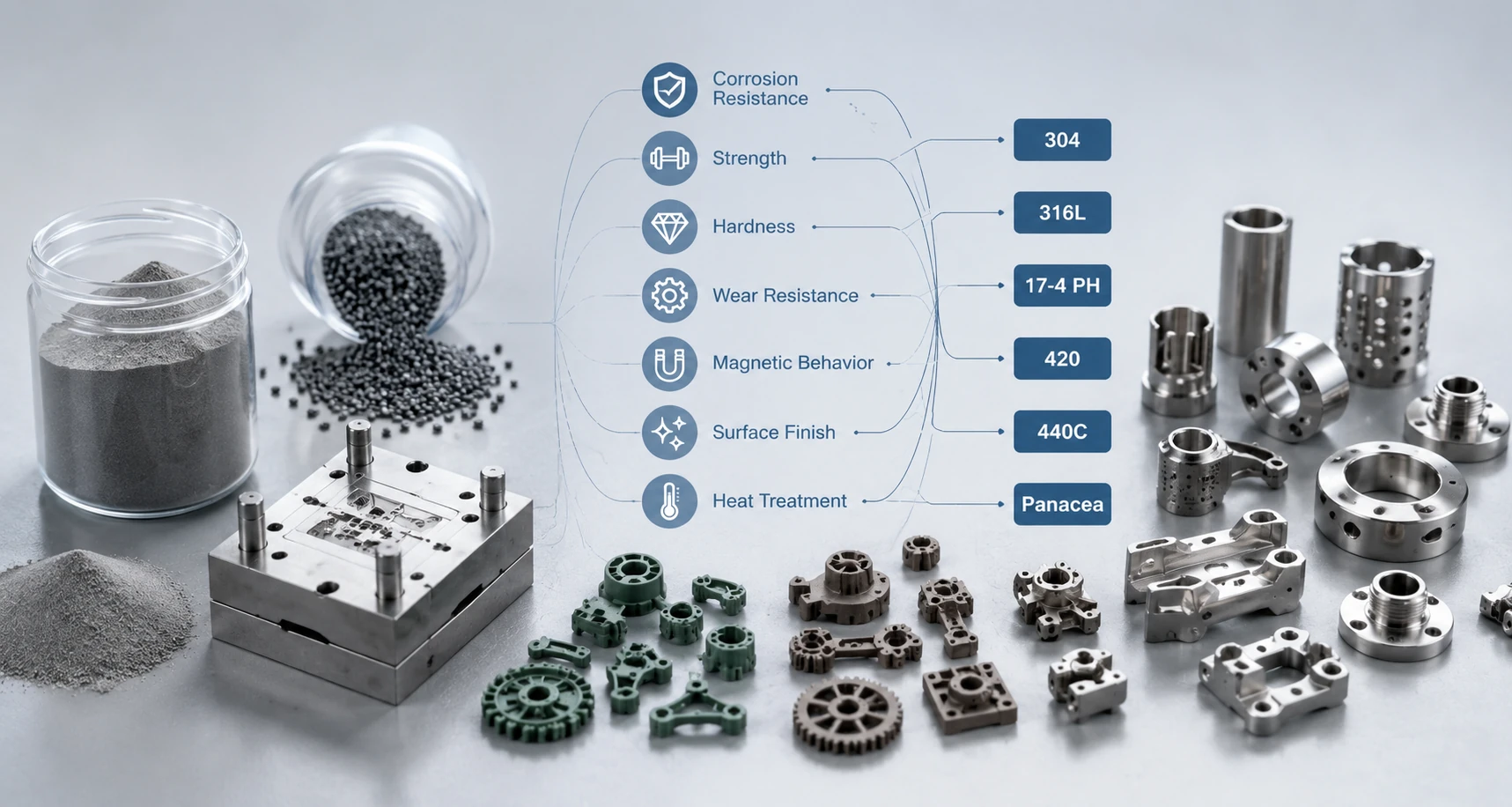
Quick Grade Decision Snapshot
Use this snapshot for early material routing. It should not replace drawing review, heat treatment review, corrosion exposure review or customer acceptance criteria.
| Grade | Choose When | Avoid or Review Carefully When | 다음 단계 |
|---|---|---|---|
| 304 | General stainless appearance, moderate corrosion resistance and basic mechanical performance are enough. | The part requires high chloride corrosion resistance, high strength, high hardness or defined wear performance. | Open the 304 material page |
| 316L | Corrosion resistance, ductility and clean stainless surface are more important than hardness. | The part needs high hardness, sliding wear resistance or heat-treatable strength. | Review 316L for corrosion-focused parts |
| 17-4 PH | High strength and heat treatment response are required for compact structural parts. | The application requires non-magnetic behavior or maximum corrosion resistance. | Review 17-4 PH heat-treatable stainless steel |
| 420 | Hardness, contact durability and moderate wear resistance are more important than 316L-level corrosion resistance. | The part is exposed to demanding corrosion conditions or needs high ductility. | Review 420 for hardness-driven parts |
| 440C | Higher hardness and wear resistance are required for small contact or engagement parts. | Toughness, corrosion exposure, edge chipping risk or distortion after heat treatment is critical. | Review 440C for high-hardness applications |
| Panacea | A nickel-free or special non-magnetic stainless option is being considered. | Material availability, feedstock route, sintering route and application validation are not yet confirmed. | Review Panacea-type stainless steel |
What Are MIM Stainless Steel Materials?
MIM stainless steel materials are stainless steel alloys processed through 금속 사출 성형(MIM). The process starts with fine stainless steel powder mixed with a binder system to create feedstock. The feedstock is injection molded into a green part, then debound and sintered to achieve the final metal structure. Depending on the grade and project requirement, secondary operations such as heat treatment, passivation, polishing, sizing, machining, or inspection may follow.
This is different from simply machining stainless steel bar stock. In MIM, final properties are influenced by powder selection, feedstock stability, injection molding control, green part handling, debinding, sintering shrinkage, furnace atmosphere, heat treatment, and part geometry. The material name alone cannot define the final part. From a design review perspective, the grade, geometry, tooling compensation, sintering support strategy and inspection plan must be evaluated together.
For a broader view of material families used in metal injection molding, see the MIM materials hub.
When Stainless Steel Is a Good Fit for MIM Parts
MIM stainless steel is usually a strong candidate when the part is small, complex, and difficult to manufacture economically by CNC machining, stamping, or casting. It is especially useful when the design combines fine features, holes, slots, thin walls, curved surfaces, undercuts, or multiple functional surfaces in one compact part.
| Good Fit for MIM Stainless Steel | 중요성 |
|---|---|
| 소형 복잡 금속 부품 | MIM can reduce machining steps for geometries that are expensive to mill or turn. |
| Corrosion resistance is required | Stainless steel offers better corrosion resistance than most low alloy steels, but the level depends on grade and finishing route. |
| Clean surface or cosmetic appearance is important | Stainless steel can support polishing, passivation, and visible metal surfaces depending on grade and surface requirement. |
| Medium-to-high production volume | Tooling investment can be justified when the design is stable and repeatable production is needed. |
| Fine details, holes, slots, or undercuts | MIM can form complex features that may be difficult to machine repeatedly. |
| Strength, hardness, or wear resistance is required | 17-4 PH, 420, and 440C may be considered when the application needs heat treatment response or higher hardness. |
When Another Material or Process Should Be Reviewed
| 프로젝트 조건 | Why It Needs Review | Possible Direction |
|---|---|---|
| Large and simple geometry | MIM tooling and sintering shrinkage control may not provide a cost advantage. | CNC machining, casting, forging or another process may be more practical. |
| Very low-volume prototype only | Tooling cost may not be justified before the design is stable. | Prototype machining or additive manufacturing may be reviewed first. |
| Very tight tolerance without secondary operation | Sintering shrinkage and distortion may exceed the tolerance strategy. | Add machining, sizing, datum control or redesign the critical feature. |
| Severe corrosion environment | Common stainless grades may not meet the exposure requirement. | Review titanium, cobalt-chromium, special alloys, coating or test validation. |
| Long thin arms, heavy wall transitions or asymmetric shapes | These features can increase sintering distortion or support risk. | Use DFM review before tooling to adjust wall transitions, supports or datum strategy. |
엔지니어링 참고사항: Stainless steel MIM should be selected for the part system, not only for the alloy name. In practice, corrosion resistance, hardness, heat treatment, polishing, passivation, critical tolerances and sintering support often interact. A correct grade can still fail if geometry, post-treatment or inspection requirements are not reviewed before tooling.
Common MIM Stainless Steel Grades
This page helps users choose the correct stainless steel material family path. Detailed properties, heat treatment notes, applications, and design considerations should be reviewed on each individual material page.

| MIM Stainless Steel Grade | Material Type | Best Starting Point For | Key Limitation | 다음 페이지 |
|---|---|---|---|---|
| 304 | Austenitic stainless steel | General stainless parts, appearance parts, moderate corrosion resistance | Not the best option for high chloride exposure or high strength | MIM 304 Stainless Steel |
| 316L | Austenitic stainless steel | Better corrosion resistance, ductility, wet-environment components | Not ideal when high hardness is the main requirement | MIM 316L Stainless Steel |
| 17-4 PH | Precipitation hardening stainless steel | High strength, heat-treatable structural parts | Not ideal when non-magnetic behavior is required | MIM 17-4 PH Stainless Steel |
| 420 | Martensitic stainless steel | Hardness, contact surfaces, wear-related parts | Lower corrosion resistance than 316L | MIM 420 Stainless Steel |
| 440C | High-carbon martensitic stainless steel | High hardness and wear resistance | Toughness and corrosion limits need review | MIM 440C Stainless Steel |
| Panacea | Nickel-free high-nitrogen austenitic stainless steel | Special nickel-free or non-magnetic requirements | Availability and processing validation must be confirmed | MIM Panacea Stainless Steel |
MIM 304 Stainless Steel
MIM 304 stainless steel is often considered for general stainless applications where moderate corrosion resistance, appearance, and basic mechanical performance are required. It is usually not the first choice when chloride corrosion, high hardness, or high strength is the main design requirement.
MIM 316L Stainless Steel
MIM 316L stainless steel is commonly selected when corrosion resistance is more important than hardness. If the real requirement is high load capacity, wear resistance, or heat-treatable hardness, another grade may be more suitable.
MIM 17-4 PH Stainless Steel
MIM 17-4 PH stainless steel is a precipitation hardening stainless steel used when strength and heat treatment response matter. Final performance depends heavily on heat treatment condition, and magnetic behavior should be checked if the application is sensitive to magnetism.
MIM 420 Stainless Steel
MIM 420 stainless steel is used when hardness and wear resistance are important. Its corrosion resistance is generally not the same as 316L, so the application environment should be reviewed before selection.
MIM 440C Stainless Steel
MIM 440C stainless steel is used when high hardness and wear resistance are more important than ductility or maximum corrosion resistance. Toughness, corrosion resistance, and heat treatment control should be reviewed carefully.
MIM Panacea Stainless Steel
Panacea-type stainless steel is a special nickel-free, high-nitrogen austenitic stainless steel option. It should be treated as a special-project material that requires feedstock, sintering, availability and application validation.
How to Choose the Right MIM Stainless Steel Grade
A common mistake is to select stainless steel by grade name only. In real MIM projects, the material should be chosen based on the function of the part, the environment, the production route, and the inspection requirement. The same grade can behave differently depending on part thickness, sintering support, surface finishing, heat treatment and acceptance criteria.

| Engineering Requirement | Recommended Starting Point | 엔지니어링 노트 |
|---|---|---|
| Better corrosion resistance | 316L | Good starting point for moisture, mild chemical exposure, and clean-surface applications. See also 내식성 MIM 재료. |
| General stainless appearance | 304 | Suitable for many non-extreme stainless applications where corrosion exposure and strength demand are moderate. |
| 고강도 | 17-4 PH | Heat treatment condition affects final strength and hardness. See also 고강도 MIM 재료. |
| 고경도 | 420 / 440C | Confirm wear, corrosion, and toughness balance. See also high-hardness MIM materials. |
| 내마모성 | 420 / 440C | Surface contact, friction, lubrication, mating material and corrosion exposure should be reviewed together. See also 내마모성 MIM 재료. |
| Heat-treatable stainless steel | 17-4 PH / 420 / 440C | Final performance depends on post-sintering heat treatment route. See also heat-treatable MIM materials. |
| Non-magnetic requirement | 316L / Panacea depending on project | Do not assume all stainless steels are non-magnetic. See also 자기적 MIM 재료. |
| Nickel-free requirement | Panacea-type stainless steel | Availability, feedstock route and processing validation must be confirmed before tooling. |
| 외관 가시면 | 304 / 316L / Panacea | Surface finishing, polishing, passivation and visual inspection criteria should be defined early. |
Common Mistakes in MIM Stainless Steel Selection
The most important question is not “Which stainless steel is best?” but “Which grade fits the part’s function, environment, geometry, tolerance, and production plan?” The following mistakes often appear during early RFQ discussions and can lead to wrong material assumptions before tooling.

Choosing 316L when the real requirement is hardness
316L is often selected because users associate it with corrosion resistance. But if the part needs high hardness, sliding wear resistance, or contact durability, 420 or 440C may be more appropriate starting points.
Choosing 17-4 PH when non-magnetic behavior is required
17-4 PH is useful for high-strength stainless parts, but it is not normally selected for non-magnetic requirements. If magnetic behavior matters, this must be stated during RFQ review.
Assuming all stainless steels have the same corrosion resistance
304, 316L, 17-4 PH, 420, and 440C do not behave the same in corrosive environments. Chloride exposure, cleaning chemicals, humidity, or outdoor use can change the correct material choice.
Ignoring heat treatment requirements
17-4 PH, 420, and 440C are often selected because they can achieve higher strength or hardness after proper heat treatment. If heat treatment is not specified clearly, final property expectations may be misunderstood.
Selecting material before checking sintering distortion
Even when the grade is correct, geometry may create sintering distortion risk. Heavy sections, thin unsupported features, long arms, sharp transitions, and asymmetric shapes should be reviewed before tooling.
MIM Stainless Steel Risk Checks Before Tooling
| Potential Problem | 주요 원인 | 금형 제작 전 검토 |
|---|---|---|
| 소결 변형 | Asymmetric geometry, uneven wall thickness, weak support strategy or long unsupported features. | Review wall transitions, sintering support, datum plan, gate location and critical flatness requirements. |
| Poor wear performance | Wrong stainless grade, missing hardness target, unclear heat treatment route or unsuitable mating material. | Confirm contact load, friction condition, mating material, target hardness and whether 420 or 440C should be reviewed. |
| Corrosion complaint after production | Grade, surface finish, passivation requirement or exposure environment was not defined clearly. | Confirm moisture, chloride, cleaning chemical, outdoor exposure, passivation requirement and customer acceptance method. |
| Unexpected magnetic behavior | Stainless steel was treated as one material group instead of checking grade-specific magnetic behavior. | State whether magnetic response is functional, cosmetic or irrelevant before selecting 17-4 PH, 420 or 440C. |
| Cost or lead time increase after sampling | Secondary machining, polishing, heat treatment or inspection fixture needs were not identified at RFQ stage. | Define critical dimensions, surface finish, heat treatment, inspection method and annual volume before quotation approval. |
Composite Field Scenario for Engineering Training: 316L Selected for a Wear-Loaded Contact Part
발생한 문제: A small stainless contact part was initially specified as 316L because the buyer requested “corrosion-resistant stainless steel.” During engineering review, the part also had repeated sliding contact and a hardness requirement that 316L was not intended to satisfy.
발생 원인: The material was chosen by corrosion reputation instead of full application function. The drawing did not clearly separate corrosion exposure, wear condition, mating material, surface finish and hardness target.
실제 시스템적 원인: The issue was not only material selection. It was an RFQ information gap: the supplier could see the grade name but not the working load, contact mode, lubrication condition or acceptance method.
수정 방법: The material review compared 316L with 420 and 440C, then checked whether corrosion resistance, heat treatment, distortion risk and secondary finishing could fit the part function. The final route had to balance wear resistance with the actual exposure environment.
재발 방지 방법: Before tooling, provide the application environment, hardness target, wear condition, mating material, surface requirement and critical dimensions. Do not use a stainless grade name as a substitute for engineering requirements.
Manufacturing Considerations for MIM Stainless Steel Parts
Material choice is only one part of the decision. Stainless steel MIM performance also depends on process control across feedstock preparation, injection molding, green part handling, debinding, sintering, post-treatment, and inspection. The real issue is not only whether a grade can be molded, but whether the grade, geometry and process route can meet the required tolerance and functional performance repeatedly.

Feedstock stability
Consistent feedstock helps maintain molding stability, shrinkage behavior, and dimensional repeatability. For stainless steel MIM parts with thin walls, small holes, or fine surface details, feedstock consistency is important for complete filling and defect reduction.
사출 성형 및 그린 파트 취급
MIM stainless steel parts are molded as green parts before debinding and sintering. Gate position, flow path, wall thickness, parting line strategy and handling method can affect molding quality and later dimensional stability.
탈지 및 소결
Debinding removes binder from the molded part. Sintering densifies the metal structure and creates predictable shrinkage. Atmosphere, support strategy, furnace loading, and part geometry can influence density, surface condition, and distortion.
열처리
17-4 PH, 420, and 440C are commonly reviewed with heat treatment in mind. Heat treatment can improve strength or hardness, but it may also affect distortion, surface condition, and inspection planning.
Passivation, polishing, and surface finishing
Many stainless steel MIM parts require passivation, polishing, tumbling, or other finishing operations. A cosmetic consumer part, a medical-related component, and a mechanical wear part may require different finishing strategies.
Secondary machining and critical dimensions
MIM can produce complex near-net-shape parts, but not every tolerance should be forced into the molded and sintered state. Threads, precision bores, sealing surfaces, flatness-critical areas, and reference features may require secondary machining or sizing.
Inspection Checks to Define Before Production
| 확인 항목 | 중요성 | What to Confirm Before Tooling |
|---|---|---|
| Critical dimensions and datums | Sintering shrinkage and distortion can affect functional fit. | Identify which dimensions must be molded, sized, machined or inspected with fixtures. |
| Hardness or strength requirement | Heat-treatable stainless grades require a defined post-treatment route. | Confirm target property, heat treatment plan and acceptance method. |
| Surface finish and appearance | Polishing, tumbling, passivation and visual inspection can affect cost and lead time. | Define visible surfaces, cosmetic limits and required finish before sampling. |
| Corrosion-related requirement | Grade, surface condition and passivation can change corrosion performance. | Confirm exposure environment and any required test or customer acceptance condition. |
| Magnetic behavior | Not all stainless steels are non-magnetic, especially martensitic and precipitation hardening grades. | State whether magnetism is functional, cosmetic or irrelevant to the application. |
Typical Applications of MIM Stainless Steel Parts
MIM stainless steel is used across many industries, but grade choice should always follow the part requirement rather than the industry name. For broader market routing, see MIM 산업, metal injection molding applications, 및 MIM 부품.
| Application Need | Suitable Grade Starting Points | Example Part Types |
|---|---|---|
| Corrosion-resistant small parts | 304 / 316L | Small medical device parts, electronic parts, brackets, housings |
| High-strength compact structures | 17-4 PH | Mechanical inserts, lock parts, structural connectors |
| Wear or contact surfaces | 420 / 440C | Contact parts, small cutting parts, wear pins, mechanical engagement parts |
| Cosmetic stainless components | 304 / 316L / Panacea | Consumer electronics, watch parts, polished visible parts |
| Heat-treated stainless parts | 17-4 PH / 420 / 440C | Parts requiring final hardness, strength, or wear resistance |
| Nickel-free or special contact applications | Panacea-type stainless steel | Special consumer, wearable, or medical-related parts requiring review |
MIM Stainless Steel vs Other MIM Material Families
Stainless steel is only one part of the MIM material system. It should be compared with other material families when the application requires different performance. This section is a routing guide, not a replacement for detailed material-family pages.
| Material Family | Stainless Steel Advantage | When Another Material May Be Better |
|---|---|---|
| 저합금강 | Better corrosion resistance and cleaner appearance | Low alloy steel may be better when cost and strength are more important than corrosion resistance. |
| 연자성 재료 | Better corrosion and appearance options | Soft magnetic alloys are better when magnetic performance is the primary requirement. |
| Titanium alloys | More common and economical for many stainless applications | Titanium may be better for weight reduction or certain biocompatibility requirements. |
| Cobalt-chromium alloys | Easier option for many general stainless applications | Cobalt-chromium may fit high wear, medical, or special performance requirements. |
| 텅스텐 합금 / cemented carbides | More balanced manufacturability for many parts | Tungsten or carbide materials may be better for density or extreme wear applications. |
What to Provide for MIM Stainless Steel Material Review
For accurate material selection and RFQ evaluation, provide more than a material name. The engineering team should understand the part function, working environment, inspection requirements, expected production volume and any manufacturing route you are trying to replace.

Drawing and Design Data
- 치수와 공차가 포함된 2D 도면
- 3D CAD 파일
- Critical dimensions and inspection method
- Functional surfaces and assembly requirements
Material and Performance Requirements
- Target stainless steel grade, if already selected
- Corrosion resistance requirement
- Hardness or strength requirement
- Wear, friction, or magnetic requirement
Process and Project Information
- Surface finish, polishing, or passivation requirement
- 열처리 요구사항
- 예상 연간 생산량
- Current manufacturing process, if replacing CNC, casting, stamping, or machining
A material review before tooling can help identify grade mismatch, heat treatment issues, tolerance risk, secondary operation requirements, and possible sintering distortion problems. For quotation preparation, see the RFQ 준비 가이드 or send drawings through 도면 제출하여 검토 요청.
Send Your Drawing for MIM Stainless Steel Material Selection Review
XTMIM can review part geometry, stainless steel grade suitability, sintering risk, heat treatment needs, critical tolerances, surface finishing requirements, inspection criteria, and secondary operation requirements before tooling or production planning.
Useful inputs include 2D drawings, 3D CAD files, target grade, working environment, hardness or corrosion requirement, critical dimensions, surface finish needs, heat treatment expectations and estimated annual volume.
FAQ: MIM Stainless Steel Materials
What stainless steels are commonly used in MIM?
Common MIM stainless steel grades include 304, 316L, 17-4 PH, 420, and 440C. Special materials such as Panacea-type nickel-free stainless steel may also be considered when the project requires nickel-free or non-magnetic material behavior.
Is 316L better than 304 for MIM parts?
316L is usually a better starting point when corrosion resistance is more important, especially in wet or mildly chemical environments. 304 may be suitable for general stainless applications where the corrosion requirement is not as demanding.
Is 17-4 PH better than 316L for MIM parts?
17-4 PH is not simply better than 316L; it serves a different purpose. 17-4 PH is usually reviewed when heat-treatable strength is needed, while 316L is usually preferred when corrosion resistance, ductility, and non-hardness-driven performance are more important. The correct choice depends on load, environment, magnetic behavior, heat treatment, and inspection requirements.
When should I choose 17-4 PH stainless steel?
Choose 17-4 PH when the part requires higher strength and heat treatment response. It is often used for compact structural parts, mechanical inserts, lock components, and stainless parts that need stronger mechanical performance than common austenitic stainless steels.
Can MIM 420 or 440C stainless steel be heat treated?
Yes, 420 and 440C are martensitic stainless steels and are often considered when hardness and wear resistance are required. Heat treatment requirements should be reviewed early because they affect final hardness, distortion risk, and inspection planning.
Which MIM stainless steel is best for wear resistance?
420 and 440C are common starting points when wear resistance and hardness are more important than maximum corrosion resistance or ductility. The final choice should consider contact load, mating material, lubrication, corrosion exposure, heat treatment route, and distortion risk.
Is MIM stainless steel non-magnetic?
Not all MIM stainless steels are non-magnetic. Austenitic grades such as 304 and 316L are commonly associated with non-magnetic or weakly magnetic behavior, while 17-4 PH, 420, and 440C may show magnetic behavior. If magnetic performance matters, it should be specified during RFQ review.
Which MIM stainless steel is best for corrosion resistance?
316L is usually the first grade to consider for improved corrosion resistance among common MIM stainless steels. However, the final choice depends on the environment, surface finish, passivation, exposure condition, and part function.
Can MIM stainless steel parts be passivated or polished?
Yes, many MIM stainless steel parts can be passivated, polished, tumbled, or otherwise finished after sintering. The correct finishing route depends on grade, surface requirement, cosmetic standard, and functional requirement.
What information is needed for MIM stainless steel material selection?
Provide the 2D drawing, 3D CAD file, application environment, target grade, corrosion requirement, hardness or strength requirement, surface finish, critical tolerances, heat treatment needs, and estimated annual volume. This helps the engineering team review the material before tooling.
표준 및 기술 참고 자료
MIM stainless steel material selection should be reviewed against recognized material standards, supplier datasheets, and project-specific requirements. ASTM B883 covers ferrous metal injection molded materials produced through powder-binder mixing, injection molding, debinding, sintering, and optional heat treatment. The MPIF Standard 35-MIM covers common materials used in metal injection molding, with explanatory notes and definitions for material specification.
For Panacea-type stainless steel, Sandvik Osprey PANACEA describes the material as a nickel-free, high-nitrogen austenitic stainless steel powder. Material properties should not be treated as universal guarantees. Final performance depends on powder/feedstock, sintering route, heat treatment, part geometry, density, surface condition, and inspection method. Final material acceptance should follow the customer specification, approved material datasheet, project-specific inspection plan, and any required validation tests.