
MIM과 CIM의 주요 차이점은 완성된 금속 또는 세라믹 부품의 성능입니다. 금속 사출 성형(MIM)과 세라믹 사출 성형(CIM)은 모두 분말-바인더 피드스톡, 성형, 탈지 및 소결을 사용합니다. 부품에 금속의 강인성, 기계적 결합 또는 적합한 금속 합금이 필요한 경우 MIM을 평가하십시오. 특정 세라믹 등급이 필요한 절연성, 경도, 내마모성 또는 환경 성능을 제공하는 경우 CIM을 평가하십시오. 스테인리스강 MIM 부품을 세라믹으로 대체하는 경우, 원래의 하중 경로 및 조립 요구 사항과 원하는 새로운 특성을 확인하십시오. 두 공정 중 하나를 선택하기 전에 재료, 설계, 제조 능력 및 비용이 프로젝트 요구 사항을 충족하는지 확인하십시오.
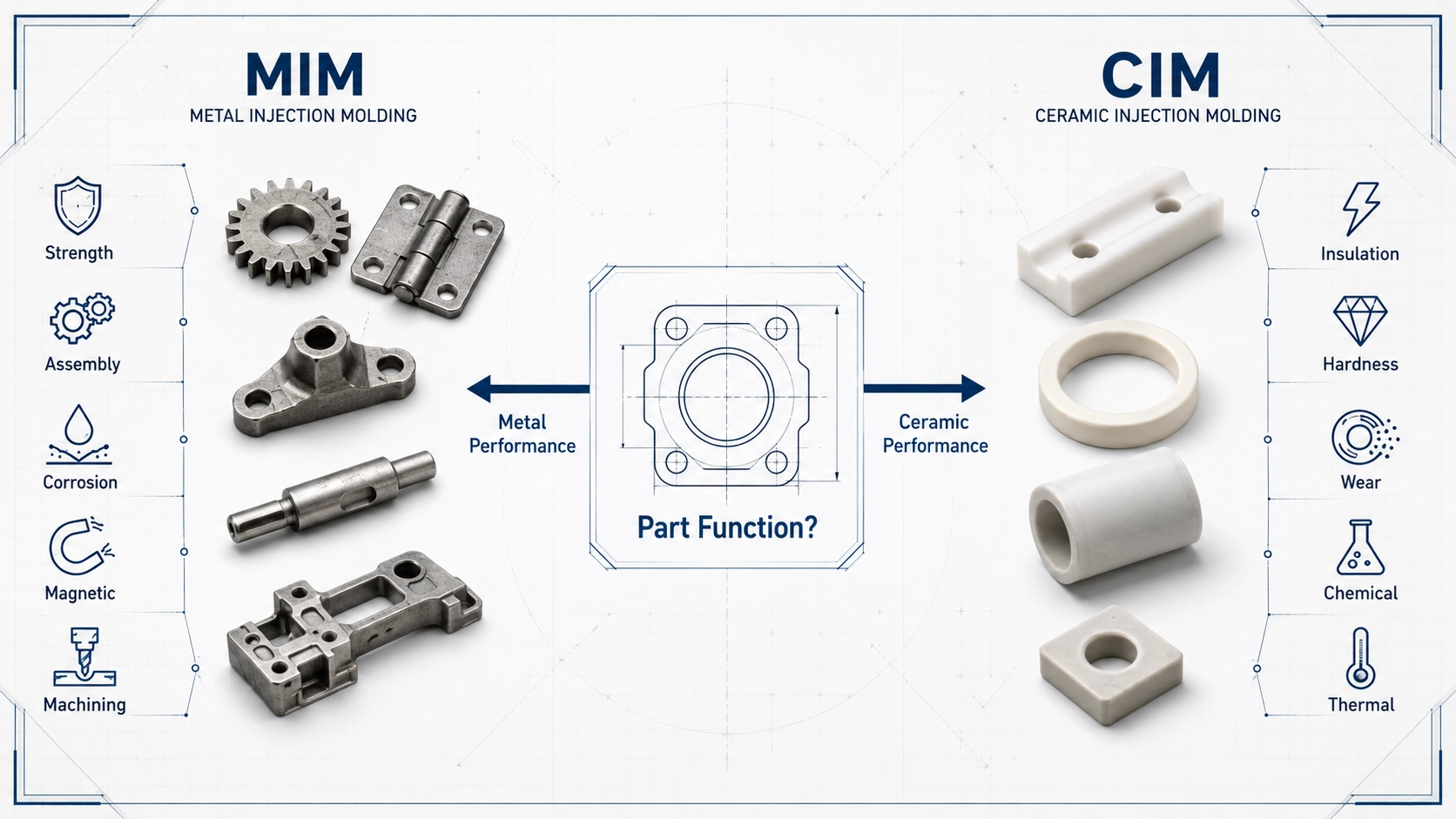
일러스트레이션 전용: 고객, 생산 또는 테스트 데이터가 아닙니다.
MIM과 CIM의 차이점은 무엇인가요?
금속 사출 성형(MIM)과 세라믹 사출 성형(CIM)은 분말 사출 성형(PIM)의 한 분야입니다. 두 공정 모두 분말과 바인더 혼합물을 금형에 성형하고, 바인더를 제거한 후 성형된 부품을 소결합니다. 결정적인 차이는 남아있는 재료로, MIM은 금속, CIM은 세라믹입니다. 일반적인 공정 순서가 상호 교환 가능한 재료 특성이나 금형을 설정하는 것은 아닙니다. [1].
복잡한 형상의 컴팩트 부품의 경우, 먼저 필수 기능이 금속 또는 세라믹에 의존하는지 결정하십시오. 그런 다음 의도된 생산량으로 해당 재료를 제조하는 데 사출 성형이 올바른 방법인지 확인하십시오. 더 넓은 공정군에 대해서는 다음을 참조하십시오. 금속 분말 사출 성형 (PIM).
| 결정 요소 | MIM | CIM |
|---|---|---|
| 출발 재료 | 금속 분말 피드스톡 | 세라믹 분말 피드스톡 |
| 평가 시 일반적인 이유 | 금속 하중 경로, 기계적 결합 또는 특정 자기 특성 | 절연, 경도 또는 특정 화학 및 열 특성 |
| 제조 제약 | 등급별 밀화 및 치수 제어 | 등급별 밀화 및 파손 민감성 처리 |
| 첫 번째 선택 질문 | 부품에 금속적 거동이 필요한가요? | 부품에 특정 세라믹 기능이 필요한가요? |

일러스트레이션 전용: 고객, 생산 또는 테스트 데이터가 아닙니다.
기계적 특성이 MIM 대 CIM 선택에 미치는 영향
강도 및 하중 지지 거동
부품이 하중을 받을 방식을 재료 강도 값을 비교하기 전에 비교하십시오. 세라믹은 상당한 압축 하중을 견딜 수 있지만 굽힘 또는 국부 인장 응력을 받는 부품에는 부적합할 수 있습니다. 금속 등급은 파괴 전에 항복할 수 있지만, 그 강도는 여전히 조성, 밀도, 열처리 및 형상에 따라 달라집니다. 테스트가 동일한 것처럼 세라믹 굽힘 강도를 금속 인장 강도와 직접 비교하지 마십시오. 각 후보 재료의 실제 하중 모드와 관련 속성을 비교하십시오.
인성, 취성 및 충격 저항
파괴 인성은 균열 성장에 대한 저항을 설명하며, 경도 또는 충격 에너지와 동일한 속성이 아닙니다. 노치, 표면 결함 또는 접촉 하중은 명백한 소성 변형 없이 세라믹 부품에서 균열을 시작시킬 수 있습니다. 지르코니아 등급은 많은 다른 세라믹보다 더 큰 인성을 제공할 수 있지만, 여전히 설계 및 테스트 검증이 필요합니다. MPIF 재료 사양 [2] 및 ASTM 세라믹 테스트 방법 [3, 4]은 평가를 위한 서로 다른 보완적인 기준을 제공합니다.
경도, 내마모성 및 접촉 조건
높은 경도만으로는 긴 내마모 수명을 보장하지 않습니다. 상대면 재료, 접촉 압력, 윤활, 연마 입자 및 충격이 모두 마모에 영향을 미칩니다. 열처리되거나 코팅된 MIM 합금은 슬라이딩 접촉에 유용할 수 있으며, 세라믹 내마모 거동이 필요한 경우 알루미나 또는 지르코니아를 평가할 가치가 있습니다. 경도만으로 선택하지 말고 실제 접촉 쌍을 테스트하십시오. 테스트는 통과하지만 상대 금속의 마모를 가속화하는 세라믹은 여전히 잘못된 선택일 수 있습니다. 양쪽 후보 부품과 그 짝이 되는 표면의 마모를 비교하십시오.
전기적, 열적 및 환경적 요구 사항이 재료 선택에 미치는 영향
전기 전도성 및 절연
부품 자체가 전기 절연을 제공해야 하는 경우, 작동 온도에서의 유전 성능을 포함하여 적합한 절연 세라믹을 평가하십시오. 금속은 일반적으로 별도의 절연 장벽이 필요합니다. 모든 세라믹이 전기 절연체는 아닙니다. 정확한 등급, 전압, 주파수 및 환경을 확인하십시오.
열 성능 및 열 충격
최대 사용 온도는 급격한 온도 변화에 대한 저항을 설명하지 않습니다. 열 구배 및 구속된 팽창은 재료의 온도 한계 이하에서도 응력을 생성할 수 있습니다. 가열 및 냉각 속도, 온도 범위 및 열 전달 요구 사항을 지정하십시오. 세라믹 등급은 전도성과 팽창에서 상당히 다릅니다.
부식 및 내화학성
실제 유체, 농도, 온도 및 노출 시간을 비교하십시오. 스테인리스강은 특정 환경에서 적합할 수 있지만 다른 환경에서는 세라믹이 선호될 수 있습니다. 어떤 재료 계열도 보편적으로 부식 방지 기능을 제공하지는 않습니다. 금속 오염이 제한되는 경우, 세라믹이 자동으로 허용된다고 가정하기보다는 허용되는 방출 또는 오염 수준을 정의하십시오.
자기적 거동과 질량 또한 등급에 따라 달라집니다. 연자성 금속은 자기 회로에 적합할 수 있지만, 페라이트 세라믹은 다른 자기적 및 전기적 특성을 제공할 수 있습니다. 특정 재료 밀도와 형상을 사용하여 질량을 계산하십시오. 세라믹 특성 참조 ["5] illustrate why grade selection matters.
| 필요 기능 | 검증할 사항 |
|---|---|
| 기계적 하중 | Load direction, peak stress, fatigue and fracture resistance |
| Wear | Contact pair, lubricant and wear mechanism |
| Insulation | Dielectric strength and resistivity under service conditions |
| Thermal exposure | Conductivity, expansion, cycling and thermal gradients |
| Chemical stability | Compatibility with actual media and contamination limits |
| Magnetic response or mass | Magnetic specification or grade-specific density |

일러스트레이션 전용: 고객, 생산 또는 테스트 데이터가 아닙니다.
MIM 또는 CIM에 더 적합한 부품은 무엇인가요?
When MIM Is the Better Fit
Consider MIM for compact metal brackets, gears, hinges and joining features where complex geometry and repeat production make molding attractive. The candidate must still have a suitable feedstock, feasible geometry and a realistic finishing plan. Review MIM 재료 for alloy selection.
When CIM Is the Better Fit
Consider CIM for complex insulating supports, ceramic guides and other components that rely on specific ceramic properties. Alumina may be evaluated for electrical isolation; zirconia may be considered where ceramic toughness and appearance matter. The 세라믹 사출 성형 page explains the route in more detail.
When Both Processes Are Potential Options
A wear insert or decorative housing may have more than one viable material. Establish which requirements are mandatory and which are preferences, then retain only candidates that satisfy the mandatory ones.
| Component example | Initial candidate | 의사 결정 지점 |
|---|---|---|
| Hinge or mechanical bracket | MIM | Verify cyclic load and assembly stress |
| Electrical insulating support | CIM | Verify dielectric and mounting requirements |
| Wear guide | MIM or CIM | Test the actual mating surface and wear conditions |
| Watch housing | MIM or CIM | Check scratch resistance, drop performance and fastening |
| Chemical-exposure component | Grade-specific MIM or CIM | Confirm compatibility with service medium |
금속 및 세라믹 사출 성형 부품은 서로 대체될 수 있나요?
When Replacing Metal with Ceramic Makes Sense
A stainless steel MIM part can be replaced with ceramic only when the replacement satisfies the complete functional specification. A change may be worth investigating to improve insulation, scratch resistance or compatibility with a particular chemical environment. Review each functional area of the drawing: load path, wear surface, fastening interface, critical dimensions and environmental exposure.
When Material Substitution Can Create New Failure Risks
A metal-to-ceramic change can eliminate the plastic deformation that previously accommodated assembly loads. Conversely, a ceramic-to-metal change can remove electrical isolation or alter wear, thermal or contamination behavior. Matching the original shape does not establish equivalent performance. In a watch housing, for example, a metal mounting boss may tolerate limited local yielding, whereas a ceramic boss can crack under concentrated fastening loads. A zirconia housing must meet the original retention and enclosure requirements, not just reproduce the external shape.
How to Validate Functional Equivalence Before Changing Materials
Record the current material and any known failure modes, set measurable acceptance criteria, select candidate grades and test representative parts under the intended service conditions. Include assembly and environmental testing rather than relying only on coupon properties.
Zirconia may improve scratch resistance and appearance compared with a particular stainless steel grade and finish. The original stainless steel housing, however, may carry screw preload at thin mounting bosses and experience edge impact during a drop. A ceramic candidate should be checked for local tensile stress, edge damage and mounting loads. Consider revised radii, a separate metal fastening element or a different joining method if appropriate; verify the revised assembly with representative drop and fastening tests. This hypothetical example is not a customer project or test result.
| Function to preserve or improve | Evidence to request before approving a stainless steel-to-ceramic change |
|---|---|
| Scratch resistance and appearance | Compare representative finished surfaces under the agreed scratch and cosmetic acceptance methods. |
| Fastening and enclosure integrity | Check mounting geometry, tightening limits and damage after assembly and disassembly. |
| Drop and handling resistance | Test the assembled housing at the specified impact orientations and inspect edges and mounting features. |
| Dimensional and environmental compatibility | Verify mating dimensions and fit after relevant temperature or humidity exposure. |
Approve the material change only after the replacement meets every mandatory requirement. If the ceramic improves scratch resistance but fails the agreed assembly or impact test, retain the metal route or redesign the interface and repeat validation.
MIM과 CIM 간 전환 시 어떤 설계 특징을 재검증해야 하나요?
Wall Thickness, Corners and Stress Concentration
Review thin unsupported regions, abrupt thickness changes and inside corners. They influence filling and sintering in both routes; in a ceramic component they may also create fracture-sensitive locations during service. Use gradual transitions where practical and verify minimum sections with the selected feedstock and supplier.
Holes, Threads and Mechanical Joining Features
A hole or thread that works in metal is not automatically suitable for ceramic. Evaluate the local load, root geometry, machining access and tightening method. A separate insert or compliant joint may reduce stress, but the interface must itself be validated.
Assembly Loads, Fits and Tolerance Requirements
Press fits, screw preload and differential thermal expansion can create localized tensile stress. Review maximum and minimum fit conditions, not just nominal dimensions. Establish acceptable assembly force and operating clearance across the temperature range. For a ceramic ring around a metal pin, check the largest pin against the smallest bore at the relevant temperatures; increased interference can generate tensile hoop stress in the ceramic. If that condition cannot be qualified, evaluate a clearance fit or a compliant interface before approving the ceramic route. Ceramic design guidance [7] supports reviewing concentrated loads, corners and thermal mismatch; it does not establish CIM-specific dimensional limits.
| 도면 형상 | Revalidation task |
|---|---|
| Thin or slender sections | Check filling, handling, support and service stress |
| Internal corners | Review radii and stress concentration |
| Threads and holes | Check fastening loads, edge condition and finishing access |
| Press fits | Evaluate worst-case interference and assembly force |
| Mating interfaces | Calculate tolerance stack and thermal clearance |
| Existing CAD | Identify assumptions tied to the previous material |

일러스트레이션 전용: 고객, 생산 또는 테스트 데이터가 아닙니다.
MIM과 CIM 간 제조 요구 사항은 어떻게 다른가요?
Feedstock and Injection Molding Behavior
Particle characteristics, solids loading and binder formulation influence flow and packing. Changing feedstock may alter filling, gate behavior and tool wear. Confirm that the chosen material has a qualified injection route rather than assuming a powder sold for another process is moldable.
Debinding, Sintering and Shrinkage Control
Binder removal must preserve the shaped part while avoiding internal damage. During sintering, material-specific temperature, atmosphere, support and densification behavior determine dimensions and microstructure. Both routes can develop cracks, porosity and distortion; their dominant risks depend on the material and geometry. The PIM review [1] explains the interdependence of these stages.
Tooling Compatibility and Dimensional Compensation
Do not assume the same mold can produce equivalent metal and ceramic dimensions. Confirm the feedstock-specific shrinkage allowance, directional variation, gate and ejection suitability and finishing stock. Use a trial with representative geometry to establish shrinkage rather than relying on a generic percentage. A single overall shrinkage factor may reproduce the outer envelope but miss hole spacing or flatness if contraction or support effects vary by feature. Measure the features relative to the functional datums and check the mating interfaces before accepting a shared or modified mold. The comparative precision study [6] evaluates shrinkage and feature replication as distinct process capabilities.
Use the supplier’s measured shrinkage for the selected feedstock and geometry to determine whether existing cavities can be modified or new ones are needed. Equipment compatibility also depends on feedstock handling, contamination control and qualified thermal processing; shared molding principles alone do not establish equipment suitability.
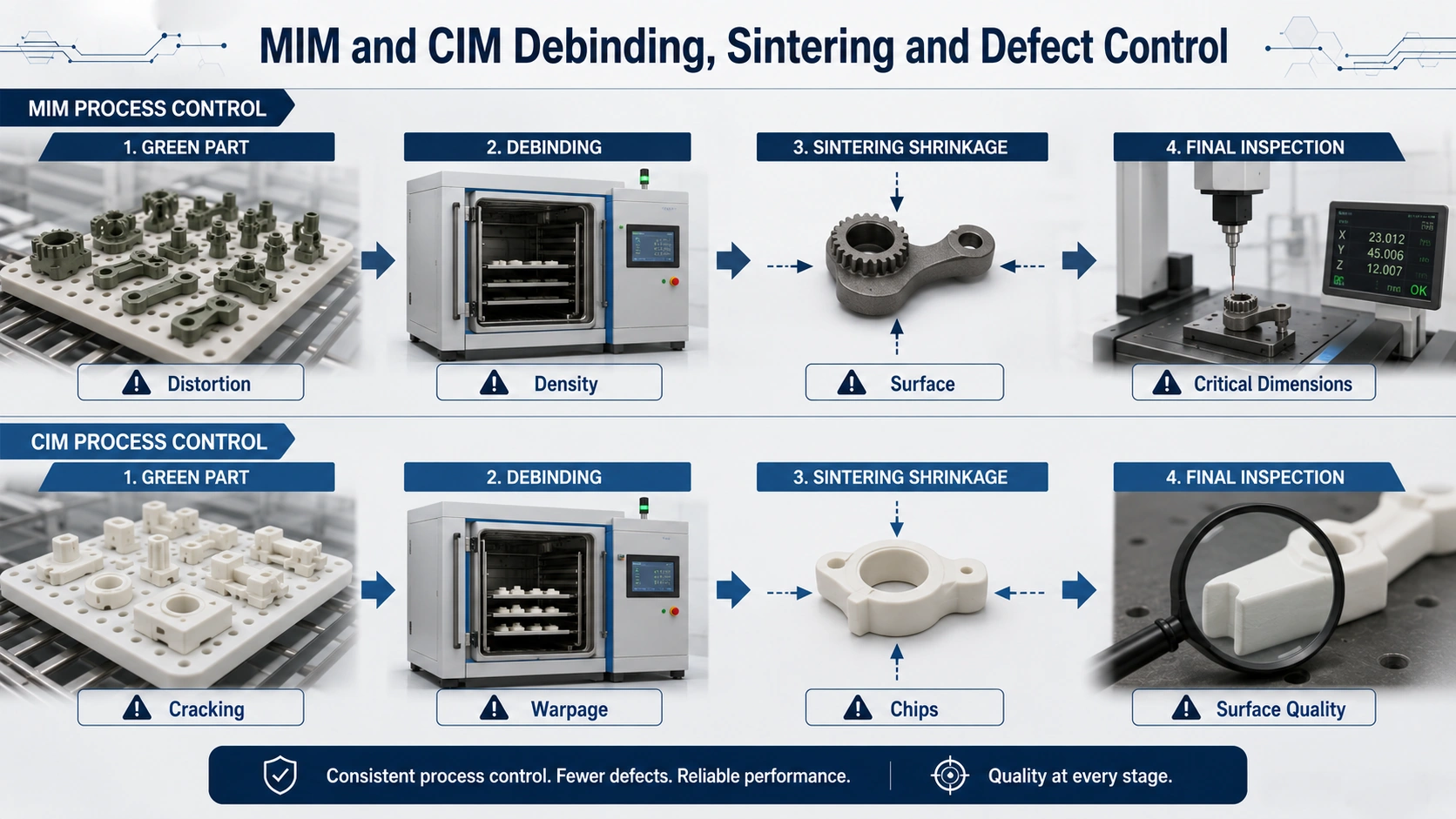
일러스트레이션 전용: 고객, 생산 또는 테스트 데이터가 아닙니다.
For detailed metal process background, see the MIM 공정 페이지를 참조하십시오.
치수 정확도 및 부품 품질 측면에서 MIM과 CIM 비교
Dimensional Accuracy and Tolerance Capability
Neither process consistently produces tighter tolerances across all materials and geometries. Define datums, critical dimensions and measurement conditions, then request capability evidence for comparable features and material. Study [6] compares shrinkage, surface replication, tolerance and geometric fidelity; its findings are not universal production limits.
Separate dimensions that can be accepted as sintered from those that require finishing. For a critical bore, for example, agree the final diameter, roundness, datum relationship and measurement method; then decide whether as-sintered capability is sufficient or a finishing allowance is needed. Request measurements from representative production-route samples before setting a capability target. If a bore is ground after sintering, inspect it relative to its final mounting datums, not only for diameter. A bore that meets size but is displaced from the assembly axis can still prevent correct fit. For ceramic parts, agree how finishing-induced edge damage will be assessed as well.
2차 가공 및 표면 처리
MIM parts may require machining, sizing, grinding, polishing or a suitable surface treatment. Sizing is conditional on material and geometry. Sintered ceramics can be precision ground or lapped when appropriate; access, edge chipping, subsurface damage and machining stock must be considered. Plan functional surfaces before tooling.
Defects, Inspection and Acceptance Criteria
Agree on acceptance criteria before ordering tooling. Surface inspection alone cannot establish internal integrity or mechanical performance. Material tests, dimensional measurement and representative functional tests serve different purposes. ASTM C1161 and C1421 [3, 4] concern ceramic specimen testing, not universal finished-part acceptance limits.
| Quality requirement | 검증 방향 |
|---|---|
| Critical size and form | Agree datums, measurement method and sampling plan |
| 표면 마감 | Specify roughness and visual acceptance separately |
| Cracks, chips and porosity | Define defect limits and suitable detection methods |
| 기계적 성능 | Use relevant grade data and representative load tests |
| Electrical or environmental function | Test under specified service conditions |
| 조립 | Verify fit, force and operation across tolerance extremes |
MIM 대 CIM 부품 비용은 무엇으로 결정되나요?
Material, Tooling and Processing Costs
Compare qualified feedstock availability, mold complexity, cavity count and the complete molding-to-sintering route. A low powder price does not imply a low finished-part price; process time and tooling investment matter.
Secondary Operations, Yield and Quality Costs
Finishing stock, inspection requirements and scrap can dominate the difference between quotations. Ask which operations and acceptance criteria are included. Compare the cost per conforming finished component, rather than the cost per molded piece.
Production Volume and Lifecycle Economics
Tooling cost per accepted part falls as cumulative accepted volume increases. Compare the same demand forecast and service requirements. A higher initial price may be justified by a verified longer wear life, but premature assembly failure can reverse that advantage.
For a comparable RFQ, normalize the tooling cost over the expected accepted quantity and add the quoted recurring cost per accepted part, including any excluded finishing or inspection. Compare service-life costs separately when replacement frequency is material to the application. Avoid counting scrap twice if it is already included in the accepted-part quotation. If the ceramic route requires a revised joint, include the extra insert, assembly and qualification costs; comparing only the molded housings would omit a cost created by the substitution itself.
| Cost item | 동일 기준 비교 |
|---|---|
| 금형 | Ownership, maintenance and lifetime accepted volume |
| Feedstock and processing | Qualified grade and included manufacturing steps |
| Finishing and quality | Critical surfaces, tests and acceptance limits |
| Yield and service life | Accepted quantity, replacement frequency and verified performance |
For a metal route, see 금속 사출 성형 비용. No universal price ratio or minimum order quantity applies to both processes.
MIM과 CIM 모두 부적합한 경우는 언제인가요?
Consider another manufacturing route if neither candidate can satisfy the material specification, if the geometry exceeds demonstrated capability, or if tooling is not justified by the expected volume. A changing design may be better served by prototypes before committing to a production mold.
| 프로젝트 조건 | Alternative to evaluate |
|---|---|
| Small or changing metal batch | CNC machining or metal additive manufacturing |
| Small ceramic batch | Suitable ceramic machining or additive manufacturing |
| Simple regular metal geometry | 기존 분말 야금 |
| Simple regular ceramic geometry | Ceramic pressing |
| Unqualified material or impossible acceptance requirement | Revise material, design or manufacturing route |
Explore the broader MIM 공정 비교 가이드 before committing to a route.
MIM과 CIM 중 최종 선택은 어떻게 해야 하나요?
Assess each candidate in the following order. A lower price cannot compensate for failure to meet a mandatory requirement.
- Define function: list mandatory loads, electrical behavior, environment and assembly requirements.
- Screen grades: retain materials supported by relevant property data.
- Revalidate design: check geometry, joining and tolerance stack.
- Verify production: confirm qualified feedstock, tooling, finishing and inspection capability.
- Evaluate economics: compare accepted-part cost and demand.
The metal grade and manufacturing route satisfy the requirements checked above.
The ceramic grade and manufacturing route satisfy the requirements checked above.
If both routes pass: compare the verified trade-offs in service performance, accepted-part cost, supply risk and qualification effort. If a mandatory requirement remains untested, neither route has yet been approved; define the missing evidence before committing to tooling.

일러스트레이션 전용: 고객, 생산 또는 테스트 데이터가 아닙니다.
금형 제작 및 생산 전 확인할 사항
Provide the following information so that the material and manufacturing route can be evaluated against your requirements.
- 2D drawing, 3D model and critical datums or tolerances
- Current and target material grades and substitution objectives
- Service loads, environment, assembly conditions and required life
- Functional surfaces, finishing and acceptance criteria
- Prototype quantity, annual volume and validation plan
For projects requiring metal injection molding, XTMIM can evaluate MIM suitability from the drawing and project requirements. Ceramic-specific production capability must be confirmed with a qualified CIM supplier.
MIM 및 CIM에 대한 자주 묻는 질문
MIM 부품과 CIM 부품을 동일한 어셈블리에 함께 사용할 수 있습니까?
네, 금속 부품과 세라믹 부품을 분리하여 조립하면 기계적 지지 기능과 절연 또는 내마모 기능을 결합할 수 있습니다. 접합 방법, 접촉 응력 및 환경 호환성을 검증해야 하며, 인터페이스는 설계의 일부입니다.
열팽창이 금속-세라믹 어셈블리에 미치는 영향은 무엇인가요?
서로 다른 팽창 계수는 온도 사이클링 중 간극 또는 간섭을 변경할 수 있습니다. 반복적으로 가열 및 냉각되는 어셈블리의 경우, 상온에서의 성능뿐만 아니라 대표적인 사이클 후 유지되는 끼워맞춤, 접촉 손상 및 기능적 성능을 검증해야 합니다. 필요한 사이클 수와 허용 기준은 애플리케이션 사양에서 나와야 합니다.
세라믹 프로토타입으로 향후 CIM 부품을 검증할 수 있습니까?
시제품은 형상, 조립 및 일부 기능 요구 사항을 검증하는 데 도움이 될 수 있습니다. 하지만 CIM 수축률, 결함 분포, 표면 상태 또는 생산 능력을 자체적으로 확립할 수는 없습니다. 최종 공정 자격을 위해서는 대표적인 CIM 샘플을 사용하십시오.
기술 참고 자료
- Momeni et al., Research Progress on Low-Pressure Powder Injection Molding, Materials 16 (2023), 379. PIM process family and feedstock/process relationships; low-pressure-specific results are not universal.
- MPIF Standard 35-MIM. Material specification reference; agree grade and acceptance requirements.
- ASTM C1161. Flexural strength testing of advanced ceramics; confirm applicable edition.
- ASTM C1421. Fracture toughness testing of advanced ceramics.
- KYOCERA Fine Ceramics: Ceramic Properties. Grade-dependent mechanical, thermal, electrical and chemical properties; not CIM-specific qualification data.
- Experimental Investigation of Comparative Process Capabilities of Metal and Ceramic Injection Molding for Precision Applications (2016), DOI 10.1115/1.4033820. Comparative study scope: shrinkage, surface replication, tolerance and geometric fidelity.
- KYOCERA Fine Ceramics: Design ideas for ceramic parts. General guidance on concentrated loads, stress-sensitive geometry, impact and thermal conditions in ceramic assemblies; not a CIM-specific process specification.
Use the applicable standard edition, material specification and supplier capability data for actual acceptance decisions.