
빠른 답변: 특정 무게 목표, 특정 서비스 요구 사항 또는 필요한 티타늄 합금이 소재 및 공정 제어를 정당화하는 이점을 제공할 때 티타늄 MIM을 고려하십시오. 적합한 등급이 하중, 부식, 외관 및 공차 요구 사항을 충족하고 더 잘 검증되고 비용이 통제된 생산 경로를 제공할 때 스테인리스강 MIM으로 시작하십시오.
티타늄이 모든 스테인리스강 등급보다 자동으로 더 강하거나, 더 단단하거나, 더 내식성이 있는 것은 아닙니다. 최종 MIM 상태의 지정된 합금을 비교하고 실제 형상, 작동 환경, 피드스톡 공급, 소결 경로 및 금형 출시 전 승인된 부품당 비용을 확인하십시오.
어떤 프로젝트 요구 사항이 실제로 티타늄 대 스테인리스강 결정을 변경합니까?
합금 데이터 시트를 비교하기 전에 실패할 수 없는 요구 사항과 비용과 거래할 수 있는 선호도를 분리하십시오. 스테인리스강 대 티타늄 비교는 실제 부품에 대한 이러한 요구 사항이 정의된 후에만 유용합니다.
금속이 아닌 부품부터 시작하십시오. 얇은 하우징의 경우, 지정된 최대 질량이 합금의 공칭 강도보다 더 중요할 수 있습니다. 하중 지지 래치의 경우, 강성, 피로 및 접촉 마모가 설계를 결정할 수 있습니다. 자주 세척되는 메커니즘의 경우, 실제 화학적 노출 및 최종 표면이 둘 다 지배할 수 있습니다.
| 정의할 제약 조건 | 충족해야 함 또는 협상 가능? | Ti 대 스테인리스강 선택을 변경하는 것은 무엇입니까? | 요청할 증거 |
|---|---|---|---|
| 최대 부품 질량 / 시스템 질량 | 설계에 검증된 중량 상한선이 있는 경우 충족해야 합니다. | 티타늄은 낮은 밀도가 의미 있는 중량 문제를 해결할 경우 진지한 후보가 됩니다. | CAD 볼륨 및 어셈블리 수준의 질량 예산. |
| 하중, 강성, 피로 및 마모 | 일반적으로 충족해야 합니다. | 정확한 합금, 최종 MIM 상태, 접촉 쌍 및 설계 변경 허용 여부를 평가합니다. | 하중 사례, 접합 표면, 수명 목표, 테스트 방법. |
| 부식 및 세척 노출 | 기능 또는 안전에 영향을 미치는 경우 충족해야 합니다. | 일반적인 부식 순위 대신 실제 매체 하에서의 정확한 등급을 비교합니다. | 땀/염분/세척제 세부 정보, 기간, 온도, 세척 주기. |
| 외관 및 기능 마감 | 정의된 외관 또는 밀봉 표면에 충족해야 함. | 마감 시험, 표면 손상 한계, 코팅 호환성 및 접근성은 재료 선택을 변경할 수 있습니다. | 표면 영역, 거칠기, 코팅 사양, 시각적 기준. |
| 비용, 연간 생산량 및 인증 | 계약 또는 규정에 의해 고정되지 않는 한 절충. | 작은 성능 이점이 특수 재료 공정 경로를 정당화하지 못할 수 있습니다. | 목표 연간 생산량, 예산, 승인 및 추적성 규칙. |
재료가 완전한 MIM 공정 후 필수 하중, 작동 매체, 치수 또는 지정된 등급을 충족할 수 없는 경우, 다른 속성이 매력적으로 보이더라도 단순히 선택해서는 안 됩니다.
두 후보 모두 모든 필수 요구 사항을 충족하는 경우, 실제 부품 질량 절감, 마감 복잡성, 인증된 생산 증거, 승인된 부품 비용 및 공급 연속성을 평가하십시오.
선택 시 기능 요구사항을 우선적으로 충족하고, 두 번째로 입증된 MIM 제조성을 고려하며, 세 번째로 프로젝트 경제성을 고려해야 합니다. 다른 합금 계열은 다음을 참조하십시오. MIM 재료 또는 MIM 재료 선정 가이드.
완성된 MIM 부품에서 티타늄과 스테인리스강은 어떻게 비교될까요?
"티타늄"은 상업용 순수 티타늄 또는 Ti-6Al-4V와 같은 합금을 의미할 수 있으며, "스테인리스강"은 316L, 17-4 PH, 420 또는 다른 등급을 의미할 수 있습니다. 최종 MIM 상태, 열처리, 밀도 및 표면 상태에 따라 적용 가능한 공개 속성이 결정됩니다.
| 결정 속성 | 티타늄 경로 | 스테인리스강 경로 | 실용적인 부품 설계 결과 |
|---|---|---|---|
| 밀도 / 질량 | Ti-6Al-4V 기준 밀도: 약 4.43 g/cm3. | 316L 기준 밀도: 약 8.0 g/cm3. | 동일한 고체 부피에서 티타늄은 상당히 가볍습니다. 절대 질량 절감이 중요한지 확인하십시오. |
| 강성 | Ti-6Al-4V 기본 금속 계수는 약 110 GPa입니다. | 316L 기본 금속의 탄성 계수는 약 200 GPa입니다. | 동일한 형상에서 더 강성이 높은 재료는 일반적으로 탄성 하중 하에서 덜 변형됩니다. 실제 MIM 데이터 및 형상이 여전히 중요합니다. |
| 강도 / 경도 | CP titanium and Ti-6Al-4V have different strength levels; MIM condition matters. | 316L, 17-4 PH, 420, and 440C serve different strength, hardness, and wear directions. | Choose specific grades and treatment conditions, not a generic titanium-versus-steel label. |
| 내식성 | Protective oxide film can be effective in many services; performance is environment-specific. | The alloying and surface condition of each stainless grade are decisive. | Identify the actual chemical and cleaning exposure before ranking materials. |
| Finish and appearance | Surface preparation and decorative processes need grade- and geometry-specific trials. | Many established polishing, passivation, and PVD routes are available for suitable stainless grades. | Specify functional and cosmetic criteria; do not assume a finish is approved for any grade. |
These density and elastic-modulus values are reference properties for the specified base alloys, 해당 산업의 모든 부품에 MIM을 사용해야 한다는 것을 guaranteed properties of finished MIM parts. The NBS/NIST Ti-6Al-4V compilation 과 316/316L manufacturer datasheet provide the underlying values. Final acceptance must use the specified MIM material condition and relevant part-level tests.
Weight Savings vs. Stiffness and Part Geometry
At equal theoretical solid volume, Ti-6Al-4V (approximately 4.43 g/cm3) is about 45% lighter than 316L stainless steel (approximately 8.0 g/cm3). A 1 cm3 solid-volume example weighs about 4.43 g versus 8.0 g: a 3.57 g difference. Screening method: multiply the part's solid CAD volume in cm3 by approximately 3.57 g/cm3 to estimate the weight saving at unchanged geometry. Actual MIM part mass depends on final density, finishing and any design changes.
Lower density is not the same as greater stiffness. Reference elastic modulus is approximately 110 GPa for Ti-6Al-4V and about 200 GPa for 316L. At the same geometry and loading, a titanium bracket may deflect more in the elastic range. Changing rib thickness or section geometry can recover stiffness, but that modification also changes part mass and MIM shrinkage behavior. Ask whether the assembly-level mass saving is significant before treating titanium as a requirement.
Strength, Fatigue, Hardness, and Wear Resistance
Do not compare "titanium strength" with "steel strength" without naming both grades. Commercially pure titanium 및 Ti-6Al-4V differ substantially; so do 316L and heat-treatable 17-4 PH. Hardenable stainless families can be relevant where sliding wear or high hardness matters. Is titanium a soft metal? That cannot be answered for titanium as a family: commercially pure titanium and Ti-6Al-4V do not share one hardness level, and a hardened stainless grade can behave differently again.
Strength-to-weight is helpful only after load path and geometry are known. Fatigue under cycling, friction at a pin, edge toughness, and galling at mating metal contacts may rule out a material that looks excellent on a simple tensile property table. MIM density, residual porosity, oxygen content, heat treatment, and surface condition can further alter the finished-part result. Confirm performance with the specified MIM condition and appropriate testing rather than borrowing a wrought-bar value.
Corrosion Resistance and Service Environment
Titanium forms a protective oxide surface and may be a strong candidate in certain corrosive environments. Stainless alloys rely on a chromium-rich passive surface but have distinctly different resistance across grades and exposure conditions. Neither material has universal corrosion immunity. Chlorides, crevices, surface damage, dissimilar-metal contact, cleaning agents, and temperature may change the result.
For skin-contact wearables, define sweat and cosmetic-product exposure rather than assuming that a generic "hypoallergenic" or "surgical" label proves suitability. For medical-device mechanisms, specify disinfectants, cleaning cycles, and customer acceptance criteria; whether a surface can be cleaned consistently may matter as much as nominal bulk corrosion resistance.
Surface Finish, Passivation, and Coating Requirements
Stainless parts may be reviewed for polishing, brushing, blasting, passivation, and PVD when suitable for the chosen grade and surface geometry. Passivation treatments for stainless steel are intended to improve the surface condition by removing free iron and promoting the protective passive film; the procedure and verification must be specified. Titanium's native oxide surface and its preparation are different: a stainless passivation recipe must not be assumed interchangeable with a titanium treatment.
For both routes, define roughness, edge appearance, coating thickness, adhesion, cosmetic zones, masking, and dimensional changes after finishing. A visible housing can fail the project even when material chemistry and tensile properties are acceptable, if polishing access or finish repeatability was not considered before tooling.
A medical-device drawing that calls for passivated 316L should define the stainless grade, treatment sequence and verification method. Substituting titanium changes both the material and the surface-treatment requirements; a stainless-steel passivation procedure is not automatically suitable for titanium.
For grade-level data, review MIM용 티타늄 합금 및 stainless steel MIM grades before specifying the final material.
Which MIM Manufacturing Limits Could Change the Material Choice?
Even if a material meets the theoretical design target, the actual metal injection molding route may not. Feedstock supply, debinding, controlled sintering, dimensional behavior, and proof of finished properties determine whether a proposed grade can be released to tooling.
Can the Required Material Grade Be Sourced as MIM Feedstock?
Metal injection molding uses a qualified mixture of metal powder and binder as feedstock. Availability must be checked for the specified grade, not only for the broad label "titanium" or "stainless steel." A vendor's ability to supply powder for additive manufacturing does not automatically prove that a matching MIM feedstock and processing history exist.
Prepared feedstock supply, minimum purchase quantity, chemistry and traceability documents, lot consistency, and debinding compatibility belong in the initial supplier review. For XTMIM projects, prepared feedstock is a purchased manufacturing input, not an in-house compounding service. A titanium grade must not be committed for production until a compatible manufacturing and inspection route has been confirmed.
How Do Debinding, Sintering, and Contamination Affect the Final Part?
After injection, binder must be removed without cracking or leaving unacceptable residue. Sintering then densifies the brown part. Titanium has a strong affinity for interstitial impurities, including oxygen and carbon; binder removal, handling, and furnace conditions can affect contamination and final ductility. This is a materially different qualification challenge from assuming that a familiar stainless-steel cycle can simply be reused.
Research on clean titanium MIM binder systems documents the importance of interstitial-impurity control. Experimental and simulated Ti-6Al-4V sintering research also shows why shrinkage and support strategy must be validated for the actual geometry. These published examples establish technical possibilities, not a particular supplier's qualified manufacturing capability. Stainless steel also requires controlled debinding and sintering, although established stainless MIM routes are generally more widely available.
Can MIM Meet the Part's Tolerances and Acceptance Requirements?
Both titanium and stainless steel MIM parts shrink during sintering. Tooling compensation depends on feedstock, wall transitions, geometry, gates, supports, and final density. Long thin features, uneven cross-sections, sharp transitions, deep holes, and cosmetic faces may distort or become costly to correct. A grade change can therefore force a new review of shrinkage allowances and tooling design.
Before approving the route, separate dimensions that can remain as-sintered from those needing machining, sizing, grinding, or fixture-supported sintering. Define how the supplier will measure them, not merely an average nominal tolerance. The MIM 공차 가이드 provides broader design context; final capability must be verified for the actual drawing and material condition.
Published manufacturing evidence, not a general MIM guarantee: In an ElementPlus Ti-6Al-4V watch-case pilot reported in 2020, most complex case features were formed by MIM, while some tight-tolerance features still needed CNC machining. The company also reported sintered density above 99% for its tested route. These are 사례별 결과, not tolerance, density or cost promises for another supplier. Ask what was actually measured on your required grade and geometry before authorising tooling.
| 타당성 게이트 | Can proceed when... | Hold or reject the route when... | Who must verify |
|---|---|---|---|
| Specified grade / feedstock | A traceable feedstock route exists for the exact grade and target quantity. | Only an approximate alloy is offered, or qualified feedstock is unavailable. | Powder or feedstock supplier and MIM manufacturer. |
| 탈지 / 소결 | Binder removal and atmosphere control are documented for this route. | Contamination limits or sintering controls cannot be demonstrated. | Manufacturing engineer and qualified process owner. |
| Geometry / shrinkage | DFM, tooling compensation, sintering support, and corrections are feasible. | Distortion-sensitive features cannot meet the print or cannot be inspected. | MIM tooling and process engineering. |
| Acceptance properties | Required chemistry, density, mechanical properties, and surface results have defined tests. | Customer expects wrought-bar properties without equivalent MIM qualification. | Quality engineer and customer. |
| Production evidence | Sample and repeat-run qualification expectations are agreed. | The supplier has no validated capability yet and the schedule assumes immediate scale-up. | Customer and manufacturing supplier. |
Critical stop condition: The existence of a published titanium MIM standard or research process does not validate any specific factory's feedstock, furnace setup, impurity control, tolerances or production yield. Request evidence for the proposed route; otherwise hold the tooling decision.
How Should Cost and Production Risk Affect the Material Choice?
The relevant number is the cost of a qualified, accepted production component, not simply the price of one kilogram of metal powder. A more expensive alloy can still be justified if its unique benefit is essential; an unnecessary special-material route can turn an otherwise practical MIM design into a costly project.
Is titanium more expensive than stainless steel for MIM production? For many common project comparisons, titanium is likely to carry a higher material and qualification burden than established stainless-steel grades. But there is no responsible universal premium: the actual difference depends on grade, feedstock sourcing, process qualification, finishing, acceptance yield, and order size. Use comparable quotations with the same part geometry, specifications, volume, and inspection scope.
| Cost or risk driver | How titanium may change the project | What to compare in the quote |
|---|---|---|
| 준비된 피드스톡 | Special-alloy availability, order size, and procurement risk may be less favorable. | Confirmed grade, material specification, supplier MOQ, material price basis. |
| Process controls | Atmosphere, contamination monitoring, and sintering validation can add complexity. | Qualified route, process checks, sample qualification, applicable testing. |
| 툴링 및 개발 | Material-specific shrinkage and distortion behavior may require additional trials. | Mold design, sample iterations, support strategy, validation responsibilities. |
| Accepted-part yield | Scrap or rework risk matters more than nominal powder cost alone. | Cost per accepted part, defect limits, measurement plan. |
| Finishing and inspection | Cosmetic finish, masking, machining, or extra testing can materially change cost. | All secondary operations and acceptance criteria on the same quotation basis. |
| Volume and continuity | Tooling amortization and supply reliability depend on forecast volume. | Prototype quantity, annual demand, ramp-up plan, supply-change provisions. |
Make the comparison at accepted-part level. For example, a low quote based on raw powder or unqualified samples is not equivalent to a quote that includes required chemistry testing, controlled sintering, secondary machining, cosmetic inspection, and rejected-unit risk. Ask the supplier what evidence the price includes and what remains subject to trial.
Production volume also changes the result. Small, complex parts with repeat orders may justify MIM tooling; very low quantities or simple geometry can favor another manufacturing route. If volume or geometry is uncertain, the economic case for either MIM material is not yet established. The broader cost factors are explained in 금속 사출 성형 비용.
Quote comparison rule: Ask both suppliers to quote the same drawing revision, grade/alternate policy, annual quantity, surface and inspection specification. Compare tooling and trial charges separately from the recurring price per 승인된 part. A low as-molded price is not a better offer if more items fail dimensional, cosmetic, chemistry or functional acceptance after sintering and finishing.
결정 규칙: Choose titanium only if its measurable part-level benefit and required technical qualification justify the additional total project burden. If a qualified stainless grade meets every must-have requirement, stainless may be the more defensible starting route.
How Does the Material Choice Change Across Typical Part Designs?
Different part requirements can lead to different material choices. Independent manufacturer reports document both titanium and stainless MIM components in wearables and non-implant medical equipment. These are applications with different geometries and acceptance criteria, not a controlled head-to-head material trial.
Wearable Housings: When Does Lower Weight Justify Titanium?
Consider a compact wearable housing with complex geometry, visible external surfaces, sealing details, and repeat production demand. If the product has a documented weight target and the housing is a substantial fraction of total device mass, titanium's lower density may deliver a meaningful benefit. But if the housing is only a tiny share of device weight, the total product saving may be too small to justify the change.
Visible housings must also meet polishing or brushing requirements, PVD color, edge consistency, assembly-fit tolerances, and corrosion behavior after sweat exposure. A suitable stainless grade may be preferable when cost and repeatable surface quality dominate. Titanium remains an option when the measured weight benefit is worth qualifying its MIM and finishing processes.
| Wearable design condition | Most useful comparison | 결정 영향 |
|---|---|---|
| Low overall device weight is a measured requirement | Mass saving based on actual CAD volume and assembly contribution. | Titanium deserves a feasibility review if the saving is material to product function. |
| Visual appearance and finish consistency dominate | Polishing, edge consistency, masking, PVD trial, cosmetic inspection. | Do not choose by metal name alone; qualify the entire finish route. |
| Extremely tight sealing or assembly features | Datum control, sintering distortion, selective machining and post-finish fit. | Either material may need a hybrid MIM-plus-machining process. |
| 비용 민감 반복 생산 | Qualified route, supplier continuity, accepted-part cost. | A stainless grade may be the better starting point if weight is not decisive. |
Two published watch-case examples show established use of Ti-6Al-4V and 316L MIM for different products. They do not establish relative cost, yield or performance under identical production conditions.
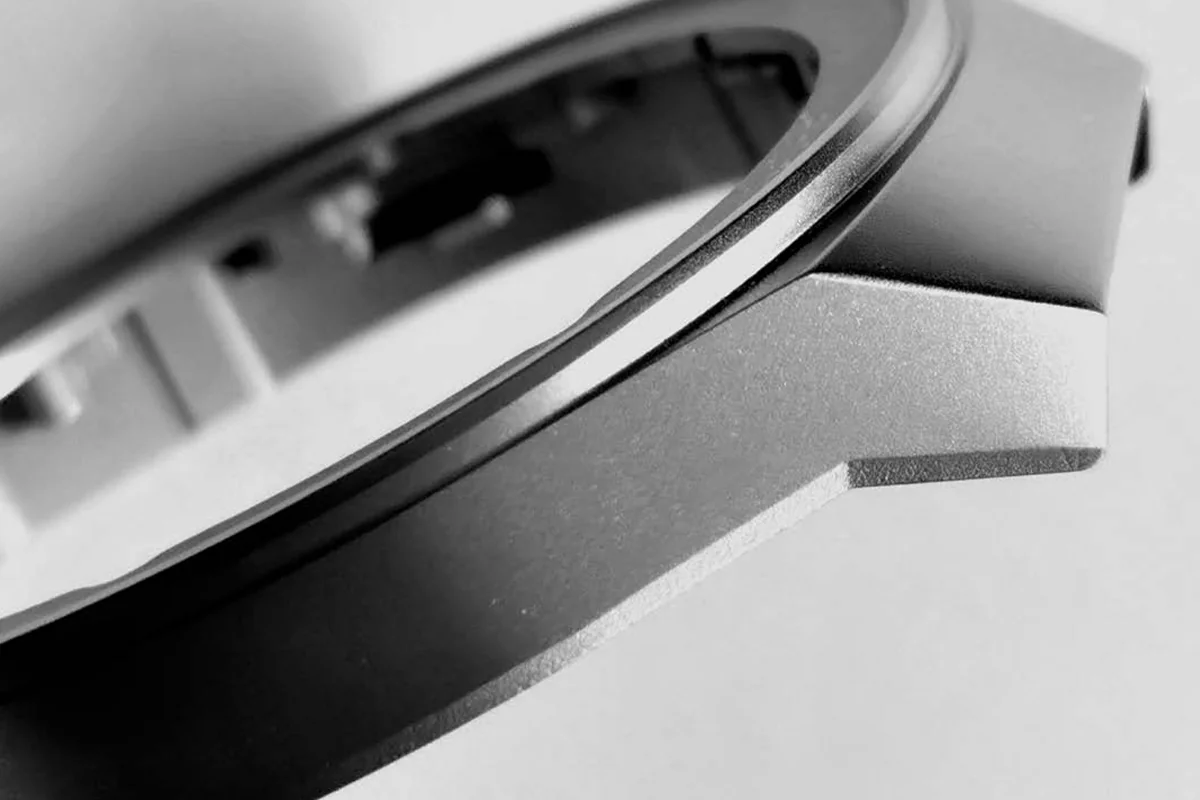
Ti-6Al-4V smartwatch case — ElementPlus
ElementPlus described a Ti-6Al-4V MIM watch-case development in which complex housing details could be molded and selected precision areas machined afterward. The published account concerns pilot development; it does not establish universal production yield or as-sintered tolerances.
Material-selection relevance: A lower-density alloy can be useful for a weight-constrained housing, but the selected finish, assembly datum, and post-machining requirements still determine viability.
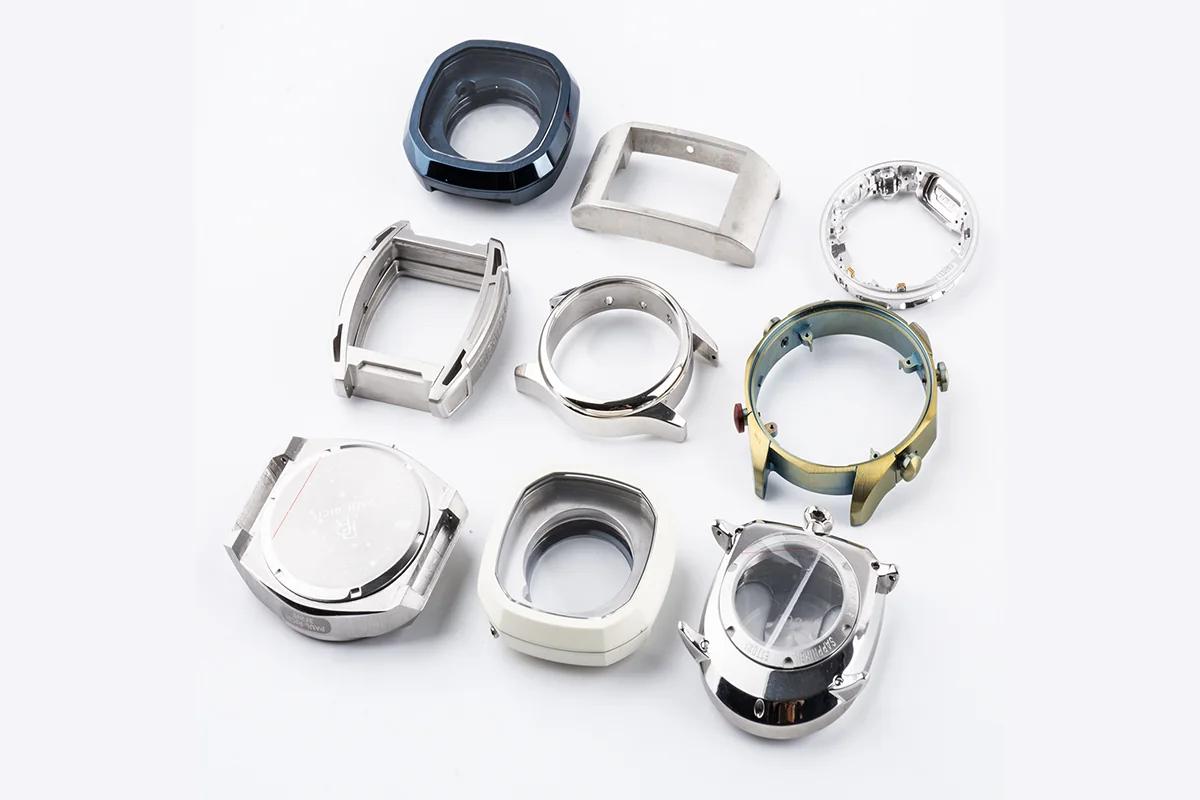
316L watch cases and smartwatch housings — ZCMIM
ZCMIM identifies square and round 316L stainless steel watch-case parts made by MIM. Its published gallery lists finishing routes such as magnetic polishing, sandblasting, polishing and PVD, depending on the individual component.
Material-selection relevance: When the design is driven by surface appearance and repeatable finishing rather than maximum weight reduction, a qualified 316L MIM route may be a practical starting point.
A 2026 MTIG industry case also reports titanium MIM wearable-device housings. The source does not identify the exact alloy grade of the pictured part, so it should not be used as proof of a specific titanium grade or another supplier’s production capability.
Non-Implant Medical Device Parts: How Do Cleaning and Material Requirements Affect the Choice?
For non-implant medical instruments and equipment, the choice depends on cleaning chemicals, access to internal corners, surface condition, edge quality, exact material grade and acceptance tests. Stainless steel and titanium use different passive-surface and finishing routes; the customer’s passivation requirement must be checked for the selected grade rather than transferred from one alloy to another.
A stainless 316L component with a defined cleaning and passivation process may be appropriate if the drawing and customer specification allow it. Titanium normally develops its own protective oxide film and requires a different surface-treatment review; a stainless-steel passivation callout cannot simply be transferred to a titanium drawing. A titanium route may be relevant when a specified grade or verified service benefit requires it. Both need application-specific qualification. Terms such as "surgical stainless" or "medical grade titanium" cannot replace the material specification, tests or applicable approval process; this is not an implant-suitability claim.
| Non-implant mechanism requirement | Why this changes material review |
|---|---|
| Repeated cleaning or disinfectant contact | Identify actual agents and temperature; verify alloy and finish compatibility. |
| 부동태 처리된 스테인리스 표면 | Define relevant grade, cleaning/passivation method, and acceptance; do not equate passivation with certification. |
| Titanium oxide surface behavior | Confirm exact alloy, surface treatment, and exposure; the passive film does not independently prove device suitability. |
| Complex miniature geometry | Check blind pockets, crevices, burr control, cleanability, and inspection access. |
| Customer/regulatory requirement | Specify the governing standard and evidence; this article does not grant medical or implant approval. |
The published titanium handle and stainless steel equipment bracket serve different functions. Together, they show why material requirements must follow part function and qualification; they are not interchangeable specimens in a controlled test.
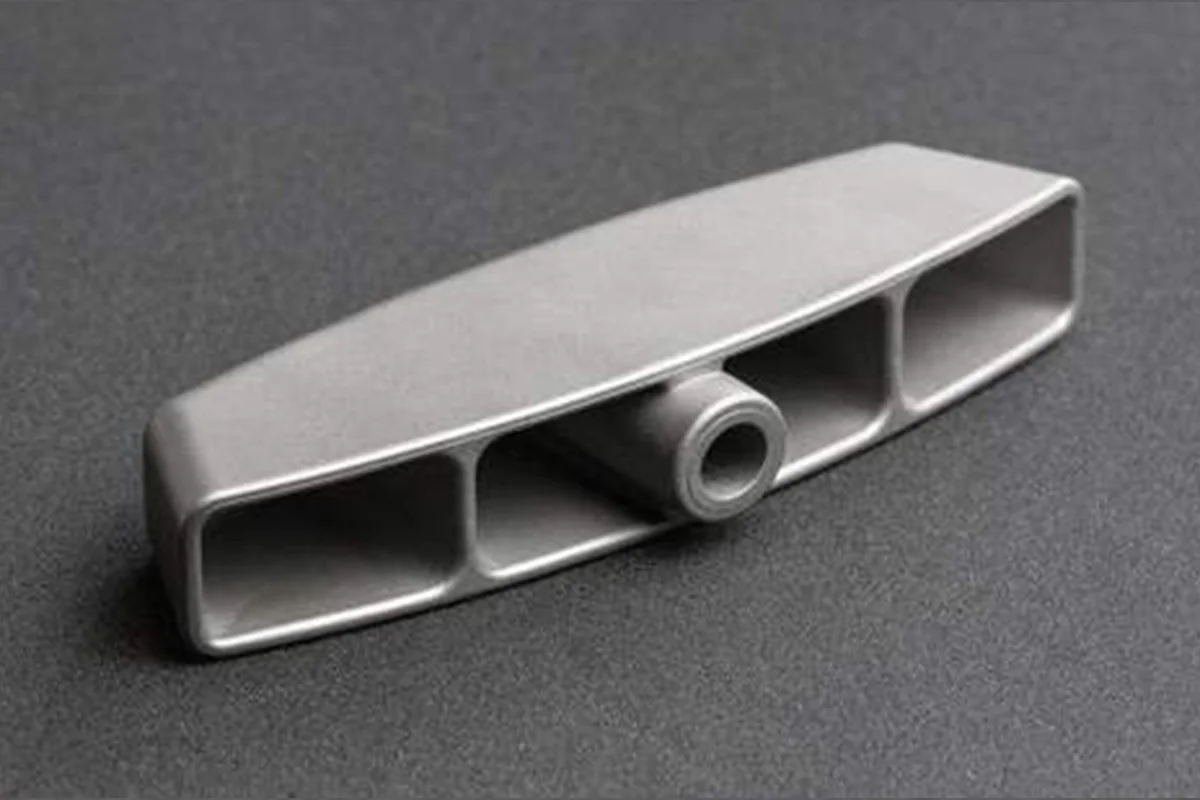
Ti-6Al-4V orthopaedic surgical-instrument handle — Element 22
A PIM International feature identifies an approximately 80 g Ti-6Al-4V MIM handle used as an orthopaedic surgical-instrument component. Its hollow geometry is documented, but the publication does not provide complete cleaning or sterilization qualifications.
Material-selection relevance: The example demonstrates a specific titanium MIM instrument component, not blanket medical approval, implant suitability, or proof that titanium is preferable for every medical mechanism.
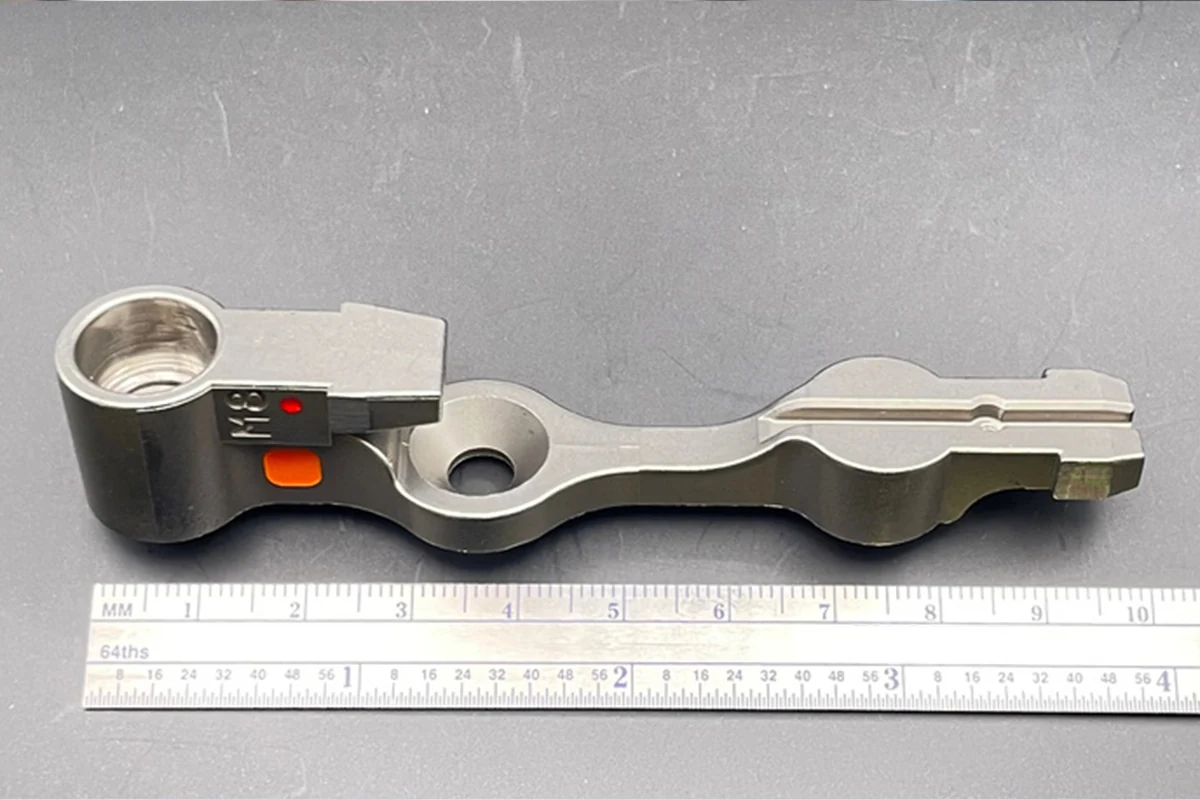
316L portable digital X-ray equipment bracket — CASTEM
CASTEM lists a stainless steel 316L MIM bracket for a portable digital X-ray diagnostic device. The manufacturer confirms the material and application category, but does not publish the bracket’s exact operating load, cleaning chemistry, tolerance or production volume.
Material-selection relevance: A corrosion-resistant stainless grade can be appropriate for medical-equipment hardware when it meets the actual specification; the device application alone does not require titanium.
Grade specificity matters: The same CASTEM brochure identifies other components as 17-4 PH MIM forceps parts, illustrating why a medical mechanism needing a different strength response may require a different stainless grade rather than a titanium substitution. The manufacturer does not disclose the exact role of each forceps subcomponent. Source: CASTEM medical MIM samples.
증거 경계: The four photographs document third-party manufacturer or publication examples. They are not XTMIM production records, comparative material tests, or evidence of XTMIM titanium MIM qualification.
Related application details are covered under MIM medical-device components 및 wearable-device components.
How to Choose Between Titanium and Stainless Steel for Your MIM Part?
The matrix below combines mandatory performance requirements, material grade, the supplier’s demonstrated MIM capability, and total project cost. Each result is conditional: an otherwise attractive material must be rejected or paused when a required property or production route cannot be verified.
| 프로젝트 상황 | 초기 방향 | Condition that can overturn the choice |
|---|---|---|
| Verified weight reduction is required and consequential. | Evaluate titanium first. | Reject or pause if feedstock, mechanical properties, cost, or qualified sintering route cannot be supported. |
| Stainless grade meets corrosion, strength, and wear requirements. | Evaluate stainless steel first. | Reopen titanium if weight, customer specification, or a tested environmental limitation makes stainless unacceptable. |
| High hardness or sliding contact is the priority. | Review suitable stainless grades first. | Check actual wear pair, hardness condition, lubrication and potential titanium surface engineering. |
| A specified titanium grade is mandatory. | Titanium route, subject to feasibility. | A grade requirement does not waive qualification of MIM feedstock, chemistry, sintering, and final properties. |
| Small weight saving with no demonstrated function benefit. | Prefer a validated stainless route where it meets the print. | Compare accepted-part cost; do not pay for nominal material prestige alone. |
| No supplier can demonstrate the required chemistry, dimensional control, or quality evidence. | Stop before tooling. | Resolve grade or specification, test method and route ownership; consider another qualified process or supplier. |
The selected grade must pass three checks together: it meets the drawing and service requirements, the supplier can demonstrate a suitable MIM and finishing route, and the total cost of accepted parts is viable.
What Must Be Verified Before You Lock the Material and MIM Tooling?
A material decision is ready for tooling only when the customer requirements and the supplier's feasibility evidence agree. An attractive comparison chart cannot replace a documented grade, controlled manufacturing route, drawing review, and agreed acceptance criteria.
| 프로젝트 입력 | Customer should define | Supplier must demonstrate or confirm |
|---|---|---|
| 형상 | 2D drawing, 3D CAD, critical datums, threads, slots and thin features. | MIM feasibility, gates, sintering supports, post-machining need. |
| 재료 | Requested grade, alternate grades allowed, performance priority. | Exact available feedstock, chemistry basis, processed-part data. |
| 서비스 노출 | Load history, sweat, moisture, disinfectants, corrosion or wear conditions. | Relevant grade suitability and test / finishing proposal. |
| 검사 | Critical tolerances, surface roughness, cosmetic acceptance, required tests. | Measurement approach, achievable capability, material test evidence. |
| 경제성 | Prototype quantity, forecast annual volume, cost and delivery targets. | Tooling, samples, total accepted-part cost, qualification plan. |
| 자격 | Customer-specific standards, controlled-use requirements, documentation needs. | Which requirements are already validated and which require development or external qualification. |
Minimum material-specific verification: For a proposed titanium MIM route, ask which final-part oxygen, carbon and nitrogen limits, density and mechanical acceptance properties apply, and who will test them. For a proposed 316L or 17-4 PH MIM route, confirm the exact grade, final condition, heat-treatment requirements where relevant, corrosion/surface tests and dimensional capability. The applicable values must come from the project specification and appropriate standard, not from an unrelated marketing datasheet.
Include both candidate grades and their allowable alternatives in the same RFQ package, alongside the drawing and test requirements. For document preparation, see the MIM RFQ 준비 가이드. If a supplier has not qualified a titanium route, that limitation must be clear before quotation or tooling.
Standards and medical-use boundary
ASTM B883-24 concerns MIM materials including ferrous grades; MPIF Standard 35-MIM (2025 edition) identifies MIM titanium grades and additional stainless specifications. ASTM F2885-17(2023) has a particular scope for MIM Ti-6Al-4V components used in surgical-implant manufacture. None of these standards automatically certifies a factory or grants approval to a customer's finished device. The correct specification and qualification path must be determined for the actual use.
기술 참고 자료
The sources below support the stated material properties, manufacturing constraints and published part examples. They are not XTMIM material test reports or manufacturer certifications.
- MPIF Standard 35-MIM (2025): official edition announcement - scope and added MIM titanium grades.
- ASTM B883-24: 금속 사출 성형 (MIM) 재료 - scope for ferrous and selected other MIM materials.
- U.S. National Bureau of Standards: Ti-6Al-4V properties, Table 4 - compiled density (4.43 g/cm3) and Young's modulus (110 GPa); not sintered MIM qualification data.
- Alleima: Sanmac 316/316L product datasheet - reference density (8.0 g/cm3) and Young's modulus (200 GPa at 20 C) for bar stock, not MIM acceptance data.
- Lim et al., Powder Technology (2024): titanium MIM clean-binder feedstock - impurity control and binder-removal engineering considerations.
- Su et al., Materials (2022): Ti-6Al-4V sintering simulations and experiments - evidence for geometry-dependent shrinkage, deformation and support effects.
- ASTM F2885-17(2023) - limited scope for selected MIM Ti-6Al-4V surgical-implant components.
- ElementPlus Ti-6Al-4V MIM 스마트워치 케이스 — PIM International, Dec. 2020, pp. 86–87; supplier-reported pilot, sintered-density/finishing information and watch-case images.
- ZCMIM: MIM 시계 부품 갤러리 — Manufacturer-published 316L MIM watch-case and smartwatch-shell examples, dimensions and post-treatment routes.
- MTIG 티타늄 MIM 웨어러블 기기 케이스 (2026) — PIM International, Feb. 2026; manufacturer-reported titanium wearable case, exact grade of pictured part not published.
- 22번 원소 Ti-6Al-4V MIM 수술용 핸들 — PIM International, June 2020, Fig. 10; approx. 80 g MIM Ti-6Al-4V surgical instrument handle.
- CASTEM MIM 의료 샘플 카탈로그 — CASTEM Technology Labs, MIM Samples page; 316L X-ray equipment bracket and 17-4PH forceps parts (PART-115 and PART-117).
Need an engineering material decision before tooling?
Send the drawing and CAD model with candidate grades, operating environment, critical tolerances, finishing and estimated volume. The engineering review should confirm which route is already supported and which requirements still need sample testing before tooling approval.