
빠른 답변: 선택하세요 316L MIM 스테인리스강 부식 노출, 표면 상태 또는 연성이 설계에 영향을 미치고 강도 요구 사항이 중간 정도일 때 시작 후보로 고려하십시오. 17-4 PH MIM 스테인리스강 최종 열처리 조건에서 더 높은 강도 또는 경도가 필요한 부품의 경우.
부식과 기계적 하중이 모두 중요하면 각 항목에 대해 측정 가능한 허용 한계를 설정하십시오. 도면, 최종 재료 상태, MIM 공정 경로 및 검사 계획에 따라 두 등급 중 하나를 승인할 수 있는지 여부가 결정됩니다.
MIM 부품용 316L 또는 17-4 PH 선택 시 가장 중요한 것은 무엇입니까?
두 합금을 비교하기 전에 부품의 부식 노출, 기계적 하중 및 협상 불가능한 허용 기준을 정의하십시오. 이러한 요구 사항은 부식 중심의 316L 경로 또는 더 높은 강도의 17-4 PH 경로를 검증할 가치가 있는지 여부를 결정합니다.
부품이 견뎌야 하는 부식 및 환경 조건은 무엇입니까?
부품이 실제로 접촉하는 것을 정의하십시오: 간헐적인 습기, 피부 및 땀, 염분 함유 스프레이, 세척 화학 물질, 응결 또는 지속적으로 젖은 틈새. 노출 시간, 온도, 습/건 주기 및 갇힌 액체의 존재는 “옥외 사용”과 같은 광범위한 설명만큼 중요할 수 있습니다. 미용적 변색이 용납되지 않는지 또는 기능 손실만 실패로 간주될 것인지 질문하십시오.
예를 들어, 가시적인 표면과 중간 정도의 하중을 받는 작은 하우징은 습한 어셈블리 내부에 있는 스트레스가 많은 잠금 핀과 다릅니다. 둘 다 “스테인리스 부품”으로 설명될 수 있지만, 잠재적인 고장 모드는 다릅니다. 염화물 노출 또는 화학 세척이 중요한 경우, 검증되지 않은 “내식성” 라벨에 의존하는 대신 특정 응용 분야에 적합한 내식성 허용 테스트를 정의하십시오.
부품이 충족해야 하는 기계적 및 기능적 요구 사항은 무엇입니까?
하중 경로를 지정하십시오: 정적 인장 또는 굽힘 하중, 반복적인 맞물림, 충격, 국부적 접촉 또는 정확한 맞춤 유지가 필요한 경우. 높은 인장 강도 값은 피로 수명, 충격 저항 또는 내마모성을 자체적으로 확립하지 못합니다. 필요한 안전 여유, 부품의 중요 특징 및 설계가 추가 두께 또는 후가공을 허용하는지 여부를 결정하십시오.
분리 필수 요구 사항 선호도에 따라. 명시된 항복 하중, 합의된 테스트 후 녹슬지 않는 상태, 자기 응답 한계 또는 최종 결합 공차는 필수적일 수 있습니다. 외관, 처리 복잡성 및 비용은 협상 가능할 수 있습니다. 이 구별은 더 강한 합금이 환경에 실패하거나(또는) 더 내식성 있는 합금이 기능적 하중에 실패하는 것을 방지합니다.
- 환경: 실제 접촉 매체, 온도, 시간 및 부식 또는 변색 한계.
- 하중: 정적, 주기적, 충격 또는 접촉 응력 및 필요한 성능 여유.
- 기능: 경도, 내마모성, 인성, 자기 응답 또는 외관 요구 사항 (해당되는 경우).
- 형상: 중요 벽, 가는 형상, 기준 구조 및 후처리 치수.
- 제약 조건: 어떤 사양이 고정되어 있고 어떤 사양이 엔지니어링 검토 후 변경될 수 있는지.
도면에서 316 대 316L 확인: 316 및 316L 타입은 관련이 있지만 별개의 명칭입니다. 이 페이지는 MIM-316L 및 MIM-17-4 PH에 관한 것입니다. 도면에서 “316” 또는 단순히 “17-4”로 지정된 경우, 견적 또는 등급 대체 전에 의도된 조성, 적용 가능한 MIM 사양 및 최종 재료 상태를 확인하십시오.
두 합금 모두 요구 사항을 충족하지 못하는 경우, MIM 재료 선정 가이드 대안을 평가하기 위해 사용하십시오.
316L 대 17-4 PH: 주요 재료 차이점은 무엇인가요?
316L은 일반적으로 부식 중심 균형 및 연성으로 선택되는 오스테나이트계 스테인리스강입니다. 17-4 PH는 석출 경화성, 일반적으로 마르텐사이트계 스테인리스강으로, 최종 상태에서 훨씬 높은 강도와 경도를 제공할 수 있습니다. 다음 비교는 정성적입니다. 실제 MIM 속성 값 및 조건은 아래에서 별도로 논의됩니다.
| 결정 요소 | 316L 스테인리스강 | 17-4 PH 스테인리스강 | 차이가 중요한 이유 |
|---|---|---|---|
| 야금 계열 | 오스테나이트계; 17-4 PH처럼 석출 경화되지 않음 | 마르텐사이트계 석출 경화 등급 | 다른 강화 메커니즘과 잠재적인 공정 경로. |
| 부식에 민감한 환경 | 종종 선호되는 초기 후보 재료이며, 특히 염화물 관련 국부 부식이 우려되는 경우 | 많은 용도에서 유용한 내식성을 제공하지만, 노출 및 재료 상태에 대한 면밀한 검토가 필요합니다. | 등급만으로는 특정 환경에 대해 두 합금 모두 승인될 수 없습니다. |
| 강도 및 경도 | 일반적으로 적절하게 시효 처리된 17-4 PH보다 낮음 | 일반적으로 적절한 석출 경화 상태에서 더 높음 | 부품에 실제로 더 높은 기계적 특성이 필요한지 결정하십시오. |
| 연성 및 변형 거동 | 일반적으로 더 연성이 좋음 | 최종 상태에 따라 연성/인성 균형이 다름 | 더 높은 강도가 충격이나 취성 파괴에 대해 자동으로 안전한 것은 아닙니다. |
| 열처리 역할 | 석출 경화 강도 증가를 위해 선택되지 않음 | 시효 상태는 중요한 성능 변수입니다. | 합금 이름뿐만 아니라 목표 상태를 명시하십시오. |
| 자기적 특성 | 오스테나이트 상태에서 종종 저자성을 띱니다. 엄격한 비자성 요구 사항은 여전히 테스트가 필요합니다. | 일반적으로 강자성임 | 측정된 자기 제한을 충족한다고 가정하지 말고 검증하십시오. |
| 프로젝트 비용 | 피드스톡, 형상, 후처리 및 생산량에 따라 다름 | 피드스톡, 열처리, 검사 및 생산량에 따라 다름 | 비교 가능한 공정 견적 없이 고정 단가 승자를 주장하지 마십시오. |
부식성 환경에서 어떤 합금이 더 나은 성능을 발휘할까요?
316L은 몰리브덴(발행된 MIMplus MIM-316L 조성 2.0–3.0% Mo 명시)을 포함하며, 이는 몰리브덴이 없는 유사한 오스테나이트계 등급에 비해 염화물 관련 국부 공격에 대한 저항성을 향상시킬 수 있습니다. 따라서 316L은 많은 부식 민감 설계에 합리적인 첫 번째 후보가 됩니다., 면역 보장은 아닙니다 공식, 틈새 부식 또는 기타 공격에. 맹목적인 간격, 정체된 유체, 세척 화학 물질 및 최종 표면 상태가 결과를 제어할 수 있습니다.
17-4 PH는 단순히 “부식성이 낮은” 강철이 아닙니다. ATI의 단조 합금 지침 이를 중간 정도의 내식성을 가진 고강도 스테인리스강으로 설명합니다. 기술 데이터시트는 많은 매체에서 17-4 PH의 부식 거동을 304형과 비교합니다. 그것은 해당 산업의 모든 부품에 MIM을 사용해야 한다는 것을 직접적인 MIM-17-4 PH 대 MIM-316L 부식 테스트입니다. 실제 환경, 재료 상태, 소결 품질 및 표면 상태를 고려해야 합니다. MPIF 2025 MIM 표준 발표 MIM-17-4 PH의 부식 관련 내용을 업데이트했지만, 해당 공지는 성능 표가 아닙니다. 적용 가능한 전체 표준 및 응용 관련 테스트를 사용하십시오.
강도, 경도 및 연성은 어떻게 비교됩니까?
래치력을 유지하거나 항복을 방지하거나 접촉 시 경도를 유지해야 하는 부품은 17-4 PH가 유리할 수 있습니다. 대신 상당한 소성 변형 후 파단 시까지 내식성이 필요한 부품은 316L을 선호할 수 있습니다. 이는 선택 방향이며, 피로 강도, 충격 거동 또는 내마모 수명에 대한 포괄적인 보증은 아닙니다.
재료 표를 확인할 때 다음을 식별하십시오. 항복 강도 영구 변형 위험의 경우, 인장 강도 인장 하중의 경우, 신율 연성 및 경도 접촉 또는 표면 내구성이 중요한 경우. 한 측정값을 다른 측정값으로 대체하지 마십시오. 더 넓은 계열에 대한 자세한 내용은 다음을 참조하십시오. MIM용 316L 및 MIM용 17-4 PH.
열처리는 17-4 PH 특성을 어떻게 변화시킵니까?
17-4 PH는 석출 경화(precipitation hardening)를 통해 시효 처리(aging treatment)에 반응합니다. H900, H1025, H1150과 같은 일반적인 명칭은 기존 17-4 PH 제품 형태의 다양한 열처리 조건을 나타내며, 결과적인 강도, 경도 및 인성의 균형이 동일하지는 않습니다. 부식 균열 위험, 충격 거동 또는 중요 부품의 정밀한 결합이 제어되는 경우 더 높은 최대 강도가 항상 최선의 선택은 아닙니다.
이 ATI 17-4 PH 기술 데이터 시트 이러한 조건 의존적 거동을 단조(wrought) 재료에 대해 문서화합니다. 해당 수치 열처리 및 기계적 값은 해당 산업의 모든 부품에 MIM을 사용해야 한다는 것을 자동 MIM 승인 목표로 사용되어야 합니다. 특정 시효 경로가 MIM 프로젝트에 필요하거나 가능한지는 별도의 공급업체 및 자격 결정 사항입니다.
자기 요구 사항: 설계에서 낮은 투자율 또는 최대 자기 응답을 지정하는 경우, 최종 재료 조건에 대한 측정값을 요청하십시오. “316L”이라는 명칭은 자기 민감성 MIM 부품 테스트를 대체할 수 없으며, 17-4 PH는 비자성 요구 사항으로 가정하여 선택해서는 안 됩니다.
데이터시트 속성은 최종 MIM 부품에 적용됩니까?
자동으로 적용되지 않습니다. 단조강 데이터, MIM 재료 사양, 공급업체 참조 속성 및 최종 부품 테스트 보고서는 서로 다른 제조 조건 또는 증거 수준을 설명합니다. 해당 사양 및 최종 부품 승인 기준은 프로젝트에 대해 합의되어야 합니다.
단조 및 MIM 재료 속성이 다른 이유는 무엇입니까?
금속 사출 성형(MIM)은 금속 분말과 바인더를 결합하고, 사출 성형, 탈지 및 소결 과정을 거칩니다. 결과적인 밀도, 잔류 기공, 화학 성분, 미세 구조 및 표면 상태는 단조 바 또는 시트와 다를 수 있습니다. 따라서 동일한 등급 명칭이 제조 경로에 따라 동일한 강도, 연신율 또는 부식 성능을 보장하지는 않습니다.
ASTM B883-24 MIM-316L 및 MIM-17-4 PH를 모두 명시적으로 다룹니다. MPIF Standard 35-MIM (2025년판) 는 또 다른 적절한 MIM 특정 참조입니다. 실제 적용 가능한 재료 사양 및 검사 계약을 사용하십시오. 표준 이름을 인용한다고 해서 특정 제품이 자동으로 준수된다는 의미는 아닙니다.
소결 후 및 열처리된 MIM 조건이 성능에 어떤 영향을 미칩니까?
의미 있는 기준 비교를 위해 아래 표는 동일한 명칭의 제3자 MIM 공급업체로부터 소결 후 316L과 소결 후 17-4 PH을 나란히 배치합니다. “≥”로 표시된 값은 해당 공급업체의 일반적인 물성 표에서 재현된 것이며 전체 MPIF 또는 ASTM 승인 요구 사항에서 재현된 것이 아닙니다. 열처리된 17-4 PH은 별도의 조건이며 소결 후 강도 비교에 혼합해서는 안 됩니다. 이러한 수치 중 어느 것도 XTMIM 생산 데이터 또는 프로젝트 보증이 아닙니다.
| 게시된 소결 후 물성 | MIMplus MIM-316L | MIMplus MIM-17-4 PH | 그림 사용 방법 |
|---|---|---|---|
| 밀도, g/cm³ | ≥ 7.6 | ≥ 7.5 | Supplier-published reference; not a shared production tolerance. |
| Ultimate tensile strength, MPa | ≥ 450 | ≥ 790 | Published values illustrate different mechanical capability; final MIM results must be qualified. |
| 0.2% proof/yield strength, MPa | ≥ 140 | ≥ 650 | Use the actual load case and agreed test method, not a grade name. |
| Elongation (A10), % | ≥ 40 | ≥ 3 | A10 is the notation used in these datasheets; elongation results must be compared on compatible test bases. |
| Hardness HV10 | ≥ 100 | ≥ 270 | One supplier's stated as-sintered values, not universal targets. |
Separate heat-treated 17-4 PH example: the MIMplus 17-4 PH datasheet also lists 360–440 HV10 에 대해 열처리 후 entry. It does 해당 산업의 모든 부품에 MIM을 사용해야 한다는 것을 publish matching heat-treated tensile strength, yield strength or elongation values in that row. Do not infer those missing values from the hardness figure or assume an H900/H1025/H1150 designation without supplier confirmation.
Source and scope: MIMplus 316L (E/01, 2020) and 17-4 PH (E/02, 2025). The values describe that supplier's stated test conditions. Supplier-to-supplier differences and actual part tests still require qualification; these are not XTMIM production guarantees.
Which Finished-Part Properties Must Be Verified?
Confirm the material designation and chemical composition as required by the selected specification. Then determine which finished-state checks matter: sintered density, tensile/proof strength, elongation, hardness, corrosion behavior, dimensions, surface condition and functional tests. Not every project needs every test; the acceptance plan should follow the actual risks and the customer's drawings.
Where a test coupon is used, agree how its processing relates to the production part and which measurements must be taken on actual components. High headline datasheet values cannot replace assembly-fit testing or inspection after all relevant heat treatment, machining and finishing steps.
Do not compare unrelated case data as a controlled alloy test: The 316L gas-chromatography flow-block case reports 520 MPa tensile strength, while the 17-4 PH H900 door-lock case reports 1,190 MPa. These are different products, production routes and final states. Their values illustrate documented applications, not a matched 316L versus 17-4 PH experiment.
What MIM Manufacturing Risks Could Change the Material Choice?
A grade may satisfy the performance target on paper but create tooling, distortion or finishing risks in a specific geometry. Review these risks before releasing a mold rather than assuming the higher-rated alloy will produce a better part.
How Can Sintering and Part Geometry Affect Critical Dimensions?
MIM tooling accounts for 소결 수축률, but shrinkage is not a fixed percentage transferable to every feedstock, furnace profile and shape. Before sintering, a long flow path, thin section or difficult gate can also affect filling and green-part integrity. After debinding, unsupported arms, thick-to-thin transitions, deep slots, sharp corners and asymmetrical sections can affect distortion or local dimensional consistency in either alloy. The selected feedstock and production route therefore need geometry-specific validation.
For a precision latch, it matters whether the drawing controls the hook location after sintering, after heat treatment or after final machining. Review the datum chain, required post-processing state and support strategy. A change from 316L to 17-4 PH may require new shrinkage compensation and sintering validation even if the nominal 3D model is unchanged.
Published dimensional-control example: An external MIMA case describes a MIM 17-4 PH upper-beam handle for a turbine-generator brush holder. It needed a custom sintering tray to reduce distortion, followed by coining and machining of one critical dimension. The concrete lesson is to identify distortion-sensitive datums 이전에 specifying tooling or promising as-sintered tolerances. MIMA 출처. This is not an XTMIM production record.
What Changes When 17-4 PH Requires Heat Treatment or Secondary Operations?
If 17-4 PH is selected for a specified final hardness or strength, plan the aging route together with the final dimension and inspection plan. Confirm whether the treatment changes the fit of thin arms, locking features or hole patterns. Dimensional change depends on actual material, condition and process; avoid adopting wrought-product change factors as a guaranteed MIM correction.
Both 316L and 17-4 PH may require post-sintering CNC machining 또는 사이징 for critical features. Surface finish, polishing, cleaning and passivation should also be specified where they affect appearance or corrosion. See MIM secondary operations and heat-treatment planning 및 소결 시 변형 for the broader process background.

Cable-tie installation tool: six MIM mechanism parts
MIMA documents six 17-4 PH MIM components in a handheld tool that grips, tensions and cuts nylon cable ties: a pinion, nosepiece, pawl gripper, insertable rack, cutoff cam and short link. Four parts require limited operations including reaming and coining.
The pinion and rack need controlled tooth geometry; the pivot holes and cam profile also demand defined fits. Near-net-shape molding reduces machining, but it does not remove the need to specify which features will be finished and inspected after sintering.
Original industry case. Third-party application; not manufactured by XTMIM.
| Part or process risk | 잘못될 수 있는 것 | What to decide before tooling |
|---|---|---|
| Thin or unsupported feature | Distortion or a shift in mating position after sintering | Identify supported surfaces and critical datums in DFM. |
| Switching stainless grade | Different shrinkage or processing response | Do not assume existing tooling compensation remains valid. |
| 17-4 PH aging requirement | Final hardness or critical fit differs from the assumed condition | Specify final state and post-treatment inspection. |
| Visible or wetted surface | Finish or trapped-media geometry does not meet corrosion/appearance requirements | Agree surface route, crevice review and relevant tests. |
| Critical threads, bores or mating faces | As-sintered tolerance is insufficient for assembly | Review sizing, CNC operations and final inspection method. |
Before tooling, confirm feedstock availability, suitable furnace and heat-treatment routes, critical tolerances and inspection capability against the actual drawing. These conditions vary by supplier, alloy and part geometry.
When Should You Choose 316L or 17-4 PH for a MIM Part?
The same part category can require different alloys depending on load, exposure and the final processing condition. The published industry cases below illustrate specific working parts; they are not direct 316L-versus-17-4 PH trials.
Corrosion-Exposed Components with Moderate Mechanical Loads
A frequently handled housing or insert with moderate load and repeated cleaning may favor 316L. Compare the actual cleaner, chloride exposure, crevices and surface finish against the required load. The material should pass an application-relevant corrosion or staining criterion as well as mechanical inspection.

Gas chromatography: EPR inlet flow block
MIMA identifies this specimen-inlet flow block as MIM 316L. Two internal passages route gas through five ports; hydraulic core pulls produced the 90° channels, and tapping of preformed holes was the main secondary operation.
The published case reports density 7.6 g/cm³, ultimate tensile strength 520 MPa, yield strength 175 MPa and hardness 67 HRB. Its selection value is the combined need for material properties, internal-channel accuracy and leakage control. The original source does not state that corrosion resistance alone determined the grade.
Original industry case. Third-party application; not manufactured by XTMIM.
High-Load or Hardness-Critical Mechanical Components
For a compact locking component with repeated engagement and a specified proof load or hardness, 17-4 PH may provide the necessary strength margin after an agreed treatment. Validate toughness, distortion-sensitive fit and the inspection method for a part with limited test surfaces.
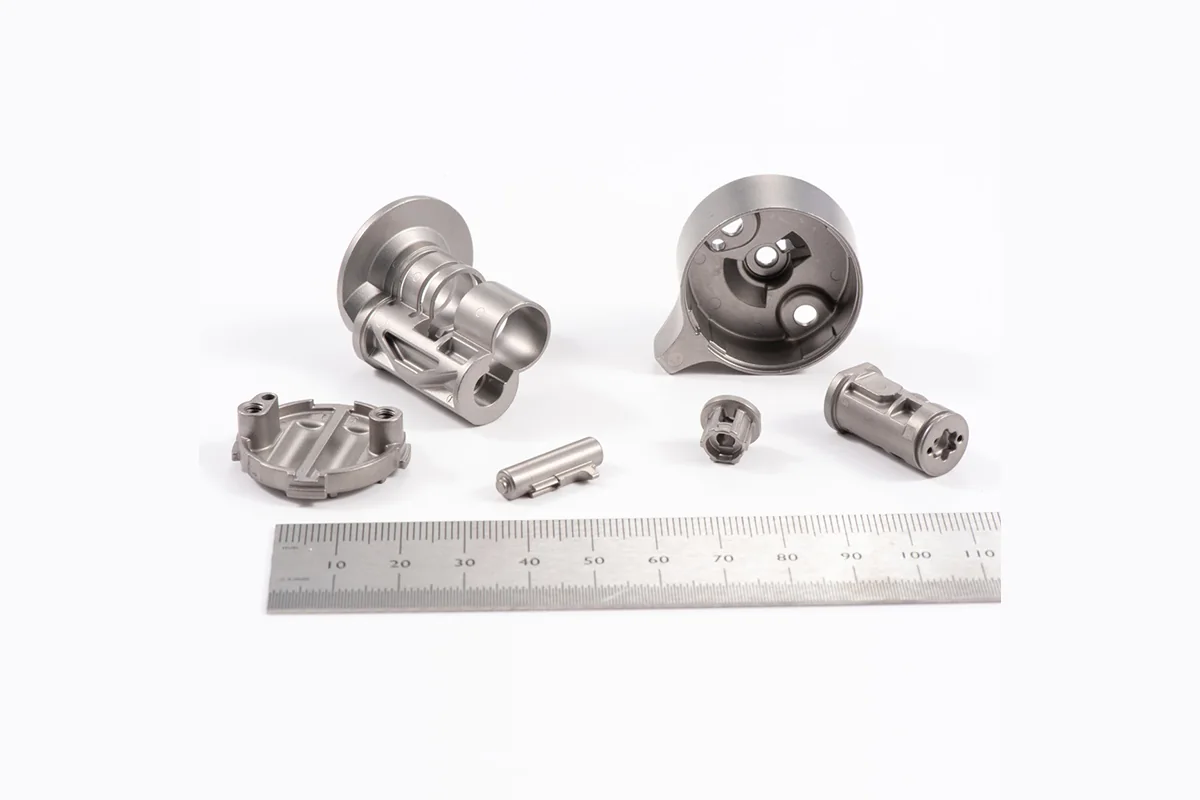
Digital door lock: shafts, clutches and locking components
PickPM documents a knob shaft, clutch, knob shield, core plug, core body and actuator made by MIM from 17-4 PH aged to H900. The stated case properties are density 7.6 g/cm³ and ultimate tensile strength 1,190 MPa.
The parts require precise mating profiles and molded threads. FMEA and multi-cavity tooling were part of the documented development route. H900 is a specified condition for this project, not a default requirement or guaranteed strength for all 17-4 PH MIM parts. An equivalent design still needs defined load, fit and post-treatment acceptance checks.
Original industry case. Third-party application; not manufactured by XTMIM.
Parts Requiring Both High Strength and Corrosion Resistance
A loaded component exposed to chloride-bearing moisture, especially with undrained crevices, needs both a mechanical acceptance criterion and a corrosion assessment. Neither alloy is an automatic winner. Consider geometry, sealing, coatings and lower-stress design changes; reopen material selection if both grades fail the defined requirements.
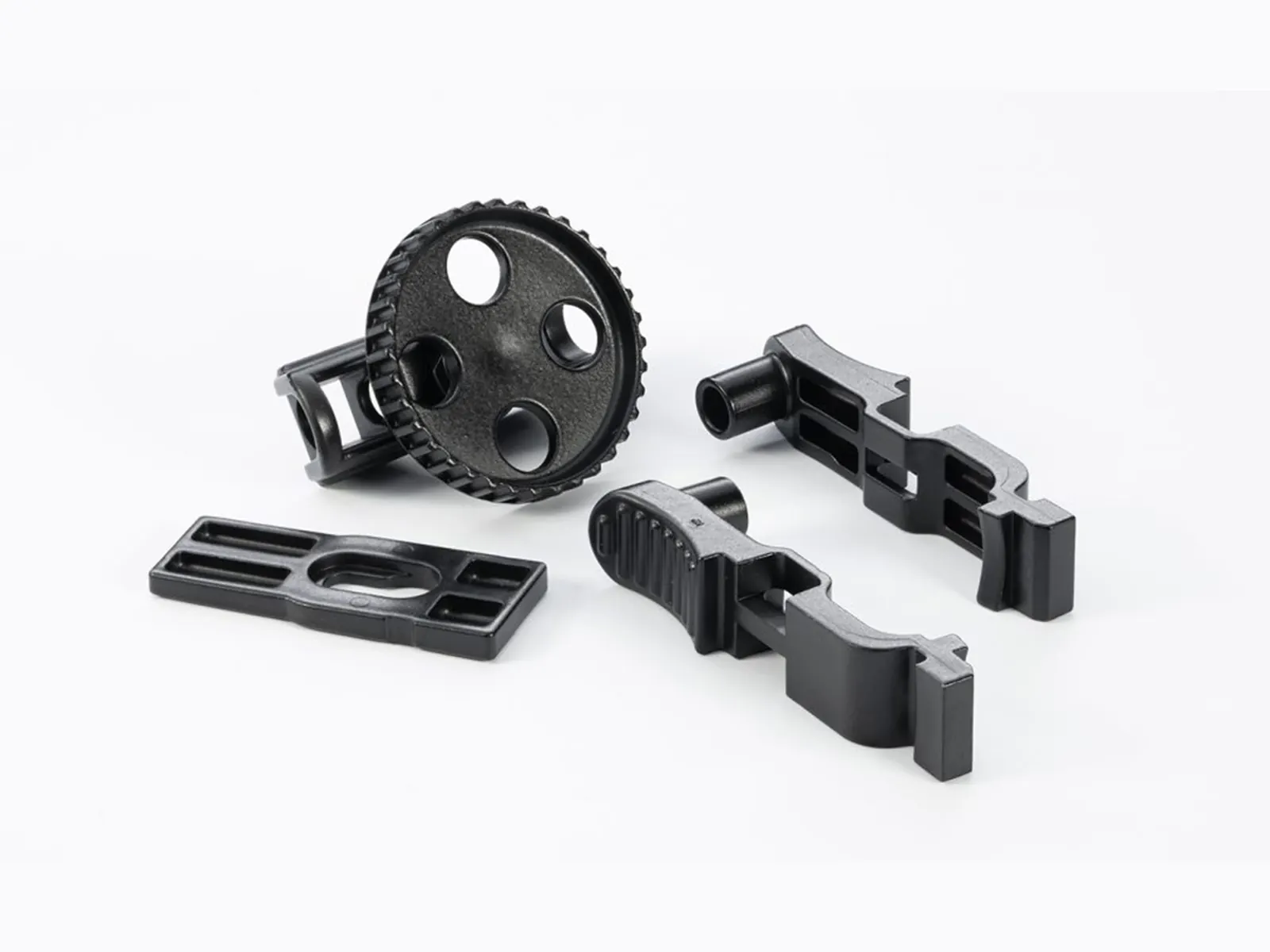
Deep-ocean cable latch: load, corrosion and coating together
A published MPP / Schilling Robotics SeaNet cable-connection case uses four designs, five MIM 316L pieces in total, for a latch and tightening mechanism. The previous plastic design experienced stretching and cracking; the MIM replacement uses a low-friction, corrosion-resistant coating.
This is a counterexample to selecting 17-4 PH solely because a part is called a latch. The alloy, applied coating, contact friction and loading have to work as a system. The source does not establish that uncoated 316L would pass or that 17-4 PH was tested as an alternative.
Original industry case. Third-party application; not manufactured by XTMIM.
Can 316L and 17-4 PH Replace Each Other Without Redesign?
Usually not without an engineering change review. Switching 316L에서 17-4 PH로 may improve a needed strength target, but can change corrosion suitability, magnetic behavior, heat-treatment steps and manufacturing compensation. Switching 17-4 PH에서 316L로 may favor corrosion or ductility while reducing the available strength or hardness margin. Either direction requires reviewing the load case, final acceptance criteria, shrinkage strategy and whether existing tooling or inspection plans can still be used.
| Actual part priority | First candidate | Most important confirmation | When to stop and review |
|---|---|---|---|
| Visible/wetted surface with moderate load | 316L | Actual media, finish and sufficient mechanical margin | If the corrosion test is severe or crevices trap liquid. |
| High proof load, latch retention or final hardness | 17-4 PH | Final material state, strength/hardness and feature tolerance | If impact, corrosion or process distortion are critical. |
| Substantial strength plus demanding chloride exposure | Neither by default | Agreed strength and corrosion tests, including geometry | If one candidate fails either mandatory requirement. |
| Material substitution on an existing molded part | Engineering change review | Load recheck, tooling shrinkage, heat treatment and final inspection | If existing tooling or qualifications were approved for the other grade. |
If neither grade can meet the acceptance criteria, review the MIM material comparison range 또는 MIM 재료 개요 before changing the design or committing to tooling.
What Must Be Verified Before RFQ, Tooling, and Production Approval?
A material preference is enough to begin an RFQ, but not to release tooling. The project needs agreed final material condition, critical dimensions, functional tests and acceptance criteria before production approval.
What Information Is Needed for Material Screening and RFQ?
Provide a 2D drawing with tolerances and datums, a usable 3D model if available, expected annual production volume, service environment, functional load, and the reason 316L or 17-4 PH was proposed. State whether the grade is mandatory or open to change. Include required surface finish, corrosion or hardness criteria and the current manufacturing process if this is a conversion project.
An RFQ with only a material name and part image cannot establish final feasibility. For a practical submission workflow, see the MIM RFQ 준비 가이드 과 MIM 재료 선정 체크리스트.
What Must Be Agreed Before Tooling Release?
Confirm the exact MIM material specification and final condition; identify target material properties, critical dimensions after all processing, applicable corrosion or functional tests and how they will be measured. Do not copy a supplier's “typical” property number into a contractual minimum without agreeing the test method, specimen basis and acceptance rule. Review feedstock route, moldability, sintering support and compensation assumptions, heat treatment if specified, and any machining or sizing needed to meet the drawing. Assign responsibility for any remaining design trade-offs before the mold is committed.
Examples of an actionable material requirement: For a 316L flow component, specify the service medium, permissible leakage, port/thread fit, surface condition and any required corrosion test. For a 17-4 PH locking component, specify the required proof load or strength/hardness criterion, final material condition (for example H900 only if justified and approved), post-treatment dimensions and inspection locations. These examples are specification patterns, not claims that XTMIM can guarantee a particular material value.
What Should Be Validated During T0 Sampling and Production Qualification?
Inspect the T0 or agreed first-article sample for the critical dimensions, visual and surface condition, and the final material state. Confirm the required hardness, strength or functional tests on the agreed basis; corrosion testing should use a method that represents the relevant risk. If the sample fails, review whether the cause is design, feedstock, sintering, heat treatment, surface processing or test specification before modifying the tooling.
Approve the production control and inspection plan only after the agreed first-article results and corrective actions have been accepted.
| 의사 결정 지점 | Required project input or evidence | Release criterion |
|---|---|---|
| RFQ / screening | Drawings, 3D model if available, volume, environment, load, material preference, key surface and tolerance requirements | Supplier can review 316L vs 17-4 PH feasibility and identify assumptions. |
| 금형 제작 전 | Agreed grade/standard, final condition, critical dimensions, DFM review and performance/test requirements | Technical risks and acceptance targets are documented. |
| T0 / first articles | Dimensional, material-state, surface, hardness and functional test results as applicable | Measured results meet the agreed sample criteria or corrective actions are resolved. |
| Production qualification | Approved process controls, inspection plan and traceable acceptance requirements | Consistent manufacture against the approved criteria can be demonstrated. |
Drawing-level material review
Need to validate 316L or 17-4 PH for your own MIM part? Send the drawing, service environment, required material state, critical dimensions and expected annual volume. XTMIM can review the technical questions and assess the appropriate next engineering step before tooling.