
Peças MIM para Dispositivos Vestíveis em Pulseiras de Pagamento
As peças MIM para dispositivos vestíveis são pequenos componentes metálicos utilizados em pulseiras de pagamento, dispositivos NFC/RFID de pulso, pulseiras de controle de acesso e módulos eletrônicos vestíveis compactos. Não são produtos vestíveis completos, caixas de relógio, pulseiras de relógio, pulseiras de silicone, chips NFC, antenas, firmware ou sistemas de pagamento. Do ponto de vista da revisão de projeto, o MIM se torna relevante quando uma peça metálica combina tamanho pequeno, geometria complexa, posição de montagem repetível, resistência local, exposição à corrosão ou funções repetidas de travamento/contato que são difíceis de usinar ou estampar eficientemente em volume de produção. Exemplos típicos incluem suportes de módulo, armações de retenção, micro suportes, clipes de retenção, bases de conector, pinos, pivôs, peças de travamento e insertos de aço inoxidável. Se sua peça estiver próxima a uma antena, área de contato com a pele, contato de carregamento, interface móvel ou espaço de montagem apertado, ela deve ser revisada antes do ferramental.
Peças metálicas pequenas, complexas e orientadas por volume, com funções de retenção, travamento, posicionamento, suporte de contato ou reforço.
Caixas de relógio, carcaças de smartwatch, pulseiras, bandas de silicone, chips NFC, antenas, firmware ou montagem completa de dispositivo de pagamento.
Espessura de parede, furos pequenos, tensão de encaixe, folga da antena, retração na sinterização, acabamento superficial e acumulação de tolerâncias.
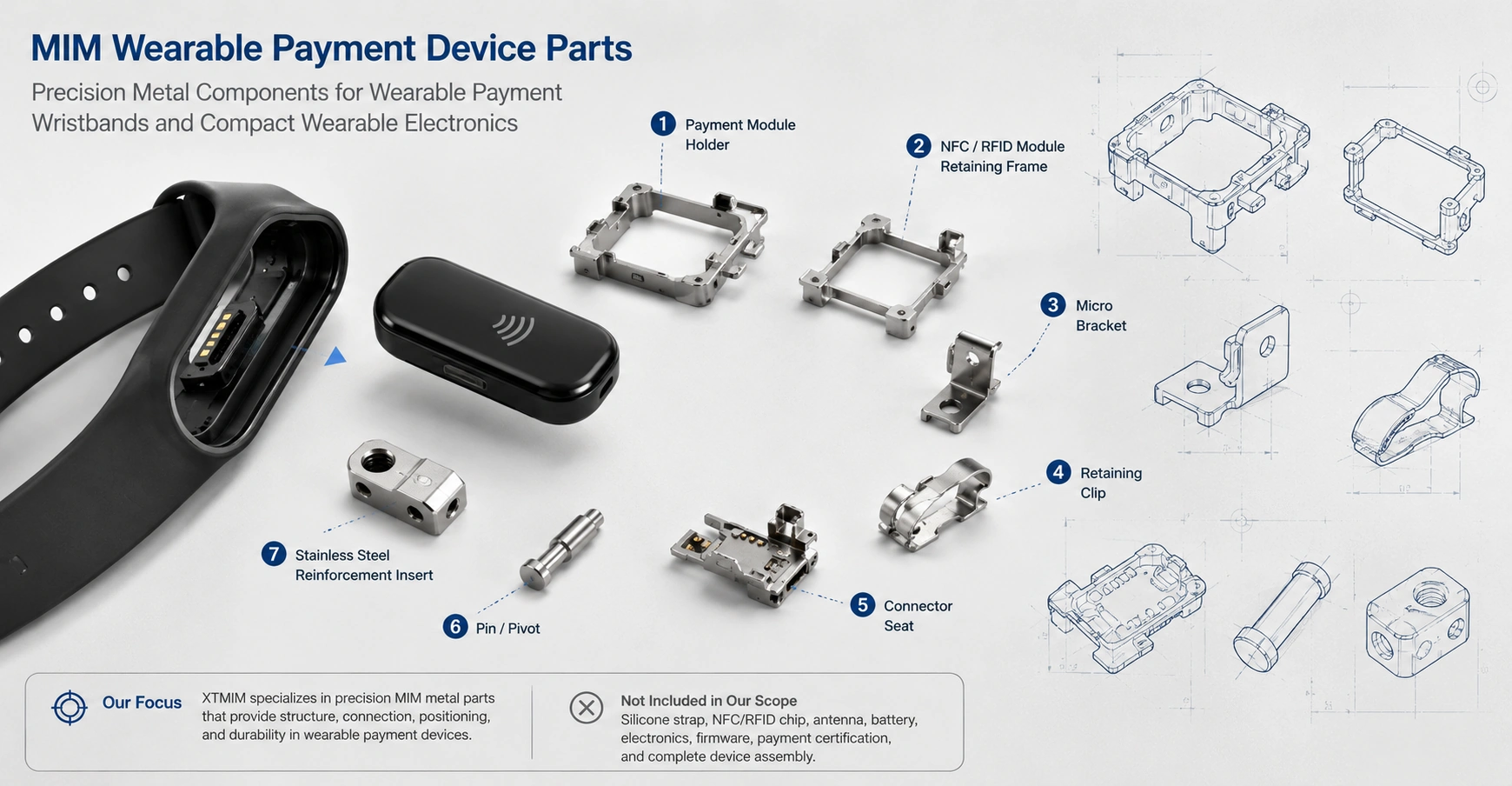
Quais Peças de Dispositivos Vestíveis Podem Ser Feitas por Moldagem por Injeção de Metal?
Em dispositivos de pagamento vestíveis e eletrônicos compactos, a oportunidade do MIM geralmente está dentro ou ao redor do módulo funcional, não no produto vestível inteiro. Candidatos típicos incluem suportes, estruturas de posicionamento, clipes de retenção, suportes de conectores, peças de trava, pinos, pivôs e insertos de reforço.
Essas peças são frequentemente pequenas o suficiente para caber dentro de uma montagem de pulseira de plástico, silicone ou compósito, mas ainda podem precisar de resistência metálica, resistência ao desgaste, posicionamento repetível ou geometria tridimensional compacta. Na prática, a decisão é tomada no nível da peça: um dispositivo vestível pode incluir muitos elementos não-MIM, enquanto apenas componentes metálicos selecionados justificam o ferramental MIM e o controle de sinterização.
| Área do Dispositivo Vestível | Peças MIM Típicas | Por que o MIM Pode Ser Considerado |
|---|---|---|
| Área do módulo de pagamento | Suportes de módulo, estruturas de retenção, assentos de localização | Geometria compacta, posicionamento do módulo e referências de montagem repetíveis |
| Interface de travamento | Travas, ganchos, clipes de retenção | Abertura repetida, pequenas superfícies de contato, tensão local e controle de desgaste |
| Suporte interno para eletrônicos | Suportes para PCB, suportes para sensores, suportes para conectores | Pequenos furos, nervuras, recursos curvos e superfícies de posicionamento precisas |
| Área de carregamento ou contato | Suportes para pinos de mola, bases de conectores, peças de alinhamento magnético | Repetibilidade dimensional, alinhamento de contato e condição superficial controlada |
| Interface de módulo destacável | Pinos, pivôs, peças pequenas tipo eixo | Comportamento de desgaste, ajuste de acoplamento, retenção do módulo e estabilidade da montagem |
| Área adjacente à pele | Insertos de aço inoxidável, peças metálicas expostas à corrosão | Exposição ao suor, condição de borda, acabamento superficial e resistência à corrosão |
O MIM deve ser avaliado peça por peça. Um dispositivo vestível completo pode incluir peças moldadas por injeção de plástico, componentes de silicone, conjuntos de circuitos impressos, estruturas de antena, baterias, chips, revestimentos e processos de montagem final. O MIM se aplica apenas aos componentes metálicos onde o processo oferece valor mecânico ou de fabricação.
Para uma visão mais ampla das categorias de peças MIM do site, visite a página principal de fabricação de peças MIM . Se o seu projeto for uma aplicação mais ampla de eletrônicos de consumo, em vez de um módulo de pagamento usado no pulso, a página relacionada de peças MIM para eletrônicos de consumo também pode ser útil.
O Que Esta Página Abrange — e o Que Não Abrange
A palavra “vestível” pode facilmente gerar confusão no nível da página. Nesta página, peças para dispositivos vestíveis significam peças metálicas funcionais usadas em pulseiras de pagamento, pulseiras de controle de acesso, módulos vestíveis NFC/RFID e conjuntos eletrônicos vestíveis compactos. Não significa peças de caixa de relógio ou fabricação completa de eletrônicos vestíveis.
Abrangido: pulseiras de pagamento e peças metálicas para eletrônicos vestíveis compactos
- Peças metálicas para pulseiras de pagamento vestíveis
- Peças metálicas para dispositivos vestíveis NFC/RFID
- Peças metálicas para pulseiras de controle de acesso
- Peças metálicas para wearables híbridos de fitness/pagamento
- Suportes compactos para módulos eletrônicos vestíveis
- Peças estruturais pequenas, de travamento, retenção, posicionamento e suporte para conectores
Não abrange: caixas de relógio, pulseiras de relógio e módulos NFC completos
- Caixas de relógio ou carcaças de smartwatch
- Pulseiras de relógio, braceletes, fivelas ou componentes de relógios de luxo
- Corpos de pulseira de silicone
- Chips NFC, antenas, elementos seguros, firmware ou certificação de pagamento
- Montagem completa de dispositivo vestível para pagamento
Peças Metálicas MIM Comuns Usadas em Dispositivos de Pagamento Vestíveis

Suportes de módulo de pagamento e estruturas de retenção
Suportes de módulo de pagamento e estruturas de retenção localizam e fixam módulos eletrônicos compactos dentro do conjunto vestível. O MIM pode ser considerado quando a peça possui geometria tridimensional complexa, nervuras pequenas, cavidades internas, bossas de posicionamento ou múltiplas superfícies funcionais. Os principais itens de revisão são folga da antena, geometria do plástico de encaixe, superfícies críticas de localização e acumulação de tolerâncias.
Micro suportes para posicionamento de PCB, sensor e conector
Micro suportes podem segurar uma PCB, sensor, conector ou pequeno contato de bateria. Esta página discute apenas suportes em conjuntos vestíveis. A estrutura geral do suporte, estratégia de furos, direção de carga e aplicações de suportes entre setores devem ser revisadas no artigo dedicado Suportes MIM página.
Grampos de travamento, encaixe e retenção
Módulos vestíveis destacáveis geralmente necessitam de um encaixe, gancho de travamento, clipe de retenção ou inserto de encaixe por pressão. Essas peças exigem revisão antecipada do raio de raiz, espessura local da parede, área de contato, concentração de tensão, localização do ponto de injeção, condição da borda e superfícies de desgaste. Um erro comum é copiar diretamente a geometria de encaixe por pressão de plástico para metal.
Assentos de conector e peças de suporte de contato de carregamento
Assentos de conector, suportes de pino pogo, estruturas de alinhamento magnético e suportes de contato de carregamento podem exigir repetibilidade dimensional e condição de superfície estável. A área de contato, controle de rebarbas, compatibilidade de revestimento e requisitos de acabamento secundário devem ser definidos antes do ferramental.
Pinos pequenos, eixos e peças tipo dobradiça
Cápsulas destacáveis, tampas pivotantes e pequenas interfaces rotativas podem usar pinos, eixos ou peças tipo dobradiça. Esta página cobre apenas aplicações em dispositivos vestíveis. Para uma revisão mais aprofundada do mecanismo, use o artigo dedicado Eixos e pinos MIM e Dobradiças MIM .
Insertos metálicos expostos ao suor e contato com a pele
Dispositivos vestíveis estão expostos ao contato com a pele, suor, umidade, limpeza e atrito. Se corrosão, deslizamento repetido ou conforto da borda forem importantes, revise peças MIM resistentes à corrosão e peças MIM resistentes ao desgaste.
Onde a MIM se Encaixa em um Conjunto de Dispositivo Vestível

Dentro do módulo da pulseira
Dentro do módulo, as peças MIM podem suportar a PCB, posicionar o módulo de pagamento, reforçar uma área fina de plástico ou fornecer uma interface metálica estável para montagem. A questão da revisão é se a peça metálica melhora a confiabilidade mecânica sem criar custo desnecessário, interferência de RF ou complexidade de montagem.
Na interface do módulo destacável
Módulos destacáveis criam desafios mecânicos. A interface deve segurar firmemente, liberar de forma previsível e suportar uso repetido. A MIM pode ser adequada para pequenas peças de trava, ganchos de retenção, assentos de travamento, peças de pivô e insertos de reforço. Na produção, a peça metálica deve ser revisada em conjunto com o recurso de plástico ou silicone correspondente, porque uma trava metálica forte ainda pode falhar se a estrutura de encaixe for fraca ou mal suportada.
Próximo a áreas de carregamento, contato ou alinhamento
Áreas de carregamento e contato frequentemente exigem alinhamento preciso. Um assento de conector ou componente de alinhamento magnético pode precisar de consistência dimensional, condição de superfície controlada e acabamento de borda adequado. Superfícies de contato críticas devem ser identificadas no desenho para que o fornecedor possa planejar o acabamento e a inspeção corretamente.
Próximo a áreas de contato com a pele ou expostas ao suor
Peças metálicas próximas à pele do usuário ou ao ambiente de suor exigem revisão de material e acabamento. O aço inoxidável pode ser considerado para resistência à corrosão, mas o grau específico, processo de acabamento e requisitos de aceitação devem ser confirmados de acordo com a aplicação. A condição da borda e o controle de rebarbas são especialmente importantes para peças que podem ser tocadas durante o uso ou montagem.
Quando a MIM é uma boa opção para peças de dispositivos vestíveis?
A peça é pequena, complexa e difícil de usinar economicamente
A MIM geralmente é mais atrativa quando uma peça possui cavidades curvas, nervuras pequenas, múltiplos degraus, características internas, formatos de trava complexos ou várias superfícies funcionais em um único componente pequeno. Se a mesma peça requer várias configurações de CNC ou múltiplas peças estampadas montadas, a MIM pode reduzir a contagem de peças e melhorar a repetibilidade.
O projeto precisa de dimensões repetíveis na produção em volume
Módulos vestíveis geralmente têm espaços de montagem apertados. Um pequeno desvio pode afetar a sensação de travamento, o alinhamento de contatos, a retenção do módulo ou o ajuste do invólucro. O planejamento dimensional da MIM deve identificar superfícies funcionais, dimensões críticas pós-sinterização e pontos de inspeção antes do projeto do molde.
A peça combina funções estruturais, de travamento e estéticas
Se a face visível, a face de travamento e a face de localização crítica estão todas na mesma peça, a equipe de projeto deve definir quais superfícies são críticas para a função e quais são cosméticas. Isso evita que o fornecedor otimize uma superfície visível enquanto perde uma superfície de contato funcional.
O volume anual pode justificar o ferramental e a configuração de engenharia
A MIM requer ferramental, compensação de retração, validação de remoção do ligante e sinterização, planejamento de operações secundárias e configuração de inspeção. Os compradores devem fornecer o volume anual esperado, o estágio do projeto e a incerteza da previsão antes da seleção do processo.
Quando a MIM não é o processo adequado
O MIM não é selecionado simplesmente porque um componente é pequeno ou metálico. O processo deve ser comparado com a geometria da peça, custo do ferramental, volume anual, função de montagem, requisito de superfície e maturidade do projeto.
| Situação | Por que o MIM Pode Não se Adequar | Alternativa Possível |
|---|---|---|
| Placas planas simples, abas ou arruelas | A peça pode não ter complexidade tridimensional suficiente para justificar o ferramental MIM, remoção do ligante e controle de sinterização. | Estampagem |
| Protótipos de volume muito baixo | O ferramental MIM e o desenvolvimento do processo podem não ser econômicos para algumas peças de teste, a menos que o projeto tenha um caminho de produção claro. | Usinagem CNC ou usinagem de protótipos |
| Grandes carcaças cosméticas | As carcaças de smartwatch e caixas de relógio externas têm diferentes requisitos de superfície, polimento, revestimento e aceitação cosmética. | Revisão de processo dedicada para caixas de relógio |
| Corpo de pulseira de silicone | Os corpos de banda flexível são componentes poliméricos, não peças moldadas por injeção de metal. | Moldagem de silicone ou polímero |
| Chip NFC, antena, firmware ou certificação de pagamento | Estas são responsabilidades do sistema eletrônico, não responsabilidades de fabricação de peças metálicas MIM. | Fornecedor de eletrônicos ou soluções de pagamento |
Riscos de projeto a revisar antes do ferramental

Paredes finas, furos pequenos e cantos internos vivos
Peças para dispositivos vestíveis frequentemente exigem recursos pequenos em espaços limitados. Paredes finas, furos pequenos e cantos vivos podem criar riscos na moldagem, remoção do ligante, sinterização e acabamento. Um recurso CAD fácil de modelar pode ainda ser difícil de moldar, remover o ligante, sinterizar ou inspecionar de forma consistente.
Tensão de encaixe por pressão e ciclos repetidos de abertura
Um pequeno gancho pode funcionar em um protótipo, mas falhar após uso repetido se o raio da raiz, espessura da parede, ângulo de contato ou condição do material não forem adequados. Peças metálicas MIM de travamento exigem uma lógica de revisão diferente dos encaixes por pressão moldados em plástico.
Posição do metal próximo a antenas NFC/RFID
O metal próximo a uma antena NFC ou RFID pode afetar o desempenho do dispositivo dependendo da posição, geometria, distância, material e design da montagem. Um fornecedor de MIM pode revisar a manufaturabilidade mecânica, mas o desempenho de RF deve ser validado pela equipe de eletrônica.
Retração na sinterização e acumulação de tolerâncias na montagem
As peças MIM retraem durante a sinterização. O ferramental deve compensar a retração, e o fornecedor deve entender quais dimensões são críticas após a sinterização e operações secundárias. Em módulos vestíveis, o acúmulo de tolerâncias pode ser mais importante do que uma dimensão isolada da peça.
Qual problema ocorreu: Um clipe de retenção de módulo vestível segurava o módulo durante a montagem inicial, mas a força de travamento tornou-se inconsistente após repetidas aberturas e fechamentos.
Por que isso aconteceu: O design foi adaptado de um conceito de encaixe por pressão de plástico sem revisar o comportamento de deformação do metal, o raio da raiz do encaixe e a tensão de contato local.
Qual foi a causa real do sistema: O problema envolveu a geometria do encaixe, a rigidez do plástico de acoplamento, o ângulo de contato, o raio local, a condição de rebarbação e o carregamento de uso repetido. A peça metálica era apenas uma parte do sistema de falha.
Como foi corrigido: O raio da raiz foi aumentado, o ângulo de contato foi ajustado, a espessura do encaixe foi revisada e o recurso plástico de acoplamento foi modificado para reduzir a sobrecarga local.
Como evitar recorrência: Para clipes de retenção, a revisão DFM deve incluir o conjunto de montagem, o método de liberação, a direção de uso repetido, a área de contato e o requisito de acabamento de borda antes do ferramental.
Qual problema ocorreu: Um suporte compacto de módulo metálico foi projetado próximo à área da antena NFC. O design mecânico era fabricável, mas a equipe de eletrônica levantou preocupações sobre o desempenho da leitura sem contato.
Por que isso aconteceu: O layout mecânico tratou o suporte metálico apenas como um suporte estrutural e não definiu zonas sensíveis a RF durante a revisão inicial do projeto.
Qual foi a causa real do sistema: O problema foi uma revisão incompleta em nível de sistema. A peça MIM em si poderia ser fabricada, mas sua posição no conjunto precisava de coordenação com o layout da antena e validação eletrônica.
Como foi corrigido: A geometria do suporte foi ajustada para reduzir a cobertura metálica próxima à área da antena, e a equipe de eletrônica do cliente validou o layout revisado do módulo.
Como evitar recorrência: Qualquer peça metálica MIM próxima a áreas NFC/RFID deve ser revisada com desenhos de montagem e layout eletrônico. A fabricabilidade mecânica e o desempenho de RF devem ser validados pelas equipes corretas.
Considerações sobre Material e Acabamento Superficial para Peças MIM Vestíveis
Aço inoxidável para peças vestíveis expostas à corrosão
O aço inoxidável é comumente considerado para peças metálicas vestíveis expostas a suor, umidade, manuseio ou limpeza. A seleção final do grau deve depender do requisito de corrosão, resistência, comportamento magnético, acabamento superficial, tratamento térmico, custo e requisitos específicos do cliente.
Materiais de alta resistência para peças de travamento e suporte de carga
Algumas presilhas e peças de travamento necessitam de maior resistência ou dureza. A decisão também deve considerar ductilidade, tenacidade, resposta ao tratamento térmico, comportamento de corrosão e material de acoplamento. A resistência por si só não resolve uma geometria de trava inadequada.
Acabamento superficial para controle de aparência, atrito e corrosão
Rebarbação, tamboreamento, polimento, passivação, galvanoplastia, revestimento PVD, jateamento com microesferas ou acabamento localizado podem ser considerados dependendo se a peça é oculta, visível, deslizante, adjacente à pele ou exposta à corrosão.
Foco típico em material, acabamento e inspeção por tipo de peça
A tabela abaixo é um guia inicial de revisão de engenharia. Os requisitos finais de material, acabamento e inspeção devem ser confirmados a partir do desenho, montagem de acoplamento, ambiente de aplicação e especificação do cliente.
| Tipo de Peça | Direção comum do material | Foco no Acabamento | Foco da inspeção |
|---|---|---|---|
| Grampo de retenção / trava | Aço inoxidável ou liga de alta resistência, dependendo da carga e exposição à corrosão | Rebarbação, raio de borda, superfície de contato de desgaste, polimento local se necessário | Raio da raiz da trava, superfície de contato, ajuste de travamento, interface de uso repetido |
| Suporte de módulo / estrutura de retenção | Aço inoxidável ou liga específica para a aplicação, com base em resistência, corrosão e local de montagem | Controle de rebarbas, planeza local, acabamento de bordas de contato, controle de superfície visível se exposto | Datum de localização, ajuste de montagem, folga para antena, posição crítica de furo e boss |
| Assento do conector / suporte de contato de carregamento | Aço inoxidável ou liga selecionada com base no alinhamento do contato e requisito de acabamento | Acabamento da área de contato, remoção de rebarbas, passivação ou revestimento se especificado | Alinhamento do contato, posição do furo ou rasgo, altura de encaixe, rebarba nas bordas adjacentes ao contato |
| Pino pequeno / pivô | Material resistente ao desgaste ou focado em resistência, dependendo do movimento e carga de encaixe | Controle do diâmetro superficial, acabamento de bordas, polimento localizado onde necessário | Diâmetro, circularidade, retilineidade, ajuste de encaixe, área de contato por desgaste |
| Insert adjacente à pele | Direção de aço inoxidável resistente à corrosão quando contato com suor ou pele for relevante | Passivação, polimento, conforto da borda, limpeza superficial | Rugosidade superficial, condição da borda, requisito de corrosão, aceitação cosmética se visível |
Tabela de Seleção de Peças MIM para Dispositivos Vestíveis
Esta tabela destina-se à triagem inicial de projetos. Ela não substitui a revisão do desenho, mas ajuda engenheiros e compradores a decidir quais peças metálicas para dispositivos vestíveis são candidatas viáveis para MIM e quais peças podem exigir comparação de processos primeiro.
| Grupo de Peças | Peças típicas | Adequação MIM | Risco Principal | Próxima Revisão Sugerida |
|---|---|---|---|---|
| Suportes de módulo | Estruturas de módulo NFC/RFID, bases de módulo de pagamento | Alto | Folga da antena, empilhamento de tolerâncias | Revisão de desenho + montagem |
| Peças de travamento | Travas, clipes, ganchos | Alto | Concentração de tensão, desgaste, cantos vivos | Revisão de DFM + risco de uso repetido |
| Micro suportes | Suportes para PCB, suportes para sensores | Médio a alto | Paredes finas, furos, distorção na sinterização | Revisão de viabilidade do suporte |
| Assentos de conectores | Assentos para pinos de mola, suportes de contato de carregamento | Médio a alto | Estabilidade de contato, acabamento superficial | Revisão de tolerância e superfície |
| Pinos / pivôs | Micro pinos, peças pivotantes | Médio | Desgaste, controle de diâmetro, ajuste de encaixe | Revisão de pino/eixo |
| Insertos adjacentes à pele | Insertos de aço inoxidável, insertos decorativos-funcionais | Médio | Corrosão, condição de borda, acabamento | Revisão de material + acabamento |
| Peças planas simples | Placas, abas planas | Baixo a médio | Estampagem pode ser melhor | Comparação de processos |
Use esta tabela como ferramenta de roteamento. Peças com alta adequação devem seguir diretamente para revisão de desenho e montagem. Peças com adequação média geralmente precisam de comparação com usinagem CNC, estampagem ou outros processos metalúrgicos. Peças com baixa adequação devem ser revisadas cuidadosamente antes de investir em ferramental MIM.
Lista de Verificação de Revisão DFM Antes do Ferramental

Quais desenhos e arquivos o comprador deve fornecer?
O que os engenheiros revisarão primeiro?
A revisão de engenharia da XTMIM deve focar no tamanho e peso da peça, espessura de parede, furos e ranhuras pequenos, rebaixos, cantos vivos internos, viabilidade da localização do ponto de injeção, risco de manuseio da peça verde, risco de distorção na remoção do ligante e sinterização, requisitos de operações secundárias, adequação do material, viabilidade de acabamento superficial e método de inspeção.
O que a XTMIM pode revisar vs o que sua equipe de eletrônica deve validar
Um dispositivo de pagamento vestível é um sistema mecânico e eletrônico. A XTMIM pode revisar a manufaturabilidade da peça MIM e o risco mecânico, mas o desempenho eletrônico e a validação do sistema de pagamento devem permanecer com a equipe de eletrônica do cliente ou com o parceiro do módulo de pagamento.
| XTMIM Pode Revisar | Cliente / Equipe de Eletrônica Deve Validar |
|---|---|
| Viabilidade MIM, risco de ferramental, compensação de retração, manuseio da peça verde, preocupações com remoção do ligante e sinterização | Desempenho de leitura NFC/RFID, layout da antena, desempenho do módulo eletrônico e folga sensível a RF |
| Direção do material, viabilidade de acabamento superficial, controle de rebarbas, exposição à corrosão, superfícies de contato por desgaste | Certificação de pagamento, requisitos de elemento seguro, firmware, comportamento do software e segurança do sistema |
| Controle dimensional, superfícies críticas, estratégia de inspeção, ajuste metal/plástico de encaixe, risco de montagem | Conformidade completa de dispositivos vestíveis, validação de bateria/eletrônicos, teste final do produto e requisitos de aprovação de mercado |
Solicite uma Revisão de Desenho para Peças MIM Vestíveis
Se o seu projeto de dispositivo de pagamento vestível, pulseira NFC/RFID, pulseira de controle de acesso ou eletrônicos vestíveis compactos incluir um pequeno suporte metálico, clipe de retenção, micro suporte, assento de conector, pino, trava ou inserto exposto à corrosão, envie seus desenhos para uma revisão de engenharia.
Inclua desenhos 2D, arquivos CAD 3D, requisitos de material, requisitos de tolerância, expectativas de acabamento superficial, local de montagem, informações da peça correspondente, volume anual e se a peça está próxima a uma antena, área de contato com a pele, região exposta ao suor, contato de carregamento ou interface móvel.
A XTMIM pode apoiar uma revisão preliminar de adequação do processo, identificar riscos de ferramental MIM, preocupações com retração e sinterização, opções de material, requisitos de acabamento superficial, estratégia de inspeção e onde CNC, estampagem, fundição sob pressão ou outro processo pode ser mais prático antes do início do ferramental.
FAQ Sobre Peças MIM para Dispositivos Vestíveis
Peças de pulseira de pagamento vestível são adequadas para MIM?
Algumas peças de pulseira de pagamento vestível são adequadas para MIM, especialmente pequenos suportes metálicos, clipes de retenção, assentos de conector, peças de travamento, pinos e insertos expostos à corrosão. O MIM normalmente não é usado para o corpo completo da pulseira, pulseira de silicone, chip NFC, antena ou eletrônicos do módulo de pagamento.
Esta página inclui caixas de relógio ou carcaças de smartwatch?
Não. Esta página é focada em peças metálicas MIM para pulseiras de pagamento, dispositivos vestíveis NFC/RFID e eletrônicos vestíveis compactos. Caixas de relógio, carcaças de smartwatch, pulseiras de relógio e hardware decorativo de relógio devem ser analisados na seção de peças de relógio ou peças de caixa de relógio.
Peças metálicas MIM podem ser usadas próximas a antenas NFC ou RFID?
Elas podem ser usadas em algumas montagens, mas a posição do metal, geometria, distância da antena e estrutura ao redor devem ser analisadas cuidadosamente. Um fornecedor de MIM pode revisar a manufaturabilidade mecânica, enquanto o desempenho de RF deve ser validado pela equipe de eletrônicos do cliente ou pelo fornecedor do módulo de pagamento.
Quais materiais são comumente considerados para peças metálicas MIM vestíveis?
O aço inoxidável é frequentemente considerado para peças metálicas expostas ao suor, à corrosão ou adjacentes à pele. Materiais de alta resistência podem ser considerados para peças de travamento e suporte de carga. A seleção final do material deve ser baseada na exposição à corrosão, resistência, desgaste, comportamento magnético, acabamento superficial e requisitos de montagem.
Quando a estampagem ou o CNC são melhores que o MIM?
A estampagem pode ser melhor para placas planas simples, abas ou peças de baixa complexidade. O CNC pode ser melhor para protótipos de baixo volume, peças grandes ou projetos que não estão prontos para ferramental. O MIM se torna mais atraente quando a peça é pequena, complexa, repetida em volume e difícil de usinar ou estampar eficientemente.
O MIM pode substituir o CNC ou a estampagem para todas as peças metálicas vestíveis?
Não. O MIM não pode substituir a usinagem CNC ou a estampagem para todas as peças metálicas vestíveis. O MIM é mais útil para peças metálicas pequenas, complexas, de alto volume de produção, com geometria tridimensional, múltiplas superfícies funcionais ou recursos de montagem difíceis. O CNC pode ser melhor para protótipos ou peças de baixo volume, enquanto a estampagem pode ser melhor para peças metálicas planas simples.
Quais informações são necessárias para um orçamento de peça MIM vestível?
Uma solicitação de cotação útil deve incluir desenhos 2D, arquivos CAD 3D, requisitos de material, tolerâncias, acabamento superficial, dimensões críticas, desenhos de montagem, volume anual esperado e contexto de aplicação. Também é útil informar se a peça está próxima a uma antena NFC/RFID, contato com a pele, exposição ao suor, contato de carregamento ou interface móvel.
A XTMIM pode fabricar dispositivos completos de pagamento vestíveis?
Não. A XTMIM foca em peças metálicas MIM e revisão de fabricação para pequenos componentes metálicos. Dispositivos completos de pagamento vestíveis exigem eletrônica, módulos NFC/RFID, antenas, elementos seguros, firmware, certificação de pagamento e montagem final do produto de fornecedores de tecnologia relevantes.
Notas sobre Normas e Referências Técnicas
Normas e referências técnicas podem orientar a seleção de materiais, o entendimento do processo MIM e a revisão em nível de sistema, mas não devem substituir a revisão DFM específica do projeto. Valores atuais de material, requisitos de teste e critérios de aceitação devem ser confirmados com base no desenho do cliente, ficha técnica do material, especificação de compra e norma formal aplicável.
- MIMA — O que é Moldagem por Injeção de Metal? Esta fonte é útil para explicar feedstock, green part, brown part, remoção do ligante, sinterização e a rota geral do processo MIM. Consultar referência
- Norma MPIF 35-MIM. Este recurso auxilia na revisão de especificação de materiais para materiais MIM comuns. Os valores finais dos materiais devem ser verificados com a documentação oficial atual e os requisitos do projeto. Consultar referência
- Comitê de Normas MIMA. Esta referência apoia o papel da MIMA no desenvolvimento e manutenção da Norma MPIF 35-MIM e métodos ou diretrizes MIM relacionados. Consultar referência
- Série ISO/IEC 14443. Isso é relevante apenas como contexto para tecnologia de proximidade/sem contato e reforça por que o posicionamento de metal próximo a interfaces NFC/RFID precisa de revisão em nível de sistema. Consultar referência
A capacidade final de tolerância, adequação do material, aceitação do acabamento superficial e risco relacionado ao layout da antena dependem da geometria da peça, material, comportamento de sinterização, montagem de encaixe e requisitos de validação específicos do cliente.