
Custo de Moldagem por Injeção de Metal | Guia de Engenharia e RFQ
custo de moldagem por injeção de metal possui dois componentes distintos: o investimento único em um molde de produção e qualificação de projeto, e o custo recorrente de cada peça metálica acabada aceita. Uma estimativa confiável depende da geometria da peça, material, tolerâncias críticas, operações secundárias, volume de produção esperado e condição de entrega acordada.
A XTMIM publicou anteriormente US$ 4.500 por molde como referência para algumas configurações de ferramental padrão. Este valor não é uma oferta fixa nem uma estimativa do custo unitário da sua peça. É necessária uma revisão baseada em desenho para determinar se o MIM pode reduzir o custo de vida do seu componente específico.
Todos os exemplos numéricos de custo unitário abaixo são cálculos ilustrativos, não cotações de clientes ou preços de fabricação garantidos. A referência de ferramental é específica da experiência publicada anteriormente pela XTMIM.
Quanto Custa a Moldagem por Injeção de Metal?
Não existe um preço padrão para peças acabadas em moldagem por injeção de metal customizada. Um orçamento realista combina o molde de produção e qualquer trabalho de qualificação cobrado separadamente com o preço de cada peça acabada aceita em uma quantidade especificada. O valor final depende do desenho, liga, tolerâncias, operações secundárias, requisitos de inspeção e o volume esperado ao longo do programa. A tabela separa os valores que podem ser discutidos inicialmente daqueles que requerem uma cotação baseada em desenho.
| Pergunta sobre custo | Resposta útil | O que determina o valor |
|---|---|---|
| Quanto custa o molde? | Referência XTMIM publicada anteriormente: aproximadamente US$ 4.500 para algumas configurações de ferramental padrão; confirme o escopo. | Estratégia de cavidade, "sliders" ou insertos, extração da peça, complexidade do ferramental, compensação de retração e requisitos de testes. |
| Quanto custa cada peça MIM? | Requer cotação específica da peça; nenhum preço fixo por peça ou por grama é confiável. | Material e peso, plano de produção, tolerâncias finais, acabamento, inspeção e rendimento do processo. |
| Qual é o custo total do projeto? | Taxas únicas + custo recorrente da peça aceita sobre o volume relevante. | Volume aceito vitalício, inclusões acordadas na cotação e quaisquer operações faturadas separadamente. |
A XTMIM citou anteriormente em torno de US$ 1.500 para certas configurações de molde MIM padrão. Esta é uma referência histórica de orçamento, não uma oferta fixa atual ou um preço médio da indústria. A proposta para uma peça real deve identificar a contagem de cavidades, slides ou insertos, material da ferramenta e vida útil esperada, provisões para testes e qualificação, ajustes incluídos e quaisquer gabaritos dedicados. Um molde que parece barato inicialmente pode custar mais ao longo do programa se as correções de teste necessárias ou o trabalho de qualificação forem excluídos.
O Que Está Incluído em uma Cotação MIM?
Dois fornecedores podem cotar diferentes condições de entrega para o mesmo desenho: um bruto como sinterizado, uma peça após usinagem crítica ou um componente totalmente acabado e inspecionado. Antes de comparar seus preços, confirme quais operações e requisitos de aceitação cada cotação inclui. Um preço unitário mais baixo não é necessariamente um custo menor para a mesma peça acabada.
Custo Único do Ferramental e Desenvolvimento do Projeto
Um molde MIM deve liberar uma peça mecanicamente fraca peça bruta da cavidade e antecipar a mudança dimensional durante a remoção do ligante e a sinterização em alta temperatura. Seu preço reflete mais do que a usinagem de uma cavidade: o projeto da porta e do canal de injeção, as superfícies de partição, a resistência do núcleo, a ejeção, as cavidades, os insertos ou slides, a compensação de retração e os testes planejados do molde afetam o trabalho. O comportamento da retração depende do feedstock, da geometria do componente e da rota do processo, portanto, a compensação final e o desempenho dimensional devem ser verificados por meio de peças de teste, em vez de assumidos a partir de um único fator de retração nominal. Amostragem, testes de qualificação, suportes de sinterização dedicados e gabaritos de usinagem podem ser incluídos na proposta inicial ou precificados separadamente. Confirme a propriedade, os termos de manutenção e armazenamento, as rodadas de teste e quem paga pelas revisões antes de autorizar o molde. Para mais detalhes sobre esses impulsionadores de custo, consulte por que o custo do ferramental MIM é alto.
Custo Recorrente por Peça Acabada Aceita
Para cada lote de produção, o feedstock é injetado no molde, o ligante é removido e o esqueleto de pó restante é sinterizado à condição necessária. O custo de uma peça entregue e aceita também pode incluir manuseio, suportes de sinterização, furação ou rosqueamento, calibração, acabamento CNC, tratamento térmico, processamento de superfície, inspeção e embalagem. O denominador de custo correto é o número de peças que atendem aos critérios de aceitação acordados, não o número de peças brutas moldadas ou peças sinterizadas produzidas. Perdas de processo, carregamento extra do forno, manuseio repetido e esforço de inspeção importam porque aumentam os recursos usados por componente aceito. Um fornecedor pode já incluir perdas de rendimento normais e operações secundárias no preço da peça acabada; o comprador não deve adicionar essas cobranças uma segunda vez.
Verificação ilustrativa de rendimento (não são dados de produção XTMIM): Se um lote incorrer em US$200 em uma etapa de processamento aplicável e produzir 92 peças aceitas de 100 peças iniciadas, essa etapa contribui US$200 ÷ 92 = US$2.17 per accepted part, not US$2.00 per started part. This arithmetic explains why acceptance yield affects delivered-part economics. It does not justify adding another scrap percentage to a supplier's price when that supplier has already allowed for normal losses.
| Quotation line | Cost timing | What the buyer must confirm |
|---|---|---|
| Mold and initial tooling | Usually upfront or recovered under an agreed pricing structure | Cavity count, trial scope, ownership and adjustment terms. |
| Engineering / qualification / fixtures | One-time if separately charged | What is included in mold price, test scope and the criteria for approval. |
| Feedstock + molding + debinding + sintering | Recurring manufacturing cost | Part weight, material grade, batch plan and expected accepted yield. |
| Necessary secondary operations | Recurring, unless quoted as a separate service | Specific critical surfaces, threads, heat treatment, coating, and finish. |
| Inspection + packaging | Usually part of delivered cost, sometimes a separate quote line | Inspection plan, acceptance documents, packing and delivery basis. |
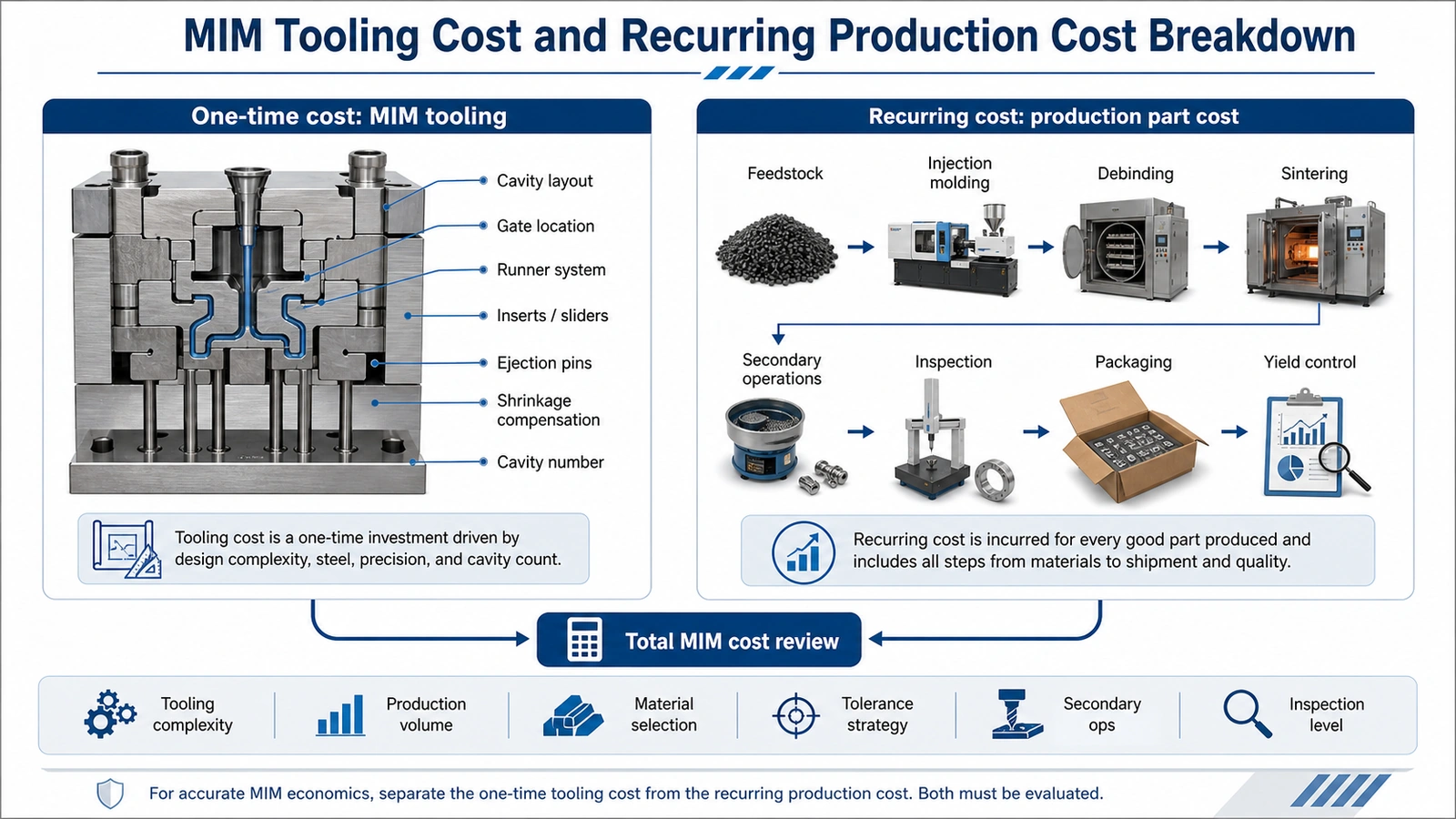
A seemingly low MIM part price may simply omit machining or inspection that another supplier includes. Conversely, a slightly higher tooling proposal may be economically justified if it supports a stable cavity layout, fewer defects, or fewer recurring operations. Neither is automatically better; the comparison becomes meaningful only when both quotations cover the same drawing revision, material specification, acceptance criteria and finished delivery condition.
Avoid double counting. If the unit price already recovers tooling investment, add only one-time charges that are genuinely invoiced separately. Likewise, do not add machining, inspection or normal process losses again when they are included in the supplier's accepted finished-part price.
Por Que Peças MIM Semelhantes Têm Custos Diferentes?
Similar weight does not mean similar MIM cost. Two parts in the same stainless-steel grade may need different mold actions, sintering support, post-machining and inspection. The cost difference arises when a drawing feature changes how the green part is released, how it survives debinding and sintering, or how the finished part must be checked and delivered.
Part Geometry, Tooling Complexity, and Sintering Risk
MIM geometry affects cost first at injection and ejection, then again after the binder is removed. A deep narrow slot may need a slender core; an internal undercut may need a slide or split tool; and the gate must fill the cavity without creating unacceptable flow defects or marks on functional surfaces. Industry design guidance discusses placing gates to encourage flow from thicker toward thinner sections and balancing runners in multi-cavity tools. After ejection, the binder-containing green part must survive handling, debinding and substantial sintering shrinkage. Wall-thickness changes, long unsupported arms and poorly chosen contact faces can make distortion or surface damage more difficult to control. A dedicated setter or additional sizing step may then become part of the real manufacturing route. These outcomes are conditional on geometry, feedstock, orientation and process settings—not proof that a particular feature will fail. See orientação de projeto complexo da MIMA for gating, ejection, thickness and sintering-support considerations.
For a drawing-based cost review, mark acceptable gate and ejector contact areas, check core access and mold-release direction in CAD, and identify surfaces that can support the part during sintering without damaging a functional face. Initial tooling and sample trials then provide measurements for shrinkage compensation and the specified dimensions. Until the agreed inspections have been completed, predicted yield and as-sintered tolerances belong in the quotation assumptions rather than being presented as confirmed production capability.
Material Selection, Part Weight, and Processing Cost
Specifying only a familiar alloy name is not enough to determine manufacturing cost. The required final condition—for example, corrosion performance for 316L stainless steel or a specified strength/heat-treatment condition for 17-4PH—affects how the chosen grade must be processed and verified. Powder characteristics and a qualified feedstock system influence filling, binder removal, sintering and dimensional repeatability. Changing to an unfamiliar powder or binder formulation can introduce development and qualification work even if its quoted raw-material price is lower. Part weight affects material consumption, but mass distribution and section thickness can also constrain binder removal, sintering batch capacity, part handling and cycle time. Therefore, dividing a feedstock price by component weight is not a reliable finished-part cost calculation. Material suitability should be checked against the drawing and the agreed final properties; MPIF Standard 35-MIM is a material-specification reference, not a price list.
Tolerances, Secondary Operations, and Inspection Cost
A drawing with close-fitting bores, sealing faces, threads, flatness requirements or cosmetic surfaces may require post-sintering machining, sizing, grinding, tapping or surface finishing. MIMA describes approximately ±0.3% as a general process-level average for as-sintered MIM tolerances, while emphasizing secondary operations for more demanding features; this is not an XTMIM capability guarantee and cannot be applied blindly to every dimension or geometry. Tool compensation can adjust systematic shrinkage, but it cannot by itself remove distortion, cavity-to-cavity differences or insufficient measurement capability. The engineering drawing should identify the function-critical datum and acceptance method, then the supplier should explain which features are expected as-sintered and which are priced for finishing. For a closer examination of those quotation effects, see como as operações secundárias afetam o custo de RFQ MIM.
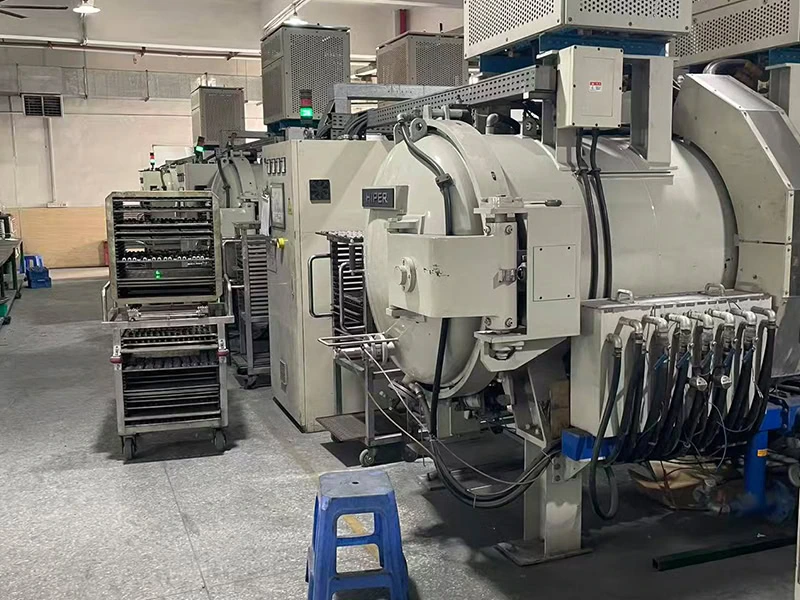
Engineering example A · Hypothetical design comparison
Two Similar Stainless-Steel Parts, Different Manufacturing Costs
Consider two stainless-steel designs with similar mass and the same requirement for 8,000 accepted parts. Part A has relatively even wall thickness, a straightforward mold-release direction and close tolerances only on functional interfaces. Part B has a deep slot, thick-to-thin transitions, extensive close-tolerance callouts and specified tapping, machining and polishing after sintering. Part B may therefore require a more demanding core or mold action, specific sintering support and additional inspected operations. The extent of those costs cannot be established from weight or appearance alone; it needs a tool concept, process plan and quotation. These are hypothetical designs, with no measured price difference or yield data.
| Engineering feature | Part A (illustrative) | Part B (illustrative) | What changes in cost review |
|---|---|---|---|
| Material and quantity | Same stainless steel; 8,000 parts | Same stainless steel; 8,000 parts | These variables alone do not explain the difference. |
| Wall / slot geometry | Relatively uniform walls | Uneven walls; deep narrow slot | Review green-part ejection, debinding, support and distortion risk. |
| Estratégia de tolerância | Selected functional dimensions controlled closely | Most features marked to tight limits | Review capability and need for additional machining or inspection. |
| Secondary work | Limitado | Rosqueamento, usinagem, polimento | Additional recurring operations change delivered-part cost. |
| Before-quote action | Confirm key interfaces | Identify noncritical requirements and redraw only with customer approval | Verify a technically equivalent specification before quoting. |
To evaluate the difference, mark the function-critical surfaces and permitted gate and ejector locations on both drawings. Review core support and any moving mold actions, establish whether special sintering setters are needed, then list the machining and inspection required for each design. Trial measurements can determine whether the proposed tolerances are realistic. If a change to the slot, wall transition or nonfunctional tolerance could reduce work, obtain customer approval before issuing a revised quotation. Both prices should describe parts in the same accepted finished condition.
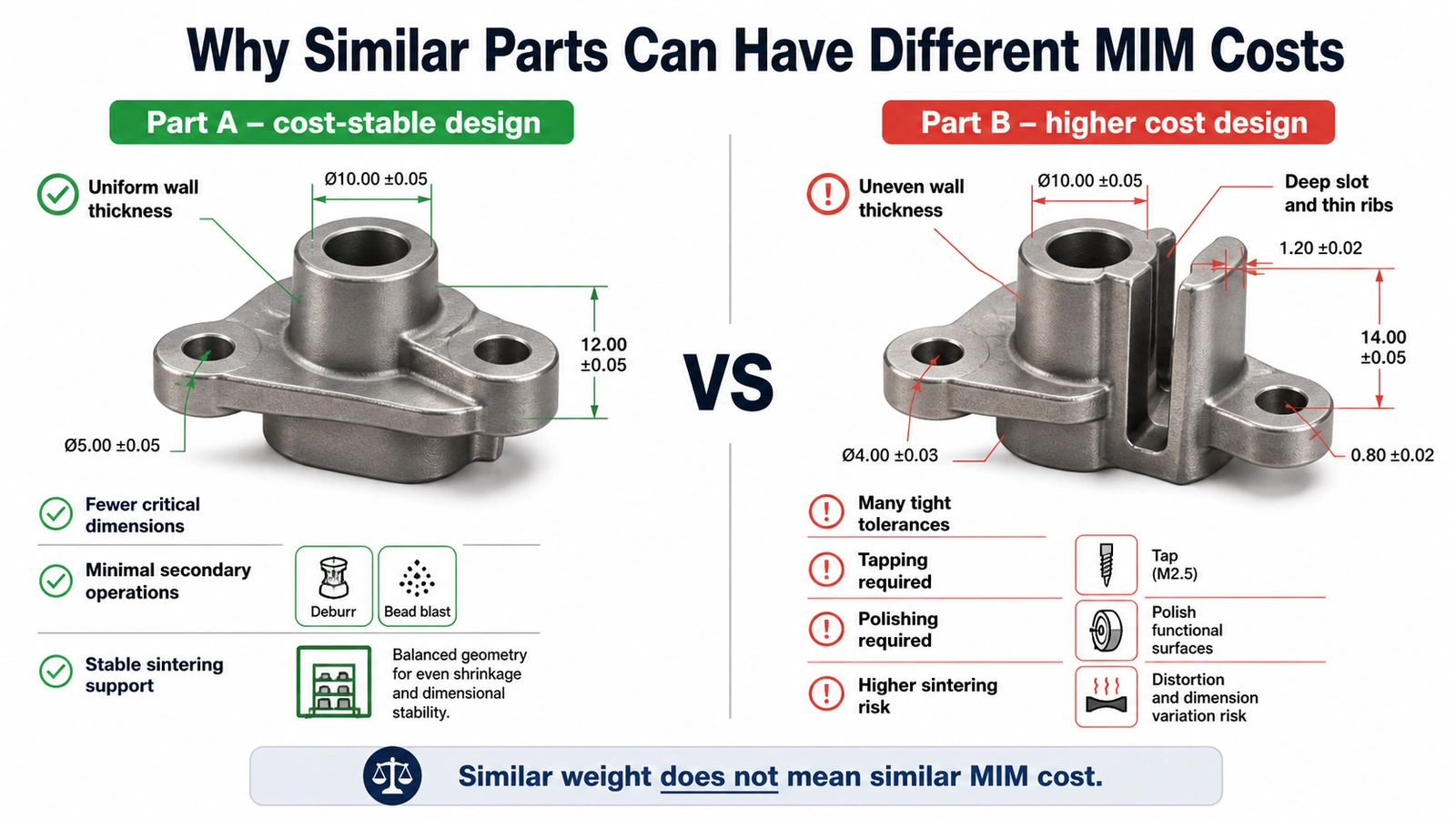
Mold release, sintering orientation and finishing requirements affect one another. A MIM design-for-cost review before the tool is finalized can prevent a design change from turning into repeated tooling, sample and qualification work.
Como Estimar o Custo MIM por Peça?
For a custom MIM project, lifetime economics and the first-order budget are different calculations. Tooling amortization distributes the initial investment across expected accepted parts to compare manufacturing options; it does not change when the supplier invoices the mold. The estimate should therefore state both the forecast quantity and the actual payment terms. It also should not be mistaken for a calculation of the supplier's internal production cost or margin.
Calculate Total Project Cost and All-In Unit Cost
Estimated Total Program Cost = F + (N × Centregue)
Estimated All-In Cost per Accepted Part = (F ÷ N) + Centregue
F is the total genuinely separate one-time tooling, fixtures and qualification investment not already recovered in the quoted unit price; N is the number of accepted finished parts delivered within the chosen forecast period; and Centregue is the price per accepted, finished part for the specified material, operations and inspection. This simple model assumes a constant delivered-part price and no additional tooling events. If orders have different prices or a tool is expected to require refurbishment, the better model is to add the actual lot-by-lot spending and any additional investment. Do not insert an extra yield allowance when the supplier's quoted unit price is already per accepted component.
Assume a separately invoiced US$ 4.500 mold, a constant US$3.50 price per accepted finished part and 10,000 accepted parts over the program. Total nominal spending is US$40.500, equivalent to US$4.05 per part over its lifetime. If the first order is only 1,000 parts and the complete mold charge is due upfront, the immediate tooling and production payment is US$9,000, excluding any separately agreed freight, qualification or other charges. The US$4.05 figure is a planning average, not the invoice price of the first 1,000 units. These figures are hypothetical, not a customer quotation.
Tooling amortization falls as accepted lifetime quantity rises, provided that the same one-time investment serves the entire forecast and the finished-part price remains unchanged. In practice, batch size, material contracts, cavity count, production requalification, tool wear and maintenance can alter costs. Ask the supplier for realistic order-size pricing, expected tool service life and any refurbishment or replacement assumption. If a program requires a second mold or a separate major qualification, include its cost rather than spreading the first mold charge across volumes it cannot produce.
How Annual and Lifetime Volume Affect Tooling Amortization
Initial batch quantity describes the first purchase and its immediate cash need. Demanda anual informs repeat scheduling and how soon the tooling may be recovered. Expected lifetime accepted volume is the quantity relevant to an investment comparison across the program. One order of 4,000 units and a four-year program of 4,000 units each year have very different amortization outcomes.
Do not treat forecast volume as committed demand. If annual orders are uncertain, calculate at least a conservative volume case and the planned lifetime case. A higher-volume scenario may look attractive on paper while exposing the buyer to unrecovered tooling investment if repeat orders do not occur. Keeping these cases separate is more useful than applying a universal annual MIM quantity threshold.
| Accepted lifetime volume | Tooling share at F = US$5,500 | Meaning for the cost model |
|---|---|---|
| 1,000 | US$5.50 / part | A large fixed-cost burden per accepted part. |
| 3,000 | US$1.83 / part | Tooling cost remains significant. |
| 5,000 | US$1.10 / part | Amortization decreases, subject to manufacturing fit. |
| 10,000 | US$0.55 / part | Fixed-cost share falls further. |
| 50,000 | US$0.11 / part | Tooling share is small, but recurring production cost remains. |
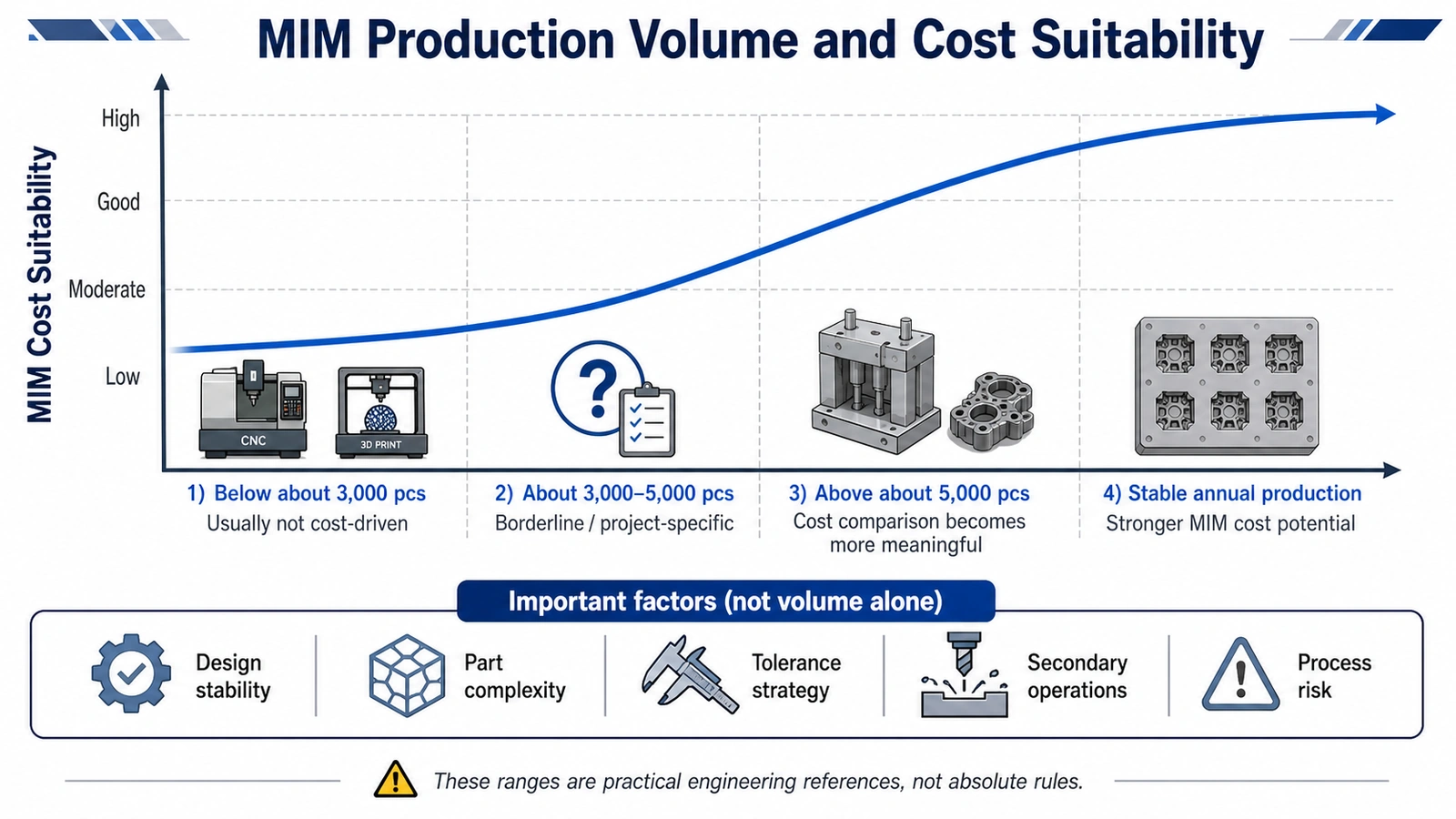
XTMIM has used approximate annual-demand screening cues: below 3,000 accepted parts per year often requires caution for purely cost-driven conversion; around 3,000–5,000 warrants a project-specific comparison; above roughly 5,000 may justify a full engineering and cost review. These are indicative XTMIM screening cues, not a contractual MOQ, an industry standard or a fixed break-even threshold. A design with strong machining savings and repeat demand may justify tooling below these levels, while a simple part may remain cheaper by another process at higher volumes.
Manufacturing condition: Favorable amortization does not prove that the proposed component can be molded, debound, sintered and inspected to its required specification. A production decision also needs an acceptable mold design, trial results and agreed functional and dimensional criteria.
When orders are uneven, the first batch is uncertain or production volumes will ramp up gradually, the MIM tooling amortization guide provides further detail on quantity planning and the effect of changing demand.
Quando o MIM é Mais Barato que a Usinagem CNC?
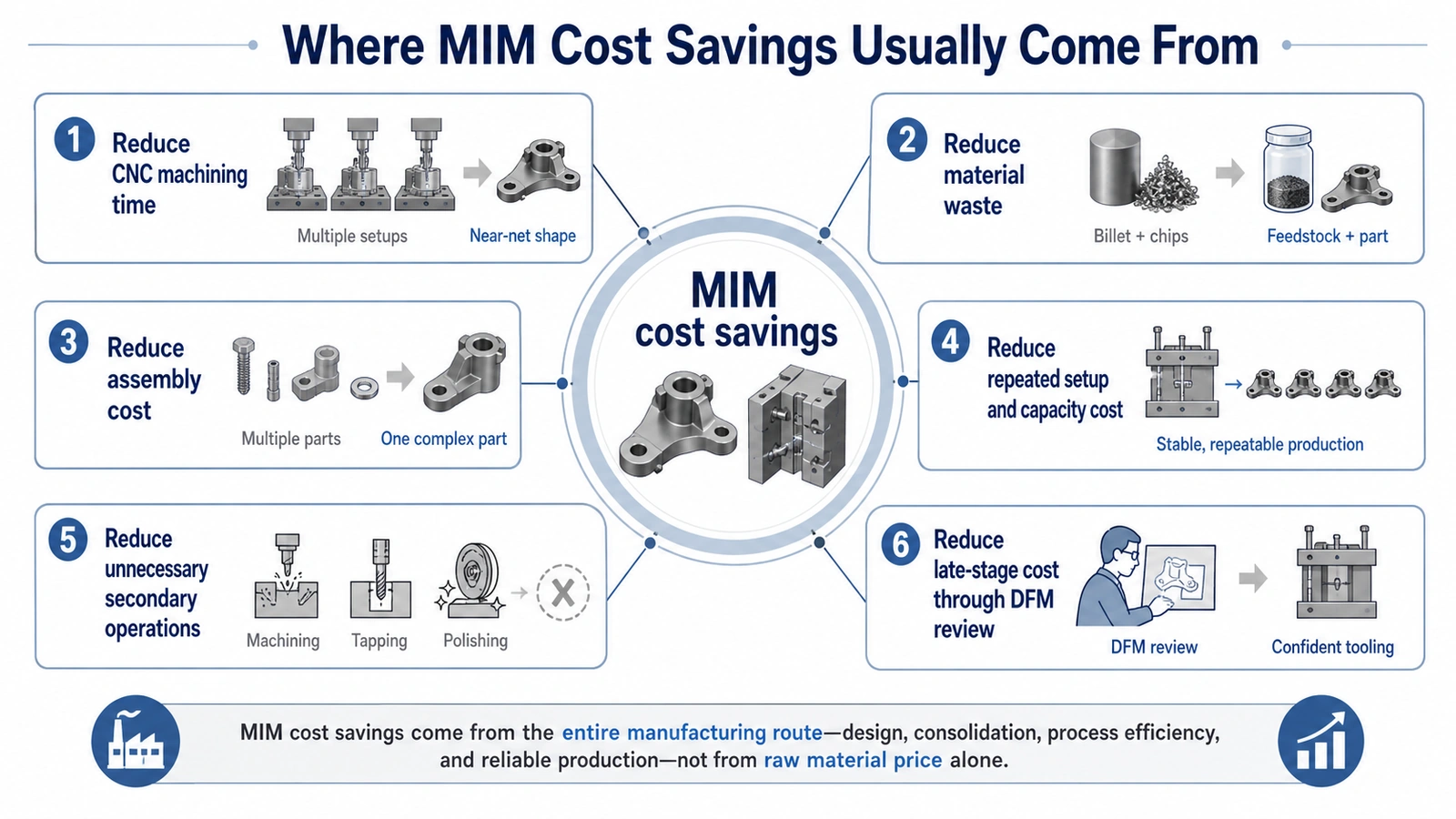
Metal injection molding can be cost-competitive with CNC machining when an existing metal part requires repeated setups, expensive material removal, fine-feature machining, deburring or assembly—and when the design is stable enough and the production quantity large enough to recover the mold investment. The comparison must be based on the same accepted finished part, not a MIM blank versus a fully machined and tested CNC component.
Compare the Same Finished-Part Requirements
Begin with the actual CNC routing and accepted finished-part cost: stock material, cutting/removal, setups, deburring, joining, heat treatment, finishing, inspection and handling. Next mark the features that MIM could form near net shape, and identify those that would still require machining or grinding. A material grade name alone does not establish performance equivalence: the final strength, corrosion behavior, heat-treatment condition, assembly fit and required testing must satisfy the same drawing and application. The MIM comparison must therefore include the production mold and trials, feedstock, molding, debinding, sintering, approved secondary operations and the accepted delivery condition. Counting all current CNC operations as removed while leaving necessary MIM finishing out of the calculation would create a false saving.
Near-net-shape molding may eliminate repeated setups and difficult fine-feature machining, while consolidating separate pieces can reduce assembly and inventory work. The combined geometry must still be released from the mold, debound and sintered without losing its required function. Precision bores, threads and sealing surfaces may remain machined. Those operations belong in the MIM finished-part price. The revisão de conversão CNC para MIM explains how to assess which original CNC features may be molded and which need to stay machined.
Calculate the MIM vs CNC Break-Even Quantity
Under a simplified constant-unit-cost assumption, the break-even quantity is the one-time MIM investment divided by the saving per accepted finished part when compared with CNC. This relationship is valid only when both processes meet the same specification and when the CNC cost is higher than the recurring MIM cost. If the recurring MIM cost is equal to or higher than the CNC cost, this simple model has no positive payback quantity from tooling amortization alone.
Break-Even Accepted Quantity = F ÷ (CCNC − CMIM)
Hypothetical example: F = US$5,500; CNC accepted finished part = US$5.00; MIM accepted finished part after tooling = US$3.50. Recurring saving = US$1.50 per part. Break-even quantity = 5,500 / 1.50 ≈ 3,667 accepted parts.
| Accepted lifetime parts | CNC total (US$5.00/part) | MIM total (US$5,500 + US$3.50/part) | Lower-cost route in this example |
|---|---|---|---|
| 3,000 | US$15.000 | US$16.000 | CNC by US$1,000 |
| 4,000 | US$20,000 | US$19,500 | MIM by US$500 |
| 10,000 | US$50.000 | US$40.500 | MIM by US$9,500 |
The crossover depends on the accepted-part saving and on both processes meeting the same specification. With the same hypothetical US$5,500 investment, a saving of only US$0.50 per accepted part requires 11,000 parts to recover tooling, compared with about 3,667 parts at a saving of US$1.50. Added machining, qualification, replacement tooling or lower-than-expected acceptance yield can reduce or eliminate the saving. Confirm the complete production route and comparable finished-part quotations before approving tooling.
Engineering example B · Hypothetical CNC-to-MIM conversion
A CNC-Machined Stainless-Steel Bracket Under MIM Review
Consider a hypothetical stainless-steel bracket currently produced from bar stock through five CNC setups, deburring and joining two small features, with planned repeat demand of about 12,000 finished parts per year. Those operations make MIM worth investigating because one near-net component might eliminate some milling, multiple setups and assembly. But combining the features can change the section thickness, load path and sintering support requirements. A proposed unit price is only credible after identifying which CNC steps disappear, which precision fits remain machined, and whether an integrated MIM design satisfies the same strength and dimensional requirements. The volume and production steps are assumptions, not actual XTMIM order records.
| Etapa de revisão | Questão de engenharia | Cost implication |
|---|---|---|
| Problema | Which repeated machining, deburring and assembly operations drive the present cost? | Potential opportunity to reduce repeated work. |
| Causa provável | Are those operations necessary because of complex geometry that could be injection molded? | Near-net shaping might replace part of the CNC route. |
| Verificação | Can the bracket be molded and sintered with stable critical interfaces and required mechanical properties? | Mold trial, shrinkage review, validation and inspection must be considered. |
| Remaining work | Do two critical fits still require finish machining? | Retain the real secondary operations in the MIM accepted-part price. |
| Decisão | Does the expected lifetime saving exceed tooling and qualification cost? | Proceed to quotation only if both technical and economic conditions are credible. |
Review the bracket's functional datums, joint loads and critical fit dimensions before considering a one-piece design. Identify which assembly operations would disappear and which tight-fitting surfaces would still need machining. Tolerance or cosmetic changes must receive customer approval. The assumed annual quantity of 12,000 parts supports a quotation study, but does not establish a cost saving or guarantee dimensional capability.
Before committing to production tooling, compare the proposed molded geometry, post-sinter machining plan, sintering supports and inspection method with the original bracket's load-bearing and locating requirements. Representative trial parts must meet the agreed functional criteria. If required machining increases or functional testing reveals a design problem, revise both the manufacturing plan and cost comparison rather than relying on the original assumed price.
Quando o MIM Não é Custo-Efetivo?
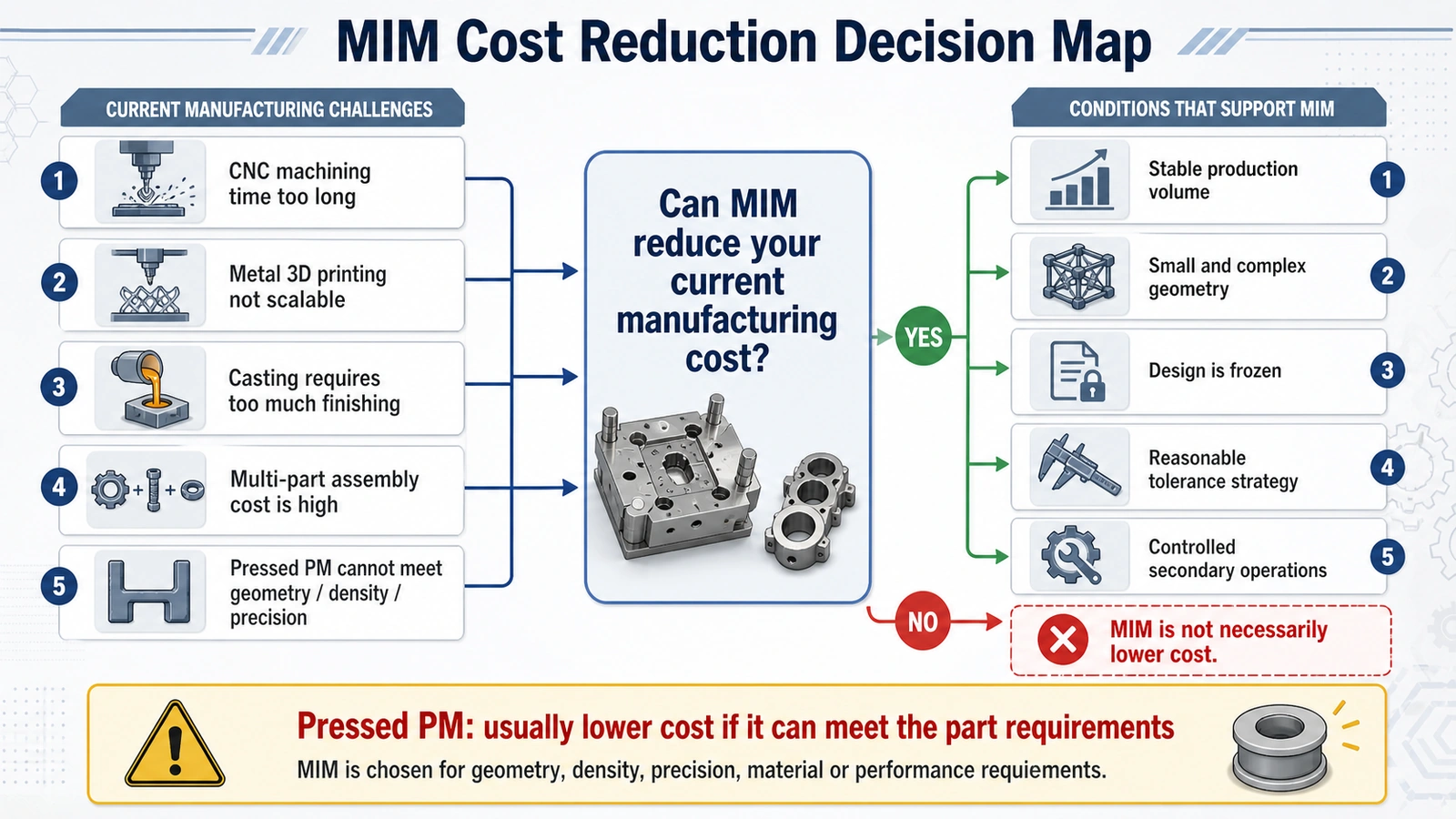
A part may be technically moldable without offering an economic advantage. Production tooling requires an upfront commitment, and frequent drawing changes, uncertain demand or extensive machining after sintering can offset the benefit of near-net-shape production. These factors need to be examined before approving a mold, particularly when the current process already delivers the required quality at a competitive cost.
Low Volume, Design Changes, and High Post-Processing Costs
A prototype-only design usually needs speed and flexibility more than the recurring economies of a production mold. When the drawing is still changing, each revision can trigger new trial work, delayed qualification or mold rework. Even with repeat volume, tight specifications on many surfaces can require nearly as much finishing as the CNC route the project aimed to replace. Large and simple parts can also be poor candidates because material, handling, binder removal and furnace economics may not favor MIM.
Annual demand is only an initial screening measure. The stronger test is expected lifetime accepted quantity against a credible per-part saving. A small first order may be viable within a confirmed multi-year program, while a larger one-off order may still fail to recover tooling if the cost difference is small or negative. The low-volume MIM project review discusses the additional planning issues when repeat demand is uncertain.
When CNC, Pressed PM, Casting, or Metal 3D Printing May Be Better
Usinagem CNC is often practical when volumes are low, part designs change frequently or the shape is relatively simple. Impressão 3D de metal can support prototype validation or complex geometries before a production design is stable, although final surface and material requirements still need validation. Fundição may suit larger parts and features that its tooling, tolerances and finishing routes can accommodate.
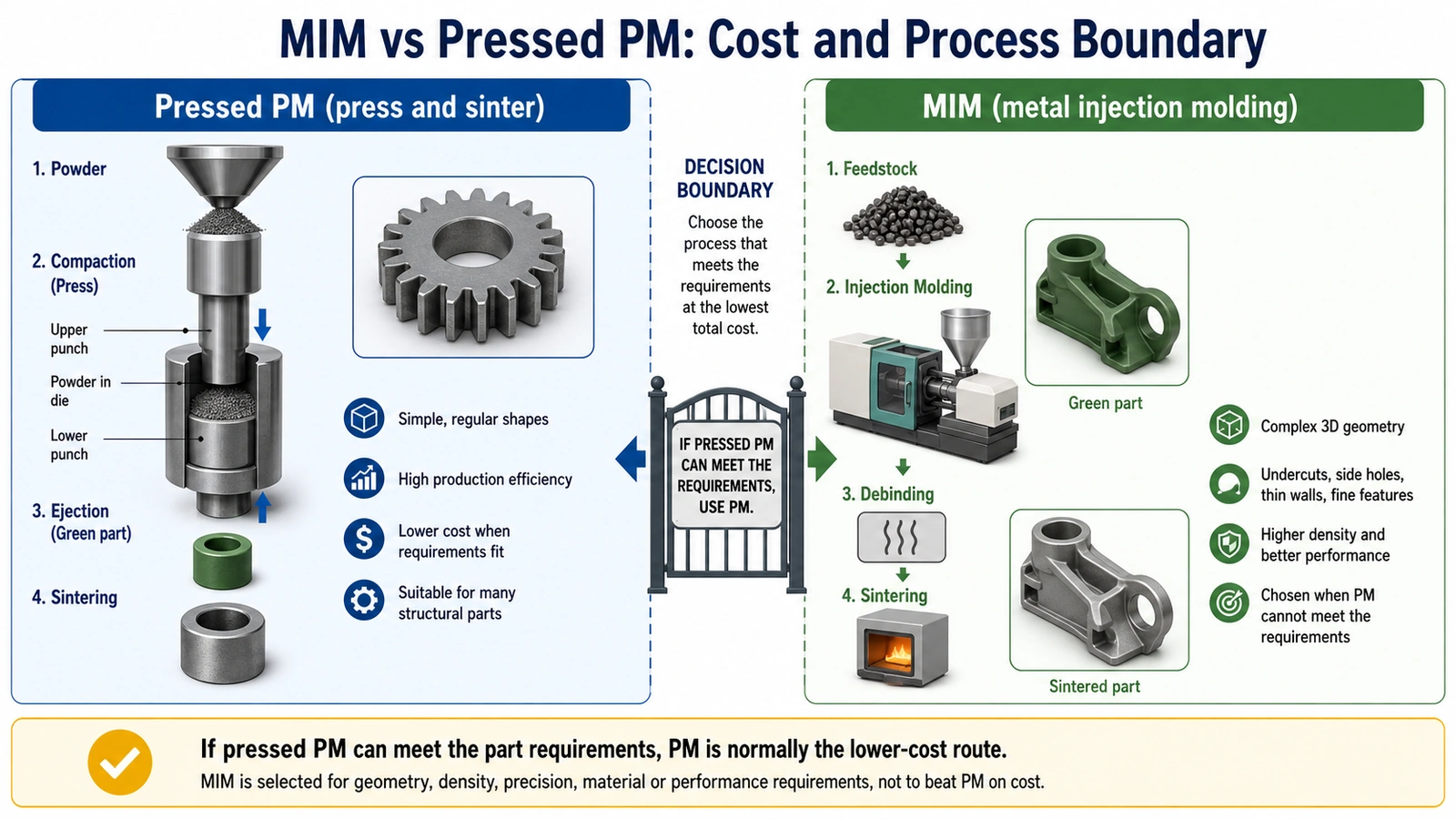
Conventional press-and-sinter powder metallurgy (PM) deserves special attention because the forming method uses primarily axial compaction and ejection. A shape that can be pressed and ejected directly, while meeting the required material, density, tolerances and performance, may be more economical than MIM. MIM is more attractive for three-dimensional detail and features that are difficult to produce in the pressing direction. However, geometry alone does not make MIM cheaper: a high post-machining burden or a large powder mass can still outweigh its near-net-shape advantage. The EPMA process guidance explains the pressing/ejection distinction, while the MIM vs pressed PM comparison covers the detailed process decision.
| Situação do projeto | Initial cost decision | Next sensible action |
|---|---|---|
| Drawing is changing; no repeat demand | MIM tooling is a weak default | Use CNC or another suitable prototyping route, then reassess. |
| Small complex part; stable design; credible repeat demand | Potential MIM candidate | Calculate delivered-part savings and request a DFM review. |
| Large simple form; limited fine features | Alternative route often stronger | Compare CNC, casting or other geometry-appropriate processes. |
| Pressed PM meets geometry and property targets | MIM often difficult to justify on cost alone | Review a PM quotation at equivalent acceptance requirements. |
| Many high-precision features still require machining | Potentially weak MIM economics | Estimate realistic finishing burden before tooling. |
Engineering example C · Hypothetical low-volume project
A Low-Volume Mechanism Part with a Changing Drawing
Consider a representative, hypothetical small mechanism part requiring fewer than 1,000 initial validation pieces. Its fit surfaces and assembly interfaces have not yet passed functional testing. MIM may seem attractive because a future mold could form its complex profile, but the dominant near-term uncertainty is whether the drawing will survive testing. An upfront tool can become partially unusable if an interface, thin wall or parting-sensitive feature is revised after samples; an apparently attractive recurring MIM unit price does not recover those sunk costs.
For a design still undergoing functional trials, make validation samples by a technically suitable flexible process, test critical fits and loads, and freeze the drawing revision and datum scheme before ordering a production mold. Document realistic annual orders and total expected accepted volume, then establish which features could remain as-sintered and which would need additional machining. A prototype produced by CNC or additive manufacturing does not automatically represent final MIM microstructure or performance, so the selected MIM material and finished part still require their own validation.
When the functional interfaces or material requirements are still changing, deferring production tooling limits exposure to mold changes and repeated trials. Once the design and expected demand are credible, a MIM DFM and cost quotation should state the sampling scope, responsibility for modifications and criteria for proceeding. A small first order alone is not grounds for rejection when a stable repeat-production program is planned.
Como Reduzir o Custo MIM Antes do Ferramental?
The best cost-reduction opportunities are usually identified before a mold is released for manufacture. Once gating, cavity geometry, ejection and shrinkage compensation are built into tooling, changes may require rework, additional trials or repeated validation. Cost reduction should remove unnecessary operations and over-specified requirements; it must not compromise the application's material performance, critical fit, wear resistance or inspection criteria.
Optimize Functional Tolerances and Part Geometry
Mark functional datums, contact faces and critical fit dimensions before proposing any tolerance change. A precision mating bore or sealing surface may legitimately need finishing, while a non-contact external profile may be accepted in the as-sintered condition if trials show the required repeatability. A uniform-wall redesign can reduce debinding or sintering problems, but thickness cannot be reduced below what mechanical loading requires. Likewise, improving ejection direction, modifying a nonfunctional deep slot or adding a feasible support face may avoid tool actions or costly setters. For every design alternative, compare the exact requirement being changed, the expected manufacturing operation removed, and the validation required to maintain function. The customer or design authority must approve specification changes before the lower-cost route is quoted as equivalent.
A design-for-cost review should also check undercuts, deep slots and any surfaces that require a new mold action. Removing an unnecessary insert or simplifying a feature can improve tooling simplicity; keeping a genuinely necessary undercut may be the correct engineering decision even if it raises cost. Review all proposals through a formal DFM assessment and, where relevant, sample validation.
Reduce Unnecessary Secondary Operations and Production Risks
Identify every post-sinter step and why it is specified: machining a precision bore, tapping a functional thread, grinding a reference face, polishing an appearance-critical surface, or applying heat treatment or passivation for a stated property. Internal threads can sometimes be molded, but a complex unscrewing tool may cost more than tapping; select the route using geometry, tolerance and lifetime production economics, not a blanket rule that one method is always cheaper. Review whether a surface can remain as-sintered, whether a specified finish is necessary, and whether one operation can satisfy several legitimate requirements. When material substitution is considered, validate final strength, corrosion behavior, heat-treatment response and qualified feedstock availability; a lower powder price does not establish a lower accepted-part cost.
| Item de revisão | Cost mechanism | Proposed engineering action | Verification / constraint |
|---|---|---|---|
| Critical vs noncritical tolerances | Excess machining and inspection when every dimension is tight | Mark the real fit / datum features and agree reasonable general tolerances elsewhere | Verify assembly function and acceptance criteria. |
| Uneven walls or difficult green-part ejection | Tool complexity, sintering support and potential scrap | Review wall transitions, feature access and mold-release strategy | Confirm strength, molding, debinding and distortion behavior. |
| Threads, bores and sealing faces | Additional drilling, tapping, sizing or grinding | Determine what must remain post-machined and what may be formed | Verify actual tolerance, finish and repeatability. |
| Surface and cosmetic specification | Polishing, plating, coating and extra inspection | Keep only necessary surface requirements | Validate application environment, appearance and performance. |
| Cavity count and repeat production | Upfront mold investment vs batch productivity | Compare viable cavity proposals against lifetime demand | Check filling balance, tooling life and production qualification. |
| Conjunto de múltiplas peças | Inventory, joining and tolerance stack-up | Assess part consolidation only if the new shape is MIM-suitable | Validate fit, loading and quality acceptance. |
| Sintering support faces and long spans | Custom setters, distortion-related sizing and extra handling | Review resting orientation, common-plane supports and protected functional faces before tool release | Confirm sample flatness, contact marks and dimensional repeatability without compromising the design. |
A production-volume discussion should include realistic batch sizes, lifetime demand and projected changes. Multi-cavity tooling may be valuable for repeat production, but the larger initial investment must be justified through an achievable lower delivered cost and acceptable process stability. Tooling ownership and storage should be documented in the purchase agreement, not assumed from general industry practice.
Compare the approved original drawing with a customer-approved alternative under the same finished-part and inspection requirements. Request separate figures for any change in tooling investment, machining time, inspection work and acceptance-yield assumptions. Where the proposed saving depends on better dimensional stability, use measurements from representative trials; a guessed reduction in scrap is not an adequate basis for the revised price.
Geometry and tolerance changes should be checked against the MIM design for cost guide. orientação de operações secundárias da MIMA explains why machining, sizing and finishing can increase the cost of a delivered MIM component. Any reduction still has to be confirmed against the part's functional and inspection requirements.
Cost reductions are valid only when the finished part continues to meet its specified material properties, load-bearing requirements, critical datums, heat treatment and acceptance tests. Any proposed drawing change must be approved by the customer or design authority.
Como Obter uma Cotação MIM Confiável?
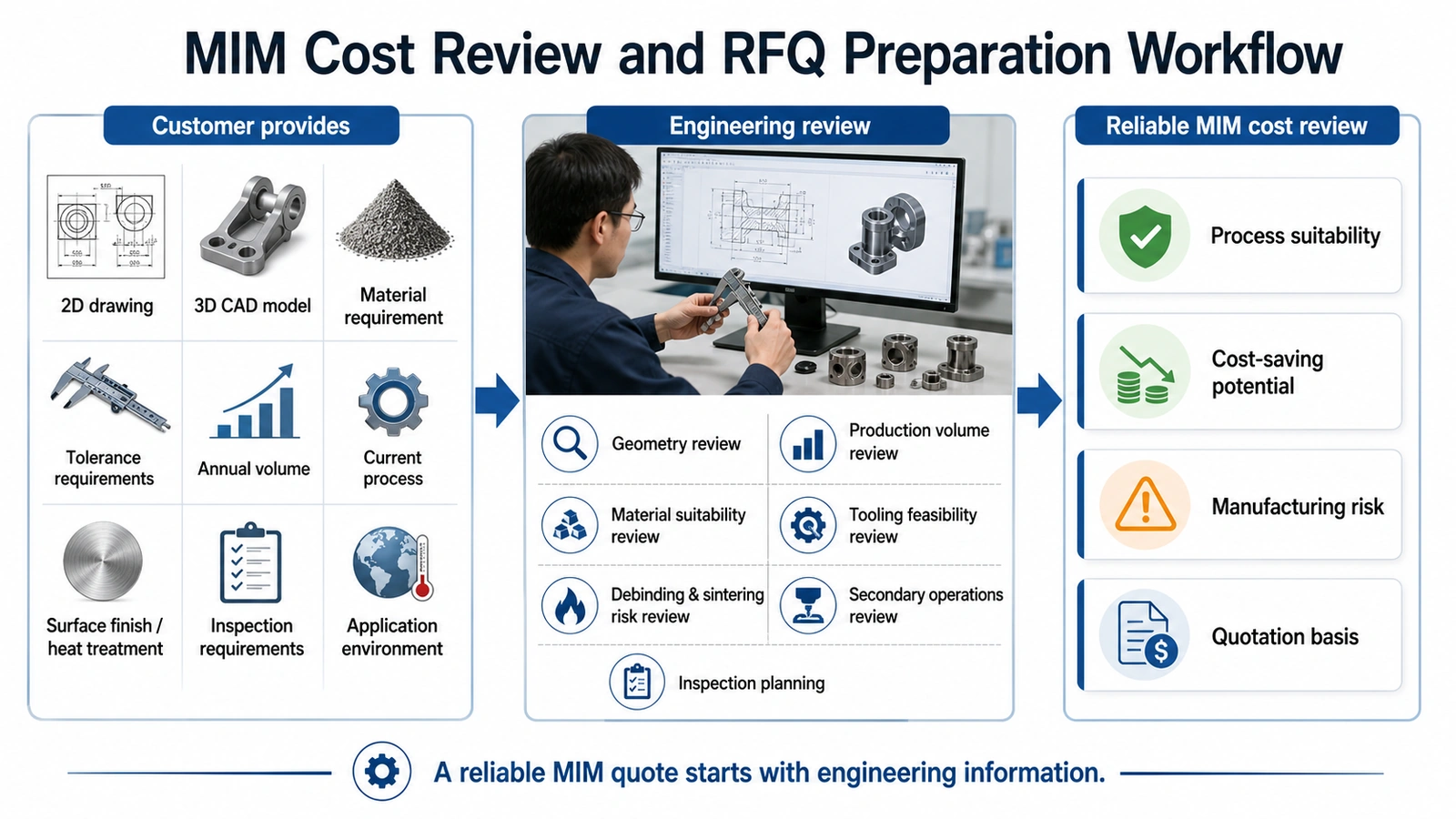
A reliable custom MIM quotation starts by agreeing on what constitutes an accepted finished part: the drawing revision, material and final properties, critical dimensions, finishing, test method, forecast quantity and delivery terms. The supplier then determines which requirements can be built into the mold and sintering route, which require a secondary operation, and which remain unresolved until a sample trial. A preliminary budgetary estimate is not a confirmed production capability. Its open assumptions should be visible so that later approval or rejection has a clear technical basis.
What Drawings and Production Data Should You Submit?
Provide the 2D controlled drawing and 3D STEP model together. The 3D model helps locate undercuts, cores, parting directions and local wall changes; the 2D drawing identifies which tolerances and datums must actually be met after sintering and any finishing. State material grade and required final condition, coatings, heat treatment, inspection method, key performance tests, first batch size, expected annual orders and realistic program lifetime. If the project is a CNC conversion, an existing routing or accepted finished-part price can help identify the real cost-reduction opportunity, although disclosure is optional. Flag any specifications still subject to customer confirmation rather than allowing different suppliers to assume different acceptance criteria.
| Entrada do RFQ | Why the supplier needs it |
|---|---|
| 2D drawing and 3D STEP model | Define geometry, functional interfaces, moldability and tolerance requirements. |
| Material grade and intended final condition | Check feedstock route, strength/corrosion requirements and possible heat treatment. |
| First order, annual quantity and program lifetime | Distinguish initial batch price, recurring production and mold amortization. |
| Critical tolerances, datums and inspection scope | Separate achievable as-sintered features from post-machining and testing needs. |
| Surface finish, threads, coatings and heat treatment | Price all required secondary operations into the final accepted part. |
| Current process, present finished-part cost if available | Create a meaningful MIM vs CNC or other-route cost comparison. |
| Application, acceptance criteria and delivery conditions | Confirm non-negotiable function and compare quotations on the same basis. |
How to Compare MIM Supplier Quotations Fairly
A fair comparison puts supplier proposals on one controlled drawing revision and one acceptance specification: material and treatment state, finished dimensions, post-processing, inspection/reporting, packaging and delivery condition. Separately compare tooling configuration and cavity count, tool service life, trial/qualification rounds, charges for revisions, batch minimum assumptions, quoted price tiers and lead time. For cross-border buying, compare currency, price validity, Incoterms, freight, taxes and duties using the same basis; an ex-works unit price is not a delivered landed cost. If one supplier quotes an as-sintered blank and another quotes a fully finished component, first add the missing validated operations or request a revised common-scope offer.
For a new part, XTMIM can review mold release and gating, cavity strategy, critical tolerances, debinding and sintering supports, post-sinter machining and the inspection scope. The quotation should distinguish confirmed drawing requirements, engineering assumptions e features requiring sample validation. For example, a close-fit bore may initially be priced as finish-machined until measured trials support an as-sintered solution. A slender arm with uncertain flatness may need a support concept and dimensional checks before a production yield assumption is credible. The guia de preparação de RFQ helps organize the specifications and files suppliers need.
Before tool release, the quotation package should identify the approved drawing revision, mold and cavity configuration, planned sintering and finishing route, method for inspecting critical dimensions and properties, one-time and recurring charges, and responsibility for samples and changes. Documentation can be proportionate to the project's complexity, but the price must remain traceable to the agreed engineering and delivery requirements.
Before placing a tooling order: Confirm whether the quoted unit price covers an as-sintered blank or a finished accepted part, how tooling charges are invoiced, and which tests, dedicated fixtures, secondary operations or trial revisions are excluded. Any unresolved requirement should be identified in the quotation rather than assumed to be included.
Drawing-based cost review
Get a quote based on your actual part, not a generic unit price
Share your drawings, material, estimated production volume and critical requirements. XTMIM can review whether MIM is a technically and economically reasonable route before you commit to production tooling.
FAQ sobre Custos de Moldagem por Injeção de Metal
A taxa do molde MIM está incluída no preço unitário da peça?
Nem sempre. Pode ser um custo único e separado, um custo recuperado através do preço da peça, ou uma combinação. Pergunte se a cotação inclui testes, gabaritos dedicados e qualificação, e confirme como o custo do molde será recuperado nos pedidos projetados. Se o preço unitário da peça aceita já inclui essa recuperação, não adicione o custo total do molde novamente em um modelo de ciclo de vida.
Um pedido inicial de 1.000 peças justifica o ferramental MIM?
Pode ser revisado, mas o caso econômico geralmente é difícil quando essa é toda a demanda esperada. Um pequeno pedido inicial pode ser diferente de um programa de repetição multianual. Verifique a estabilidade do projeto, o volume aceito ao longo da vida útil, o custo de fabricação alternativo e a recuperação do ferramental antes de prosseguir.
As cotações incluem testes de amostra, inspeções e revisões de ferramental?
Eles podem ser incluídos ou precificados separadamente, dependendo do acordo com o fornecedor. Pergunte quantas rodadas de teste estão incluídas, quais relatórios de qualificação e inspeção são cobrados, e se alterações de projeto exigem novas cobranças de ferramental.
Aumentar o número de cavidades do molde sempre reduz o custo por peça MIM?
Nº. Cavidades adicionais podem produzir mais peças "verdes" (green parts) por ciclo de injeção, mas o molde é mais caro e o sistema de canal/alimentador deve preencher as cavidades de forma consistente. Cada cavidade também deve atender aos requisitos de sinterização e dimensionais acordados posteriormente. Solicite o custo do ferramental específico por cavidade, a produção aceitável esperada e a quantidade de produção necessária para justificar a diferença.
E se o molde precisar de substituição antes do fim do projeto?
A vida útil do ferramental depende do projeto do molde, do feedstock, das condições operacionais, da manutenção e do histórico de produção. Se o volume aceito esperado exceder a vida útil qualificada do molde, inclua os custos potenciais de recondicionamento, substituição e custos de aprovação relacionados no modelo de investimento de ciclo de vida. Confirme as premissas de vida útil do ferramental e os termos de responsabilidade do fornecedor antes de aprovar o orçamento.
A ferramenta pode permanecer utilizável se o desenho for alterado após a amostragem?
Possivelmente, dependendo da alteração. Ajustar uma característica não crítica pode ser simples; mover uma superfície crítica de referência, alterar um rebaixo sensível à linha de partição ou alterar materialmente a espessura da seção pode exigir novos núcleos, grandes revisões de molde ou nova qualificação de sinterização. Confirme a revisão exata do desenho, a aprovação técnica e o responsável pelos custos antes de aceitar uma alteração.
Technical References and Scope of Evidence
The references cover MIM geometry, molding and sintering limits, secondary operations, material standards and process selection. They do not set XTMIM's current tooling prices or establish guaranteed tolerances, measured yields or savings for an individual project. MPIF Standard 35-MIM is a material-specification reference, not a pricing standard.
- MIMA — Projetos Complexos com MIM: gate location and cavity balance, variable wall thickness, green-part ejection, mold undercuts and sintering supports; technical design guidance, not a price database.
- Metal Injection Molding Association — Designing with MIM: design complexity, production volume, reducing machining and component consolidation.
- MIMA — Operações Secundárias: machining, sizing, heat treatment and effects of finishing on component cost.
- European Powder Metallurgy Association — Metal Injection Moulding: MIM processing and economic boundaries compared with conventional pressed PM.
- Metal Powder Industries Federation — Standard 35-MIM materials: general material specification reference, not a costing standard or a finished-part quotation.
Equipe de Engenharia da XTMIM · Project-specific prices and technical suitability are confirmed through drawing review and the agreed manufacturing requirements.