Kurze Antwort: Was ist der Unterschied zwischen MIM und PM?
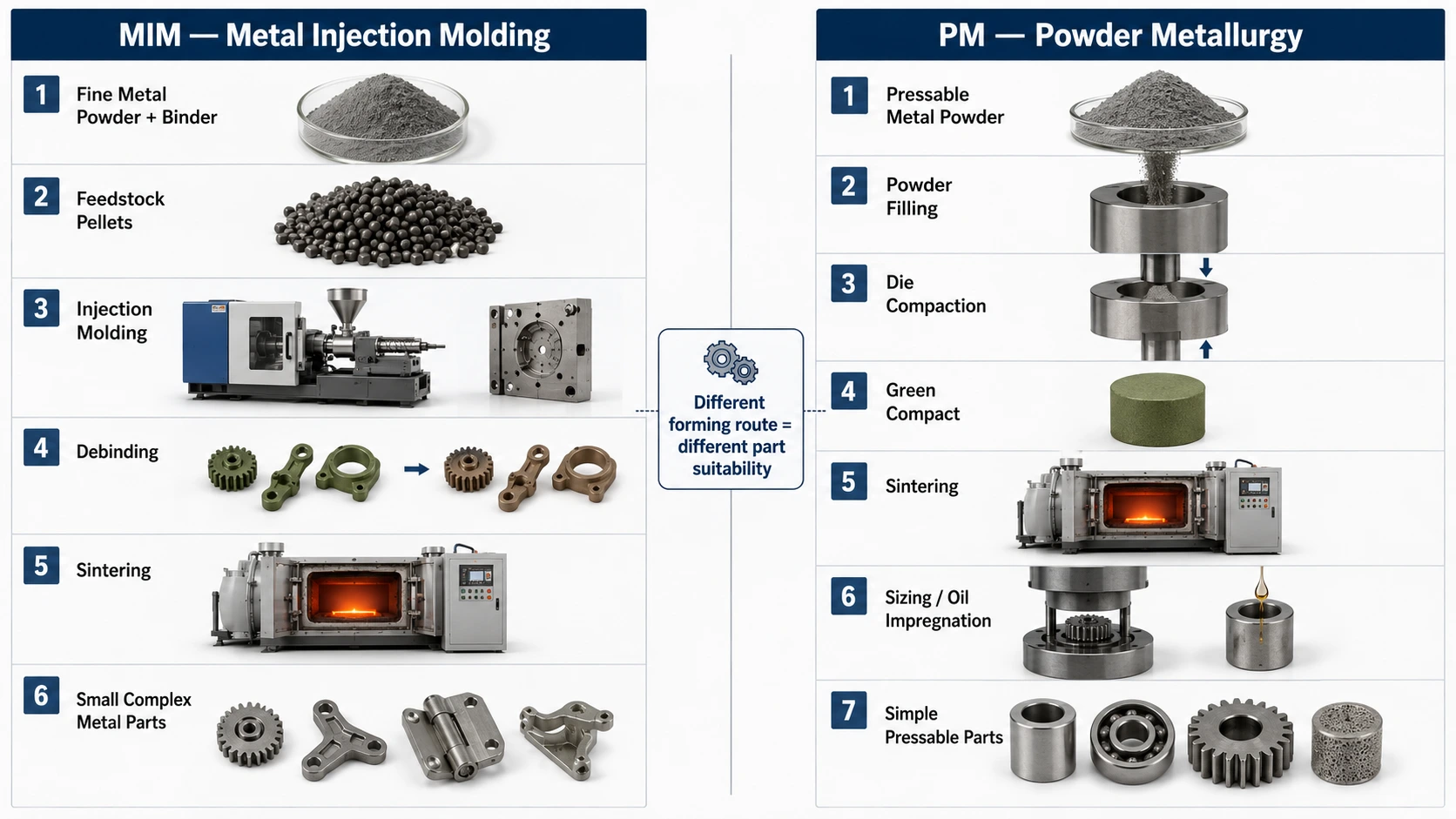
Metallpulverspritzguss, oder MIM, verwendet feines Metallpulver, das mit einem Bindemittel gemischt wird, um einen formbaren Feedstock zu erzeugen. Der Feedstock wird spritzgegossen, entbindert und zu einem dichten Metallteil gesintert. Herkömmliches Pulvermetallurgie, oder PM, verdichtet Metallpulver in der Regel direkt in einer Matrize, sintert dann den Grünling und kann Kalibrieren, Prägen, Nachpressen, Bearbeiten oder Öltränken umfassen.
In der Praxis ist MIM in der Regel besser für kleine, komplexe Metallteile mit dünnen Wänden, Hinterschneidungen, feinen Merkmalen und höheren Dichteanforderungen geeignet. PM ist in der Regel besser für einfachere Formen, die zuverlässig gepresst und ausgeworfen werden können, wie Buchsen, Lager, einfache Zahnräder, poröse Teile und kostenempfindliche Bauteile in hohen Stückzahlen. Die richtige Wahl hängt von Geometrie, Dichte, Porosität, Toleranzen, Material, Stückzahl und davon ab, ob die PM-Verdichtung das Teil ohne übermäßige Nachbearbeitung formen kann.
Das Teil klein, komplex, dünnwandig, hochdicht, schwer zu verdichten ist oder Hinterschneidungen, Seitenmerkmale, feine Details oder eine Geometrie aufweist, die übermäßige Bearbeitung erfordern würde.
Das Teil einfach, pressbar, in hohen Stückzahlen, kostenempfindlich oder für kontrollierte Porosität, Öltränkung, Kalibrieren, Prägen oder andere Press-und-Sinter-Vorteile ausgelegt ist.
Geometrie, Toleranz, Dichte, Porosität, Werkstoff, Kosten und Stückzahl weisen in unterschiedliche Richtungen. Eine zeichnungsbasierte Prüfung ist zuverlässiger als die Auswahl anhand eines Bauteilnamens.
MIM vs. PM auf einen Blick
Der schnellste Weg, MIM und PM zu vergleichen, ist zu betrachten, wie jeder Prozess das Bauteil formt. MIM formt Feedstock in einer Spritzgussform. PM verdichtet loses Pulver in einer Matrize. Dieser Unterschied führt zu unterschiedlichen Konstruktionsfenstern, Kostenstrukturen und Qualitätsrisiken.
| Faktor | MIM | PM |
|---|---|---|
| Vollständiger Name | Metallpulverspritzguss | Pulvermetallurgie / Pressen und Sintern |
| Umformverfahren | Spritzgießen von Metallpulver-Feedstock | Pulververdichtung in einer Matrize |
| Pulver und Binder | Feines Metallpulver gemischt mit einem Bindersystem | Pressfähiges Metallpulver, in der Regel ohne MIM-Bindersystem |
| Hauptprozessroute | Feedstock-Vorbereitung, Spritzgießen, Entbindern, Sintern | Pulvermischen, Matrizenpressen, Sintern, Kalibrieren, Prägen oder Nachbearbeitung |
| Geometriefähigkeit | Stark für kleine, komplexe, dreidimensionale Formen | Stark für einfachere Formen, die gepresst und ausgeworfen werden können |
| Hinterschnitte und seitliche Merkmale | Besser umsetzbar, wenn Werkzeugkonstruktion, Angusslage und Entbinderungspfad geprüft werden | Begrenzt durch Pressrichtung, Matrizenbefüllung und Auswurfweg |
| Dünne Wände und Mikromerkmale | Oft besser geeignet, aber Füllung, Grünfestigkeit und Sinterschwindung müssen dennoch geprüft werden | Begrenzter, abhängig von Pulverfluss, Druckübertragung und Teilegeometrie |
| Dichte und Porosität | Meist höhere Dichte und geringere Porosität | Oft geringere Dichte, aber Porosität kann für Schmier- oder Filterfunktionen nützlich sein |
| Typische Teile | Präzisionsscharniere, Mikrozahnräder, Halterungen, Uhrwerkteile, medizintechnische Komponenten, elektronische Strukturteile | Buchsen, Lager, einfache Zahnräder, poröse Filter, ölgetränkte Teile, strukturelle PM-Teile |
| Kostenlogik | Höhere Werkzeug- und Feedstock-Kosten, aber möglicherweise Reduzierung von Zerspanung, Schweißen oder Montage bei komplexen Teilen | Oft wirtschaftlicher für einfache, hochvolumige, pressbare Teile |
| Beste Eignung | Kleine komplexe Präzisionsmetallteile | Einfache, kostenoptimierte, hochvolumige Sinterteile |
Das wichtigste Auswahlkriterium ist, ob die Geometrie durch Pressen geformt werden kann. Wenn das Teil komplexe seitliche Merkmale, Hinterschneidungen, dünne Wände oder kleine dreidimensionale Details aufweist, ist MIM oft eine Prüfung wert. Wenn das Teil in einer relativ einfachen Richtung gepresst werden kann und keine hochdichte komplexe Geometrie erfordert, kann PM der wirtschaftlichere Weg sein.
Verfahrensunterschied: Spritzgegossener Feedstock vs. Pulverpressen
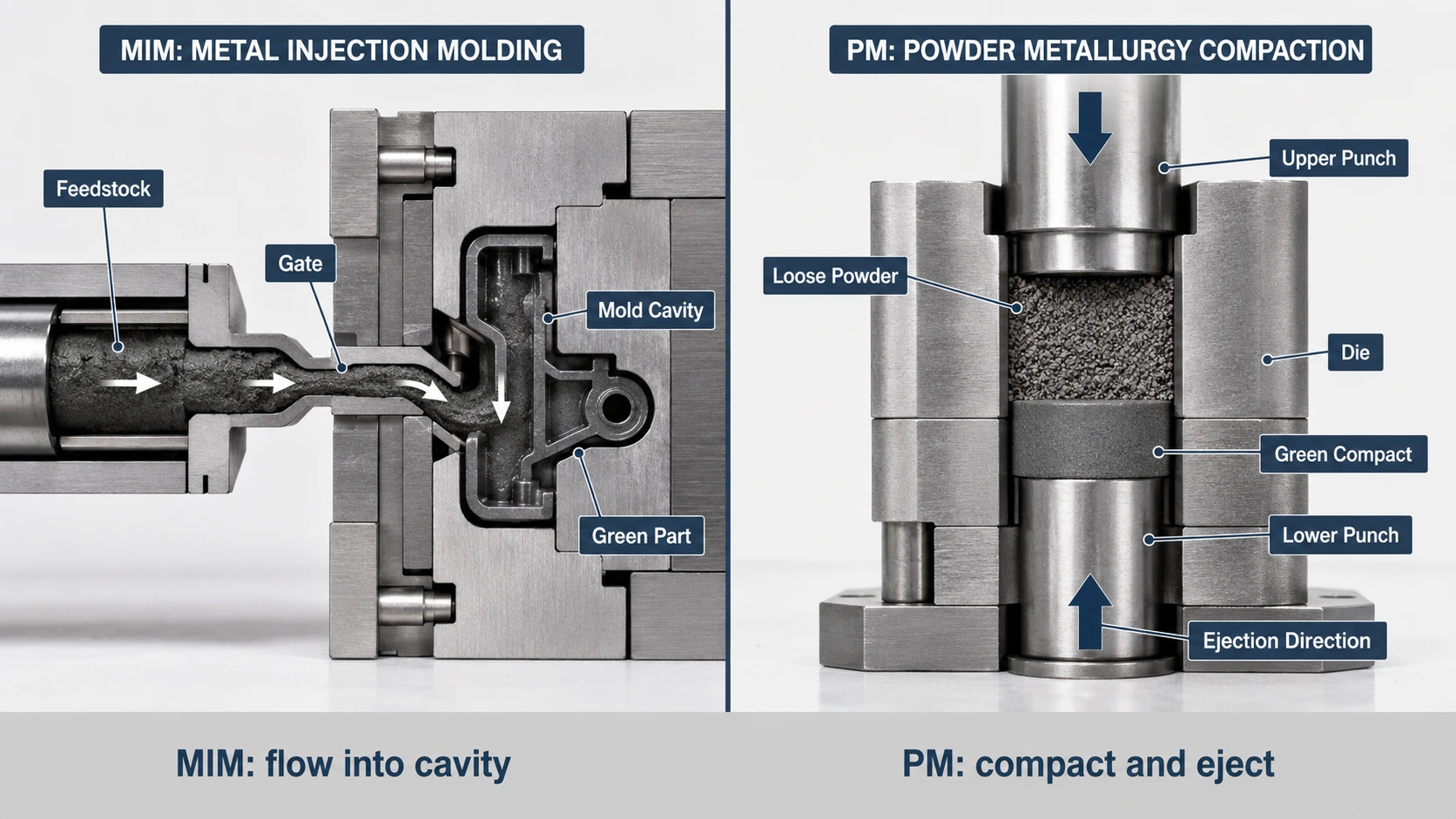
MIM und PM verwenden beide Metallpulver, aber sie erzeugen das Grünling nicht auf die gleiche Weise. Für die technische Prüfung ist dieser Unterschied wichtiger als das gemeinsame Wort “Pulver”.”
Wie MIM Teile formt
Beim Metallpulverspritzguss wird feines Metallpulver mit einem Bindersystem gemischt, um einen spritzgießfähigen Feedstock. herzustellen. Dieser Feedstock wird in einem Verfahren ähnlich dem Kunststoffspritzguss in eine Formkavität eingespritzt. Das geformte Teil ist ein Grünling. Nach dem Formen wird der Binder während des Entbindern, entfernt, und das Teil wird dann gesintert um seine endgültige metallische Struktur zu erreichen.
Aus Sicht der Konstruktionsprüfung ist MIM nützlich, da das Spritzgießen kleine und komplexe Formen herstellen kann, die mit konventionellem Pressen nur schwer zu realisieren wären. Das Verfahren birgt jedoch auch eigene Risiken: Angussreste, Kurzspritzungen, Grünlingsschäden, Entbinderungsrisse, Sinterschwindung und Schwindungsabweichungen müssen vor dem Werkzeugbau geprüft werden. Für einen breiteren Überblick siehe MIM-Prozess Seite.
Wie PM Teile formt
Die konventionelle Pulvermetallurgie formt Teile in der Regel durch Verdichten von Metallpulver in einer Matrize. Das Pulvergemisch wird zu einem Grünling gepresst und dann gesintert, um die Partikel zu verbinden. Je nach Teil und Anwendung können PM-Teile auch Kalibrieren, Prägen, Nachpressen, Bearbeiten, Wärmebehandeln oder Öltränken erfordern. Für einen vollständigeren Prozessablauf siehe Pulvermetallurgie-Verfahren .
PM sollte nicht als minderwertige Version von MIM betrachtet werden. Es ist ein anderer Fertigungsweg mit eigenen Vorteilen, insbesondere für einfache, hochvolumige, kostenempfindliche Teile, bei denen das Pressen stabil ist und eine kontrollierte Porosität oder Öltränkung nützlich sein kann.
Warum die Umformmethode die Auswahl bestimmt
Die eigentliche Auswahlfrage lautet nicht: “Welches Verfahren ist besser?” Die bessere Frage ist: Kann das Teil zuverlässig gepresst werden oder erfordert es eine spritzgegossene Geometrie?
Wenn das Teil in einem Presswerkzeug mit akzeptabler Dichteverteilung, Auswerfung, Toleranzen und Kosten verdichtet werden kann, ist PM möglicherweise die bessere Wahl. Wenn das Teil eine komplexe dreidimensionale Geometrie, Hinterschneidungen, dünne Abschnitte, kleine Details oder Merkmale aufweist, die nach der PM-Verdichtung umfangreiche Bearbeitung erfordern würden, könnte MIM die stärkere Option sein.
Aus diesem Grund ist eine zeichnungsbasierte Überprüfung zuverlässiger als die Auswahl aus einer allgemeinen Vergleichstabelle. Derselbe Teilename, wie “Zahnrad” oder “Halterung”, kann je nach Zahngeometrie, Wandstärke, Größe, Dichteanforderung, Toleranzstrategie und Funktionsflächen für MIM oder PM geeignet sein.
Geometrie und Designfreiheit: Wo sich MIM und PM klar trennen
Die Geometrie ist in der Regel die klarste Trennlinie zwischen MIM und PM. Bevor die Stückkosten verglichen werden, sollte zunächst geprüft werden, ob die Teileform zum Spritzgießen oder zur Pulververdichtung passt.

Wann MIM einen starken Designvorteil hat
MIM wird oft gewählt, wenn ein Teil klein, komplex und wirtschaftlich schwer zu bearbeiten oder zu verdichten ist. Typische Designmerkmale, die MIM begünstigen können, sind:
- Dünne Wände
- Kleine Löcher
- Seitliche Merkmale
- Hinterschnitte
- Feine Zähne
- Komplexe Halterungen
- Kleine Scharniere
- Mehrdirektionale Geometrie
- Integrierte Merkmale, die sonst eine Montage erfordern würden
- Teile, die mehrere CNC-Aufspannungen aus Stangenmaterial oder Platte erfordern würden
Ein häufiger Fehler ist es, das Verfahren nur anhand der Bauteilgröße zu beurteilen. Ein kleines Teil ist nicht automatisch ein MIM-Teil. MIM wird attraktiver, wenn kleine Größe mit komplexer Geometrie, hoher Materialausnutzung, reduzierter Bearbeitung oder reduzierter Montage kombiniert wird.
Wo die PM-Geometrie begrenzter ist
PM ist vorteilhaft, wenn die Geometrie mit der Matrizenverdichtung und dem Auswerfen kompatibel ist. Es wird häufig für relativ regelmäßige Formen wie Buchsen, Lager, einfache Zahnräder, Distanzstücke und Strukturbauteile mit pressbaren Profilen verwendet.
PM wird schwieriger, wenn das Teil Merkmale erfordert, die nicht mit der Verdichtungsrichtung kompatibel sind. Querlöcher, tiefe Hinterschnitte, scharfe lokale Dickenänderungen und komplexe dreidimensionale Formen können eine sekundäre Bearbeitung, Konstruktionsänderungen oder ein anderes Verfahren erfordern.
Das bedeutet nicht, dass PM keine nützlichen technischen Teile herstellen kann. Es bedeutet, dass das PM-Design den press- und sinterbasierten Formgebungsprozess respektieren sollte.
Warum PM durch Pressrichtung und Auswurf begrenzt ist
Das PM-Pressen ist in der Regel dadurch begrenzt, wie das Pulver die Matrize füllt, wie der Druck durch das Pulver übertragen wird und wie der Grünling ausgeworfen wird. Diese Faktoren beeinflussen die Dichteverteilung, das Rissrisiko, die Maßhaltigkeit und die Produktionsausbeute.
Mehrere Designbedingungen sollten vor der Wahl von PM sorgfältig geprüft werden:
- Hinterschnitte: Merkmale, die den Auswurf blockieren, sind ohne Designänderungen oder Nachbearbeitung möglicherweise nicht praktikabel.
- Seitenlöcher: Löcher senkrecht zur Pressrichtung können eine Bearbeitung nach dem Sintern erfordern.
- Hohe oder dünne Abschnitte: Diese können die Dichteschwankung oder das Risiko der Handhabung des Grünlings erhöhen.
- Große Dickenübergänge: Ungleichmäßige Verdichtung kann zu inkonsistenter Dichte und Verzug führen.
- Komplexe multidirektionale Geometrie: PM erfordert möglicherweise vereinfachte Geometrie, geteilte Komponenten oder zusätzliche Bearbeitung.
Aus fertigungstechnischer Sicht ist PM am effizientesten, wenn die Teileform eine stabile Verdichtung, gleichmäßige Dichte und sauberes Auswerfen unterstützt.
Dichte, Porosität und mechanische Eigenschaften
Dichte und Porosität sind wichtige Auswahlfaktoren, sollten aber nicht vereinfacht werden zu “MIM ist gut und PM ist schlecht”. Bei einigen PM-Teilen ist kontrollierte Porosität Teil der Funktion.

Warum MIM in der Regel höhere Dichte erreicht
MIM verwendet üblicherweise feine Metallpulver und einen sinterbasierten Verdichtungsweg. In der Praxis können höhere Dichte und geringere Porosität bessere mechanische Eigenschaften, bessere Oberflächenqualität und verbesserte Leistung in anspruchsvollen kleinen Komponenten unterstützen.
Die endgültige Leistung hängt jedoch weiterhin vom Materialsystem, der Sintersteuerung, der Wärmebehandlung, der Bauteilgeometrie und den Prüfanforderungen ab. Ein verantwortungsbewusster MIM-Lieferant sollte keine Leistung allein aufgrund des Prozessnamens versprechen. Materialgüte, Dichteziel, Härte, Wärmebehandlung, kritische Abmessungen und Anwendungsbedingungen müssen gemeinsam geprüft werden.
Warum PM-Porosität ein Merkmal und nicht nur ein Defekt sein kann
PM weist oft eine höhere Porosität auf als MIM, aber Porosität ist nicht immer ein Defekt. In einigen PM-Anwendungen ist kontrollierte Porosität Teil des funktionalen Designs. Dies ist ein Grund, warum PM für Pulvermetallurgie-Anwendungen, bei denen Schmierung, Permeabilität oder kontrollierte Dichte erforderlich sind, weiterhin wichtig ist.
- Ölgetränkte Lager
- Selbstschmierende Buchsen
- Poröse Filter
- Bauteile mit kontrollierter Dichte
- Bestimmte magnetische oder reibungsbezogene PM-Komponenten
Bei diesen Teilen kann die Wahl von MIM nur zur Reduzierung der Porosität die Kosten erhöhen, ohne die Funktion zu verbessern. Eine PM-Buchse, die eine Ölimprägnierung erfordert, ist beispielsweise möglicherweise ein schlechter Kandidat für MIM, selbst wenn MIM eine höhere Dichte erzeugen kann.
Kosten, Werkzeug und Produktionsvolumen
Der Kostenvergleich zwischen MIM und PM hängt von Geometrie, Material, Toleranzen, Sekundäroperationen und Jahresstückzahl ab. Ein einfacher Stückpreisvergleich kann irreführend sein.

Warum PM bei einfachen Teilen oft kostengünstiger ist
PM ist oft wirtschaftlicher für einfache, pressbare Teile mit hohen Stückzahlen. Der Prozess kann effizient sein, wenn die Teilegeometrie beim Pressen stabil ist, die erforderliche Dichte erreichbar ist und die Sekundäroperationen begrenzt oder vorhersagbar sind.
PM eignet sich besonders für einfache Zahnräder, Buchsen, Lager, Abstandshalter, Strukturteile mit pressbarer Geometrie, poröse oder ölimprägnierte Komponenten und Teile mit hohen Stückzahlen und starker Kostenempfindlichkeit.
Wenn das Design bereits zum PM-Prozessfenster passt, kann die Wahl von MIM unnötige Kosten für Feedstock, Werkzeug, Entbindern und Sintersteuerung verursachen.
Warum MIM bei komplexen Teilen kosteneffektiv sein kann
MIM hat in der Regel höhere Werkzeug- und Feedstockkosten als konventionelles PM. Es kann jedoch kosteneffektiv sein, wenn die Geometrie komplex genug ist, um Bearbeitung, Montage, Schweißen oder mehrteilige Konstruktionen zu reduzieren.
MIM kann die Gesamtkosten senken, wenn mehrere spanend zu bearbeitende Merkmale direkt spritzgegossen werden können, mehrere Teile zu einer Komponente zusammengefasst werden können, die CNC-Bearbeitung hohen Materialabfall verursachen würde oder das Teil kleine, wiederholbare, komplexe Geometrien erfordert.
Der korrekte Vergleich sollte Werkzeugkosten, Materialausnutzung, Bearbeitungszugabe, Prüfaufwand, Ausschussrisiko, Montagekosten und jährliche Produktionsmenge umfassen. Für eine detailliertere Kostenaufschlüsselung siehe unseren Leitfaden zu Metallpulverspritzguss-Kosten.
Toleranzen und Maßkontrolle
Die Toleranzfähigkeit muss für MIM und PM unterschiedlich betrachtet werden, da die dimensionalen Risiken unterschiedlich sind.
Die Maßhaltigkeit beim MIM hängt vom Schwindungsmanagement ab
MIM-Teile erfahren während des Sinterns eine erhebliche Dimensionsänderung. Die Form muss die Schwindung kompensieren, und das Endteil hängt von der Feedstock-Konsistenz, der Formfüllung, der Entbinderungsstabilität, der Sinterunterstützung, der Teileorientierung und der Ofensteuerung ab.
Kritische Maße erfordern möglicherweise besondere Aufmerksamkeit, wenn das Teil ungleichmäßige Wandstärken, lange dünne Abschnitte, dünne Rippen, ungestützte Bereiche während des Sinterns, enge Ebenheits- oder Geradheitsanforderungen, kritische Bohrungen, Lagerflächen oder Bezugsmerkmale aufweist.
MIM kann präzise Kleinteile herstellen, aber enge Toleranzen müssen unterteilt werden in Maße, die spritzgegossen und gesintert werden, Maße, die eine sekundäre Bearbeitung erfordern können, und Merkmale, die während der DFM angepasst werden sollten. Weitere Details finden Sie auf unseren Seiten zu MIM-Toleranzen und MIM-Schwindungskompensation.
Die Maßhaltigkeit bei PM beruht oft auf Kalibrieren oder Prägen
Die Maßhaltigkeit bei PM wird durch Pulverfüllung, Pressdruck, Grünrohdichte, Werkzeugverschleiß, Sinterveränderung sowie durch Kalibrieren oder Prägen beeinflusst.
Bei einigen PM-Teilen kann Kalibrieren oder Prägen die Maßgenauigkeit nach dem Sintern verbessern. Dies ist ein Grund, warum PM für bestimmte regelmäßige Formen und mechanische Serienteile gut geeignet ist.
Allerdings wird die Maßhaltigkeit bei PM schwieriger, wenn das Design komplexe multidirektionale Merkmale, ungleichmäßige Dichteverteilung oder Geometrien umfasst, die kein stabiles Pressen und Auswerfen ermöglichen.
Qualitätsrisiken vor der Wahl von MIM oder PM
Ein Prozessvergleich ist ohne Qualitätsrisikobewertung unvollständig. MIM und PM haben unterschiedliche Ausfallarten, daher sollte der Prüfplan dem gewählten Prozess folgen.

| Risikobereich | MIM-Prüfpunkt | PM-Prüfpunkt |
|---|---|---|
| Dichte | Sintersteuerung und Schwindungsgleichmäßigkeit | Verdichtungsdichteverteilung |
| Porosität | In der Regel minimiert, außer materialspezifisch | Kann funktional oder gesteuert sein |
| Maßhaltigkeit | Schwindungsausgleich, Vorrichtungshalterung, Sinterorientierung | Kalibrieren, Prägen, Werkzeugverschleiß, Pressrichtung |
| Rissrisiko | Entbinderungsspannung, Grünling-Handhabung, Sinterschrumpfungsspannung | Grünfestigkeit, Pressfehler, Auswerferspannung |
| Verzug | Wanddickenausgleich, Stützdesign, Sinterplatzierung | Dichtegradient, Formstabilität, Nachkalibrierung |
| Oberflächenbeschaffenheit | Werkzeugoberfläche, Angussbereich, Sinterbedingungen, Endbearbeitung | Pulverzustand, Werkzeugoberfläche, sekundäre Endbearbeitung |
| Steuerung der Sekundäroperationen | Bearbeitungszugabe, Verzug durch Wärmebehandlung, Einfluss der Endbearbeitung auf kritische Oberflächen | Kalibrierdruck, Präzisionsgenauigkeit beim Prägen, Ölimprägnierungsgrad, Repressstabilität, Bearbeitung für seitliche Merkmale |
| Prüfschwerpunkt | Kritische Maße, Dichte, Härte, Oberflächenzustand, Sichtfehler | Maße, Dichte, Porosität, ggf. Ölgehalt, funktionale Passung |
Ein Lieferant sollte nicht nur erklären können, welcher Prozess das Bauteil herstellen kann, sondern auch, wo die Prozessrisiken wahrscheinlich auftreten und welche Merkmale vor der Werkzeugfreigabe überprüft werden sollten.
Werkstoffauswahl: MIM-Werkstoffe sind nicht gleich PM-Werkstoffe
Die Werkstoffwahl sollte im richtigen Prozessweg geprüft werden. Ein in der PM gebräuchlicher Werkstoff ist nicht automatisch für MIM praktikabel, und ein in MIM häufig verwendeter Werkstoff ist möglicherweise nicht die wirtschaftlichste PM-Wahl.
Gängige MIM-Werkstofffamilien
MIM wird häufig für kleine komplexe Teile aus Werkstoffen wie Edelstählen, niedriglegierten Stählen, weichmagnetischen Legierungen, Titanlegierungen, Nickellegierungen, Kobalt-Chrom-Legierungen und ausgewählten Sonderlegierungen in Betracht gezogen, bei denen MIM-Feedstock und Sinterkontrolle praktikabel sind.
Die endgültige Wahl hängt von Korrosionsbeständigkeit, Festigkeit, Härte, Verschleißfestigkeit, magnetischem Verhalten, Wärmebehandlungsreaktion und Anwendungsumgebung ab. Die vollständige Werkstoffstruktur finden Sie in unserer MIM-Werkstoffen Seite.
Gängige PM-Werkstofflogik
Bei der Auswahl von PM-Werkstoffen liegt der Fokus oft auf struktureller Leistung, Kosten, Dichte, Porosität, Verschleißverhalten oder Schmierfunktion. PM ist besonders wichtig für eisenbasierte Strukturteile, rostfreie PM-Teile, kupferbasierte oder bronzene Lagerwerkstoffe, ölgetränkte Buchsen, poröse Werkstoffe und ausgewählte weichmagnetische Teile.
Für PM-spezifische Werkstofffamilien sollte die Seite für Pulvermetallurgie-Werkstoffe verwendet werden, um Eisenwerkstoffe, Edelstahl-PM-Werkstoffe, Kupferwerkstoffe, Bronzelagerwerkstoffe und poröse Werkstoffe im Press-und-Sinter-Verfahren zu bewerten.
Deshalb sollten kupferbasierte, bronzene, ölgetränkte und poröse Werkstoffe normalerweise im PM-Kontext diskutiert werden und nicht als Standard-MIM-Werkstoffauswahl behandelt werden.
Typische Teile: Welches Verfahren passt zu welchem Bauteil?
Der Teilename allein reicht nicht aus, um das Verfahren zu wählen. Ein Zahnrad, eine Halterung oder ein Gehäuse können je nach Geometrie, Präzision, Werkstoff, Dichte und Produktionsvolumen für verschiedene Verfahren geeignet sein.
| Teiletyp | Meist besser geeignet | Grund |
|---|---|---|
| Kleines Präzisionsscharnier | MIM | Kleine komplexe Geometrie und funktionelle Merkmale begünstigen Spritzguss |
| Mikrozahnrad | MIM oder PM | Abhängig von Zahnform, Dichte, Präzision und Größe |
| Einfaches Stirnzahnrad | PM oder MIM | PM kann wirtschaftlich sein, wenn die Geometrie pressbar ist; MIM kann geeignet sein, wenn das Zahnrad sehr klein oder komplex ist |
| Buchse | PM | Porosität und Ölimprägnierung können nützlich sein |
| Lagerkomponente | PM | PM wird häufig für selbstschmierende Lagerteile verwendet |
| Komplexe Halterung | MIM | Mehrdirektionale Geometrie und kleine, detaillierte Merkmale begünstigen MIM |
| Strukturelles Uhrenteil | MIM | Kleine Größe, Detailtreue und Oberflächenerwartungen sprechen oft für MIM |
| Poröser Filter | PM | Kontrollierte Porosität ist normalerweise erforderlich |
| Kleinteil für medizinische Geräte | MIM | Komplexe kleine Geometrie und Materialeigenschaften können für MIM sprechen |
| Großer einfacher Metallblock | Normalerweise nicht die erste Wahl | CNC, Gießen, Schmieden oder ein anderes Verfahren können praktikabler sein |
Wann MIM anstelle von PM gewählt werden sollte
MIM sollte gewählt werden, weil die Geometrie und die Produktionswirtschaftlichkeit dies rechtfertigen, nicht nur weil das Teil klein ist.
MIM ist eine Bewertung wert, wenn:
- Das Teil klein und komplex ist.
- Die Geometrie mit PM nicht leicht verdichtet und ausgeworfen werden kann.
- Das Teil Hinterschneidungen, Seitenmerkmale, dünne Wände, feine Zähne oder Mikrodetails aufweist.
- Höhere Dichte und geringere Porosität erforderlich sind.
- Die Zerspanung aus Vollmaterial mehrere Aufspannungen erfordern oder hohen Materialabfall verursachen würde.
- Mehrere Komponenten potenziell zu einem Formteil zusammengefasst werden können.
- Das Produktionsvolumen kann die Werkzeug- und Feedstockkosten rechtfertigen.
- Das Projekt erfordert eine reproduzierbare Geometrie nach der Konstruktions- und Sinterprüfung.
Was vor der Wahl von MIM geprüft werden muss
- Kann der Feedstock die dünnen oder detaillierten Merkmale zuverlässig füllen?
- Wo sollte der Anguss platziert werden?
- Wird der Grünling stark genug für die Handhabung sein?
- Besteht ein Risiko von Entbinderungsrissen aufgrund dicker Querschnitte oder eingeschlossener Binderpfade?
- Wird die Sinterschwindung für kritische Abmessungen gleichmäßig genug sein?
- Benötigt das Teil eine Sinterunterstützung oder eine spezielle Ausrichtung?
- Sind kritische Toleranzen besser durch sekundäre Bearbeitung zu erreichen?
- Ist das jährliche Volumen für eine MIM-Werkzeuginvestition geeignet?
Ein gut konstruiertes MIM-Teil beginnt vor dem Werkzeugbau. Die meisten schwerwiegenden Qualitäts- und Kostenprobleme lassen sich während der DFM-Prüfung leichter vermeiden als nach Fertigstellung des Werkzeugs.
Wenn PM die bessere Wahl als MIM ist
PM kann die bessere Wahl sein, wenn die Teileform einfach, pressbar, kostenempfindlich ist oder wenn eine kontrollierte Porosität für die Funktion nützlich ist.
- Die Teileform ist einfach und pressbar.
- Das Projekt ist stark kostenempfindlich.
- Das jährliche Volumen ist hoch.
- Die erforderliche Dichte kann durch Pressen und Sintern erreicht werden.
- Kontrollierte Porosität ist akzeptabel oder nützlich.
- Das Teil ist eine Buchse, ein Lager, ein einfaches Zahnrad, ein poröses Teil oder ein ölgetränktes Bauteil.
- Das Design erfordert keine komplexen seitlichen Merkmale, dünne Mikrodetails oder Hinterschnitte.
- Kalibrieren, Prägen oder Öltränkung können die endgültigen funktionalen Anforderungen erfüllen.
Sekundäre PM-Operationen, die oft über Endkosten und Funktion entscheiden
Bei vielen PM-Teilen werden Kosten und Endfunktion nicht allein durch Pressen und Sintern bestimmt. Sekundäre Operationen können Teil des normalen Press-und-Sinter-Pulvermetallurgie-Prozesses, sein, insbesondere wenn das Teil engere Toleranzen, bessere Oberflächeneigenschaften, Schmierverhalten oder eine funktionale Korrektur nach dem Sintern erfordert.
Wird verwendet, um die Maßgenauigkeit, die lokale Formkontrolle oder die funktionale Passung nach dem Sintern zu verbessern.
Wird verwendet, wenn für bestimmte PM-Teile eine zusätzliche Dichte oder Maßkorrektur erforderlich ist.
Wichtig für selbstschmierende Buchsen, Lager und andere poröse PM-Komponenten.
Kann für Seitenlöcher, scharfe Kanten, Bezugsflächen oder Merkmale erforderlich sein, die nicht direkt gepresst werden können.
Wird verwendet, wenn Härte, Verschleißfestigkeit oder Festigkeit nach dem Sintern angepasst werden müssen.
Wird angewendet, wenn Korrosionsbeständigkeit, Reibungsverhalten, Aussehen oder Oberflächenfunktion verbessert werden müssen.
Diese Nachbearbeitungen können PM für geeignete Teile sehr effektiv machen, beeinflussen aber auch die Gesamtkosten. Ein fairer MIM- vs. PM-Vergleich sollte die gesamte Nachsinter-Route berücksichtigen, nicht nur den Preis des ersten geformten Teils.
Häufige Auswahlfehler beim Vergleich von MIM und PM
Viele Probleme bei der Prozessauswahl entstehen, weil MIM und PM zu spät verglichen werden oder nur der Stückpreis ohne Berücksichtigung von Geometrie und Qualitätsrisiken betrachtet wird.
Die geringe Größe allein rechtfertigt MIM nicht. Wenn das Teil einfach, pressbar und kostenempfindlich ist, kann PM wirtschaftlicher sein. Mögliche Folge: unnötige Werkzeugkosten, höhere Materialkosten und kein echter Fertigungsvorteil.
PM ist möglicherweise nicht geeignet für komplexe Hinterschneidungen, Seitenlöcher, dünne lokale Merkmale oder mehrdirektionale Geometrien. Mögliche Folge: Neukonstruktion, Nachbearbeitung, schlechte Ausbeute oder instabile Maßhaltigkeit.
Ein niedriger Stückpreis kann Bearbeitungs-, Prüf-, Montage- oder Ausschusskosten verbergen. Ein höherer Formteilpreis kann dennoch angemessen sein, wenn er mehrere Sekundäroperationen überflüssig macht.
PM-Porosität kann für ölgetränkte oder poröse Funktionsteile nützlich sein. MIM-Dichte kann unnötig oder sogar nicht anwendungsgerecht sein.
MIM und PM verwenden beide Metallpulver, unterscheiden sich jedoch in Formgebungswegen, Prozesskontrollen, Konstruktionsregeln und Kostenstrukturen.
DFM-Prüfcheckliste vor der Wahl zwischen MIM und PM
Ein Lieferant kann MIM oder PM nicht allein anhand des Teilenamens zuverlässig empfehlen. Eine zeichnungsbasierte DFM-Prüfung sollte Geometrie, Material, Toleranzen, Dichte, Porosität, Volumen und Anwendungsbedingungen gemeinsam bewerten.

| Prüfpunkt | Warum das wichtig ist |
|---|---|
| Teilegröße und -gewicht | MIM ist in der Regel besser für kleine komplexe Teile; PM kann für einfache gepresste Teile besser geeignet sein |
| Wanddicke | Dünne oder ungleichmäßige Wände beeinflussen Formgebung, Pressen, Entbindern und Sintern |
| Hinterschnitte und seitliche Merkmale | Diese sprechen oft für MIM gegenüber konventionellem PM |
| Kritische Toleranzen | Können Schwindungskontrolle, Kalibrieren, Prägen oder sekundäre Bearbeitung erfordern |
| Dichteanforderung | Hochdichte Teile sprechen oft für MIM; poröse oder ölgetränkte Teile eher für PM |
| Materialanforderung | Manche Werkstoffe sind in einem Verfahren praktikabler als im anderen |
| Oberflächenbeschaffenheit | Werkzeugzustand, Pulver, Sintern und Nachbearbeitung beeinflussen das endgültige Erscheinungsbild |
| Jahresvolumen | Werkzeug- und Prozesskosten müssen durch das Produktionsvolumen gerechtfertigt sein |
| Anwendungsbedingungen | Verschleiß, Korrosion, Magnetismus, Schmierung, Belastung und Temperatur beeinflussen die Auswahl |
| Sekundäre Bearbeitungen | Zerspanung, Wärmebehandlung, Kalibrieren, Nachbearbeitung oder Montage können die Gesamtkosten verändern |
Für eine zuverlässige Prüfung senden Sie bitte die Zeichnung, ggf. die 3D-Datei, die Werkstoffanforderung, Toleranzangaben, Oberflächenanforderungen, die geschätzte Jahresstückzahl und den Anwendungshintergrund.
Szenario mit zusammengesetzten Feldern für die technische Schulung
Die folgenden Szenarien sind zusammengesetzte technische Beispiele für die Verfahrensauswahl-Diskussion. Es handelt sich nicht um offengelegte Kundenprojekte und sie sollten als Schulungsreferenzen dienen, nicht als garantierte Ergebnisse für jedes Bauteil.
Szenario A: Ein kleines, komplexes Bauteil von PM auf MIM umgestellt
Welches Problem ist aufgetreten: Ein kleines Metallbauteil hatte Seitenlöcher, dünne lokale Wände und ein kleines Verriegelungsmerkmal. PM schien zunächst attraktiv, da die erwartete Jahresstückzahl hoch war.
Warum es passiert ist: Bei der Überprüfung verursachten die seitlichen Merkmale und der Hinterschnittbereich Probleme beim Pulververdichten und Auswerfen. Die Herstellung des Teils mittels PM hätte sekundäre Bearbeitung und konstruktive Kompromisse erfordert.
Was die eigentliche Systemursache war: Das Problem lag nicht am Material selbst. Die Geometrie war nicht für den Press-Sinter-Formgebungsweg geeignet.
Wie wurde es korrigiert: MIM wurde zur besseren Wahl, da der Spritzguss die komplexen Merkmale in einer einzigen gegossenen Geometrie formen konnte. Die wichtigsten MIM-Prüfpunkte waren Angusslage, Wanddickenausgleich, Sinterunterstützung und Toleranzstrategie für die Funktionslöcher.
Wie kann ein erneutes Auftreten verhindert werden: Überprüfen Sie die Pressrichtung, den Auswerfweg, die Seitenmerkmale und den Bedarf an sekundärer Bearbeitung, bevor Sie die Stückpreise vergleichen.
Szenario B: Eine einfache Buchse blieb bei PM statt MIM
Welches Problem ist aufgetreten: Eine zylindrische Buchse wurde für MIM in Betracht gezogen, da der Kunde ein dichtes Metallteil und eine kleine Größe wünschte.
Warum es passiert ist: Das Teil hatte eine einfache pressbare Form und erforderte im Betrieb ein Schmierverhalten. Es benötigte keine Hinterschnitte, dünne Mikromerkmale oder hochdichte komplexe Formgebung.
Was die eigentliche Systemursache war: Die funktionale Anforderung begünstigte kontrollierte Porosität und Ölimprägnierung, nicht maximale Dichte.
Wie wurde es korrigiert: PM blieb der bessere Weg, da das Teil effizient verdichtet werden konnte und die kontrollierte Porosität die Anwendung unterstützte.
Wie kann ein erneutes Auftreten verhindert werden: Beginnen Sie mit der Teilefunktion, Geometrie, Dichteanforderung und Schmierungsbedarf, bevor Sie einen fortschrittlicher klingenden Prozess wählen.
Was für die MIM- vs. PM-Prüfung senden
Eine sinnvolle Prozessempfehlung erfordert mehr als nur einen Teilenamen. Je klarer Zeichnung, Funktion, Toleranz, Material und Stückzahl definiert sind, desto einfacher ist es, MIM, PM oder einen anderen Weg vor dem Werkzeugbau zu vergleichen.
Zeichnung und technische Anforderungen
- 2D-Zeichnung mit Maßen und Toleranzen
- 3D-CAD-Datei, falls verfügbar
- Materialgüte oder Zieleigenschaften
- Kritische Maße und Bezugsflächen
- Oberflächengüteanforderung
- Härte-, Dichte-, Porositäts- oder Magnetisierungsanforderung
Projekt- und Anwendungskontext
- Geschätzte Jahresstückzahl
- Prototypen- oder Serienproduktionsphase
- Anwendungsumgebung und Betriebslast
- Aktueller Fertigungsprozess oder Fehlerpunkt
- Erforderliche Sekundäroperationen
- Angestrebter Kostenbereich oder Beschaffungseinschränkung, falls vorhanden
Nicht sicher, ob Ihr Teil MIM oder PM verwenden sollte?
Senden Sie uns Ihre Zeichnung, 3D-Datei, Materialanforderung, Toleranzangaben, geschätzte Jahresmenge, Oberflächenanforderungen und Anwendungshintergrund. Unser Engineering-Team kann prüfen, ob Ihr Teil besser für MIM, PM oder einen anderen Fertigungsweg geeignet ist, bevor Werkzeugentscheidungen getroffen werden.
Während der Prüfung konzentriert sich XTMIM auf die Formbarkeit, Wandstärke, Hinterschneidungen, Dichte- oder Porositätsanforderungen, Toleranzstrategie, Sekundäroperationen, Materialeignung und Produktionsvolumen-Passung.
Technische Referenzhinweise für die Auswahl von MIM und PM
Branchenreferenzen sind nützlich für Terminologie, Materialerwartungen, Prozessverständnis und die Kommunikation zwischen Engineering- und Beschaffungsteams. Allerdings kann kein allgemeiner Standard die prozessspezifische Auswahl auf Zeichnungsebene ersetzen.
Für die Auswahl von MIM und PM sollten Normen und Verbandsressourcen verwendet werden, um Diskussionen über Material, Dichte, Prüfverfahren, Prozessterminologie und Akzeptanzerwartungen zu unterstützen. Die endgültige Entscheidung hängt dennoch von der Teilegeometrie, dem Produktionsvolumen, der Toleranzstrategie, den funktionalen Anforderungen und der Fertigungskapazität des Lieferanten ab.
Empfohlene technische Referenzen für weiterführende Lektüre MIMA-Prozessübersicht für MIM, EPMA-Übersicht zum Metallpulverspritzguss, MPIF-Pulvermetallurgie-Normen, und MPIF-Konventionelles Pulvermetallurgie-Verfahren.
Die endgültige Materialabnahme, mechanische Eigenschaften, Dichteanforderungen, Porositätsgrenzen und Prüfverfahren sollten gegen die geltenden MPIF-, ASTM-, ISO-, Kundenzeichnungen, Einkaufsspezifikationen oder projektspezifischen Qualitätspläne bestätigt werden. Diese Seite dient der frühen Prozessauswahl und technischen Kommunikation, nicht als Ersatz für formelle Material- oder Prüfspezifikationen.
Häufig gestellte Fragen zu MIM vs. PM
Ist MIM eine Art Pulvermetallurgie?
Ja. MIM ist ein pulverbasiertes Metallfertigungsverfahren, unterscheidet sich jedoch von der konventionellen Press-Sinter-PM. MIM verwendet feines Metallpulver, das mit einem Binder zu Feedstock gemischt wird, und formt das Teil anschließend durch Spritzgießen, Entbindern und Sintern. Bei der konventionellen PM wird das Metallpulver vor dem Sintern meist direkt in einer Matrize verdichtet.
Ist MIM besser als PM?
MIM ist nicht einfach besser als PM. MIM ist in der Regel besser für kleine, komplexe, hochdichte Metallteile mit dünnen Wänden, Hinterschneidungen oder feinen Details geeignet. PM ist oft besser für einfachere, pressbare, kostenempfindliche Teile in hohen Stückzahlen, insbesondere wenn kontrollierte Porosität oder Ölimprägnierung von Vorteil ist.
Ist MIM fester als PM?
MIM erreicht oft eine höhere Dichte und geringere Porosität als herkömmliches PM, was bei geeigneten Werkstoffen und Konstruktionen eine bessere mechanische Leistung ermöglichen kann. Die Festigkeit hängt jedoch vom Werkstoff, der Dichte, der Wärmebehandlung, der Sintersteuerung, der Geometrie und den Prüfanforderungen ab. PM kann auch für viele strukturelle und funktionelle Teile geeignet sein.
Ist PM günstiger als MIM?
Bei einfachen, pressbaren Teilen mit hohen Stückzahlen ist PM oft wirtschaftlicher als MIM. MIM kann kosteneffizient werden, wenn das Teil klein und komplex genug ist, um CNC-Bearbeitung, Montage, Schweißen oder mehrere Nachbearbeitungsschritte zu reduzieren. Der korrekte Vergleich sollte die gesamten Herstellungskosten umfassen, nicht nur den Stückpreis.
Kann PM komplexe Teile herstellen?
PM kann nützliche technische Teile herstellen, aber das konventionelle Pulverpressen ist durch Pressrichtung, Formfüllung, Dichteverteilung und Auswerfen begrenzt. Teile mit Hinterschneidungen, Querbohrungen, dünnen lokalen Merkmalen oder komplexer dreidimensionaler Geometrie erfordern möglicherweise Bearbeitung, Konstruktionsänderungen oder eine MIM-Bewertung.
Ist MIM oder PM besser für Zahnräder?
Das hängt von der Zahnradgröße, der Zahnform, den Dichteanforderungen, der Toleranz, dem Werkstoff und der Produktionsmenge ab. Einfache pressbare Zahnräder sind oft für PM geeignet, insbesondere bei kostenempfindlichen Projekten mit hohen Stückzahlen. Sehr kleine Zahnräder, Zahnräder mit feinen Merkmalen, komplexen Naben, Seitenmerkmalen oder höheren Dichteanforderungen erfordern möglicherweise eine MIM-Prüfung.
Kann derselbe Lieferant sowohl MIM als auch PM für eine Zeichnung bewerten?
Ja, wenn der Lieferant über technische Erfahrung mit pulverbasierten Fertigungswegen verfügt. Eine sinnvolle Bewertung sollte die Geometriefähigkeit, Pressgrenzen, Formgebungsrisiken, Dichte- oder Porositätsanforderungen, Toleranzen, Werkstoffeignung, Nachbearbeitung, Werkzeugkosten und Jahresstückzahl vergleichen, bevor MIM, PM oder ein anderes Verfahren empfohlen wird.
Wann sollte ich MIM anstelle von PM wählen?
Wählen Sie MIM, wenn das Teil klein, komplex, schwer zu pressen ist und Merkmale wie Hinterschneidungen, dünne Wände, feine Details, hohe Dichte oder reduzierte Bearbeitung erfordert. MIM ist auch dann eine Überlegung wert, wenn mehrere bearbeitete oder montierte Komponenten zu einem einzigen gegossenen Metallteil zusammengefasst werden können.
Wann sollte ich PM anstelle von MIM wählen?
Wählen Sie PM, wenn das Teil einfach, pressbar, kostenempfindlich und in hohen Stückzahlen hergestellt wird. PM eignet sich oft für Buchsen, Lager, einfache Zahnräder, poröse Teile, ölgetränkte Komponenten und Strukturteile, bei denen die erforderliche Dichte und Toleranzen durch Pressen und Sintern erreicht werden können.
Welche Informationen werden benötigt, um MIM vs. PM zu bewerten?
Eine zuverlässige Prozessprüfung benötigt eine 2D-Zeichnung, ein 3D-Modell (falls vorhanden), Materialanforderung, kritische Toleranzen, Oberflächengüteanforderungen, geschätzte Jahresstückzahl, Teilgewicht oder -größe, Anwendungsbedingungen sowie besondere Anforderungen wie Verschleißfestigkeit, Korrosionsbeständigkeit, Magnetismus, Schmierung oder Nachbearbeitungsgrenzen.