
Fe-50Co Weichmagnetischer MIM-Werkstoff
Fe-50Co ist eine weichmagnetische Eisen-Kobalt-Legierung, die dann in Betracht gezogen wird, wenn eine kompakte elektromagnetische Komponente eine hohe Flussdichte bei einem begrenzten magnetischen Querschnitt benötigt. Der Metallpulverspritzguss (MIM) kann relevant sein, wenn diese Komponente auch komplexe dreidimensionale Merkmale und wiederkehrende Produktionsanforderungen aufweist. Dies sind zwei separate Entscheidungen: Die Legierung muss die magnetische Spezifikation erfüllen, und das Teil muss das MIM-Verfahren rechtfertigen. Bestätigen Sie vor der Werkzeugbestellung die genaue Fe-Co-Zusammensetzung, das Betriebsfeld und die Frequenz, kritische Luftspalte, die Pulver-/Feedstock-Route, den Wärmebehandlungszustand und wie die magnetische Leistung am Endprodukt oder einem vereinbarten Prüfkörper gemessen wird.
Hohe magnetische Sättigung eine echte Designbeschränkung bei einem kleinen flussführenden Teil darstellt.
Komplexe Geometrie und wiederkehrende Produktion Werkzeugbau, Schwindungskontrolle und Validierung rechtfertigen könnten.
Genaue Chemie, magnetische Prüfziele, Verfügbarkeit von Feedstock, funktionale Abmessungen und Abnahmekriterien.
Wann sollten Sie Fe-50Co für ein MIM-Teil in Betracht ziehen?
Fe-50Co sollte in Betracht gezogen werden, wenn eine weichmagnetische Komponente relativ hohen magnetischen Fluss in begrenztem Raum führen muss und ein Material mit geringerer Sättigung den magnetischen Kreis einschränken könnte. Kandidaten für das Design sind kompakte Polschuhe, Anker und flussführende Merkmale, aber der tatsächliche Bedarf ergibt sich aus dem Betriebsfeld, der erforderlichen Kraft oder magnetischen Reaktion und dem verfügbaren magnetischen Querschnitt. Fe-50Co ist eine weichmagnetische Legierung, kein Permanentmagnet; der Zweck ist, auf ein angelegtes Feld zu reagieren, anstatt eine gespeicherte Magnetisierung als Hauptfunktion bereitzustellen.
Den magnetischen Kreis prüfen: Identifizieren Sie den engsten flussführenden Querschnitt, den Arbeitsluftspalt und die tatsächliche Spulenanregung. Eine dünne magnetische Brücke kann sich der Sättigung nähern, während der Rest der Komponente darunter bleibt. Wenn der Luftspalt oder die Spulenanregung der limitierende Faktor ist, hat eine Umstellung auf Fe-50Co möglicherweise wenig Einfluss auf die Aktuatorkraft. Der erwartete Nutzen hängt vom tatsächlichen Betriebspunkt ab.
Die Materialwahl sollte offen bleiben, wenn die erforderliche Flussdichte nicht berechnet wurde, das Magnetfeld moderat ist, die Betriebsfrequenz Wirbelstromverluste wichtig macht oder Kosten und Beschaffungskomplexität den magnetischen Nutzen überwiegen. Eine Legierung mit hoher Sättigung ist nicht unbedingt die beste Wahl für hohe Permeabilität, niedrige Koerzitivfeldstärke oder minimale Wechselstromverluste. Für die Auswahl über die Legierungsfamilien hinweg beginnen Sie mit der Übersicht über weichmagnetische MIM-Werkstoffe Übersicht über weichmagnetische MIM-Werkstoffe.
Material- und Prozessauswahl sind getrennt: Stellen Sie zuerst den Bedarf an höherer Sättigung fest. Bewerten Sie dann, ob die Geometrie, die Produktionsmenge und die erforderliche magnetische Akzeptanz MIM als praktikablen Herstellungsweg darstellen.
Was ist Fe-50Co und wie sollte die Legierung spezifiziert werden?
Fe-50Co bezeichnet eine ungefähr gleiche Eisen-Kobalt-Legierungszusammensetzung, aber der Name allein ist keine vollständige Beschaffungsspezifikation. Bestätigen Sie, ob ein angegebener Prozentsatz in Gewichtsprozent (wt%) oder Atomprozent (at%) angegeben ist: 50 Gew.-% Co und 50 Atom-% Co sind nicht genau dasselbe chemische Verhältnis. Kommerzielle Pulver und gewalzte Fe-Co-Produkte können unterschiedliche Grenzwerte für geringe Elemente, zugesetzte Elemente und Verarbeitungsbedingungen aufweisen. Eine Teilezeichnung sollte die beabsichtigte Chemie oder eine zugelassene Lieferantenspezifikation angeben, anstatt davon auszugehen, dass jedes Produkt mit “50Co” im Namen austauschbar ist.
| Werkstoffbezeichnung | Was die Quelle festlegt | Spezifikationshinweis |
|---|---|---|
| Fe-50Co (nominal) | Ungefähr 50 % Co mit Fe als Hauptbestandteil; häufig als weichmagnetische Legierung mit hoher Sättigung diskutiert. | Ein nominaler Name definiert keine Verunreinigungsgrenzwerte, Prüfbedingungen, Wärmebehandlung oder Abnahmekriterien für Fertigteile. |
| Osprey Fe50Co0.2Si | Veröffentlichte Pulverqualität von Sandvik listet 50,0 Gew.-% Co, Fe als Rest und Si mit maximal 0,25 Gew.-% sowie weitere Spezifikationen für Elemente auf. Es enthält Informationen zu MIM-Pulver. | Lieferantenspezifische Zusammensetzungs- und Pulverdaten; keine garantierte Eigenschaftstabelle für ein anderes Feedstock oder ein fertiges MIM-Teil. |
| ADVAMET / ADVACAT Fe-50%Co Feedstock | Datenblatt von Advanced Metalworking Practices aus dem Jahr 2023 beschreibt Wachs/Polymer- und POM-basierte Feedstock-Optionen. Seine Zusammensetzungsgrenzen nach dem Sintern beinhalten 48–50 Gew.-% Co und bis zu 2,5 Gew.-% V. | Die 2,5 % V sind ein zulässiges Maximum, keine Aussage, dass jede Charge diese Menge enthält. Überprüfen Sie die gelieferte Qualität, die Kompatibilität des Binders und des Entbinderungsprozesses sowie die fertige chemische Zusammensetzung. |
| Fe49Co2V / kommerzielles Fe-Co-V | Einige kommerzielle Legierungen mit hoher Sättigung enthalten ungefähr 49 % Co, 49 % Fe und 2 % V; zum Beispiel, Legierungsfamilien für Vakuumschmelzen. | Kaltgewalzte Vanadium-Legierungen sind nicht identisch mit binärem Fe-50Co MIM. Ihre veröffentlichten Eigenschaften dürfen nicht als MIM-Abnahmewerte substituiert werden. |
Ein als Fe-50Co verkauftes Feedstock kann etwas Vanadium enthalten, während ein anderer Lieferant ein im Wesentlichen binäres Fe-Co-Pulver anbieten kann. Diese Legierungen sollten nicht als austauschbar behandelt werden, ohne ihre chemische Zusammensetzung und Leistungsanforderungen zu prüfen. Die Zeichnung, die Kaufspezifikation und die Abnahmekriterien für das fertige Teil sollten dasselbe vereinbarte Material identifizieren.
Der Materialien der Metal Injection Molding Association (MIMA) listet Fe50Co unter den magnetischen MIM-Legierungsoptionen auf. Dies unterstützt die Relevanz der Materialfamilie für MIM; es stellt jedoch nicht fest, dass ein bestimmter Lieferant Pulver, Binder, Sintern und Inspektion für jede Teilegeometrie qualifiziert hat.
Geben Sie für eine technische RFQ an, ob Fe-50Co zwingend erforderlich oder ein Kandidat ist, die akzeptable chemische Zusammensetzung und Grenzwerte für Spurenelemente, den erforderlichen Zustand nach dem Sintern oder der Wärmebehandlung und die magnetischen Eigenschaften, die die gelieferte Komponente erfüllen muss. Wenn eine Kundenanforderung für kaltgewalzte Legierungsbestände geschrieben wurde, überprüfen Sie deren Anwendbarkeit auf gesintertes MIM-Material, bevor Sie sie übernehmen.
Welche magnetischen Eigenschaften bestimmen die Eignung von Fe-50Co?
Hohe Sättigung ist ein wichtiger Grund für die Betrachtung von Fe-50Co, aber ein Material kann nicht anhand eines einzigen magnetischen Wertes ausgewählt werden. Die korrekte Spezifikation hängt davon ab, wie das Gerät angesteuert wird, ob es wiederholt schaltet und welche Reaktion vom fertigen Magnetkreis benötigt wird.
Magnetische Sättigung und Flussdichte unter definierten Bedingungen
Die Sättigung beschreibt den Punkt, über den hinaus die Erhöhung des angelegten Feldes nur noch geringfügig zusätzliche Magnetisierung bewirkt. Sie ist wichtig, wenn der magnetische Querschnitt klein ist oder die Komponente einen hohen Fluss ohne übermäßige Sättigung führen muss. Die bei einem spezifizierten angelegten Feld gemessene magnetische Induktion, B bei H, ist jedoch nicht dieselbe Größe wie die Sättigungsflussdichte oder die Sättigungspolarisation der Legierung. Jeder angegebene Wert muss sein Prüffeld, den Probenzustand und die Quelle beibehalten.
Nützliche Designbeziehung: In einem Abschnitt, der einen magnetischen Fluss Φ führt, ist die durchschnittliche Induktion ungefähr B ≈ Φ / Aeffective. Reducing the effective magnetic cross-section raises the local induction for a given flux. This is only a preliminary geometry check: leakage, fringing, the working air gap and the field actually available from the coil must still be considered. Compare the estimated operating point against a measured B-H curve for the specified finished material condition, not a catalogue saturation figure.
Permeability, Coercivity and Operating Frequency
Permeability influences how readily a component carries flux at the relevant field strength; coercivity influences the field needed to reverse magnetization. In switching or alternating-field equipment, hysteresis loss, eddy-current loss, material resistivity, cross-section, and operating frequency may become decisive. A bulk MIM part is not automatically equivalent to a thin laminated magnetic stack for an AC application.
| Eigenschaft oder Bedingung | Why the designer needs it | What should be specified or measured |
|---|---|---|
| Saturation behavior | Tests whether the magnetic path can tolerate the intended flux without excessive saturation. | Define the relevant saturation-related requirement and the measurement convention; do not substitute a generic wrought-alloy figure. |
| B at an applied field H | Shows induction at a stated magnetizing field, rather than an unconditional saturation value. | Report B together with H, specimen geometry, material condition, and measurement method. |
| Permeabilität | Affects magnetic reluctance and response at the application's operating point. | Specify initial, maximum, or differential permeability as appropriate, including field and test condition. |
| Coercivity and hysteresis | Relevant to demagnetization, switching behavior, and hysteresis loss. | State Hc or B-H-loop acceptance limits if the circuit requires them. |
| Frequency, duty cycle, temperature | Can change losses, heating, and functional performance. | Provide operating waveform, frequency and duty cycle; request application-level validation when necessary. |
Published as-sintered reference values: Der ADVAMET / ADVACAT Fe-50%Co datasheet lists typical maximum permeability of 5,200, coercivity of 1.5 Oe and induction entries B25 = 20.0 kG and B500 = 22.0 kG. These values describe that supplier's material and test condition; they are not automatic contractual limits for another MIM process. Confirm the B25/B500 field conventions and test method before specifying a finished-part requirement.
The PM2012 Fe50Co study reports induction at an applied field of 2,000 A/m, whereas commercial feedstock datasheets may quote different B-H points and material conditions. A numerical comparison is meaningful only when the field strength, test method and specimen condition are comparable.
Which Component Functions May Benefit from Fe-50Co MIM?
Fe-50Co is most relevant where high magnetic induction is needed in a limited cross-section and the part has geometry that could benefit from MIM. The examples below connect component function to specific drawing checks. XTMIM has manufactured comparable precision component geometries; alloy grade and magnetic acceptance must still be established for each Fe-50Co project. For more component types, see weichmagnetische MIM-Teile.
Candidate Components and Their Magnetic Functions
| Potential component | What it does in a magnetic circuit | Why Fe-50Co may be considered | Part-specific check |
|---|---|---|---|
| Pole piece / pole shoe | Directs flux toward a controlled working gap. | Local flux concentration can make saturation a constraint. | Pole-face finish, air gap, flatness, field condition, heat treatment. |
| Compact actuator armature | Forms a moving magnetic element in an energized mechanism. | High flux may support magnetic-force goals within limited space. | Force-stroke curve, friction and wear, clearance, thermal duty cycle. |
| Small magnetic yoke | Provides part of the magnetic return path. | Restricted cross-sections may demand higher flux-carrying capability. | Flux bottlenecks, assembly interfaces, distortion and dimensional stability. |
| Three-dimensional flux guide | Routes flux around an integrated assembly geometry. | Complex small passages and mounting features may suit near-net-shape forming. | Section transitions, magnetic response, surface condition and repeatability. |
| Solenoid-related magnetic insert | Contributes to a coil-driven magnetic circuit. | Possible benefit if high induction is more critical than other magnetic criteria. | Working field, B-H requirements, frequency, air-gap and functional test. |
Precision part geometries: The four photographs below come from Neway Precision's Fe-50Co MIM application page. They show features also encountered in XTMIM's experience with comparable metal components: square bores, stepped hubs, slots and asymmetric arms. The original page groups the first three images under magnetic sensors, miniature motors and telecommunications; it uses the fourth as a general product image. The drawings and material specifications, rather than photographs alone, determine the actual magnetic function.
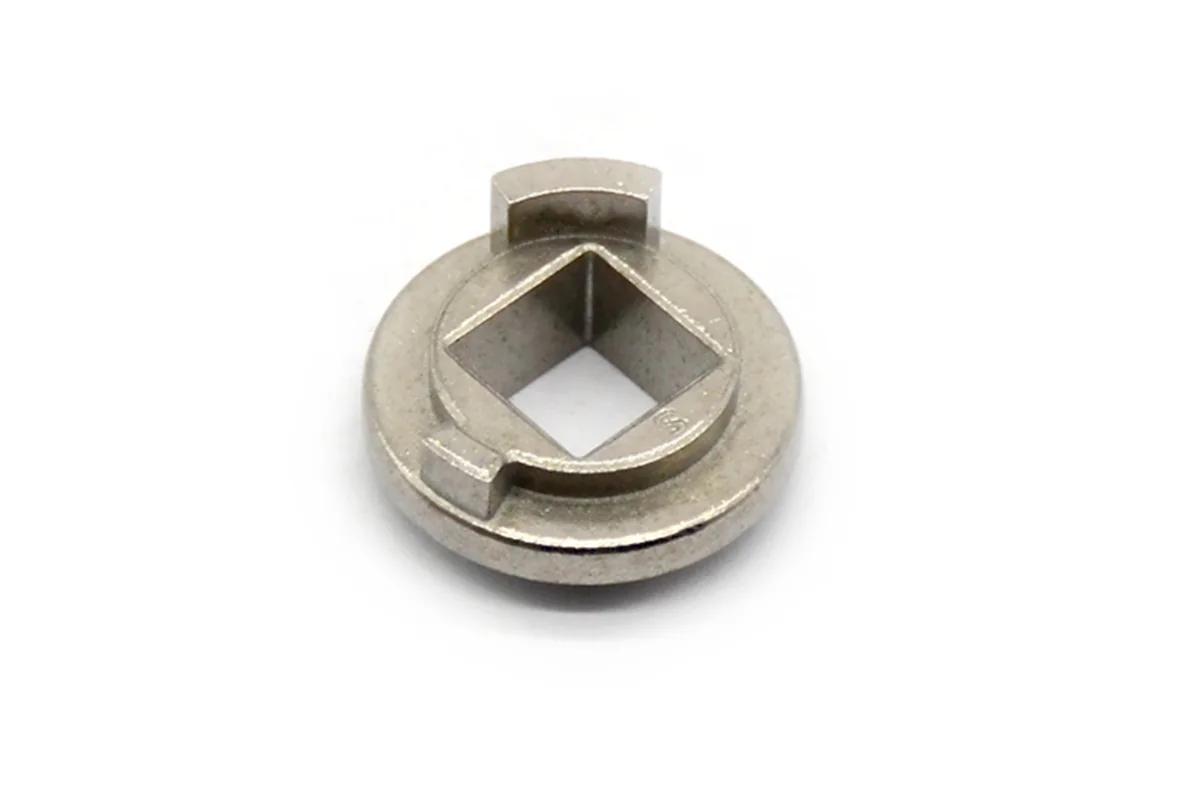
01 | Magnetic sensor category
The central square bore establishes orientation, while the raised rim and small tabs create local seating and positioning features. Check bore dimensions, seating flatness, tab strength and distortion after sintering; the exact sensor function depends on the assembly design.
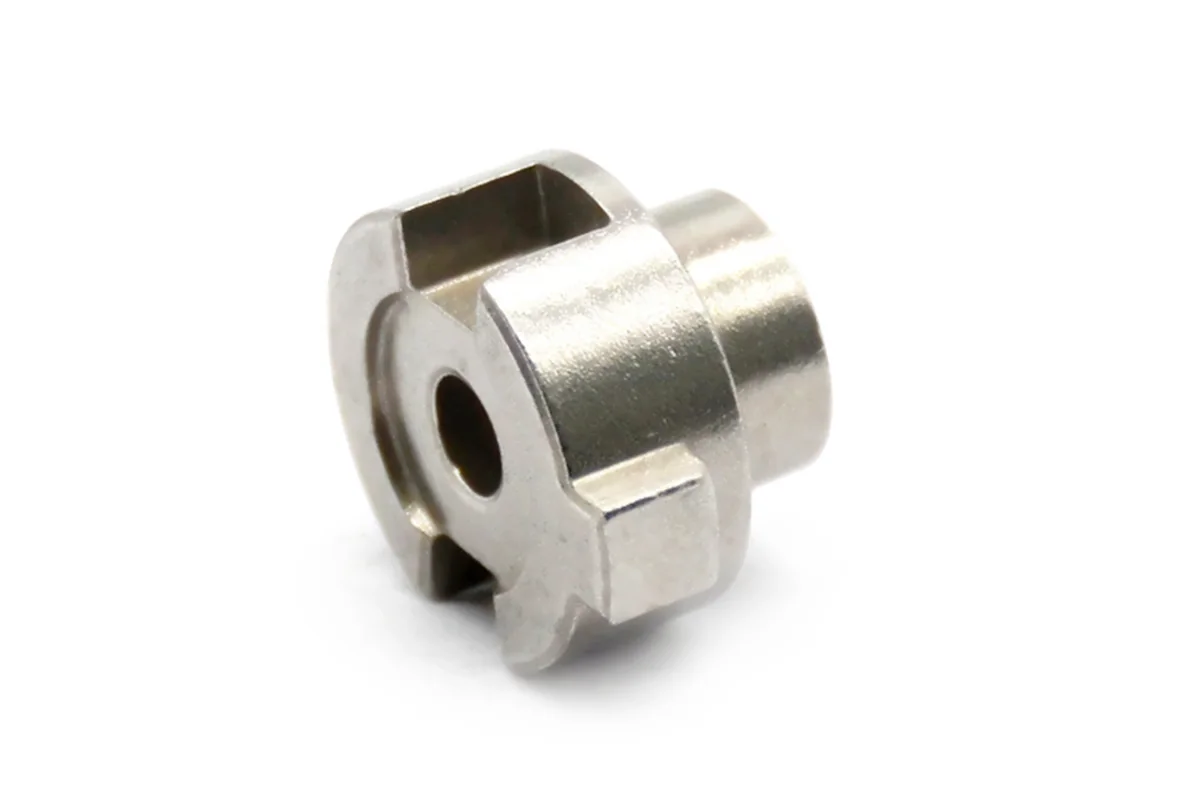
02 | Miniature motor category
The stepped hub, axial bore and deep recess form uneven wall sections. Review core-pin support, release direction, concentricity and sintering distortion at the mating surfaces. The part's specific magnetic role depends on the motor configuration.
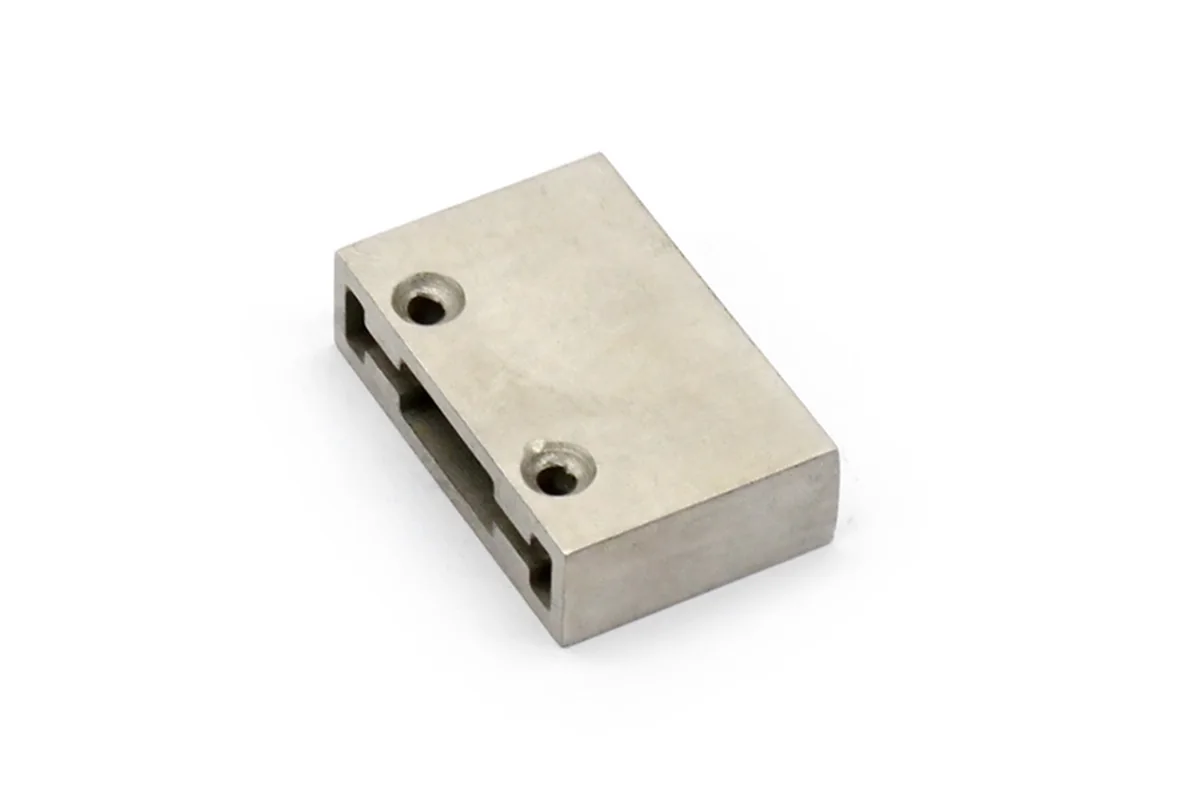
03 | Telecommunications category
Two recessed mounting holes and lateral slots make hole-to-slot position, local wall thickness and sintering flatness important. Establish whether the component carries magnetic flux or serves a structural function before defining a magnetic test.
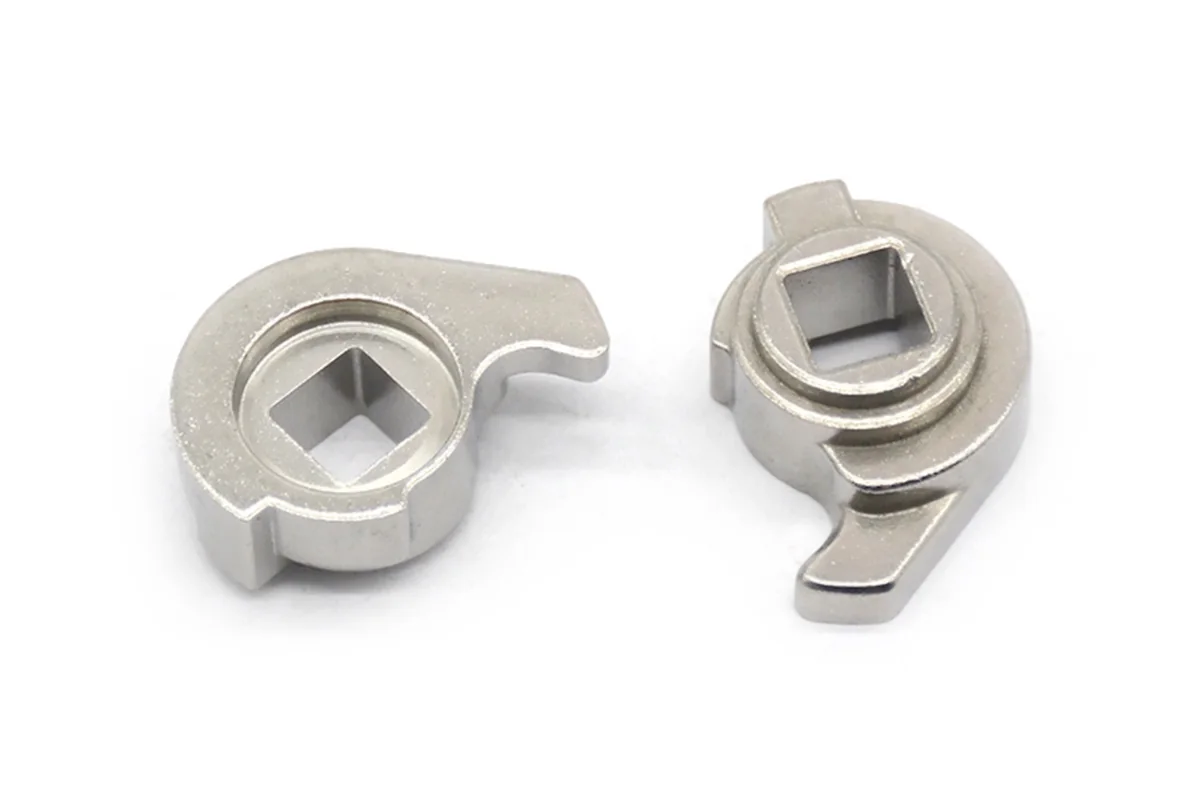
04 | Square-bore parts with offset arms
These parts combine square through-bores, offset arms and changing wall sections. Their functional risks include bore orientation, arm distortion and locating-face accuracy. Neway presents the pair as a general overview image rather than a specifically identified electronic-lock component.
Across these geometries, the highest-value DFM questions are usually the accuracy of mating bores, local section changes, thin projections and the position of functional surfaces after sintering. For magnetic parts, the drawing must also identify which faces or sections belong to the flux path and require magnetic or assembly-function verification.
A June 2013 Powder Injection Moulding International review (pp. 38–39, Figs. 13–14) (pp. 38–39, Figs. 13–14) documents MIM dot-matrix printer yokes identified as Permendur, with Nippon Piston Ring (Japan) and Epson Atmix (Japan) credited for the parts. Magnetic yokes provide a flux-return path, making this a relevant industrial example of a complex soft-magnetic MIM component. The article does not include batch-level chemistry, so it supports a Permendur-class MIM application without establishing the exact binary Fe50Co composition.
A component should not be designated Fe-50Co solely because it is installed in a solenoid, motor, relay, or sensor. Its particular operating point and geometry must justify the material choice.
What Has Been Demonstrated in Fe-50Co MIM Research?
Im Fe2.7Si, Fe50Ni and Fe50Co Soft Ferromagnetic Materials by Powder Injection Moulding (PM2012), Carreño-Morelli and colleagues describe Fe50Co square toroidal specimens produced by powder injection moulding and measured using B-H hysteresis loops. The following results apply to their experimental feedstock and test geometry:
| Reported PM2012 Fe50Co result | Value for that experiment | Correct interpretation |
|---|---|---|
| Experimental feedstock and geometry | Elemental Fe and Co powders, 50 vol% solids loading, injection-moulded square toroids | These are research-compounded test specimens—not a commercial pre-alloyed powder or a production pole piece. |
| Experimental sintering condition | 1,300 °C for 2 h in hydrogen | A condition reported in this study, beweist a transferable recipe for another furnace, binder or part. |
| Magnetic induction at H = 2,000 A/m | 2.0 T | A measured induction under the stated applied field; not a universal saturation value or delivery guarantee. |
| Sinterdichte | 8.02 g/cm³ (97.8% of theoretical density) | Observed density for the published experimental specimens, not a mandatory production target. |
| Reported relative permeability | 4,100 | The study's reported relative permeability; its value and measurement conditions are not a universal material guarantee. |
Interpreting the study: The ring specimens establish a demonstrated Fe50Co powder-injection-moulding route under the reported conditions. Their density and B-H results are not universal specifications for commercial pole pieces or actuators; the selected feedstock and production geometry still need qualification.
When Is MIM the Right Manufacturing Process for Fe-50Co Parts?
After identifying a credible Fe-50Co magnetic requirement, evaluate the manufacturing route independently. A small, complex, three-dimensional part with repeated production demand is a stronger MIM candidate than a simple geometry needed only for a few prototype assemblies.
Part Geometry, Production Volume and Tooling Suitability
MIM can integrate holes, slots, steps, mounting features and contoured magnetic surfaces into a near-net-shape component. Its economics depend on tooling cost, output volume, feature complexity, scrap and any mandatory finishing operations. As-sintered tolerances may not be sufficient at critical pole faces or precision air gaps; secondary machining must be included in the cost and validation plan rather than assumed away.
When CNC, Press-and-Sinter PM or Laminations May Be Better
| Fertigungsweg | Stärkere Passung | Main caution for Fe-50Co applications |
|---|---|---|
| MIM | Small, intricate 3D geometry where repeat volume justifies tooling and process development. | Feedstock and furnace compatibility, shrinkage, magnetic qualification and post-process acceptance must be established. |
| CNC from suitable stock | Prototype quantities, simple geometry, very tight local interfaces, or evolving designs. | Stock availability, machining difficulty, material waste, and the magnetic state after machining must be reviewed. |
| Press-und-Sinter-PM | Geometries that suit directional compaction and an established powder metallurgy route. | Shape freedom and magnetic/density outcomes differ from MIM and must be checked for the actual design. |
| Stamped laminations / stacked core | Designs where lamination geometry and AC loss control dominate. | A monolithic MIM part must not be assumed to match a laminated core's eddy-current behaviour. |
Cost assessment: Include cobalt-bearing raw material, feedstock and furnace qualification, tooling, debinding, sintering, magnetic testing, possible scrap, annealing and local CNC finishing. Break-even volume depends on part geometry and the required magnetic acceptance condition; a single minimum annual quantity would give an unreliable estimate.
A simple low-volume geometry is often better suited to machining. By contrast, a small part that integrates multiple datum, locating and magnetic features may justify MIM tooling even if a critical pole face still needs finishing.
What Must Be Controlled to Produce Fe-50Co MIM Parts Reliably?
An Fe-50Co MIM route must combine a suitable powder and binder with controllable debinding, sintering, distortion, heat treatment and magnetic inspection. Powder availability and laboratory trials provide a starting point; the selected factory process must be validated for the part and acceptance requirements.
Powder and Feedstock Feasibility
Sandvik publishes MIM powder information for Fe50Co0.2Si, including chemistry and particle-size options. Powder availability alone does not establish an injectable feedstock. commercially compounded Fe-50%Co feedstock is also available from Advanced Metalworking Practices in wax/polymer and POM-based binder options, allowing a factory to assess an existing compounded route rather than automatically developing its own. The chosen feedstock must match the injection equipment, debinding method and sintering system. Particle-size distribution, binder chemistry, solids loading and batch consistency affect that assessment. PM2012 used blended elemental Fe and Co powders with an experimental binder, rather than Sandvik's Fe50Co0.2Si feedstock. Its processing results therefore cannot qualify a different commercial feedstock without additional tests.
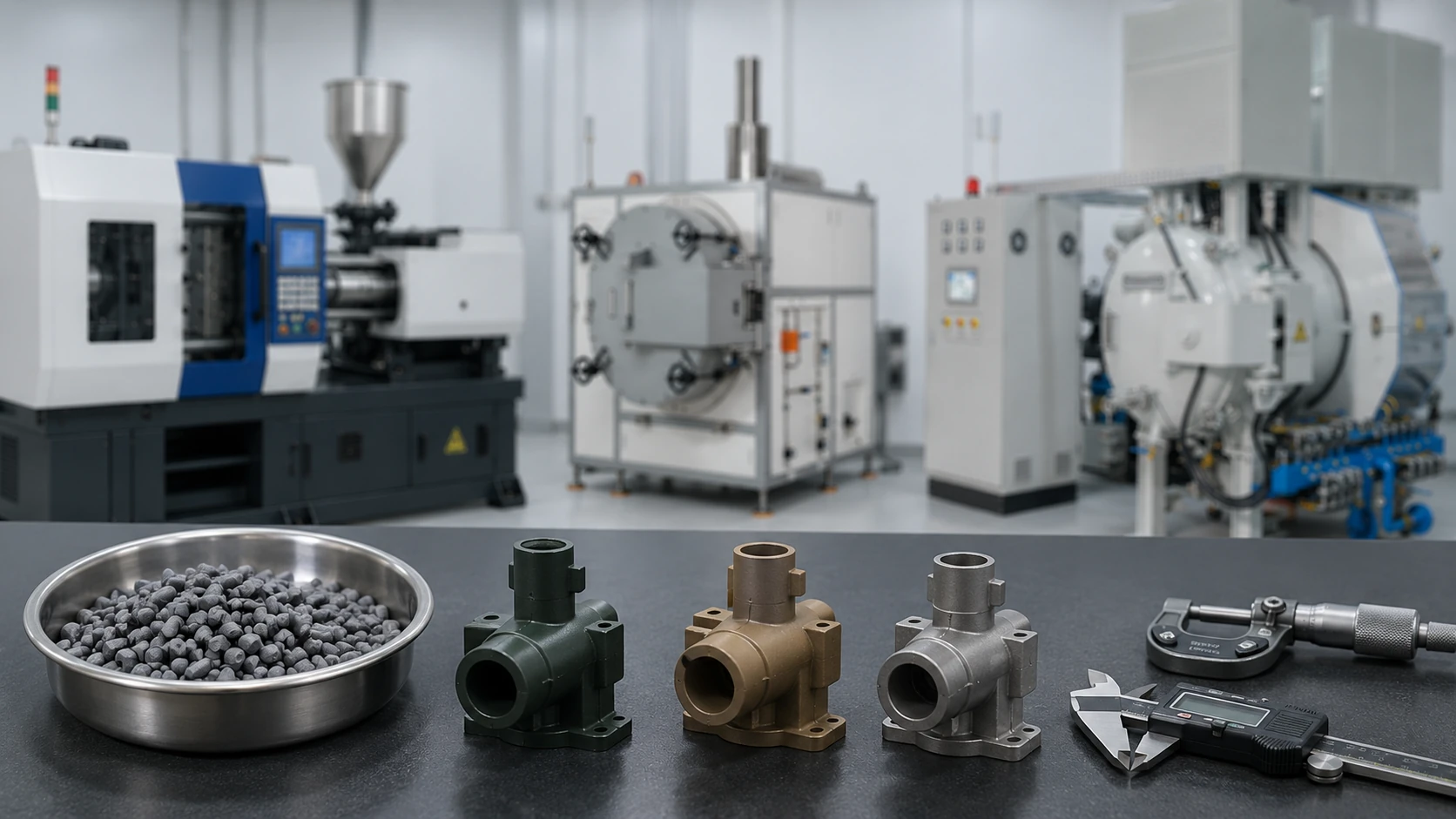
General MIM process schematic. The actual Fe-Co powder, binder and furnace combination determines the process-validation requirements.
Debinding, Sintering, Density and Heat Treatment
Der Entbindern und Sintern stages determine binder removal, impurity pickup, densification, residual porosity, shrinkage and microstructure. In a soft-magnetic alloy, these variables can affect coercivity and permeability as well as mechanical integrity. Verify furnace atmosphere, contamination control and thermal cycle on the actual equipment; the conditions reported for a research specimen are not a ready-made production recipe.
Magnetic and mechanical requirements must be assessed together: Near-equiatomic Fe-Co alloys can undergo atomic ordering associated with brittleness. Fe-Co mechanical-property research discusses how vanadium additions affect ductility in wrought Fe-Co alloys; those findings help identify a failure mechanism but do not supply mechanical allowables for sintered MIM parts. Thin arms, pole tips and moving components therefore need a fracture-risk assessment alongside magnetic testing. The AMP Fe-50%Co datasheet reports typical as-sintered elongation below 1% for its Fe-50%Co feedstock, a supplier-specific value that should not be applied automatically to another material or heat-treatment state.
Magnetic annealing may improve the required magnetic response, depending on alloy chemistry, microstructure and prior processing. Establish whether annealing occurs before or after machining, then measure the part or agreed specimen in that final condition. The process must deliver the required magnetic properties without compromising dimensions or mechanical integrity.
Critical Geometry, Shrinkage and Secondary Machining
Thin walls, abrupt section changes and asymmetric mass distribution can impair injection filling or cause sintering distortion. Even when general dimensions pass inspection, a shifted pole face or enlarged air gap may reduce magnetic performance. Identify the magnetic interfaces and functional datums during DFM-Prüfung so those areas receive appropriate allowances and checks.
Prüfen Sie gate location, Sinterunterstützungen und Schwindungskompensation before tooling. Keep gate marks and secondary finishing away from function-critical surfaces where practical. If machining is needed to correct pole-face flatness, bore fit or air-gap dimensions, assess whether machining-induced stress or subsequent heat treatment changes the magnetic acceptance condition.
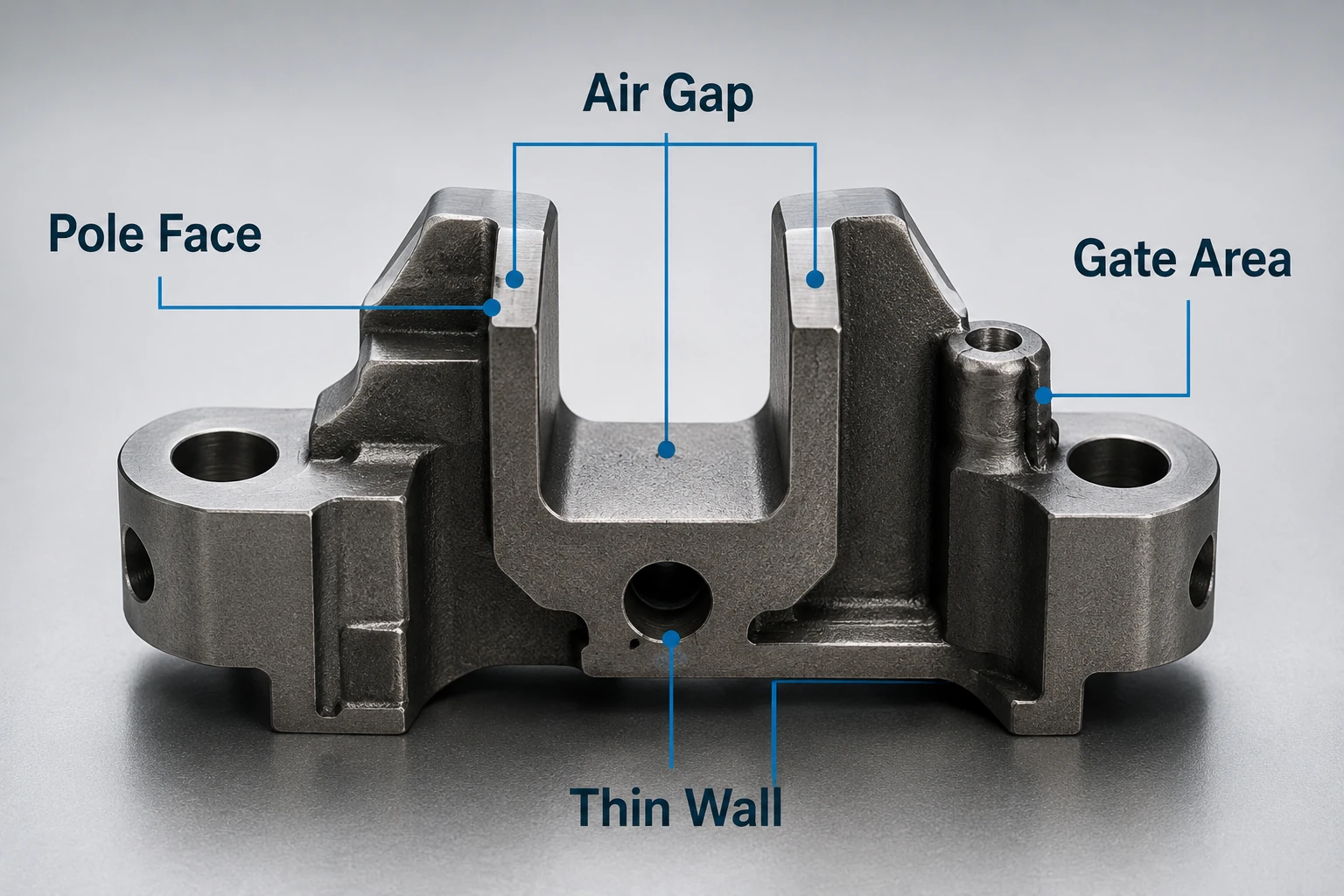
Engineering illustration; the diagram conveys potential design risks and does not document a tested Fe-50Co production part.
| Fertigungsfaktor | Potential functional consequence | Required engineering response |
|---|---|---|
| Powder chemistry and impurity pickup | Uncertain magnetic response or inconsistent batch behavior. | Confirm powder specification and evaluate finished sintered chemistry where required. |
| Debinding residues, densification and residual porosity | Contamination, density variation, dimensional instability or changes in the magnetic path. | Validate density, microstructure, shrinkage and defect controls on representative samples. |
| Furnace and thermal cycle | Distortion or magnetic properties differing from research/datasheet expectations. | Confirm equipment suitability and test the selected route; do not transfer recipes automatically. |
| Gate / support / mass distribution | Witness marks, warpage or inaccurate magnetic interfaces. | Review functional surfaces, gating and sintering support during DFM. |
| Critical air-gap / pole geometry | Functional magnetic deviation despite acceptable general dimensions. | Apply separate datum, flatness and air-gap inspection requirements. |
| Machining and stress-relief sequence | Magnetic condition may differ from the pre-machined or pre-annealed specimen. | Agree on the final processing state before selecting acceptance tests. |
Before production tooling: Select a feedstock and binder route, confirm material chemistry, demonstrate compatible debinding and sintering on representative specimens, and agree on critical magnetic and dimensional acceptance tests. First-article validation must cover the real part geometry as well as magnetic test pieces.
Project-specific qualification: Commercial powder and published Fe50Co processing studies establish possible routes, but the selected feedstock, furnace conditions, test methods and repeatability must be confirmed for each project. XTMIM's Fe-50Co material-specific capability and delivery conditions require engineering confirmation before commitments are made.
How Should Finished Fe-50Co MIM Parts Be Specified and Verified?
Material identity and final magnetic performance are not the same acceptance criterion. A finished part may meet nominal chemistry and general dimensional tolerances but still fail a particular air-gap, switching-response or magnetic-flux requirement. Define the inspection state and testing method before trial production, not after a disagreement over the reported results.
Magnetic Test Methods and Acceptance Conditions
A B-H curve or other magnetic measurements can be reported on a toroidal witness specimen, while the customer's final assembly may depend on actual pole-piece geometry, mating gaps and operating waveform. Decide whether a representative specimen, the finished component, a defined fixture, or a complete assembly functional test is required. For low-coercivity material testing, ASTM A773/A773M is one published direct-current magnetic test-method reference; applicability to the selected specimen and equipment must be checked.
MPIF Standard 35-MIM is a MIM material specification framework; the Fe-50%Co grade is also referenced in published feedstock documentation. Confirm the edition, grade designation and which properties actually apply to the project. Supplier datasheet figures are typisch unless the contract explicitly specifies acceptance limits and conditions.
ISO 22068:2012 addresses specifications for sintered metal injection-moulded materials and is a useful general framework, but do not assume it automatically defines every Fe-50Co magnetic property required by a specific design. ASTM A801 covers wrought iron-cobalt high-saturation alloys; it should not be presented as direct evidence of compliance for a sintered Fe-50Co MIM part.
Dimensional and Functional Acceptance
Coupon results and assembly performance answer different questions: A toroidal sample can meet the required B-H response while a finished pole piece produces insufficient force because of a larger air gap or a misaligned contact face. Where magnetic force matters, combine an appropriate material or part test with a force-versus-gap or force-versus-stroke check under defined excitation conditions.
Define magnetic-critical dimensions separately from MIM-Toleranzen. Air-gap height, pole-face position, flatness, locating surfaces and fit can dominate the delivered magnetic function. Confirm whether inspection is performed as-sintered, after machining, after annealing or in the final coated/assembled state. For repeat orders, define how the approved sample and process are compared with subsequent lots.
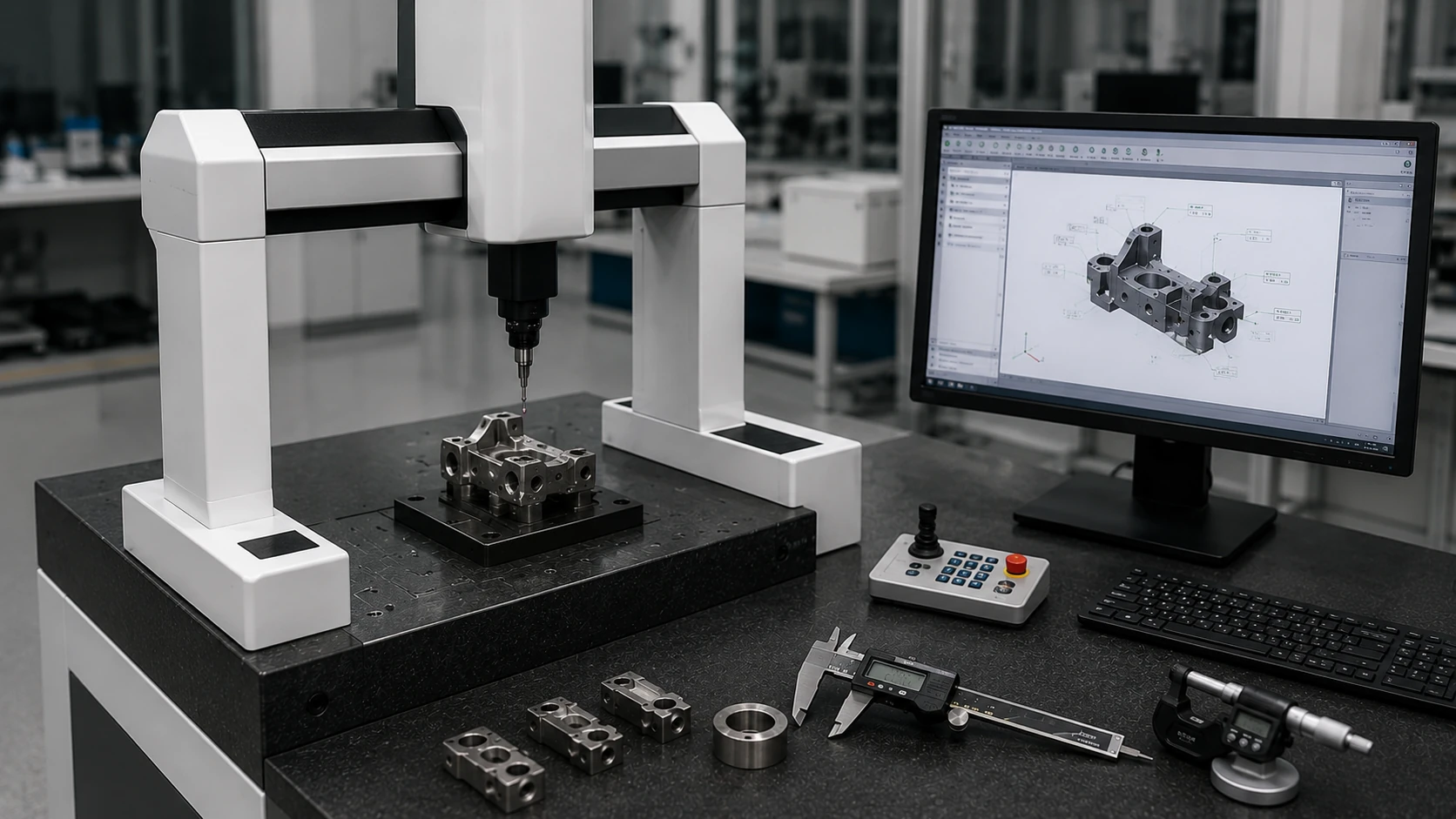
Illustrative inspection imagery; it is not proof that the pictured parts or instruments were used to qualify a Fe-50Co production lot.
| Acceptance subject | Evidence or test to agree | When to check |
|---|---|---|
| Legierungszusammensetzung | Supplier material certificate and, where necessary, finished-part chemical verification. | Powder qualification / receiving and process qualification. |
| Gesinterte Dichte und Porosität | Agreed density or metallographic assessment with specimen and method defined. | Trial / first article; production control if functionally required. |
| B at a specified magnetic field | Magnetic induction, applied H, unit, test geometry and material condition. | Material qualification and agreed final-state checks. |
| Permeability, coercivity and B-H response | Specify which parameter is relevant and the measurement method; do not assume one scalar value describes the whole curve. | After applicable final thermal and mechanical processing. |
| Functional surfaces / air gaps | Dimensions, datum references, flatness, surface and measurement method. | First article and final inspection. |
| Component / assembly magnetic performance | Fixture or assembled-system test, waveform, duty cycle, force/flux response and pass/fail criteria where required. | Design validation and agreed production release. |
| Chargenkonstanz | Critical parameter monitoring, change-control rule and acceptance sampling agreed with the customer. | Ongoing production after qualification. |
Test the agreed final condition: Specify whether the result applies to an as-sintered coupon, an annealed specimen, a machined part or the finished assembly. These states may give different magnetic or dimensional results and may require separate acceptance methods.
Is Your Fe-50Co MIM Project Ready for Engineering Review?
An Fe-50Co RFQ should distinguish fixed requirements from unresolved magnetic or manufacturing questions. Drawings and preliminary volume are enough to begin a geometry review; material sourcing, tooling and magnetic qualification cannot be finalized until the remaining assumptions are defined.
Proceed, Validate or Consider an Alternative
| Entscheidung | What the project has established | Angemessene nächste Aktion |
|---|---|---|
| Fortfahren zur technischen Prüfung | A credible high-saturation requirement, part drawings, likely MIM geometry/volume fit and a proposed verification path. | Review tooling, powder/feedstock sourcing, furnace compatibility, sample plan and RFQ assumptions. This is not automatic production approval. |
| Validierung vor Werkzeugbau | Fe-50Co is plausible, but the required B-H response, material condition, sintering route or critical dimensions remain uncertain. | Define functional targets, request material/route evidence and determine necessary trials before making commitments. |
| Consider another material or process | Higher saturation is not needed, the geometry/quantity does not justify MIM, or losses/lamination requirements dominate. | Compare an appropriate magnetic material or CNC, PM, or laminated-core route against the actual requirements. |
If a buyer can provide only a CAD model and annual quantity, a supplier can begin a geometry review, but cannot responsibly promise a magnetic result. In that situation, request the operating context and define the acceptance test before fixing the alloy and production route. If the magnetic function is still open, the MIM-Materialauswahl-Leitfaden is a useful preliminary reference.
What to Include in an Fe-50Co MIM RFQ
| Input group | Information needed for a useful review | Why it changes the decision |
|---|---|---|
| Geometry and drawing | 2D drawing, 3D CAD, datum features, critical air gaps, pole faces, fits and general tolerances. | Determines moldability, shrinkage risk, machining allowance and measurement strategy. |
| Werkstoffspezifikation | Fe-50Co as mandatory or candidate; target chemistry, approved grade or alternate allowed. | Establishes the correct powder/part qualification route. |
| Magnetische Funktion | Operating field, B-H or target flux requirements, permeability / coercivity needs, frequency and duty cycle if known. | Determines whether Fe-50Co offers a real benefit and which test is meaningful. |
| Processing and surface needs | Heat-treatment expectation, critical machined surfaces, coating, finish, working environment. | Connects manufacturing sequence to final magnetic state and assembly interfaces. |
| Quality and test requirements | Acceptance values, inspection fixture, coupon versus finished-part test and production-release criteria. | Prevents disagreement between material certificate, component test and customer requirement. |
| Commercial context | Prototype/sample quantity, estimated annual volume, current production process and project stage. | Allows realistic selection of MIM versus other routes and assessment of tooling economics. |
Validation sequence: (1) agree on alloy chemistry and magnetic targets; (2) qualify the selected feedstock and sintering route on representative specimens; (3) inspect first-article geometry and the final machining or annealing condition; and (4) release repeat production against agreed magnetic, dimensional and, when applicable, assembly-function criteria.
If some magnetic targets are not yet available, label them as open requirements rather than inventing values. XTMIM can evaluate the drawing and discuss material-selection or DFM questions; Fe-50Co feedstock availability, process capability, magnetic testing and delivery commitments must be established for the specific project.
Request an Fe-50Co MIM Material and DFM Review
Share your part drawing, intended magnetic function, material specification and estimated volume. XTMIM can assess the geometry, discuss Fe-50Co material and process suitability, and identify the tests or design changes needed before committing to tooling.