
17-4 PH vs MIM 4605: Beide können für festigkeitskritische MIM-Komponenten verwendet werden. Sie sind nicht austauschbar: Das eine ist ein ausscheidungshärtender rostfreier Stahl, das andere ein härtbarer niedriglegierter Stahl. Beginnen Sie mit der Korrosionsanforderung des Teils, der mechanischen Beanspruchung und dem erforderlichen Endzustand.
Kurze Antwort: Wählen Sie MIM, 17-4 PH für die Erstbewertung, wenn das Teil rostfreies Korrosionsverhalten zusammen mit hoher Festigkeit benötigt. Erwägen Sie MIM 4605 wenn die Exposition kontrolliert werden kann und die spezifizierten wärmebehandelten mechanischen Eigenschaften erreicht werden können. Keine der beiden Sorten ist ein direkter Ersatz, ohne Oberflächenschutz, funktionale Belastung, kritische Abmessungen und kundenspezifische Zulassungsanforderungen zu prüfen.
| Hauptanforderung | Material zur Erstbewertung | Bestätigung erforderlich |
|---|---|---|
| Festigkeit plus zwingende Edelstahl-Korrosionsleistung | 17-4 PH | Korrosionskriterien der Serviceumgebung, Alterungszustand und Abmessungen |
| Mechanische Leistung in einer geschützten oder entsprechend bearbeiteten Baugruppe | MIM 4605 kann qualifizieren | Endgültige mechanische Eigenschaften, Lagerungsbedingungen und Oberflächenschutz |
| Unspezifizierte Ermüdungs-, Schlag-, Korrosions- oder Ersatzanforderungen | Entscheidung ausstehend | Vollständige Zeichnung, Prüfziele, Endzustand und technische Freigabe |
Welche Anforderungen sind bei der Wahl zwischen 17-4 PH und MIM 4605 am wichtigsten?
Bevor Sie Datenblätter vergleichen, trennen Sie die Funktionen des Teils muss aus Attributen bestehen, die gegen Kosten oder Sekundärbearbeitungen abgewogen werden können. Eine Materialentscheidung ist nur dann sinnvoll, wenn diese Grenzen definiert sind.
Ist Korrosionsbeständigkeit eine nicht verhandelbare Anforderung?
Beschreiben Sie die Exposition während der gesamten Lebensdauer des Teils: Herstellung und Reinigung, Montagehandhabung, Versand und Lagerung sowie Endservice. Eine Komponente kann in einer fertigen Maschine eingeschlossen sein, aber während der ungeschützten Lagerung dennoch Korrosion entwickeln. Umgekehrt benötigt eine abgedichtete oder geschützte Baugruppe möglicherweise nicht die gleiche Edelstahl-Korrosionsreserve wie eine extern exponierte Komponente.
17-4 PH ist ein ausscheidungshärtender Edelstahl, während MIM 4605 ein niedriglegierter Nickel-Molybdän-Stahl ist – kein Edelstahl. Dieser Unterschied ist wichtig, wenn Rost, Fleckenbildung oder kundenseitig sichtbare Verschlechterung inakzeptabel sind. Dennoch ist 17-4 PH beweist korrosionsbeständig: Chloride, Schweiß, Reinigungschemikalien und aggressive Medien erfordern eine anwendungsspezifische Bewertung. Wenn 4605 in Betracht gezogen wird, muss das Ingenieurteam entscheiden, ob eine kontrollierte Umgebung, eine Beschichtung oder ein anderer Schutz die tatsächlichen Akzeptanzkriterien erfüllen kann.
Welche Festigkeit, Härte, Verschleißfestigkeit und Zähigkeit muss das Teil aufweisen?
Beschreiben Sie den Lastpfad und den Versagensmodus des Teils. Trägt es eine statische Last, erhält es Stöße, wird es wiederholt belastet, stützt es eine Presspassung oder gleitet es gegen eine andere Oberfläche? Zugfestigkeit, Streckgrenze, Härte, Bruchdehnung, Ermüdungsfestigkeit und Verschleißlebensdauer beantworten unterschiedliche Fragen. Eine härtere Güte ist nicht zwangsläufig schlagzäher, und die Härte allein kann den Verschleiß ohne Anpressdruck, Gegenfläche, Schmierung und Oberflächenzustand nicht vorhersagen.
Kundenspezifische Legierungsbezeichnungen, Beschichtungsverbote, kritische Bezugsflächen und vereinbarte Abnahmekriterien können ebenfalls absolute Einschränkungen darstellen. Wenn die Zeichnung 17-4 PH vorschreibt, ist der Austausch gegen 4605 eine kontrollierte technische Änderung – keine informelle Kaufoption.
| Zu definierende Anforderung | Frage an den Konstrukteur | Warum dies die Materialwahl ändern kann |
|---|---|---|
| Korrosion oder Aussehen | Welcher Exposition und welcher Menge an Anlaufen, falls überhaupt, sind akzeptabel? | Kann eine Edelstahlroute zwingend vorschreiben oder einen validierten Schutz für 4605 erfordern. |
| Mechanische Funktion | Welche Last, welcher Stoß, welche zyklische Belastung, welche Härte oder welche Verschleißlebensdauer ist erforderlich? | Bestimmt die notwendige endgültige Balance zwischen Festigkeit und Duktilität. |
| Oberfläche und Montage | Kann eine Beschichtung die Kontaktmaße, die Reibung oder die optische Oberfläche verändern? | Kann eine Schutzbeschichtung unpraktisch machen, selbst wenn das Substrat stark genug ist. |
| Spezifikation und Freigabe | Ist eine Güte, Norm, ein Prozess oder ein Test explizit vorgeschrieben? | Kann einen Materialwechsel ohne formale Neuzulassung verbieten. |
Entscheidungs-Gate: Wenn das Korrosionsverhalten von Edelstahl eine Akzeptanzvoraussetzung ist und kein alternatives Schutzsystem genehmigt wurde, ist MIM 4605 kein direkter Ersatz. Wenn die Exposition kontrolliert wird und die mechanischen Ziele klar sind, können beide Güten zu einem zustandspezifischen Eigenschaftsvergleich übergehen.
Für die Auswahl von Werkstofffamilien über diese beiden Güten hinaus verwenden Sie die MIM-Materialauswahl-Leitfaden.
Wie schneiden 17-4 PH und MIM 4605 in Bezug auf Korrosionsbeständigkeit und mechanische Eigenschaften ab?
17-4 PH ist ein ausscheidungshärtender rostfreier Stahl; 4605 ist ein härtbarer niedriglegierter Stahl. Ihre Chemie, Behandlungsbedingungen und daraus resultierenden Eigenschaften führen zu unterschiedlichen Kompromissen bei Korrosion und mechanischer Leistung.
Warum ist rostfreier Stahl im Vergleich zu niedriglegiertem Stahl für die Korrosionsbeständigkeit wichtig?
MIM 17-4 PH verwendet eine chromhaltige ausscheidungshärtende Edelstahlzusammensetzung; eine veröffentlichte MIM-Lieferantenzusammensetzung listet etwa 15,5–17,5 % Chrom mit Nickel- und Kupferzusätzen auf. MIM 4605 verwendet stattdessen eine niedriglegierte Formulierung mit etwa 0,4–0,6 % Kohlenstoff, 1,5–2,5 % Nickel und 0,2–0,5 % Molybdän in veröffentlichten Pulverspezifikationen. Sie ist nicht dafür ausgelegt, Korrosionsbeständigkeit wie Edelstahl zu bieten. Siehe die Spezifikation für MIM-Werkstoffe ASTM B883-24 und die nachstehenden Lieferantendaten.
Therefore a wet, chloride-bearing or appearance-sensitive application cannot be resolved by simply comparing hardness numbers. 17-4 PH may be the better initial route, but its corrosion behavior still needs to be verified for the actual medium and surface condition. A protected 4605 part may work well if the environment and required coating performance have both been defined.
Wie vergleichen sich Festigkeit, Härte und Duktilität?
Both grades can achieve substantial mechanical strength in suitable states, but their strength and ductility profiles change with treatment. The figures below are supplier-published typical MIM material examples from Advanced Powder Products (APP), included to make the trade-off concrete—not XTMIM qualification values and not a matched-condition experimental comparison.
| MIM material and supplier-listed condition | Dichte (g/cm³) | Streckgrenze (MPa) | UTS (MPa) | Dehnung (%) | Härte |
|---|---|---|---|---|---|
| 17-4 PH, standard row (condition not further specified by APP) | 7.6 | 740 | 900 | 6 | 27–32 HRC |
| 17-4 PH, H900 | 7.6 | 1,100 | 1,200 | 4 | 38–42 HRC |
| 4605, heat treated (HT) | 7.55 | 1,480 | 1,650 | 1 | 43–48 HRC |
Data conditions: These are typical values published by Advanced Powder Products (17-4 PH) und Advanced Powder Products (4605), not guaranteed XTMIM limits. The 4605 HT and 17-4 PH H900 treatments are not matched test conditions; the first 17-4 PH entry does not specify its delivered condition. Use the figures to identify trade-offs, and specify the final treatment, test method and acceptance values for the actual part.
Do not rank materials by UTS alone. The example 4605 HT row has high reported tensile strength but low reported elongation. For an impact-loaded, fatigue-sensitive or safety-critical component, the necessary ductility and validated functional performance may control the decision more than the highest tensile figure. Wear also requires a separate contact-system review.
How Does Heat Treatment Affect the Final Properties of 17-4 PH and MIM 4605?
Heat treatment can change the same grade's strength, hardness and ductility enough to change a design decision. A useful comparison therefore names the gelieferte Zustand, not just the grade.
How Does Aging Affect MIM 17-4 PH?
17-4 PH is strengthened through a precipitation-hardening (aging) route after the necessary preceding processing condition. Different approved aging schedules produce different property combinations. The APP example above shows 17-4 PH H900 with higher published strength and hardness than its non-H900 entry, alongside lower elongation. The required condition should be written into the material and inspection requirements rather than assumed from the label “17-4 PH.”
Corrosion expectations must also be considered for the specified condition and finish. An aging condition selected to meet a strength target is not automatically a corrosion-test approval for a particular chemical or chloride environment.
How Do Hardening and Tempering Affect MIM 4605?
4605 is a hardenable low-alloy steel. Quenching and tempering can deliver substantially higher strength and hardness than a softer condition, but an increase in strength may reduce ductility. A published 4605 heat-treated example illustrates why the designer must check elongation and the intended failure mode in addition to hardness.
Confirm the actual heat-treatment schedule and final test targets with the MIM producer. Do not mix a minimum value from a standard, a supplier's typical value, and a test result from a different state as though all three were equivalent.
INDO-MIM reports a MIM 4605 diesel fuel-injection valve poppet weighing 0.9 g, with 320 MPa ultimate tensile strength and 100–250 HB hardness. Those values differ markedly from APP's 4605 HT typical row. The publications do not establish equivalent final conditions or test methods, so neither set of figures should be used as the universal specification for “MIM 4605.”
Before design freeze: State the material grade, required final treatment, minimum functional properties, corrosion acceptance criteria if relevant, and which measurements will be made on specimens versus finished components. MPIF Standard 35-MIM is the correct standards family for MIM; its 2025 edition supersedes older editions.
Which MIM Part Requirements Favor 17-4 PH or MIM 4605?
The same machine can contain 17-4 PH and 4605 parts. Their functional loads, exposure and finishing needs—not the industry name—determine which route is appropriate.
Corrosion-Exposed and Appearance-Sensitive Components
For small exposed structural components, housings or handling surfaces, start by asking whether rust staining, cleaning exposure or corrosion-driven loss of function is acceptable. If stainless behavior is explicitly required alongside mechanical strength, 17-4 PH is generally the more appropriate first material to qualify. Exposure to sweat, salt, aggressive cleaners or other chlorides remains a separate test question; the word “stainless” is not a substitute for an acceptance method.
If an exposed component is proposed in 4605, the supplier needs a credible protective system and a plan to inspect corrosion protection, appearance, coating integrity and dimensions after finishing. A vague instruction to “add plating later” is not enough for a precision assembly.
Protected Mechanical and Wear-Contact Components
For enclosed mechanisms, retaining elements, locking parts or contact components where corrosion exposure is demonstrably controlled, MIM 4605 may be worth evaluating. Specify the actual load and wear mechanism, the counterface material, expected lubrication, and the final hardness/ductility requirement. 17-4 PH can also serve structural components; it should not be excluded simply because the part is internal.
When a part has narrow contact faces, bores or a thread that governs alignment, its finishing and tolerance plan may be decisive. A functional surface that needs grinding or turning after sintering can change both approval risk and cost, regardless of which alloy is selected.
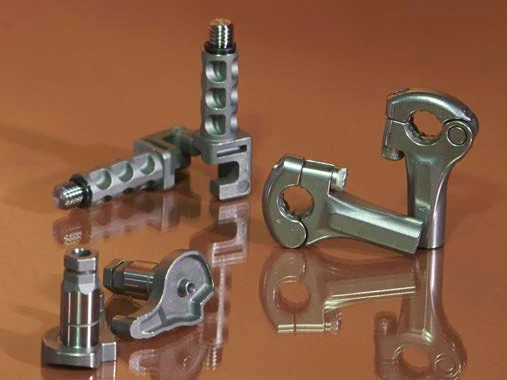
Two alloys in one hydraulic proportional-valve assembly
Four metal-injection-molded parts serve proportional valves in agricultural and off-highway hydraulic circuits. The base cap and body use MIM 17-4 PH, while the catcher and tension bar use MIM 4605, according to the published MIMA example.
The catcher required outside-diameter grinding and burnishing; an external thread was turned on the tension bar. Both grade selection and finishing differ within one assembly. The source identifies the materials and operations but does not disclose every reason behind the original alloy choices.
MIMA: published hydraulic-valve case. Third-party example, not XTMIM manufacture.
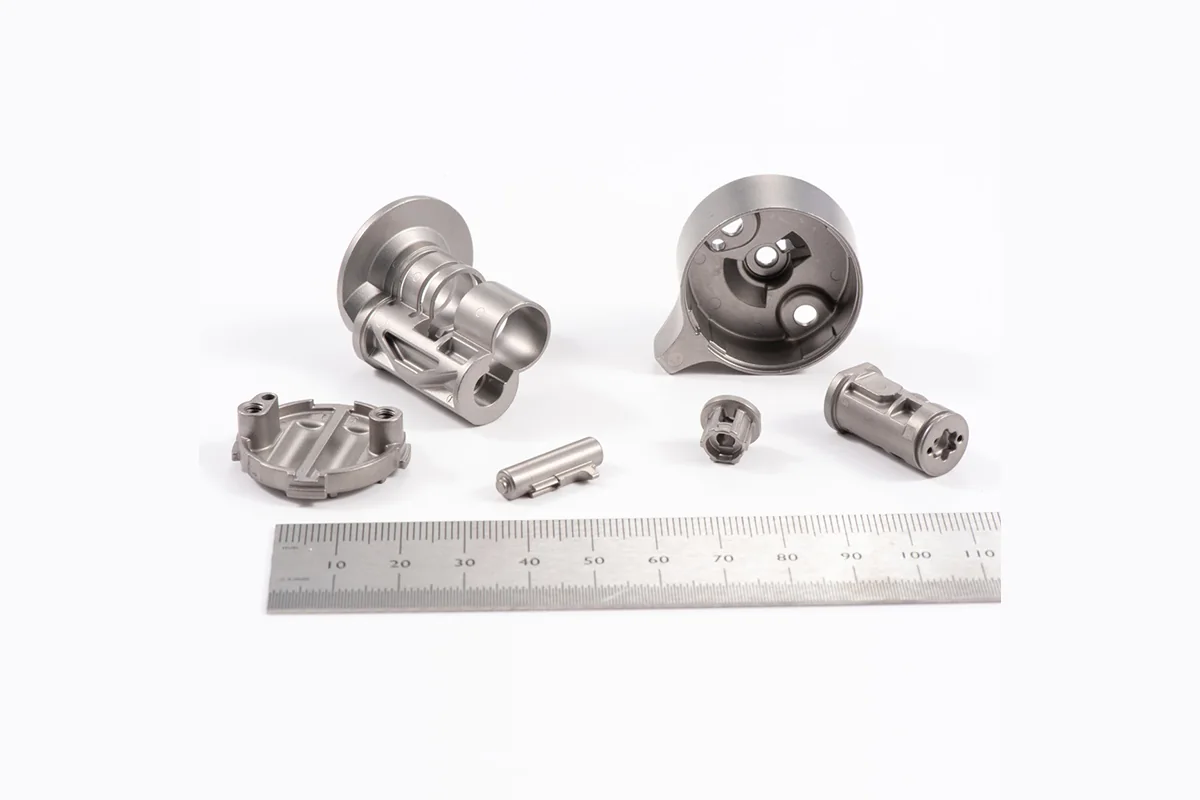
17-4 PH H900 in digital door-lock mechanisms
This digital-lock application uses MIM 17-4 PH aged to H900 for shafts, clutches, cores and other precision mechanisms. The award entry reports a density of 7,6 g/cm³ und Zugfestigkeit von 1.190 MPa for this specific project.
The required strength, corrosion behavior and tightly mating features show why an internal moving mechanism can still use 17-4 PH. It should not be rejected solely because the part is not externally visible.
MPIF / PickPM: digital door-lock parts. Third-party case-specific values, not XTMIM specification limits.
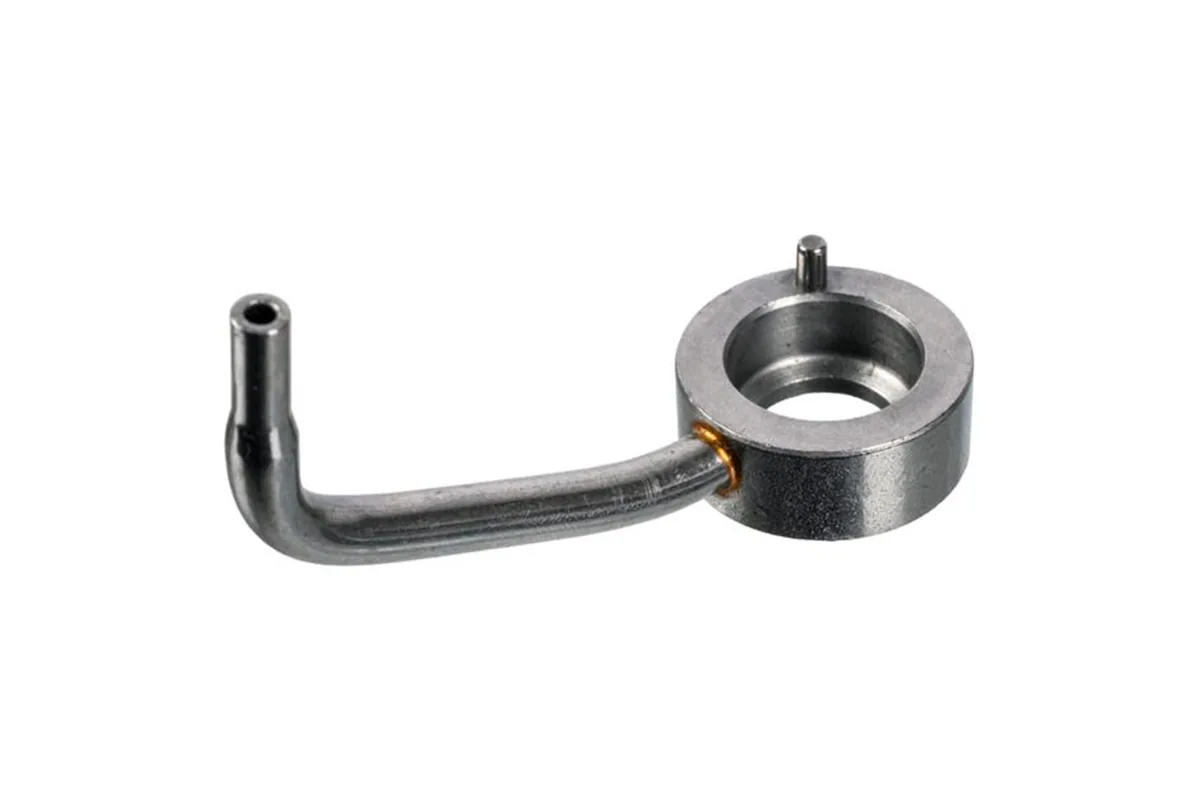
4605 piston oil-spray cooler: control of internal passages
Der MIM 4605 oil-spray piston cooler directs oil through intersecting passages to cool a heavy-vehicle engine piston. Internal-flow integrity matters: the published case describes eliminating machining-related burrs and the risk of restricted passages.
The source reports a density of 7.55 g/cm³ und Zugfestigkeit von 1.550 MPa for this part. These are case results, not a universal guarantee for every 4605 component. The actual oil, temperature, loads and final treatment remain project-specific review conditions.
MIMA: oil-spray piston cooler. Third-party application.

4605 power-tool clamp: material choice is not the only cost driver
A complex U-shaped MIM 4605 clamp body mounts and locates parts within a hand-power-tool subassembly. Bosses and projecting features made tool design, molding and production control relevant to feasibility and cost.
The award report cites about 60% cost savings compared with the previously machined component. This is evidence for a manufacturing-route change, beweist evidence that swapping 17-4 PH for 4605 produces a 60% saving.
PIM International: 2023 award cases. Third-party application.
Internal mechanisms can also use 17-4 PH. A separate MIMA cable-tie tool case uses six MIM 17-4 PH parts, including a pinion, rack and cutoff cam. Whether a component is internal or external does not determine the grade by itself; the load case, required condition and service environment do.
Example selection check (hypothetical): A locking insert has a sliding contact face and two closely toleranced holes. If humidity and storage exposure are controlled, 4605 may be evaluated against hardness, wear and fit requirements. If staining is unacceptable, or a protective coating would alter the hole fit, 17-4 PH may offer the more practical route. Confirm these conditions against the part drawing rather than the generic description “locking insert.”
Can MIM 4605 Replace 17-4 PH in an Existing Part?
Not as a drop-in substitution. A proposal to replace 17-4 PH with 4605 must be assessed as a change in material system, corrosion behavior, heat treatment and possibly surface processing. The ability to meet one hardness figure is not sufficient for approval.
When Should Material Replacement Be Rejected?
Reject or stop the change review when the part requires a specified stainless grade, corrosion behavior that the proposed 4605 system cannot demonstrate, an unacceptable coating or appearance change, or mechanical performance that has not been validated for the substitute. Also stop when the existing specification requires customer qualification and no approval path has been agreed.
For instance, a contact part may pass a hardness target in treated 4605 yet still fail a salt, cleaning or storage requirement—or a coating might disturb its press-fit tolerance. An apparent materials-cost benefit cannot override a mandatory functional or contractual requirement. If the original part specification includes corrosion, fatigue or impact acceptance tests, the proposed 4605 version needs an agreed equivalent validation program; a typical supplier datasheet is not a substitute for those tests.
What Must Be Requalified Before Replacing 17-4 PH?
Compare the drawing and acceptance requirements before and after the proposed change, then identify which tests and manufacturing steps must be repeated. A replacement can also trigger tooling, process-parameter, dimensional, surface-finishing and assembly requalification even when the CAD geometry appears unchanged. Differences in feedstock behavior or sintering shrinkage may mean that the existing MIM mold cannot produce the same final dimensions without modification; tooling reuse must be assessed rather than assumed.
| Approval gate | Go / conditional / no-go rule | Anzufordernde Nachweise |
|---|---|---|
| Specified grade or customer approval | No-go without authorized deviation when 17-4 PH is mandatory. | Approved material deviation and revised drawing/specification. |
| Corrosion and appearance | No-go if a required stainless function cannot be matched; otherwise conditional. | Service-environment test, protective-finish specification and acceptance criteria. |
| Mechanical and fatigue performance | Bedingt until critical load, wear and ductility requirements are met. | Grade/condition data, mechanical testing and part-level functional validation. |
| Dimensions and finishing | Bedingt if heat treatment, coating or secondary machining changes fits. | Inspection plan, first-article dimensions and assembly checks. |
| Supplier process and traceability | Bedingt until repeatable MIM route and control plan are confirmed. | Material traceability, processing route and agreed acceptance records. |
Example of a controlled substitution review: suppose a released 17-4 PH digital-lock component is proposed in 4605 to reduce total cost. The buyer must not infer interchangeability from the fact that 4605 has appeared in other MIM mechanisms. Confirm the released drawing's mandatory grade, stiffness/load path, lock-cycle and corrosion tests, thread/shaft fits, coating acceptance and customer engineering-change procedure. A successful 4605 prototype in another industry is not a release test for this lock.
Substitution rule: “MIM 4605 is cheaper” or “MIM 4605 is stronger” is never sufficient justification. A documented, approved functional equivalence assessment must come first.
What Manufacturing and Total-Cost Checks Matter Before Tooling?
A material can look suitable on a datasheet but be difficult to deliver in the required geometry, condition or price range. Once the functional choice is clear, confirm the actual MIM route and the cost of the finished, accepted part.
Can the Supplier Achieve the Required Final Material Condition?
Confirm available feedstock, powder quality, sintering route, achievable density, carbon/chemistry control and the applicable treatment and test capability. For example, Osprey's MIM powder catalog includes 4605, showing that the grade is commercially established as a powder option; this alone does beweist prove that a particular factory has qualified a complete 4605 part-production route. The same distinction applies to 17-4 PH: material availability does not equal guaranteed part properties.
Ask the supplier to identify the final condition it can repeatedly produce and how chemistry, hardness, mechanical tests and dimensional conformity will be documented. Properties of a published test bar do not automatically represent a thin wall, small notch or complex finished component.
Will Heat Treatment, Finishing, or Tolerances Add Manufacturing Risk?
Review shrinkage compensation, sintering support, post-treatment dimensional movement, flatness and the positions of holes or mating faces. Flag any feature that cannot be accepted as-sintered and must undergo sizing, grinding, turning or CNC after thermal processing. Those requirements belong in the tooling and inspection review, not as unexpected changes after sampling.
For 4605, a corrosion-protection system may add thickness, masking or edge-coverage issues. For 17-4 PH, aging state and appearance or passivation expectations may add their own controls. Neither route should be described as automatically free of secondary operations. See MIM-Wärmebehandlungsprozess und MIM-Kalibrierung for process-specific details.
Does the Total Finished-Part Cost Still Support the Material Choice?
Compare costs at the same geometry, annual volume, final material condition and acceptance level. The meaningful comparison is feedstock and processing plus thermal treatment, machining, protective finishing, inspection and expected yield. A low-alloy grade may have an attractive raw-material route, but extra plating and tight post-treatment finishing can narrow or reverse the advantage. A stainless route may be justified if it avoids an otherwise necessary protective process; neither outcome is universal.
| Manufacturing check | Why it changes feasibility or cost | Action before tooling |
|---|---|---|
| Feedstock / chemistry control | Impacts final consistency, carbon balance and density. | Confirm qualified material route and material specification. |
| Wärmebehandlung | Changes hardness, strength, ductility and sometimes dimensions. | Specify final state and test locations. |
| Kritische Schnittstellen | May need machining, sizing or additional gauges after thermal cycles. | Mark critical-to-function features on the drawing. |
| Coating or appearance | Can add steps, masking, dimensional changes and rejection risk. | Define approved finish, thickness and corrosion acceptance. |
| Volume and quality plan | Changes tooling amortization, inspection effort and unit economics. | Quote both routes to the same finished-part specification. |
Cost evidence must be compared on the same basis. The 4605 power-tool clamp report compares MIM with an earlier machined part; the hydraulic-valve case involves redesign and changes in the manufacturing route. Neither case measures a direct cost saving from substituting 4605 for 17-4 PH. Request prices for the same geometry, final properties, finishing, quality controls and production volume.
For other tooling and unit-cost factors, see the Leitfaden zu den Kosten im Metallpulverspritzguss.
Which Material Should You Choose, and What Must Be Validated Next?
Select the grade against the finished part's corrosion exposure, load case, heat-treated properties and acceptance tests. If those conditions are incomplete, treat the result as a preliminary material recommendation—not an approved substitution.
Final Selection Rules for 17-4 PH vs MIM 4605
| Preliminary decision | When it is defensible | Required final check |
|---|---|---|
| Prioritize 17-4 PH | Stainless corrosion behavior is important together with structural strength, and the selected aging condition can satisfy the part's mechanical requirements. | Verify service-environment corrosion, condition-specific properties, dimensional and surface requirements. |
| Evaluate MIM 4605 | The part's environment is controlled or a validated protection method is allowed; its final heat-treated strength, ductility and wear behavior suit the duty. | Verify protection, load/impact performance, functional surfaces and repeatable MIM process control. |
| Do not decide yet | The environment, grade mandate, final condition or critical failure mode remains unknown—or neither route meets the full specification. | Complete the requirements review, functional tests and, if needed, widen the material shortlist. |
What Should Be Included in a Material Review or RFQ?
Ask suppliers to evaluate both materials against the same finished-part requirements: mechanical performance, corrosion exposure, dimensions, surface condition and inspection criteria. Otherwise the quotations may not be technically comparable.
For the broader quotation package, see the MIM-RFQ-Vorbereitungsleitfaden. If replacement of an already released part is proposed, include the original approval specification and the intended deviation or change-control process.
Vor dem Werkzeugbau: confirm the selected material, the final heat-treatment condition, critical dimensions and any corrosion or mechanical acceptance tests on the drawing. These requirements determine whether either route can be released for production.
Technical references and data notes
Standards define material specifications; supplier data list typical examples; the published case studies identify actual applications. Verify the applicable issue, treatment state and test conditions when preparing a released specification.
- ASTM B883-24 — Standard Specification for Metal Injection Molded (MIM) Materials — grade/specification reference; full standard requirements should be consulted for formal compliance.
- MPIF Standard 35-MIM (2025 Edition) — published MIM material standards and definitions.
- Advanced Powder Products — MIM Stainless Steel — cited 17-4 PH typical material-property rows.
- Advanced Powder Products — MIM Low-Alloy Steels — cited 4605 heat-treated typical-property row.
- Osprey — Metal Powder Materials Catalog — powder-material availability and alloy context; availability is not part qualification.
- MIMA — Catcher, Tension Bar, and Base Cap & Body — documented third-party hydraulic-valve MIM example.
- PickPM / MPIF — Digital Door Lock Parts — 17-4 PH H900, part function, reported material properties and design approach.
- MIMA — Oil Spray Piston Cooler — 4605 engine component, function, reported material values and intersecting passage design.
- PIM International — 2023 MPIF Award-Winning Parts — 4605 power-tool clamp and its process-based savings comparison.
- INDO-MIM — MIM Case Studies — 4605 diesel valve-poppet example and its disclosed property data.
- MIMA — Kabelbinderwerkzeugteile — 17-4 PH mechanical application with six MIM components.
Prüfung von 17-4 PH oder MIM 4605 vor der Werkzeugerstellung
Have a part drawing but still need to confirm the material route? Share your drawing, application environment, required final properties, critical dimensions, surface specification and production volume. XTMIM can evaluate the material and process questions that must be resolved before quotation or tooling.