Wolframlegierungen für den Metallpulverspritzguss (MIM) sind eine Überlegung wert, wenn ein kleines, komplexes Bauteil mehr Masse innerhalb eines vorgegebenen Raums benötigt. Die wichtigsten Materialkandidaten für diesen Einsatzzweck sind Wolframschwerlegierungen wie W-Ni-Fe und W-Ni-Cu. Eine geeignete Legierung ist nur die erste Entscheidung: Verfügbarkeit von Feedstock, Geometrie, Entbindern, Sintern, Endgewicht und Abnahmekriterien müssen ebenfalls bewertet werden, bevor die Werkzeugerstellung erfolgt.
Materialeignung
Hohe Masse, Dichte und Balance in einem kleinen Bauteil mit begrenztem Designraum.
Prozess-Eignung
Komplexe Near-Net-Shape-Geometrie und wiederholtes Volumen, das Werkzeugkosten rechtfertigen kann.
Muss validiert werden
Tatsächliche Güte, verfügbarer Feedstock, Ofenroute, Endmasse, Abmessungen und Inspektion.
Wann benötigt ein kleines Teil eine Wolfram-Schwerlegierung?
Beginnen Sie mit der funktionalen Anforderung, nicht mit dem Wort "Wolfram" auf einer Zeichnung. Eine Wolfram-Schwerlegierung ist eine Überlegung wert, wenn das verfügbare Bauteilvolumen fest vorgegeben ist, die Baugruppe aber mehr Masse, einen anderen Schwerpunkt oder eine kontrollierte Trägheit benötigt. Wenn eine konventionelle Legierung das funktionale Ziel bereits erfüllt, kann die Auswahl eines schwereren Materials Kosten hinzufügen, ohne ein Problem zu lösen.
Hohe Massenanforderungen bei begrenztem Bauraum
Eine erste Abschätzung ist erforderliche Durchschnittsdichte = Zielteilmasse / verfügbares Festmaterialvolumen. Zum Beispiel benötigt eine hypothetische 20 g Komponente mit nur 1,2 cm3 Festvolumen eine Durchschnittsdichte von etwa 16,7 g/cm3. Bei gleichem Volumen würde ein beispielhaftes 7,8 g/cm3 konventionelles Metall etwa 9,4 g Masse liefern, während eine 17,0 g/cm3 Schwermetalllegierung etwa 20,4 g liefern würde. Dies sind einfache Volumen- und Dichteberechnungen, keine gemessenen MIM-Ergebnisse oder ein garantiertes Fertigteilgewicht. Bohrungen, Einsätze, Bearbeitungszugaben und das tatsächliche CAD-Volumen müssen berücksichtigt werden.
Die Berechnung benötigt das Netto-Metallvolumen aus dem fertigen CAD-Modell, nicht das Volumen seiner Bounding Box. Für ein 18,0 g/cm³3 Material wiegt ein 1,2 cm³3 festes Teil 21,6 g, aber das Entfernen von 0,2 cm³3 für eine Montagebohrung reduziert die Masse auf 18,0 g. Oberflächenbearbeitungen, Einsätze und alle Beschichtungs- oder Fügefunktionen müssen daher in die endgültige Gewichtsbewertung einbezogen werden.
Veröffentlichte kommerzielle Wolfram-Schwerlegierungs-Sortenbeispiele umfassen ungefähr 17,0-18,5 g/cm³3, abhängig von der Zusammensetzung. Sie beschreiben katalogisierte Materialgüten; ein gespritztes Teil erfordert immer noch eine tatsächliche Dichte- und Massenverifizierung. Die Toleranz für das Fertigteilgewicht sollte separat angegeben werden, da die Legierungszusammensetzung und die Dichte des Probekörpers nicht das exakte Gewicht jedes Teils bestimmen. Siehe den Hersteller-Sortenvergleich für die angegebenen Zusammensetzungen und Dichten.
Wenn hohe Dichte nicht die einzige Anforderung ist
Dichte kann notwendig, aber nicht ausreichend sein. Das Design kann auch Festigkeit, Stoßbelastung, zulässige magnetische Reaktion, Korrosionsbelastung, Balanceposition, eine Befläche zur Befestigung oder eine Mindestduktilität spezifizieren. Erhöhter Wolframgehalt kann Dichte und Steifigkeit erhöhen und gleichzeitig die erreichbare Duktilität verringern. Diese Kompromisse werden in ASTM B777-15(2026); die endgültige Wahl muss den Einsatzbedingungen des Teils entsprechen.
Ein Gewicht kann seine Nennmasse erreichen und dennoch seine Funktion nicht erfüllen. In einer rotierenden oder oszillierenden Baugruppe ist die Position der Masse relativ zur Drehachse möglicherweise genauso wichtig wie das Gewicht selbst. Wenn sich das Teil in der Nähe eines Sensors oder eines Magnetfeldes befindet, definieren Sie die zulässige magnetische Reaktion, anstatt sich auf eine allgemeine Bezeichnung wie “nichtmagnetisch” zu verlassen. Wo Stoß- oder Klemmbelastungen auftreten, können Mindestduktilität oder lokale Festigkeit die Wolfram-höchsten Legierungen einschränken.
Welche Wolfram-Schwermetalllegierung passt zu den Anforderungen des Teils?
Für Anwendungen mit kompakter Masse beginnen Sie mit der W-Ni-Fe und W-Ni-Cu Schwerlegierungsfamilien. Beide enthalten Wolframkörner in einer metallischen Binderphase, aber ihre Zusammensetzung, ihr magnetisches Verhalten, ihre mechanischen Eigenschaften und die verfügbaren MIM-Feedstocks müssen separat bewertet werden. Keine Legierungsfamilie sollte allein nach ihrem Handelsnamen ausgewählt werden.
W-Ni-Fe vs W-Ni-Cu: Wichtige Auswahlfaktoren
| Auswahlfaktor | W-Ni-Fe Schwermetalllegierung | Schwerlegierung W-Ni-Cu | Was die Zeichnung / RFQ bestätigen muss |
|---|---|---|---|
| Primärer Grund für die Berücksichtigung | Hohe Dichte mit definierter mechanischer Leistung | Hohe Dichte, bei der das magnetische Ansprechverhalten oder die Binderzusammensetzung wichtig ist | Masse, Volumen, Belastung und tatsächliche Funktionspriorität |
| Magnetisches Verhalten | Kann magnetisch reagieren; keine Nichtmagnetisierung annehmen | Wird oft gewählt, wenn ein geringes magnetisches Ansprechverhalten erforderlich ist, abhängig von der Güte und Prüfung | Maximal zulässige Permeabilität oder anwendungsspezifisches Prüfverfahren |
| Mechanisches Verhalten | Abhängig vom Wolframanteil, der Mikrostruktur und dem Sinterverfahren | Ebenfalls güte- und prozessabhängig; keine gleiche Festigkeit bei gleicher Dichte annehmen | Kritische Anforderungen an Zugfestigkeit, Härte, Dehnung oder Ermüdung, falls zutreffend |
| MIM-Machbarkeit | Es existieren veröffentlichte Spritzgussstudien und MIM-Materialspezifikationen | Es existieren dokumentierte MIM-Materialpfade, jedoch müssen das genaue Feedstock und der Prozess bestätigt werden | Qualifiziertes Feedstock, Ausrüstungskompatibilität, Versuchspläne und Inspektion |
Sowohl in W-Ni-Fe als auch in W-Ni-Cu werden Wolframkörner in einer metallischen Matrix gehalten. Die Ni-Fe- oder Ni-Cu-Bindemittelzusammensetzung beeinflusst die magnetische Reaktion und die mechanischen Eigenschaften, die nach dem Sintern erreichbar sind. Eine nichtmagnetische Anforderung ist ein Grund, einen dokumentierten Ni-Cu-Pfad zu untersuchen, kein Beweis dafür, dass jede W-Ni-Cu-Güte jede magnetische Prüfung besteht. Fordern Sie eine definierte Testbedingung und eine Akzeptanzgrenze an, wenn die magnetische Kompatibilität kritisch ist.
Beweise für diese Materialfamilienunterschiede umfassen eine begutachtete Überprüfung der Verarbeitung von Wolfram-Schwermetalllegierungen und eine veröffentlichte nichtmagnetische W-Ni-Cu MIM-Entwicklung, berichtet von Parmaco. Parmaco beschreibt eine nominale 97W-2Ni-1Cu-Entwicklungslegierung mit einer Sinterdichte von ca. 18,5 g/cm³3 , was ein spezifisches, von einem Lieferanten berichtetes Entwicklungsergebnis ist, keine allgemeine W-Ni-Cu-Güte-Spezifikation oder eine Produktionsaussage von XTMIM. Die genaue chemische Zusammensetzung, magnetische Grenzwerte und Abnahmetests müssen für jedes Projekt festgelegt werden.
Was muss über die Legierungszusammensetzung hinaus spezifiziert werden?
Wenn eine hohe Dichte nicht die Hauptanforderung ist, vergleichen Sie andere Werkstofffamilien in der MIM-Sonderlegierungen Übersicht, bevor Sie eine Wolfram-Schwerlegierung spezifizieren.
Schreiben Sie messbare Anforderungen in die Kaufspezifikation: nominelle Legierung oder akzeptierte Chemie, Ziel-Dichte oder fertige Masse, Massentoleranz, erforderliche magnetische Reaktion, kritische Abmessungen, Belastung im Betrieb und alle speziellen mechanischen oder Umwelteinschränkungen. ASTM B777 liefert einen Referenzrahmen für bearbeitbare Wolfram-basierte hochdichte Metalle, aber es ist keine pauschale MIM-Prozessfreigabe.
Die Zeichnung sollte eine minimale Materialdichte, eine Nennmasse des Fertigteils, und eine zulässige Massenabweichung. Jede steuert eine andere Abnahmebedingung. Beachten Sie auch, ob eine angegebene Materialklasse zwingend ist oder ob eine funktional äquivalente Güte vorgeschlagen werden darf. Wenn die Bestellung zitiert ASTM B777, geben Sie die relevante Klasse an und definieren Sie separat alle MIM-spezifischen Abnahmeprüfungen; die ASTM-Materialklasse allein genehmigt keine bestimmte Formgebungs- oder Sinterroute.
What Real Components Use Tungsten Heavy Alloys?
For high-density components, the application matters because it defines where mass must sit, how tightly it must be controlled, and whether the shape benefits from MIM. Published manufacturer information identifies vibrator weights and compact inertial parts as possible uses. Those sources describe industry applications and material development; they do not identify production parts made by XTMIM.
Compact Vibration Motor Weights
In a compact vibration module, an off-center weight contributes to the oscillating or rotating mass needed to generate vibration within a limited housing. Higher material density can deliver more mass without requiring a larger weight envelope. That makes tungsten heavy alloys relevant to certain mobile-device and haptic-mechanism components; the exact vibration outcome still depends on the entire motor design.
For a rotating eccentric mass, a useful screening quantity is the unbalance U = m × e, in der m is the eccentric mass and e is its offset from the axis of rotation. Density enables a specified mass to fit a compact envelope; it does not independently set the vibration output, which also depends on speed, offset and the assembled motor system. Therefore a candidate part should be checked for mass, eccentricity, attachment geometry and rotation clearance, not just for alloy density.
Manufacturer evidence: The 2026 Biomerics Metal Injection Molding Material Offerings sheet identifies W-Ni-Fe and W-Ni-Cu tungsten alloys, describes their characteristic as high density, and lists vibrator as an application. The document connects these material families to vibrator applications within MIM; it does not describe the geometry, specifications or inspection results of an identifiable finished component.
Critical drawing requirements: Maximum envelope, nominal and permitted mass, mounting or joining features, surface condition and any balance-position tolerance.
Precision Counterweights and Inertia Components
Counterweights correct the position of mass in a moving assembly; inertial components may require a controlled mass distribution rather than simply the highest possible density. Candidate geometries include compact weights with steps, openings or local attachment features, but not every commercial tungsten counterweight is made by MIM. Simple blocks or rings can be more economical by conventional press-and-sinter PM or machining.
For a balancing weight, where the metal is placed matters: two parts of equal total mass may shift the assembly's center of gravity differently. A flywheel or inertia component is even more sensitive to how mass is distributed about the axis. Define the required assembly result first and then identify which dimensions and local mass distribution control that result. This avoids treating “maximum density” as a substitute for a functional balance specification.
Reference applications: ASTM B777 lists weights, counterbalances, rotating inertia members and vibration-damping uses for tungsten-base high-density metal. A separate Parmaco MIM development report discusses a nonmagnetic W-Ni-Cu route intended for high-density flywheel and counterweight applications. The latter documents material/process development, not a verified XTMIM customer part.
Critical drawing requirements: Permitted mass deviation, center-of-gravity requirement where relevant, mounting datums and expected production quantity.
Photographed MIM applications beyond motor weights. Two examples published by Powder Injection Moulding International show that tungsten-composite injection moulding has also been used for shielding and small high-density weights. Both photographs are published industry examples, not XTMIM production samples. Their precise tungsten-alloy compositions were not disclosed.

Published MIM example: PIM International, March 2016, Fig. 15. Not an XTMIM-manufactured part.
Component and use. This tungsten-composite shield is designed to surround part of a syringe used when handling radiopharmaceuticals. Its purpose is to attenuate radiation exposure for medical personnel while preserving access to the syringe. The source photograph shows an elongated hollow body and a flanged opening, rather than a simple solid weight.
Material and manufacturing evidence. Powder Injection Moulding International identifies the Fig. 15 component as a tungsten-composite syringe radiation shield made by metal injection moulding. The exact W-Ni-Fe or W-Ni-Cu composition, shielding thickness and test results are not published with the image; no particular grade or certification should be inferred.
Engineering implications. An MIM feasibility review must consider continuous shielding coverage, minimum wall thickness, internal clearance, local section changes, debinding and sintering distortion, and the finished fit. Shielding effectiveness must be validated for the actual radiation type, energy and device design; high density alone is not a device-level protection claim.
Original case source: PIM International, Vol. 10 No. 1, p. 64, Fig. 15.
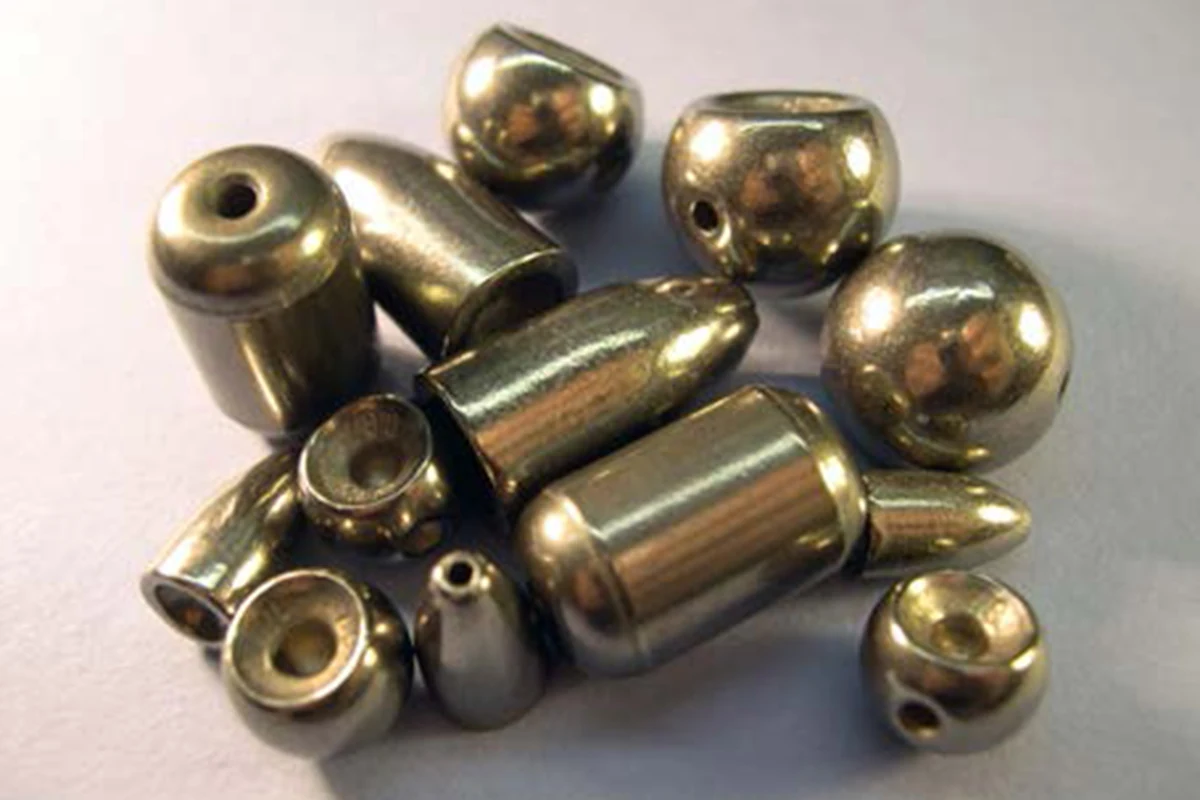
Published MIM examples: PIM International, March 2016, Fig. 14 (photo courtesy J. Sery). Not XTMIM products.
Component and use. Fishing sinkers provide ballast to position or sink fishing tackle. Compact tungsten-based weights can supply the required mass with less volume than lower-density materials. The published photograph includes different weight profiles and small openings, illustrating the importance of finished shape as well as material density.
Material and manufacturing evidence. The journal explicitly identifies the Fig. 14 items as tungsten-composite fishing weights fabricated by metal powder injection moulding. It does not assign an exact tungsten percentage, W-Ni-Fe/W-Ni-Cu grade, or measured density to each pictured component.
Engineering implications. Review the specified mass range, net volume, hole dimensions, edge condition, corrosion exposure and finishing requirements. Multiple compact profiles can be relevant to an MIM study, but the process must still compete economically with pressing or machining at the required production volume.
Original case source: PIM International, Vol. 10 No. 1, p. 64, Fig. 14.
When Should Tungsten Alloy Parts Be Made by MIM Rather Than CNC or Conventional PM?
A need for tungsten heavy alloy does beweist automatically justify MIM. The manufacturing decision depends on geometry, target volume, available feedstock, material utilization, tooling investment, the planned sintering route, and the finished-part acceptance criteria.
Part Geometry and Production Volume
MIM is most interesting where the part combines compact dimensions with three-dimensional features that would otherwise require repeated machining: local ribs, recesses, stepped contours, cross-features or multiple setup operations. Conventional powder pressing can be attractive for simpler shapes that are accessible along a compaction direction. CNC is often practical for prototypes, low quantities, or parts that must be cut to tight final dimensions from qualified stock.
Example (hypothetical): A cylindrical ballast with one axial bore can often be turned or drilled; conventional pressing may also be competitive if suitable powder and tooling are available. A similarly sized weight with offset pockets, ribs and several non-axial mounting features may require multiple CNC setups or waste expensive stock. Only the latter geometry gives MIM a clearer near-net-shape opportunity; expected repeat volume, qualified feedstock and sintering risk still determine whether the mold is justified.
| Projektbedingung | MIM | Konventionelle PM | CNC / machining |
|---|---|---|---|
| Small, complex 3D form with repeated production | Candidate if feedstock and sintering can be qualified | May be limited by pressing geometry | Possible, but material waste and cycle time need review |
| Simple weight, ring or block | Tooling advantage often limited | Often worth comparing | Often worth comparing |
| One-off prototype or a very small pilot | Dedicated mold may not be justified | Depends on available tooling | Often the faster feasibility route |
| Critical final surfaces or tightly controlled fit | May need post-sinter machining | May need sizing or machining | Precision is established by machining and inspection |
General process trade-offs are covered in the XTMIM MIM vs. CNC und MIM vs. PM guides. The choice for tungsten heavy alloys still depends on a grade-specific material and furnace review, not on the general process comparison alone.
Tooling, Material Utilization, and Total Manufacturing Cost
For tungsten heavy alloys, stock removal can be costly because high-density material is valuable and some features are inefficient to machine. MIM may reduce removed material on complex repeated parts, but it introduces a mold, qualified feedstock, process development, shrinkage compensation, yield risk and possibly final machining. Compare total accepted-part cost rather than the purchase price of raw material alone.
Compare quotations at the same finished, accepted-part specification. A sensible cost model accounts for (a) tooling and development, (b) purchased alloy and unrecovered waste, (c) molding, debinding and sintering, (d) inspection and secondary machining, and (e) rejected or reworked units. A quoted low molding price is not a lower delivered-part cost if the part needs extensive grinding, has uncertain yield or fails its final mass requirement. Conversely, machining may be cheaper for a short pilot even if the eventual series production favors MIM.
A quotation becomes more useful when it states the planned lifetime volume, expected accepted-part yield, finishing operations and the evidence behind those assumptions. The mold cost should be spread over akzeptierten Teilen, not merely molded shots; a lower yield raises the effective cost per usable part. Without specific quotations and trial results, a universal break-even quantity or percentage saving would be misleading. The Leitfaden zu den MIM-Kosten explains general cost drivers separately.
What Must Be Validated Before MIM Processing Tungsten Heavy Alloys?
Published tungsten heavy-alloy MIM studies establish technical feasibility under specified conditions. They do not mean the same conditions can be copied to any furnace, geometry or grade. Verify a complete production path before promising tooling, pricing or final properties.
Feedstock Availability and Material Consistency
MIM requires powder and binder blended into a feedstock suitable for injection molding and debinding. The selected heavy-alloy chemistry must be available as an appropriate prepared feedstock, not merely as bar stock or a powder sold for another process. Confirm powder chemistry, binder system, lot consistency, supplier documentation and availability over the planned project life.
Ask whether the supplier offers MIM-ready feedstock with a documented binder system, rather than only tungsten powder for pressing, additive manufacturing or machining stock. Particle-size distribution, powder loading and binder formulation affect flow during filling, green strength, debinding and subsequent sintering contraction. If a new powder or feedstock lot differs from the development lot, confirm what change-control and sampling evidence will be required before assuming the previous process window remains valid.
Feedstock sourcing at XTMIM: XTMIM sources prepared feedstock pellets where an appropriate supplier route is available; it does not claim to compound tungsten heavy-alloy powder and binder in-house. Suitability and continuity of supply for any specific W-Ni-Fe or W-Ni-Cu formulation require confirmation.
Debinding, Sintering, and Densification Feasibility
Debinding must remove the binder without damaging fragile sections. Subsequent sintering must produce the agreed density, microstructure and dimensions while limiting shape change. The relevant variables include alloy chemistry, particle characteristics, debinding route, furnace atmosphere, liquid-phase behavior, support method and part geometry. For tungsten heavy alloys, distortion during liquid-phase sintering is a particularly important qualification risk.
During sintering of certain tungsten heavy alloys, a Ni-rich matrix phase can become liquid. This helps rearrange and densify the tungsten particles, but it can also reduce the support available to an unsupported feature while gravity acts on the heavy mass. More severe local section changes, excessive liquid-phase exposure or an unsuitable support orientation can increase the risk of distortion. The relevant control is a validated combination of alloy composition, debinding path, furnace atmosphere, temperature history and sintering support, not a universal furnace setting. The 2019 Handbook of Metal Injection Molding chapter explicitly highlights minimizing distortion for W-Ni-Fe and W-Ni-Cu MIM liquid-phase sintering.
What Production Evidence Is Required Before Tooling?
| Validierungs-Anguss | Benötigte Nachweise | Reason it matters |
|---|---|---|
| Material availability | Confirmed feedstock grade / supplier and material acceptance plan | Prevents tooling around unavailable chemistry |
| Equipment compatibility | Technical review of actual debinding and sintering equipment, atmosphere and fixtures | Prevents assuming general steel-MIM capability equals tungsten-MIM capability |
| Trial feasibility | Defined trial objectives, expected dimensional changes and sample inspection | Tests whether a workable processing path exists |
| Produktionsentscheidung | Agreed material, geometry, tolerances and acceptance evidence | Separates research feasibility from repeatable commercial production |
Before tooling, identify the exact feedstock grade, assess the available equipment, choose representative trial features and agree on the measurements needed to assess feasibility. If these items are missing, the proper result is “process feasibility not yet demonstrated,” even if published literature reports successful W-Ni-Fe MIM. A laboratory study and a vendor datasheet should guide the test plan, never substitute for a signed-off part qualification.
XTMIM has injection-molding and debinding operations as well as vacuum and continuous-furnace resources for its broader MIM production. Those equipment categories alone do not verify suitability for the specified tungsten heavy alloy. Tooling commonly involves manufacturing partners, with trial molding and corrective review coordinated through the project team. A tungsten-alloy project must pass its own equipment and process assessment.
Which Design Features Increase the Risk of Tungsten Heavy Alloy MIM?
A compact symmetrical weight and a part with two heavy lobes connected by a thin web can behave differently during molding, debinding and sintering, even when their alloy is identical. Section thickness, mass distribution, ejection, sintering support and the location of critical dimensions need to be evaluated together.
Thick Sections and Debinding-Related Design Risks
Substantial section-thickness changes may complicate binder removal and green-part handling. Thin connecting sections, abrupt transitions, deep pockets and enclosed paths may be fragile before sintering. Review how binder can be removed, how the green part is ejected and supported, and whether a geometry change can reduce local risk.
The thickest section tends to govern how far the binder must travel before leaving the compact. A thin mounting web adjacent to a heavy boss may be fragile during ejection and brown-part handling, while the thick boss may debind more slowly. Identify the thickest cross-section, abrupt transitions and any difficult-to-vent enclosed cavities. A geometry review may suggest making a cavity accessible, reducing concentrated mass where function permits, or changing feature transitions; the correct solution depends on the validated feedstock and debinding method.
Sintering Shrinkage, Support, and Shape Stability
Tooling dimensions are based on the expected shrinkage of a validated process. For tungsten heavy alloys, the issue is not only total shrinkage but also the possibility of distortion from geometry, liquid-phase behavior and support conditions. A universal shrinkage allowance or as-sintered tolerance is unreliable without material-specific and part-specific trials.
Trennen overall scale change und shape distortion. Uniform shrinkage can be compensated in mold design once the specific feedstock and thermal route are qualified. A heavy overhang that bends or an asymmetric boss that moves relative to its datum is a different problem: scaling the mold alone cannot restore the intended geometry. Record dimensional deviations in the as-molded, debound and sintered states where feasible, review support contact positions, and validate the proposed correction with further samples.
Critical Features and Secondary Machining
General considerations for gating, undercuts and dimensions are covered in the MIM-Konstruktionsleitfaden. Tungsten heavy-alloy parts also require evaluation of their material-specific shrinkage and sintering behavior.
Datum faces, bores, threads, locating features and cosmetic surfaces should be identified on the drawing. Some features can remain as-sintered; others may need a machining allowance, grinding or another finishing step. The choice affects final mass, balance, tolerance stack-up and accepted-part cost, so it should be planned before mold design.
| Design feature / risk | Warum es wichtig ist | Review action before tooling |
|---|---|---|
| Dicke-zu-dünne Übergänge | Binder removal, green strength and uneven shape change may become difficult | Review local section balance and debinding pathway |
| Unsupported or asymmetric mass | May increase deformation or support demands during sintering | Evaluate orientation, support points and section distribution |
| Small holes, ribs or undercuts | Impacts molding, tooling release, ejection and dimensional control | Identify tool directions and fragile geometry |
| Precision bores / assembly faces | May require finishing after sintering | Mark critical datums and machining allowances |
| Mass-sensitive features | Machining or density variation can change the final weight | Set mass acceptance conditions and inspection sequence |
How Should a Tungsten Heavy Alloy MIM Part Be Verified?
Verification must be defined for the fertige Komponente, not only for a material sample. For a high-density weight, a nominal alloy density can be acceptable while the part still misses its mass tolerance, critical dimensions or balance requirement. Agree on measurable acceptance rules before selecting the manufacturing route.
Material Density vs Finished Part Mass
Density is a material property; finished mass depends on both density and actual solid geometry. Final machining, coating, porosity and dimensional variation may influence weight. Identify whether the drawing controls material density, individual part mass, a mass range, position of the center of gravity, or some combination. Record the method, sampling plan and location of any density measurements.
Weight and density are different measurements: a balance checks total finished-part mass, while density requires both mass and an appropriate volume measurement. A part can meet its nominal mass even if internal porosity is out of specification, because dimensional variation or finishing has changed its volume. Conversely, a coupon may meet the material density target while a small machined component fails its individual mass limit. Record the inspection condition—im gesinterten Zustand oder after machining/coating—so that separate laboratories do not compare different states.
Density test selection: establish whether the sample is sufficiently impermeable for water displacement without liquid uptake. ASTM B311-22(2026) describes a water-displacement method for PM materials with less than 2% porosity and cemented carbides, but explicitly directs surface-connected porous specimens to another method. ASTM B962-23 addresses density determination for PM products with surface-connected porosity using suitable pore treatment. Agree on which method applies and who will perform it; neither citation implies that every tungsten MIM part has the same pore state.
A reproducible density report records the sample condition, the selected test method, any treatment needed for open porosity, the measured values and the acceptance range. Record whether density was measured on a test coupon or a finished part, and whether the sample was tested before or after finishing. These details help separate a material-density problem from an individual-part weight problem when results are compared across batches.
Critical Dimensions and Acceptance Requirements
Specify the dimensions, datum structure and surfaces that determine assembly performance. Define which characteristics are inspected as-sintered, which are measured after secondary machining, and which require functional assembly tests. Additional strength, hardness or magnetic-permeability testing should be specified only when the application requires it.
For parts that perform a balancing function, add a functional measurement in addition to the dimension and weight checks if the assembly requires it. A dimensional inspection can confirm the mounting bore while a separate mass measurement confirms the weight; neither necessarily establishes the correct center of gravity or assembled vibration response. Define the test datum, measurement stage, sample quantity and acceptance limits in the drawing or inspection agreement.
| Abnahmegegenstand | Specify on drawing / purchase order | How to establish evidence |
|---|---|---|
| Material chemistry / grade | Permitted alloy, composition or grade reference | Supplier material records and agreed verification |
| Dichte | Target range, measurement method and sampling plan | Agreed density measurement and actual sample results |
| Finished mass / balance | Mass tolerance and center-of-gravity requirement if critical | Finished-part weighing / balancing method |
| Kritische Maße | Datums, tolerance, inspection state and key interfaces | Part inspection after the specified process steps |
| Functional properties | Only the needed mechanical, magnetic or other criteria | Relevant coupon and/or part-specific tests as agreed |
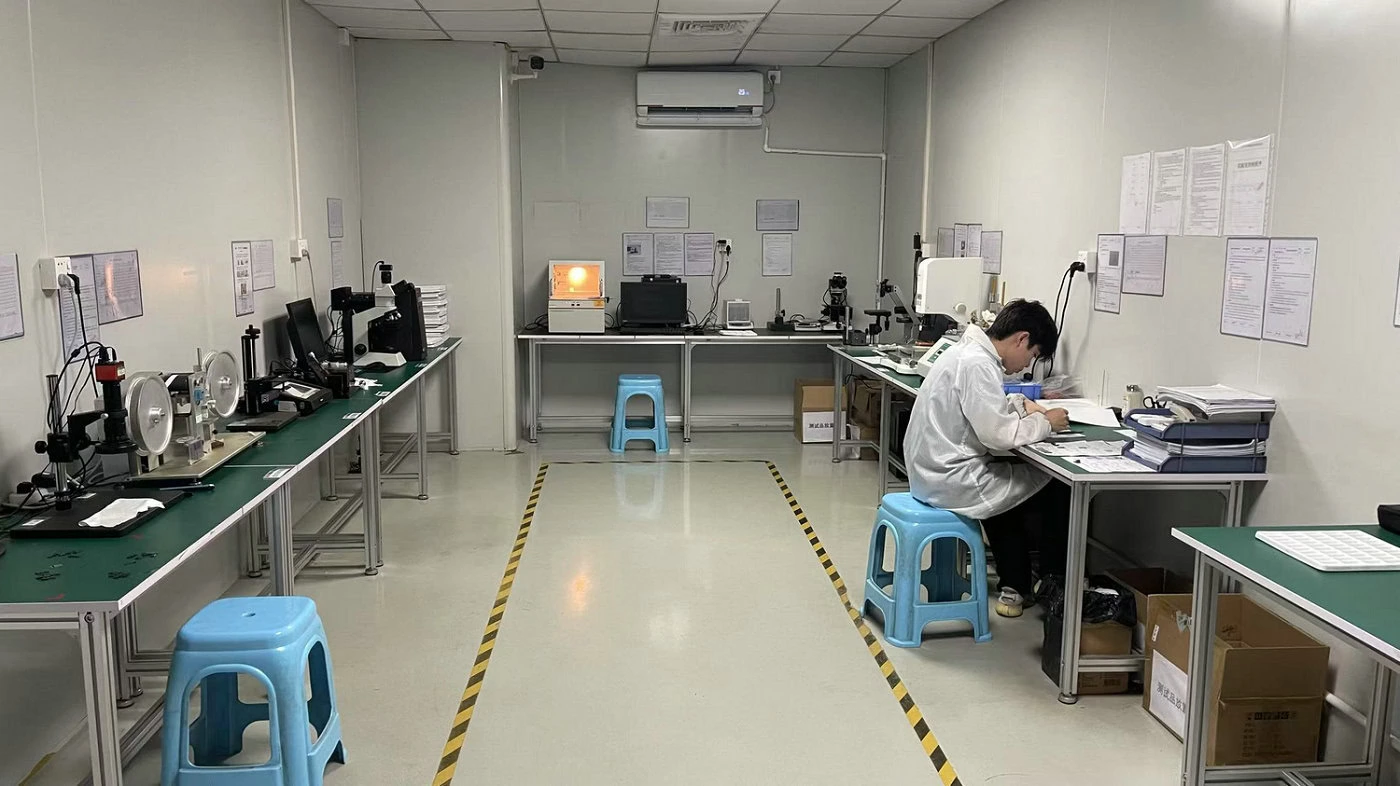
XTMIM inspection facility; tungsten heavy-alloy qualification requires separate part-specific test records.
Part-specific inspection matters more than a workshop photograph. The image shows XTMIM's general inspection setting. It does not document a tungsten heavy-alloy qualification run or demonstrate an approved tolerance for this material.
For a proposed part, agree which results must appear on the sample report: finished mass after any machining or coating, critical dimensions referenced to the drawing datums, the selected density method and specimen condition, plus any balance or magnetic checks that the application requires.
Accept the sample against those agreed part requirements, rather than treating a material certificate or a general inspection image as proof that the assembled component will function correctly.
What Is Needed for a Tungsten Alloy MIM Feasibility Review?
A tungsten heavy-alloy project may be ready for an MIM feasibility review, better suited to machining or conventional PM, or still missing essential technical information. The choice follows from the material specification, part geometry, expected volume and acceptance plan.
Proceed with MIM, Compare Alternatives, or Validate Further
| Entscheidung | Typical project condition | Nächster Schritt |
|---|---|---|
| Proceed to MIM engineering review | High-density function is clear; the geometry is potentially suitable and the expected volume may justify tooling | Confirm actual material/feedstock availability and request DFM, process and cost assessment |
| Compare other processes | Part is simple, bulky or needed only in small quantities | Compare conventional PM or machining and their total accepted-part costs |
| Validate further before tooling | Missing grade, weight tolerance, magnetic requirement, sintering route or acceptance criteria | Complete the technical specification and investigate the process gap first |
Ein engineering screening ist nicht dasselbe wie production approval. Screening can compare possible materials and manufacturing routes from a drawing. Approval requires agreed evidence for the selected feedstock, actual process, sample geometry and acceptance tests. If the current problem is an unqualified furnace route or unavailable feedstock, the next deliverable should be a validation plan, not a production promise.
What to Include in Your Drawing Review Request
An RFQ needs more than an alloy name. The drawing package should identify what the part must do, which dimensions and properties matter, and how an acceptable sample will be judged.
Drawing and Part Function
2D toleranced drawing, 3D CAD, intended assembly function, critical datums, key interfaces, and available mounting space.
Material and Mass Targets
Preferred W-Ni-Fe / W-Ni-Cu grade or permitted alternatives, density / final weight range, balance and magnetic-response requirements if relevant.
Acceptance and Finishing
Critical dimensions, required tests, surface condition, machining, coating, marking, and any assembly checks.
Project Quantity and Stage
Prototype or production status, annual volume, expected project life, and timing or qualification constraints.
If the package is incomplete, use the published MIM-RFQ-Vorbereitungsleitfaden before requesting pricing. XTMIM can review material sourcing, geometry, possible MIM tooling strategy, manufacturing risks and necessary validation. A specific tungsten-alloy MIM production commitment requires confirmation by the engineering team.
Submit a Tungsten Heavy-Alloy Part for Engineering Review
Send the drawing, intended function, alloy or target density, required final mass, key tolerances and expected volume. The engineering review can then recommend whether MIM, CNC or conventional PM warrants detailed costing and qualification.
Additional Questions About Tungsten Heavy Alloy MIM
Ist W-Ni-Cu dasselbe Material wie W-Cu?
Die Legierungsgruppe W-Ni-Cu ist eine Familie von Wolfram-Schwerlegierungen mit einem Nickel-Kupfer-Binder. W-Cu bezieht sich typischerweise auf einen Wolfram-Kupfer-Verbundwerkstoff, der für spezifische thermische und elektrische Funktionen bewertet wird. Geben Sie die tatsächliche chemische Zusammensetzung und Anwendung an, anstatt "Wolfram-Kupfer" generisch zu verwenden.
Kann eine veröffentlichte W-Ni-Fe MIM-Studie die kommerzielle Produktion garantieren?
Nein. Es zeigt, dass eine Route unter den untersuchten Bedingungen funktionieren kann. Ein spezifischer Lieferant muss jedoch sein Feedstock, seine Ausrüstung, seine Geometrie, seine Prozesskontrolle und seine teilespezifischen Akzeptanzanforderungen bewerten.
Können Dichte und Toleranz vor der Zeichnungsprüfung garantiert werden?
Nicht pauschal. Das Material, die Geometrie, das tatsächliche feste Volumen, der Sinterprozess, die nachgelagerte Bearbeitung und der Inspektionsplan müssen gemeinsam geprüft werden. Bestätigte Ziele und Nachweise sollten vor der Werkzeugerstellung festgelegt und durch relevante Versuche validiert werden.
Führt ein höherer Wolframanteil immer zu einem besseren MIM-Gewicht?
Ein höherer Wolframgehalt kann die erreichbare Dichte erhöhen, kann jedoch die Duktilität verringern und das Verhalten beim Flüssigphasensintern verändern. Berechnen Sie zuerst die benötigte Masse innerhalb des Nettovolumens des Teils und vergleichen Sie dann die Festigkeits-, Magnetanforderungen und die Verarbeitbarkeit. Die Güte mit maximaler Dichte ist nicht automatisch die beste Güte für ein dünnes oder stark beanspruchtes Merkmal.
Wie kann ein Teil seine Massenprüfung bestehen, aber die Anforderung an die Auswuchtung nicht erfüllen?
Die Gesamtmasse gibt nicht an, wo sich das Material befindet. Dezentrales Bearbeiten, ein versetztes Loch oder Sinterschwindung können den Schwerpunkt verändern, ohne das Gesamtgewicht stark zu beeinflussen. Wenn die Ausgewogenheit eine funktionale Anforderung ist, spezifizieren Sie zusätzlich zum Wiegen und zur Maßprüfung das relevante Bezugselement und eine Ausgewogenheitsprüfung auf Teile- oder Montageebene.
Technical Sources and Interpretation Limits
The references below provide material specifications, MIM processing evidence and industrial application context. Actual XTMIM capability for a specified heavy-alloy part remains subject to material and process validation.
| Quelle | What it supports | Was es nicht begründet |
|---|---|---|
| ASTM B777-15(2026) | Tungsten-base high-density material specification, uses, magnetic considerations and coupon-testing limits | An approved XTMIM tungsten MIM sintering route or finished-part qualification |
| Kim et al., W-Ni-Fe MIM research | Experimental feasibility and the importance of debinding / sintering conditions | A universally transferable processing recipe |
| ASTM B311-22(2026) | Density test-method scope for low-porosity PM materials and the limitation of water immersion when surface-connected porosity is present | A default acceptance method for every tungsten MIM composition or unqualified testing capability at XTMIM |
| Biomerics, MIM Material Offerings (2026) | Manufacturer-listed W-Ni-Fe / W-Ni-Cu for high-density vibrator applications | Details of a particular XTMIM component or its manufacturing process |
| Parmaco W-Ni-Cu MIM development | Documented nonmagnetic heavy-alloy development and counterweight / flywheel application direction | Qualification of a different factory's equipment or customer parts |
| 2019 Handbook of Metal Injection Molding, heavy-alloy chapter | Powder/feedstock processing and the need to control liquid-phase sintering distortion in W-Ni-Fe and W-Ni-Cu MIM | A validated furnace cycle or dimensional tolerance for XTMIM's equipment and the customer's geometry |
Applying ASTM B777: Use the material specification alongside the drawing and agreed trial results. It does not by itself qualify a feedstock, furnace cycle or finished MIM part.