MIM-Werkstoffauswahl-Leitfaden
Vergleichen Sie MIM-Werkstofffamilien nach Korrosion, Festigkeit, Härte, Verschleiß, magnetischer Funktion, Geometrischem Risiko, Wärmebehandlung und RFQ-Prüfung vor der Werkzeugerstellung.
Kurze Antwort: Wie sollten Sie ein MIM-Material auswählen?
Nutzen Sie diesen Leitfaden, um MIM-Werkstofffamilien nach Funktion, Umgebung, Last, Toleranzrisiko und RFQ-Anforderungen vor der Werkzeugerstellung einzugrenzen. Ein Werkstoff, der als CNC-Stangenmaterial oder Gusswerkstoff funktioniert, kann in MIM immer noch riskant sein, wenn die Feedstock-Aufbereitung, das Spritzgießen, das Entbindern, die Sinterschwindung, die Wärmebehandlung oder die Inspektion die Zeichnung nicht unterstützen. Beginnen Sie mit dem erforderlichen Ergebnis – Korrosionsbeständigkeit, Festigkeit, Härte, Verschleißfestigkeit, magnetische Funktion, kontrollierte Ausdehnung, hohe Dichte oder Prüfung für spezielle Anwendungen – und bestätigen Sie dann die Sorte nach Prüfung der Geometrie und DFM. Diese Seite hilft Ingenieuren beim Vergleich von Edelstählen, niedriglegierten Stählen, weichmagnetischen Legierungen, Titan, Kobalt-Chrom, Legierungen mit kontrollierter Ausdehnung, Wolframlegierungen und kundenspezifischen Materialwegen, ohne die Entscheidung zu einer generischen Legierungsliste zu machen.
Technische Schlussfolgerung: Der richtige MIM-Werkstoff ist nicht einfach die stärkste oder bekannteste Sorte. Es ist der Materialweg, der die Anwendungsanforderung erfüllen kann und dabei stabil bleibt während der Feedstock-Vorbereitung, des Spritzgießens, des Entbinderns, der Sinterschwindung, der Nachbearbeitung und der Endinspektion.
Für einen breiteren Überblick über verfügbare Materialfamilien besuchen Sie MIM-Werkstoffen Hub.
Welche Informationen sind vor der Auswahl eines MIM-Materials wichtig?
Bevor eine Güte wie 316L, 17-4 PH, 420, 440C, 4605 oder Ti-6Al-4V gewählt wird, sollte das Entwicklungsteam verstehen, wie das Bauteil verwendet und wie es abgenommen wird. Eine Materialempfehlung, die nur auf einer Gütebezeichnung basiert, ist schwach, da sie keine Korrosionsbelastung, Belastungsbedingung, Toleranzrisiko, Oberflächenanforderung, Wärmebehandlungsbedarf oder Jahresstückzahl erklärt. In der Praxis kann dieselbe Materialfamilie für eine Zeichnung geeignet sein und für eine andere riskant.

Anwendungsumgebung und Umgebungsbedingungen
Die Betriebsumgebung eliminiert oft ungeeignete Materialien, bevor ein detaillierter Gütevergleich beginnt. Ein Bauteil, das Schweiß, Reinigungschemikalien, Feuchtigkeit, Salzsprühnebel, schwachen Säuren oder medizinischen Reinigungsprozessen ausgesetzt ist, benötigt möglicherweise Edelstahl, Titan, Kobalt-Chrom oder einen Oberflächenbehandlungsweg. Ein trockener interner Mechanismus kann ein breiteres Spektrum an Stählen zulassen, wenn Festigkeit und Kosten wichtiger sind als Korrosionsbeständigkeit.
| Umgebungseingabe | Warum dies für die Materialauswahl wichtig ist | Prüfung vor dem Werkzeugbau |
|---|---|---|
| Feuchtigkeit, Schweiß oder Salzeinwirkung | Kann korrosionsbeständigen Edelstahl oder eine Oberflächenbehandlung erforderlich machen. | Einwirkdauer, Reinigungsmethode, Oberflächengüte und Passivierungsanforderungen bestätigen. |
| Reinigungsmittel oder Sterilisationseinwirkung | Kann spezielles Material, Passivierung, Oberflächenzustand oder Validierungsprüfung erfordern. | Chemische Umgebung und Kundenakzeptanzkriterien bestätigen. |
| Hohe Temperatur | Kann einige Materialien einschränken oder eine Überprüfung auf hitzebeständige Legierungen erfordern. | Arbeitstemperatur, Einschaltdauer und Anforderungen an die Festigkeitserhaltung bestätigen. |
| Menschlicher Kontakt oder medizinische Umgebung | Erfordert sorgfältige Prüfung von Material, Oberfläche, Reinigung, Prüfung und behördlichen Anforderungen. | Gehen Sie nicht allein vom Materialnamen auf die Eignung aus; bestätigen Sie Spezifikation und Prüfweg. |
| Magnetfeld- oder Sensorumgebung | Kann eine weichmagnetische oder nichtmagnetische Materialausrichtung erfordern. | Definieren Sie magnetische Leistungsziele und Prüfverfahren vor der Materialfestlegung. |
Wenn ein Projekt speziell eine nickelfreie Zusammensetzung, eine geringe magnetische Reaktion oder eine polierte Edelstahloberfläche für Hautkontakt erfordert, PANACEA Edelstahl für MIM kann in die Materialauswahl aufgenommen werden. Die tatsächliche Pulver- oder Feedstock-Quelle, der Entbinderungsweg, die Sinterbedingung, die Oberflächenbearbeitung und die Validierung des fertigen Teils sollten vor der Werkzeugerstellung noch bestätigt werden.
Mechanische Belastung, Verschleißart und Sicherheitsfaktor
Die Materialwahl sollte widerspiegeln, wie das Bauteil belastet wird. Ein Scharnier, eine Rastklinke, ein Riegel, eine Welle, ein Zahnrad, ein Sensor- oder Chirurgieinstrumententeil kann ein sehr unterschiedliches Materialverhalten erfordern. Statische Festigkeit, Ermüdung, Schlagbelastung, Oberflächenverschleiß, Kantenausbrüche und Montagespannung sollten nicht als gleiche Anforderung behandelt werden. Ein häufiger Fehler ist die Angabe “hohe Härte”, wenn das eigentliche Problem der Kontaktdruck, der Verschleißmechanismus, das Gegenmaterial oder die Kantenzähigkeit ist.
Kritische Maße, Schwindungsempfindlichkeit und Toleranzzonen
MIM-Teile schrumpfen während des Sinterns. Der Lieferant gleicht diese Schwindung im Werkzeug aus, aber die endgültige Maßhaltigkeit hängt dennoch vom Materialverhalten, der Bauteilgeometrie, der Auflagerstrategie und den Prüfanforderungen ab. Dünne Wände, ungleiche Wandstärken, lange Schlitze, tiefe Löcher, kleine Ansätze, Hinterschnitte und Mikromerkmale können je nach gewähltem Material unterschiedliche Risiken darstellen. Vor dem Werkzeugbau ist die entscheidende Frage, ob das Material und die Geometrie vorhersagbar genug schrumpfen können, um der Zeichnung zu entsprechen.
Anforderungen an Oberfläche, Wärmebehandlung und Nachbearbeitung
Einige MIM-Materialien benötigen möglicherweise eine Wärmebehandlung, Passivierung, Politur, spanende Bearbeitung, Beschichtung oder andere Sekundäroperationen, um die endgültige Anforderung zu erfüllen. Diese Operationen können Kosten, Lieferzeit, Maßhaltigkeit und Abnahmekriterien beeinflussen. Wenn ein Bauteil hohe Festigkeit, hohe Härte, Korrosionsbeständigkeit oder eine kosmetische Oberfläche benötigt, sollte der Nachbearbeitungsweg vor dem Werkzeugbau besprochen werden. Für Prozesshintergrund siehe MIM-Prozess Übersicht.
Jahresstückzahl, Kostenziele und Versorgungssicherheit
Ein spezielles Material kann technisch möglich, aber kommerziell ungeeignet sein, wenn Pulververfügbarkeit, Feedstock-Entwicklung, Mindestlosgröße, Prüfanforderungen oder Qualifikationskosten nicht zum Projektvolumen passen. Für frühe Projektphasen ist es oft sicherer, ein Standard-MIM-Material mit einem Spezialmaterial zu vergleichen, bevor man sich für den Werkzeugbau entscheidet.
MIM-Materialauswahlmatrix nach Leistungsanforderung
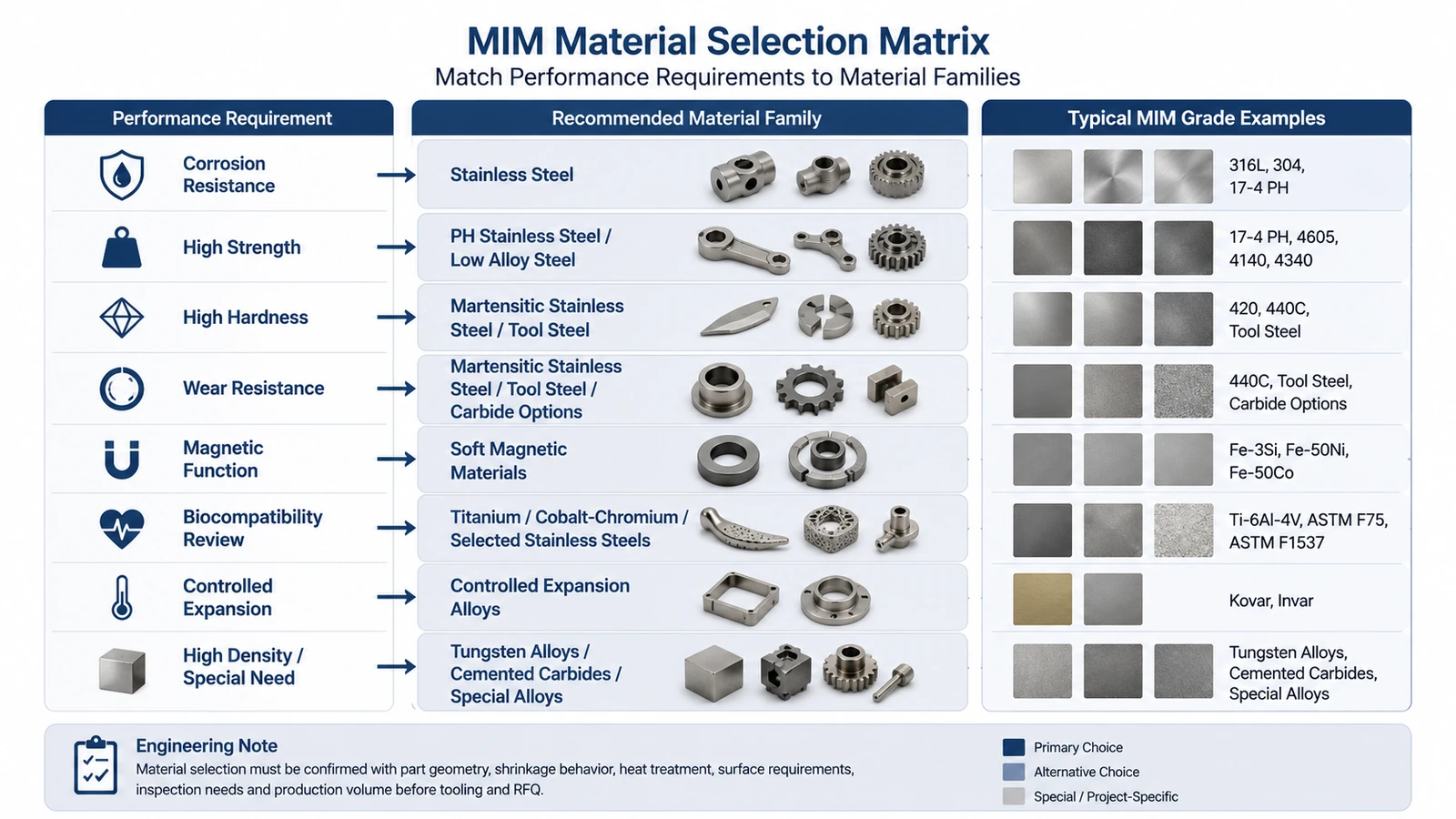
Die folgende Tabelle dient als Ausgangspunkt für die Materialdiskussion. Sie sollte projektspezifische Materialdaten, die Prozessprüfung des Lieferanten oder formelle Tests nicht ersetzen. Nutzen Sie sie, um Materialfamilien vorzuselektieren, bevor Sie eine bestimmte Legierung, Wärmebehandlungszustand, Sekundärbearbeitungsroute oder Prüfplan bestätigen.
| Anforderung | Erste zu prüfende Materialfamilie | Typische Legierungsbeispiele | Technischer Hinweis |
|---|---|---|---|
| Korrosionsbeständigkeit | Edelstahl | 316L, 304, 17-4 PH | Bestätigen Sie die tatsächliche Umgebung vor der Auswahl. 316L wird oft für Korrosionsbeständigkeit in Betracht gezogen, während 17-4 PH eher festigkeitsorientiert ist. |
| Hohe Festigkeit | PH-Edelstahl / niedriglegierter Stahl | 17-4 PH, 4605, 4140, 4340 | Wärmebehandlung, Maßänderung, Belastungszustand und Sicherheitsmarge prüfen. |
| Hohe Härte | Martensitischer Edelstahl / Werkzeugstahl | 420, 440C | Sprödigkeit, Kantenzustand, Verschleißart und Nachbehandlung prüfen. |
| Verschleißfestigkeit | 440C / Werkzeugstahl / Hartmetall-Optionen | 440C, Hartmetall-Optionen | Verschleißfestigkeit hängt von Kontaktbedingungen, Gegenmaterial, Schmierung und Oberflächengüte ab. |
| Magnetische Funktion | Weichmagnetische Werkstoffe | Fe-3Si, Fe-50Ni, Fe-50Co | Magnetische Eigenschaften können von Zusammensetzung, Wärmebehandlung, Dichte und Prüfverfahren abhängen. |
| Biokompatibilitätsprüfung | Titan / Kobalt-Chrom / ausgewählter Edelstahl | Ti-6Al-4V, ASTM F75, ASTM F1537 | Gehen Sie nicht allein vom Materialnamen auf medizinische Eignung aus. Bestätigen Sie Oberfläche, Reinigung, Prüfung und regulatorische Anforderungen. |
| Kontrollierte Ausdehnung | Legierungen mit kontrollierter Ausdehnung | Kovar, Invar | Wird verwendet, wenn eine Anpassung der Wärmeausdehnung wichtig ist. |
| Hohe Dichte / Abschirmung / Gewicht | Wolframlegierungen | Wolfram-Schwermetalllegierungen | Geeignet für Konstruktionen mit hoher Dichte, Auswuchtung, Gewicht oder Abschirmung. |
| Nicht standardmäßiger Bedarf | Kundenspezifische MIM-Materialprüfung | Projektspezifisch | Erfordert Prüfung von Pulver, Feedstock, Sinterfenster, Kosten, Prüfaufwand und Fertigungsmachbarkeit. |
Materialauswahl nach Anwendungsszenario
Viele Projekte beginnen mit einem Anwendungsproblem und nicht mit einer festgelegten Legierung. Die folgende Szenariotabelle hilft, typische Anwendungsanforderungen mit Materialfamilien und frühen Prüfrisiken vor einer formellen RFQ zu verknüpfen.
| Anwendungsszenario | Typische Materialrichtung | Warum es geeignet sein könnte | Prüfrisiko vor dem Werkzeugbau |
|---|---|---|---|
| Medizinisches Instrument oder reinigungsbelastetes Teil | 316L, Titanlegierung, Kobalt-Chrom-Legierung | Eine Überprüfung der Korrosionsbeständigkeit, Reinigungseinwirkung, Oberflächenbeschaffenheit und Biokompatibilität kann wichtig sein. | Kundenspezifikation, Oberflächengüte, Reinigungsprozess, Prüfverfahren und Abnahmekriterien bestätigen. |
| Scharnier, Halterung oder kleines Strukturteil für Unterhaltungselektronik | 17-4 PH, 316L, 420, ausgewählter niedriglegierter Stahl | Erfordert ein Gleichgewicht zwischen Festigkeit, Korrosionsbeständigkeit, kosmetischer Oberfläche und Maßhaltigkeit. | Dünne Wände, Polierzugabe, Montagelast, Toleranzzonen und Wärmebehandlungsanforderungen prüfen. |
| Verschleißteil, Riegel, Klinke oder Verriegelungselement | 420, 440C, niedriglegierter Stahl, karbidbasierte Optionen | Härte und Verschleißfestigkeit können an Kontaktflächen oder Verriegelungskanten erforderlich sein. | Sprödigkeit, Kontaktspannung, Gegenmaterial, Wärmebehandlung, Schmierung und Kantengeometrie prüfen. |
| Magnetischer Sensor, Aktuator oder Magnetkreisteil | Fe-3Si, Fe-50Ni, Fe-50Co | Weichmagnetische Eigenschaften können wichtiger sein als die allgemeine Strukturfestigkeit. | Definieren Sie Permeabilität, Sättigung, Koerzitivfeldstärke, Wärmebehandlung und magnetische Prüfmethode. |
| Komponente für thermische Ausdehnungsanpassung oder Dichtungsanwendung | Kovar, Invar, kontrollierte Ausdehnungslegierung | Kontrolliertes Ausdehnungsverhalten kann für thermische Stabilität oder Schnittstellenanpassung erforderlich sein. | Bestätigen Sie CTE-Ziel, Fügefläche, Materialverfügbarkeit und Maßprüfmethode. |
| Hochdichtes, Ausgleichs-, Abschirmungs- oder Gegengewichtsteil | Wolframlegierung | Hohe Dichte kann wichtiger sein als die allgemeinen Eigenschaften von Edelstahl oder niedriglegiertem Stahl. | Überprüfen Sie Pulververfügbarkeit, Sinterverhalten, Dichteziel, Toleranz und Wirtschaftlichkeitsmachbarkeit. |
Häufige Materialkonflikte bei der Auswahl
Viele RFQs scheitern daran, die tatsächliche Anforderung zu kommunizieren, weil die Zeichnung einen bekannten Werkstoffnamen nennt, aber nicht den Grund dafür. Der folgende Vergleich hilft, die Entscheidungsbasis vor der detaillierten Werkstoffprüfung zu klären.
| Auswahlkonflikt | Üblicherweise zuerst prüfen | Entscheidungsbasis | Risiko bei Ignorieren |
|---|---|---|---|
| 316L vs. 17-4 PH | 316L für Korrosionsbeständigkeit; 17-4 PH für Festigkeit und Wärmebehandlungsfähigkeit | Umgebung, Belastung, Wärmebehandlung, Maßhaltigkeit | Korrosionsversagen oder unzureichende Festigkeit nach Montagebelastung. |
| 420 vs. 440C | 420 für ausgewogene Härte; 440C für höhere Härte und Verschleißrichtung | Verschleißart, Sprödigkeitsrisiko, Kantenzustand, Wärmebehandlung | Ausbrüche, Risse oder geringe Standzeit trotz hoher Härte. |
| 4605 vs. 17-4 PH | 4605 für kosteneffiziente Festigkeit; 17-4 PH, wenn auch Edelstahleigenschaften erforderlich sind | Kosten, Korrosionsbelastung, mechanische Anforderung, Oberflächenschutz | Überspezifikation oder unzureichender Schutz gegen die Arbeitsumgebung. |
| Titan vs. Edelstahl | Titan für Leichtbau- oder Sonderanwendungsprüfung; Edelstahl für breitere Fertigbarkeit | Dichte, Korrosion, Kosten, Qualifikation, Versorgungssicherheit | Unnötige Sonderwerkstoffkosten oder Qualifikationsverzögerung. |
| Kovar vs. Invar | Kovar für Dichtungskompatibilität; Invar für geringe Ausdehnungsanforderung | Wärmeausdehnungsziel und Anwendungsschnittstelle | Thermische Fehlanpassung, Dichtungsrisiko oder Maßabweichung. |
Für Entscheidungen auf Sorte-Ebene beginnen Sie mit dem MIM-Werkstoffvergleichs-Zentrum, dann spezifische Vergleiche wie 316L vs 17-4 PH Edelstahl, 420 vs 440C Edelstahl oder Titan vs. Edelstahl wenn diese Entscheidungen mit der Zeichnung und der Anwendungsumgebung übereinstimmen.
Korrosionsbeständigkeit: 316L, 304 und ausgewählte Edelstähle
Wenn Korrosionsbeständigkeit die Hauptanforderung ist, wird Edelstahl normalerweise als erste Werkstofffamilie geprüft. MIM 316L Edelstahl wird oft für Teile in Betracht gezogen, die Feuchtigkeit, milden Chemikalien, Reinigungsprozessen oder Umgebungen ausgesetzt sind, in denen Korrosionsbeständigkeit wichtiger ist als maximale Festigkeit. Für eine breitere Materialauswahl siehe korrosionsbeständige MIM-Werkstoffe.
Hohe Festigkeit: 17-4 PH, 4605 und niedriglegierte Stähle
Wenn das Bauteil Last tragen, Verformungen widerstehen oder mechanische Eingriffe aufrechterhalten muss, können hochfeste Edelstähle oder niedriglegierte Stähle besser geeignet sein als eine rein korrosionsorientierte Legierung. Für lasttragende Anwendungen siehe hochfeste MIM-Werkstoffe.
Härte und Verschleißfestigkeit
Härte und Verschleißfestigkeit sollten entsprechend dem tatsächlichen Verschleißmechanismus ausgewählt werden. 420, 440C, Werkzeugstahlrichtungen oder karbidbezogene Optionen können in Betracht gezogen werden, aber Härte allein garantiert keine Lebensdauer. Siehe verschleißfeste MIM-Werkstoffe für die entsprechende Auswahllogik.
Magnetische Eigenschaften
Magnetische MIM-Werkstoffe sollten nach ihrer magnetischen Funktion ausgewählt werden, nicht nur nach mechanischer Festigkeit. Weichmagnetische Teile können eine bestimmte Permeabilität, Sättigung, Koerzitivfeldstärke oder magnetische Ansprechempfindlichkeit erfordern. Weiter zu magnetische MIM-Werkstoffe für eine leistungsbasierte Auswahl.
Gängige MIM-Werkstofffamilien und wann sie verwendet werden
Bei den meisten Projekten sollte die Werkstoffauswahl mit einer Vorauswahl auf Familienebene beginnen. Die genaue Legierung sollte nach Prüfung der Geometrie, Toleranzen, Betriebsumgebung, Oberflächenanforderungen und Produktionsmenge festgelegt werden.
Edelstahl-MIM-Materialien
Edelstähle decken viele Anforderungen an Korrosionsbeständigkeit, Festigkeit und Oberflächengüte ab. Übliche Richtungen sind 304, 316L, 420, 440C und 17-4 PH. Erfahren Sie mehr über Edelstahl-MIM-Werkstoffe.
Niedriglegierte Stahl-MIM-Werkstoffe
Niedriglegierte Stähle werden in der Regel geprüft, wenn Festigkeit, Wärmebehandlungsverhalten und Kosten wichtiger sind als die Korrosionsbeständigkeit von Edelstahl. Je nach Umgebung können sie Oberflächenschutz oder Nachbearbeitung erfordern. Siehe niedriglegierte Stahl-MIM-Werkstoffe.
Weichmagnetische MIM-Werkstoffe
Weichmagnetische Werkstoffe werden nach ihrer magnetischen Funktion ausgewählt, nicht nur nach der Formkomplexität. Das Projekt sollte magnetische Leistungsziele und Prüfmethoden vor der Werkstoffbestätigung definieren. Überprüfen weichmagnetische MIM-Werkstoffe.
Titan- und Kobalt-Chrom-MIM-Werkstoffe
Titan- und Kobalt-Chrom-Werkstoffe werden in der Regel für hochwertige Anwendungen in Betracht gezogen, bei denen eine Prüfung hinsichtlich Leichtbauweise, Korrosionsbeständigkeit, Festigkeit, Verschleißfestigkeit oder Biokompatibilität erforderlich ist. Sie sollten vor dem Werkzeugbau hinsichtlich Kosten, Pulververfügbarkeit, Sinter- und Prüfanforderungen bewertet werden.
Nickel, kontrollierte Ausdehnung, Wolfram- und Karbidoptionen
Diese Werkstofffamilien sind projektspezifisch. Sie können für Hitzebeständigkeit, kontrollierte Ausdehnung, hohe Dichte, Verschleißfestigkeit oder besondere Leistungsanforderungen geeignet sein. Entdecken Sie Sonderlegierungen für MIM.
Kupfer- und Aluminiumlegierungen
Kupfer- und Aluminiumlegierungen sollten bei der MIM-Werkstoffplanung nicht wie übliche Edelstähle oder niedriglegierte Stähle behandelt werden. Sie erfordern eine Machbarkeitsprüfung hinsichtlich Pulververfügbarkeit, Feedstock-Verhalten, Oxidationsrisiko, Sinterkontrolle, Kosten und Produktionsstabilität. Die Lieferfähigkeit, Pulververfügbarkeit und Feedstock-Reife können je nach Legierung und Projektvolumen erheblich variieren.
Auswahlhinweis: Spezialwerkstoffe sind nicht automatisch besser. Ein Standard-MIM-Werkstoff oder eine nahezu standardmäßige Alternative kann das Risiko der Pulverbeschaffung, die Prozessentwicklungszeit, den Prüfaufwand und die Qualifizierungskosten reduzieren.
Wie die MIM-Verarbeitung die Werkstoffauswahl beeinflusst
Die MIM-Materialauswahl ist untrennbar mit dem Fertigungsweg verbunden. Feines Metallpulver, Bindersystem, Spritzgießverhalten, Grünling-Handhabung, Entbindern, Sinterschwindung, Wärmebehandlung und Endprüfung können alle beeinflussen, ob ein Material für ein bestimmtes Bauteil praktikabel ist.

Feines Metallpulver und Binder beeinflussen die Feedstock-Stabilität.
MIM verwendet feines Metallpulver, das mit einem Bindersystem gemischt wird, um Feedstock für das Spritzgießen herzustellen. Dies unterscheidet sich von der Bearbeitung eines Vollstabs oder dem Pressen von Pulver zu einem einfachen Pressling. Pulverchemie, Partikelgröße, Partikelform, Bindersystem und Feedstock-Gleichmäßigkeit können die Formfüllung, Grünling-Festigkeit, Entbinderungsstabilität und das Sinterverhalten beeinflussen. Wenn der Feedstock dünne Rippen, Mikromerkmale oder lange Fließwege nicht gleichmäßig füllt, kann das ausgewählte Material zu Kurzschüssen, schwachen Grünlingen oder Maßabweichungen führen.
Das Entbinderungs- und Sinterverhalten kann die Materialmachbarkeit verändern.
Ein Material kann aus mechanischer Sicht attraktiv sein, aber aus prozessstabilitätsbezogener Sicht schwierig. Das Entbindern muss den Binder entfernen, ohne Risse, Verformungen, Verunreinigungen oder innere Fehler zu verursachen. Das Sintern muss die erforderliche Dichte und Eigenschaften erreichen, während Schwindung und Verzug kontrolliert werden. Die Materialwahl sollte daher unter Berücksichtigung von Ofenatmosphäre, Sinterunterstützung, Bauteilorientierung und Geometrieempfindlichkeit überprüft werden.
Das Risiko von Schwindung und Verzug hängt sowohl vom Material als auch von der Geometrie ab.
MIM-Teile schrumpfen während des Sinterns. Der Werkzeugbau kann die erwartete Schwindung kompensieren, aber ungleichmäßige Wandstärken, lange ungestützte Abschnitte, kleine Löcher, dünne Kanten und asymmetrische Geometrien können dennoch zu Verzug führen. Manche Material-Geometrie-Kombinationen sind empfindlicher als andere. Deshalb sollten Materialauswahl und DFM-Prüfung gemeinsam erfolgen.
Wärmebehandlung und Sekundäroperationen können die endgültigen Eigenschaften verändern.
Wärmebehandlung, Passivierung, Polieren, Bearbeitung, Beschichtung, Kalibrieren oder andere Sekundäroperationen können den Endzustand des Teils verändern. Diese Schritte können Festigkeit, Härte, Oberflächenbeschaffenheit, Korrosionsverhalten oder Maßgenauigkeit verbessern, aber sie können auch Kosten, Durchlaufzeit und Prüfanforderungen erhöhen. Vor der Produktion sollte die Überprüfung bestätigen, ob das Teil im gesinterten Zustand die Anforderungen erfüllen kann oder ob eine Nachbearbeitung erforderlich ist.
Materialauswahlfehler, die Werkzeug- oder Produktionsrisiken verursachen
Ein Material mag auf dem Papier geeignet erscheinen, kann aber dennoch ein Produktionsrisiko darstellen, wenn Last, Geometrie, Umgebung, Wärmebehandlung und Prüfung nicht gemeinsam betrachtet werden. Der teuerste Fehler ist in der Regel nicht die Wahl einer unbekannten Legierung, sondern die Wahl einer bekannten Legierung aus dem falschen Grund, bevor die Zeichnung geprüft wurde.

| Auswahlfehler | Warum er ein Risiko darstellt | Bessere Prüfungsrichtung |
|---|---|---|
| Wahl von 316L, wenn die tatsächliche Anforderung hohe Festigkeit ist | 316L kann Korrosionsbeständigkeit bieten, ist aber möglicherweise nicht die beste Wahl für hochbelastete Verriegelungs- oder Strukturmerkmale. | Prüfen Sie 17-4 PH, niedriglegierten Stahl oder andere festigkeitsorientierte Werkstofffamilien. |
| Die Wahl von 17-4 PH ohne Bestätigung der Korrosions- und Wärmebehandlungsanforderungen | Ein starker Werkstoff kann dennoch versagen, wenn der gewählte Zustand nicht der Umgebung oder den Maßanforderungen entspricht. | Prüfen Sie Korrosionseinwirkung, Wärmebehandlungszustand, Oberflächenbeschaffenheit und Prüfanforderungen. |
| Direkte Verwendung von CNC- oder Walzwerkstoffdaten für MIM-Teile | MIM verwendet pulverbasiertes Feedstock, Entbindern und Sintern; das endgültige Verhalten hängt von Dichte, Porosität, Wärmegeschichte und Prozesskontrolle ab. | Verwenden Sie MIM-spezifische Werkstoffdaten, prozessseitige Prüfung durch den Lieferanten und vereinbarte Prüfkriterien. |
| Ignorieren schwindungsempfindlicher Merkmale | Dünne Wände, Mikrolöcher, lange Schlitze und ungleichmäßige Querschnitte können während des Sinterns verziehen. | Prüfen Sie Geometrie, Werkzeugkompensation, Sinterunterstützung und kritische Toleranzen gemeinsam. |
| Behandlung von Sonderlegierungen als Standardwerkstoffe | Spezielle Pulver und Feedstock können Beschaffung, Prüfung, Mindestbestellmengen, Kosten und Prozessrisiken erhöhen. | Vergleichen Sie Standardalternativen, bevor Sie eine kundenspezifische Materialentwicklung durchführen. |
Szenario mit kombinierten Anforderungen für die technische Schulung: Festigkeitsanforderung hinter “Edelstahl” verborgen”
Welches Problem ist aufgetreten: Ein Konstruktionsteam spezifizierte 316L-Edelstahl für eine kleine Verriegelungskomponente, da das Teil Korrosionsbeständigkeit und eine saubere Oberfläche benötigte. Bei der technischen Prüfung stellte sich heraus, dass die lokale Spannung an der Verriegelungskante höher war, als die Materialrichtung bequem tragen konnte.
Warum es passiert ist: Das Material wurde nur aufgrund der Korrosionsanforderung ausgewählt. Belastungszustand, Kontaktspannung und Verformungsrisiko wurden nicht frühzeitig geprüft.
Was die eigentliche Systemursache war: Die tatsächliche Anforderung war nicht einfach “Edelstahl”. Es war eine Kombination aus Korrosionsbeständigkeit, Kantenfestigkeit, Dimensionsstabilität und Verschleißverhalten.
Wie wurde es korrigiert: Das Projekt wurde mit alternativen Materialrichtungen geprüft, darunter 17-4 PH und ausgewählte niedriglegierte Stahloptionen, während gleichzeitig geprüft wurde, ob die Korrosionsbelastung weiterhin Edelstahl erforderte.
Wie kann ein erneutes Auftreten verhindert werden: Definieren Sie vor der Auswahl eines MIM-Materials die funktionale Belastung, Kontaktfläche, kritischen Abmessungen, Korrosionsbelastung und erforderliche Sicherheitsmarge.
Szenario mit kombinierten Anforderungen für die technische Schulung: Hohe Härte vor Geometrieprüfung ausgewählt
Welches Problem ist aufgetreten: Ein dünnwandiges Verschleißteil wurde zunächst mit einer hochharten Werkstoffrichtung belegt. Während der DFM-Prüfung zeigte das Teil ein Risiko von Kantensprödigkeit und Sinterverzug aufgrund ungleichmäßiger Wandstärke und eines schmalen, ungestützten Merkmals.
Warum es passiert ist: Der Werkstoff wurde allein nach dem Härteziel ausgewählt.
Was die eigentliche Systemursache war: Verschleißverhalten, Geometriestabilität, Wärmebehandlungsreaktion und Kantenzustand wurden nicht gemeinsam betrachtet.
Wie wurde es korrigiert: Das Konstruktionsteam überprüfte Wandübergänge, Radien, Stützstrategie, Werkstoffalternativen und mögliche Nachbehandlungswege.
Wie kann ein erneutes Auftreten verhindert werden: Definieren Sie bei Verschleißteilen vor der Werkstoffbestätigung den Verschleißmodus, Gegenwerkstoff, Belastungsrichtung, Schmierzustand, Wandstärke und akzeptable Sekundäroperationen.
Wenn Standard-MIM-Werkstoffe nicht ausreichen
Wann eine kundenspezifische Werkstoffprüfung sinnvoll ist
Eine kundenspezifische Werkstoffprüfung kann sinnvoll sein, wenn das Teil ungewöhnliche magnetische, thermische, Korrosions-, Dichte-, Verschleiß-, regulatorische oder Festigkeitsanforderungen hat, die mit Standard-MIM-Werkstoffen nicht erfüllt werden können. Die Entwicklung kundenspezifischer Werkstoffe sollte jedoch durch Projektwert, Volumen, technischen Bedarf und Qualifizierungsplan gerechtfertigt sein. Für nicht standardgemäße Anforderungen prüfen Sie kundenspezifische MIM-Werkstoffe.
Wann ein Werkstoffersatz sicherer ist als die Entwicklung einer kundenspezifischen Legierung
In vielen Projekten kann ein geeigneter Standardwerkstoff oder eine nahezu standardmäßige Alternative Kosten, Lieferzeit und Produktionsunsicherheit reduzieren. Wenn ein Kunde ein Material auf Basis eines früheren CNC- oder Gussdesigns spezifiziert, kann der MIM-Lieferant eine Alternative mit besserer Feedstock-Verfügbarkeit, Sinterstabilität oder Nachbearbeitungskompatibilität vorschlagen.
Welche zusätzlichen Risiken bringen Sonderpulver, kundenspezifischer Feedstock und nicht standardmäßige Sinterfenster mit sich?
Spezielle Materialwege können zusätzliche Risiken bei der Pulverversorgung, Binderkompatibilität, Sinterschwindung, Dichtekontrolle, Oberflächenbeschaffenheit, Prüfung und Mindestproduktionsmenge mit sich bringen. Diese Risiken machen das Projekt nicht immer ungeeignet, müssen aber vor Werkzeugbau und Angebotserstellung verstanden werden.
Praktische Prüfregel: Wenn ein Standardwerkstoff die funktionalen Anforderungen mit akzeptabler Nachbearbeitung und Prüfung erfüllen kann, ist dies in der Regel ein risikoärmerer Ausgangspunkt als eine kundenspezifische Legierung. Die Entwicklung kundenspezifischer Materialien sollte Anforderungen vorbehalten sein, die nicht durch Standard- oder nahezu standardmäßige MIM-Werkstoffe gelöst werden können.
Schritt-für-Schritt-Arbeitsablauf zur MIM-Materialauswahl vor der RFQ
- Definieren Sie funktionale und umgebungsbezogene Anforderungen.
Ermitteln Sie, ob das Teil Festigkeit, Korrosionsbeständigkeit, Härte, Verschleißfestigkeit, magnetische Eigenschaften, Hitzebeständigkeit, kontrollierte Ausdehnung, Dichte oder biokompatibilitätsbezogene Anforderungen erfüllen muss. - Erstellen Sie eine Vorauswahl von Materialfamilien.
Beginnen Sie mit Edelstahl, niedriglegiertem Stahl, weichmagnetischen Werkstoffen, Titan, Kobalt-Chrom, Legierungen mit kontrollierter Ausdehnung, Wolframlegierungen oder karbidbasierten Optionen. - Überprüfen Sie Geometrie-, Schwindungs- und Toleranzrisiken.
Prüfen Sie dünne Wände, Hinterschnitte, Löcher, Schlitze, lange Spannweiten, Mikromerkmale, Querschnittsübergänge, Angusslage und kritische Maße. - Bestätigen Sie Sekundäroperationen und Prüfanforderungen.
Identifizieren Sie Wärmebehandlung, Passivierung, Polieren, Bearbeitung, Beschichtung, Härteprüfung, Dichteprüfung, Magnetprüfung, Korrosionsprüfung oder Oberflächenanforderungen. - Reichen Sie Zeichnungen für die Material- und DFM-Prüfung ein.
Eine lieferantenseitige Prüfung kann Materialsubstitutionsmöglichkeiten, Werkzeugrisiken, Toleranzbedenken und Kostentreiber identifizieren, bevor die RFQ festgelegt wird.
Was für eine MIM-Materialprüfung bereitgestellt werden sollte
Für eine zuverlässige Materialempfehlung benötigt der Lieferant mehr als nur einen Materialnamen. Die folgenden Informationen helfen, Rückfragen während der frühen Prüfung zu reduzieren und unterstützen eine genauere Material-, DFM- und Angebotsdiskussion.

| Bereitzustellende Informationen | Warum das wichtig ist |
|---|---|
| 2D-Zeichnung | Zeigt Maße, Toleranzen, Hinweise, Oberflächenanforderungen und kritische Merkmale. |
| 3D-CAD-Datei | Hilft bei der Überprüfung der Formbarkeit, Trennebene, Anschnittposition, Schwindung und Verzugsrisiko. |
| Zielwerkstoff oder aktueller Werkstoff | Gibt einen Ausgangspunkt für Substitution oder Bestätigung. |
| Erforderliche mechanische Eigenschaften | Hilft beim Vergleich von Festigkeit, Härte, Duktilität und Wärmebehandlungsanforderungen. |
| Kritische Maße und Toleranzzonen | Bestimmt, ob Werkstoff und Geometrie die Maßhaltigkeit unterstützen können. |
| Oberflächengüteanforderung | Beeinflusst Entscheidungen zu Polieren, Passivieren, Bearbeiten oder Beschichten. |
| Wärmebehandlungsanforderung | Beeinflusst Festigkeit, Härte, Maßänderung und Prüfung. |
| Anwendungsumgebung | Steuert die Prüfung von Korrosion, Verschleiß, Temperatur, magnetischen Eigenschaften oder Biokompatibilität. |
| Geschätzte Jahresstückzahl | Beeinflusst Werkzeugbau, Materialentwicklung, Kostenmachbarkeit und Produktionsplanung. |
| Aktueller Fertigungsprozess | Hilft beim Vergleich, ob MIM gegenüber CNC, Gießen, Stanzen oder einem anderen bestehenden Fertigungsweg geeignet ist. |
| Projektphase | Stellt klar, ob es sich um eine Konzeptprüfung, Prototypenprüfung, Werkzeugprüfung oder Produktionsübergabe handelt. |
Materialanforderung vs. Prüfmethode
Die Materialauswahl sollte auch widerspiegeln, wie das Teil abgenommen wird. Wenn die Zeichnung enge Toleranzzonen, Härteprüfungen, Dichteprüfungen, magnetische Prüfungen, Korrosionsprüfungen oder optische Prüfungen vorschreibt, sollten diese Anforderungen vor dem Werkzeugbau besprochen werden, anstatt nach einem Probenfehler hinzugefügt zu werden.
| Anforderung oder Abnahmekriterium | Typische Prüf- oder Überprüfungsmethode | Warum es die Materialwahl beeinflusst | Vor RFQ bestätigen |
|---|---|---|---|
| Kritische Maße und Toleranzzonen | Maßhaltigkeitsprüfung, Bezugsprüfung, KMM- oder Lehrenplanung bei Bedarf | Materialspezifische Schwindung und Geometrieempfindlichkeit beeinflussen die Maßwiederholbarkeit nach dem Sintern. | Funktionskritische Maße, Toleranzzonen, Prüfbezüge und erwartete Fähigkeit. |
| Anforderung an Dichte oder Porosität | Dichtemessung, Querschnittsprüfung oder projektspezifische Qualitätskontrollen | Die Enddichte kann Festigkeit, Korrosionsverhalten, Dichtheitsrisiko und Funktionsleistung beeinflussen. | Ziel-Dichteerwartung, akzeptables Porositätsniveau und Prüfmethode. |
| Anforderung an Härte oder Verschleißfestigkeit | Härteprüfung, Wärmebehandlungsverifikation und Oberflächenzustandsprüfung | Härte kann eine andere Werkstofffamilie oder einen anderen Wärmebehandlungszustand erfordern. | Zielhärtebereich, Prüfverfahren, Verschleißart, Gegenwerkstoff und Wärmebehandlungszustand. |
| Zugfestigkeit oder Tragfähigkeitsanforderung | Werkstoffdatenprüfung, Zugversuch bei Bedarf und Lastpfadprüfung | Festigkeitsorientierte Werkstoffe können sich von korrosionsorientierten Werkstoffen unterscheiden. | Lastrichtung, Sicherheitsmarge, erforderlicher Festigkeitszustand und ob eine Prüfung erforderlich ist. |
| Magnetische Eigenschaften | Magnetische Eigenschaftsprüfung oder vom Lieferanten festgelegtes magnetisches Prüfverfahren | Das magnetische Verhalten kann von der chemischen Zusammensetzung, Dichte, Wärmebehandlung und Prozesskontrolle abhängen. | Permeabilität, Sättigung, Koerzitivfeldstärke oder andere magnetische Zielwerte und Prüfverfahren. |
| Korrosions- oder Reinigungseinwirkung | Oberflächenzustandsprüfung, Passivierungsprüfung oder projektspezifische Korrosionsprüfung | Werkstoffgüte, Oberflächenbeschaffenheit und Nachbehandlung können das Korrosionsverhalten beeinflussen. | Einwirkmedium, Reinigungsmethode, Akzeptanzstandard und Anforderung an die Nachbehandlung. |
Wenn Sie bereits ein Zeichnungspaket haben, können Sie Zeichnungen zur Prüfung einreichen oder eine formelle RFQ über ein Angebot anfordern.
FAQ zur MIM-Materialauswahl
Welches Material wird am häufigsten im MIM verwendet?
Edelstähle gehören zu den häufigsten Werkstofffamilien im MIM. Die richtige Wahl hängt dennoch von der Korrosionsbelastung, den Festigkeitsanforderungen, der Wärmebehandlung, der Geometrie und den Prüfanforderungen ab.
Ist 316L oder 17-4 PH besser für MIM-Teile?
Keines ist universell besser. 316L wird oft bevorzugt, wenn Korrosionsbeständigkeit die primäre Anforderung ist. 17-4 PH wird oft bevorzugt, wenn höhere Festigkeit und Wärmebehandlungsreaktion wichtiger sind. Die beste Wahl hängt von der Belastung, Umgebung, Toleranz, Oberflächenbeschaffenheit und dem Nachbearbeitungsweg des Teils ab.
Welches MIM-Material eignet sich am besten für hohe Festigkeit?
Bei hochfesten MIM-Projekten werden häufig 17-4 PH Edelstahl, 4605 niedriglegierter Stahl, 4140, 4340 oder andere festigkeitsorientierte Werkstoffe geprüft. Die geeignete Wahl hängt von Lastpfad, Korrosionsbelastung, Wärmebehandlung, Geometrie, Toleranz und Prüfanforderungen ab.
Welches MIM-Material eignet sich am besten für Korrosionsbeständigkeit?
316L Edelstahl wird häufig geprüft, wenn Korrosionsbeständigkeit die Hauptanforderung ist, während 304 oder 17-4 PH in anderen Fällen in Betracht gezogen werden können. Die endgültige Wahl sollte durch die tatsächliche Umgebung, Oberflächenbeschaffenheit, Passivierungsanforderungen und Kundenakzeptanzkriterien bestätigt werden.
Welches MIM-Material eignet sich am besten für Verschleißfestigkeit?
Verschleißfestigkeit hängt vom Verschleißmechanismus ab. 420, 440C, Werkzeugstahlrichtungen oder karbidbezogene Optionen können geprüft werden, aber die Materialhärte allein reicht nicht aus. Der Lieferant sollte auch Kontaktspannung, Gegenmaterial, Schmierung, Kantengeometrie, Wärmebehandlung und Oberflächenbeschaffenheit prüfen.
Kann ich dasselbe Material wie für mein CNC-Bauteil für MIM verwenden?
Sie können das aktuelle CNC-Material als Ausgangspunkt angeben, aber der MIM-Lieferant sollte prüfen, ob dieselbe Sorte für Pulver, Binder-Feedstock, Formgebung, Entbindern, Sinterschwindung, Wärmebehandlung und Endprüfung geeignet ist. Eine nahezu standardmäßige MIM-Alternative kann manchmal das Prozessrisiko verringern.
Beeinflusst die MIM-Materialauswahl die Wärmebehandlung?
Ja. Einige MIM-Materialien benötigen eine Wärmebehandlung, um die gewünschte Festigkeit oder Härte zu erreichen, während andere im gesinterten oder nachbehandelten Zustand verwendet werden können. Die Wärmebehandlung kann die endgültigen Eigenschaften, Abmessungen, Kosten und Prüfanforderungen beeinflussen, daher sollte sie vor dem Werkzeugbau bestätigt werden.
Kann Titan im MIM verwendet werden?
Titan und Titanlegierungen können für MIM-Projekte geprüft werden, insbesondere wenn Leichtbaueigenschaften, Korrosionsbeständigkeit oder besondere Anwendungsanforderungen relevant sind. Titan-MIM-Projekte erfordern in der Regel eine sorgfältige Prüfung von Pulver, Sintern, Oberflächenzustand, Prüfung, Kosten und Qualifikationsanforderungen.
Können Kupfer oder Aluminium im MIM verwendet werden?
Kupfer- und Aluminiumlegierungen sollten als Sonderwerkstoffe für Machbarkeitsprüfungen behandelt werden, nicht als Standard-MIM-Werkstoffe. Sie sind für bestimmte Projekte möglicherweise geeignet, aber der Lieferant muss die Pulververfügbarkeit, das Oxidationsverhalten, die Feedstock-Stabilität, die Sinterkontrolle, die Kosten und die Produktionsmachbarkeit prüfen.
Beeinflusst die Materialauswahl die Kosten für das MIM-Werkzeug?
Ja. Die Materialauswahl kann die Schwindungskompensation, die Sinterunterstützung, die Wärmebehandlung, die spanende Nachbearbeitung, die Oberflächenveredelung, die Prüfung und die Qualifikationsanforderungen beeinflussen. Die Werkzeugkosten werden nicht allein durch das Material bestimmt, aber die Materialwahl kann den Fertigungsplan ändern.
Sollte ich das Material auswählen, bevor ich Zeichnungen an einen MIM-Lieferanten sende?
Sie können ein bevorzugtes Material angeben, aber es ist besser, die Zeichnung zusammen mit den Anwendungsanforderungen zu senden. Ein MIM-Lieferant kann prüfen, ob das gewählte Material zur Geometrie, Toleranz, Schwindungsverhalten, Oberflächenanforderung und Produktionsmenge passt.
Welche Informationen sollte ich für die MIM-Materialprüfung senden?
Senden Sie die 2D-Zeichnung, die 3D-CAD-Datei, das Zielmaterial, die kritischen Toleranzen, die Oberflächenanforderung, die Wärmebehandlungsanforderung, die Anwendungsumgebung, die erwartete Jahresstückzahl und den aktuellen Fertigungsweg, falls das Teil aus einem anderen Verfahren umgestellt wird.
Fordern Sie eine MIM-Material- und Fertigbarkeitsprüfung an
Wenn Ihr Bauteil Korrosionsbeständigkeit, hohe Festigkeit, Härte, Verschleißfestigkeit, magnetische Eigenschaften, kontrollierte Ausdehnung, hohe Dichte oder eine spezielle Materialanforderung erfordert, senden Sie Ihre 2D-Zeichnung, 3D-CAD-Datei, das Zielmaterial, kritische Toleranzen, Oberflächenanforderungen, Wärmebehandlungsanforderungen, die Anwendungsumgebung und die geschätzte Jahresmenge zur Prüfung ein.
XTMIM kann prüfen, ob ein Standard-MIM-Material geeignet ist, ob ein Materialersatz das Risiko verringern kann und ob Geometrie, Sinterschwindung, Wärmebehandlung oder Prüfanforderungen die Werkzeug- und Produktionsmachbarkeit vor der RFQ oder Werkzeugentwicklung beeinflussen können. Wir können auch Ihr spezifiziertes Material mit Standard- oder nahezu standardmäßigen MIM-Alternativen vergleichen, wenn das ursprüngliche Zeichnungsmaterial nicht der risikoärmste Weg für die MIM-Produktion ist.
Normen und technische Referenzhinweise
Die Materialauswahl für MIM-Projekte kann sich auf anerkannte Pulvermetallurgie- und Metallpulverspritzguss-Ressourcen beziehen, wenn diese auf das Projekt anwendbar sind. Die MIMA-Werkstoffpalette kann Ingenieuren helfen, die breiten MIM-Materialfamilien zu verstehen und die Notwendigkeit, die Legierungsverfügbarkeit mit einem Lieferanten zu bestätigen. Die MPIF Standard 35-MIM ist eine relevante Referenz für häufig verwendete Metallpulverspritzguss-Materialstandards und erläuternde Anmerkungen. ASTM B883 ist relevant bei der Überprüfung von eisenbasierten Metallpulverspritzguss-Materialien und dem Prozessumfang des Mischens von Pulver mit Bindemitteln, Formens, Entbinderns und Sinterns, mit oder ohne anschließender Wärmebehandlung.
Diese Referenzen können die Materialspezifikation, Testdiskussion und Lieferantenkommunikation unterstützen, sollten jedoch nicht die projektspezifische DFM-Prüfung, Materialdatenbestätigung, Prozessvalidierung oder Kundenabnahmeanforderungen ersetzen.
Für regulierte, sicherheitskritische oder qualifikationsempfindliche Anwendungen sollte die endgültige Materialauswahl durch die aktuelle Spezifikation des Kunden, geltende formale Standards, Lieferantenfähigkeitsprüfung, Materialdaten und vereinbarte Prüfanforderungen bestätigt werden.