
MIM 4340 Low Alloy Steel for Heat-Treated Structural Parts
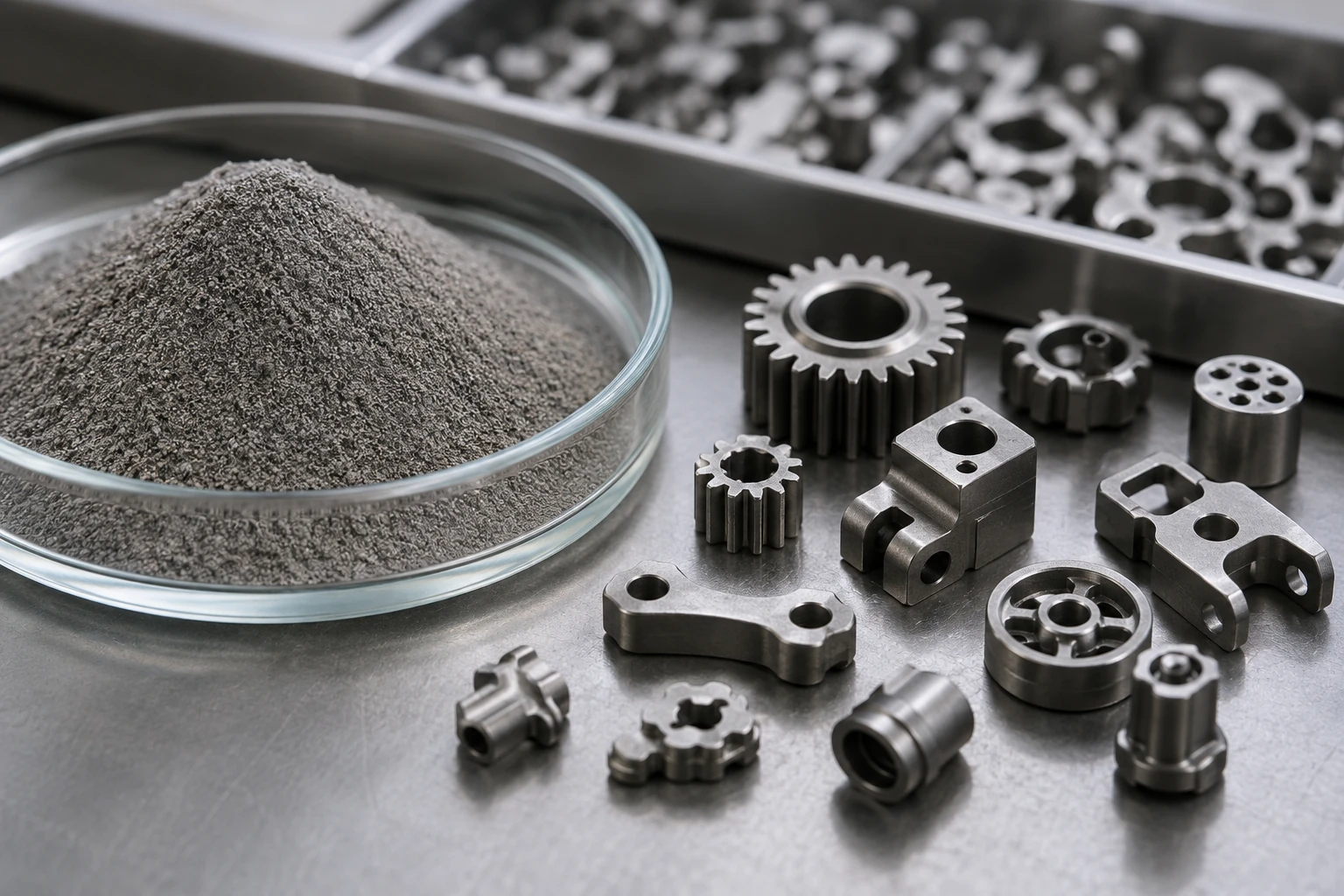
MIM 4340 low-alloy steel is worth reviewing when a compact metal part needs heat-treated structural performance, toughness potential beyond a basic low-alloy option, and geometry that is difficult or costly to machine from bar stock. The decision should not be based on the grade name alone. For a MIM project, engineers must confirm whether 4340 can pass through feedstock preparation, injection molding, debinding, sintering shrinkage, heat treatment and final inspection without unacceptable distortion, hardness variation, surface risk or dimensional instability. 4340 is most relevant for protected mechanical assemblies, small load-bearing levers, brackets, shafts, pins and functional hardware. It is not the first material to review when corrosion resistance, stainless appearance or low-volume simple machining is the main requirement.
Hızlı Mühendislik Özeti
The part is compact, mechanically loaded, protected from severe corrosion, suitable for MIM tooling economics, and likely to benefit from heat-treated low-alloy steel performance.
The main requirement is stainless corrosion resistance, high sliding wear, soft magnetic performance, very low-volume production, or a large simple geometry better suited to machining, forging or casting.
Feedstock availability, target heat treatment condition, critical dimensions, post-machined surfaces, coating thickness, inspection method and annual volume should be confirmed before a 4340 MIM tool is released.
MIM 4340 Engineering Snapshot
This snapshot helps engineers and sourcing teams quickly decide whether MIM 4340 should stay in the material review list before moving into detailed drawing, tolerance and heat treatment evaluation.
| Decision Item | MIM 4340 Review Direction |
|---|---|
| Malzeme ailesi | Ni-Cr-Mo low-alloy steel direction for heat-treated structural MIM parts. |
| En uygun | Compact, complex, mechanically loaded parts where MIM can reduce machining and integrate small features. |
| Ana avantaj | Strength and toughness potential after heat treatment, when geometry and process control are suitable. |
| Main engineering risks | Heat treatment movement, hardness variation, carbon control, residual porosity, coating allowance and corrosion exposure. |
| İdeal değil | Stainless appearance, strong corrosion exposure, very simple low-volume CNC parts, or large thick structural components. |
| RFQ must include | 2D drawing, 3D CAD file, material requirement, target hardness or heat treatment condition, critical dimensions, surface finish and annual volume. |
| Supplier review focus | Feedstock availability, DFM risk, sintering shrinkage, heat treatment response, post-machining need and final inspection method. |
XTMIM 4340 Feedstock Datasheet Reference
The following values are extracted from the XTMIM 4340 general-purpose MIM feedstock datasheet. They should be used as engineering reference data for material review, tooling discussion and RFQ clarification, not as universal guaranteed values for every MIM 4340 part. Final properties depend on part geometry, injection molding stability, green density, debinding, sintering, carbon control, heat treatment, surface finishing and supplier-specific validation.
How to Use This Datasheet Module
This datasheet is useful when engineers need a more concrete starting point for MIM 4340 material review. It supports discussion of shrinkage allowance, feedstock flowability, typical chemistry range, reference mechanical properties, injection setup, debinding route and sintering conditions. Do not copy these values directly into a production drawing without confirming the actual part design, inspection method and validation data.
Feedstock and Molding Reference Data
| Öğe | XTMIM 4340 Reference Value | Mühendislik Anlamı |
|---|---|---|
| Product | 4340 general-purpose MIM feedstock | Suitable for reviewing 4340 low-alloy steel parts made by metal injection molding. |
| Büyütme faktörü | Min. 1.213 / Average 1.216 / Max. 1.219 | Useful for early tooling shrinkage discussion, but final shrinkage compensation must be verified through part-specific trials. |
| MFI | 400-1200 g/10 min, average 800 g/10 min, DIN EN ISO 1133, 190°C / 21.6 kg | Indicates feedstock flow behavior. Actual filling stability still depends on gate design, wall thickness, flow length and injection conditions. |
| Recommended barrel temperature | Zone 1: 185°C; Zone 2: 185°C; Zone 3: 175°C; Zone 4: 150°C; Nozzle: 190°C | Reference injection setup only. Final settings should be adjusted based on part geometry, filling balance, green strength and dimensional stability. |
| Önerilen kalıp sıcaklığı | 90-125°C | Mold temperature affects filling, surface quality, green density and shrinkage stability. |
| Referans yeşil yoğunluk aralığı | 4.85-4.92 g/cm³ | Green density is important because variation can influence final dimensions, density and performance after sintering. |
Typical Composition After Sintering
| Element | Reference Range After Sintering | Neden Önemlidir |
|---|---|---|
| Fe | Denge | Base element of the 4340 low-alloy steel system. |
| C | 0.30-0.60% | Carbon control is critical for heat treatment response, hardness and consistency. |
| Cr | 0.75-1.25% | Supports hardenability and low-alloy steel performance. |
| Ni | 1.50-2.50% | Supports toughness and differentiates 4340-type chemistry from simpler Cr-Mo low-alloy options. |
| Mo | 0.20-0.30% | Contributes to hardenability and heat-treated strength response. |
| Mn | 0.00-1.00% | Part of the alloy balance and process control window. |
| Si | 0.00-1.00% | Part of the alloy balance and process control window. |
Typical Reference Properties
| Özellik | As-Sintered Reference | Heat-Treated Reference | Mühendislik Notu |
|---|---|---|---|
| Yoğunluk | >7.50 g/cm³ | >7.50 g/cm³ | Density should be reviewed together with residual porosity and critical mechanical requirements. |
| Yield strength Rp0.2 | >500 MPa | >750 MPa | Heat treatment can increase strength, but dimensional movement and inspection risk must also be reviewed. |
| Çekme mukavemeti | >700 MPa | >900 MPa | Useful as reference data, not a substitute for project-specific validation. |
| Elongation A10 | >5% | >2% | Higher strength after heat treatment may come with reduced ductility. |
| Sertlik | >200 HV1 | >400 HV1 | Hardness location, surface condition and test method should be defined on the drawing. |
| Salt spray test | Not specified | Not specified | 4340 should not be positioned as a corrosion-resistant stainless material. Surface protection may be required. |
Debinding and Sintering Route Reference
| Proses Aşaması | Reference Condition | Mühendislik Anlamı |
|---|---|---|
| Debinding acid | 98% HNO3 | Indicates a catalytic debinding route. Actual debinding behavior depends on part thickness and geometry. |
| Debinding temperature | 100-150°C | Temperature range should be controlled to remove binder without damaging green part integrity. |
| Debinding time | Depending on part thickness; 3 mm part approx. 3 h | Thicker sections, uneven wall thickness and blind features may require longer review. |
| Debinding endpoint | Minimum debinding rate reaches 9.8% | Used as a process reference for judging whether the debinding stage can be terminated. |
| Sinterleme atmosferi | 100% kuru argon | Atmosphere control is relevant to carbon condition and final material consistency. |
| Sinterleme altlığı | Non-metallic base, such as Al2O3 | Support condition affects distortion control and surface contact during sintering. |
| Negatif basınçla bağlayıcı giderme | Room temperature to 600°C with multi-stage holding; total around 450 min | Used to remove remaining binder before higher-temperature sintering stages. |
| Vakum sinterleme aşaması | 600°C to 850°C at 3°C/min and hold for a period of time | Helps keep carbon content within a reasonable process window. |
| Kısmi basınçlı sinterleme aşaması | 850°C to 1050°C at 3°C/min with short hold, then to 1260°C at the same heating rate, followed by furnace cooling | Reference densification route. Final profile should be confirmed based on part geometry, distortion risk and material validation. |
Storage and Reference Limitation
If stored appropriately, the feedstock shelf life is listed as 12 months, and the material should be protected against moisture. The datasheet values are based on material and process experience and have reference significance, but final part requirements and performance may vary because of geometry, process setup, heat treatment, finishing and inspection conditions.
Where 4340 Fits in the MIM Low-Alloy Steel Family
4340 belongs to the low-alloy steel direction, not the stainless steel, soft magnetic, titanium or cemented carbide family. In MIM material selection, this matters because each material family solves a different engineering problem. Low-alloy steels are usually reviewed when the part needs a balance of strength, heat treatment response, structural reliability and cost control, while corrosion resistance is not the primary requirement.
AISI 4340 is commonly described as a heat-treatable low-alloy steel containing chromium, nickel and molybdenum, with high toughness and strength in heat-treated condition. For a MIM page, that statement must be used carefully: MIM 4340 performance depends not only on alloy chemistry, but also on powder quality, binder system, feedstock stability, injection molding conditions, debinding, sintering density, carbon control, heat treatment and final inspection. Traditional wrought or CNC-machined 4340 data should not be copied directly into a MIM project decision.
The Metal Enjeksiyon Kalıplama Derneği malzeme yelpazesi lists 4340 within the low-alloy steel direction and advises users to confirm alloy or substitute alloy availability with the supplier. This supports the correct engineering position for this page: 4340 is a legitimate MIM material candidate, but final selection must be project-specific.
4340 as a Ni-Cr-Mo Low-Alloy Steel Candidate
From a design review perspective, 4340 should be positioned as a Ni-Cr-Mo low-alloy steel candidate for parts that need heat-treated structural performance. It is not normally the first choice for corrosion exposure, medical cleaning environments, salt spray, outdoor moisture or cosmetic stainless applications.
For corrosion-sensitive projects, review MIM paslanmaz çelik malzemeler before locking 4340 as the target material.
Why 4340 Requires MIM-Specific Review
MIM uses fine metal powder mixed with binder to form moldable feedstock. After injection molding, the green part must pass through debinding and sintering, where shrinkage, density, carbon condition and dimensional stability become critical. A 4340 grade name alone does not define final part performance.
For non-routine material requests, start with custom MIM material review instead of assuming every steel grade is ready for immediate production.
| İnceleme Noktası | Why It Matters for MIM 4340 |
|---|---|
| Toz ve besleme stoğu bulunabilirliği | 4340 may require supplier confirmation before quoting, trial planning or tooling release. |
| Sinterlenmiş yoğunluk | Strength, ductility and fatigue behavior depend on density and residual porosity, not only nominal chemistry. |
| Karbon kontrolü | Carbon condition affects heat treatment response, final hardness and lot-to-lot consistency. |
| Parça geometrisi | Thin arms, thick masses, asymmetric sections and isolated bosses can distort during sintering or heat treatment. |
| Isıl işlem durumu | Heat treatment influences hardness, strength, toughness, dimensional movement and inspection planning. |
| Yüzey koruması | 4340 is not corrosion-first and may require coating, plating or a controlled service environment. |
| Muayene yöntemi | Small MIM parts need realistic hardness locations, stable datums and functional checks. |
When MIM 4340 Is a Good Candidate
MIM 4340 should be reviewed when the project combines three conditions: the part is small enough for MIM economics, complex enough to justify tooling, and structurally demanding enough to require heat-treated low-alloy steel performance. If the part is simple, large, low-volume or easy to machine, CNC may remain the more practical route.
| Parça / Gereksinim | Why 4340 May Be Reviewed |
|---|---|
| Compact load-bearing mechanisms | 4340 can be reviewed when strength and toughness are more important than corrosion resistance. |
| Small levers, latches and engagement components | MIM can form compact functional shapes while reducing secondary machining, provided heat treatment movement is controlled. |
| Miniature transmission or motion hardware | Heat-treated low-alloy steel may support higher mechanical demand than a softer material route. |
| Structural brackets, hooks or carriers | MIM can integrate ribs, bosses, holes and undercuts in small parts. |
| Protected mechanical assemblies | 4340 may be suitable when surface protection or controlled service conditions are acceptable. |
| CNC-to-MIM conversion parts | 4340 may be reviewed if current machined parts are small, complex and produced in sufficient volume. |

Engineering Judgment Before Selecting 4340
- Is the geometry small and complex enough to justify MIM tooling?
- Does the part require heat-treated low-alloy steel performance?
- Is corrosion exposure manageable through coating, plating or controlled service conditions?
- Can critical dimensions be maintained after sintering and heat treatment?
- Is the expected production volume high enough to justify MIM development?
- Are functional surfaces suitable for as-sintered condition, or do they need secondary machining?
- Can the drawing separate functional datums from non-critical surfaces?
When 4340 May Not Be the Right MIM Material
A useful material page should also define when not to use the material. 4340 can be a valuable low-alloy steel candidate, but it is not the correct answer for every high-strength or wear-related project. In practice, the first boundary is often not strength; it is corrosion exposure, wear mechanism, dimensional requirement, production volume or post-treatment risk.
| Requirement or Risk | İnceleme İçin Daha İyi Yönlendirme |
|---|---|
| Güçlü korozyona maruz kalma | 316L, 17-4 PH or another stainless MIM material. |
| Need for stainless appearance | Stainless steel MIM, not 4340. |
| High sliding wear or edge wear | 420, 440C, tool steel direction or carbide direction. |
| Yumuşak manyetik işlev | Fe-Si, Fe-Ni or Fe-Co soft magnetic materials. |
| Very simple low-volume geometry | CNC işleme daha pratik olabilir. |
| Large or thick structural component | Forging, machining or casting may be more suitable. |
| No coating or surface protection allowed | Review stainless or another corrosion-resistant alloy. |
| Extremely tight datum features | Secondary machining may be required after MIM. |
Corrosion Exposure Is Usually the First Boundary
The real issue with 4340 is not only strength. If the part will operate in moisture, sweat, cleaning chemicals, outdoor air, salt spray or a regulated cleaning environment, 4340 should not be treated as a stainless material. Surface finishing may help, but it should be reviewed together with dimensional allowance, coating thickness, inspection method, friction requirements and service condition.
For corrosion-first material decisions, review korozyona dayanıklı MIM malzemeleri.
MIM 4340 vs 4140, 4605 and 17-4 PH: How Engineers Should Compare
This comparison is often more useful than a standalone material description. Engineers rarely ask only “Is 4340 strong?” They usually ask whether 4340 is safer than a neighboring material for a specific geometry, heat treatment target, corrosion condition and production volume.
| Karşılaştırma | Practical Selection Logic |
|---|---|
| 4340 vs 4140 | 4140 is a common Cr-Mo low-alloy steel direction; 4340 adds Ni-Cr-Mo logic and may be reviewed when toughness and hardenability are more important. |
| 4340 vs 4605 | 4605 is often reviewed as a mature low-alloy MIM steel for structural applications; 4340 may be reviewed when the project specifically needs a 4340-type performance direction. |
| 4340 vs 17-4 PH | 17-4 PH is usually stronger in corrosion-sensitive stainless applications; 4340 is more appropriate when protected low-alloy structural performance is acceptable. |
| 4340 vs 420 / 440C | 420 and 440C are better starting points when hardenable stainless wear or high surface hardness is central. |
| 4340 vs CNC 4340 | MIM may be better for small complex volume parts; CNC may be better for low-volume simple parts or very tight machined datums. |
4340 vs 4140 for MIM Parts
4140 and 4340 are close enough that page boundaries must be clear. MIM 4140 düşük alaşımlı çelik should be treated as a more general Cr-Mo low-alloy steel direction. 4340 should be reviewed when the project needs a stronger toughness and hardenability discussion, especially for compact mechanical parts that carry load or impact.
This does not mean 4340 is automatically better. It means the engineering review should compare required hardness, load path, section thickness, heat treatment response, distortion risk, part cost and feedstock availability before selection.
4340 vs 4605 for Heat-Treated MIM Parts
MIM 4605 düşük alaşımlı çelik is often a practical low-alloy MIM material direction when the project needs structural performance and production stability. 4340 should be reviewed when the drawing, customer specification or mechanical requirement points toward a Ni-Cr-Mo low-alloy steel direction.
A sourcing mistake is to ask for 4340 simply because it sounds stronger. A better RFQ should state the application load, target hardness, critical dimensions, surface condition and annual volume. Then the supplier can review whether 4340, 4605, 4140 or another material is the safer route.
4340 vs 17-4 PH Stainless Steel
17-4 PH paslanmaz çelik MIM is often a better starting point when the part needs a combination of strength and corrosion resistance. 4340 may be more suitable when the part operates in a protected mechanical assembly, corrosion exposure is controlled, and low-alloy steel heat treatment is the main requirement.
If the project has both strength and corrosion requirements, do not choose 4340 only because of strength. Review whether the corrosion risk changes the material family through the broader MIM malzeme seçim kılavuzu. When strength and corrosion resistance are both primary requirements, start by comparing the project against the 17-4 PH paslanmaz çelik MIM route before confirming 4340.
4340 vs 420 / 440C Stainless Steel
If the main concern is hardness, sliding wear, edge retention or high contact stress, 420 or 440C stainless steel may be a better starting point. 4340 can be heat treated, but that does not make it the default material for every high-hardness or wear-focused part. For hardness-first projects, compare the options in yüksek sertlikte MIM malzemeleri.
Heat Treatment, Hardness and Dimensional Risk in MIM 4340
Heat treatment is central to the value of 4340, but it also introduces project risk. In production, the heat treatment target must be reviewed together with part geometry, sintered density, carbon control and critical dimensions.
Do Not Treat Wrought 4340 Data as MIM Batch Data
Wrought or CNC-machined 4340 datasheets can help explain the alloy family, but they should not be used as a direct guarantee for MIM 4340 production parts. Final MIM performance depends on powder quality, feedstock stability, debinding, sintering density, residual porosity, carbon control, heat treatment condition and supplier-specific validation data.
Representative MIM alloy property references show why MIM material properties should be treated as process-dependent rather than universal. Porosity, impurities, grain size and post-sintering heat treatment can all affect final performance. That is why this page does not promise a universal hardness or tensile strength value for every MIM 4340 part.

Why Heat Treatment Is Central to 4340 Performance
4340 is usually reviewed because the project needs heat-treated structural performance. The heat treatment condition affects hardness, tensile and yield behavior, toughness, distortion risk, dimensional repeatability, surface condition and inspection method. For small MIM parts, heat treatment should be discussed before tooling, not after first production.
Dimensional Change After Heat Treatment
MIM already includes significant shrinkage during sintering. After that, heat treatment may introduce additional dimensional movement. This is especially important for long thin arms, asymmetric parts, flat components requiring low warpage, holes near thick sections, engagement features under load, tight coaxiality or perpendicularity requirements, and surfaces that must mate with shafts, pins, bearings or housings.
For broader tolerance planning, review MIM tolerans incelemesi.
Hardness Testing on Small MIM 4340 Parts
Hardness inspection should be defined realistically. Small MIM parts may not have enough flat surface area or section thickness for every hardness method. Surface treatment, decarburization risk, carburizing effect, grinding, polishing or plating may also affect the measured result.
A useful drawing or RFQ should specify:
- target hardness range or heat treatment condition;
- hardness test method, if required;
- test location;
- surface condition before testing;
- whether the value applies to the whole part or only a functional zone;
- whether destructive section testing is acceptable during validation;
- whether dimensions are controlled before or after heat treatment and finishing.
MIM Process Factors That Affect 4340 Part Quality
MIM 4340 quality is not determined by grade name alone. A technically sound supplier should review the full route from feedstock to final inspection. The important question is not only whether 4340 exists as a MIM material, but whether the selected feedstock, geometry, sintering route, heat treatment and inspection plan can support the actual drawing.
The XTMIM 4340 feedstock datasheet gives a practical reference window for oversize factor, MFI, injection temperature, green density, debinding and sintering route. These values help engineers understand the material system, but final production settings should still be validated against the actual part geometry and quality requirements.
Feedstock and Powder Availability
Before confirming 4340, the supplier should verify whether suitable 4340 powder or feedstock is available for the project. If the material is not a routine production feedstock, lead time, minimum volume, validation cost and risk should be discussed before tooling.
This is why supplier confirmation is important for real projects. It prevents the buyer from assuming that every listed material is automatically available for every geometry, order volume or delivery schedule.
Sinterlenmiş Yoğunluk ve Kalıntı Gözeneklilik
MIM parts usually achieve high density compared with conventional press-and-sinter PM parts, but density and porosity still matter. Residual porosity can affect tensile properties, fatigue behavior, impact resistance, fracture risk, plating or coating response, sealing-related applications and consistency after heat treatment.
For this reason, a MIM 4340 drawing should not rely only on nominal material grade. Critical mechanical requirements should be reviewed against production validation data, part geometry and inspection plan.
Carbon Control and Sintering Atmosphere
For low-alloy steels, carbon control can influence heat treatment response and final hardness. If carbon is not controlled properly through debinding, sintering and heat treatment, the part may not respond as expected. This is not only a metallurgy issue; it can become a production consistency issue.
For more process context, see the MIM sinterleme prosesi.
Design Review Points for MIM 4340 Structural Parts
This section is not a full MIM design guide. It focuses only on design checks that become especially important when 4340 is used for heat-treated structural parts. If a topic requires deeper treatment, the page points to the relevant design guide instead of turning this material page into a general DFM article.

| İnceleme Sorusu | Neden Önemlidir |
|---|---|
| Parça MIM için yeterince küçük ve karmaşık mı? | Simple low-volume parts may be better machined. |
| Are wall thickness transitions gradual? | Sudden mass changes can create shrinkage and distortion risk. |
| Are high-stress corners radiused? | Sharp corners can increase crack or fatigue risk after heat treatment or loading. |
| Are thin arms supported during sintering? | Unsupported features may distort, especially when heat treatment is added after sintering. |
| Are critical datums clearly defined? | Inspection and correction depend on stable datum strategy. |
| Are mating surfaces as-sintered or machined? | Functional surfaces may need secondary machining to control fit, friction or alignment. |
| Will heat treatment affect critical dimensions? | Post-treatment movement can change assembly fit and functional contact. |
| Is surface protection required? | Coating or plating can affect dimensions, friction and inspection sequence. |
| Is the annual volume suitable for tooling? | MIM economics depend on production scale, part complexity and the amount of machining replaced. |
Yaygın Tasarım Hataları
A common mistake is to request 4340 for strength but leave the geometry unchanged from a machined design. MIM can form complex features, but it still requires attention to wall thickness, gate location, flow path, debinding path, sintering support and post-sintering correction.
Another common mistake is to specify a hardness target without identifying the actual working surface. For example, a lever may only need controlled hardness on the contact area, while the datum face may need dimensional stability more than maximum hardness.
For deeper design rules, move to the MIM parçaları için DFM incelemesi ve MIM tasarım kılavuzu.
Surface Protection and Secondary Operations for MIM 4340 Parts
4340 should be treated as a low-alloy structural steel, not a stainless material. If the part will face humidity, sweat, salt, cleaning fluid or outdoor exposure, surface protection must be reviewed early. The finishing decision should be made together with the tolerance plan because coating thickness, polishing, grinding or plating can change fit, friction and inspection sequence.
Possible finishing routes may include black oxide, plating, coating, polishing, tumbling or other surface processes. The correct method depends on function, appearance, corrosion exposure, friction, coating thickness and inspection requirements.
Dimension After Coating Must Be Defined
If a MIM 4340 part has tight assembly clearance, coating or plating thickness should be included in the tolerance stack-up. The drawing should clarify whether critical dimensions apply before finishing, after finishing, or after both heat treatment and surface protection.
Secondary Machining May Be Needed For
- bearing seats;
- shaft holes;
- sealing faces;
- threaded areas;
- high-precision datums;
- sliding or rotating contact zones;
- assembly-critical surfaces.
Surface Treatment Must Be Reviewed with Tolerance
Surface protection is not only a cosmetic decision. Coating thickness may affect assembly fit. Surface finishing may change friction. Heat treatment scale or surface condition may affect plating quality. If a part has tight assembly clearance, the drawing should define whether dimensions apply before or after finishing.
Inspection and Acceptance Checks for MIM 4340
Supplier quality engineers and design engineers should align on acceptance checks before production. For MIM 4340, inspection should connect material condition, heat treatment, dimensions and function. A visual check alone is not enough when the part depends on hardness, datum stability, functional contact or post-treated surfaces.

| Kontrol Maddesi | Why It Matters for MIM 4340 |
|---|---|
| Material and heat treatment condition | Defines the intended performance route and prevents confusion between grade name and final condition. |
| Kritik boyutlar | Sintering and heat treatment can influence dimensional stability. |
| Hardness test method and location | Small parts may give misleading hardness readings if location and surface condition are undefined. |
| Density or mechanical validation | MIM properties depend on density, porosity and process control. |
| Surface protection check | 4340 may need coating or plating for corrosion control, and coating thickness can affect assembly fit. |
| Fonksiyonel uyum | Engagement features, gears, pins, shafts and latches require application-specific inspection. |
| Post-machined areas | Machined datums and holes must be clearly identified before validation. |
| Lot traceability | Heat treatment and finishing should be traceable to production batches. |
For broader quality support, review XTMIM’s muayene ve test yeteneği.
Mühendislik Eğitimi için Bileşik Saha Senaryoları
Composite Field Scenario for Engineering Training: Heat Treatment Distortion in a Small Structural Lever
Hangi sorun oluştu: A small structural lever was designed for a heat-treated low-alloy steel MIM route. The first trial parts met general shape requirements but showed inconsistent engagement at the functional contact area after heat treatment.
Neden oldu: The drawing focused on material grade and target hardness but did not clearly define the functional datum, heat-treatment-sensitive dimensions or support strategy during sintering and heat treatment.
Gerçek sistem nedeni neydi: The problem was not only material selection. The system cause involved geometry asymmetry, a thin unsupported lever arm, unclear datum control and a hardness target that was specified without a defined test location.
Nasıl düzeltildi: The drawing review separated critical engagement surfaces from non-critical cosmetic areas. Datum references were clarified, the heat treatment condition was reviewed with the supplier, and the functional area was evaluated for possible secondary correction.
Tekrarını önlemek için: Before tooling, define functional surfaces, target hardness location, datum strategy, heat treatment condition and allowable distortion. For 4340-type MIM parts, strength targets should always be reviewed together with geometry and inspection method.
Composite Field Scenario for Engineering Training: Wrong Material Family for Corrosion Exposure
Hangi sorun oluştu: A compact mechanical component was initially specified as 4340 because the design team wanted high strength. During project review, the application environment included repeated moisture exposure and occasional cleaning.
Neden oldu: The material was selected from a strength-first perspective. Corrosion exposure, coating feasibility and maintenance environment were not reviewed early enough.
Gerçek sistem nedeni neydi: The issue was not that 4340 could not be strong enough. The real problem was that the application requirement belonged partly to a corrosion-resistance decision, not only a strength decision.
Nasıl düzeltildi: The material review compared 4340 with 17-4 PH and other stainless MIM options. Surface protection feasibility, coating thickness, inspection requirements and expected service condition were reviewed before confirming the material path.
Tekrarını önlemek için: For MIM material selection, engineers should separate mechanical load requirements from environmental exposure. If corrosion is a primary requirement, stainless steel materials should be reviewed before low-alloy steel.
RFQ Checklist for MIM 4340 Parts
If you are reviewing MIM 4340 for a new or converted part, prepare the following information before RFQ. This helps the engineering team evaluate material suitability before tooling decisions are made.
Sağlanacak Bilgi
- 2D drawing with tolerances and datum references;
- 3B CAD dosyası;
- current material requirement or equivalent grade;
- target hardness, strength requirement or heat treatment condition;
- critical functional surfaces and load-bearing areas;
- surface finish or corrosion protection requirement;
- existing production route, such as CNC machining, casting, stamping, PM or previous MIM;
- estimated annual volume and expected production stage;
- application environment, including moisture, heat, friction, impact or cleaning exposure;
- inspection requirements, including hardness, CMM, functional fit or mechanical validation;
- areas where post-machining is allowed or not allowed;
- known failure risks or current production problems, if any.
What XTMIM Reviews Before Confirming 4340
- whether MIM is the right manufacturing route;
- whether 4340 feedstock is practical for the project;
- whether 4140, 4605, 17-4 PH or another material should be compared;
- whether geometry is suitable for injection molding, debinding and sintering;
- ısı işleminin kritik boyutları etkileyip etkilemeyeceği;
- whether surface protection is required;
- whether the tolerance plan is realistic;
- whether inspection can verify the required function.
Submit Your Drawing for a MIM 4340 Material Review
If your part requires compact geometry, heat-treated structural performance, functional surfaces or a possible CNC-to-MIM conversion, send XTMIM your 2D drawing, 3D CAD file, material requirement, target hardness or heat treatment condition, critical dimensions, surface finish requirement, annual volume and application background.
XTMIM’s engineering team can review whether 4340, 4140, 4605, 17-4 PH or another MIM material is the safer route, and whether the part geometry, sintering behavior, heat treatment risk, tolerance plan and inspection method should be adjusted before tooling or production planning.
FAQ About MIM 4340 Low-Alloy Steel
4340 çeliği MIM parçaları için uygun mudur?
Evet, 4340, özellikle küçük, karmaşık, ısıl işlem görmüş yapısal parçalar için MIM düşük alaşımlı çelik adayı olarak incelenebilir. Ancak uygunluk, besleme stoğu bulunabilirliğine, parça geometrisine, sinterlenmiş yoğunluğa, ısıl işlem durumuna, yüzey korumasına ve muayene gereksinimlerine bağlıdır.
MIM 4340 yerine 4140'ı ne zaman tercih etmeliyim?
Proje, daha güçlü tokluk veya sertleşebilirlik gereksinimleri olan bir Ni-Cr-Mo düşük alaşımlı çelik yönelimi gerektirdiğinde 4140 yerine 4340 incelenebilir. Sadece adı daha güçlü duyulduğu için seçilmemelidir. Karar, yük yolu, ısıl işlem hedefi, geometri, tolerans ve uygulama ortamına dayanmalıdır.
MIM 4340 korozyona dayanıklı mıdır?
4340 numaralı malzeme, korozyona dayanıklı paslanmaz çelik olarak değerlendirilmemelidir. Parça neme, tere, tuzlu suya, temizlik kimyasallarına veya dış ortama maruz kalacaksa, paslanmaz MIM malzemeleri veya yüzey koruması gözden geçirilmelidir.
MIM 4340, sinterleme sonrası ısıl işlem görebilir mi?
Birçok projede, 4340'ın incelenmesinin temel nedeni ısıl işlemdir. Ancak ısıl işlem sertliği, mukavemeti, tokluğu ve boyutları etkileyebilir. Özellikle ince, asimetrik veya dar toleranslı parçalar için kalıplama öncesinde hedeflenen durum tartışılmalıdır.
MIM 4340, CNC işlenmiş 4340 parçaların yerini alabilir mi?
Parça küçük, karmaşık ve yeterli hacimde üretildiğinde CNC ile karşılaştırması yapılabilir. MIM, talaşlı imalat operasyonlarını azaltabilir ve karmaşık özellikleri entegre edebilir, ancak düşük hacimli basit parçalar veya çok hassas işlenmiş datumlar gerektiren özellikler için CNC hala daha iyi olabilir.
MIM 4340 için bir RFQ (Teklif Talebi) için hangi bilgilere ihtiyaç vardır?
Faydalı bir Teklif Talebi (RFQ), 2B çizimler, 3B CAD dosyaları, hedef malzeme veya eşdeğer kalite, ısıl işlem veya sertlik gereksinimi, kritik boyutlar, yüzey kalitesi, korozyon maruziyeti, yıllık hacim, uygulama geçmişi ve muayene gereksinimlerini içermelidir.
Yüksek mukavemetli MIM parçaları için 4340, 17-4 PH'den daha mı iyi?
Her zaman değil. 17-4 PH, proje hem güç hem de paslanmaz korozyon direnci gerektirdiğinde genellikle daha güçlü bir adaydır. Parça korumalı bir ortamda çalıştığında ve ısıl işlem görmüş düşük alaşımlı yapısal performans ana gereksinim olduğunda 4340 daha iyi değerlendirilebilir.
MIM 4340, dökümhaneden çıkan 4340 ile aynı mıdır?
Hayır. MIM 4340 ve dövme 4340 benzer bir alaşım yönünü paylaşabilir, ancak nihai MIM parça özellikleri toz, besleme stoğu, bağlayıcı giderme, sinterleme yoğunluğu, karbon kontrolü, ısıl işlem ve muayeneye bağlıdır. Tedarikçiye özel doğrulama olmadan dövme 4340 veri sayfası değerlerini doğrudan bir MIM üretim çizimine kopyalamayın.
MIM 4340 kaplama veya yüzey koruması gerektirir mi?
Parça neme, tere, tuza, temizlik kimyasallarına veya dış ortama maruz kalıyorsa kaplama veya başka bir yüzey koruma yöntemi gerekebilir. Özellikle dar montaj boşlukları için kaplama kalınlığı ve bitirme sırası tolerans ve muayene planına dahil edilmelidir.
Standartlar ve Teknik Referans Notu
MIM 4340 material selection should be reviewed using MIM-specific material references rather than relying only on wrought steel or CNC machining data. The following sources are useful for engineering direction, but they should not replace project-specific material validation, drawing review, supplier-specific feedstock confirmation or formally purchased standards. Do not use this article as a substitute for the latest MPIF Standard 35-MIM, customer specification, or supplier-specific validation data.
- XTMIM 4340 Feedstock Datasheet: relevant because it provides internal reference data for oversize factor, MFI, sintered chemistry, typical as-sintered and heat-treated properties, injection setup, debinding route, sintering route and shelf-life control. These values should be treated as reference data, not universal guaranteed production values.
- MIMA Malzeme Aralığı: relevant because it places 4340 within the MIM low-alloy steel direction and advises supplier confirmation for alloy or substitute alloy availability.
- MPIF Standard 35-MIM: relevant because MPIF describes this standard as covering common MIM materials with explanatory notes and definitions. Use the latest applicable edition before publishing exact standard values on a drawing or purchase specification.
- AISI 4340 general material reference: useful for basic 4340 alloy positioning as a heat-treatable Cr-Ni-Mo low-alloy steel, but not as a direct MIM performance guarantee.
- Representative MIM alloy property reference: useful because it explains that representative MIM properties can depend on porosity, impurities, grain size and post-sintering heat treatment.