XTMIM prend en charge la planification de l'inspection MIM, de la revue des plans à l'approbation des échantillons, en passant par la vérification de la production et la libération des expéditions. La portée peut inclure l'inspection dimensionnelle, les contrôles de dureté et liés aux matériaux, les tests de surface ou de fiabilité, et des rapports d'inspection documentés. La méthode correcte dépend des dimensions critiques, des datums, de la nuance du matériau, de l'état de surface, de l'environnement d'application et des critères d'acceptation, et non d'une liste de contrôle universelle.
Pour les ingénieurs qualité fournisseurs, les ingénieurs produit et les acheteurs techniques, cette page explique les ressources d'inspection disponibles, comment les méthodes de mesure sont liées au risque projet, ce qui doit être défini avant l'outillage ou la production, et comment le retour d'information de l'inspection soutient l'outillage, le frittage et le contrôle des processus. Tous les projets ne nécessitent pas tous les tests ; la méthode de test, la fréquence, les règles d'échantillonnage, le format du rapport et les critères de libération sont confirmés par projet.
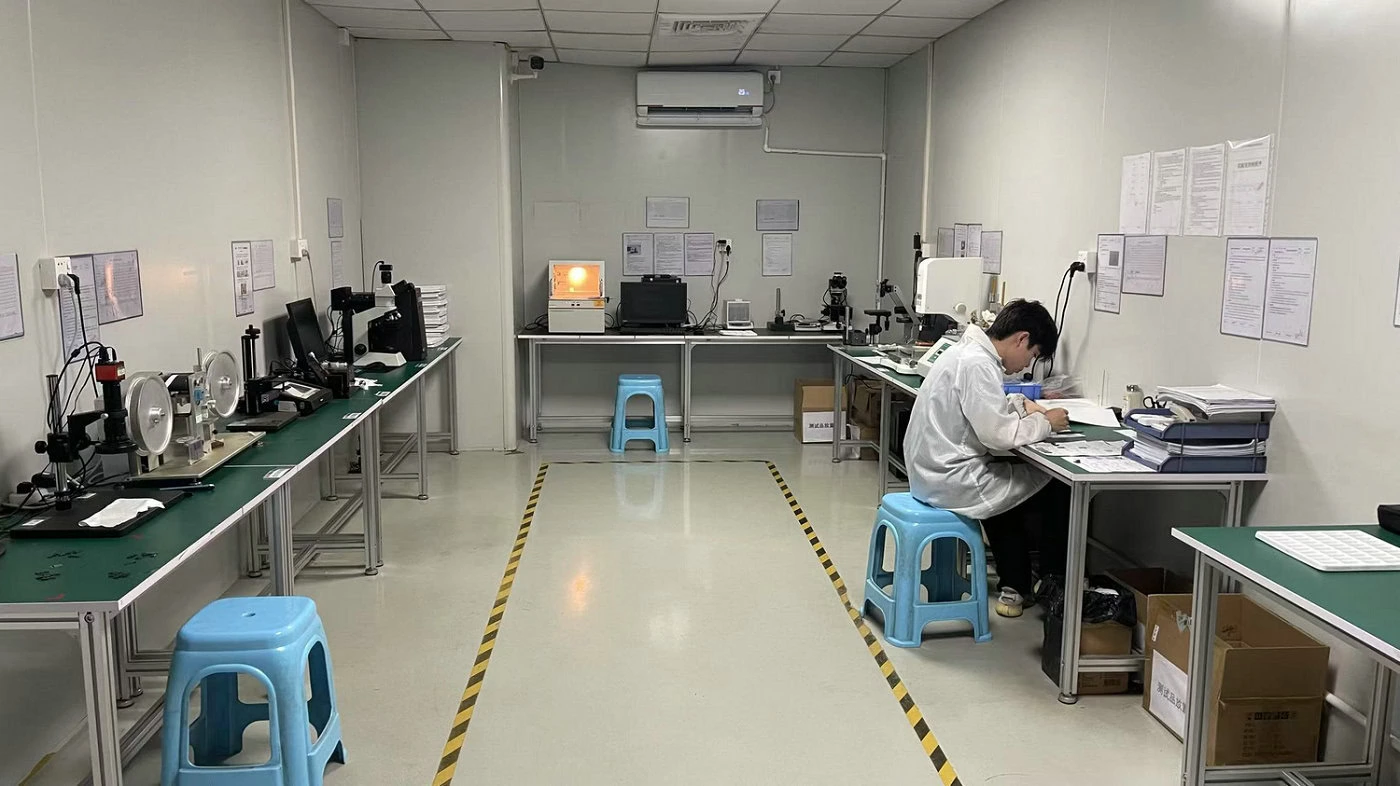
Capacité d'inspection et d'essai pour l'évaluation des fournisseurs MIM
L'inspection des pièces MIM doit être planifiée en fonction du dessin de la pièce, et non d'une liste de contrôle fixe. Un petit composant de charnière en acier inoxydable, une pièce magnétique douce, un composant de verrouillage en acier faiblement allié et une pièce cosmétique portable peuvent tous nécessiter des priorités d'inspection différentes. Certains projets se concentrent sur les cotes basées sur les références et les surfaces d'accouplement. D'autres nécessitent une vérification de la dureté, des essais liés aux matériaux, des contrôles de rugosité, des essais de corrosion ou un examen de l'apparence.
Les ressources d'inspection de XTMIM comprennent des MMT, des machines de mesure optique, la numérisation 3D, des duromètres, des machines d'essai de traction, des équipements métallographiques, des rugosimètres, des brouilleurs de sel et des chambres environnementales. La sélection de la méthode suit la géométrie du plan, la stratégie de datum, l'état du matériau, l'exigence de surface, le risque d'application et les preuves de rapport requises.
La capacité d'inspection n'est qu'une partie de la qualification d'un fournisseur. Pour une revue plus complète couvrant le support DFM, les hypothèses d'outillage, l'expérience des matériaux, le contrôle du retrait de frittage, la traçabilité, la communication RFQ et la préparation à la production, utilisez le Liste de contrôle d'évaluation des fournisseurs MIM.
Pour une vue d'ensemble des capacités, consultez la présentation des capacités de XTMIM.
| Question d'inspection | Pourquoi c'est important pour les pièces MIM | Points d'examen typiques |
|---|---|---|
| Quelles dimensions sont critiques pour la fonction ? | Le retrait de frittage et le mouvement de frittage du MIM peuvent affecter différemment les trous, les caractéristiques fines, les relations de référence et les surfaces d'accouplement. | Références, surfaces d'accouplement, trous, rainures, planéité, position et exigences de profil |
| Quels défauts peuvent affecter l'assemblage ou la fiabilité ? | Les fissures de surface, le gauchissement, les marques de porte, la déformation et les dommages de finition peuvent être inacceptables même si les dimensions de base sont conformes. | Inspection visuelle, microscopie, revue de profil, revue des caractéristiques à haut risque et contrôles des défauts liés à la manipulation |
| Quelles exigences de matériau ou de dureté s'appliquent ? | Le frittage, le traitement thermique, la nuance de matériau et les opérations secondaires peuvent affecter la dureté et la réponse mécanique. | Dureté, contrôles liés à la traction, vérification des matériaux, état de traitement thermique et spécifications client |
| Quels rapports ou enregistrements sont nécessaires ? | Les équipes SQE et OEM ont souvent besoin de preuves objectives avant l'approbation d'échantillons, la libération de production d'essai ou l'expédition. | Rapports dimensionnels, première inspection d'article, enregistrements d'inspection de sortie, rapports d'essais spéciaux et enregistrements d'expédition |
Résumé des ressources d'inspection actuelles
La liste des équipements ci-dessous est une référence de capacité. Le plan d'inspection du projet est défini par les caractéristiques critiques, les exigences du plan, la voie du matériau, l'état de surface et les besoins de reporting.
| Catégorie d'inspection | Référence de ressource actuelle | Valeur fabrication / qualité | Limite importante |
|---|---|---|---|
| Mesure dimensionnelle | MMC 7 ; MMO 21 ; scanner 3D 1 ; altimètre électronique 7 | Prend en charge les cotes critiques, la position des trous, la vérification du profil, la variation dimensionnelle après frittage et la confirmation des résultats de calibrage. | La méthode de mesure doit être choisie en fonction de la géométrie du dessin et de la stratégie de référence. |
| Essais de dureté et mécaniques | Duromètre Rockwell 2 ; duromètre Vickers 2 ; machine d'essai de traction automatique 5 ; machine d'essai hydraulique 1 | Prend en charge la vérification de la dureté et des propriétés mécaniques lorsque cela est requis par la spécification du matériau ou du projet. | Ne pas considérer comme une certification universelle pour toutes les pièces ; la méthode d'essai et les règles relatives aux éprouvettes doivent être confirmées. |
| Analyse métallographique et des matériaux | Trancheuse de précision 2 ; enrobeuse automatique 1 ; microscope métallographique 2 ; analyseur XRF 2 | Permet la préparation métallographique, l'observation de la structure et le criblage des matériaux ou des éléments. | L'XRF est utile pour le criblage mais ne remplace pas toutes les analyses chimiques formelles ou les certifications tierces. |
| Tests liés à la surface et à la fiabilité | Testeur de rugosité 2 ; testeur de brouillard salin 3 ; chambre d'essai à température et humidité constantes 2 ; chambre d'essai de choc thermique 2 ; ressources de test liées à l'abrasion | Permet l'examen des exigences de surface, de corrosion, de revêtement, d'aspect et environnementales pour certains projets. | Ces tests dépendent du projet et doivent être définis avant le devis ou l'approbation des échantillons. |
Comment les méthodes d'inspection soutiennent les décisions de projet
Pour l'évaluation des fournisseurs, la question importante n'est pas seulement quel équipement existe, mais quel risque de projet l'équipement aide à contrôler. Le tableau ci-dessous relie les risques courants des projets MIM avec le support d'inspection pratique et la valeur décisionnelle pour les équipes d'ingénierie.
| Risque du projet | Support d'inspection recommandé | Valeur de décision |
|---|---|---|
| Position de trou serrée, tolérance de référence ou alignement d'assemblage | CMM, OMM, mesure de hauteur ou revue de jauge spécifique au projet | Confirme si les dimensions frittées et post-dimensionnées correspondent aux exigences fonctionnelles d'assemblage. |
| Petits trous, profils minces, fentes ou caractéristiques de contour optique | OMM et revue dimensionnelle visuelle | Aide à vérifier les petites caractéristiques qui peuvent être difficiles à mesurer de manière cohérente par des méthodes de contact seules. |
| Surfaces courbes complexes ou écart de forme précoce | Scan 3D combiné à une mesure basée sur le dessin | Permet la comparaison d'échantillons et le retour sur l'outillage ou le frittage sans remplacer l'inspection dimensionnelle critique finale. |
| Confirmation de la nuance de matériau ou de la famille d'alliage | Criblage XRF, examen du certificat matière et vérification matière définie par le projet | Réduit le risque d'inadéquation matière et détermine si une confirmation matière supplémentaire est nécessaire. |
| Caractéristiques traitées thermiquement, liées à l'usure ou sensibles à la dureté | Essai de dureté Rockwell ou Vickers selon les exigences du projet | Vérifie la réponse au traitement thermique, l'état du matériau ou les critères d'acceptation liés à l'usure. |
| Surface esthétique, durabilité du revêtement ou exposition à la corrosion | Essais de rugosité, examen visuel, contrôles liés à l'abrasion, essais au brouillard salin ou environnementaux lorsque spécifiés | Soutient les décisions liées à l'apparence, au traitement de surface et à la fiabilité avant le lancement de la production. |
Que faut-il inspecter avant l'approbation d'un échantillon ou le lancement de la production ?
Avant qu'une pièce MIM soit approuvée pour le lancement de la production, le périmètre d'inspection doit être défini en fonction de la fonction de la pièce. En pratique, toutes les cotes d'un plan ne présentent pas le même risque. Une surface esthétique, un trou de montage, une interface coulissante, un élément de verrouillage et une surface de référence peuvent nécessiter des méthodes d'inspection et des règles d'acceptation différentes.
Dimensions et tolérances critiques
L'inspection dimensionnelle se concentre généralement sur les caractéristiques qui affectent l'assemblage, la fonction ou le traitement ultérieur. Pour les pièces MIM, les dimensions critiques peuvent inclure la longueur, le diamètre, la position des trous, la largeur des fentes, la hauteur des gradins, la planéité, le profil, les caractéristiques liées aux parois, les zones liées aux filetages et les surfaces d'accouplement. Pour une vue complète de la manière dont les alésages critiques, les caractéristiques de référence, les surfaces d'accouplement, les opérations secondaires et les méthodes d'inspection sont examinés conjointement, consultez la section sur revue d'ingénierie de pièces MIM de haute précision.
État de surface et défauts visuels
L'inspection de surface doit prendre en compte à la fois l'aspect et le risque lié au procédé. Un défaut de surface peut être esthétique ou indiquer des dommages lors de la manipulation de la pièce verte, des contraintes de déliantage, des déformations de frittage, une contamination ou des dommages liés à la finition.
Matériau, dureté et exigences mécaniques
L'inspection liée au matériau dépend de la nuance de matériau sélectionnée et des exigences de l'application. La dureté, les essais de traction, l'examen métallographique et la vérification du matériau doivent être définis conformément aux spécifications du client et aux plans d'inspection convenus.
Contrôles de surface, de corrosion et de fiabilité
Les pièces esthétiques, les composants d'usure, les pièces d'électronique grand public et les pièces traitées en surface peuvent nécessiter des tests de rugosité, des contrôles d'abrasion, des essais au brouillard salin, des essais de température et d'humidité ou des essais de choc thermique.
Les éléments typiques d'une revue dimensionnelle incluent la structure de datum et la référence de mesure, les dimensions critiques pour la fonction, les trous liés à l'assemblage, les fentes, les nervures, les bossages et les faces d'accouplement, la planéité et les relations de position, les caractéristiques affectées par le support de frittage ou le calibrage post-frittage, ainsi que les dimensions pouvant nécessiter un usinage secondaire ou une inspection par calibre. Pour la stratégie de tolérance, voir Tolérances MIM et stratégie dimensionnelle.
Équipement d'inspection dimensionnelle pour les caractéristiques MIM critiques
L'inspection dimensionnelle est un élément central de la validation MIM car les pièces MIM sont formées surdimensionnées puis rétrécissent pendant le frittage. Le plan d'inspection doit confirmer que la pièce finale frittée ou post-traitée répond aux exigences fonctionnelles. Les ressources d'inspection dimensionnelle de XTMIM comprennent la MMT, la MMO, le scan 3D et les équipements de mesure de hauteur électroniques.
MMT
Idéale pour les relations basées sur les datums, la position des trous, le profil, les faces d'accouplement et les dimensions 3D fonctionnelles où le dessin définit des références de mesure claires.
MMO
Utile pour les petits trous, les fentes, les bords minces, les profils 2D, les contours optiques et les petites caractéristiques de précision pouvant être sensibles à la mesure par contact.
Scan 3D
Utile pour la comparaison de géométries complexes, l'examen précoce des écarts d'échantillons et le retour sur l'outillage ou le frittage, mais elle ne remplace pas toutes les inspections finales basées sur le dessin.
Inspection CMM pour les dimensions basées sur les références
L'inspection CMM est utile lorsque la pièce nécessite des relations contrôlées entre les références, les trous, les faces de montage, les profils ou les dimensions de position. Pour les pièces MIM, cela est particulièrement important lorsque la pièce sera assemblée dans un dispositif, un mécanisme, un boîtier, un loquet, une charnière, un connecteur ou un module de précision.
L'inspection CMM peut soutenir l'examen des caractéristiques basées sur les références, la position et l'espacement des trous, les faces d'accouplement critiques, les dimensions de profil et de forme, les relations de planéité ou de hauteur, et les dimensions d'approbation de production. En pratique, l'inspection CMM doit être utilisée lorsque le dessin définit des références et des relations de tolérance significatives. Si le dessin manque de références claires, l'équipe d'ingénierie peut devoir examiner comment la pièce doit être mesurée avant l'approbation de l'échantillon.
Mesure optique pour les petites caractéristiques et les profils
Les machines de mesure optique sont utiles pour les petites caractéristiques MIM, les profils fins, les fentes, les trous, les bords et les dimensions liées aux contours. De nombreuses pièces MIM sont petites et géométriquement complexes, de sorte que la mesure optique peut être plus pratique que la mesure par contact pour certaines caractéristiques.
L'inspection OMM peut soutenir l'examen des petits trous et fentes, la mesure des bords fins ou des profils, la comparaison de contours, l'inspection des micro-caractéristiques et l'examen dimensionnel visuel des petites pièces de précision. Pour les petits composants MIM, la mesure optique peut aider à identifier les écarts qui peuvent affecter l'assemblage même lorsque la pièce semble acceptable à l'inspection visuelle.
Numérisation 3D pour l'examen de géométries complexes
La numérisation 3D peut être utile pour l'examen de géométries complexes, la comparaison de premiers échantillons, l'analyse des écarts de forme et le retour d'information sur l'outillage ou le frittage. Elle permet de visualiser comment une pièce complexe s'écarte de la forme prévue, en particulier lorsque la pièce comprend des surfaces courbes, des caractéristiques asymétriques ou de multiples transitions géométriques.
Cependant, la numérisation 3D ne doit pas être présentée comme un remplacement de toutes les mesures de précision. Elle est mieux utilisée dans le cadre d'une stratégie d'inspection plus large, combinée à des mesures basées sur des dessins, des inspections CMM, des mesures optiques, des contrôles par calibre et des examens techniques.
Essais de dureté, mécaniques et liés aux matériaux
Les tests de dureté, les tests liés à la traction et la vérification des matériaux répondent aux exigences que l'inspection dimensionnelle seule ne peut confirmer. Ils sont sélectionnés lorsque l'état du matériau, le traitement thermique, la charge, le risque d'usure ou les spécifications du client nécessitent une preuve objective.
Essais de dureté pour les pièces traitées thermiquement ou liées à l'usure
Les essais de dureté sont souvent pertinents lorsque la pièce est traitée thermiquement, liée à l'usure, porteuse de charge ou spécifiée avec une exigence de dureté. Par exemple, les pièces MIM en acier faiblement allié peuvent nécessiter un traitement thermique selon l'application, tandis que les pièces en acier inoxydable ou en matériaux magnétiques doux peuvent nécessiter des priorités de vérification différentes.
L'examen de la dureté peut soutenir la confirmation du traitement thermique, l'examen des applications liées à l'usure, l'acceptation de lots pour les pièces sensibles aux matériaux, la comparaison entre les lots d'échantillons et de production, et l'analyse des défaillances lorsqu'un écart de dureté est suspecté. L'exigence de dureté doit être définie avant la production car le choix du matériau, les conditions de frittage, le traitement thermique et la finition de surface peuvent tous affecter le résultat final.
Essais de traction et mécaniques lorsque le projet l'exige
Des essais de traction ou mécaniques peuvent être nécessaires lorsque le cahier des charges du client, la norme matière ou le risque lié à l'application exige une vérification des propriétés mécaniques. La méthode d'essai, le type d'éprouvette, les critères d'acceptation et le format du rapport doivent être confirmés avant que le projet n'entre en phase de planification de la production.
Une erreur courante consiste à supposer que la pièce MIM finie peut toujours être utilisée directement comme éprouvette de traction. En réalité, les essais de traction pour les matériaux métalliques frittés dépendent de la géométrie de l'éprouvette, de la méthode de préparation, de l'état du matériau et des normes applicables. ISO 2740:2023 est pertinent lors de la définition des exigences relatives aux éprouvettes de traction pour les matériaux métalliques frittés, y compris les applications de frittage liées au MIM.
Support d'analyse métallographique et XRF
Les inspections liées aux matériaux peuvent nécessiter plus qu'une simple vérification du nom du matériau fourni par le fournisseur. Pour certains projets, la préparation métallographique, la microscopie et l'analyse XRF peuvent soutenir la vérification des matériaux, la revue des procédés et l'analyse des défauts.
Préparation métallographique et microscopie
Le support métallographique peut aider à évaluer certaines questions liées aux matériaux ou aux procédés. Dans les projets MIM, il peut être utilisé pour soutenir la revue de la structure liée au frittage, l'investigation des défauts, l'état du matériau ou les exigences spéciales du client.
Une revue métallographique peut être envisagée lorsqu'une pièce présente un comportement de fissuration ou de rupture inhabituel, que l'état du matériau lié au frittage nécessite une investigation, qu'un client exige des preuves liées à la structure, qu'un problème de production suggère une variation de matériau ou de procédé, ou que la revue technique nécessite plus de preuves que la seule inspection dimensionnelle. Ce type d'essai doit être lié à une question réelle du projet. Il ne doit pas être ajouté uniquement pour rendre le processus d'inspection plus complexe.
Support de vérification des matériaux par XRF
L'analyse XRF peut soutenir la vérification liée aux matériaux et le criblage des éléments d'alliage. Elle peut aider à confirmer si l'état du matériau est aligné avec la famille de matériaux attendue ou si un examen plus approfondi du matériau est nécessaire.
Cependant, l'analyse XRF ne doit pas être présentée comme un remplacement complet de toute certification de composition chimique ou d'analyse en laboratoire tierce. L'acceptation finale du matériau doit suivre les spécifications du client, la norme de matériau applicable et le plan d'inspection confirmé.
Tests de surface, d'abrasion et de fiabilité
Les tests de surface et de fiabilité deviennent pertinents lorsque l'apparence, la durabilité du revêtement, l'exposition à la corrosion, le cyclage environnemental ou l'usure par contact affectent l'acceptation. La méthode de test doit correspondre aux conditions d'utilisation réelles et aux critères d'acceptation convenus.

Examen de la rugosité de surface et de l'aspect esthétique
Les tests de rugosité de surface peuvent être nécessaires lorsque la pièce a une surface d'accouplement, une surface de glissement, une surface d'étanchéité ou une exigence d'apparence esthétique. Pour les pièces MIM, l'état final de la surface peut être influencé par la qualité du feedstock, la surface du moule, les conditions d'injection, le frittage, le polissage, le grenaillage, le sablage, la passivation, le revêtement ou d'autres processus de finition.
L'examen de la surface doit définir quelle surface est importante, si l'exigence est esthétique ou fonctionnelle, si la rugosité doit être mesurée, si la finition peut affecter les dimensions et si des échantillons d'apparence doivent être approuvés avant la production.
Support aux tests de brouillard salin et d'environnement
Les tests de brouillard salin, de température et d'humidité, et de choc thermique peuvent être pertinents pour les pièces exposées à la corrosion, à l'humidité, aux cycles de température ou à des conditions environnementales définies par le client. Ces tests ne sont pas des exigences par défaut pour chaque projet MIM. Ils doivent être spécifiés lorsque l'environnement d'application ou les critères d'acceptation du client l'exigent.
Ceci est particulièrement important pour les composants MIM plaqués, passivés, polis ou traités en surface. Si le traitement de surface est fourni par un processus externe ou une voie approuvée par le client, le plan d'inspection doit également clarifier la responsabilité, la méthode d'acceptation et les exigences de rapport.
Contrôles d'abrasion et de revêtement pour les pièces sensibles en surface
Les contrôles d'abrasion et de revêtement sont utiles pour les pièces qui sont touchées, frottées, usées, nettoyées, assemblées à plusieurs reprises ou exposées en tant que composants visibles. Ces tests peuvent s'appliquer aux dispositifs portables, à l'électronique grand public, aux pièces d'horlogerie, aux boutons, aux couvercles, aux composants décoratifs et à des applications similaires sensibles en surface.
La question technique importante n'est pas de savoir si un test d'abrasion existe, mais si la méthode de test correspond aux conditions d'utilisation réelles. Une pièce décorative, une surface de contact et une pièce coulissante fonctionnelle peuvent nécessiter une logique d'acceptation différente.
Flux d'inspection de la revue de plan à la libération d'expédition
L'inspection doit commencer avant la production, pas après que les pièces soient déjà terminées. Pour les projets MIM, le flux d'inspection doit relier la revue technique, le retour sur outillage, l'inspection des échantillons, la vérification de la production d'essai, l'inspection de production et la libération d'expédition.
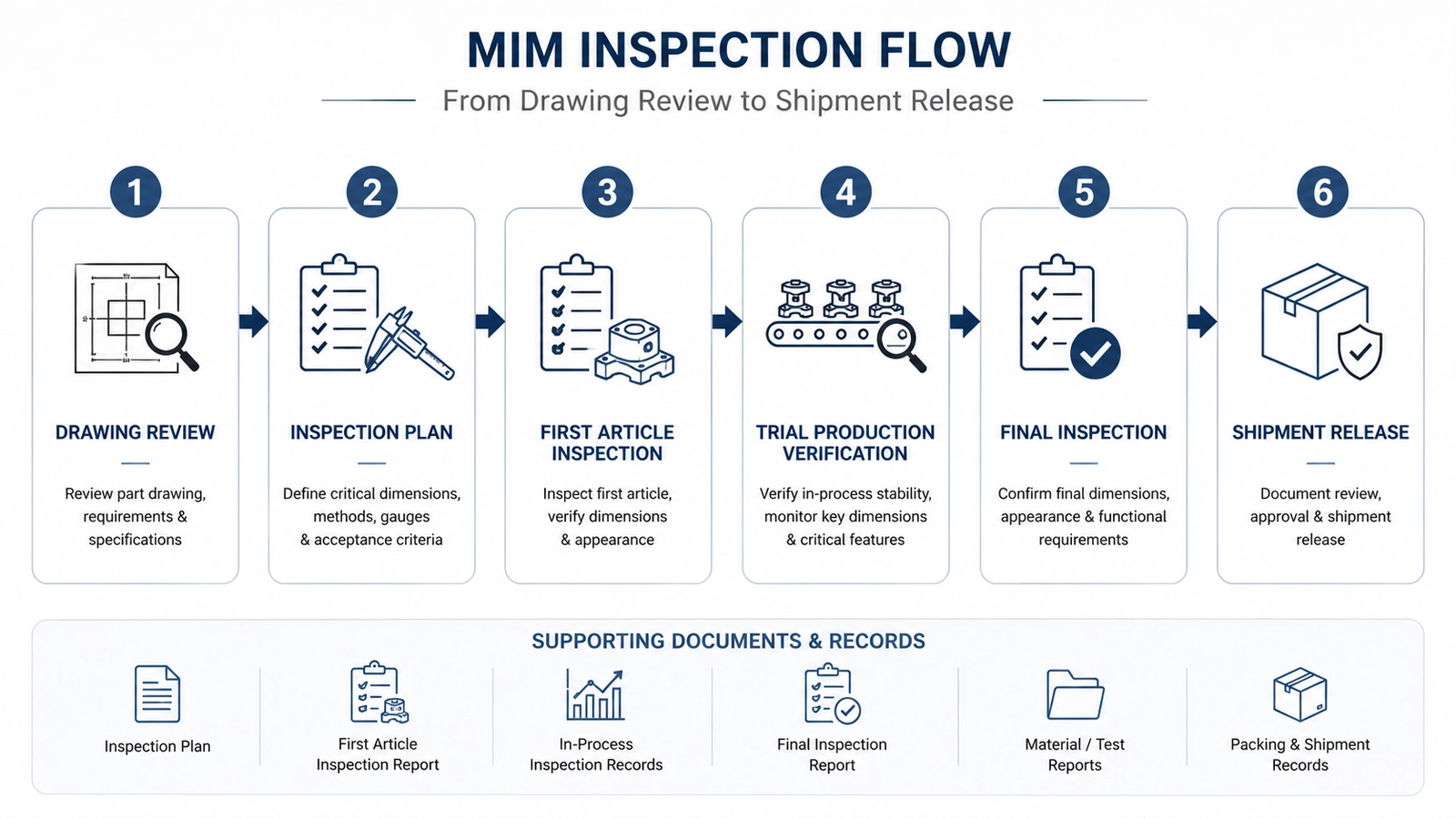
| Étape | Point d'inspection | Objectif technique |
|---|---|---|
| Examen du dessin et du cahier des charges | Dimensions critiques, références, matière, état de surface et exigences d'essai | Définir ce qui doit être inspecté avant l'approbation de l'outillage ou des échantillons |
| Inspection des échantillons / première pièce | Dimensions initiales, état de surface et caractéristiques fonctionnelles | Identifier les besoins de correction de l'outillage, du retrait ou du frittage |
| Vérification de la production d'essai | Répétabilité, variation, adéquation du montage et des jauges | Confirmer que le procédé peut soutenir une production stable |
| Contrôle en cours de fabrication | Vérifications clés du processus, revue des pièces semi-finies et contrôles par calibre | Détecter les variations avant l'expédition finale |
| Inspection finale | Dimensions, aspect, caractéristiques fonctionnelles et rapports | Confirmer l'état de préparation à l'expédition |
| Enregistrements d'expédition | Rapport d'inspection, lot de fabrication, enregistrements d'emballage et d'expédition | Assurer la traçabilité et la revue client |
Revue du dessin et des dimensions critiques
L'étape de revue du dessin doit définir quelles dimensions sont critiques et comment elles doivent être mesurées. Cela inclut les références de datum, les exigences de tolérance, les surfaces fonctionnelles, les caractéristiques d'assemblage, les exigences de surface, le grade de matériau et les exigences de test. Si le dessin est incomplet, le plan d'inspection peut être flou. Par exemple, une pièce peut avoir une exigence de position de trou serrée mais aucune structure de datum claire. Dans ce cas, le fournisseur et le client doivent s'accorder sur la méthode de mesure avant l'inspection de la première pièce.
Les exigences d'inspection doivent être examinées conjointement avec la revue de conception avant l'outillage.
Échantillon et première inspection de l'article
L'inspection d'échantillon permet de vérifier si la pièce répond aux exigences du dessin et si le procédé nécessite un ajustement avant l'essai ou la production. Pour les pièces MIM, l'inspection d'échantillon peut révéler des problèmes de compensation d'outillage, des déformations au frittage, des marques liées au point d'injection, des défauts de surface ou des besoins de calibrage après frittage.
Le but de la première inspection de l'article n'est pas seulement d'approuver ou de rejeter des pièces. Elle doit également générer un retour d'information pour la correction du moule, la compensation du retrait, le support du frittage, la révision des conditions de déliantage ou de frittage, la stratégie de calibrage ou d'usinage après frittage, et la confirmation de la méthode d'inspection. Pour plus de contexte, voir le développement de projet et le transfert en production.
Inspection de production et finale
Pendant la production, l'inspection doit confirmer que le procédé reste suffisamment stable pour respecter les critères d'acceptation convenus. Selon la pièce et les exigences du projet, l'inspection de production peut inclure des contrôles en cours de fabrication, une inspection par calibre, une inspection optique, une mesure par MMT, un examen de surface, des contrôles de dureté et une inspection finale avant expédition.
Cette section est liée à le processus de contrôle qualité de XTMIM, où les SOP, les contrôles de processus, l'inspection en cours de fabrication, les enregistrements qualité et la logique de contrôle de production sont expliqués plus en détail.
Ce que l'inspection peut révéler dans la production MIM
Les résultats d'inspection ne doivent pas être traités uniquement comme des données de conformité/non-conformité. Pour les pièces MIM, les constats d'inspection révèlent souvent où se situe le véritable risque process. Un écart dimensionnel peut être lié à la compensation d'outillage, au support de frittage, au déséquilibre géométrique ou au calibrage post-frittage. Une fissure de surface peut être liée à la manipulation de la pièce verte, aux contraintes de déliantage ou aux transitions géométriques locales. Un problème de dureté peut indiquer un problème de matériau, de frittage ou de traitement thermique.

| Constat d'inspection | Cause possible liée au MIM | Réponse technique |
|---|---|---|
| Dimension hors tolérance | Variation de retrait, compensation d'outillage, distorsion au frittage | Revoir la compensation du moule, la stratégie des cotes critiques et le support de frittage |
| Problème de planéité ou de déformation | Déséquilibre géométrique, contrainte de frittage, mauvais support | Revoir la conception du support, l'orientation de la pièce et le calibrage post-frittage |
| Déviation de trou ou de fente | Conception du noyau, direction du retrait, mouvement de frittage | Revoir la conception du noyau, la surépaisseur d'usinage et les exigences de calibrage |
| Fissure de surface | Manutention de la pièce verte, contrainte de déliantage, transition brusque | Revoir la transition de paroi, le parcours de déliantage et la méthode de manutention |
| Déviation de dureté | Variation de l'état du matériau, du frittage et du traitement thermique | Examiner le chemin du matériau, l'état du traitement thermique et les critères d'acceptation |
| Surface rugueuse | Variation du moulage, du frittage, de la finition ou du traitement de surface | Examiner l'exigence de surface et le processus de finition |
Scénario d'inspection représentatif
Le scénario suivant combine des conditions d'inspection MIM récurrentes pour une explication technique. Il n'est pas présenté comme un projet spécifique au client ou un enregistrement de production.
Quel problème s'est produit : Un petit composant MIM a passé l'inspection visuelle générale, mais une position de trou fonctionnel a montré des résultats incohérents lors de la revue d'échantillon.
Pourquoi cela s'est produit : Le dessin définissait une exigence de position serrée, mais l'interprétation de la référence et la méthode d'inspection n'étaient pas alignées suffisamment tôt. La caractéristique était également sensible au mouvement de frittage et à l'équilibre géométrique local.
Quelle était la véritable cause système : Le problème n'était pas seulement un problème de mesure. Il impliquait l'interprétation du dessin, la compensation d'outillage, le support de frittage et le retour sur le premier article.
Comment cela a été corrigé : La méthode d'inspection a été alignée sur la référence fonctionnelle, les dimensions critiques ont été revues, et la correction d'outillage ou de processus a été évaluée sur la base des données d'échantillons répétés.
Comment éviter la récurrence : Avant l'approbation de l'outillage ou de l'échantillon, les dimensions critiques doivent être identifiées, la stratégie de référence doit être convenue, et la méthode d'inspection doit être confirmée avec la revue technique.
Registres d'inspection, rapports et traçabilité
Les preuves d'inspection sont importantes pour l'évaluation des fournisseurs car elles montrent comment une usine maîtrise la réception, et pas seulement comment elle fabrique les pièces. Pour les projets MIM, la documentation peut inclure des rapports de contrôle dimensionnel, des enregistrements de première inspection, des enregistrements de contrôle en cours de fabrication, des enregistrements de contrôle final, des documents relatifs aux matériaux, des rapports d'essais de surface ou de fiabilité, et des enregistrements d'expédition.

Rapports d'inspection pour les échantillons et les lots de production
Selon les exigences du client, les rapports d'inspection peuvent inclure des rapports de première inspection, des rapports de contrôle dimensionnel, des données de mesure CMM ou OMM, des rapports d'essais de dureté ou de matériaux, des rapports d'essais de surface ou de fiabilité, des rapports de contrôle final, et des formats de rapport spécifiques au client lorsqu'ils sont convenus avant la production.
Un rapport ne doit pas seulement lister des mesures. Il doit relier la méthode de mesure à l'exigence du plan, la cote critique, la tolérance et les critères d'acceptation.
Enregistrements de processus et d'expédition
Les enregistrements de production aident à relier l'inspection finale au processus réel. Ceux-ci peuvent inclure des SOP, des enregistrements de vérification des paramètres, des enregistrements de contrôle en cours de fabrication, des enregistrements de contrôle des jauges, des enregistrements d'emballage, des enregistrements d'entreposage et des enregistrements d'expédition.
Pour les ingénieurs qualité, la traçabilité aide à répondre à quel lot a été inspecté, quelles dimensions ont été vérifiées, quels critères d'acceptation ont été utilisés, si l'inspection était liée au plan, si des essais spéciaux étaient requis, et si l'expédition a été libérée après inspection.
Quand les exigences d'inspection spéciales doivent être définies tôt
Les exigences d'inspection spéciales doivent être définies avant l'outillage, l'échantillonnage ou la planification de la production. Si un client fournit uniquement un modèle 3D sans dimensions critiques, nuance de matériau ou exigences de test, le fournisseur peut ne pas savoir quelles caractéristiques nécessitent un contrôle spécial.
| Exigence à définir | Pourquoi c'est important |
|---|---|
| Dimensions critiques | Aide à définir ce qui doit être mesuré en premier et ce qui nécessite un retour de processus plus strict. |
| Références de datum | Empêche les interprétations de mesure incohérentes entre le client, le fournisseur et l'équipe d'inspection. |
| Niveau de tolérance | Affecte le processus, la revue d'outillage, la méthode d'inspection, l'effort de correction des échantillons et le coût. |
| Surfaces fonctionnelles | Identifie les surfaces qui affectent l'assemblage, le glissement, l'étanchéité, l'apparence ou la finition aval. |
| Nuance de matériau | Détermine les exigences d'inspection liées aux matériaux, de contrôle de dureté, de traitement thermique et d'essais. |
| Exigence de dureté | Influence la planification du traitement thermique et la méthode de vérification de la dureté. |
| Exigence de finition de surface | Affecte le polissage, le grenaillage, le revêtement, les contrôles de rugosité, les échantillons d'aspect et le risque dimensionnel après finition. |
| Exigence de corrosion ou environnementale | Détermine si des essais de brouillard salin, d'humidité, de choc thermique ou d'autres tests de fiabilité sont nécessaires. |
| Critères d'acceptation esthétique | Prévient les litiges tardifs sur la qualité de surface visible, les différences de couleur, la visibilité du point d'injection ou l'état de finition. |
| Exigence d'inspection ou norme d'acceptation | Précise si le projet nécessite un rapport CMM, un rapport de dureté, une vérification des matériaux, un test de fiabilité, un format client ou toute autre preuve convenue. |
| Format du rapport | Aide à aligner la documentation avant expédition et évite les modifications tardives des exigences de preuve d'inspection. |
| Volume annuel estimé | Soutient la fréquence d'inspection, la planification des jauges, la stratégie de contrôle de production et la révision des coûts du projet. |
| Environnement d'application | Aide à décider si des tests spéciaux sont nécessaires au lieu d'ajouter des tests inutiles à chaque projet. |
Avant le devis, les clients doivent fournir le dossier de dessin, les exigences de matériau ou de performance, les caractéristiques critiques, les exigences de surface, les critères d'inspection, le volume annuel et le contexte d'application. Avant la production, les deux parties doivent confirmer la révision finale, le parcours matière, la méthode d'inspection, les critères d'acceptation, le format du rapport, la traçabilité, l'emballage et les exigences de libération pour expédition.
Pour une révision précoce, les clients peuvent soumettre les dessins pour une revue technique et d'inspection.
Envoyez votre dossier de dessins pour la planification de l'inspection
Envoyez le dossier de dessin lorsqu'une pièce comprend des dimensions critiques, des surfaces fonctionnelles, des exigences de matériau ou de dureté, des critères cosmétiques, des traitements de surface ou des besoins de test spéciaux. Incluez le dessin 2D, les données 3D disponibles, les exigences de matériau, les caractéristiques critiques, les critères d'inspection ou d'acceptation, le volume annuel et l'environnement d'application.
L'équipe technique et qualité de XTMIM peut évaluer si la pièce nécessite une inspection par MMT, une mesure optique, des tests de dureté, une vérification matière, des tests de surface, des contrôles liés à la fiabilité, des rapports d'inspection spécifiques au client ou des contrôles de libération de production avant l'outillage, l'échantillonnage ou la libération de production.
Notes de référence technique et normes
Les normes pertinentes et les références techniques peuvent soutenir les discussions sur les matériaux, les essais et l'inspection, mais elles ne doivent pas remplacer l'examen des dessins spécifiques au projet, les spécifications client ou l'évaluation des processus propres au fournisseur.
- ASTM B883 — Spécification standard pour les matériaux moulés par injection de métal: pertinent pour les matériaux MIM ferreux fabriqués en mélangeant des poudres métalliques avec des liants, par moulage par injection, déliantage, frittage et traitement thermique optionnel.
- ISO 22068:2012 — Matériaux frittés moulés par injection de métal — Spécifications: pertinent pour la spécification de la composition chimique et des propriétés mécaniques ou physiques des matériaux MIM frittés.
- ISO 2740:2023 — Matériaux métalliques frittés, à l'exclusion des métaux-durs — Éprouvettes d'essai de traction: pertinent lorsque la préparation d'éprouvettes de traction est requise pour les matériaux métalliques frittés, y compris les applications liées au MIM.
FAQ
Quelles méthodes d'inspection XTMIM utilise-t-elle pour les pièces MIM ?
XTMIM prend en charge l'inspection des pièces MIM via la mesure dimensionnelle sur plan, la mesure optique, l'inspection par MMT, le support de numérisation 3D, l'inspection visuelle, les essais de dureté, les essais de traction si nécessaire, l'examen métallographique, l'analyse XRF, les tests de rugosité et certains essais de fiabilité sélectionnés. Le plan d'inspection réel dépend du plan, des dimensions critiques, de la nuance de matériau, des exigences de surface et des critères d'acceptation du client.
XTMIM peut-il inspecter les dimensions critiques selon les plans clients ?
Oui. Les dimensions critiques peuvent être examinées à partir du dessin 2D du client et des exigences d'inspection. Pour les pièces MIM, les dimensions critiques doivent être clairement liées aux références, aux surfaces fonctionnelles, aux caractéristiques d'assemblage, aux niveaux de tolérance et au risque d'application. Si le dessin ne définit pas clairement les références de mesure, la méthode d'inspection doit être alignée avant l'approbation des échantillons.
Les inspections CMM et OMM sont-elles disponibles pour les petites pièces MIM ?
Oui. Les ressources de contrôle dimensionnel de XTMIM comprennent des équipements MMT et MMO. Le contrôle par MMT est adapté aux dimensions basées sur des références, aux positions, aux profils et aux relations fonctionnelles. Le contrôle par MMO est utile pour les petits trous, fentes, bords, contours et petites caractéristiques de précision. La meilleure méthode de contrôle doit être sélectionnée en fonction de la géométrie de la pièce et des exigences du dessin.
Des tests de dureté, de traction ou métallographiques peuvent-ils être organisés ?
Les essais de dureté, les essais de traction et l'examen métallographique peuvent être utilisés lorsque le matériau, le traitement thermique, la spécification client ou le risque lié à l'application l'exigent. Ces essais doivent être définis avant la production car la préparation des éprouvettes, la méthode d'essai, les critères d'acceptation et le format de rapport peuvent varier selon le projet.
Tous les projets MIM nécessitent-ils des tests mécaniques ou de fiabilité complets ?
Aucun test mécanique complet, test au brouillard salin, test environnemental, test d'abrasion ou examen métallographique n'est requis pour chaque projet MIM. Le périmètre des tests doit être défini en fonction du dessin, du grade de matériau, du risque fonctionnel, de l'exigence de surface, de l'environnement d'application, de la norme client et des critères d'acceptation convenus.
Les essais au brouillard salin et les tests environnementaux sont-ils requis pour chaque pièce MIM ?
Non. Les essais au brouillard salin, les tests de température et d'humidité constantes, les tests de choc thermique, les tests d'abrasion et les contrôles liés au revêtement dépendent du projet. Ils sont plus pertinents pour les pièces sensibles à la corrosion, les composants traités en surface, les pièces cosmétiques, les dispositifs portables, les pièces d'électronique grand public ou les exigences de fiabilité définies par le client.
XTMIM peut-il fournir des rapports d'inspection avant expédition ?
Les rapports d'inspection peuvent être préparés conformément au plan d'inspection convenu et aux exigences du client. Les rapports peuvent inclure, selon les besoins, des contrôles dimensionnels, une inspection de première pièce, une inspection de sortie, des vérifications de dureté ou liées aux matériaux, des tests de surface ou des résultats d'essais de fiabilité. Le format du rapport doit être confirmé avant la production.
Quelles informations les clients doivent-ils fournir pour la planification des inspections ?
Les clients doivent fournir les dessins 2D, les fichiers CAO 3D si disponibles, la nuance de matériau, les dimensions critiques, les exigences de référence, les niveaux de tolérance, les exigences de finition de surface, les critères esthétiques, les normes de test spéciales, le volume annuel estimé et le contexte d'application. Cela aide les équipes d'ingénierie et de qualité à définir un plan d'inspection pratique avant l'outillage ou la production.
Comment les retours d'inspection aident-ils à améliorer l'outillage MIM ou le contrôle du frittage ?
Le retour d'inspection peut indiquer si un problème dimensionnel, de surface, de dureté ou de planéité est lié à la compensation d'outillage, à la direction du retrait, au support de frittage, aux contraintes de déliantage, au traitement thermique ou aux conditions de finition. Cela aide l'équipe d'ingénierie à ajuster le processus au lieu de considérer l'inspection comme une simple étape de validation.