Une demande de devis MIM fiable doit inclure plus qu'un nom de pièce ou une demande de prix. Avant de demander le prix unitaire, envoyez le dessin 2D, le fichier CAO 3D, le matériau cible ou l'environnement d'application, les tolérances critiques, le volume annuel estimé, la quantité de la première commande, les exigences de finition de surface, les opérations secondaires, les besoins d'inspection et le stade actuel du projet. Ces informations aident le fournisseur à…
Une demande de devis MIM fiable doit inclure plus qu'un nom de pièce ou une demande de prix. Avant de demander le prix unitaire, envoyez le dessin 2D, le fichier CAO 3D, le matériau cible ou l'environnement d'application, les tolérances critiques, le volume annuel estimé, la quantité de la première commande, les exigences de finition de surface, les opérations secondaires, les besoins d'inspection et le stade actuel du projet. Ces informations aident le fournisseur à examiner l'adéquation MIM, le risque lié à l'outillage, le retrait de frittage, les besoins d'usinage secondaire et la charge de travail d'inspection avant l'établissement du prix. Si seule une photo ou une taille approximative est fournie, le devis peut reposer sur des hypothèses qui changeront plus tard lors de la revue DFM.
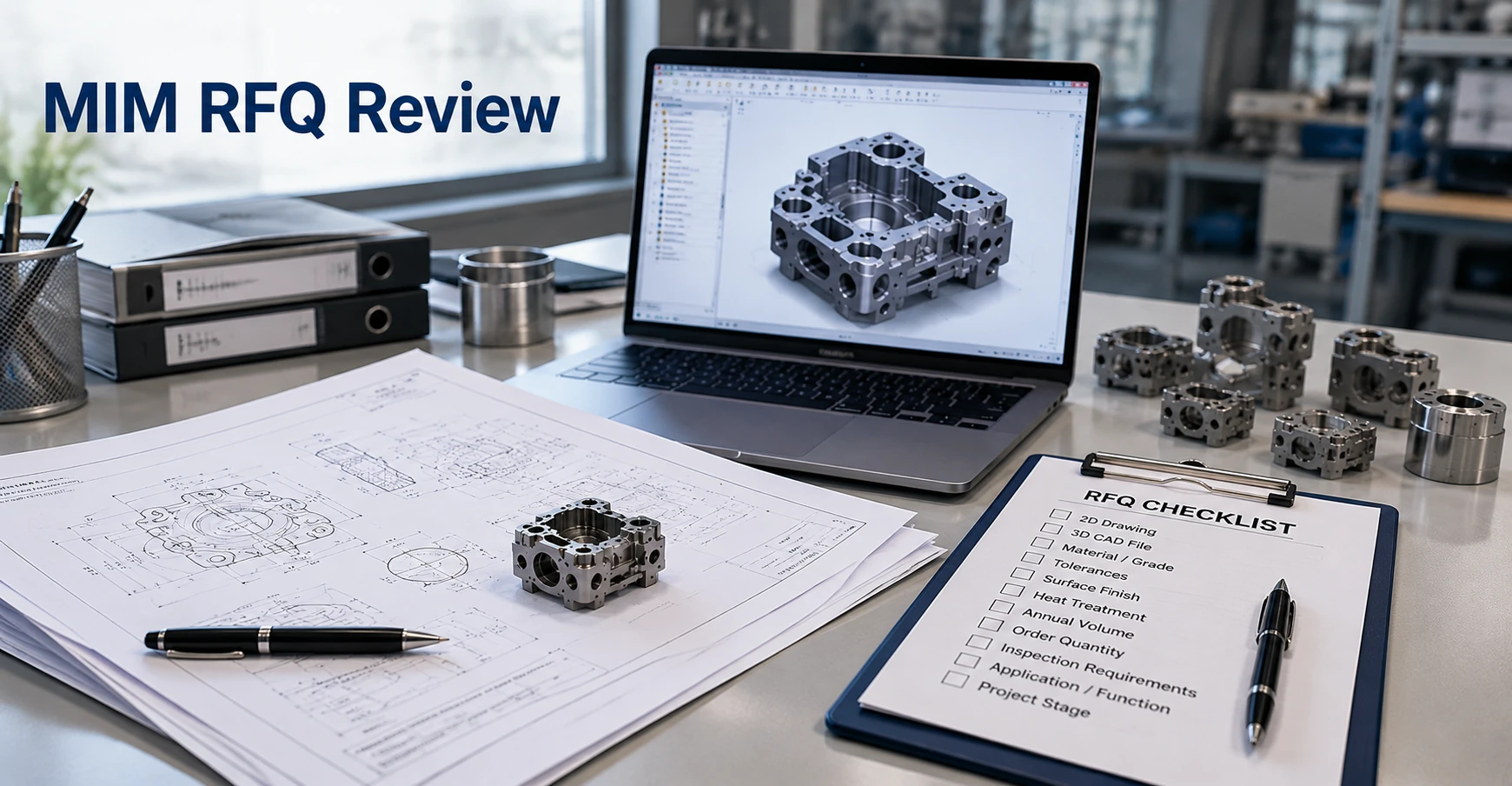
L'objectif d'un dossier de demande de devis est de passer de l'estimation de prix approximative à l'examen technique. Pour un parcours de préparation plus complet, consultez l' Guide de préparation de devis MIM.
Résumé technique : Que faut-il envoyer avant de demander un prix MIM ?
Un devis MIM devient plus fiable lorsque le fournisseur peut examiner à la fois la conception du composant et les conditions du projet qui le sous-tendent. La première demande de devis n'a pas besoin de contenir tous les documents de production, mais elle doit inclure suffisamment d'informations pour juger si la pièce peut être moulée, déliantée, frittée, inspectée et produite de manière répétée au volume attendu.
Informations minimales pour un devis MIM initial
- Dessin 2D avec niveau de révision
- Fichier CAO 3D, de préférence au format STEP
- Matériau cible ou matériau actuel
- Volume annuel estimé
- Quantité de première commande ou quantité pilote
- Exigences de tolérance critiques
- Exigences de finition de surface ou de revêtement
- Exigences de traitement thermique, le cas échéant
- Besoins d'inspection ou de documentation
- Contexte de l'application
- Procédé de fabrication actuel, si la pièce est convertie depuis l'usinage CNC, la fonderie, l'estampage, le moulage sous pression, ou un autre procédé
Informations qui rendent le devis plus stable
- Dimensions critiques pour la fonction
- Surfaces fonctionnelles
- Relation d'assemblage avec les pièces adjacentes
- Exigences en matière d'usure, de charge, de corrosion, de température ou cosmétiques
- Coût actuel ou problème de production, si disponible
- Durée de vie en production attendue
- Phase de lancement cible : prototype, présérie, ou production de masse
- Rapports d'inspection requis, première pièce inspectée (FAI), ou documentation de projet
- Exigences d'emballage, de propreté ou de manipulation, le cas échéant
La question pratique n'est pas seulement de savoir si la pièce peut être fabriquée par MIM. La question la plus importante est de savoir si la conception, le matériau, la tolérance, le volume et les exigences d'inspection correspondent à la voie du procédé MIM avant que l'investissement dans l'outillage ne commence.
| Informations pour la demande de devis | Pourquoi c'est important pour la revue MIM | Risque en cas d'absence |
|---|---|---|
| Plan 2D | Définit les tolérances, la structure des datums, les dimensions critiques, les notes de surface et les exigences d'inspection. | Le fournisseur peut établir un devis basé sur des hypothèses de tolérances incomplètes. |
| Fichier CAO 3D | Prend en charge la revue de la moulabilité, de l'épaisseur de paroi, des retraits, de l'éjection, de l'outillage et du retrait de frittage. | Les risques liés à l'outillage et les problèmes géométriques peuvent être manqués. |
| Exigence de matériau | Affecte le feedstock, le processus de frittage, le traitement thermique, la résistance à la corrosion, la résistance mécanique et la disponibilité. | Un mauvais matériau ou un alliage sur-spécifié peut être cité. |
| Volume annuel | Affecte l'amortissement de l'outillage, la stratégie de cavité, la planification de la production et la discussion du prix unitaire. | Le prix unitaire peut être trompeur ou non évolutif. |
| Finition de surface | Affecte la revue du polissage, de la passivation, du revêtement, du placage, de l'ébavurage et de l'aspect cosmétique. | Le coût des opérations secondaires peut être exclu. |
| Besoins d'inspection | Affecte l'inspection par MMT, la FAI, l'échantillonnage, la documentation et la charge de travail qualité. | Le coût qualité peut être sous-estimé. |
| Contexte de l'application | Aide le fournisseur à évaluer le risque lié au matériau, aux tolérances, à la surface et aux défaillances. | Le fournisseur peut ignorer les exigences fonctionnelles réelles. |
Que se passe-t-il si des informations clés de la demande de devis (RFQ) sont manquantes ?
Les informations RFQ manquantes retardent généralement non seulement la communication. Elles modifient les hypothèses sous-jacentes au devis. Pour les projets MIM, ces hypothèses peuvent affecter la conception de l'outillage, la sélection des matériaux, la compensation du retrait, la charge de travail d'inspection, et si les caractéristiques sélectionnées doivent rester telles quelles après frittage ou être usinées après frittage.
| Entrée manquante | Hypothèse typique de devis | Impact technique ou économique potentiel | Meilleure façon de l'envoyer |
|---|---|---|---|
| Pas de dessin 2D | Le fournisseur peut considérer les dimensions comme une simple référence. | Les tolérances critiques, les données de référence, les exigences de surface et d'inspection peuvent être ignorées. | Envoyer le dessin avec la révision, les dimensions critiques, les notes sur les matériaux et les notes d'inspection. |
| Aucun fichier CAO 3D | Le fournisseur ne peut estimer la géométrie qu'à partir de vues de dessin ou d'images. | Les dépouilles, les transitions d'épaisseur de paroi, les options de point d'injection, le risque d'éjection et la difficulté d'outillage peuvent être sous-estimés. | Envoyez un fichier STEP ou un autre fichier CAO neutre avec la dernière géométrie. |
| Volume annuel non spécifié | Le fournisseur peut établir un devis basé sur un lot unique ou une quantité par défaut approximative. | L'amortissement de l'outillage, la stratégie de cavité, le coût unitaire et la planification de la production peuvent ne pas correspondre au projet réel. | Envoyez la quantité de la première commande, la quantité pilote et la plage de volume annuel attendue. |
| Aucun contexte matériau ou applicatif | Le fournisseur peut proposer une famille de matériaux courante sans comprendre les besoins de performance. | Les exigences de corrosion, d'usure, de dureté, de résistance, magnétiques ou thermiques peuvent être mal évaluées. | Envoyez le matériau cible, le matériau actuel ou l'environnement de performance. |
| Aucune exigence de finition de surface ou d'opération secondaire | Le fournisseur peut proposer un prix pour la pièce brute de frittage uniquement. | Les coûts de polissage, de passivation, de traitement thermique, d'usinage, de revêtement ou d'inspection pourront être ajoutés ultérieurement. | Indiquez si la cotation doit couvrir les pièces brutes de frittage, semi-finies ou finies. |
Quand cette liste de contrôle est suffisante : Elle est généralement suffisante pour un examen initial de faisabilité ou une orientation de devis approximatif. Quand elle n'est pas suffisante : une cotation d'outillage formelle, une approbation de production, un PPAP client, des applications réglementées et des tolérances fonctionnelles serrées peuvent nécessiter des plans de dessin, des plans d'inspection, des spécifications de matériaux et des exigences d'approbation plus complets.
Prochaine étape pratique : Si vous avez déjà un dossier de plans, vous pouvez soumettez votre dessin pour examen afin que la demande de devis puisse être vérifiée pour l'aptitude MIM avant une tarification formelle. Pour une préparation de projet plus large, vous pouvez également consulter le Listes de contrôle de projet MIM.
Pourquoi un prix MIM ne peut pas être fiable à partir d'une seule photo
Une photo peut lancer une conversation, mais elle ne peut pas définir les informations qui régissent un devis MIM. Elle ne montre pas la géométrie complète, les caractéristiques internes, la distribution de l'épaisseur des parois, les exigences de tolérance, les références de datum, la nuance du matériau, l'état de surface, la méthode d'inspection ou le volume de production.
D'un point de vue de la revue de conception, le prix MIM dépend de plus que la forme. Le fournisseur doit comprendre si la pièce peut être moulée par injection avec un placement de point d'injection approprié, si la pièce brute peut être manipulée sans dommage, si le déliantage et le frittage peuvent créer une déformation, et si le retrait peut être compensé par l'outillage. Le MIMA décrit la voie MIM comme un processus impliquant la préparation du feedstock, le moulage par injection, les pièces brutes, le déliantage et le frittage, c'est pourquoi le prix ne peut être dissocié de la revue du processus. Aperçu du processus MIMA
| L'acheteur n'envoie qu'une photo | L'acheteur envoie un dessin + CAO + exigences |
|---|---|
| Le fournisseur ne peut qu'estimer l'apparence et la taille approximative. | Le fournisseur peut examiner la géométrie, les dimensions, les tolérances et les besoins d'application. |
| Aucune base de tolérance. | Les dimensions critiques peuvent être examinées. |
| Aucune confirmation de matériau. | Le feedstock, le frittage et le traitement thermique peuvent être discutés. |
| Pas de volume annuel. | La stratégie d'outillage et de production peut être jugée plus réalistement. |
| Risque plus élevé de révision ultérieure des prix. | Base de devis plus stable. |
| Utile uniquement pour la discussion préliminaire. | Convient pour la revue d'ingénierie et le devis formel. |
En pratique, une demande de devis basée uniquement sur des photos doit être traitée comme une demande de présélection. Elle peut aider le fournisseur à déterminer si le MIM mérite d'être exploré, mais elle ne doit pas servir de base pour un prix final, une décision d'outillage ou une comparaison de fournisseurs.
Dessin 2D vs CAO 3D : Pourquoi les deux sont nécessaires pour une demande de devis MIM
De nombreux acheteurs envoient un fichier CAO 3D et demandent immédiatement un prix. C'est utile, mais pas toujours suffisant. Un modèle 3D explique la géométrie. Un dessin 2D explique les exigences d'ingénierie associées à cette géométrie. Pour le devis MIM, les deux sont importants.

Un dossier de demande de devis complet comprend généralement les deux fichiers car la géométrie seule ne définit pas les exigences de qualité, et les notes de dessin seules peuvent ne pas fournir suffisamment d'informations pour la revue de l'outillage et du retrait.
Ce que le dessin 2D indique au fournisseur
Un dessin 2D aide le fournisseur à comprendre :
- Dimensions globales
- Dimensions critiques
- Structure de référence
- Tolérances géométriques, si spécifiées
- Exigences de filetage, de trou, de fente et de rainure
- Exigences de planéité, de concentricité, de perpendicularité ou de parallélisme
- Notes sur la rugosité de surface
- Notes sur le traitement thermique
- Spécification du matériau
- Niveau de révision
- Exigences d'inspection
- Zones fonctionnelles ou cosmétiques
En production, le dessin 2D détermine souvent si une pièce peut être chiffrée telle quelle après frittage, si des caractéristiques sélectionnées nécessitent un usinage secondaire, ou si la stratégie de tolérancement doit être revue avant l'outillage.
Ce que le fichier CAO 3D indique au fournisseur
Un fichier CAO 3D aide le fournisseur à examiner :
- Géométrie complète
- Distribution de l'épaisseur des parois
- Sections minces
- Contre-dépouilles
- Caractéristiques internes
- Options de ligne de joint
- Possibilités de position d'alimentation
- Risque d'éjection
- Besoins de supports de frittage
- Référence de compensation d'outillage
- Interférence avec les composants d'assemblage, si les fichiers d'assemblage sont fournis
Le guide de conception de MIMA explique que la justification du MIM repose souvent sur l'intersection de la complexité de la forme, des performances du matériau, de la quantité de production et du coût du composant. C'est pourquoi le fournisseur a besoin d'informations de conception suffisantes pour juger à la fois de la géométrie et de l'économie, et pas seulement de l'apparence de la pièce. MIMA Designing with MIM
Quand un seul fichier ne suffit pas
Un fichier 3D sans dessin 2D peut montrer la forme mais pas la tolérance. Un dessin 2D sans CAO 3D peut montrer les dimensions mais pas la géométrie complète. Une photo sans aucun fichier ne peut soutenir qu'une conversation de faisabilité approximative.
| Question lors de la revue RFQ | Meilleure source d'information | Pourquoi c'est important |
|---|---|---|
| Quelle est la dernière géométrie ? | Fichier CAO 3D | La revue de l'outillage, des points d'injection, de l'éjection, de l'épaisseur de paroi et du retrait dépend de la géométrie complète. |
| Quelles dimensions sont fonctionnellement importantes ? | Plan 2D | Les tolérances critiques, les plans de référence et les exigences d'inspection sont généralement contrôlés par les notes de dessin. |
| Quelles surfaces doivent être cosmétiques ou fonctionnelles ? | Dessin 2D plus notes d'application | Les exigences de finition de surface, de polissage, de revêtement ou d'opérations secondaires peuvent modifier la portée du devis. |
| La pièce peut-elle être laissée telle quelle après frittage ? | Dessin 2D plus revue CAO | Certaines dimensions peuvent être adaptées telles quelles après frittage, tandis que des caractéristiques sélectionnées peuvent nécessiter un usinage après frittage. |
| La conception nécessite-t-elle une clarification DFM avant l'outillage ? | Dessin 2D, CAO et contexte du projet combinés | La fabricabilité MIM dépend de la géométrie, de la tolérance, du matériau, du volume et des exigences d'inspection combinés. |
Pour une demande de devis formelle, le dossier le plus complet comprend : Un dessin 2D pour les tolérances et les exigences, un fichier CAO 3D pour la géométrie et la revue de l'outillage, et des notes de demande de devis pour le volume, l'application, l'état de surface, l'inspection et le stade du projet.
Si la conception est encore en cours de finalisation, la Guide de conception MIM peut aider votre équipe à examiner la géométrie, l'épaisseur des parois, les trous, les dépouilles, le retrait et la stratégie de tolérancement avant la discussion sur l'outillage.
Exigences relatives au matériau, à l'application et aux performances à inclure
Les informations sur le matériau doivent être incluses dans la demande de devis, mais les acheteurs n'ont pas toujours besoin de connaître le grade final du matériau MIM dès la première demande. Si le grade est déjà confirmé, envoyez-le. Si le matériau est encore en cours d'évaluation, envoyez plutôt les conditions d'application et les exigences de performance.
Si le grade du matériau est confirmé
Envoyez le grade ou la famille de matériaux, tels que :
Acier inoxydable Acier faiblement allié Acier à outils Alliage de tungstène Alliage de titane Alliage cobalt-chrome Alliage magnétique Alliage de nickel
Si la pièce est convertie à partir de l'usinage CNC ou de la fonderie, envoyez également le matériau actuel. Cela aide le fournisseur à juger si un équivalent MIM est réalisable ou si le grade sélectionné peut nécessiter un ajustement.
Si le matériau n'est pas confirmé
Envoyez les exigences fonctionnelles :
- Résistance à la corrosion
- Résistance à l'usure
- Résistance
- Dureté
- Réponse magnétique
- Résistance à la chaleur
- Exigence de biocompatibilité, le cas échéant
- Exigence de surface cosmétique
- Exposition chimique
- Condition de charge de contact ou de friction
Ceci est important car le choix du matériau affecte la disponibilité du feedstock, le comportement au frittage, le traitement thermique, le traitement de surface et le coût. MIMA note que les poudres MIM varient en chimie, taille de particule et forme de particule, et que la disponibilité de la poudre affecte les matériaux techniques qui peuvent être produits par MIM. Gamme de matériaux MIMA
Évitez de sur-spécifier le matériau sans contexte d'application
Une erreur courante dans les RFQ est de spécifier un alliage haute performance sans expliquer l'exigence de charge, de corrosion, d'usure, magnétique, de température ou cosmétique qui la sous-tend. Dans certains projets, l'alliage sélectionné est nécessaire. Dans d'autres, l'acheteur peut reprendre une nuance de matériau CNC qui n'est pas l'option MIM la plus pratique. Le contexte de l'application aide le fournisseur à examiner si la direction du matériau est réaliste avant l'outillage.
Pour des options de matériaux plus larges, consultez la matériaux MIM page.
Tolérances, dimensions critiques et exigences d'inspection
Les informations sur les tolérances sont l'une des parties les plus importantes d'une RFQ MIM. Elles affectent la revue de l'outillage, le risque de frittage, les opérations secondaires, la méthode d'inspection et la précision du devis.

Si les dimensions critiques ne sont pas marquées tôt, le fournisseur peut ne pas savoir quelles caractéristiques nécessitent un contrôle de processus plus strict, une usinage secondaire, un contrôle fonctionnel ou un rapport d'inspection.
Marquer les dimensions critiques au lieu de resserrer chaque dimension
Un problème courant lors de l'établissement des devis est que chaque dimension sur le dessin se voit attribuer une tolérance serrée. Cela peut donner l'impression que la pièce est mieux contrôlée, mais cela crée souvent de la confusion lors de l'examen de la demande de devis (RFQ). Toutes les dimensions n'affectent pas la fonction. Si toutes les dimensions sont traitées comme critiques, le fournisseur peut supposer qu'une inspection supplémentaire, une correction de l'outillage ou un usinage secondaire est nécessaire.
Une meilleure RFQ sépare :
- Dimensions critiques pour la fonction
- Dimensions d'assemblage
- Dimensions cosmétiques
- Dimensions de référence non critiques
- Caractéristiques qui peuvent rester telles que sorties du frittage
- Caractéristiques qui peuvent nécessiter un usinage secondaire
Du point de vue du processus MIM, la question importante n'est pas seulement de savoir si une tolérance peut être mesurée. La question clé est de savoir si elle peut être contrôlée par le moulage, le déliantage, le frittage, le support, la compensation de l'outillage et l'inspection sans créer de coûts inutiles ou de risque de rendement.
Exigences d'inspection à envoyer avec la RFQ
Envoyez les exigences d'inspection si elles sont connues :
- Exigence de contrôle par MMT
- Exigence de premier article
- Critères d'inspection visuelle
- Exigence de finition de surface
- Exigence de dureté
- Exigence de densité ou de propriétés mécaniques, si pertinent
- Rapport de dimensions critiques
- Exigence d'échantillonnage
- Certificat matière ou documentation de conformité, si requis par le projet
Pourquoi les exigences d'inspection affectent la précision du devis
L'inspection n'est pas seulement une activité qualité après production. Elle affecte la préparation du devis. Si la pièce nécessite des rapports MMT pour de nombreuses caractéristiques, la conception de calibres fonctionnels, une inspection visuelle 100%, une documentation spéciale ou une vérification post-traitement, ces exigences doivent être connues avant la cotation.
Si les exigences d'inspection ne sont pas partagées tôt, le prix unitaire devisé peut exclure un travail qui devient obligatoire plus tard.
Volume Annuel, Quantité de Première Commande et Stade du Projet
Le volume annuel est l'une des données les plus importantes dans une demande de devis MIM. Le MIM implique généralement des outillages et des mises en place d'ingénierie, le fournisseur doit donc savoir si le projet est un test de prototype, une série pilote ou un programme de production répétée.
Pourquoi le volume annuel est plus important que la quantité ponctuelle
Une première commande peut être petite, mais le volume annuel peut être important. Ou un acheteur peut demander un petit lot sans expliquer que le projet est encore en phase de validation. Ce sont des situations différentes.
Le volume annuel affecte :
- Amortissement de l'outillage
- Nombre de cavités du moule
- Planification de la production
- Planification de l'inspection
- Achat de matériaux
- Planification des opérations secondaires
- Discussion sur les coûts à long terme
- La pertinence économique du MIM
Les directives de conception de MIMA relient également l'adéquation du MIM à la quantité de production et au coût des composants, ce qui soutient la nécessité d'envoyer des informations sur le volume lors de la préparation d'une demande de devis (RFQ). MIMA Designing with MIM
Ce qu'il faut envoyer si le projet est encore à un stade précoce
Si le volume annuel n'est pas définitif, envoyez une fourchette :
- Quantité de prototype
- Quantité pilote
- Volume annuel estimé
- Durée de vie attendue du produit
- Date de lancement cible
- Procédé actuel
- Raison principale de l'évaluation du MIM
Note d'exemple pour une demande de devis : “ Nous évaluons actuellement le MIM pour cette pièce. La première quantité d'essai peut être faible, mais la demande annuelle attendue pourrait atteindre une production à volume moyen après validation. Veuillez examiner si le MIM est adapté avant toute discussion formelle sur l'outillage. ”
Cela donne au fournisseur suffisamment de contexte pour éviter de deviser le projet comme un petit lot unique. Pour une discussion plus approfondie des coûts, voir coût du moulage par injection de métal.
Finition de surface, traitement thermique et opérations secondaires
Le MIM peut souvent produire des pièces de forme quasi-finale, mais de nombreux projets nécessitent encore des opérations secondaires. Celles-ci doivent être mentionnées dans la demande de devis car elles peuvent affecter le coût, le délai de livraison, l'inspection et la planification de la production.
Opérations secondaires à mentionner
Envoyer les exigences pour :
- Polissage
- Passivation
- Placage
- Revêtement
- Traitement thermique
- Usinage des caractéristiques critiques
- Taraudage
- Perçage
- Rectification
- Ébavurage
- Marquage laser
- Assemblage
- Assemblage
- Nettoyage
- Contrôle de l'aspect de surface
MIMA note que les composants MIM peuvent utiliser des opérations secondaires telles que l'usinage, le taraudage, le perçage, la rectification, le traitement thermique, l'assemblage et les traitements de surface, et que ces opérations peuvent augmenter le coût des composants. Opérations secondaires MIMA
Pourquoi ces exigences doivent être envoyées avant l'établissement du prix
Si un acheteur demande un prix pour la pièce frittée uniquement, mais exige plus tard un polissage, une passivation, un traitement thermique ou un usinage, le coût final et le délai de livraison peuvent changer. Lors de la revue de la demande de prix (RFQ), le fournisseur doit savoir si le devis doit couvrir :
- Pièce brute de frittage uniquement
- Pièce brute de frittage plus usinage secondaire sélectionné
- Pièce entièrement finie
- Pièce finie avec rapport d'inspection
- Pièce finie prête pour l'assemblage
Plus ces informations sont claires, moins le devis nécessitera de révisions majeures ultérieurement.
Erreurs courantes dans les demandes de devis (RFQ) qui entraînent des devis MIM erronés ou retardés
Un devis retardé n'est souvent pas causé par une réponse lente du service commercial. Dans de nombreux cas, le fournisseur ne peut pas établir de devis de manière responsable car des informations techniques clés sont manquantes.
| Erreur de RFQ | Pourquoi cela présente un risque pour le devis | Meilleure saisie pour la RFQ |
|---|---|---|
| Envoi d'une seule photo | La géométrie, la tolérance, le matériau et le volume ne peuvent pas être vérifiés. | Envoyer un dessin 2D, une CAO 3D, le matériau et la quantité. |
| Envoi d'une CAO 3D sans tolérances 2D | Le fournisseur voit la forme mais pas les exigences fonctionnelles. | Ajouter des notes de dessin et les dimensions critiques. |
| Tolérance serrée sur chaque dimension | Le devis peut inclure une inspection ou une usinage inutile. | Marquer les dimensions critiques et utiliser des tolérances générales raisonnables. |
| Volume annuel non spécifié | L'amortissement de l'outillage et la stratégie de cavité ne peuvent pas être jugés. | Fournir la demande annuelle ou la fourchette attendue. |
| Aucun contexte matériel | Le matériau peut être sur-spécifié ou inadapté au MIM. | Envoyer le grade du matériau ou l'environnement d'application. |
| Aucune exigence de finition de surface | Le polissage, le placage, la passivation ou le revêtement peuvent être exclus. | Indiquer l'état final de la surface. |
| Aucune exigence d'inspection | La charge de travail de qualité peut être sous-estimée. | Indiquer les besoins en CMM, FAI, inspection visuelle ou documentation. |
| Comparer le prix MIM et CNC uniquement | L'économie du MIM dépend de l'outillage et du volume de production. | Expliquer le processus actuel et la cible de production. |
Scénario de terrain composite pour la formation en ingénierie : Demande de prix (RFQ) basée uniquement sur une photo
Quel problème s'est produit : Un acheteur a demandé un prix MIM en utilisant uniquement une photo d'un petit support métallique et une taille approximative.
Pourquoi cela s'est produit : La photo montrait la forme de la pièce, mais pas les exigences de tolérance, le matériau, l'épaisseur de paroi, les surfaces fonctionnelles, ni le volume annuel.
Quelle était la véritable cause système : La demande de prix a été traitée comme une demande de prix avant d'être traitée comme une revue de fabrication. Le fournisseur n'a pas pu juger si la pièce était adaptée au MIM, si la géométrie nécessitait des modifications d'outillage, ou si des caractéristiques nécessitaient un usinage secondaire.
Comment cela a été corrigé : L'acheteur a ensuite fourni un dessin 2D, un fichier STEP, une exigence de matériau, un volume annuel estimé et a marqué les dimensions critiques. Le fournisseur a alors pu examiner l'adéquation au MIM et clarifier si les caractéristiques sélectionnées devaient rester telles qu'issues du frittage ou être usinées après frittage.
Comment éviter la récurrence : Avant de demander un prix, envoyez le dossier de plans et le contexte du projet. Une photo peut lancer une conversation, mais elle ne doit pas servir de base à un devis MIM formel.
Dossier RFQ minimum vs Dossier RFQ prêt pour la production
Tous les acheteurs n'ont pas les informations complètes dès la première demande. C'est normal. L'essentiel est d'identifier le stade du projet et d'envoyer le bon niveau d'information.

Les acheteurs n'ont pas besoin d'une documentation parfaite dès la première conversation, mais ils doivent clarifier le stade du projet. Un dossier RFQ plus complet aide le fournisseur à examiner plus précisément la faisabilité de l'outillage, des tolérances, des matériaux, de l'inspection et de la production.
| Stade RFQ | Adapté à | Que envoyer | Ce que le fournisseur peut examiner |
|---|---|---|---|
| Dossier RFQ minimum | Faisabilité précoce et orientation de devis approximatif | Dessin 2D, CAO 3D, idée de matériau, quantité estimée | Adéquation MIM de base, orientation de coût approximative, risques géométriques évidents |
| Dossier d'examen technique | Avant discussion sur l'outillage | Dimensions critiques, application, état de surface, besoins d'inspection, processus actuel | Risque DFM, adéquation du matériau, risque de tolérance, besoins d'opérations secondaires |
| Dossier RFQ prêt pour la production | Comparaison formelle des fournisseurs ou sourcing | Dossier de plans complet, CAO, spécification des matériaux, volume annuel, plan d'inspection, processus d'approbation, notes d'emballage | Devis, stratégie d'outillage, planification qualité, faisabilité de production |
Quel dossier envoyer ?
- Utilisez un dossier RFQ minimum si vous demandez : “ Le MIM est-il envisageable pour cette pièce ? ”
- Utilisez un dossier d'analyse technique si vous demandez : “ Quels risques de conception, de matériau, de tolérance ou d'outillage doivent être examinés avant l'outillage ? ”
- Utilisez un dossier RFQ prêt pour la production si vous demandez : “ Ce fournisseur peut-il fournir un devis formel pour comparaison ou planification de production ? ”
Comment XTMIM examine une RFQ MIM avant devis
Une revue RFQ utile ne doit pas commencer uniquement par le prix unitaire. Pour les pièces MIM, l'équipe d'ingénierie doit d'abord vérifier si la pièce est adaptée au processus et si des hypothèses nécessitent des clarifications avant la cotation.

Les informations manquantes sur le matériau, la tolérance, le volume ou la surface entraînent souvent des révisions de devis. Un flux de travail de revue simple aide les acheteurs à voir où leurs entrées RFQ s'intègrent dans le processus d'ingénierie du fournisseur.
Une revue RFQ MIM typique comprend :
- Vérification de l'exhaustivité du dessin et de la CAO
- Revue de l'adéquation au processus MIM
- Examen du matériau et de l'application
- Revue des risques liés à l'épaisseur de paroi, aux dépouilles, aux trous, aux fentes et aux caractéristiques
- Revue des risques liés aux tolérances et au retrait de frittage
- Revue de la faisabilité de l'outillage, des points d'injection, de la ligne de joint et de l'éjection
- Revue des risques de déformation lors du déliantage et du frittage
- Revue des opérations secondaires et de l'état de surface
- Revue de l'inspection et de la documentation
- Clarification de la demande de devis avant tarification
Ce processus permet d'identifier les questions auxquelles il faut répondre avant la fabrication de l'outillage, telles que :
- Le matériau sélectionné est-il adapté au MIM ?
- Les dimensions critiques sont-elles réalistes à l'état fritté ?
- Certaines caractéristiques sont-elles mieux usinées après frittage ?
- Le volume annuel justifie-t-il l'outillage MIM ?
- La conception actuelle risque-t-elle de se déformer pendant le déliantage ou le frittage ?
- Les exigences de surface ou d'inspection sont-elles manquantes dans la demande de devis ?
Pour plus de détails sur la revue de projet côté fournisseur, visitez Capacité de revue d'ingénierie XTMIM.
Modèle simple d'e-mail pour demande de devis MIM
Utilisez la structure suivante lors de l'envoi d'une demande de devis MIM. Le but n'est pas de forcer un long e-mail, mais de donner au fournisseur suffisamment de contexte technique pour examiner la pièce avant la tarification.
Subject: RFQ for MIM Part – Drawing and CAD Attached

Hello XTMIM Engineering Team,

We are evaluating metal injection molding for the attached part. Please review whether this design is suitable for MIM before quotation.

Attached files:
- 2D drawing with revision level
- 3D CAD file
- Any available sample photos or assembly references

Project information:
- Target material: [insert grade or material family]
- Application environment: [insert load, wear, corrosion, temperature, cosmetic, or assembly requirements]
- Estimated annual volume: [insert range or quantity]
- First order or trial quantity: [insert quantity]
- Critical dimensions: [mark on drawing or describe]
- Surface finish / coating / heat treatment: [insert requirement]
- Inspection or documentation needs: [insert requirement]
- Current process, if applicable: [CNC / casting / stamping / die casting / other]
- Main project goal: [cost review / miniaturization / assembly reduction / material performance / production scale-up]

Please review MIM feasibility, material suitability, tolerance risk, tooling considerations, secondary operation needs, and any questions that should be clarified before pricing.

Best regards,
[Name / Company]
Note d'ingénierie : Tolérances serrées sur chaque dimension
Quel problème s'est produit : Un acheteur a envoyé un dessin complet mais a appliqué des tolérances serrées sur presque toutes les dimensions.
Pourquoi cela s'est produit : L'acheteur souhaitait éviter les risques de qualité, mais n'avait pas distingué les dimensions fonctionnelles des dimensions non critiques.
Quelle était la véritable cause système : Le dessin ne communiquait pas quelles dimensions contrôlaient l'assemblage ou la performance. Lors de la revue de la demande de devis (RFQ), le fournisseur a dû supposer que de nombreuses caractéristiques pourraient nécessiter une inspection supplémentaire ou un usinage secondaire.
Comment cela a été corrigé : L'acheteur a marqué les dimensions critiques, clarifié les surfaces d'accouplement et autorisé une tolérance générale raisonnable pour les caractéristiques non critiques. Le fournisseur a ainsi pu distinguer les dimensions après frittage des caractéristiques pouvant nécessiter un usinage post-frittage ou une inspection plus rigoureuse.
Comment éviter la récurrence : Avant la demande de prix, marquez les dimensions critiques pour la fonction et expliquez la relation d'assemblage. Une tolérance serrée doit être utilisée là où elle protège la fonction, et non comme réglage par défaut pour chaque caractéristique.
Liste de contrôle de préparation pour la demande de prix avant de contacter XTMIM
Avant d'envoyer une demande de prix MIM, vérifiez si votre dossier fournit suffisamment d'informations au fournisseur pour séparer l'examen de faisabilité, la discussion des coûts, la planification de l'outillage et le risque de production. Si certains éléments ne sont pas encore disponibles, indiquez-le clairement au lieu de laisser le fournisseur supposer.
Fichiers de conception
- Dessin 2D avec niveau de révision
- Fichier CAO 3D, de préférence au format STEP
- Dimensions critiques marquées
- Référence d'assemblage si disponible
Exigences techniques
- Matériau cible ou besoin de performance
- Exigence d'état de surface ou de revêtement
- Traitement thermique ou exigence de dureté
- Besoins d'inspection et de documentation
Contexte commercial
- Quantité de prototype ou pilote
- Volume annuel estimé
- Phase du projet et calendrier de lancement
- Procédé de fabrication actuel, si conversion vers MIM
Meilleure pratique : Si le projet est encore à un stade précoce, envoyez les fichiers disponibles et expliquez ce qui n'est pas encore décidé. Un “ inconnu ” clair est préférable à l'omission des exigences de matériau, de tolérance, de volume ou de finition de surface.
Si votre dossier de demande de prix est prêt pour une tarification formelle, vous pouvez demander un devis MIM formel. Si la pièce nécessite toujours une revue de fabricabilité, utilisez Soumettre un plan pour revue d'abord.
FAQ : Envoi d'informations pour une demande de prix MIM
Puis-je demander un devis MIM sans dessin 2D ?
Oui, mais uniquement pour une discussion préliminaire de faisabilité. Un devis MIM fiable nécessite généralement un dessin 2D, car le fournisseur doit examiner les tolérances, les références de datum, les dimensions critiques, les notes de matériau, les exigences de surface et les besoins d'inspection. Sans dessin, le prix peut être basé sur des hypothèses qui changeront ultérieurement lors de la revue technique.
Un fichier CAO 3D est-il suffisant pour un devis MIM ?
Un fichier CAO 3D est très utile pour examiner la géométrie, l'épaisseur de paroi, les contre-dépouilles, la faisabilité de l'outillage et la compensation du retrait. Cependant, il ne définit généralement pas toutes les exigences de tolérance, d'inspection, d'état de surface, de matériau et fonctionnelles. Pour une demande de devis plus complète, envoyez à la fois le fichier CAO 3D et le dessin 2D.
Pourquoi le volume annuel est-il important pour le prix des pièces MIM ?
Le MIM nécessite généralement un outillage et une configuration technique. Le volume annuel influence l'amortissement de l'outillage, la stratégie d'empreintes, l'achat de matières premières, la planification de production, la charge d'inspection et la discussion sur le prix unitaire. Une petite commande initiale peut rester raisonnable si le volume annuel attendu justifie la production par MIM.
Et si le matériau n'est pas encore confirmé ?
Si le matériau final n'est pas confirmé, transmettez l'environnement d'application et les exigences de performance. Par exemple, expliquez si la pièce nécessite une résistance à la corrosion, une résistance à l'usure, une résistance mécanique, une dureté, une réponse magnétique, une résistance thermique ou une qualité de surface esthétique. Le fournisseur pourra alors examiner les orientations possibles en matière de matériaux MIM.
Dois-je envoyer les informations sur les coûts actuels d'usinage CNC ou de fonderie ?
Si le projet est converti depuis l'usinage CNC, la fonderie, le moulage sous pression, l'emboutissage ou un autre procédé, les coûts actuels et les problèmes de production peuvent aider le fournisseur à comprendre l'objectif du projet. Cependant, le prix MIM doit toujours être évalué en fonction de la géométrie, du matériau, de la tolérance, du volume, de l'outillage, des opérations secondaires et des exigences d'inspection.
Quelles informations permettent d'éviter un retard de devis ?
Envoyez un dossier de demande de devis complet : plan 2D, fichier CAO 3D, exigences de matériau ou d'application, tolérances critiques, volume annuel, quantité de première commande, état de surface, traitement thermique, besoins d'inspection et stade du projet. Des informations manquantes entraînent souvent des demandes de clarification répétées avant l'établissement du prix.
Puis-je envoyer un dossier RFQ minimal pour un examen de faisabilité préliminaire ?
Oui. Si le projet est encore à un stade précoce, un dossier RFQ minimal peut suffire pour une étude de faisabilité. Envoyez le plan 2D disponible, le fichier CAO 3D, l'idée de matériau, la quantité estimée et les notes d'application. Indiquez également quelles exigences ne sont pas encore décidées afin que le fournisseur ne considère pas les hypothèses comme des données définitives pour le devis.
XTMIM peut-il analyser la fabricabilité avant le devis ?
Oui. Pour les projets MIM, la revue de fabricabilité doit avoir lieu avant l'établissement formel du prix lorsque la pièce présente des risques liés à la géométrie, aux tolérances, au matériau ou au volume de production. Envoyez les dessins, fichiers CAO, exigences matérielles, tolérances, état de surface, besoins d'inspection, volume annuel et contexte d'application pour analyse.
Préparez votre demande de prix MIM pour l'examen technique
Si vous préparez une demande de devis MIM (RFQ), envoyez votre dessin 2D, fichier CAO 3D, matériau cible ou environnement d'application, tolérances critiques, volume annuel, exigences de finition de surface, besoins en opérations secondaires, exigences d'inspection et étape du projet.
XTMIM peut examiner si votre pièce est adaptée au MIM, si la géométrie présente des risques d'outillage ou de frittage, si le matériau sélectionné est réalisable, si les dimensions critiques peuvent nécessiter un usinage secondaire, et quelles informations doivent être clarifiées avant l'outillage, la production pilote ou la production répétée.
Si vos fichiers sont prêts pour l'évaluation, demandez un devis MIM formel. Si la conception nécessite toujours une analyse technique, soumettez d'abord le dossier de dessin pour examen.
Demander un devis MIM formel Soumettre un plan pour revue Contacter XTMIMNote sur les normes et références techniques
La préparation d'une demande de devis MIM (RFQ) doit être basée sur les dessins spécifiques au projet, les données CAO, les exigences matérielles, les besoins en tolérances, le volume de production et la capacité du procédé du fournisseur. Les références industrielles peuvent soutenir la discussion, mais elles ne doivent pas remplacer l'examen technique ou les exigences formelles énoncées sur un dessin, une spécification de matériau, une spécification d'achat ou un document qualité client.
- Aperçu du procédé MIMA : MIM — pertinent car il explique le parcours du procédé MIM, y compris la préparation du feedstock, le moulage par injection, les pièces brutes (green parts), le déliantage et le frittage.
- MIMA Designing with MIM — pertinent car il établit un lien entre l'adéquation au MIM, la complexité de la forme, les performances du matériau, la quantité de production et le coût du composant.
- Normes MPIF — pertinent pour la communication des spécifications de matériaux en métallurgie des poudres et en moulage par injection de métal. Les exigences spécifiques au projet doivent toujours être confirmées par rapport à l'édition standard applicable et au dessin client.
- Opérations secondaires MIMA — pertinent car des opérations telles que l'usinage, le taraudage, le perçage, le traitement thermique, l'assemblage et les traitements de surface peuvent affecter le coût des composants MIM.