MIM Sintering Process: How Shrinkage, Density, and Distortion Control Affect Final Metal Parts
MIM sintering is the high-temperature densification stage within the metal injection molding process that converts a debound brown part into a final metal component. During this stage, metal powder particles bond together, pores shrink, density increases, and the part moves from an oversized fragile structure to its final functional condition.
For product engineers and sourcing teams, the practical question is not only what sintering means. The real question is whether the part can shrink predictably, reach the required density, avoid distortion, and meet the drawing after production. That result depends on tooling compensation, feedstock consistency, injection molding stability, the MIM debinding process, furnace atmosphere, support design, and inspection feedback.
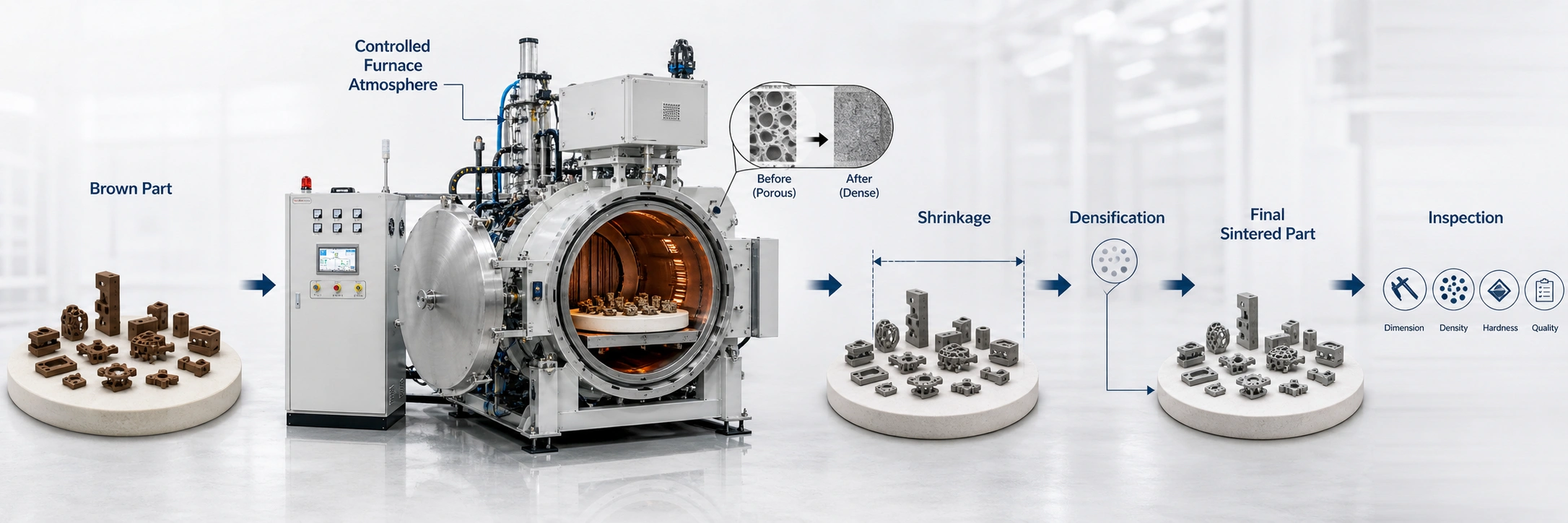
Image disclosure: The process diagrams on this page are representative engineering illustrations unless specifically identified as real XTMIM factory photography. They do not depict a customer project.
Quick answer: MIM sintering is the controlled high-temperature stage that turns a debound brown part into a dense metal component. During the MIM sintering process, metal powder particles bond together, pores shrink, density increases, and the oversized brown part contracts toward its final drawing dimensions. The key engineering risks are not only furnace temperature, but also predictable shrinkage, density control, furnace atmosphere, support design, distortion, and whether post-sintering sizing or machining is needed. For parts with thin walls, long spans, small holes, tight flatness, press-fit areas, or cosmetic surfaces, sintering risk should be reviewed before tooling so the mold compensation, support method, inspection plan, and RFQ assumptions are realistic.
What sintering controls
Final size, density, porosity, strength, hardness, corrosion performance, magnetic behavior, surface condition, and batch consistency.
What can go wrong
Warpage, sagging, cracking, blistering, oxidation, carbon imbalance, high porosity, grain growth, and dimensional drift.
What should be reviewed early
Wall thickness, support direction, critical tolerances, cosmetic surfaces, material behavior, furnace atmosphere, and possible sizing or machining needs.
Sintering Risk Quick Review for MIM Parts
Before tooling, certain part features should be reviewed for MIM sintering risk. A common mistake is to judge MIM feasibility only by mold filling, part size, or unit cost. From a manufacturing review perspective, the part should also be checked for how it will shrink, how it will be supported in the furnace, and which surfaces or dimensions must remain stable after sintering. Thin walls, long unsupported sections, small holes, tight flatness, press-fit areas, and cosmetic surfaces should be reviewed early because these features can create distortion, dimensional drift, or post-sintering correction needs. This review helps decide whether the drawing can be controlled by sintering alone, or whether tooling compensation, setter support, sizing, machining, or tolerance adjustment should be planned before mold development.
| Part Feature | Main Sintering Risk | What Should Be Reviewed Early |
|---|---|---|
| Thin walls | Warpage, cracking, local deformation | Wall thickness transition, support direction, and debinding support |
| Long slender sections | Sagging, bending, out-of-straightness | Setter design, furnace loading direction, and sintering orientation |
| Tight flatness | Distortion after shrinkage | Support surface, datum selection, and possible post-sintering sizing |
| Small holes or slots | Shrinkage variation, hole closure, inspection difficulty | Hole compensation, tool design, and measurement method |
| High density requirement | Residual porosity, weak mechanical performance | Material, furnace cycle, atmosphere, and density verification |
| Cosmetic surface | Setter marks, oxidation, discoloration | Contact surface, furnace atmosphere, and post-sintering handling |
| Press-fit or mating features | Assembly failure after shrinkage | Critical dimension strategy, sizing correction, and final inspection control |
What Is Sintering in Metal Injection Molding?
From Debound Brown Part to Final Metal Part
In metal injection molding, sintering is the high-temperature densification stage after debinding. After injection molding, the part is called a green part. After most of the binder has been removed, it becomes a brown part. The brown part already has the molded geometry, but it is still porous, fragile, and oversized compared with the final drawing dimensions.
During sintering, the brown part is heated in a controlled furnace environment so the metal powder particles bond through diffusion, pores shrink, density increases, and the part contracts toward its final size. This is why the mold does not directly create the final metal dimension.
The mold creates an oversized shape that must survive debinding and then shrink predictably during sintering. For engineering review, the key question is whether that shrinkage can be controlled consistently for the required material, geometry, tolerance, and inspection plan.
Why Sintering Is Different From Simple Heat Treatment
Sintering should not be treated as ordinary heat treatment. Heat treatment modifies the microstructure or hardness of an already dense metal part. MIM sintering creates the dense metal structure itself.
During sintering, several changes happen at the same time: size decreases, density increases, pores reduce, powder particles bond, strength develops, and upstream defects may become visible. Poor green density, incomplete debinding, weak support, or aggressive heating can turn a good-looking brown part into a distorted or rejected sintered part.

The mold does not create the final metal part directly. The final MIM part is formed after debinding and controlled sintering shrinkage.
This image is useful because it separates three conditions that buyers often confuse: molded geometry, debound brown part strength, and final sintered metal performance. The final drawing dimension should be judged after sintering, not from the green or brown part size.
Why Sintering Determines Final MIM Part Quality
Sintering determines whether a molded and debound MIM part becomes a functional metal component. Final size, density, porosity, mechanical properties, surface condition, and dimensional stability are all affected by the sintering cycle. Controlled shrinkage must be built into the tooling strategy, but shrinkage is not a single universal value. It depends on the selected feedstock, material system, green density consistency, wall thickness, furnace cycle, atmosphere, support condition, and part orientation. If densification is insufficient, the part may show low strength, poor hardness, weak wear resistance, reduced corrosion performance, or unstable magnetic behavior. If shrinkage or support is poorly controlled, the part may warp, sag, crack, blister, oxidize, or drift out of tolerance. This is why sintering quality should be reviewed together with feedstock, injection molding, debinding, support design, sizing strategy, and final inspection feedback.
Final Dimensions and Controlled Shrinkage
MIM parts shrink significantly during sintering. This shrinkage is expected and must be compensated in tooling. The mold cavity is larger than the final part, and the expected shrinkage is built into the mold design through an oversize factor.
However, shrinkage is not a fixed value that can be applied to every part. It is affected by material system, powder loading, binder content, powder particle size, green density consistency, wall thickness, furnace cycle, atmosphere, support condition, and part orientation during sintering.
The tooling strategy should be based on the selected feedstock and expected sintering behavior. Industry references such as MIMA process overview for metal injection molding describe MIM sintering as a high-shrinkage densification stage, which is why shrinkage compensation is a core engineering task rather than a minor adjustment.
Density, Porosity, and Mechanical Properties
Sintering also determines final density and pore structure. If densification is insufficient, the part may show lower strength, poor hardness, weak wear resistance, reduced corrosion performance, or inconsistent magnetic behavior.
In many MIM applications, the buyer does not only need a part that looks correct. The part must also meet functional requirements such as tensile strength, yield strength, hardness, elongation, wear resistance, corrosion resistance, magnetic properties, fatigue performance, and dimensional stability after assembly.
If a stable MIM sintering route still leaves a verified requirement for additional internal densification, hot isostatic pressing (HIP) can be reviewed separately as an optional post-sintering process.
How Upstream Defects Become Final Part Problems
Sintering often amplifies upstream process problems. A molded green part with uneven density may shrink unevenly. A brown part with incomplete binder removal may blister or crack during early sintering. A thin part without proper support may sag or warp.
This is why sintering quality cannot be separated from feedstock, injection molding, debinding, and handling. In a stable MIM project, these stages are reviewed as one connected process chain rather than separate operations.
How the MIM Sintering Process Works Step by Step
Brown Part Loading and Support
Before sintering, brown parts are placed on setters, trays, or custom support fixtures. This step looks simple, but it can directly affect flatness, roundness, straightness, and cosmetic surfaces.
The part must be supported in a way that allows controlled shrinkage while reducing gravity-driven deformation. Thin walls, long spans, rings, brackets, and asymmetric parts often need special attention. Poor support can create sagging before the part reaches final density.
Early Heating and Residual Binder Removal
Even after debinding, a small amount of residual binder or carbonaceous residue may remain. During early heating, this residue must be removed while preserving the weak powder structure. Poor support or aggressive heating can cause cracking, blistering, local collapse, or internal contamination before densification begins.
Particle Necking and Pore Reduction
As temperature increases, metal powder particles begin to form necks at contact points. These necks grow as diffusion continues. Pores start to shrink, and the part begins to densify.
This stage is sensitive to material, powder characteristics, and furnace atmosphere. If the process window is not stable, density variation and dimensional drift may appear between trial batches and volume production.
Densification and Holding Time
At higher temperature, densification becomes stronger. Pores reduce further, shrinkage continues, and the part approaches its final density. Holding time at sintering temperature must be controlled. If holding time is too short, density may be insufficient. If holding time is excessive, the part may experience grain growth, dimensional change, or unnecessary cost increase.
Controlled Cooling
Cooling is also part of sintering control. Cooling rate can influence distortion, residual stress, microstructure, and post-sintering properties. Some materials may require additional treatment through MIM secondary operations to reach final hardness, strength, or surface requirements.

Sintering quality depends on the full furnace cycle, not only on the peak temperature.
Two parts may reach the same maximum temperature and still produce different results if the heating rate, atmosphere, holding time, cooling condition, or loading pattern is different. This is why sintering should be validated as a complete thermal cycle.
Process Control Points for MIM Sintering
The table below summarizes the process controls that usually matter most when a MIM part must meet final dimensional, density, and mechanical requirements. These are practical factory control points, not general quality slogans.
| Process Stage | What Must Be Controlled | Common Risk | Why It Matters to Final Parts | Typical Verification Method |
|---|---|---|---|---|
| Feedstock and molding input | Solid loading, flow consistency, powder-binder uniformity | Green density variation, powder-binder separation | Uneven green density can become uneven sintering shrinkage | Feedstock batch control, molding stability check, green part review |
| Brown part condition | Debinding completeness, residual binder, handling damage | Cracking, blistering, carbon residue, weak sections | Residual binder or damaged brown parts can fail during early heating | Debinding weight loss check, visual inspection, handling control |
| Loading and support | Setter contact, support surface, orientation, tray loading | Sagging, warpage, setter marks, contact deformation | Support condition affects flatness, straightness, and cosmetic surfaces | Loading procedure, fixture review, post-sintering dimensional check |
| Furnace thermal cycle | Heating rate, holding time, peak temperature, cooling condition | High porosity, grain growth, dimensional drift | The thermal cycle controls densification and final property stability | Furnace record, density check, hardness test, dimensional trend review |
| Atmosphere control | Vacuum or gas atmosphere, moisture, oxygen, carbon-related conditions | Oxidation, discoloration, carbon imbalance, weak surface condition | Atmosphere affects chemistry, corrosion behavior, and mechanical properties | Furnace atmosphere record, visual inspection, material verification when required |
| Post-sintering control | Dimension verification, sizing need, hardness, surface condition | Out-of-tolerance features, assembly failure, late-stage scrap | Inspection feedback helps adjust tooling, support, sizing, and process window | CMM or gauge inspection, hardness test, density check, functional fit review |
Why MIM Parts Shrink During Sintering
Powder Packing, Binder Removal, and Pore Elimination
MIM feedstock contains metal powder and binder. The binder allows the powder mixture to flow during injection molding. After debinding, much of the binder is removed, leaving a porous powder skeleton.
During sintering, the powder particles bond and the pore network shrinks. As the pores reduce, the entire part becomes smaller and denser. This shrinkage is normal. It is not a defect by itself. The defect occurs when shrinkage is not uniform, not predictable, or not correctly compensated in tooling.
Typical MIM Sintering Shrinkage Range
Many MIM parts shrink significantly during sintering. Industry references often describe typical linear shrinkage in the range of roughly 15%–22%, depending on feedstock, binder volume, material system, and process conditions. The exact shrinkage should be confirmed through material data, tooling compensation, and project validation.
Oversize Factor and Tooling Compensation
The oversize factor defines how much larger the mold cavity must be compared with the final sintered part. It is affected by the selected material and feedstock system.
A common mistake is to treat shrinkage as a single universal value. In real production, different materials and feedstocks may require different oversize factors. Even with the same material, wall thickness, part mass distribution, injection conditions, and sintering support can influence actual dimensional results.
From a tooling review perspective, critical dimensions should be divided into dimensions controlled by sintering compensation, dimensions that may need sizing or calibration, dimensions that may require machining, and dimensions that need tolerance adjustment. This is the practical meaning of MIM sintering shrinkage review before tooling.

Shrinkage is not a defect in MIM. Uncontrolled or poorly compensated shrinkage is the problem.
The image shows why mold cavity design cannot use the final drawing size directly. The oversize factor must be selected from material behavior, feedstock system, part geometry, and expected sintering response. Critical features may still require sizing or machining after sintering.
How Furnace Atmosphere Affects Sintering Quality
Why Controlled Atmosphere Is Required
MIM sintering is usually carried out in a controlled atmosphere or vacuum environment. The atmosphere helps prevent oxidation, supports densification, and helps control material chemistry.
The EPMA metal injection moulding process overview explains that MIM sintering is carried out in controlled atmosphere furnaces, sometimes in vacuum, and often at higher temperatures than traditional PM sintering to enhance densification and pore elimination.
Poor atmosphere control may cause surface oxidation, discoloration, high oxygen content, carbon imbalance, poor corrosion resistance, reduced mechanical properties, or inconsistent batch performance.
Common MIM Sintering Atmospheres
| Atmosphere | Typical Purpose | Possible Risk if Poorly Controlled |
|---|---|---|
| Vacuum | Clean sintering, low contamination, selected steels and alloys | Carbon or alloy element control may require experience |
| Argon | Inert protection for selected materials | Residual oxygen or moisture can still affect the part |
| Hydrogen | Reducing condition for selected systems | Safety and material compatibility must be controlled |
| Nitrogen / Hydrogen Mixture | Used for selected alloys and systems | Not suitable for every material |
| Dissociated Ammonia | Reducing atmosphere in some production systems | Requires strict gas quality and process stability control |
Why Different Materials Need Different Sintering Conditions
Stainless steels, low alloy steels, copper alloys, cobalt-chromium alloys, and magnetic alloys do not use the same sintering logic. This section should not be treated as a full MIM materials guide. The main point is that sintering is material-specific.
A reliable MIM supplier should not apply one universal furnace recipe to every alloy. For some materials, oxidation control is the main concern. For others, carbon control, nitrogen interaction, cooling strategy, or magnetic property stability may be more important.

Furnace atmosphere is a material-specific process decision, not a universal setting.
The image helps explain why material selection and sintering cycle selection must be reviewed together. A cycle that works for one stainless steel or low alloy steel may not be suitable for a copper alloy, cobalt-chromium alloy, or soft magnetic alloy.
Sintering Distortion: Why MIM Parts Warp, Sag, or Lose Shape
Geometry-Driven Distortion
Distortion often starts with geometry. Some part shapes are more sensitive during sintering because they shrink while losing temporary support strength at elevated temperature.
High-risk features include long unsupported sections, thin walls, wide flat surfaces, uneven wall thickness, asymmetric mass distribution, rings with tight roundness requirements, small slots near thick sections, and fine arms or fork-shaped structures.
A part may look acceptable as a green part and still distort after sintering. The risk is not only whether the geometry can be molded. The risk is whether the geometry can survive shrinkage and densification.
Support and Setter Design
Setter design affects final shape. If a part rests on a poor contact surface, gravity and shrinkage can cause sagging or twisting. If the contact area touches a cosmetic surface, marks may remain after sintering.
In practice, sintering support should be reviewed together with critical surfaces, cosmetic surfaces, functional contact areas, flatness requirements, roundness requirements, part loading direction, and expected shrinkage path.
Shrinkage Direction and Gravity Effects
The target is uniform shrinkage, but real parts do not always shrink perfectly. Local green density variation, wall thickness differences, support constraints, and gravity can create non-uniform movement.
This is why early MIM sintering support design should include furnace orientation, contact surfaces, gravity direction, and setter strategy, not just mold parting line and gate location. For a deeper review of warpage, sagging, and support strategy, see our MIM sintering distortion review.

Many sintering distortion problems are support problems, not only furnace temperature problems.
This comparison shows why a part that looks feasible in CAD can still be difficult in production. The part must have a realistic support plan during shrinkage. Unsupported spans, poor contact points, or cosmetic-surface conflict should be resolved during DFM review.
Common MIM Sintering Defects and Root Causes
Defect analysis should consider the full process chain. A crack found after sintering may have started during green part handling. A dimensional problem may come from injection density variation. A surface issue may come from furnace atmosphere or setter contact.
| Defect | What It Looks Like | Likely Root Cause | Prevention |
|---|---|---|---|
| Warpage | Bent, twisted, or uneven part | Poor support, uneven shrinkage, weak geometry | DFM review, support design, uniform wall transition |
| Sagging | Long section drops or curves | Unsupported span, high-temperature softening, gravity | Improve setter contact and sintering orientation |
| Cracking | Visible or internal cracks | Fast heating, residual binder, handling damage, stress concentration | Improve debinding, adjust ramp rate, protect green and brown parts |
| Blistering | Surface bubbles or swelling | Trapped gas, incomplete debinding, fast early heating | Validate debinding rate and early sintering profile |
| High porosity | Low density or weak part | Insufficient temperature, short hold time, poor feedstock or atmosphere | Optimize sintering cycle and material control |
| Oxidation | Discoloration or weak surface | Poor atmosphere purity, moisture, oxygen contamination | Improve gas quality, furnace control, and loading procedure |
| Carbon imbalance | Abnormal hardness, brittleness, or property variation | Binder residue, atmosphere condition, material-specific carbon sensitivity | Control debinding, atmosphere, and validation testing |
| Dimensional drift | Batch-to-batch size variation | Feedstock variation, furnace variation, support inconsistency | Process window control and inspection feedback |

Sintering defects usually have process-chain causes, not isolated furnace causes.
This root-cause map helps engineering teams avoid one-sided troubleshooting. A blister may indicate incomplete debinding or aggressive early heating. Warpage may come from geometry and support. Dimensional drift may come from feedstock, tooling compensation, furnace loading, or inspection feedback.
Post-Sintering Sizing and Calibration: When Final Dimensions Need Additional Control
What Is Post-Sintering Sizing in MIM?
Post-sintering sizing, sometimes called calibration, is a secondary operation performed after sintering. The sintered part is placed into a precision die, fixture, or tool, and controlled pressure is applied to improve selected dimensions or geometric features.
Sizing is not the same as remaking the part. It is a controlled correction method for specific dimensions or surfaces. It may be useful when the part has a press-fit area, flat contact surface, roundness requirement, or local tolerance that cannot be held economically by sintering alone.
What Sizing Can Improve
| Sizing Can Help Improve | Typical Examples |
|---|---|
| Local dimensional accuracy | Outer diameter, hole diameter, width, thickness |
| Flatness | Small brackets, plates, contact surfaces |
| Roundness | Rings, sleeves, cylindrical features |
| Assembly consistency | Press-fit zones, mating surfaces, functional areas |
| Batch-to-batch consistency | Critical dimensions after sintering |
What Sizing Cannot Fix
| Sizing Cannot Reliably Fix | Reason |
|---|---|
| Severe warpage | Excessive distortion may exceed correction capability |
| Internal cracks | Cracks are material defects, not dimensional errors |
| High porosity | Sizing cannot replace proper densification |
| Poor material properties | Strength and hardness must come from correct material and process |
| Incorrect shrinkage compensation | Tooling and process strategy must be correct from the beginning |
| Complex 3D deformation | Sizing usually works best on controlled functional areas |
When Should Sizing Be Considered Before Tooling?
Sizing should be discussed before tooling when the drawing includes tight hole diameter, critical outer diameter, flat contact face, roundness requirement, press-fit dimension, bearing surface, assembly datum, thin or wide flat structure, or function-critical mating surface.
If sizing is needed, it may affect tool design, datum selection, fixture design, inspection planning, and production cost. It should not be decided only after trial parts fail.

Sizing is a controlled correction method for selected features, not a rescue method for severe sintering failure.
The image clarifies the boundary of sizing. Local correction can be useful for press-fit zones, holes, flatness, or roundness. It cannot compensate for internal cracks, high porosity, incorrect material properties, or major shrinkage compensation errors.
Design Considerations for Stable MIM Sintering
Uniform Wall Thickness Helps Reduce Differential Shrinkage
Uniform wall thickness helps reduce shrinkage variation and distortion risk. Sudden transitions between thick and thin sections can create uneven densification, local stress, and dimensional instability.
In practice, wall thickness does not need to be perfectly identical everywhere, but transitions should be gradual. Thick masses attached to thin arms, deep blind features, or sharp internal corners should be reviewed carefully.
Flatness, Roundness, and Long Thin Features Need Early Review
Some drawing requirements look simple but are difficult after sintering. Examples include flatness on thin plates, roundness on rings or sleeves, straightness on pins or long shafts, parallelism on small brackets, hole position near thin walls, and tight width across flexible arms.
Support Surfaces and Cosmetic Surfaces Should Not Conflict
A part needs to sit somewhere during sintering. If the best support surface is also a visible cosmetic surface, the engineering team must decide which requirement is more important. This is common in consumer electronics, medical tools, watch parts, and small precision components.
The sintering support plan should be discussed during DFM review, not after production starts.
Example: How Sintering Risk Is Reviewed Before Tooling
Case Example: Thin Stainless Steel Bracket With Flatness Requirement
| Project situation | A customer provides a 3D model for a small stainless steel MIM bracket. The part has two thin arms, one wide flat contact surface, and several small holes. The drawing includes flatness and hole-position requirements. |
|---|---|
| Problem observed | The part appears suitable for MIM from a shape and cost perspective, but the thin arms and wide contact face create sintering distortion risk. |
| Engineering cause | The two thin arms may sag during sintering. The flat surface may warp if unsupported. Small holes may shift slightly if local shrinkage is not uniform. The preferred support surface may also conflict with the cosmetic surface. |
| Process adjustment | The engineering review may recommend smoother wall transitions, defined sintering orientation, suitable setter support, confirmation of functional and cosmetic surfaces, and a decision on whether the flatness should be controlled by sintering, sizing, or machining. |
| Result / lesson learned | The goal is to reduce repeated trial adjustments after mold completion. Good MIM engineering does not only ask whether the part can be molded. It asks whether the part can be sintered, measured, assembled, and produced consistently. |
How XTMIM Controls Sintering Quality for Custom MIM Parts
Material-Based Sintering Cycle Selection
Different materials require different sintering conditions. XTMIM reviews the material system, expected properties, part geometry, and dimensional requirements before defining the sintering approach.
The process window for stainless steel is not the same as that for low alloy steel, copper alloy, magnetic alloy, or cobalt-chromium alloy. Furnace atmosphere, peak temperature, holding time, cooling strategy, and post-sintering treatment must match the material.
Furnace Atmosphere and Thermal Cycle Control
Sintering quality depends on stable furnace control. Key factors include heating rate, peak temperature, holding time, cooling condition, atmosphere type, gas purity, furnace loading pattern, and batch traceability.
For critical parts, furnace records and inspection feedback should be used together. Dimensional drift should not be treated as a random problem if it shows a repeatable process pattern.
Sintering Support and Fixture Review
For thin, long, flat, or asymmetric parts, XTMIM reviews how the brown parts should be loaded before sintering. Support method can affect final flatness, straightness, cosmetic surfaces, and batch consistency.
Post-Sintering Inspection Feedback
After sintering, inspection is used to confirm whether the process produced the expected result. Typical checks may include dimensional inspection, visual inspection, density evaluation when required, hardness testing, surface condition review, material verification when specified, and functional or assembly checks for critical parts.
Inspection data should feed back into tooling compensation, sintering support, sizing strategy, and future production control. Review our MIM quality control process for the broader inspection and production-feedback path.

Good sintering control is a closed-loop engineering process, not a one-time furnace setting.
This control flow shows what sourcing teams should expect from a capable MIM supplier: material review before tooling, shrinkage and support planning before trial production, and inspection feedback after sintering. This loop helps reduce dimensional drift and repeated process adjustments.
MIM Sintering vs Conventional Powder Metallurgy Sintering
MIM sintering and conventional press-and-sinter powder metallurgy share the same basic principle: metal powder particles bond and densify below the melting point of the metal. However, the manufacturing context is different.
MIM starts with fine metal powder mixed with binder, molded like plastic, debound, and then sintered. It is commonly used for small, complex, high-density metal parts. Conventional PM usually starts with pressable powder compacted in a die, followed by sintering. It is often used for parts with more regular geometry, high-volume cost efficiency, and controlled porosity requirements.
For buyers, the practical difference is this: MIM usually requires more careful shrinkage compensation and geometry support because the part experiences large controlled shrinkage from an injected feedstock structure. For process selection, see MIM vs powder metallurgy.
When Should You Discuss Sintering Risk With a MIM Supplier?
Part Features That Need Early Review
You should discuss sintering risk before tooling if the part has thin walls, long unsupported sections, tight flatness, tight roundness, small holes or slots, large wall thickness variation, high density requirement, high strength requirement, cosmetic surface requirement, press-fit features, magnetic or corrosion-sensitive material, tight tolerance after sintering, or expensive tooling risk.
A supplier should be able to explain which risks are controlled by design, which by tooling compensation, which by furnace control, and which may need sizing or secondary machining.
What to Send for a Sintering Feasibility Review
- 2D drawing
- 3D CAD file
- Material requirement
- Annual volume
- Critical dimensions
- Tolerance requirements
- Surface finish requirement
- Heat treatment requirement
- Functional surfaces and cosmetic surfaces
- Assembly requirements
- Existing sample photos if available
The earlier these details are reviewed, the easier it is to prevent tooling changes, trial delays, and batch quality problems.
Standards and Technical References
This page uses industry references as background for material specification, process understanding, and engineering review. These references are useful for discussion, but they do not replace project-specific DFM review, tooling compensation, sintering validation, and inspection planning.
- MPIF Standard 35-MIM information is commonly used as a reference for metal injection molded material specifications, explanatory notes, and definitions.
Final tolerance, density, hardness, strength, corrosion resistance, magnetic behavior, and appearance requirements should be confirmed through the drawing, material grade, expected production volume, inspection plan, and actual process validation.
FAQ About MIM Sintering
What is sintering in metal injection molding?
Sintering is the high-temperature stage after debinding where the brown part densifies, shrinks, and becomes a final metal component. During this stage, metal powder particles bond together, pores reduce, and the part reaches its final dimensions and mechanical properties.
How much do MIM parts shrink during sintering?
Many MIM parts shrink significantly during sintering, often in the range of roughly 15%–22% linearly depending on material, binder volume, powder loading, feedstock system, part geometry, and sintering conditions. The exact shrinkage should be confirmed through material data, tooling compensation, and project-specific validation.
Why do MIM parts warp during sintering?
MIM parts may warp because of uneven wall thickness, poor support, long unsupported spans, green density variation, incomplete debinding, incorrect furnace loading, or unsuitable sintering cycle. Distortion risk should be reviewed before tooling, especially for thin, flat, long, or asymmetric parts.
What atmosphere is used for MIM sintering?
MIM sintering may use vacuum, argon, hydrogen, nitrogen-hydrogen mixtures, dissociated ammonia, or other controlled atmospheres depending on the material and required properties. Stainless steels, low alloy steels, copper alloys, magnetic alloys, and cobalt-chromium alloys may need different atmosphere strategies.
Can MIM parts be sized after sintering?
Yes. Some MIM parts can be sized or calibrated after sintering to improve selected dimensions, flatness, roundness, or assembly consistency. However, sizing has a limited correction range and cannot fix severe warpage, internal cracks, high porosity, or poor sintering density.
Can MIM parts meet tight tolerances after sintering?
Yes, many MIM parts can meet tight tolerances, but tolerance capability depends on part geometry, material, shrinkage consistency, tooling compensation, support method, and whether secondary operations such as sizing or machining are required. Final tolerance capability should be confirmed through project-specific DFM review.
When should sintering risk be reviewed in a MIM project?
Sintering risk should be reviewed before tooling, especially for parts with thin walls, long sections, tight flatness, tight roundness, small holes, press-fit features, high-density requirements, or cosmetic surfaces. Early review helps reduce tooling changes and production instability.
When should I send a drawing for MIM process review?
You should send a drawing before tooling if the part has tight tolerances, thin walls, long unsupported features, flatness or roundness requirements, small holes, press-fit areas, or material performance requirements. Early review allows the supplier to evaluate shrinkage compensation, sintering support, sizing needs, and inspection strategy before cost and lead time are fixed.
What information should be provided before requesting a MIM quote?
A useful quote review should include a 2D drawing, 3D CAD file, material requirement, annual volume, critical dimensions, tolerance requirements, surface finish, heat treatment requirement, assembly function, and any cosmetic surfaces. This information helps the supplier judge process risk instead of quoting only by part weight or size.
Need a MIM Process Review Before Tooling?
Share your 2D drawing, 3D model, material requirement, tolerance requirements, and annual volume. Our engineering team can review whether the part is suitable for MIM and identify possible sintering shrinkage, distortion, density, sizing, and secondary operation risks before production starts.
Request Engineering Review