Manufacturing Process Comparison
MIM is usually the better route for small, complex metal parts when the design is stable, the geometry is moldable, and annual volume is predictable enough to justify tooling. Metal 3D printing is usually better when the project is still in prototype development, the design may change, volume is low, or the part depends on AM-specific geometry such as internal channels, lattice structures, or topology-optimized shapes. For engineers and sourcing teams, the real question is not which process is more advanced. The real question is whether the part is ready for a tooling-based, shrinkage-controlled production route, or whether it should remain in a tool-less additive route until the design and production plan are clearer. This article focuses on the process selection decision before tooling, quotation, and production planning.
Quick Answer: MIM vs Metal 3D Printing for Production Parts
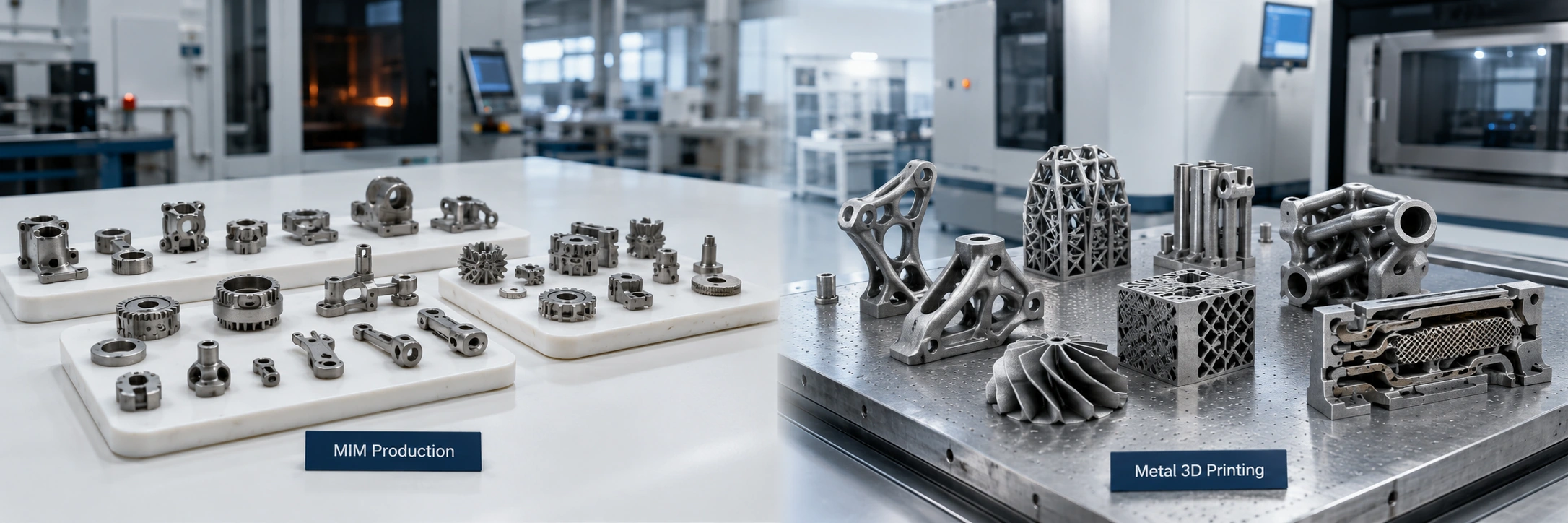
MIM and metal 3D printing solve different production problems. Choose Metal Injection Molding when a small, complex metal part has a stable design, repeatable annual demand, and enough production volume to justify tooling and process development. Choose metal 3D printing when the design is still changing, only a few parts are needed, or the geometry depends on AM-specific features such as internal channels, lattice structures, or topology-optimized forms.
A metal 3D printed prototype can support functional validation, but it cannot always move directly into MIM production. Before tooling, the part must be reviewed for mold release, gate location, wall thickness balance, debinding path, sintering shrinkage, critical dimensions, material conversion, and secondary operation requirements.
When users search for “MIM 3D printing,” the real engineering question is usually whether the project should stay in a tool-less additive route or move into a tooling-based MIM route. Metal 3D printing is also not one single process. Laser powder bed fusion, binder jetting, directed energy deposition, and other metal AM routes can differ in density, surface finish, support strategy, heat treatment, sintering behavior, and inspection requirements.
Practical route: metal 3D printed prototype → functional validation → MIM DFM review → geometry adjustment → tooling → trial production → MIM mass production.
If your prototype has already passed functional testing and the next concern is production cost, repeatability, annual volume, or supplier scalability, a drawing-based MIM suitability review is usually the next useful step.
MIM vs Metal 3D Printing Decision Matrix: Production Part or Prototype?
The first screening question should not be “which process is cheaper?” It should be “what stage is the project in?” MIM becomes stronger when the part has a frozen or nearly frozen drawing, predictable annual demand, and a geometry that can be molded, debound, sintered, and inspected repeatably. Metal 3D printing becomes stronger when the part is still in design iteration, the quantity is low, or the geometry depends on additive-manufacturing freedom.
This decision map helps engineering and sourcing teams decide whether a project should stay in metal 3D printing, move toward MIM, or enter a prototype-to-MIM review. It also protects the page from a common search misunderstanding: “MIM 3D printing” is not one process. The real comparison is between a tooling-based MIM production route and a tool-less metal AM route.

| Project Condition | MIM Is Usually Better When… | Metal 3D Printing Is Usually Better When… |
|---|---|---|
| Project stage | The design is close to frozen and ready for tooling review. | The design is still changing or needs fast iteration. |
| Production volume | Annual demand is predictable enough to justify tooling and process development. | Only prototypes, pilot batches, or low-volume custom parts are needed. |
| Geometry | The part has complex external features but can still be molded, ejected, debound, and sintered. | The part depends on internal channels, lattice structures, topology optimization, or AM-only features. |
| Cost model | Lower long-term unit cost and repeatable production matter more than avoiding tooling cost. | Avoiding tooling cost and design-change risk matters more than production unit cost. |
| Lead time | The project is moving toward repeatable production after validation. | Fast prototype delivery or short-run testing is the main requirement. |
| Tolerance strategy | Critical dimensions can be reviewed for MIM capability, shrinkage compensation, and possible secondary operations. | Critical surfaces can be machined or finished after printing, and quantity does not justify tooling. |
This table is only a first screening tool. Final process selection should be based on the actual drawing, material, tolerance requirements, estimated annual volume, surface finish, application environment, inspection method, and production stage.
How MIM and Metal 3D Printing Create Parts Differently
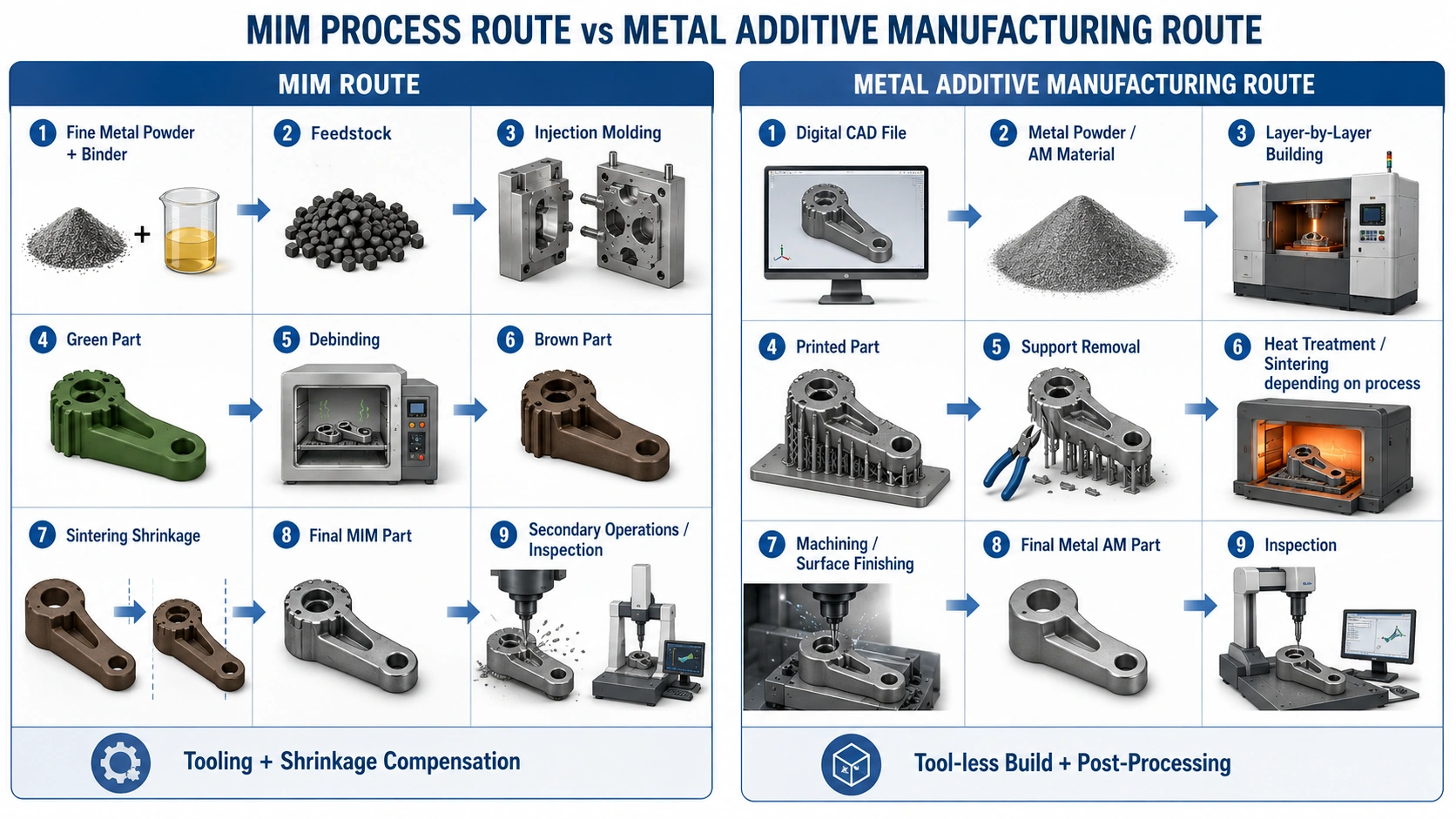
MIM and metal 3D printing may both produce metal parts, but they control shape, cost, and quality through different manufacturing routes. MIM forms a green part by injecting metal powder-binder feedstock into a mold, then removes binder and sinters the part to final density and dimensions. Metal 3D printing builds the part from digital geometry through a selected AM process, then often depends on support removal, heat treatment, machining, or finishing to meet the drawing.
This route difference changes the engineering risk. In MIM, the key questions are moldability, gate position, ejection, green part strength, debinding behavior, sintering shrinkage, distortion control, and repeatable inspection. In metal 3D printing, the key questions are build orientation, support strategy, density, residual stress, surface texture, heat treatment, post-machining, and AM process capability. A geometry that prints successfully is not automatically ready for MIM tooling.
MIM Is a Tooling-Based Sintered Manufacturing Route
MIM uses fine metal powder mixed with a binder system to form feedstock. The feedstock is injected into a precision mold to create a green part. After molding, green part handling, trimming, tray loading, debinding, and sintering all influence yield and dimensional consistency.
From a design review perspective, MIM depends on tooling and sintering control. The mold must account for shrinkage compensation, gate location, parting line, ejection, wall balance, and repeatable filling. The part must also be debindable and stable enough during sintering to avoid cracking, distortion, or unacceptable dimensional shift.
For a deeper explanation of feedstock, injection molding, debinding, and sintering, review the MIM process overview.
Metal 3D Printing Is a Tool-Less Additive Manufacturing Route
Metal 3D printing is a broad term for metal additive manufacturing. It may include laser powder bed fusion, binder jetting, and other metal AM processes. These processes do not rely on traditional production tooling in the same way as MIM. Instead, they build parts from digital geometry, often layer by layer.
This gives metal 3D printing a clear advantage during early development. Engineers can test geometry, modify designs, and produce small quantities without opening a mold. In practice, however, the printed part may still need support removal, heat treatment, machining, surface finishing, or inspection before it meets final drawing requirements.
Metal 3D printing should not be treated as one single process. Laser powder bed fusion, binder jetting, and other AM routes can differ in density, surface finish, cost, post-processing, and material availability.
Metal 3D Printing Is Not One Process: Why AM Route Matters Before MIM Comparison
“Metal 3D printing” is a useful search term, but it is not specific enough for engineering review. A laser powder bed fusion prototype, a binder jetting part, and a directed energy deposition part may all be described as metal 3D printed parts, but their process route, material behavior, density, surface finish, thermal history, and post-processing requirements can be very different.
This distinction matters before comparing metal 3D printing with MIM. If the current prototype was made by LPBF, the review may focus on support removal, residual stress, surface texture, and machining allowance. If it was made by binder jetting, the review may focus more on powder packing, binder removal, sintering shrinkage, density, and surface finish. These details affect whether the part can be converted into a MIM production route or should remain in an AM route.
| Metal AM Route | Typical Process Logic | Key Review Point Before Comparing with MIM |
|---|---|---|
| Laser Powder Bed Fusion | Metal powder is selectively fused layer by layer using a high-energy source. | Review support removal, build orientation, surface texture, residual stress, heat treatment, and post-machining needs. |
| Binder Jetting | A binder is deposited into a powder bed to form a green part, followed by curing, debinding, sintering, or infiltration depending on the system. | Do not assume it is the same as MIM. Review powder packing, shrinkage, density, surface finish, and sintering dimensional control. |
| Directed Energy Deposition | Metal feedstock is deposited and fused by a focused energy source, often used for larger features, repair, or near-net-shape buildup. | Usually not a direct substitute for small high-volume MIM parts; review size, surface finish, machining allowance, and application purpose. |
| Other Metal AM Routes | May include extrusion-based metal systems, hybrid routes, or supplier-specific processes. | Ask for the process name, material certificate, heat treatment note, and inspection report before comparing cost or production readiness. |
A customer may only say “metal 3D printed prototype,” but the supplier still needs to know the exact AM route before judging whether the part can be converted to MIM production. Binder jetting may share some words with MIM, such as binder removal and sintering, but it does not use the same forming route, tooling strategy, shrinkage control, or production economics as MIM.
Which Process Is More Cost-Effective at Different Volumes?
The cost comparison between MIM and metal 3D printing changes with project stage. Metal 3D printing often reduces upfront cost because no production mold is required. MIM usually has higher upfront tooling and development cost, but it can become more competitive when the same part is produced repeatedly in stable volume.

The real issue is not only the price of the first sample. A proper cost comparison should include tooling cost, per-part production cost, material cost, machine time, post-processing, heat treatment, inspection requirements, yield risk, design-change risk, and project lifetime volume.
Prototype Projects
For a prototype project, avoiding tooling cost is often more important than achieving the lowest unit cost. Metal 3D printing can reduce early design risk when the geometry, material, or assembly condition may still change.
Stable Production Projects
For stable production, MIM becomes more attractive when the drawing is frozen, the part is produced repeatedly, and tooling cost can be distributed across enough production volume.
Drawing-Based Break-Even Review
A fixed break-even number should not be used without reviewing part size, part weight, material, tolerances, finishing requirements, inspection needs, and expected annual volume.
The correct cost question is: at the expected annual volume and project lifetime, which process gives the best balance of tooling cost, unit cost, quality risk, lead time, and production repeatability?
Which Geometries Are Better for MIM or Metal 3D Printing?
Both MIM and metal 3D printing can produce complex metal parts, but they do not support the same kind of complexity. MIM is strong for small parts with complex external geometry, fine features, through holes, ribs, bosses, and undercuts that can be handled by tooling design. Metal 3D printing is stronger for geometry that depends on internal freedom, such as internal channels, lattice structures, topology-optimized forms, and highly customized low-volume designs.

| Feature Type | MIM Suitability | Metal 3D Printing Suitability | Engineering Note |
|---|---|---|---|
| Small complex external features | Strong | Possible | MIM is strong when the feature is moldable, fillable, ejectable, and repeatable. |
| Thin walls | Possible with review | Possible with review | Depends on section balance, material, process route, and final strength requirement. |
| Undercuts | Possible with tooling strategy | Often easier | MIM requires mold release, parting line, slider, or geometry review. |
| Internal channels | Usually difficult or unsuitable | Strong | True enclosed passages are usually an AM advantage and may not convert to MIM. |
| Lattice structures | Usually unsuitable | Strong | Lattice geometry is typically designed for additive manufacturing, not injection mold release. |
| High-volume identical parts | Strong | Less ideal in many cases | MIM benefits from tooling, stable process windows, and repeated production. |
Before moving a printed prototype into MIM production, the geometry must be reviewed from the perspective of mold filling, ejection, debinding path, shrinkage, sintering support, critical dimensions, and secondary operations.
Prototype, Low Volume, or Mass Production: Which Stage Are You In?
Early Prototype Stage
If the project is still in concept or functional validation, metal 3D printing is often the safer route. Engineers may need to test assembly, confirm shape, check ergonomics, evaluate function, or modify the design several times.
Using MIM too early can create avoidable tooling risk. If the design changes after mold fabrication, the mold may require modification or replacement.
Low-Volume or Custom Production Stage
For low-volume production, the answer depends on geometry, material, tolerance, and post-processing. Metal 3D printing may remain suitable if the part is customized, the quantity is low, or tooling cost cannot be recovered.
If the same part is expected to repeat every month or every year, MIM may become worth reviewing before the project grows into a costly additive manufacturing route.
Pre-Production Validation Stage
This is where many projects should compare MIM more seriously. If a metal 3D printed prototype has already passed functional testing, the next question is whether the design can be manufactured repeatably at production scale.
At this stage, the review should focus on moldability, wall balance, critical dimensions, material conversion, surface finish, and expected annual volume.
Stable Mass Production Stage
MIM is usually stronger when the design is stable and the project needs repeatable production of many identical parts. The mold creates the repeatable shape, while the process route is controlled through molding, debinding, sintering, and inspection.
This does not mean every stable metal part should use MIM. The part still needs to be small enough, moldable enough, and commercially suitable for a tooling-based sintered route.
If your printed prototype has passed function testing and the next concern is production cost, repeatability, annual volume, or supplier scalability, it is a good stage to request a MIM manufacturability review before investing in the next production route.
Material, Density, Surface Finish, and Post-Processing
Material selection should not be treated as a simple material-name match. A material that is printable by one metal AM process may not automatically be available or economical as a MIM feedstock. A material used in MIM may not behave the same way in metal additive manufacturing because the powder specification, binder system, thermal history, and consolidation route are different.
For MIM, material selection depends on powder characteristics, binder system, feedstock stability, debinding behavior, sintering response, shrinkage control, and final property requirements. For metal 3D printing, material selection depends on the AM process, powder specification, energy input, build orientation, thermal history, and post-processing route.
Material-Route Review: Feedstock Is Not the Same as AM Powder
If the comparison starts from powder or alloy input, review the supporting guide on MIM feedstock vs metal 3D printing powder. It explains why fine metal powder compounded with binder into MIM feedstock pellets should not be treated as the same material input as LPBF powder, binder jetting powder, DED feedstock, or bound-metal AM material.
| Requirement | MIM Consideration | Metal 3D Printing Consideration |
|---|---|---|
| Surface finish | Influenced by mold surface, feedstock, sintering, and secondary finishing. | May require support removal, polishing, machining, blasting, or other surface improvement. |
| Density and strength | Strongly related to material selection, sintering control, and part geometry stability. | Depends on AM route, process parameters, heat treatment, and inspection criteria. |
| Critical dimensions | May be as-sintered or may require machining, sizing, grinding, or other secondary operations. | May require post-machining after support removal, heat treatment, or stress relief. |
| Heat treatment | Material-dependent and should be planned with final mechanical or corrosion requirements. | Often process- and material-dependent, especially where residual stress or microstructure must be controlled. |
| Cosmetic finish | Secondary finishing may be needed for visible surfaces, assembly interfaces, or customer-facing components. | Layer texture, support marks, or rough surfaces may require additional finishing before use. |
Both routes may require CNC machining, grinding, polishing, heat treatment, surface coating, deburring, cleaning, and final inspection. Post-processing can change the cost comparison significantly. A printed part that looks economical at the forming stage may become expensive after machining and finishing. A MIM part may also require secondary operations if the drawing includes tight tolerances, sealing surfaces, threads, cosmetic surfaces, or precision assembly features.
Critical Dimensions, Inspection, and Acceptance Checks
A serious comparison should include dimensional strategy. Neither MIM nor metal 3D printing should be selected only because the shape is possible. The process should be selected based on which route can meet the drawing, application load, surface requirement, inspection method, and production plan with acceptable risk.
For MIM, some dimensions may be achievable after molding and sintering, while critical dimensions may require secondary machining, sizing, grinding, or other finishing operations. Sintering shrinkage must be considered before tooling. Wall thickness, section changes, support during sintering, and part orientation can all affect dimensional stability.
For metal 3D printing, critical dimensions may also require machining. Surface condition, support removal marks, build orientation, residual stress, and heat treatment can affect the final part.
Define Critical Features
- Critical-to-function dimensions
- Assembly interfaces
- Threaded features
- Flatness or straightness requirements
Confirm Final Requirements
- Surface finish
- Density or mechanical expectations
- Heat treatment
- Cosmetic surfaces
Plan Inspection Method
- Datum strategy
- Gauge or fixture needs
- Acceptance criteria
- Production inspection frequency
The manufacturing route should be selected based on the complete drawing and acceptance criteria, not only the 3D shape.
When to Choose MIM
MIM is usually the stronger candidate when the project requires repeatable production of small, complex metal parts and the design is stable enough for tooling.
MIM Is Usually a Good Fit When:
- The part is small or medium-small.
- The geometry is complex but moldable.
- Annual volume is predictable.
- The design is close to frozen.
- The same part will be produced repeatedly.
- Tooling cost can be justified.
- Long-term unit cost matters.
- Material requirements fit available MIM options.
- Critical dimensions can be reviewed before tooling.
- Secondary operations can be planned early.
MIM should not be selected only because a part is complex. It should be selected because the part is complex, moldable, repeatable, and commercially suitable for tooling-based production. From a design review perspective, MIM is strongest when it replaces high-cost machining or repeated additive manufacturing with a controlled production route after the design has been validated.
When to Choose Metal 3D Printing
Metal 3D printing is usually the stronger candidate when the project needs flexibility, fast iteration, low volume, or geometry that is not practical for MIM.
Metal 3D Printing Is Usually a Good Fit When:
- The project is still in prototype stage.
- The design may change.
- Only a few parts are needed.
- The geometry includes internal channels.
- The design includes lattice structures.
- Tooling cost cannot be justified.
- The part is customized.
- Lead time for samples is more important than unit cost.
- The part is being tested before production planning.
- AM-specific geometry is required for function.
It would be inaccurate to describe metal 3D printing as only a prototype method. In some applications, it can be a valid production route. However, for repeated production of the same small metal part, the cost, post-processing burden, material availability, and repeatability should still be compared carefully against MIM and other manufacturing methods.
Can a Metal 3D Printed Prototype Be Converted to MIM Production?
Yes, a metal 3D printed prototype can sometimes become the starting point for MIM production. But it should not be assumed that the same geometry can move directly into MIM tooling.
A printed prototype may prove that the part shape works in assembly or function. That does not automatically prove that the part is moldable, debindable, sinterable, dimensionally stable, or cost-effective for MIM production.

| Conversion Review Item | Why It Matters Before MIM Tooling |
|---|---|
| Mold release and parting line | AM geometry may not be removable from production tooling without redesign. |
| Gate location | Gate position can affect appearance, filling, strength, weld-line risk, and secondary finishing. |
| Wall thickness balance | Uneven sections may increase molding, debinding, or sintering distortion risk. |
| Internal channels and lattice features | True internal AM features are usually difficult or unsuitable for MIM. |
| Critical dimensions | Some dimensions may need machining allowance or a different tolerance strategy. |
| Material conversion | The printable material may not have a direct or economical MIM feedstock equivalent. |
This route is useful when a customer has already validated the product concept with metal 3D printing but needs a more economical and repeatable route for higher-volume production.
What Usually Needs to Change Before MIM Tooling?
Wall Thickness and Section Balance
Uneven wall thickness may increase the risk of molding defects, debinding stress, sintering distortion, or dimensional variation. MIM does not require all walls to be identical, but sharp section changes should be reviewed before tooling.
Sharp Corners and Stress Concentration
Very sharp transitions may be printable, but they can create stress concentration, filling difficulty, cracking risk, or sintering distortion in MIM. Radius design should be reviewed before tooling.
Internal Channels and Lattice Structures
True internal channels and lattice structures are usually difficult or unsuitable for MIM. If these features are essential to function, metal 3D printing may remain the better route.
Critical Dimensions and Machining Allowance
Critical dimensions should be separated from general dimensions. Some features may be suitable as-sintered, while others may need machining, sizing, grinding, or finishing allowance.
Composite Field Scenario for Engineering Training
Printed Prototype Passed Assembly, but the Geometry Was Not Ready for MIM Tooling
What problem occurred: A small metal bracket was first produced by metal 3D printing for functional testing. The prototype passed assembly, but the early MIM review found an enclosed internal passage, uneven wall sections, and several sharp transitions that would create tooling and sintering risk.
Why it happened: The CAD model was designed around printability, not moldability. The printed prototype confirmed product function, but it did not prove that the part could be injected, ejected, debound, and sintered consistently.
What the real system cause was: The project team compared sample price before completing a process-conversion review. They treated “metal part shape achieved” as “production route confirmed,” which is a common mistake when moving from additive development to MIM production.
How it was corrected: The internal passage was redesigned as an accessible external feature, wall transitions were balanced, sharp corners were radiused, and critical dimensions were separated into as-sintered and post-machined features before tooling review.
How to prevent recurrence: Before using a printed prototype as the basis for MIM tooling, review mold release, gate location, wall balance, debinding path, sintering support, shrinkage compensation, and critical dimension strategy.
Common Mistakes When Comparing MIM and Metal 3D Printing
Comparing Prototype Cost Instead of Production Cost
A single printed prototype may be cheaper than opening a MIM tool. That does not mean metal 3D printing will remain cheaper at stable production volume.
Assuming Printed Geometry Is Automatically Moldable
AM can create shapes that MIM cannot mold, debind, or sinter reliably. Internal channels, lattice structures, and extreme organic shapes need special review.
Choosing MIM Before the Design Is Stable
If the part design changes after tooling, the cost impact can be significant. MIM is usually better after functional validation and design freeze.
Ignoring Post-Processing
Both routes may require machining, polishing, heat treatment, coating, or inspection. Post-processing can determine the real cost and lead time.
Using One Tolerance Expectation for Every Process
MIM, metal 3D printing, and CNC machining do not share the same tolerance logic. Critical dimensions should be reviewed process by process.
Treating All Metal 3D Printing Processes as the Same
Laser powder bed fusion, binder jetting, and other metal AM routes differ in density, surface, speed, cost, and post-processing. The exact process matters.
Engineering Review Checklist Before Choosing a Process
A drawing-based review is more reliable than a general process comparison. The same process may be suitable for one part and unsuitable for another part with a similar material name or size.
| Review Item | Why It Matters |
|---|---|
| Part size and weight | Affects moldability, print time, tooling strategy, cost, and handling. |
| Material requirement | Determines process availability, feedstock feasibility, heat treatment, and final properties. |
| Annual volume | Strongly affects tooling justification and unit-cost decision. |
| Design freeze status | Determines whether tooling investment is technically and commercially safe. |
| Internal geometry | Helps identify AM-only features that may not convert to MIM. |
| Wall thickness | Affects filling, debinding, sintering shrinkage, and distortion risk. |
| Critical dimensions | Determines whether secondary machining, sizing, grinding, or special inspection is required. |
| Surface finish | Affects polishing, machining, coating, cosmetic acceptance, and cost. |
| Current prototype method | Helps evaluate prototype-to-production conversion risk. |
| Current metal AM process used | LPBF, binder jetting, DED, extrusion-based metal AM, or unknown should be identified before comparing material, density, surface finish, and MIM conversion risk. |
Need to Compare MIM and Metal 3D Printing for Your Part?
Send your 2D drawing, 3D CAD file, material requirement, tolerance needs, surface finish expectations, current prototype method, and estimated annual volume. XTMIM can review whether your part is better suited for MIM, metal 3D printing, or a prototype-to-MIM production route.
If the part is already metal 3D printed, include the AM process name, material certificate, heat treatment note, supplier process report, and inspection report if available.
RFQ Input Checklist for Process Suitability Review
If you want a supplier to evaluate whether your part is better suited for MIM, metal 3D printing, or a prototype-to-MIM route, provide as much of the following information as possible:
Drawing and Design
- 2D drawing
- 3D CAD file
- Critical dimensions
- Tolerance requirements
- Design freeze status
Material and Function
- Material grade or target properties
- Surface finish requirements
- Heat treatment requirements
- Coating or plating requirements
- Application environment
Production Planning
- Estimated annual volume
- Current prototype method
- Current metal AM process used: LPBF / binder jetting / DED / unknown
- Available AM supplier report, material certificate, heat treatment note, or inspection report
- Target production stage
- Assembly requirements
- Cosmetic requirements
FAQ: MIM vs Metal 3D Printing
Is MIM cheaper than metal 3D printing?
MIM is not always cheaper at the beginning of a project because it requires tooling and process development. However, MIM can become more cost-effective when the design is stable and the same part is produced repeatedly in predictable volume. Metal 3D printing is often more economical for prototypes, low-volume parts, and designs that may still change.
Can metal 3D printed parts be mass produced by MIM?
Sometimes, but not automatically. A metal 3D printed prototype may prove function or assembly, but the geometry still needs MIM-oriented DFM review. Internal channels, lattice structures, uneven wall sections, sharp transitions, critical tolerances, and material conversion must be checked before MIM tooling.
Which process is better for complex metal parts?
It depends on the type of complexity. MIM is strong for small, complex, repeatable metal parts with moldable external geometry. Metal 3D printing is stronger for internal channels, lattice structures, topology-optimized shapes, and low-volume custom designs.
Is binder jetting closer to MIM than laser powder bed fusion?
Binder jetting may look closer to MIM because both routes can involve binder removal and sintering-related considerations. However, they are not the same process. Binder jetting forms parts in a powder bed without MIM tooling, while MIM forms parts by injecting metal powder-binder feedstock into a mold. Powder packing, green strength, shrinkage control, surface finish, density, and production economics must be reviewed separately.
Is metal 3D printing better for low-volume production?
In many cases, yes. Metal 3D printing avoids hard tooling and allows faster design changes, which makes it suitable for prototypes, low-volume production, and custom parts. However, post-processing, material cost, surface finish, and inspection requirements still need to be considered.
When should I contact a MIM supplier for review?
You should contact a MIM supplier when your part design is close to frozen, annual volume is becoming predictable, or metal 3D printing is becoming too expensive for repeat production. A drawing-based review can help determine whether the part is suitable for MIM or whether design changes are needed before tooling.
What information should I send for a MIM vs metal 3D printing evaluation?
Send a 2D drawing, 3D CAD file, material requirement, estimated annual volume, tolerance requirements, critical dimensions, surface finish needs, post-processing requirements, application background, and the current AM process if the part is already metal 3D printed. If available, include the AM supplier report, material certificate, heat treatment note, and inspection report.
Author Box
Engineering Review by XTMIM Engineering Team
This article was prepared for engineers, sourcing managers, and OEM/ODM project teams evaluating manufacturing routes for small complex metal parts. The content is organized from a process suitability perspective, including MIM feedstock behavior, tooling review, green part handling, debinding, sintering shrinkage, dimensional control, secondary operations, and production feasibility.
XTMIM focuses on drawing-based engineering review for MIM projects. For parts currently made by metal 3D printing, CNC machining, casting, or other routes, our team can help review whether MIM is technically and commercially suitable before tooling, trial production, or mass production planning.
Standards and Technical References Note
Material selection, mechanical properties, tolerances, and acceptance requirements should be confirmed using project-specific drawings, material standards, and supplier process capability. For MIM process background, the MIMA process overview provides a useful industry reference for understanding the basic Metal Injection Molding route.
For MIM material guidance, MPIF Standard 35-MIM is a relevant reference for common materials used in metal injection molded parts. For metal additive manufacturing material comparison, MPIF Standard 35-AM may also be relevant when reviewing AM material properties against MIM material options. Final material selection should still be confirmed against project requirements, supplier capability, and formal standards documentation.
For metal additive manufacturing, process behavior depends on the specific AM route. NIST powder bed fusion and NIST binder jetting resources help explain why density, surface finish, post-processing, and inspection expectations should not be generalized across all “metal 3D printing” processes.
This article is for manufacturing process selection guidance. Final decisions should be based on engineering drawing review, material requirements, tolerance strategy, application environment, quality acceptance criteria, and production volume.