MIM Supplier Selection Guide To choose a MIM supplier, buyers should compare engineering review depth, full-process control, material capability, tooling assumptions, validation logic, and communication quality before comparing price. A reliable supplier should be able to explain how it will control molding, debinding, sintering, secondary operations, and inspection for your specific part. If a supplier …
To choose a MIM supplier, buyers should compare engineering review depth, full-process control, material capability, tooling assumptions, validation logic, and communication quality before comparing price. A reliable supplier should be able to explain how it will control molding, debinding, sintering, secondary operations, and inspection for your specific part. If a supplier only confirms that it can “make the part” without reviewing geometry, tolerance, material, and process risk, the quotation may hide future development problems.
Why this guide matters
This article is written for OEM buyers, sourcing managers, and engineers who are trying to compare MIM suppliers beyond surface-level sales claims. From an engineering standpoint, supplier choice should be based on whether the factory can control the full MIM route, not whether it can only mold a green part or offer a fast initial quotation.
For additional industry context, the Metal Powder Industries Federation (MPIF) explains that MIM is a process for complex shapes in large quantities using fine metal powders, binder-based feedstock, debinding, and controlled-atmosphere sintering. MPIF also notes that the MIMA Standards Committee is responsible for MPIF Standard 35-MIM, which is one of the most important reference points for MIM material standards and part evaluation.
Before comparing MIM suppliers, it is also useful to review the metal injection molding design guide, understand how material selection affects MIM part quality, and check why feedstock control can influence final part stability. These topics help buyers judge whether a supplier is evaluating the full process chain rather than only quoting a unit price.
What good MIM supplier selection really looks like
A strong MIM supplier does not start by promising everything. It starts by narrowing risk. That means reviewing whether the part is truly suitable for MIM, whether the target material has stable processing history, whether critical dimensions are located in areas that will shrink predictably, and whether post-sinter requirements such as threading, machining, coining, heat treatment, polishing, or plating have already been considered.
From a buyer’s perspective, the right supplier should help you answer three questions early:
Is MIM the right process?
The supplier should judge part complexity, annual volume, feature concentration, wall-thickness variation, and secondary-process load before quoting.
Can the part run stably?
The supplier should explain likely molding, debinding, and sintering risks instead of reacting only after tooling is built.
Can the quality target be proven?
The supplier should define what will be validated, when it will be measured, and what evidence will be shared during development and production.
Engineering note
If the first serious discussion is only about unit price, the evaluation is already too shallow. In MIM, the biggest cost is not always the quoted price. It is the hidden cost of retooling, unstable shrinkage, repeated correction cycles, delayed launch, cosmetic fallout, or secondary machining added after the original process window proves too weak.
Expert insight from MIM project review
In practical MIM supplier evaluation, the strongest technical signal is often not a polished capability list. It is whether the supplier can identify the first three failure modes before tooling begins. For example, a good engineering team will quickly separate cosmetic surfaces from functional datums, explain which dimensions may move after sintering, and clarify whether any tight features should be molded net-shape, sized, machined, or inspected with special fixtures.
Step-by-step supplier selection process
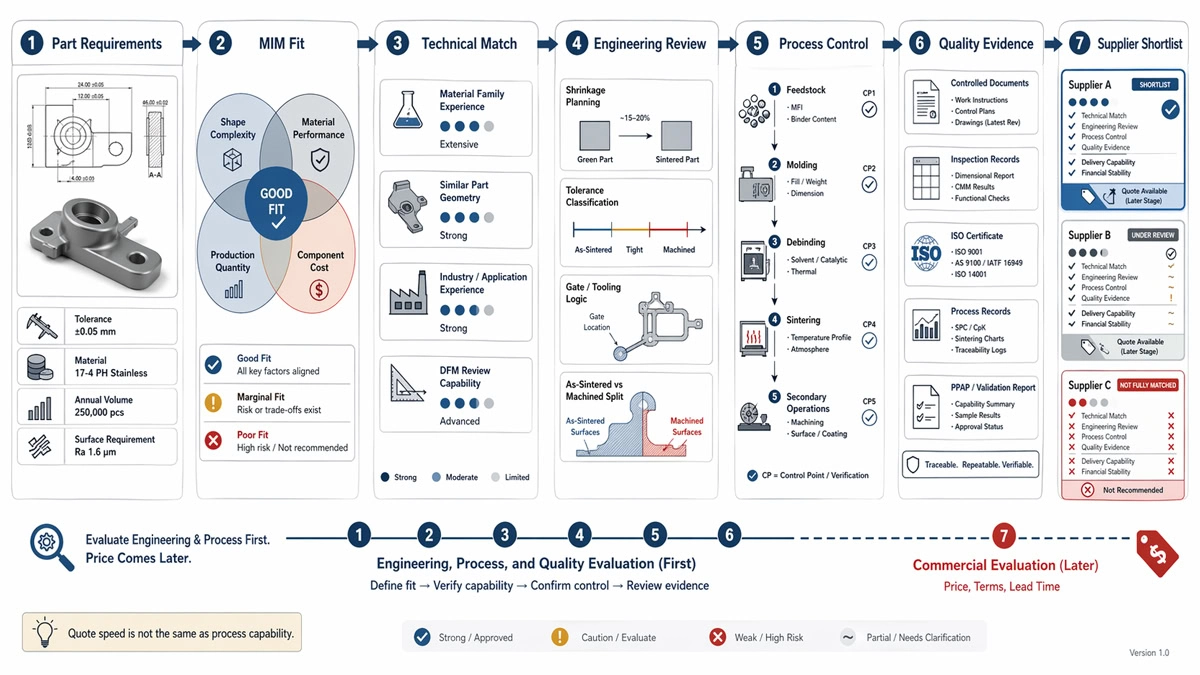
Below is a practical selection flow that works better than comparing quotations line by line.
Step 1: Confirm the part is actually suitable for MIM
Start with geometry, material, tolerance, lot size, and cost target. Good suppliers will not automatically say yes. They will tell you where the design supports MIM and where it creates risk.
Step 2: Ask for a real DFM review, not a fast sales reply
The supplier should comment on gate strategy, mass distribution, shrinkage-sensitive zones, datum logic, debinding vulnerability, and likely distortion areas.
Step 3: Verify the supplier controls the full MIM chain
Do not assume that all “MIM factories” run feedstock management, molding, debinding, sintering, dimensional correction, finishing, and final inspection in a controlled internal system.
Step 4: Compare validation methods, not just claims
Ask what they will inspect at green, brown, and sintered stages, how they monitor lot variation, and how they qualify mechanical and dimensional results.
Step 5: Review tooling and ramp-up assumptions
Some suppliers quote aggressively but understate sampling cycles, tooling optimization time, fixture work, and secondary-process development.
Step 6: Compare commercial terms only after technical filtering
Once the risk level is clear, then compare quote, tooling fee, lead time, MOQ, and communication quality on a fair basis.
What you should send before asking for quotation
| Information to share | Why it matters | What a good supplier does with it |
|---|---|---|
| 2D drawing with critical dimensions | Separates cosmetic dimensions from function-critical features | Builds a realistic tolerance and inspection strategy |
| 3D model | Shows wall transitions, hidden masses, ribs, threads, and shut-off challenges | Reviews molding, ejection, and shrinkage-sensitive geometry |
| Target material or performance target | Material choice changes shrinkage behavior, density window, and post-processing route | Recommends realistic MIM grades and validation path |
| Annual volume forecast | Strongly affects tooling logic, cavity strategy, and process economics | Quotes the right production model instead of guessing |
| Surface / cosmetic expectations | Changes gate location, parting line tolerance, finishing burden, and yield expectations | Flags visible-risk areas early |
| Secondary-process requirements | Heat treatment, machining, plating, polishing, or welding can move dimensions and cost | Integrates secondary operations into the original development plan |
Practical buyer example
Two suppliers may quote the same drawing very differently. One may quote the part as fully net-shape, while another may identify one datum face and one threaded feature that should be finished after sintering. The second quotation may look less attractive at first, but it may be safer if those features control assembly fit. This is why buyers should compare assumptions behind the quote, not only the final unit price.
Engineering review vs quote-only suppliers
One of the clearest differences between strong and weak suppliers appears in the first technical response. A capable MIM supplier usually replies with questions. A weak one replies with a price.

Better sign What a strong supplier usually asks
- Which dimensions are truly function-critical after sintering?
- Are there mating features, threads, seals, or wear zones?
- Is the material requirement driven by strength, corrosion, magnetic behavior, hardness, or certification?
- Which surfaces are cosmetic and which are hidden?
- Can any geometry be adjusted to improve molding balance or sintering stability?
- What secondary operations are acceptable after sintering?
Red flag What a weak supplier often says
- “No problem, we can do it.”
- “Tolerance is okay” without asking where the tolerance matters most.
- “Material is similar” without defining which MIM grade will actually be used.
- “Tooling lead time is short” without discussing sampling rounds or process validation.
- “Surface can be improved later” without clarifying yield and added cost.
Buyer-side rule
Do not reward the fastest quote if it comes with the least process thinking. In MIM, the supplier that raises the right issues early is usually safer than the supplier that says yes to everything.
Representative industry scenario
Consider a representative MIM sourcing scenario rather than a named customer case. A buyer sends a compact stainless-steel mechanism part to three suppliers. Supplier A gives a quick price and says the drawing tolerance is acceptable. Supplier B asks which dimensions are assembly-critical, whether cosmetic surfaces can accept gate marks, and whether one hole can be sized after sintering. Supplier C only discusses tooling lead time. In this situation, Supplier B may not be the cheapest, but it is the only one exposing the real process assumptions before tooling. That early visibility often matters more than the first quotation.
What a qualified supplier must control across the full process chain
MIM part quality is built progressively. Problems that appear at final inspection often begin much earlier, especially in feedstock preparation, molding balance, debinding discipline, furnace loading, or sintering support conditions. This is why supplier capability should be evaluated stage by stage, not by final samples alone.

| Process stage | What should be controlled | What you can ask for as evidence |
|---|---|---|
| Feedstock | Lot consistency, powder/binder stability, handling discipline, traceability | Material control method, lot identification, incoming verification approach |
| Molding | Fill balance, gate strategy, short-shot margin, flash control, green strength | DFM feedback, molding window logic, sample observations, defect review process |
| Debinding | Binder removal route, fixture/support logic, crack or blister prevention | Debinding method explanation, risk comments for thick sections or delicate features |
| Sintering | Atmosphere, temperature discipline, furnace loading, shrinkage repeatability | Sintering experience with similar materials and geometry classes |
| Secondary operations | Sizing, coining, machining, heat treatment, polishing, plating integration | Which features are kept net-shape and which are finished later |
| Inspection | Critical-dimension plan, capability tracking, lot release criteria | Inspection plan, sample report format, gauge / CMM method, traceability flow |
When evaluating material credibility, ask whether the supplier can explain its material basis against recognized MIM material standards rather than using only generic labels like “316L equivalent” or “17-4PH similar.” The standards framework matters because it helps define what “qualified” actually means in measurable terms.
Standards-based research reference
A trustworthy supplier should understand how MIM materials are referenced and evaluated under industry standards. The MIMA Standards Committee states that it develops and maintains MPIF Standard 35-MIM for materials standards for metal injection molded parts. That does not replace project-specific qualification, but it is a useful reference when a supplier discusses material selection, density, mechanical property targets, and part evaluation in a standards-based way rather than purely with marketing language.
Expert insight: why final samples are not enough
Final samples can prove that a supplier produced a few acceptable pieces, but they do not fully prove process repeatability. For a MIM program, buyers should ask how the supplier monitors process drift between feedstock lots, molding conditions, debinding cycles, sintering batches, and final inspection results. A supplier that can explain the connection between these stages is usually easier to qualify than one that only sends attractive sample photos.
Questions you should ask before placing tooling
You do not need to interrogate a supplier with dozens of abstract questions. You need a short list that reveals whether it thinks like a real MIM manufacturing partner.
Part suitability
- Which features of this part are best suited to MIM?
- Which features create the highest molding or sintering risk?
- Would you recommend design adjustments before tooling?
Material and performance
- Which MIM material grade do you recommend and why?
- Have you produced comparable parts in this material before?
- Which properties will be verified during qualification?
Tooling and development
- What is your expected number of sampling rounds before stable production?
- Which dimensions are most likely to be tuned during development?
- How will you handle dimensional correction if shrinkage moves critical features?
Production control
- What process stages are done in-house?
- How do you control lot traceability and process drift?
- What happens if one batch shows density or dimensional deviation?
A supplier does not need perfect answers to every question on the spot. But it should show structured thinking. Vagueness is more dangerous than a cautious answer.
Red flags when choosing a MIM supplier
Red flags rarely appear as one dramatic failure. More often they appear as a pattern of shallow replies, optimistic assumptions, and missing evidence. The earlier you spot them, the cheaper your decision becomes.

Watch for this Commercial red flags
- Tooling and production price look unusually low compared with the technical challenge.
- Lead time sounds aggressive but sampling assumptions are missing.
- MOQ, quality terms, and rework responsibility are unclear.
- Communication is fast on sales topics and weak on engineering questions.
Watch for this Technical red flags
- No meaningful comments on part geometry or tolerance distribution.
- Material is described only as “same as wrought” or “very close” without detail.
- No explanation of debinding and sintering risk for the specific part.
- Secondary operations are treated as an afterthought.
- Inspection plan is generic and not tied to critical features.
The buyer mistake to avoid
Many sourcing teams compare MIM suppliers too late in the funnel, after they have already accepted the factory’s assumptions. A better approach is to compare how each supplier thinks before you compare what each supplier charges.
Industry scenario: when a low quote becomes expensive
In many small precision metal programs, the cheapest early quote becomes expensive only after tooling is already committed. Typical hidden costs include extra sampling rounds, added sizing fixtures, unexpected machining on critical features, cosmetic rework, or delayed approval because inspection criteria were not agreed in advance. This is why a supplier evaluation should ask what risk has been removed before tooling, not only what price has been offered before development.
Practical final checklist before choosing your supplier
If you need a quick decision tool, use the checklist below. A supplier does not need to be perfect in every box, but weak performance across several boxes is usually enough reason to slow down or expand your search.
For a structured worksheet that compares engineering review, tooling assumptions, material experience, shrinkage control, inspection, traceability, RFQ communication, and production readiness, use the MIM Supplier Evaluation Checklist before RFQ or tooling approval.
| Evaluation item | What good looks like | What weak looks like |
|---|---|---|
| DFM depth | Comments on geometry, risk zones, tolerances, and secondary processes | Only confirms manufacturability in general terms |
| Material credibility | Specific MIM grade logic and standards-based discussion | Vague “equivalent” claims |
| Process ownership | Can explain feedstock-to-final-part control clearly | Cannot explain where risk is controlled |
| Validation logic | Has a clear plan for samples, dimensions, and performance verification | Promises results without explaining the route |
| Communication quality | Answers engineering questions directly and specifically | Replies are generic or sales-heavy |
| Commercial transparency | Tooling, sampling, lead time, and production terms are clearly defined | Important assumptions remain unstated |
In short, the best MIM supplier is not the one that makes the best first impression in a quotation spreadsheet. It is the one that reduces uncertainty before the first tool is cut.
FAQ
What is the most important factor when choosing a MIM supplier?
The most important factor is whether the supplier can control the full MIM process chain and explain project risk clearly. Price matters, but process control, engineering review depth, and validation capability matter more in preventing expensive launch problems later.
Should I choose a supplier based on the lowest quote?
Not by itself. A low quote can hide risk in tooling assumptions, process development time, yield loss, or secondary operations. Compare quotations only after confirming that each supplier has realistic technical understanding of your part.
How can I tell whether a supplier really understands my MIM part?
A strong supplier will ask specific questions about part function, tolerance distribution, material target, cosmetic zones, and post-sinter operations. A weak supplier usually responds with a fast quote and very little engineering feedback.
Why does full-process control matter so much in MIM?
Because many final defects start earlier in the process. Feedstock consistency, molding balance, debinding behavior, sintering discipline, and secondary operations are all connected. A supplier that only focuses on one stage is more likely to miss the real cause of quality drift.
What standards signal should I look for when reviewing a supplier?
A useful signal is whether the supplier can discuss MIM materials and part requirements in a standards-based way. The MPIF / MIMA framework, including MPIF Standard 35-MIM, is one of the important references for MIM material standards and evaluation logic.
Need help evaluating whether your part is a good fit for MIM?
At XT MIM, we review parts from an engineering-first perspective. That means we do not stop at “can it be molded.” We look at geometry distribution, material fit, process risk, dimensional sensitivity, secondary operations, and production feasibility before giving practical feedback.
If you already have drawings or a 3D file, send them to us and we can help you evaluate whether MIM is the right process and what a realistic supplier-development path should look like.
Send Your Drawing