MIM Special Alloys for High-Performance Precision Parts
MIM special alloys are considered only when standard stainless steels, low-alloy steels, or soft magnetic materials cannot meet a defined requirement such as low weight, biocompatibility, extreme wear, high density, controlled thermal expansion, high-temperature service, or special electrical and thermal behavior. Selection must consider more than datasheet properties: the alloy needs a viable MIM-grade powder or feedstock route, stable molding and debinding behavior, controllable sintering shrinkage and density, and an achievable inspection plan after any secondary operations. This page helps engineers and sourcing teams identify the appropriate alloy family and decide whether to remain with standard MIM materials or proceed to project-level review.
What Are Special Alloys in Metal Injection Molding?
In the XTMIM material structure, “special alloys” refer to MIM material families used when common MIM stainless steels, low-alloy steels, or soft magnetic materials are not enough for the application.
They are not grouped together because they are rare or automatically superior. They are grouped together because they usually need a more careful review before tooling. A titanium part, a cobalt-chromium component, a Kovar sealing part, a tungsten high-density component, and a cemented carbide wear part may all be candidates for MIM, but each family has different powder behavior, injection molding response, debinding risk, sintering atmosphere, contamination sensitivity, secondary operation needs, and inspection expectations.
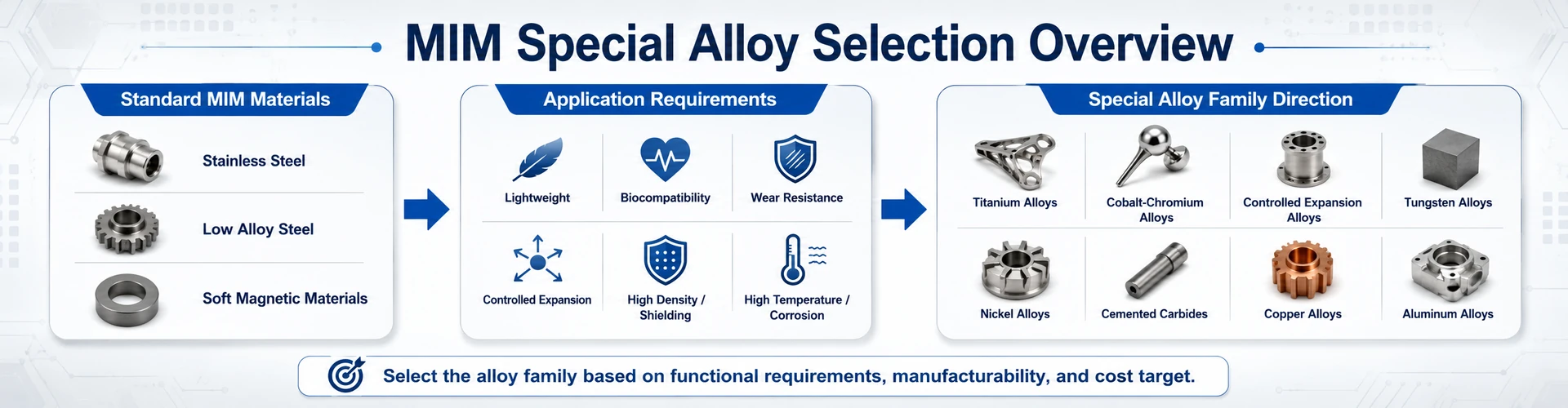
MIM Special Alloy Family Selector
The selector below is a first filter for material-family direction. It does not replace grade-level material review. For example, choosing “titanium” does not automatically mean Ti-6Al-4V is the best option, and choosing “controlled expansion alloy” does not automatically decide between Kovar and Invar. The final decision depends on the drawing, application environment, critical dimensions, surface requirements, inspection criteria, and expected annual volume.

| Special Alloy Family | Typical Material Direction | Why Engineers Consider It | Common Application Direction | Main MIM Review Point | Typical Review Level | Next Page Direction |
|---|---|---|---|---|---|---|
| Titanium Alloys | CP Titanium, Ti-6Al-4V | Lightweight, corrosion resistance, biocompatibility | Medical, wearable, aerospace-related, compact structural parts | Oxygen control, powder/feedstock availability, sintering atmosphere, surface finish, cost | Advanced review before tooling | Review titanium alloy options for MIM |
| Cobalt-Chromium Alloys | ASTM F75, ASTM F1537-type Co-Cr-Mo alloys | Wear resistance, corrosion resistance, biocompatibility | Medical, dental, high-wear precision components | Density, surface condition, fatigue-related requirements, finishing, standard applicability | Advanced review with specification confirmation | Check cobalt-chromium MIM materials |
| Controlled Expansion Alloys | Kovar, Invar | Thermal expansion matching and dimensional stability | Electronics, optical modules, sealing-related components | CTE requirement, sealing interface, thermal cycle, dimensional control | Application-interface review required | Compare Invar and Kovar for controlled expansion applications |
| Tungsten Alloys | Tungsten heavy alloys, tungsten-based materials | High density, shielding, counterweight, thermal/electrical function | Counterweights, shielding parts, compact high-density components | Powder cost, sintering control, density target, brittleness risk, finishing allowance | Project-dependent density and process review | Review tungsten MIM alloy suitability |
| Nickel Alloys | Nickel alloys, nickel-base alloy direction | Heat resistance, corrosion resistance, strength retention | High-temperature or corrosion-loaded small parts | Alloy availability, chemistry control, sintering atmosphere, heat treatment path | Project-dependent heat and corrosion review | Review nickel alloy options for MIM parts |
| Cemented Carbides | WC-Co and hardmetal direction | High hardness and wear resistance | Wear components, micro tools, friction-loaded parts | Binder system, shrinkage, brittleness, edge geometry, finishing allowance | Highly application-dependent wear review | Review MIM cemented carbide feasibility |
| Copper Alloys | Copper or copper alloy direction | Electrical or thermal function | Small complex conductive or thermal parts | Oxidation, density, conductivity, and whether PM, stamping, or machining is better | Process comparison recommended | Review copper alloy MIM or alternative routes |
| Aluminum Alloys | Case-by-case aluminum alloy direction | Lightweight potential | Limited small complex applications | Oxide control, powder/feedstock feasibility, sintering stability, process maturity | Highly project-dependent supplier review | Review aluminum alloy MIM feasibility case by case |
When Should You Consider a Special Alloy for MIM Parts?
Special alloys are worth reviewing when the part has a functional requirement that ordinary stainless steel or low-alloy steel cannot satisfy. For a broader material decision path, review the MIM material selection guide before finalizing the alloy family.
When weight reduction changes product function
Titanium alloys may be considered when the part needs lower weight, corrosion resistance, and useful mechanical performance. In practice, the review should confirm whether the design justifies higher material and processing cost compared with stainless steel, machined titanium, or an alternative process route.
When body-contact requirements are critical
Titanium alloys and cobalt-chromium alloys are often reviewed for medical, dental, and body-contact applications. The word “biocompatible” should not be used as a shortcut. Final material requirements, surface condition, cleaning requirements, and applicable standards must be confirmed at the project level.
When wear is more important than basic strength
Cobalt-chromium alloys and cemented carbides may be considered for repeated contact, sliding, abrasion, or surface wear. The real issue is not only hardness. Brittleness, surface finish, finishing allowance, mating material, and inspection method also affect whether the material is practical.
When thermal expansion affects assembly performance
Kovar and Invar-type alloys are used when dimensional change under temperature or expansion matching is part of the product function. The assembly interface, sealing method, thermal cycle, and critical dimensions should be reviewed together before selecting the alloy family.
When compact weight or shielding is required
Tungsten alloys may be considered for high density, compact weight, counterbalancing, or shielding-related performance. The review should confirm density target, geometry, sintering behavior, brittleness, secondary machining, and finishing needs.
When demanding service conditions are expected
Nickel alloys may be reviewed for higher-temperature or corrosion-loaded service. The key question is whether the MIM route can meet the required alloy chemistry, sintered density, heat treatment path, and inspection requirement for the application.
When a Special Alloy May Not Be the Right Choice
A special alloy is not automatically the best MIM material. In many projects, the material with the highest apparent performance can increase tooling risk, lead time, post-processing cost, or inspection complexity without solving the real design problem.
Engineering Review Points Before Choosing a MIM Special Alloy
Selecting a special alloy for MIM should start before tooling. Many material problems become expensive only after the mold is built, because shrinkage, distortion, surface condition, and post-processing requirements are already locked into the project plan.

| Review Point | Why It Matters in MIM Special Alloys |
|---|---|
| MIM-grade powder availability | Not every wrought, cast, or machined alloy has a mature MIM powder or feedstock route. If the powder route is not stable, the material choice may need to change before tooling. |
| Feedstock stability | Powder shape, particle size distribution, binder system, and flow behavior affect molding consistency, green strength, debinding stability, and defect risk. |
| Injection molding behavior | Special alloy feedstock may change filling behavior, weld line risk, short shot risk, gate design, green part handling, and dimensional repeatability. |
| Debinding behavior | Binder removal must be stable enough to avoid cracking, blistering, distortion, or contamination before sintering. |
| Sintering atmosphere | Titanium, tungsten, nickel, cobalt-chromium, and controlled expansion alloys may require different atmosphere control and temperature profiles. |
| Shrinkage and distortion | Special alloys may not follow the same shrinkage pattern as 316L or 17-4PH stainless steel. Tooling compensation and sintering support should be reviewed separately. |
| Oxygen, carbon, and nitrogen control | Reactive or medical-related alloys often require tighter contamination control because chemistry changes can affect properties, corrosion behavior, and acceptance risk. |
| Secondary operations | Heat treatment, HIP, machining, polishing, passivation, coating, or cleaning may be necessary depending on the final requirement. |
| Inspection method | Density, chemistry, hardness, surface condition, dimensional stability, and critical features must be defined before production instead of negotiated after defects appear. |
| Cost and volume fit | Some special alloys only make sense when geometry complexity and production volume justify MIM tooling, process validation, and inspection cost. |
Composite Field Scenario for Engineering Training
- What problem occurred: A compact part was initially specified as a special alloy because the application required better wear and corrosion resistance than standard stainless steel.
- Why it happened: The early drawing review focused on alloy name and hardness, but did not define the mating surface, critical wear zone, post-polishing requirement, or acceptable dimensional change after sintering.
- Real system cause: The material requirement, surface requirement, and inspection plan were not connected before tooling. The alloy family was treated as a purchasing decision instead of a manufacturing system decision.
- How it was corrected: The design review clarified the functional wear area, added finishing allowance, defined critical dimensions, and compared cobalt-chromium, cemented carbide, and stainless steel plus secondary treatment options.
- How to prevent recurrence: For any MIM special alloy project, confirm material family, geometry, tolerance, surface condition, secondary operation, and inspection criteria before mold design starts.
Start From the Requirement, Not the Alloy Name
Use the application requirement as the first filter. After the material family is selected, grade-level review should consider drawing geometry, wall thickness, feature size, tolerance class, surface finish, mating parts, corrosion or wear exposure, post-treatment requirements, inspection method, annual volume, and cost target.
| If Your Main Requirement Is... | Start With This Material Family | Before Tooling, Confirm... |
|---|---|---|
| Lightweight structure | Titanium alloys | Oxygen control, surface finish, wall thickness, inspection requirement, and cost target. |
| Biocompatibility | Titanium alloys or cobalt-chromium alloys | Applicable standard, surface condition, cleaning requirement, post-treatment, and intended application. |
| Wear resistance | Cobalt-chromium alloys or cemented carbides | Mating surface, load, abrasion condition, edge geometry, finishing allowance, and inspection method. |
| Controlled thermal expansion | Kovar or Invar | CTE requirement, mating material, sealing interface, thermal cycle, and dimensional stability target. |
| High density or shielding | Tungsten alloys | Density target, compact geometry, brittleness risk, sintering control, and secondary operation needs. |
| High-temperature or corrosion-loaded service | Nickel alloys | Service environment, chemistry control, heat treatment path, oxidation/corrosion exposure, and inspection plan. |
| Electrical or thermal function | Copper alloys, with process comparison | Conductivity requirement, oxidation risk, geometry complexity, and whether PM, stamping, or machining is more suitable. |
| Lightweight metal with special geometry | Aluminum alloys, case-by-case | Powder/feedstock feasibility, oxide control, sintering stability, and whether another process route is lower risk. |
For many projects, the best answer may not be “use the highest-performance alloy.” The best answer is the material and process route that can meet the functional requirement with stable production quality, realistic inspection criteria, and a reasonable total cost.
Not Sure Which Special Alloy Fits Your Part?
If your part requires a special alloy, send the drawing, 3D file, target material, application environment, critical dimensions, surface requirement, post-treatment needs, inspection requirements, and estimated annual volume for review.

XTMIM can evaluate whether the project should use a standard MIM stainless steel, low-alloy steel, soft magnetic material, titanium alloy, cobalt-chromium alloy, controlled expansion alloy, tungsten alloy, nickel alloy, cemented carbide, or another process route. Early material review can help identify powder availability issues, shrinkage risk, tolerance challenges, post-processing needs, and inspection requirements before tooling begins.
Standards and Material Specification Notes
Material selection for MIM special alloys should be confirmed at the grade level. MPIF Standard 35-MIM is a key reference for metal injection molded materials and can support material specification discussions between design engineers, sourcing teams, and MIM manufacturers. MIMA material range information can also help identify broad MIM material categories, but these references should be used to support engineering review, not to replace customer drawings, application conditions, regulatory requirements, or supplier-specific process validation.
For cobalt-chromium medical-related applications, ASTM F75 and ASTM F1537 may be relevant material reference points. ASTM F75 relates to cobalt-28 chromium-6 molybdenum alloy castings and casting alloy for surgical implant applications, while ASTM F1537 relates to wrought cobalt-28 chromium-6 molybdenum alloy used for surgical implants. These standards should not be presented as automatic finished MIM component approval. Final applicability depends on the customer specification, manufacturing route, testing plan, surface condition, cleaning requirement, and regulatory requirements for the intended application.
For final production, the applicable customer drawing, ASTM / ISO requirement, material specification, inspection plan, material datasheet, and application environment should be confirmed before tooling and mass production.
External references: MPIF Standard 35-MIM, MIMA Materials Range, ASTM Medical Device and Implant Standards
FAQ: MIM Special Alloys
What are MIM special alloys?
MIM special alloys are material families used when common stainless steels, low-alloy steels, or soft magnetic materials cannot meet the part’s functional requirements. They may include titanium alloys, cobalt-chromium alloys, controlled expansion alloys, tungsten alloys, nickel alloys, cemented carbides, copper alloys, and aluminum alloys.
Are all special alloys suitable for MIM production?
No. A material may exist as a wrought, cast, machined, or PM alloy, but that does not mean it has a mature MIM powder or feedstock route. Suitability depends on powder availability, feedstock stability, molding behavior, debinding route, sintering atmosphere, shrinkage control, density target, post-treatment needs, inspection requirements, and project volume.
When should I choose a special alloy instead of stainless steel?
You should consider a special alloy when stainless steel cannot meet the required weight, wear resistance, biocompatibility, high density, thermal expansion, high-temperature performance, or corrosion-loaded service condition. If the part only needs general corrosion resistance and strength, stainless steel may still be the more practical MIM material.
When is standard MIM stainless steel a better starting point?
Standard MIM stainless steel may be a better starting point when the part mainly needs general corrosion resistance, mechanical strength, dimensional stability, and a more mature process route. If titanium, cobalt-chromium, tungsten, aluminum, or another special alloy does not clearly solve a functional problem, starting with stainless steel and reviewing secondary treatment options can reduce tooling and validation risk.
Is Ti-6Al-4V suitable for MIM parts?
Ti-6Al-4V can be suitable for selected MIM parts where lightweight performance, corrosion resistance, and biocompatibility are important. However, titanium MIM requires careful control of oxygen pickup, sintering atmosphere, surface condition, and inspection requirements. The drawing, application, surface requirement, and applicable material specification should be reviewed before tooling.
What is the difference between Kovar and Invar in MIM applications?
Kovar and Invar are both controlled expansion alloy directions, but they are selected for different thermal expansion and interface requirements. Kovar is often reviewed for sealing-related applications, while Invar is considered when low thermal expansion and dimensional stability are important. The final choice depends on the mating material, thermal cycle, sealing method, and dimensional requirement.
Are copper alloys and aluminum alloys common MIM materials?
They are possible material directions, but they should be reviewed carefully. Copper alloys may be relevant for small complex conductive or thermal parts, but PM, machining, stamping, or other processes may be more practical in many cases. Aluminum alloy MIM is more case-specific because oxide control, powder/feedstock behavior, and sintering stability can be challenging.
What information should I provide for special alloy material review?
Provide the 2D drawing, 3D file, preferred material or performance requirement, application environment, critical dimensions, tolerance requirements, surface finish, post-treatment needs, annual volume, and any inspection or industry standard requirements.
Should I decide the special alloy before contacting a MIM supplier?
You can provide a preferred alloy or performance requirement, but the final material family should be reviewed together with part geometry, powder/feedstock feasibility, sintering behavior, tolerance needs, surface finish, inspection plan, and annual volume. In many projects, an early material suitability review can prevent unnecessary tooling risk.