Powder metallurgy can refer to several powder-based manufacturing routes, but this page focuses on conventional press-and-sinter PM: a process where metal powder is compacted in a die, handled as a green compact, and sintered into a functional metal component. For product engineers and sourcing teams, the practical question is whether a part’s shape, density requirement, tolerance strategy, porosity target, and annual volume fit the PM process window. PM is often effective for relatively regular, high-volume parts such as bushings, bearings, simple gears, porous components, soft magnetic parts, and selected structural parts. When the part becomes small, three-dimensional, thin-walled, undercut-heavy, or expensive to machine after sintering, Metal Injection Molding should be reviewed as a possible alternative rather than assuming PM remains the lowest-risk route.
Page Navigation
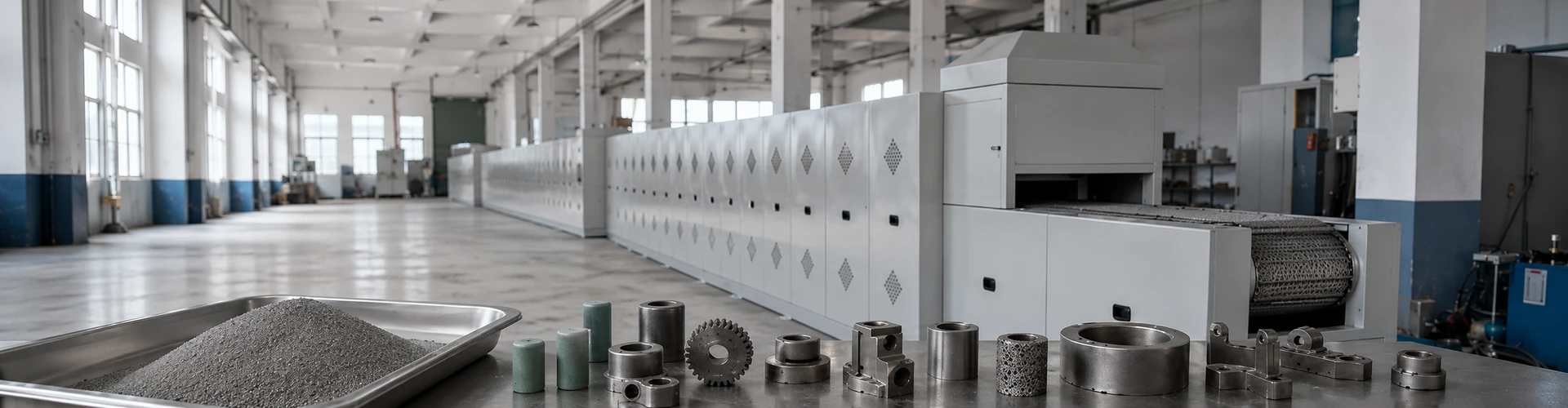
PM is strongest when the part can be compacted, ejected, sintered, and finished with controlled process steps. Complex small parts may need a separate MIM suitability review.
What Is Powder Metallurgy?
Powder metallurgy is a family of manufacturing technologies that uses metal powders to produce metal parts. In a broad technical sense, PM can include conventional press-and-sinter PM, Metal Injection Molding, isostatic pressing, powder forging, and metal additive manufacturing. On this page, “PM” refers mainly to conventional press-and-sinter powder metallurgy, because that is the route most often compared with MIM during early process selection.
This boundary is important. Many buyers use “powder metallurgy” and “MIM” as if they were the same process, but the forming logic is different. Conventional PM forms parts by compacting powder in a rigid die and then sintering the compact. MIM forms parts by injecting a feedstock made from fine metal powder and binder, followed by debinding and sintering. For the full MIM route, see the MIM process page.
The right route should not be selected by material name alone. In practice, the decision depends on part geometry, material requirement, density expectation, porosity requirement, tolerance strategy, annual volume, and how much secondary machining would be needed after sintering.
How the Press-and-Sinter PM Process Works
The conventional PM process, also called press-and-sinter, generally consists of mixing metal powders with lubricants or additives, compacting the mixture in a die, and sintering the compacted part in a controlled furnace atmosphere. From a project review perspective, each step affects final geometry, strength, dimensional consistency, porosity, and cost. A part that looks simple on a 3D model can still become difficult if powder filling, compaction pressure, green handling, or ejection is not compatible with the geometry.

PM quality and cost are controlled across several steps, not only during final sintering. Compaction direction, green strength, sintering behavior, and finishing operations should be reviewed before confirming the process route.
Powder Mixing and Lubricant Addition
The process usually begins with metal powders, alloy powders, lubricants, and sometimes functional additives. The mixture must support powder flow, die filling, compaction, and ejection. In practice, this stage affects more than basic material composition. It can influence green strength, density distribution, wear performance, machinability, and how stable the part is after sintering.
A common mistake is to evaluate PM only by final material name. Two PM parts may use similar base alloy systems but behave differently because powder characteristics, lubricant selection, compaction strategy, and post-sintering operations are different. Before tooling, the material route and forming route should be reviewed together.
Compaction into a Green Compact
During compaction, powder is pressed into a die cavity to form a green compact. The part has its approximate shape but is not yet fully sintered. The green compact must be strong enough for handling, but it is still fragile compared with the final sintered part.
This stage is where many PM design limits begin. Because conventional PM usually relies on pressing powder in a defined compaction direction, the part geometry must allow die filling, pressure transmission, and ejection. Features that are easy to machine or injection mold may not be practical for conventional powder compaction.

PM production stability depends heavily on whether the part can be compacted and ejected without excessive tooling complexity, part damage, or secondary machining.
Sintering Below the Melting Point
After compaction, the green part is sintered in a controlled atmosphere. Sintering bonds the powder particles and gives the part its functional strength. This is different from casting, where metal is melted and poured into a mold. It is also different from MIM, where a molded feedstock goes through debinding before sintering.
Sintering affects dimensional change, strength, porosity, and final part stability. Final capability depends on material, density target, geometry, furnace control, and whether secondary operations are required. If the part requires near-full density, thin walls, or complex three-dimensional features, sintering behavior should be evaluated together with the forming route instead of being treated as a separate step.

Sintering is not casting. It is a controlled thermal process that affects density, dimensional stability, and final part performance.
Secondary Operations: Sizing, Coining, Repressing, Impregnation, Machining
Conventional PM often uses secondary operations to improve dimensional accuracy, local density, surface condition, or functional performance. These operations can be valuable, but they also affect total manufacturing cost and process complexity. In sourcing review, the real comparison is often not “PM blank cost vs MIM part cost,” but “PM blank plus required secondary operations vs a different forming route.”
| Secondary Operation | Why It Is Used | Engineering Consideration |
|---|---|---|
| Sizing | Improve dimensional consistency | Useful when as-sintered dimensions are not enough; should be planned around functional dimensions and datum strategy. |
| Coining | Improve selected surfaces or local geometry | Must be planned with tooling access, part strength, and surface function. |
| Repressing | Increase local density or dimensional control | May add cost and process complexity; not every geometry can be improved economically this way. |
| Oil impregnation | Provide self-lubricating function | Common for porous bearings and bushings when controlled porosity is part of the design intent. |
| Machining | Add features not possible by compaction | Can reduce PM cost advantage if side holes, undercuts, or tight surfaces require multiple operations. |
| Heat treatment | Improve mechanical performance | Depends on alloy system, density, geometry, and application requirements. |
Where Powder Metallurgy Performs Well
PM performs well when the part geometry fits compaction tooling, production volume supports tooling investment, and the application benefits from near-net-shape production, controlled porosity, or high repeatability. For sourcing teams, the important point is that PM’s value is not only “lower cost.” Its value depends on how well the part’s geometry and functional requirements match the powder compaction route.
| PM Fit Area | Why PM Works | Typical Part Examples | MIM Review Needed When |
|---|---|---|---|
| Bushings and bearings | Controlled porosity and oil impregnation can support self-lubricating function. | Porous bearings, sleeves, bushings | Geometry becomes very small, complex, or difficult to compact. |
| Simple gears | Near-net-shape forming can reduce machining for repeatable high-volume parts. | Spur gears, timing parts, small transmission parts | Side holes, undercuts, tight datum relationships, or complex 3D geometry are required. |
| Structural components | PM can be efficient for high-volume parts with relatively regular geometry. | Levers, brackets, simple housings | Thin walls, micro features, or multiple post-sintering machined features dominate the cost. |
| Soft magnetic parts | Powder routes can support magnetic material systems and repeatable shapes. | Magnetic cores, sensor-related parts | High density, complex geometry, or tight feature control is required. |
| Porous components | PM can intentionally retain controlled porosity. | Filters, flow-control parts, self-lubricating components | Near-full density, sealed geometry, or very complex small features are required. |

PM is strongest when part design, tooling direction, green compact handling, and production volume all support stable compaction.
Where Conventional PM Has Design Limits
The most important limitation of conventional PM is not that it cannot make useful parts. It can. The limitation is that the geometry must be compatible with powder filling, compaction pressure, green part handling, ejection, sintering, and any secondary operations. This is where PM and MIM usually separate in real project review.
Common Design Features That Increase PM Review Risk
The following design features do not automatically disqualify PM, but they should be reviewed before tooling. If several of these risks appear in the same drawing, the project may need a PM plus machining vs MIM comparison instead of a simple unit-price review.
| Design Feature | PM Concern | MIM Review Trigger |
|---|---|---|
| Side holes or cross holes | They are difficult to form directly through simple axial powder compaction and may require post-sintering drilling or machining. | Multiple side holes or tight-position cross features make secondary machining the main cost driver. |
| Undercuts or reverse tapers | They can conflict with ejection direction and green compact removal from the die. | The part requires geometry that cannot be ejected cleanly without design compromise or additional operations. |
| Thin walls or tall narrow sections | Powder filling, compaction pressure, and green strength may become unstable across the section. | The part needs thin-wall geometry, tight functional surfaces, or complex small features that dominate quality risk. |
| Multiple levels or large thickness transitions | Density distribution and shrinkage behavior may vary across different heights or mass sections. | Critical dimensions cross multiple levels and cannot be controlled economically by sizing or secondary operations. |
| Near-full density or sealed function | Some PM applications intentionally use controlled porosity, while other designs require higher density or sealing behavior. | The application requires high density, leakage control, tight surfaces, or complex geometry at the same time. |
Uniaxial Pressing Limits Part Geometry
Conventional PM normally works best when the geometry can be formed through die compaction and ejected without damaging the green compact. This matters because many design features are not only “shape features.” They are tooling and ejection problems. Side holes, reverse tapers, undercuts, deep cross features, and complex three-dimensional surfaces may force additional machining or design changes.
Density Distribution Can Affect Strength and Dimensional Consistency
During compaction, powder movement and pressure transmission are affected by part thickness, height, surface friction, tooling design, and material behavior. If density distribution is not stable, the part may show differences in shrinkage, strength, or dimensional behavior after sintering.
This does not mean every PM part has a quality problem. It means PM parts should be reviewed according to geometry and functional requirement. For example, a bushing with controlled porosity may be a good PM candidate, while a small part requiring high density, thin walls, and tight functional surfaces may need a MIM review.
Complex 3D Features Often Push the Project Toward MIM
When a part has multi-directional features, thin sections, small slots, undercuts, or internal geometry, conventional PM may require machining after sintering. If those secondary operations become too expensive or reduce process stability, MIM may become a better candidate. For geometry-driven review logic, see the MIM design guide and MIM DFM review.
Powder Metallurgy vs Metal Injection Molding: Same Powder Origin, Different Forming Logic
PM and MIM are related because both use metal powders and sintering. However, the forming route changes the design window. MIM should not be promoted as a replacement for every PM part. If a shape can be made efficiently by conventional pressing and sintering, PM may remain the better route. MIM is usually reviewed when the part’s complexity, geometry consolidation, density requirement, or machining reduction justifies a different process route.
| Factor | Conventional PM | MIM | What It Means for Part Selection |
|---|---|---|---|
| Forming method | Powder compaction in a die | Injection molding of metal powder-binder feedstock | Determines geometry freedom and tooling limits. |
| Typical geometry | Pressable, relatively regular shapes | Small, complex, three-dimensional parts | Complex features may justify MIM review. |
| Common parts | Bushings, bearings, gears, porous parts, structural parts | Precision small components, complex brackets, medical, device, and industrial parts | Different application windows. |
| Density and porosity | Can be designed for specific density or controlled porosity | Often reviewed when higher density and complex geometry are needed | Depends on function, material, and inspection requirement. |
| Cost logic | Efficient for high-volume simple parts | Justified by complexity, consolidation, and precision | Not simply “which is cheaper.” |
| Secondary machining | Often used when PM cannot form a feature directly | Also possible, but ideally minimized by design | Excess machining may change process selection. |
When Should a PM Part Be Reviewed for MIM?
A PM part should be reviewed for MIM when the cost or risk is no longer controlled by the basic PM process, but by geometry correction, secondary machining, density requirements, or repeated design compromise. This does not mean the part must change to MIM. It means the drawing should be reviewed before tooling or production assumptions are locked.
| Review Trigger | Why It Matters | Possible Next Step |
|---|---|---|
| Small complex geometry | Conventional compaction may not form details reliably. | Review MIM forming feasibility. |
| Side holes or cross features | May require machining after sintering. | Compare PM plus machining vs MIM. |
| Undercuts or reverse features | May conflict with ejection direction. | Review tooling and parting strategy. |
| Thin walls or micro features | May be difficult to compact uniformly. | Check MIM wall and feedstock suitability. |
| High density requirement | PM porosity may not meet functional needs. | Review MIM material and sintering route. |
| Multiple machined features | Secondary operations may remove PM cost advantage. | Compare total manufacturing cost. |
| Tight datum relationships | As-sintered and post-operation control must be planned. | Review tolerance strategy early. |
| Part consolidation opportunity | MIM may combine several small components. | Review assembly reduction potential. |
- What problem occurred
- A small structural component was originally planned for conventional PM because the projected annual volume was suitable and the main body shape looked pressable.
- Why it happened
- After detailed drawing review, the part included side holes, a shallow undercut, and two functional surfaces requiring post-sintering machining.
- What the real system cause was
- The cost issue was not the PM blank itself. The real problem was that several key features could not be formed directly by the PM compaction route, so the project depended on multiple secondary operations.
- How it was corrected
- The design was reviewed as a potential MIM candidate. The team compared PM blank cost plus machining against MIM tooling, molding, debinding, sintering, and limited finishing.
- How to prevent recurrence
- Before confirming PM, the drawing should be reviewed for pressing direction, ejection feasibility, secondary machining load, density requirement, and whether complex features justify MIM evaluation.
- What problem occurred
- A buyer considered moving a simple porous bushing from PM to MIM because the part was small and the project team assumed “smaller means MIM.”
- Why it happened
- The project team focused on part size but did not evaluate functional requirements. The part required controlled porosity and oil impregnation.
- What the real system cause was
- The manufacturing process was being selected based on size alone, not on function, density target, lubrication behavior, and geometry.
- How it was corrected
- The part remained a PM candidate because conventional PM supported the porous structure and application requirement better than a high-density MIM route.
- How to prevent recurrence
- Process selection should consider geometry, density, porosity, material, functional surface requirements, annual volume, and secondary operations together.
What Information Should You Prepare Before Comparing PM and MIM?
For sourcing teams, a useful PM vs MIM review starts with project information, not with a process preference. The same part may look suitable for PM at first, but after reviewing geometry, tolerance, material, density, porosity, and machining requirements, the best route may change.
| Information to Provide | Why It Matters |
|---|---|
| 2D drawing | Identifies tolerances, datum structure, functional dimensions, and inspection needs. |
| 3D CAD file | Helps evaluate geometry, undercuts, wall sections, and tooling feasibility. |
| Material requirement | Determines whether PM or MIM material route is realistic. |
| Density or porosity requirement | Clarifies whether the application needs controlled porosity, near-full density, lubrication behavior, or sealed structure. |
| Annual volume | Affects tooling investment, unit cost, and process economics. |
| Current manufacturing route | Helps compare CNC, PM, casting, stamping, or MIM alternatives. |
| Functional surfaces | Identifies whether machining, sizing, coining, or finishing may be required. |
| Surface finish requirement | Affects secondary processing and inspection planning. |
| Application environment | Helps evaluate wear, corrosion, strength, temperature, lubrication, and density requirements. |
| Target problem | Clarifies whether the project is driven by cost, quality, geometry, weight, machining reduction, or supply stability. |
FAQ
Is powder metallurgy the same as MIM?
No. Powder metallurgy is a broad family of powder-based manufacturing routes, while MIM is one specific process that uses fine metal powder, binder feedstock, injection molding, debinding, and sintering. Conventional PM usually means press-and-sinter powder metallurgy, where powder is compacted in a die and then sintered.
When is conventional PM better than MIM?
Conventional PM is often better when the part has a relatively regular pressable shape, high annual volume, acceptable density or controlled porosity requirements, and limited need for complex secondary machining. Bushings, bearings, simple gears, porous parts, soft magnetic parts, and certain structural parts are common PM candidates.
When should a PM part be reviewed for MIM?
A PM part should be reviewed for MIM when it includes small complex features, side holes, undercuts, thin walls, difficult datum relationships, high-density requirements, or too many secondary machining operations. In these cases, the total cost and risk may not be controlled by the PM blank alone.
Why are side holes difficult in conventional powder metallurgy?
Side holes are difficult because conventional PM compaction mainly works along the pressing and ejection direction. A transverse hole usually cannot be formed by a simple punch-and-die route, so it may require special tooling, design changes, or post-sintering machining. If several side holes or cross features dominate the part cost, PM plus machining should be compared with MIM.
Can conventional PM make complex shapes?
Conventional PM can make many useful near-net-shape parts, but it is usually limited by powder compaction direction, die filling, green strength, and ejection. Complex three-dimensional features, reverse undercuts, and cross holes may require additional operations or a different process route.
Does PM always cost less than MIM?
No. PM can be more economical for simple, high-volume, pressable parts. However, if a PM part needs multiple machining steps, difficult tooling, or repeated dimensional correction, MIM may become worth reviewing. The correct comparison should include total manufacturing cost, not only the initial forming cost.
What information should I send for a PM vs MIM review?
Send the 2D drawing, 3D CAD file, material requirement, tolerance requirements, density or porosity requirement, surface finish needs, annual volume, current manufacturing route, and application background. This helps engineers evaluate geometry, density, tooling risk, secondary operations, and process suitability.
Is PM suitable for parts that require controlled porosity?
Yes, conventional PM can be suitable when controlled porosity is part of the functional requirement, such as porous bearings, self-lubricating components, or certain filtration-related parts. If the application requires near-full density or sealed geometry, MIM or another route may need to be reviewed.
Review a PM Part for MIM Suitability
If your current PM part is becoming difficult to compact, expensive to machine, or risky to control dimensionally, XTMIM can review whether MIM is a practical alternative. This review is most useful when the drawing includes side holes, undercuts, thin sections, tight datum relationships, high-density requirements, or multiple post-sintering machining steps.
Please send 2D drawings, 3D CAD files, material requirements, density or porosity expectations, tolerance and datum requirements, surface finish needs, estimated annual volume, current manufacturing route, and application background. The engineering review can check geometry feasibility, MIM suitability, material selection, shrinkage-related risk, tolerance strategy, secondary operation needs, and whether the part should stay with PM or move into a MIM comparison review.
Contact Engineering Team Submit Drawing for Review Request a QuoteStandards and Technical Reference Note
This page uses official powder metallurgy and metal powder references for process-level context. The MPIF powder metallurgy process reference supports the press-and-sinter route description. The EPMA Metal Injection Moulding reference supports the boundary between conventional PM and MIM for complex-shaped parts. The ASTM Committee B09 reference is relevant to metal powders and metal powder products, but specific test methods or material standards should be selected according to the actual project requirement.
These references support process understanding and evaluation language. They should not replace supplier-specific DFM review, material confirmation, tolerance agreement, density or porosity agreement, or inspection planning. Project-specific material, density, functional surface, and inspection requirements should be confirmed before tooling.