Resources / Project Checklists
A MIM quality inspection checklist helps quality engineers, product engineers, and sourcing teams define what must be checked before RFQ, sample approval, production release, or supplier review. For metal injection molded parts, final inspection alone is not enough. Critical dimensions, datum references, material condition, sintering shrinkage, density, hardness, surface finish, cosmetic areas, secondary operations, and shipment documents all affect whether a small complex metal part can be accepted consistently.
This is a buyer-side inspection planning checklist, not a general quality-control capability page. Use it to decide which dimensions, material checks, surface requirements, sample approval items, and release criteria should be discussed for a specific MIM part before tooling, trial samples, or repeat production.
Use this checklist when you already have a drawing, sample, supplier quotation, production transfer plan, or quality issue under review. The goal is to clarify CTQ dimensions, inspection methods, first article requirements, lot inspection needs, and the project information that should be sent to a MIM supplier before tooling or production assumptions become fixed.
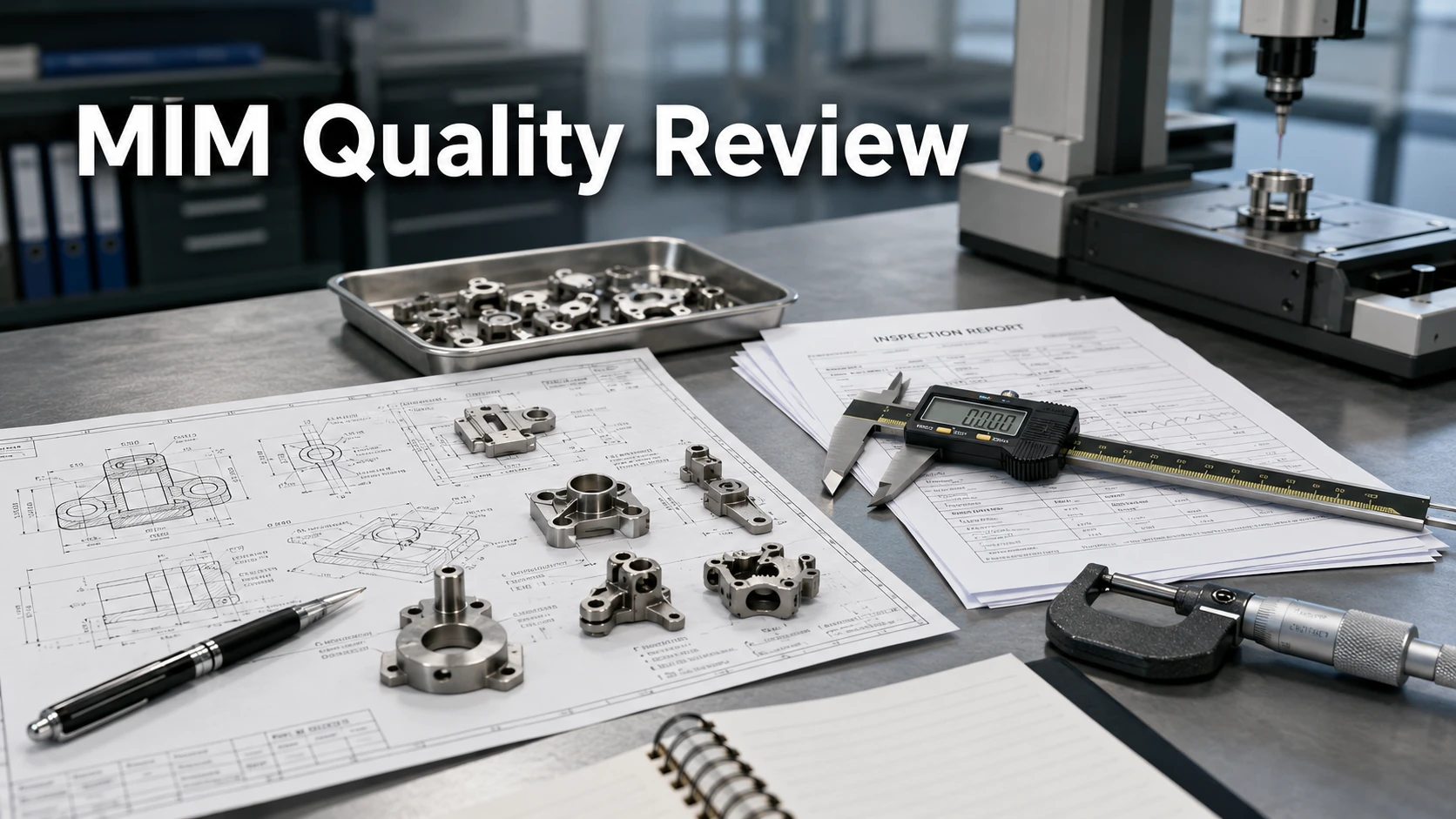
Engineering note: The useful inspection plan is usually decided before final inspection: drawing revision, CTQ features, datum strategy, material condition, and report expectations should be reviewed before sample approval.
Quick Answer: What Should a MIM Quality Inspection Checklist Cover?
A useful MIM quality inspection checklist should cover the full path from drawing requirements to shipment release. At minimum, it should review the latest drawing revision, 3D CAD model, CTQ dimensions, datum strategy, measurement method, material grade, heat treatment or coating condition, density or hardness concerns, surface finish, cosmetic surfaces, first article inspection, production lot inspection, documentation, packaging, and shipment release requirements.
The practical question is not only “Does the supplier inspect the parts?” The better question is whether the right features are inspected by the right method at the right project stage.
The expected output should be clear enough for engineering and sourcing teams to make a decision: which features are CTQ, how they should be measured, what sample approval evidence is needed, what production release criteria apply, and what information must be sent before RFQ or tooling review.
In practice, many MIM quality disputes are not caused by missing final inspection alone. They come from unclear drawings, unrealistic tolerances, weak datum definition, unconfirmed material condition, late cosmetic requirements, or inspection methods that were not agreed before sample approval.
What Output Should This Checklist Produce?
This checklist should not end as a generic document. It should produce a practical inspection planning result that can be used during RFQ discussion, first article review, supplier quality communication, or production release.
| Checklist Output | What It Should Define | Why It Matters for MIM Projects |
|---|---|---|
| CTQ list | Critical dimensions, functional surfaces, assembly features, datum references, cosmetic areas, and restricted gate mark zones. | Prevents checking easy dimensions while missing the features that control fit, function, surface acceptance, or production risk. |
| Inspection method | CMM, optical measurement, gauge, fixture, hardness check, surface review, visual inspection, or functional check. | Small MIM features, thin walls, curved surfaces, and tight datum relationships may need different inspection methods. |
| Sample review scope | First article dimensions, sample quantity, material condition, deviation record, functional fit, and report expectations. | Separates engineering learning samples from samples that are ready for production approval. |
| Production release criteria | Accepted dimensions, material or hardness requirements, surface condition, coating or finishing status, packaging, and required documents. | Reduces the risk of approving a production lot based only on visual appearance or incomplete sample data. |
| RFQ information package | 2D drawing, 3D CAD file, material requirement, tolerance requirement, surface finish need, estimated annual volume, and application background. | Helps the supplier review inspection risk, tooling compensation, secondary operation needs, and sampling logic before quotation. |
When Should You Use This MIM Inspection Checklist?
Use this checklist when inspection requirements may affect quotation, tooling decisions, sample approval, production release, supplier qualification, or production transfer.
Clarify critical dimensions, material condition, surface treatment, inspection reports, and sample approval expectations before asking for price.
Review CTQ dimensions, datum references, restricted gate mark areas, cosmetic surfaces, and secondary operation needs before mold compensation assumptions become fixed.
First samples should be reviewed against dimensions, material condition, surface requirements, functional fit, and measurement method, not only by appearance.
Confirm inspection method, sampling logic, report format, lot identification, packaging condition, and shipment release requirements.
Confirm CTQ dimensions, historical defect concerns, measurement methods, material condition, and release documents before transferring production to another supplier.
Separate drawing ambiguity, process variation, secondary operation effects, measurement method differences, and true nonconformance.
When this checklist is not enough: If the part has safety-critical function, regulated industry requirements, customer-specific approval documents, or a formal PPAP-style workflow, the checklist should be treated as a preparation tool only. The final control plan, sampling plan, report format, and acceptance criteria must be confirmed by the customer and supplier for that project.
For earlier design-stage risk review, use the MIM DFM design checklist. For quotation-stage inputs, review the RFQ preparation guide or submit drawings through the RFQ page.
MIM Quality Inspection Checklist at a Glance
The table below can be used as a starting point for MIM project inspection planning. It does not replace a project-specific quality plan, but it helps engineering and sourcing teams identify what should be clarified before RFQ, sample approval, or production release.
| Checklist Area | What to Confirm | Why It Matters in MIM | Related Review |
|---|---|---|---|
| Drawing revision | Latest 2D drawing, 3D CAD file, revision status | Prevents quotation, tooling review, or inspection based on outdated information. | RFQ / sample review |
| CTQ dimensions | Functional dimensions, assembly fits, sealing areas, rotating or sliding features | MIM shrinkage and sintering distortion may affect different features differently. | Tolerance review |
| Datum strategy | Datum references, measurement orientation, fixture reference | Prevents inconsistent inspection results between customer and supplier. | Dimensional inspection |
| Measurement method | CMM, optical measurement, gauge, fixture, visual check, functional check | Small complex MIM parts may require method-specific inspection planning. | Inspection planning |
| Material condition | Alloy grade, heat treatment, coating, passivation, final condition | Material condition affects hardness, strength, corrosion resistance, wear, and acceptance. | Material review |
| Density / porosity concern | Whether density or porosity must be verified for the application | Relevant for strength, sealing, fatigue, corrosion, coating, or functional risk. | Material / quality review |
| Surface condition | As-sintered, polished, blasted, coated, passivated, cosmetic or non-cosmetic side | Surface expectations must be defined before finishing and final acceptance. | Surface review |
| First article inspection | FAI scope, sample quantity, report format, CTQ dimensions | Confirms key risks before production release. | Sample approval |
| Production lot inspection | Sampling method, in-process checks, final inspection, lot identification | Supports repeat production control, not only one-time sample approval. | Production release |
| Documentation | Inspection report, material information, release record, shipment documents | Reduces approval delays and buyer-side quality disputes. | Supplier quality review |

Engineering note: A checklist is useful only when it links project inputs to measurable acceptance items: drawing revision, CTQ dimensions, material condition, inspection method, and release documents should be reviewed together.
Drawing, CTQ Dimensions and Datum Review
MIM quality inspection starts with the drawing. A 3D model may show the shape, but it usually does not fully define tolerances, datum references, cosmetic surfaces, material condition, inspection method, or acceptance criteria.
Which Dimensions Are Truly Critical?
A common mistake is applying tight tolerances to many dimensions without separating functional dimensions from general dimensions. In a MIM project, the inspection plan should identify assembly interfaces, press-fit features, sliding surfaces, sealing faces, locating surfaces, cosmetic zones, and dimensions affected by secondary operations.
Not every dimension should become a CTQ dimension. If all dimensions are treated as critical, inspection cost increases and manufacturing flexibility decreases. If the true functional dimensions are not marked, the supplier may spend effort controlling less important features while missing the dimensions that affect assembly or performance.

Engineering note: Measurement disagreement often starts before production. If CTQ features, datum references, and inspection orientation are not agreed, the customer and supplier may measure the same part differently.
Are Datum References Clear Enough for Inspection?
Datum ambiguity is one of the easiest ways to create inspection disagreement. The customer may measure from one surface, while the supplier measures from another. This is especially risky for small MIM parts with curved surfaces, molded features, thin walls, or multiple possible reference faces.
From a quality review perspective, datum strategy should be clear before sample measurement starts. If the part requires a fixture, the fixture concept should be discussed early. If a surface will be machined after sintering, the team should confirm whether the as-sintered feature or the machined feature becomes the inspection reference.
Which Dimensions May Need Secondary Operations?
Some MIM features can remain as-sintered. Others may need post-sintering control, such as reaming, tapping, grinding, sizing, polishing, passivation, heat treatment, or coating. The inspection checklist should identify which features are expected to remain as-sintered and which features require MIM secondary operations before final inspection.
Are Cosmetic and Functional Surfaces Marked?
A drawing that says “good surface finish” is not enough. The supplier needs to know which surfaces are cosmetic, which are functional, and which are not visible after assembly. Gate marks, parting lines, polishing direction, coating areas, and handling marks should be discussed before sample approval when appearance matters.
For deeper tolerance and shrinkage review, use the MIM tolerance and shrinkage checklist.
Dimensional Inspection Checklist for MIM Parts
Dimensional inspection should be built around the part function, not only around the drawing table. MIM parts are often small, complex, and feature-dense. Some features are easy to mold but difficult to measure consistently. Others may shift during debinding, sintering, or secondary operations.

Engineering note: A single inspection method is not always suitable for every feature. Small holes, thin walls, curved surfaces, hidden features, and tight datum relationships may require different measurement methods.
CMM Inspection
CMM inspection is useful for critical dimensions, datum relationships, position, flatness, profile, and complex geometry when the part size and feature access allow reliable probing. It is often used when functional fit depends on multiple features rather than a single linear dimension.
Optical Measurement
Optical measurement can be useful for small features, outlines, hole positions, thin sections, edge profiles, and visual geometry checks. It is often helpful when contact probing may be difficult or when feature edges need to be reviewed without applying force.
Go / No-Go Gauges and Fixtures
For production lots, gauges and fixtures may be more practical than measuring every part with complex equipment. A go / no-go gauge can support fast production checks when a functional fit is more important than a full dimensional report.
Small Holes, Thin Walls and Complex Features
Small MIM features can be affected by mold filling, binder removal, green part handling, sintering support, and shrinkage behavior. Thin walls, deep slots, undercuts, micro holes, and fragile projections may need closer inspection planning because dimensional variation may not be uniform across the part.
For equipment and test method support, see XTMIM’s MIM inspection and testing capability.
Material, Density, Hardness and Mechanical Verification
Material verification should match the application risk. Not every project needs the same level of testing, but material condition should never be left unclear.

Engineering note: Material-related checks should be based on application risk. Strength, wear, corrosion, coating adhesion, heat treatment response, and functional reliability may require different verification levels.
Confirm Material Grade and Final Condition
The material description should not stop at “stainless steel” or “steel.” A MIM supplier needs to know the required alloy grade or performance target, the expected heat treatment condition, and whether coating, passivation, polishing, or other finishing steps are required.
If the buyer allows material alternatives, this should be stated clearly. If the material is fixed by a customer specification, the required grade and acceptance condition should be provided before quotation.
When Hardness Should Be Checked
Hardness inspection is useful when wear resistance, strength, heat treatment response, or customer acceptance depends on final material condition. It should be defined together with material grade, heat treatment, surface treatment, and functional requirement.
When Density or Porosity Matters
MIM is often selected because it can produce dense, complex metal parts. However, whether density or porosity must be verified depends on the application. Density or porosity concerns may matter more when the part is exposed to fatigue load, sealing requirements, corrosion risk, coating adhesion concerns, high strength requirements, or functional reliability requirements.
When Mechanical Testing May Be Required
Mechanical testing, metallographic review, chemical verification, or other material-related checks may be required for selected projects. These should be defined by drawing requirements, customer specifications, application risk, and supplier capability. They should not be added automatically to every project without considering cost, sampling, lead time, and relevance.
For material selection before RFQ, review the MIM material selection checklist and the MIM materials hub.
Surface, Cosmetic and Secondary Operation Inspection
Surface inspection should be defined before finishing decisions are made. In MIM projects, surface appearance can be affected by molded condition, gate location, parting line, sintering atmosphere, handling, secondary machining, polishing, blasting, passivation, coating, or packaging.
As-sintered surfaces may be suitable for many functional parts when cosmetic requirements are moderate and geometry is controlled. The project should still define whether minor texture, flow mark visibility, gate vestige, parting line, discoloration, or handling marks are acceptable.
Gate marks and parting lines can affect appearance, contact surfaces, assembly, coating, and inspection. Restricted gate areas should be marked before tooling.
Secondary surface operations can improve appearance, corrosion resistance, wear resistance, or customer-facing finish, but they also change inspection timing and acceptance criteria.
For small precision MIM parts, handling and packaging can create scratches, dents, mixing risk, or surface contamination after inspection.
First Article Inspection and Sample Approval Checklist
First article inspection should confirm the part is not only shaped correctly, but also measured correctly, interpreted correctly, and ready for the next project stage.
What to Check in T1 / T2 Samples
T1 and T2 samples should be reviewed for drawing revision, CTQ dimensions, datum consistency, material condition, heat treatment or surface treatment status, as-sintered and post-processed features, cosmetic surfaces, functional assembly, visible defects, measurement method, deviations, and corrective actions.
A first sample may be acceptable for design review but not yet ready for production approval. The project team should separate prototype learning from production release.
What Should Be Included in a First Article Report
A first article report should focus on the agreed drawing requirements and CTQ dimensions. For complex MIM parts, the report may include dimensional results, measurement method, sample identification, material condition, surface status, and notes on deviations.
How to Record Deviations and Corrective Actions
When a sample fails, the key question is not only which dimension is out of tolerance. The team should ask whether the drawing was unclear, the datum strategy was ambiguous, tooling compensation was incorrect, sintering distortion affected the feature, inspection method was inconsistent, or a secondary operation shifted the dimension.
Composite field scenario for engineering training: sample approved visually, CTQ bore failed during assembly
- What problem occurred: A small MIM component passed visual sample review, but a bore used for alignment caused inconsistent fit during assembly testing.
- Why it happened: The bore was listed on the drawing but was not marked as a CTQ dimension, so it was not treated as a functional feature during the first sample review.
- What the real system cause was: The project lacked early agreement on CTQ definition, datum strategy, and measurement method.
- How it was corrected: The bore was reclassified as CTQ, the inspection method was updated, and the team reviewed whether the bore should remain as-sintered or receive post-sintering reaming.
- How to prevent recurrence: Functional dimensions should be marked before tooling or sample approval, and the RFQ package should identify assembly-critical features and acceptable inspection methods.
Production Lot Inspection and Shipment Release
Production lot inspection should confirm repeatability, not only one-time sample success. Once a MIM part enters repeat production, the inspection focus should include lot control, process discipline, final inspection, documentation, and packaging status.
Lot Identification and Traceability
Lot identification helps connect parts to production records, material condition, inspection status, and shipment release. The required level of traceability depends on the application, industry, customer requirement, and project risk. It should be discussed before production rather than after a quality issue occurs.
In-Process Checks vs Final Inspection
Final inspection can detect nonconforming parts, but it does not create quality. In MIM, quality risks may come from injection molding stability, green part handling, debinding, sintering shrinkage, sizing, finishing, or handling. In-process checks help reduce the risk of repeated defects reaching final inspection.
Sampling and Inspection Records
Sampling requirements should match the project’s risk level. Some projects may require only basic dimensional and visual checks. Others may need CTQ-focused reports, material verification, hardness checks, coating review, functional checks, or customer-specific documentation.
Packing and Shipment Release Review
Shipment release should confirm more than quantity. It may include inspection status, part identification, packaging condition, protection of cosmetic surfaces, prevention of mixed lots, and required documents. For small precision parts, poor packaging can create defects after final inspection.
For process-side control, review XTMIM’s MIM quality control capability.
Quality Questions to Ask a MIM Supplier
For sourcing and quality teams, supplier evaluation should include quality-related questions, not only price, lead time, and production capacity.
- Can you review CTQ dimensions before tooling?
- Which dimensions should be inspected by CMM, optical measurement, gauge, fixture, or functional check?
- Which MIM process steps may affect the most critical features?
- Are any dimensions likely to need secondary operations after sintering?
- What information do you need to prepare a quality control plan?
- How do you separate first article approval from production release?
- What inspection records can be provided for this project?
- How should cosmetic surfaces, gate marks, coating, or packaging requirements be defined?
- Which requirements must be confirmed before RFQ or tooling approval?
- How will deviations be reviewed and corrected before repeat production?
This section supports inspection-specific supplier review. For a broader buyer-side checklist, use the MIM supplier evaluation checklist.
What to Send for a MIM Quality Review
A useful quality review starts with the right project information. The supplier cannot define a reliable inspection plan from a 3D model alone.
| Information to Send | Why It Matters |
|---|---|
| 2D drawing with revision | Defines tolerances, datums, surface notes, and acceptance requirements. |
| 3D CAD file | Helps review geometry, molding, shrinkage, support, and measurement access. |
| Material grade or performance target | Supports material suitability and final condition review. |
| Heat treatment or coating requirement | Affects hardness, surface condition, corrosion, wear, and inspection timing. |
| CTQ dimensions | Shows which features control function, assembly, or safety. |
| Datum and measurement notes | Reduces disagreement between customer and supplier measurement. |
| Cosmetic surfaces | Helps protect visible surfaces, gate-sensitive areas, and finishing requirements. |
| Surface finish requirement | Clarifies as-sintered, polished, blasted, passivated, coated, or machined condition. |
| Inspection standard or report format | Helps align sample approval and buyer-side quality review. |
| Application environment | Helps judge corrosion, wear, load, temperature, or functional risk. |
| Estimated annual volume | Helps plan inspection method, fixture need, sampling logic, and cost. |
| Current defect or supplier issue | Helps identify what must be prevented in the next production route. |
Send Your Drawing Package for MIM Quality Review
If your MIM project has CTQ dimensions, tight assembly features, cosmetic surfaces, material verification requirements, heat treatment, coating, first article approval needs, or production release concerns, send your drawing package for engineering review before tooling or repeat production.
Please provide 2D drawings, 3D CAD files, material requirements, tolerance requirements, CTQ dimensions, datum notes, surface finish requirements, estimated annual volume, and application background. XTMIM can review MIM suitability, DFM risk, shrinkage-sensitive features, material condition, inspection method, secondary operation needs, sample approval concerns, and production release requirements before quality issues become tooling or repeat production problems.
FAQ About MIM Quality Inspection Checklist
What should be included in a MIM quality inspection checklist?
A MIM quality inspection checklist should include drawing revision, CTQ dimensions, datum references, measurement method, material condition, density or hardness concerns, surface finish, cosmetic surfaces, first article inspection, production lot inspection, documentation, packaging, and shipment release requirements.
Is final inspection enough for MIM parts?
No. Final inspection can identify nonconforming parts, but many MIM quality risks are created earlier in the process. Injection molding, green part handling, debinding, sintering shrinkage, secondary operations, surface finishing, and packaging can all affect final quality.
Which dimensions should be treated as CTQ dimensions?
CTQ dimensions should be tied to function, assembly, sealing, movement, alignment, appearance, safety, or customer acceptance. General dimensions should not automatically be treated as CTQ dimensions unless they affect part function or production risk.
When should CMM inspection be used for MIM parts?
CMM inspection is useful when the part has critical dimensional relationships, datum-based requirements, complex geometry, position control, flatness, profile, or functional fit requirements. For very small or difficult features, optical measurement, gauges, fixtures, or functional checks may also be needed.
Should density and hardness be checked for every MIM part?
Not always. Density and hardness checks should be based on material, application risk, heat treatment, mechanical requirements, customer specification, and acceptance criteria. They should not be added automatically without considering relevance, cost, and sampling plan.
What should be checked during first article inspection?
First article inspection should check the latest drawing revision, CTQ dimensions, datum strategy, material condition, surface requirement, cosmetic areas, functional fit, inspection method, and any deviations that need correction before production release.
Can this checklist replace a project-specific control plan?
No. This checklist is a preparation tool for engineering and supplier discussion. The final control plan, sampling method, report format, acceptance criteria, and release documents should be confirmed according to the drawing, application risk, customer requirement, and supplier capability.
What information should I send for a MIM quality review?
Send the 2D drawing, 3D CAD file, material or performance requirement, CTQ dimensions, datum notes, surface finish requirement, heat treatment or coating requirement, inspection report expectations, application background, estimated annual volume, and any current quality issue.
Engineering Review and Technical References Note
This checklist is an engineering preparation tool. It does not replace official standards, customer specifications, supplier-specific process review, or drawing-based qualification. Final inspection planning should be confirmed according to the part drawing, material grade, CTQ dimensions, application environment, production volume, inspection method, and customer acceptance criteria.
Relevant standards and technical references can support MIM material and quality discussions, but they should not be used as a substitute for project-specific inspection planning.
- ASTM B883: relevant when reviewing ferrous metal injection molded material requirements and material-related acceptance discussions.
- ISO 22068:2012: relevant when discussing chemical composition and mechanical or physical property specification for sintered MIM materials.
- MPIF Standard 35-MIM: relevant as a material standards reference for common MIM materials.
- MIMA Design Center: relevant for MIM design, process, material, and suitability discussions.