MIM Material Comparison
Compare 304 and 316L stainless steel from a MIM project review perspective, including corrosion exposure, prepared feedstock, sintering, surface finish, cost, and RFQ requirements.
Quick answer: 304 is often suitable for general stainless MIM parts used in indoor, dry, moderately corrosive, or cost-sensitive applications. 316L is usually the safer choice when the part may face moisture, sweat, cleaning agents, light chloride exposure, or higher surface cleanliness requirements. In MIM, the final decision should also consider prepared feedstock availability, sintering route, dimensional control, secondary operations, and inspection.
Before tooling, do not decide by grade name alone. Confirm the service environment, critical dimensions, surface finish route, annual volume, and whether the drawing allows 304 / 316L substitution after engineering review.
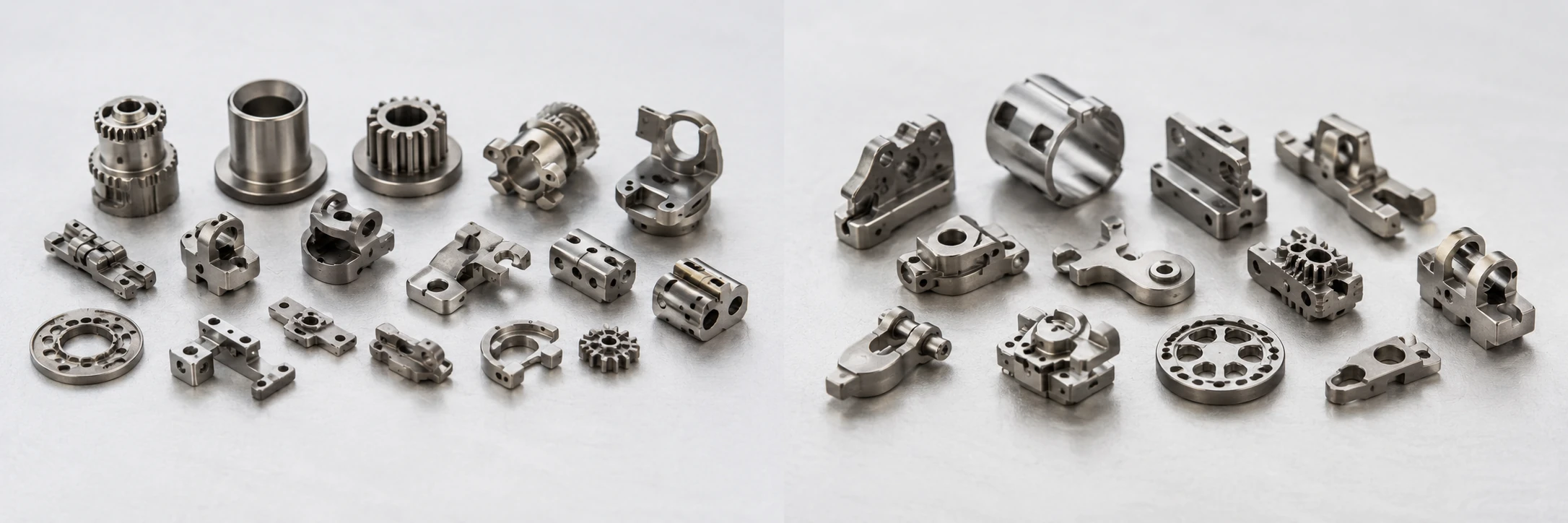
Core conclusion: 304 and 316L are both usable stainless MIM material routes, but the better choice depends on service environment and manufacturing review.
304 vs 316L Stainless Steel: Quick Answer for MIM Projects
From a MIM project review perspective, 304 and 316L stainless steel should not be selected only by comparing generic material descriptions. 304 can be a practical route for general stainless components, while 316L should be reviewed when corrosion exposure, handling conditions, cleaning environment, or surface cleanliness requirements are more demanding.
A common mistake is to treat 316L as automatically better for every MIM part. 316L can provide a stronger corrosion-resistance margin in many service environments, but it may not be necessary for every component. Before tooling, the project team should confirm the application environment, critical dimensions, surface finish requirements, expected annual volume, and whether the drawing allows material substitution.
Because 304 and 316L belong to the same austenitic stainless steel family, their shared material behavior—including density, magnetic response, MIM processing and finished-part validation—is explained in austenitic stainless steel for MIM.
304 Is Usually Enough
304 stainless steel may be suitable for indoor, dry, or moderately corrosive applications where general stainless performance and cost balance are more important than maximum corrosion margin.
316L Is the Safer Choice
316L should be reviewed when the part may face sweat, moisture, cleaning agents, mild chloride contact, or higher visual surface requirements.
The Process Changes the Decision
MIM material selection also depends on prepared feedstock, molding stability, debinding, sintering shrinkage, secondary operations, and inspection.
Project review logic: If the drawing lists only “stainless steel,” first confirm whether the project is driven by corrosion resistance, appearance, cost, dimensional stability, surface treatment, or inspection acceptance. The material grade should be locked only after those requirements are clear.
Main Differences Between 304 and 316L in MIM
The main difference between 304 and 316L stainless steel is often discussed through corrosion resistance, but a MIM project needs a broader decision table. The project team should compare material performance, production availability, sintering behavior, surface finish route, and RFQ risk.
| Review Item | 304 Stainless Steel in MIM | 316L Stainless Steel in MIM | Engineering Meaning |
|---|---|---|---|
| General corrosion resistance | Suitable for many general stainless applications | Usually stronger in more demanding corrosion environments | 316L may be preferred when environment risk is higher |
| Chloride / sweat / moisture exposure | Needs careful review | Usually safer than 304 | Important for wearable, handled, or cleaned parts |
| Cost sensitivity | Often more attractive for general use | May require higher material-cost justification | Annual volume and function should guide the choice |
| Feedstock availability | Must be confirmed with supplier | Must be confirmed with supplier | MIM uses prepared feedstock, not raw bar or sheet |
| Sintering and dimensional review | Depends on part geometry and process route | Depends on part geometry and process route | Grade choice does not remove shrinkage and distortion risk |
| Surface finishing | Polishing, cleaning, passivation, or coating may be reviewed | Often paired with stronger surface cleanliness requirements | Final surface condition affects real-world performance |
| RFQ risk | Risk if corrosion exposure is not described | Risk if selected only as a premium grade without requirements | Application environment must be submitted with the drawing |
If the drawing only says “stainless steel” or “304/316L optional,” the supplier may not know whether the project is driven by corrosion resistance, cost, appearance, magnetic response, finishing, or inspection. For wider material routing, see the MIM material comparison page. For property-driven material screening, review MIM material properties.
Do not use this table as material approval by itself. It is a project-screening guide. Final material confirmation should be based on the drawing, application environment, feedstock availability, finishing route, and customer acceptance requirements.

Core conclusion: The main difference in MIM is not only alloy chemistry but also how each material route fits the part environment and production review.
Corrosion Resistance: Where 316L Has a Real Advantage
316L is commonly selected when corrosion resistance is a stronger design requirement. Compared with 304, 316L has a stronger position in many environments where chloride exposure, moisture, sweat, cleaning solution, or surface contamination could become a concern. This does not mean 316L is corrosion-proof. It means the project has a larger corrosion-resistance margin when the service environment is more demanding. For broader corrosion-driven material routing, review corrosion-resistant MIM materials.
Technical source note: General stainless steel corrosion references identify molybdenum as one of the alloying elements that improves resistance to localized pitting and crevice corrosion in austenitic stainless steels. This supports why 316 / 316L is commonly reviewed when chloride or moisture exposure is more demanding than a normal indoor environment. This is used as material-selection background, not as a guaranteed corrosion-performance claim.
Reference: Specialty Steel Industry of North America, Pitting and Crevice Corrosion.
General Indoor or Dry Applications
For dry indoor parts or internal components with moderate corrosion requirements, 304 may be enough. Examples include general mechanical retainers, housings, brackets, small hardware, and stainless parts used in controlled environments. In these projects, the engineering review may focus more on geometry, dimensional stability, assembly, and cost than on maximum corrosion resistance.
Sweat, Moisture, Chloride, and Cleaning Exposure
316L should be reviewed when the part may contact sweat, moisture, mild chloride, cleaning agents, or other environments where 304 may not provide enough margin. This is especially relevant for small MIM parts used in handheld devices, wearable components, visible stainless parts, or assemblies that may be cleaned repeatedly.
Why Surface Finish and Passivation Still Matter
Corrosion performance is not determined by material grade alone. For stainless MIM parts, final surface condition can be affected by sintering quality, polishing, machining, blasting, cleaning, and passivation. If a part has tight cosmetic requirements or corrosion acceptance tests, the finishing route must be reviewed early.
Engineering note: A 316L part with poor surface control can still fail customer expectations, while a properly reviewed 304 part may be sufficient for a moderate environment. The material grade, post-processing route, and inspection criteria should be aligned before the tooling decision.
| Corrosion-Related RFQ Trigger | Why It Matters | Material Review Direction |
|---|---|---|
| Dry indoor use | Corrosion risk is usually moderate, so cost and geometry may drive the decision | 304 may be suitable after normal project review |
| Frequent hand contact or sweat exposure | Surface contamination and moisture can make corrosion margin more important | 316L should be reviewed before tooling |
| Cleaning agent exposure | Cleaning route and chemical environment may affect stainless surface condition | 316L plus finishing / passivation review may be needed |
| Visible cosmetic surface | Appearance complaints may occur even when function is acceptable | Review grade, polishing, cleaning, and acceptance standard together |
| Unknown service environment | The supplier cannot safely judge corrosion risk from grade name alone | Submit application environment before quotation |

Core conclusion: 316L should be reviewed when moisture, sweat, cleaning agents, or light chloride exposure create a higher corrosion-resistance requirement.
MIM Process Factors That Affect 304 and 316L Selection
MIM changes the material selection process because the part is not machined directly from bar stock. It is produced from prepared metal powder feedstock, molded as a green part, debound, sintered, and then inspected or finished. Each step can influence the final part.
MIM standards context: MPIF Standard 35-MIM is a useful background reference because it covers common materials used in metal injection molding, with explanatory notes and definitions. The actual 304 or 316L route for a project should still be reviewed against the selected feedstock, part geometry, sintering route, surface requirements, and customer acceptance criteria.
Reference: MPIF Standard 35-MIM.
Feedstock Availability and Supplier Review
MIM feedstock availability should be confirmed before quotation. A project may specify 304 or 316L, but the supplier still needs to confirm whether suitable prepared MIM feedstock is available for the required part size, geometry, volume, and performance expectation.
Sintering Route and Density Control
Both 304 and 316L stainless MIM parts require sintering review. Sintering affects shrinkage, density, distortion, surface condition, and dimensional repeatability. The material grade does not remove the need for tooling compensation or process control.
Shrinkage, Distortion, and Dimensional Review
MIM parts shrink during sintering. Thin walls, uneven sections, long slender features, holes, slots, and unsupported structures can all affect dimensional stability.
Secondary Operations After Sintering
Secondary operations may include sizing, machining, polishing, blasting, passivation, coating, or inspection. These operations can influence cost, lead time, surface finish, corrosion resistance, and final acceptance.
| MIM Review Item | Risk If Skipped | What the Supplier Should Confirm |
|---|---|---|
| Prepared feedstock route | Material name is specified, but no stable MIM feedstock route is confirmed | Availability, material route, and whether substitution needs customer approval |
| Tooling compensation | Sintering shrinkage may shift hole positions, wall sections, or assembly dimensions | Critical dimensions, expected shrinkage control approach, and tooling review points |
| Sintering support and layout | Thin or long features may deform even if the material grade is correct | Geometry risk, support method, distortion-sensitive areas, and inspection plan |
| Surface route | Material grade is correct, but surface condition does not meet corrosion or cosmetic expectations | Polishing, cleaning, passivation, coating, or other finishing requirements |
| Inspection and acceptance | Supplier and customer may use different acceptance criteria after production | Critical dimensions, surface criteria, corrosion-related tests, and reporting needs |
For broader stainless material routing, review stainless steel for MIM. For grade-specific details, see 304 stainless steel for MIM and 316L stainless steel for MIM.

Core conclusion: The MIM process changes the 304 vs 316L decision because production stability and final part quality depend on more than base alloy chemistry.
Application Fit: When to Choose 304 or 316L for MIM Parts
Material selection should begin with the application environment. The question is not “which stainless steel is better,” but “which stainless steel is appropriate for this part, this environment, this tolerance, and this production route?”
| Application Condition | 304 May Be Suitable | 316L Should Be Reviewed |
|---|---|---|
| Dry indoor mechanical part | Yes | Optional if extra corrosion margin is needed |
| Cost-sensitive stainless part | Often yes | Only if environment justifies it |
| Visible part with moderate handling | Possible with finishing review | Often safer if sweat or cleaning is expected |
| Moisture or mild chloride exposure | Needs careful review | Usually preferred |
| Repeated cleaning exposure | Case-by-case | Usually preferred |
| High surface cleanliness requirement | Case-by-case | Often preferred |
| Unknown corrosion environment | Do not assume | Submit environment details for review |
Typical 304 MIM Part Scenarios
304 may be selected for general stainless MIM components where moderate corrosion resistance, formability in the MIM route, and cost balance are important. It can fit internal mechanical parts, small hardware, brackets, fittings, retainers, and components used in controlled environments.
Typical 316L MIM Part Scenarios
316L may be selected when the project requires a stronger corrosion-resistance margin. It is commonly reviewed for parts that may be touched frequently, exposed to moisture, cleaned regularly, or used in assemblies where surface condition and corrosion resistance are important.
When Material Substitution Should Be Reviewed
Sometimes the drawing may specify 304, but the application environment suggests 316L. In other cases, the drawing may specify 316L, but the actual environment may allow 304. Material substitution should never be made only for cost or convenience. It should be reviewed against function, corrosion exposure, customer requirements, and acceptance criteria.
Substitution control: If both grades are acceptable, the RFQ should state whether 304 or 316L can be selected after engineering review. If the customer requires one fixed grade, the drawing and purchase specification should make that clear before tooling.
Cost, RFQ, and Supply Considerations
Cost is not only the price of powder or feedstock. For MIM parts, total cost may include tooling, molding stability, debinding, sintering, secondary operations, inspection, packaging, and project validation. A material that looks cheaper at the raw material level may not be cheaper if it causes finishing, tolerance, or acceptance problems.
Why 304 May Be More Cost-Sensitive
304 may be attractive when the part does not need the additional corrosion margin of 316L. If the application is general indoor use and the drawing does not require aggressive corrosion resistance, 304 can be a reasonable stainless steel route for cost-sensitive production.
Why 316L May Be Worth the Higher Material Review Cost
316L may be worth reviewing when corrosion performance, surface condition, and customer acceptance are more important than minimum material cost. It can reduce material-selection risk in environments where 304 may be questionable.
What to Confirm Before Asking for Price
| RFQ Input | Why It Matters |
|---|---|
| 2D drawing and 3D model | Required for geometry, shrinkage, tooling, and tolerance review |
| Required material grade | Confirms whether 304, 316L, or substitution is allowed |
| Application environment | Determines corrosion-resistance risk |
| Critical dimensions | Helps decide whether sizing or machining is needed |
| Surface finish requirement | Affects polishing, blasting, passivation, or coating route |
| Annual volume | Affects tooling justification and production route |
| Inspection requirement | Defines acceptance criteria before production |
| Post-processing requirement | Affects cost, lead time, and quality control |
To prepare project inputs before quotation, review the RFQ preparation guide or submit your drawing directly for engineering review.
Engineering Checklist Before Choosing 304 or 316L
Use the following checklist before locking the material grade. A clear material decision reduces RFQ back-and-forth and helps the supplier identify whether the main risk is corrosion, geometry, tolerance, surface finish, or production cost.
| Checklist Item | Review Question |
|---|---|
| Environment | Will the part face moisture, sweat, cleaning agents, chloride, or outdoor exposure? |
| Function | Is the part structural, cosmetic, sealing-related, wear-related, or assembly-critical? |
| Drawing | Are all critical dimensions clearly marked? |
| Tolerance | Are tight tolerances truly required on all features, or only on functional areas? |
| Surface finish | Does the part need polishing, passivation, coating, or visible surface control? |
| Material substitution | Is 304/316L substitution allowed after engineering review? |
| Production volume | Is the annual volume suitable for MIM tooling? |
| Inspection | What tests or inspection reports are needed for acceptance? |
| Acceptance standard | Is corrosion, surface appearance, or passivation acceptance defined by a customer specification? |

Core conclusion: A clear RFQ package helps the supplier decide whether 304 is sufficient or 316L should be reviewed before tooling.
Composite Field Scenario for Engineering Training
A small stainless MIM component is being reviewed before tooling. The part has thin walls, several small holes, a visible surface, and moderate dimensional requirements. The customer initially lists 304 stainless steel because the part is used in a general assembly. During review, the project team confirms that the component may be handled frequently and may occasionally contact sweat or cleaning agents.
In this situation, the supplier should not immediately switch the material without review. The better approach is to compare 304 and 316L against the actual environment, surface finish requirement, feedstock availability, sintering stability, and cost target. If the corrosion risk is low and the surface requirement is moderate, 304 may remain suitable. If the part is exposed to sweat, cleaning, or visible corrosion risk, 316L should be reviewed before tooling.
For broader material decision rules, see the MIM material selection guide.
FAQ About 304 vs 316L Stainless Steel in MIM
Can both 304 and 316L stainless steel be used for MIM parts?
Yes. Both can be reviewed for MIM projects, but the final choice depends on prepared feedstock availability, part geometry, sintering route, corrosion environment, surface finish, and inspection requirements.
Is 316L always better than 304 for MIM?
No. 316L usually provides stronger corrosion resistance in more demanding environments, but 304 may be sufficient for general indoor or moderate corrosion applications. The better choice depends on the part’s real service conditions.
When should I choose 316L instead of 304?
316L should be reviewed when the part may face moisture, sweat, light chloride exposure, cleaning agents, or higher surface cleanliness requirements. It is also useful when corrosion risk is more important than minimum material cost.
Does the MIM process affect corrosion resistance?
Yes. Final corrosion performance can be affected by sintered density, surface condition, polishing, machining, cleaning, passivation, and inspection. Material grade alone does not define the final result.
Can 304 be changed to 316L after tooling?
It should not be changed casually. Even if the geometry looks similar, a material change may affect feedstock availability, shrinkage review, surface route, inspection, and customer approval. Material substitution should be confirmed before tooling whenever possible.
What information should I send before asking for a 304 or 316L MIM quote?
Send a 2D drawing, 3D model, required material grade, application environment, annual volume, critical dimensions, surface finish requirements, and any corrosion or inspection requirements.
Standards and Project Specification Note
304 and 316L stainless steel selection should be reviewed according to the project’s drawing, application environment, surface requirements, and inspection criteria. If corrosion resistance, passivation, or special acceptance tests are required, the customer should provide the applicable standard, test method, or internal specification before quotation.
The references below are provided as engineering background for material and surface-treatment terminology. They should not be read as XTMIM certification, customer approval, or a guaranteed material-performance claim.
Technical References
The following references may help engineering and sourcing teams review MIM material standards, stainless steel corrosion terminology, passivation, and cleaning / surface preparation terminology.
- MPIF Standard 35-MIM — Metal Powder Industries Federation material standards resource for common MIM materials.
- SSINA, Pitting and Crevice Corrosion — Stainless steel corrosion background explaining alloying elements that improve localized corrosion resistance.
- ASTM A967/A967M — Standard specification related to chemical passivation treatments for stainless steel parts.
- ASTM A380/A380M — Standard practice related to cleaning, descaling, pickling, and passivation recommendations for stainless steel parts, equipment, and systems.
Need a 304 vs 316L Material Review for a MIM Part?
If you are comparing 304 and 316L stainless steel for a MIM part, send your drawing, 3D model, application environment, surface finish requirement, and expected annual volume. XTMIM can review whether 304 is sufficient, whether 316L should be selected, and which manufacturing risks should be confirmed before tooling.