MIM Material Terminal Page
Ti-6Al-4V / TC4 Titanium Alloy for MIM Parts
Ti-6Al-4V, also known in many engineering and sourcing contexts as TC4 titanium alloy, can be considered for metal injection molding when a project requires a small, complex, high-value metal part with a strong strength-to-weight requirement and corrosion-resistance expectations.
Quick answer for engineers and sourcing teams
Ti-6Al-4V / TC4 titanium MIM is worth reviewing when the part is small, complex, repeated in production, and difficult or wasteful to machine from titanium stock. The material name alone is not enough to approve the route. The project team should review geometry, wall balance, critical dimensions, oxygen control, sintering shrinkage, distortion risk, surface finish, inspection method, and post-sintering machining needs before tooling.
For TC4 titanium, TC4 titanium alloy, titanium alloy TC4, or metal injection moulding titanium inquiries, the practical review starts with the drawing, production volume, functional requirement, and inspection criteria.
Small complex geometry justifies tooling
MIM becomes more relevant when the design has thin sections, small internal features, repeated surfaces, or machining waste that makes near-net shaping valuable.
Tolerance, oxygen, and distortion risk
Titanium alloy MIM should be reviewed through feedstock route, debinding, sintering, support strategy, secondary operations, and inspection planning.
The part is simple, large, or very low volume
If the geometry is easy to machine or the project is only a low-volume prototype, another process may be more practical before MIM tooling.
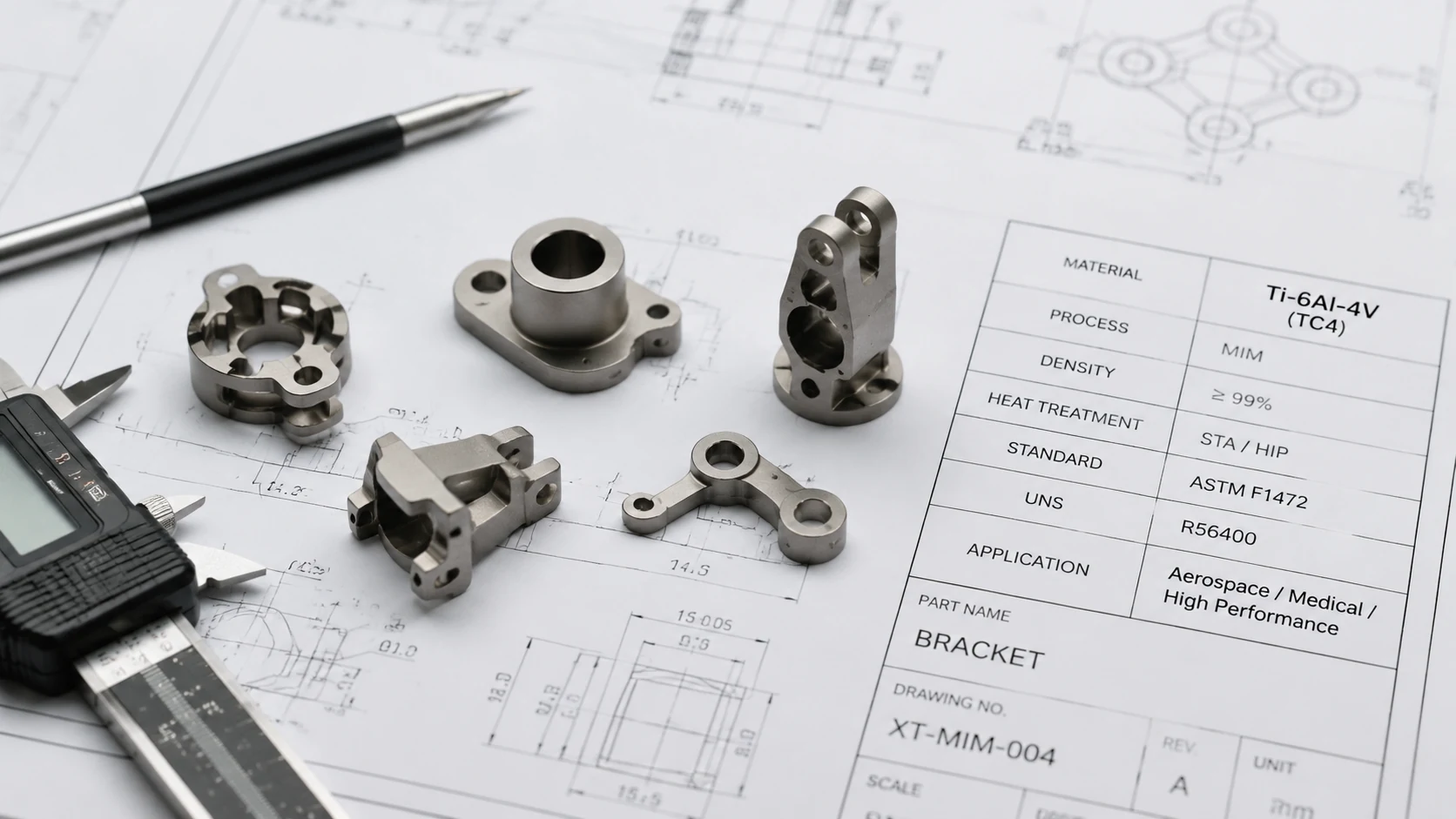
Core conclusion: Ti-6Al-4V / TC4 titanium MIM is most relevant when small complex geometry and engineering requirements justify material and tooling review.
What Is Ti-6Al-4V / TC4 Titanium Alloy in MIM?
Ti-6Al-4V is a titanium alloy family commonly reviewed when a project needs a strong strength-to-weight material. In many China-based manufacturing and sourcing contexts, the same material family may be referred to as TC4 titanium or TC4 titanium alloy.
From a MIM project review perspective, the naming must be confirmed early. A drawing may call out Ti-6Al-4V, while a buyer’s inquiry may say TC4, titanium alloy TC4, or tc4 titanium. These terms often point toward the same general alloy family, but XTMIM still needs the drawing, material specification, application requirement, and inspection expectations before confirming whether the part is suitable for MIM production review.
Final material acceptance should follow the buyer’s drawing, material specification, agreed inspection criteria, and project-specific functional requirements. The page should help align RFQ terminology, but it does not replace a formal material specification or part-level engineering review.
This page is a terminal material page under titanium alloys for MIM. It focuses on Ti-6Al-4V / TC4 only. Broader titanium alloy routing, special alloy categories, and general material selection should be reviewed through the parent material pages rather than expanded here.

Core conclusion: Material naming must be normalized before the supplier can evaluate Ti-6Al-4V / TC4 MIM feasibility.
Ti-6Al-4V, TC4, and Grade 5 Titanium Naming
Material naming matters because MIM feasibility depends on more than a commercial material label. The project team should confirm the drawing callout, supplier terminology, application requirement, and inspection expectations before quotation.
| Naming Item | What to Check | Why It Matters for MIM |
|---|---|---|
| Ti-6Al-4V | Drawing callout, material grade, and project requirement | Confirms the intended titanium alloy family before process review |
| TC4 titanium | Buyer or supplier terminology | Helps align China-based sourcing language with engineering documentation |
| Grade 5 titanium alloy | International material naming context | Prevents mismatch between drawing, RFQ, and supplier review |
| Titanium alloy TC4 | Alternate phrase used in sourcing searches | Should be normalized before quotation and tooling discussion |
Why the Material Name Must Be Confirmed Before RFQ
If the material name is unclear, the quotation may become unreliable. MIM suppliers need to know whether the project is asking for Ti-6Al-4V / TC4 titanium alloy, commercially pure titanium, or another titanium alloy route. Each material path may affect feedstock availability, molding behavior, sintering control, secondary operations, and inspection planning.
Before RFQ, the buyer should provide the 2D drawing, 3D model, material callout, critical dimensions, surface finish requirements, annual volume, and application environment. This allows the engineering team to review whether Ti-6Al-4V MIM is a realistic manufacturing route or whether another material or process should be considered.
When Ti-6Al-4V Makes Sense for MIM Parts
Ti-6Al-4V MIM is most relevant when the part is small, complex, and difficult or wasteful to machine from titanium stock. MIM becomes more attractive when the geometry includes thin sections, internal features, small holes, undercuts, multiple surfaces, or repeated production volumes that can justify tooling.
Suitable part conditions
A strong candidate usually combines small size, complex geometry, meaningful production volume, and a clear reason for titanium alloy selection.
When another route may be better
Large, simple, very low-volume, or easy-to-machine parts may be better reviewed through CNC, additive manufacturing, or another process before committing to MIM tooling.
| Project Condition | Fit for Ti-6Al-4V MIM | Engineering Review Note |
|---|---|---|
| Small and complex geometry | Strong candidate | MIM value increases when machining waste, fixture complexity, or feature count is high |
| Weight-sensitive metal component | Strong candidate | Titanium alloy may support strength-to-weight goals if the requirement is real and documented |
| Multiple small features | Possible candidate | Holes, slots, thin sections, and undercuts need DFM review before tooling |
| Tight local tolerance | Needs review | Secondary machining, sizing, or inspection planning may be needed |
| Simple large geometry | Weak candidate | MIM tooling may not be economical or practical for simple large shapes |
| Very low annual volume | Often weak | Tooling and validation effort may not be justified unless the geometry is highly demanding |
Do not choose Ti-6Al-4V only because it sounds premium
The material should match the part function. If the part does not require titanium’s weight, corrosion, or strength advantages, stainless steel, low-alloy steel, soft magnetic alloys, or another MIM material may provide a more practical cost-performance balance. For broader material routing, review the MIM material selection guide before finalizing the RFQ package.
Ti-6Al-4V vs CP Grade 4 Titanium: What Should Buyers Not Confuse?
Ti-6Al-4V / TC4 titanium alloy should not be treated as the same material choice as CP Grade 4 titanium. CP titanium and alpha-beta titanium alloy routes can serve different engineering purposes.
Material boundary note
A search for CP Grade 4 titanium properties may lead a buyer into a broader titanium comparison, but this page stays focused on Ti-6Al-4V / TC4 MIM project review. If the drawing requires CP titanium, the material route should be confirmed separately instead of assuming it is interchangeable with Ti-6Al-4V.
Why CP Titanium Searches May Lead to the Wrong Material Choice
CP titanium may be considered for certain corrosion or biocompatibility-driven applications, while Ti-6Al-4V is typically reviewed when higher strength-to-weight performance is part of the requirement. These are not interchangeable assumptions in a MIM quotation. Material selection affects powder route, sintering response, density expectations, inspection planning, and secondary operations.
What to Confirm on the Drawing or Material Specification
| Item to Confirm | Why It Matters |
|---|---|
| Material callout | Prevents confusion between Ti-6Al-4V, TC4, CP titanium, and other titanium grades |
| Mechanical requirement | Helps determine whether Ti-6Al-4V is necessary or whether another material may be more practical |
| Application environment | Supports review of corrosion, wear, cleanliness, or temperature exposure |
| Critical dimensions | Determines whether post-sintering machining is required |
| Surface finish | Affects finishing route, inspection, and quotation accuracy |
| Annual volume | Determines whether MIM tooling is practical |
MIM Process Considerations for Ti-6Al-4V
Ti-6Al-4V MIM projects require careful process review because titanium alloy behavior is sensitive to material route, binder removal, sintering, oxygen pickup, shrinkage, distortion, and final inspection.
XTMIM reviews titanium MIM projects from a full manufacturing route perspective: feedstock selection, injection molding, green part handling, debinding, sintering, secondary operations, and inspection. Prepared feedstock pellets are reviewed as part of the project route; the feedstock is not described as produced in-house.
No Ti-6Al-4V MIM project should be approved only from the material name. The part geometry, feature depth, wall balance, sintering support, oxygen-control expectation, post-sintering operation plan, and inspection method must be reviewed together before tooling.

Core conclusion: Titanium alloy MIM should be reviewed as a complete process route, not only as a material selection.
Feedstock and Powder-Binder Route
The powder-binder route affects molding stability, debinding behavior, shrinkage, and final part consistency. For Ti-6Al-4V / TC4 titanium alloy, the supplier must review whether the feedstock route is suitable for the required part geometry and production expectations.
Debinding and Sintering Sensitivity
Debinding must remove binder without damaging the green part or introducing process-related quality risks. Sintering must then densify the part while controlling shrinkage, distortion, and material condition. For more detail on dimensional change, review MIM sintering shrinkage as a related process topic.
| Process Area | Engineering Review Point | What Can Go Wrong | RFQ / Tooling Action |
|---|---|---|---|
| Feedstock | Powder-binder route and material availability | Unstable molding, inconsistent shrinkage, or material mismatch | Confirm material callout, geometry, and production expectation before quote |
| Injection molding | Flow path, gate area, thin wall filling, and feature replication | Short shots, weak features, weld-line concern, or green part damage | Review wall thickness, gate direction, and high-risk features before tooling |
| Debinding | Binder removal, support, and contamination risk | Cracking, deformation, or internal process defects | Confirm part support and section balance early |
| Sintering | Atmosphere, shrinkage, distortion, and material condition | Dimensional drift, distortion, or material condition outside expectation | Define critical dimensions and inspection requirements before tooling |
| Inspection | Dimensional and material verification | Late discovery of mismatch between drawing and process capability | Separate critical and non-critical dimensions in the RFQ package |
Shrinkage, Distortion, and Oxygen Control
All MIM parts shrink during sintering. For Ti-6Al-4V, the project team should review whether the geometry can tolerate predictable shrinkage and whether critical areas need post-sintering machining. Thin sections, unbalanced mass, long unsupported features, and asymmetric geometry may increase the risk of sintering distortion.
Oxygen control is also a key review topic for titanium alloy parts. This page does not provide unverified numerical limits. Instead, the project should define material condition, inspection requirements, and acceptance criteria before production review. If the design has long unsupported sections or uneven mass, sintering distortion should also be reviewed before tooling.
Design Review Before Tooling for Ti-6Al-4V MIM Parts
Design review is critical before tooling because Ti-6Al-4V MIM is not only a material decision. Part geometry, shrinkage behavior, moldability, sintering support, secondary operation allowance, and inspection method all affect whether the project can be manufactured reliably.

Core conclusion: Early DFM review reduces tooling risk and helps decide which features should be molded and which may need secondary machining.
Wall Thickness and Section Balance
Uniform wall thickness helps reduce molding, debinding, and sintering risk. Very thick-to-thin transitions may create shrinkage imbalance, internal stress, or distortion. If the part includes heavy local sections, ribs, bosses, or thin arms, these areas should be reviewed before tooling. Related design guidance can be reviewed through wall thickness design and MIM tolerances when defining critical dimensions.
| DFM Review Item | What to Check | Possible Risk | Possible Action |
|---|---|---|---|
| Wall thickness | Thick-to-thin transitions and local mass | Uneven shrinkage or distortion | Adjust geometry or add review notes before tooling |
| Long thin features | Deformation or support risk | Feature bending during debinding or sintering | Review sintering support and dimensional control |
| Sharp corners | Stress concentration and molding risk | Weak local areas or filling difficulty | Add radii where functional requirements allow |
| Holes and slots | Small feature size, location, and tolerance | Tooling complexity or inspection difficulty | Decide whether to mold near-net or finish by machining |
| Flatness requirement | Sintering distortion risk | Functional mismatch after sintering | Define datum strategy, inspection method, and possible secondary operation |
Holes, Slots, Undercuts, and Threads
MIM can support complex small features, but not every feature should be molded as-is. Holes, slots, and undercuts should be reviewed for tooling, filling, debinding, sintering, and inspection feasibility. For high-risk features, the drawing should identify which dimensions are functional and which surfaces may be finished after sintering.
Critical Dimensions and Post-Sintering Machining Allowance
Critical dimensions should be separated from non-critical dimensions in the drawing. If a feature controls assembly, sealing, rotation, alignment, or wear contact, the engineering team should decide whether MIM tolerance is enough or whether post-sintering machining is required.
Secondary Operations, Surface Finish, and Inspection
Ti-6Al-4V MIM parts may require secondary operations depending on the final tolerance, surface condition, assembly interface, and functional requirement. Secondary operations should be planned before tooling because they can affect datum strategy, machining allowance, inspection fixtures, and cost.
Machining or Sizing After Sintering
Post-sintering machining may be needed for threads, precision bores, flat sealing faces, datum surfaces, or assembly-critical dimensions. The goal is not to machine the whole part again. The goal is to use MIM for the complex near-net geometry and reserve machining for the few features that require tighter control. Related planning can be reviewed through post-sintering machining.
| Feature Type | Possible Route | Review Note |
|---|---|---|
| General external shape | Molded and sintered | Good candidate for MIM if geometry is suitable |
| Thread or precision bore | Machined after sintering | Define allowance and inspection method |
| Datum surface | May require machining | Confirm assembly and measurement requirement |
| Cosmetic surface | Finishing route depends on requirement | Confirm surface expectation before RFQ |
| Critical flatness | Needs review | Sintering distortion and inspection method must be considered |
Surface Condition and Finishing Requirements
Surface finish requirements should be stated clearly in the RFQ. Titanium alloy parts may require different finishing expectations depending on function, appearance, cleanliness, or assembly contact. If coating or surface finishing for MIM parts is required, the project team should confirm geometry, masking, thickness, material compatibility, and production requirements before assuming a route.
Inspection Information to Define Before Production
Inspection planning should include critical dimensions, datum references, material expectations, surface condition, and any functional requirement. Inspection acceptance criteria should be agreed before tooling so that mold design, sintering support, secondary operation planning, and measurement method all support the same project target.
What should be defined before quotation?
For Ti-6Al-4V / TC4 MIM parts, quotation is more reliable when the buyer defines which features are functional, which surfaces are cosmetic, which dimensions need inspection, and which areas may accept near-net MIM tolerance. This reduces late changes after mold design or trial molding.
RFQ Inputs for Ti-6Al-4V / TC4 Titanium MIM Projects
A useful Ti-6Al-4V MIM RFQ should give enough information for both material review and manufacturing feasibility review. The more complete the RFQ package is, the easier it is to identify whether MIM is appropriate, which features may need adjustment, and where secondary operations may be required.

Core conclusion: Complete RFQ inputs allow the supplier to review material feasibility, MIM geometry, secondary operations, and inspection before tooling.
Drawing and 3D Model Information
The RFQ should include a 2D drawing and 3D CAD model. The 2D drawing should identify material callout, critical dimensions, tolerance requirements, surface finish, datum references, and any inspection notes. The 3D model helps review moldability, wall thickness, shrinkage compensation, and tooling direction.
Material, Surface, and Inspection Requirements
The material callout should state whether the project requires Ti-6Al-4V, TC4 titanium, Grade 5 titanium alloy, or another titanium grade. If the buyer is not sure, the RFQ should explain the functional reason for selecting titanium: weight, strength, corrosion resistance, cleanliness, wear, or application environment.
The RFQ should also define acceptance criteria for critical dimensions, datum surfaces, surface condition, and any material-specific requirement. Without this information, the quotation may miss machining allowance, inspection fixtures, or production controls needed for the final part.
Annual Volume and Project Stage
MIM usually makes more sense when the annual volume and part complexity can justify tooling. For low-volume prototypes, CNC machining or another validation route may be more practical before committing to a mold. For repeated production, Ti-6Al-4V MIM may be worth reviewing if the geometry is complex enough and the performance requirement justifies the material.
| RFQ Input | Why It Matters | Engineering Note |
|---|---|---|
| 2D drawing | Shows tolerances, material callout, surface finish, and inspection notes | Mark functional dimensions and datum references clearly |
| 3D model | Supports moldability, shrinkage, and tooling review | Useful for wall balance, feature depth, and tooling direction review |
| Material requirement | Confirms whether Ti-6Al-4V / TC4 is required | Clarify if TC4, Ti-6Al-4V, or another titanium route is intended |
| Critical dimensions | Identifies machining or inspection needs | Separate must-hold dimensions from general reference dimensions |
| Surface finish | Affects secondary operations and cost | Define functional surfaces separately from cosmetic areas |
| Annual volume | Determines whether MIM tooling is practical | Repeated production volume is usually needed to justify tooling |
| Application environment | Helps review corrosion, wear, strength, or cleanliness requirements | State what the part must do rather than only naming titanium |
| Project stage | Clarifies whether the part is for concept, prototype, validation, or production | Prototype-stage projects may need process validation before tooling |
Composite field scenario for engineering training
A compact titanium component is being reviewed for a weight-sensitive assembly. The original design was considered for CNC machining, but the part includes thin sections, small internal features, and several repeated surfaces that may create machining waste and fixture complexity. The buyer asks whether TC4 titanium MIM can reduce manufacturing cost at production volume.
The engineering review does not start with price. It starts with geometry, material callout, annual volume, critical dimensions, surface finish, and inspection requirements. Some features may be suitable for near-net MIM, while threads or datum surfaces may still need post-sintering machining.
Frequently Asked Questions About Ti-6Al-4V MIM
These questions help engineering and sourcing teams clarify naming, process suitability, RFQ data, and secondary operation planning before moving into tooling discussion.
Is TC4 titanium the same as Ti-6Al-4V?
TC4 titanium is commonly used in China-based sourcing and manufacturing communication to refer to the Ti-6Al-4V titanium alloy family. For RFQ work, the drawing, material specification, and application requirement should still be confirmed before quotation.
Can Ti-6Al-4V be made by metal injection molding?
Yes, but only after part-level review. Ti-6Al-4V can be reviewed for MIM when the part is small, complex, and produced at a volume that justifies tooling. The project must also review feedstock route, debinding, sintering, shrinkage, oxygen control, secondary operations, and inspection requirements.
Is Ti-6Al-4V better than CP Grade 4 titanium for MIM parts?
Not always. Ti-6Al-4V and CP Grade 4 titanium should not be treated as interchangeable choices. The better material depends on strength, corrosion, application environment, inspection expectations, and the exact drawing requirement.
What part information is needed for a TC4 titanium MIM RFQ?
A useful RFQ should include a 2D drawing, 3D model, material callout, tolerance requirements, critical dimensions, surface finish, annual volume, application environment, and project stage.
Does Ti-6Al-4V MIM always need post-sintering machining?
No. Some features may be molded near-net, while threads, bores, datum surfaces, or assembly-critical areas may require machining after sintering. The decision depends on tolerance, function, and inspection requirements.
What are the main risks when using titanium alloy TC4 in MIM?
The main review points include material naming clarity, feedstock route, debinding stability, sintering shrinkage, distortion, oxygen control, surface finish, inspection method, and whether the part geometry is suitable for MIM tooling.
Review a Ti-6Al-4V / TC4 Titanium MIM Part Before Tooling
If your part drawing specifies Ti-6Al-4V, TC4 titanium, or a titanium alloy requirement, send the 2D drawing, 3D model, annual volume, critical dimensions, and surface finish expectations for engineering review. XTMIM can help evaluate whether the part is suitable for MIM, which features may need design adjustment, and whether secondary operations should be planned before tooling.