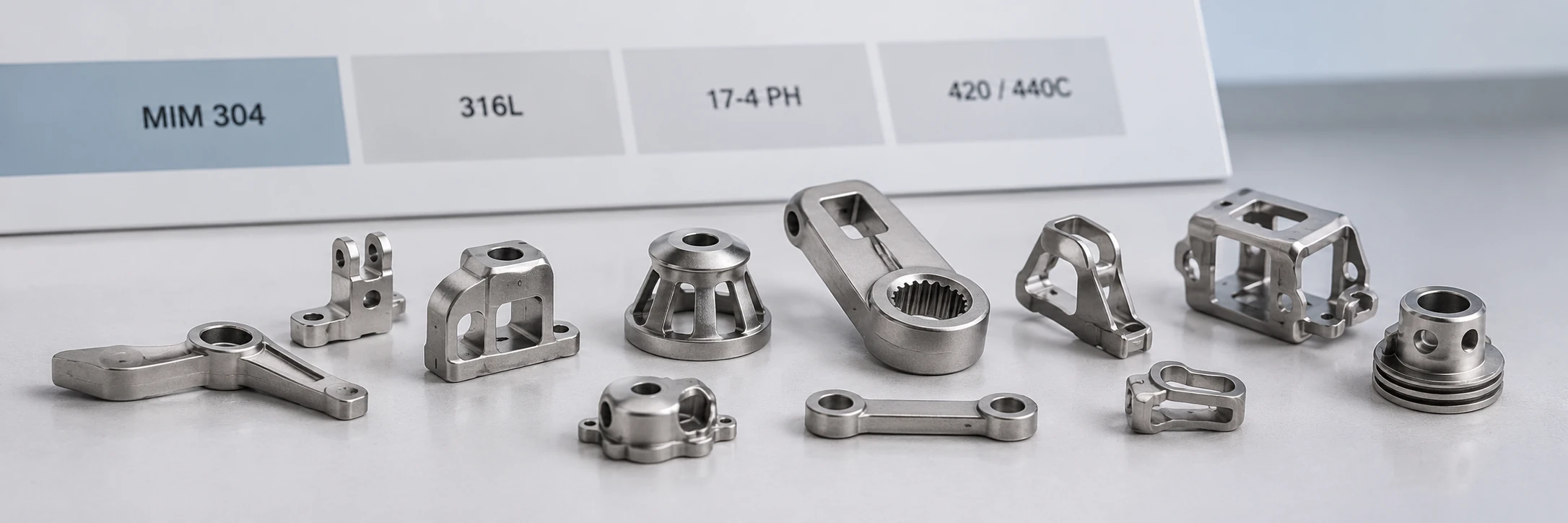
MIM 304 stainless steel, also searched as SUS304 MIM or 304 stainless steel metal injection molding, is used for small, complex parts that need general corrosion resistance, a clean stainless appearance, and moderate mechanical performance. It is a practical starting point for precision hardware, small housings, levers, buttons, brackets, and clips when high hardness, heavy wear, precipitation-hardening strength, or strong chloride resistance is not required. Approval should be based on the specified 304 / SUS304 standard, service environment, final-part properties, surface finish, critical tolerances, and annual volume—not on the grade name alone. For sweat, salt spray, marine exposure, aggressive cleaning chemicals, sliding wear, or high load, compare 316L, 17-4 PH, 420, or 440C before tooling.
What Is MIM 304 Stainless Steel / SUS304?
304, SUS304, 1.4301, and UNS S30400 Material Identity
304, SUS304, AISI 304, UNS S30400, and EN 1.4301 are commonly used to identify the 18Cr-8Ni austenitic stainless steel family. They are useful for material communication, but they do not by themselves define the acceptance requirements for a finished MIM part. The drawing or purchase specification should identify the governing standard, permitted 304 / 304L route, required condition, and any customer-specific limits.
A frequent sourcing error is approving “SUS304” without defining the service environment or final-part acceptance values. Before tooling, confirm corrosion exposure, surface condition, critical dimensions, mechanical requirements, inspection method, and whether the customer expects wrought-material values or accepts a qualified MIM material specification.
How MIM 304 Differs From Wrought or Machined 304
MIM 304 is produced from metal powder and binder feedstock rather than bar or sheet. The feedstock is injection molded, debound, and sintered; the resulting density, microstructure, surface condition, and mechanical properties depend on powder chemistry, feedstock consistency, thermal processing, geometry, and secondary operations.
For this reason, wrought 304 values must not be copied directly into a MIM drawing as guaranteed final-part performance. Material approval should connect the alloy callout with the feedstock route, sintered condition, critical geometry, test method, and supplier-agreed acceptance criteria.
MIM 304 Composition and Published Low-Carbon Reference Properties
MIM 304 is an austenitic chromium-nickel stainless steel. Chromium supports passive-film formation, nickel stabilizes the austenitic structure, and carbon control matters for corrosion behavior and thermal history. The cited composition below uses a low-carbon chemistry and is presented only as a published MIM-304 engineering benchmark—not as automatic equivalence between standard 304 and 304L, an XTMIM guarantee, or a substitute for the customer drawing.
Final values must be confirmed against the applicable standard, the actual powder/feedstock route, the agreed sintered condition, the test method, and prototype or production inspection results. If XTMIM and the customer approve a project-specific material datasheet, that document takes precedence over this web reference.
| Composition Item | Published Low-Carbon MIM-304 Reference | Project-Control Note |
|---|---|---|
| Chromium (Cr) | 18–20 wt.% | Supports passive-film formation; verify finished-part chemistry against the approved specification. |
| Nickel (Ni) | 8–10.5 wt.% | Supports the austenitic structure and ductility. |
| Carbon (C) | <0.03 wt.% in the cited low-carbon MIM-304 reference | This is a low-carbon chemistry benchmark. Do not interpret it as automatic equivalence or substitution between AISI 304 / UNS S30400 and 304L / UNS S30403; follow the drawing and approved material route. |
| Silicon (Si) | <1 wt.% | Confirm the applicable specification and feedstock certificate. |
| Manganese (Mn) | <2 wt.% | Confirm the applicable specification and feedstock certificate. |
| Iron (Fe) | Balance | Base metal of the stainless steel matrix. |
Published As-Sintered Low-Carbon MIM 304 Property Benchmark
| Property | Published Reference Value | What Must Be Confirmed for an XTMIM Project |
|---|---|---|
| Ultimate tensile strength, Rm | >630 MPa | Test specimen, sintered condition, sampling plan, and customer minimum. |
| 0.2% proof / yield strength, Rp0.2 | >170 MPa | Test method, specimen orientation, density, and final-part requirement. |
| Elongation | >60% | Gauge length, specimen preparation, sintered condition, and acceptance plan. |
| Hardness | 130 HV10 | Hardness scale, measurement location, surface preparation, and permitted range. |
| Final density | Project-specific; do not infer from wrought 304 | Approved minimum, measurement method, porosity requirements, and whether density is a qualification or lot-control test. |
MIM 304 vs 304L: When the Low-Carbon Version Should Be Reviewed
304L is the low-carbon version of the 304 stainless steel family. In MIM sourcing, 304 and 304L should not be treated as automatically interchangeable unless the drawing, applicable standard, customer specification, and supplier material data sheet allow it. If the part has corrosion-sensitive service conditions, welding-related legacy requirements, heat history concerns, or a customer drawing that explicitly calls out 304L, the low-carbon version should be reviewed before confirming material approval.
For RFQ communication, write the exact material requirement shown on the drawing, such as 304, SUS304, 304L, or a customer-specific stainless steel specification. If the drawing only says “304 stainless steel,” confirm whether the customer accepts a MIM supplier’s standard 304 / 304L stainless feedstock route before tooling.
Key Properties to Review Before Choosing MIM 304
Published values establish a starting point, but material selection still depends on how the finished part will be used. Review corrosion exposure, load, wear, surface condition, dimensional risk, inspection requirements, and production economics together before approving MIM 304.
Corrosion Resistance in Normal Service Conditions
MIM 304 can be a good candidate when the part requires general stainless steel corrosion resistance in relatively mild service environments. Examples may include indoor equipment hardware, instrument components, consumer device parts, decorative or functional metal features, and clean-environment components where the corrosion exposure is controlled.
The important boundary is service condition. “Stainless” does not mean corrosion-proof. Stainless steels rely on a passive surface film, and that passive film can be challenged by chlorides, low oxygen crevices, deposits, heat, or aggressive chemicals. In practice, the environment and geometry often matter as much as the grade name.
Chloride, Sweat, Salt Spray, and Marine Exposure Risks
This is one of the most important review points for 304. If the part will face sweat, salt spray, seawater, de-icing salt, hot water, cleaning agents, or chloride-containing environments, 304 should not be approved only because it is stainless steel.
Localized corrosion such as pitting and crevice corrosion is often associated with chloride ions in aqueous environments. From a project review perspective, the supplier should ask whether the part will contact sweat, salt spray, marine air, chloride cleaning chemicals, trapped moisture, tight assembly gaps, blind holes, or crevice-prone geometry. If these answers are unclear, material selection should remain open until MIM 316L stainless steel or another material option is reviewed.
| Exposure Condition | 304 Review Risk | Recommended Engineering Action |
|---|---|---|
| Indoor dry use | Generally suitable | Confirm cosmetic surface, tolerance, and finishing requirements. |
| Intermittent hand contact | Needs review | Check sweat exposure, cleaning method, surface finish, and passivation needs. |
| Salt spray or marine air | Higher risk | Compare with 316L or another corrosion-focused stainless material before tooling. |
| Blind holes, narrow gaps, or crevices | Higher localized corrosion risk | Review trapped moisture, oxygen limitation, cleaning access, and geometry modification. |
| Cleaning chemicals or unknown fluid contact | Application-dependent | Define chemical composition, temperature, exposure time, and acceptance criteria. |

Strength, Hardness, and Wear Limitation
MIM 304 should not be selected when the main requirement is high hardness, high wear resistance, or precipitation-hardening strength. For parts exposed to high sliding wear, repeated mechanical friction, locking surfaces, bearing-like contact, or high structural load, 304 may be the wrong starting point.
A common mistake is choosing 304 because it is familiar, then discovering that the part requires a hardened martensitic stainless steel or precipitation-hardening stainless steel. In these cases, 17-4 PH, 420, or 440C may be more suitable depending on strength, hardness, corrosion, and toughness requirements.
Surface Finish, Passivation, and Cosmetic Requirements
304 is often considered for parts that require a stainless appearance or a cleaner surface than low-alloy steel. However, the final surface condition of a MIM 304 part depends on tooling, molding, sintering, media finishing, polishing, passivation, and inspection criteria. If the part has a visible cosmetic surface, the drawing should define acceptable gate mark location, polishing direction, surface roughness expectation, burr limits, stain acceptance, and packaging requirements.
Dimensional Stability and Sintering Shrinkage
MIM parts shrink significantly during sintering. For MIM 304, dimensional stability depends on feedstock consistency, mold compensation, sintering support, part geometry, wall thickness balance, and critical dimension strategy. This does not mean 304 is dimensionally unstable by itself; it means that material and geometry cannot be separated in MIM production.
If a 304 part has long thin walls, asymmetric sections, unsupported flatness requirements, tight coaxiality, or thin features near gates, the drawing should go through MIM DFM review and MIM tolerance review before tooling.
Tooling, Volume, and Secondary Operation Trade-Off
Before selecting MIM 304, the project should also be checked against production volume and secondary-operation needs. MIM tooling is usually justified when the part geometry is complex enough and the expected volume can absorb tooling development. If the design requires extensive post-machining, heavy polishing, unusually tight dimensions, or low-volume trial demand only, the cost advantage of MIM may be reduced. The review should compare material choice, geometry, tolerance strategy, finishing route, and annual volume together.
When MIM 304 Is a Good Fit
MIM 304 is most suitable when the project combines small complex geometry, general stainless corrosion resistance, moderate mechanical loading, and production volume that can justify tooling. It is one option within the wider MIM stainless steel material family, not the default answer for every stainless MIM part.

| Project Requirement | MIM 304 Suitability | Engineering Reason |
|---|---|---|
| Small complex stainless steel part | Good fit | MIM supports small complex geometries that are costly to machine at volume. |
| General corrosion resistance | Good fit | 304 is a common austenitic stainless steel for many mild environments. |
| Cosmetic stainless surface | Possible fit | Surface finish, gate location, polishing, passivation, and packaging must be defined. |
| Moderate mechanical load | Possible fit | Suitable when high hardness or high strength is not the main requirement. |
| Chloride / sweat / salt exposure | Needs review | 316L or another corrosion-focused material may be safer. |
| High hardness / wear resistance | Usually not ideal | 420 or 440C may fit better. |
| High strength after heat treatment | Usually not ideal | 17-4 PH should be reviewed. |
MIM 304 Material Decision Matrix
Use this matrix as a first-pass engineering filter before RFQ. It does not replace drawing review, supplier material data, prototype validation, or customer approval, but it helps clarify when 304 is a reasonable starting point and when another stainless steel grade should be compared.
| If Your Part Needs... | 304 Fit? | Better Material to Review | Reason |
|---|---|---|---|
| Clean stainless appearance with mild indoor corrosion exposure | Good starting point | 304 / SUS304 | 304 can be suitable when the environment is controlled and strength or wear is not the main driver. |
| Sweat, salt spray, marine air, or chloride cleaning exposure | Needs caution | 316L or corrosion-focused stainless review | Chloride and crevice conditions may create localized corrosion risk. |
| Higher strength after heat treatment | Usually not ideal | 17-4 PH | 17-4 PH is usually reviewed when precipitation-hardening strength is required. |
| High hardness or repeated sliding wear | Usually not ideal | 420 or 440C | Martensitic stainless grades may be more suitable for hardness and wear-focused features. |
| Explicit low-carbon stainless requirement on the drawing | Must confirm specification | 304L or customer-specified material | Do not substitute 304 for 304L unless the customer specification allows it. |
| Tight tolerance, thin wall, or cosmetic surface combined with MIM geometry | Possible with review | Material + DFM review | Gate position, shrinkage, sintering support, finishing, and inspection must be reviewed together. |
When MIM 304 Should Be Reconsidered
If the Part Will Face Chlorides, Sweat, or Salt Spray
Choose 304 carefully when the part will contact sweat, salt spray, marine atmosphere, outdoor moisture, or chloride cleaning agents. The risk is not only visible rust. Localized pitting can start in small crevices, blind holes, assembly gaps, deposits, or areas where oxygen access is limited. For more demanding corrosion exposure, compare 304 with MIM 316L stainless steel before tooling.
If the Part Needs High Strength After Heat Treatment
304 is not the first choice when the project requires high strength through precipitation hardening. If the part needs stronger mechanical performance after heat treatment, MIM 17-4 PH stainless steel is often a more logical review candidate.
If the Part Needs High Hardness or Wear Resistance
For sliding contact, rotating contact, locking features, abrasive exposure, or repeated metal-to-metal contact, 304 may wear too quickly. In these cases, MIM 420 stainless steel or MIM 440C stainless steel may be better candidates, depending on corrosion and toughness requirements.
If the Part Has Tight Critical Dimensions
Tight dimensions do not automatically exclude MIM 304, but they must be reviewed carefully. Critical dimensions near gates, thin walls, unsupported spans, deep holes, long flat surfaces, or asymmetric geometry may need mold compensation, sintering support, or secondary machining.
MIM 304 vs 316L, 17-4 PH, 420, and 440C
This section is a quick material selection boundary, not a full comparison guide. For a broader selection path, use the dedicated MIM material comparisons page.
| Material | Better For | Not Ideal For | Next Review Direction |
|---|---|---|---|
| 304 / SUS304 | General corrosion resistance, cosmetic stainless parts, moderate-load hardware. | Chloride-heavy environments, high hardness, high strength. | Use this page for 304-specific review. |
| 304L | Projects that explicitly require low-carbon 304-family stainless steel. | Unapproved substitution where the drawing specifies standard 304 or another grade. | Confirm customer specification and supplier material data sheet. |
| 316L | More demanding corrosion environments where molybdenum-bearing stainless is preferred. | High hardness or high strength applications. | Review 316L page. |
| 17-4 PH | Higher strength after heat treatment. | Maximum corrosion resistance or high ductility requirements. | Review 17-4 PH page. |
| 420 | Higher hardness and wear resistance than 304. | Corrosion-critical applications. | Review 420 page. |
| 440C | High hardness and wear-focused stainless applications. | Ductility-sensitive or corrosion-critical parts. | Review 440C page. |
Typical MIM 304 Parts and Application Scenarios
MIM 304 can be suitable for selected small stainless steel parts when the design requires clean appearance, moderate load capacity, general corrosion resistance, and complex geometry. Part type alone does not approve 304. Each component still needs review for application environment, load, wear, surface finish, tolerance, and inspection requirements.

Small Housings and Covers
MIM 304 can be suitable for small stainless housings, covers, and protective shells when the part requires complex geometry, clean appearance, and moderate functional loading. If the housing includes snap-fit features, thin walls, threaded inserts, or cosmetic surfaces, DFM review should confirm gate position, parting line, shrinkage risk, and finishing method.
Buttons, Levers, and Functional Hardware
Buttons, levers, small control features, and user-contact hardware may fit MIM 304 when surface feel, appearance, corrosion resistance, and dimensional repeatability matter. If the part will contact sweat daily, 316L or finishing requirements should be reviewed.
Brackets, Clips, and Small Structural Components
304 may work for small brackets, clips, retainers, and support components under moderate loads. If the part has spring-like requirements, repeated flexing, high stress concentration, or load-bearing safety relevance, material strength and fatigue assumptions should be reviewed carefully.
Fluid or Clean-Environment Components
304 can be considered for some clean-environment or light fluid-contact components, but the medium must be defined. Water, cleaning chemicals, chloride concentration, pH, temperature, and trapped fluid areas can change the material decision.
For broader part-category navigation, see MIM parts. Medical or dental use should be reviewed carefully and should not be assumed from the material grade name alone.
Processing and Quality Review Notes for MIM 304 Projects
Feedstock and Powder Consistency
MIM 304 begins with stainless steel powder and binder feedstock. Powder chemistry, powder size distribution, binder behavior, and feedstock consistency can influence molding stability, sintering response, density, surface condition, and dimensional repeatability.
Debinding and Sintering Control
During debinding, binder must be removed without damaging the green part. During sintering, the part shrinks and densifies. Poor process control can contribute to distortion, cracks, dimensional drift, surface defects, or inconsistent mechanical performance. This is why a MIM 304 project should not be evaluated from material grade alone.

Surface Finishing and Passivation Review
For 304 parts, finishing may be required for appearance, corrosion performance, or assembly function. Common review points include polishing direction, tumbling marks, gate vestige, edge condition, passivation requirement, and acceptable discoloration. If corrosion resistance is a functional requirement, finishing should not be treated as a cosmetic afterthought.
Inspection Points for MIM 304 Parts
The inspection plan should connect the material requirement with geometry, surface condition, and end-use function. The table below summarizes common review items for MIM 304 projects.
| Inspection Item | Why It Matters |
|---|---|
| Critical dimensions | Confirms shrinkage compensation and functional fit. |
| Density / material condition | Supports review of mechanical and corrosion-related performance. |
| Surface finish | Affects appearance, friction, cleaning, and corrosion behavior. |
| Gate mark location | Can affect cosmetic surfaces and assembly areas. For deeper review, see MIM gate design. |
| Burr / edge condition | Important for handling, mating parts, and safety. |
| Passivation requirement | Relevant when corrosion performance is part of the specification. |
| Packaging condition | Helps prevent surface contamination before assembly. |
Representative Engineering Review Scenarios
The scenarios below are representative review examples, not claims about a named customer, production lot, or verified field failure. They show how application requirements can change a MIM 304 material decision before tooling.
Scenario 1: 304 Part Used in a Sweat-Contact Application
- Potential risk
- A small stainless MIM component is specified as SUS304 for a clean appearance, but the design includes a crevice and the application involves repeated sweat contact.
- Why it matters
- Moisture and chlorides can remain in the tight gap, so the grade name alone does not establish acceptable corrosion performance.
- Required review
- Define sweat and chloride exposure, cleaning method, crevice geometry, surface finishing, passivation, and the corrosion acceptance method.
- Engineering direction
- Compare 304 with 316L, reduce moisture-trapping geometry where possible, and agree the finishing and validation plan before material approval.
- Decision rule
- Do not approve SUS304 only because it appears on an earlier drawing; approve it against the actual environment and acceptance criteria.
Scenario 2: 304 Selected for a Wear Feature
- Potential risk
- A small MIM lever is designed in 304 stainless steel, but one contact face repeatedly rubs against a harder mating component.
- Why it matters
- The material choice addresses stainless appearance and general corrosion resistance but does not automatically satisfy a wear-critical contact requirement.
- Required review
- Identify sliding faces, contact pressure, cycle count, mating material, lubrication, permitted wear, surface finish, and dimensional change after use.
- Engineering direction
- Compare 304 with 420 or 440C and evaluate whether material hardness, geometry, lubrication, or a secondary surface treatment should carry the wear requirement.
- Decision rule
- Mark wear-critical surfaces on the drawing and select the material from the functional requirement, not only from the desired stainless appearance.
RFQ Checklist for MIM 304 Stainless Steel Parts
Before requesting a quote for a MIM 304 / SUS304 part, prepare the following information. These inputs help the engineering team review whether 304 is suitable before tooling, and whether material, DFM, tolerance, finishing, or inspection risks need to be clarified.

| RFQ Input | Why XTMIM Needs It |
|---|---|
| 2D drawing | Defines dimensions, tolerances, datum structure, and inspection requirements. |
| 3D CAD file | Supports geometry, tooling, gate, shrinkage, and DFM review. |
| Material callout | Confirms whether the requirement is 304, SUS304, 304L, 1.4301, or customer-specific. |
| Application environment | Determines whether 304 is suitable or whether 316L / other alloys should be reviewed. |
| Corrosion exposure | Identifies sweat, salt spray, marine air, cleaning chemicals, or fluid contact. |
| Surface finish requirement | Affects polishing, tumbling, passivation, cosmetic review, and cost. |
| Critical dimensions | Helps define as-sintered vs secondary machining strategy. |
| Mechanical load | Supports review of strength, wear, and material alternatives. |
| Annual volume | Determines whether MIM tooling is commercially reasonable. |
| Current manufacturing process | Helps compare MIM with CNC machining, casting, stamping, PM, prototype routes, or the existing production method. |
| Current issue or project pain point | Clarifies whether the project is driven by cost, machining difficulty, corrosion failure, dimensional instability, surface defects, or assembly problems. |
| Prototype or production schedule | Supports project planning, sample review, trial run preparation, and production risk control. |
Standards and Technical References for MIM 304 Review
MIM 304 material review should be based on the customer drawing, application environment, supplier material data, and relevant MIM material standards. Standards and technical references can support material communication, but they do not replace project-specific DFM review, supplier process review, prototype validation, or final customer approval.
- MPIF Standard 35-MIM: relevant because it covers materials standards for metal injection molded parts and helps align MIM material communication.
- MIMA Materials Range: relevant because it explains available MIM material families and helps place 304 within the broader MIM stainless steel selection context.
- Published MIM materials technical guide: source of the MIM-304 composition and as-sintered benchmark shown above. The figures are external reference values, not XTMIM guaranteed properties.
- BSSA crevice corrosion guidance: relevant for understanding localized corrosion mechanisms and chloride-related risk.
- ASSDA stainless steel corrosion resistance FAQ: relevant for explaining passive film behavior and why excessive chlorides can cause pitting.
- SSINA pitting and crevice corrosion resource: relevant for explaining why halide ions, typically chlorides, are associated with pitting and crevice corrosion in stainless steels.
Reference note: external technical resources are used to support material and corrosion review logic. MIM material properties can vary with powder chemistry, feedstock route, sintered density, impurity control, surface condition, heat history, and post-processing. Final acceptance should follow the customer drawing, applicable standard, project environment, supplier material data, inspection requirements, and engineering validation.
FAQ About MIM 304 / SUS304 Stainless Steel
Is SUS304 the same as 304 stainless steel?
SUS304 is commonly used in JIS-based material descriptions, while 304 is commonly used in AISI / ASTM-related communication. They are often treated as equivalent in many engineering discussions, but the exact requirement should be confirmed through the customer drawing, applicable standard, and supplier material data sheet.
Is MIM 304 the same as MIM 304L?
No. 304L is the low-carbon version of the 304 stainless steel family. In MIM projects, 304 and 304L should not be treated as interchangeable unless the drawing, applicable standard, customer specification, and supplier material data sheet allow it.
Is MIM 304 stainless steel corrosion resistant?
MIM 304 can provide general stainless steel corrosion resistance in many mild environments. However, it should be reviewed carefully for chloride exposure, sweat, salt spray, marine atmosphere, cleaning chemicals, trapped moisture, or crevice-prone geometry. In those cases, 316L or another material may be more suitable.
Is 304 better than 316L for MIM parts?
304 is not simply better or worse than 316L. 304 may be suitable for general stainless steel parts where corrosion exposure is moderate and cost or availability matters. 316L is often reviewed when corrosion resistance is more demanding, especially where chloride-related risk is a concern.
Is MIM 304 stainless steel magnetic?
304 stainless steel is generally considered an austenitic stainless steel with low magnetic response, but MIM parts can show different magnetic behavior depending on chemistry, processing route, density, heat history, and finishing. If magnetic response is functionally important, it should be specified and verified during sample inspection.
Can MIM 304 be heat treated for high strength?
304 is not normally selected as a precipitation-hardening stainless steel. If the part requires higher strength after heat treatment, 17-4 PH should usually be reviewed. If the part requires high hardness or wear resistance, 420 or 440C may be more suitable.
Can MIM 304 replace machined 304 parts?
MIM 304 can replace machined 304 parts when the geometry is small and complex, the production volume can justify tooling, and the tolerance, surface finish, corrosion exposure, and inspection requirements can be met through the MIM process. It should not be treated as a direct replacement without DFM review and sample validation.
What types of parts are suitable for MIM 304?
MIM 304 can be suitable for small housings, buttons, levers, brackets, clips, decorative stainless hardware, and moderate-load precision components. The final decision depends on corrosion exposure, surface finish, mechanical load, tolerance requirements, and production volume.
What information is needed to quote a MIM 304 part?
A useful RFQ should include 2D drawings, 3D CAD files, material callout, application environment, corrosion exposure, surface finish requirement, critical dimensions, annual volume, current manufacturing process, and current project pain point. These details help the engineering team review whether 304 is suitable before tooling.
When should I choose 420 or 440C instead of 304?
Review 420 or 440C when the part requires higher hardness, wear resistance, sliding contact performance, locking surfaces, or repeated friction. These materials may be better for wear-focused applications, but corrosion and toughness requirements still need to be reviewed.
Need to Confirm Whether 304 / SUS304 Fits Your MIM Part?
Send your 2D drawing, 3D CAD file, material callout, corrosion environment, surface finish requirement, tolerance needs, current manufacturing process, current project issue, and estimated annual volume to XTMIM for a material suitability and DFM review. Our engineering team can help evaluate whether MIM 304 is appropriate, whether 304L / 316L / 17-4 PH / 420 / 440C should be compared, and which material, geometry, surface, tolerance, or inspection risks should be confirmed before tooling or production.