
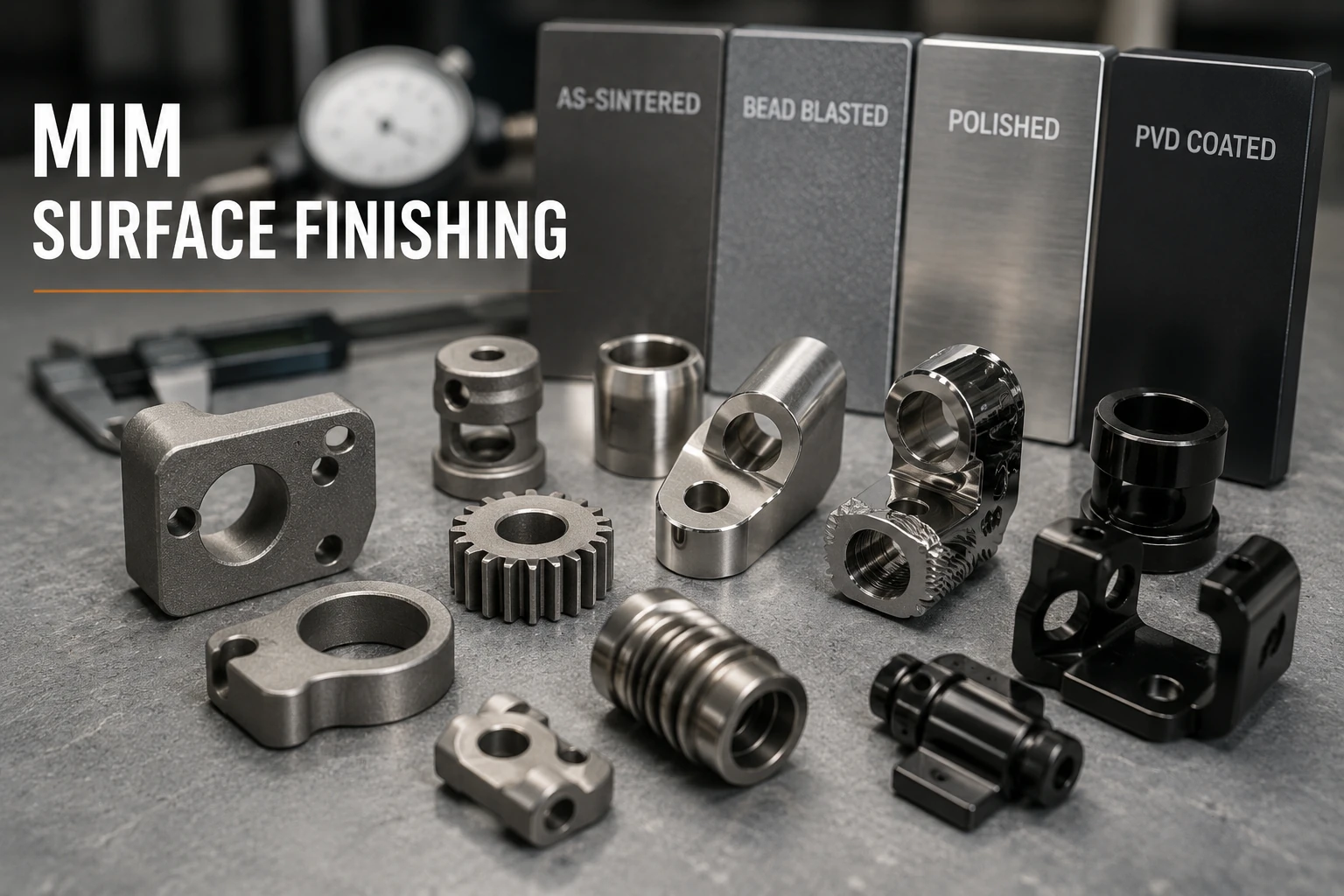
Surface finishing for MIM parts is a post-sintering engineering decision, not a default requirement. Many internal or non-cosmetic MIM components can remain as-sintered when the surface does not control appearance, corrosion behavior, sliding contact, coating adhesion, cleanliness, or final assembly fit. Finishing should be reviewed when the part has visible surfaces, stainless steel corrosion exposure, tight mating features, coating or plating requirements, controlled roughness, or small holes and threads that may trap media or chemistry.
For engineers and buyers, the key question is whether the final surface condition supports the drawing, material, application environment, inspection method, and production cost target.
- Use as-sintered: when the surface is internal, non-cosmetic, non-sliding, and not corrosion-critical.
- Plan finishing before tooling: when coating thickness, masking, edge rounding, corrosion exposure, or surface roughness may affect final fit.
- Review with XTMIM: when PVD coating, passivation, plating, polishing, or inspection criteria must be confirmed before RFQ or sample approval.
Quick Answer: When Do MIM Parts Need Surface Finishing?
From a design review perspective, surface finishing should be discussed before tooling when cosmetic areas, coating boundaries, small holes, threads, edges, or mating surfaces may affect final fit or appearance. The surface condition after sintering is connected to the MIM route itself: fine metal powder and binder feedstock, injection molding stability, green part handling, debinding, sintering shrinkage, tooling compensation, density, and final inspection.
In practice, use finishing when it improves a defined requirement, and avoid it when the as-sintered condition already supports function, cost, and inspection acceptance. Unnecessary polishing, blasting, plating, or coating can add handling cost, lead time, dimensional variation, and visual rejection risk without improving the actual part performance.
What Surface Finishing Means for MIM Parts
Surface finishing for MIM parts refers to post-sintering operations used to modify surface appearance, roughness, cleanliness, corrosion behavior, coating readiness, or functional surface performance. It belongs under MIM secondary operations after sintering, not as a separate finishing service disconnected from molding, debinding, sintering, shrinkage control, and inspection.
Surface finishing is not only cosmetic
A common mistake is to treat surface finishing as a visual requirement only. In production, the surface condition may affect how the part looks, how it feels during assembly, whether stainless steel needs passivation review, whether a coating can bond consistently, whether blind holes can be cleaned, and whether coating thickness changes final fit.
How finishing differs from machining, sizing, and heat treatment
Surface finishing should be separated from other secondary operations. Post-sintering machining for MIM parts is used for critical dimensions, holes, threads, datums, mating surfaces, or functional features requiring material removal. Sizing and dimensional calibration for MIM parts are used when shape, flatness, profile, or fit requires correction. Heat treatment for MIM parts is used to adjust hardness, strength, wear resistance, magnetic behavior, or material properties.
Why the as-sintered condition should be reviewed first
Before selecting polishing, blasting, passivation, PVD coating, plating, or another finishing route, the as-sintered part should be reviewed. The sintered surface already reflects material type, debinding quality, sintering atmosphere, shrinkage control, density, and any surface-connected defects. If the base surface is contaminated, cracked, distorted, or dimensionally inconsistent, finishing may increase risk rather than solve the real issue. For upstream context, review the MIM sintering process.

When the As-Sintered Surface May Be Enough
Internal non-cosmetic components
Internal brackets, carriers, locking pieces, sensor housings, structural inserts, and hidden mechanical components may not need decorative finishing if the surface meets functional and dimensional requirements. In these cases, the finishing decision should be driven by assembly and inspection, not appearance.
Non-sliding or non-sealing surfaces
If the surface does not slide, seal, rotate, contact a mating component, or carry a coating, the as-sintered condition may be acceptable. The review should focus on drawing tolerance, part density, edge condition, and assembly impact.
Parts without corrosion-critical exposure
For dry, enclosed, or low-corrosion environments, additional corrosion-focused finishing may not be required. Stainless steel parts exposed to humidity, sweat, chloride, or cleaning chemicals require more careful review.
Cost-sensitive parts where finishing adds no function
Every finishing step can add cost, handling, lead time, inspection, and batch variation. If finishing does not improve performance, assembly, appearance, or buyer acceptance, the as-sintered surface may be the better choice.
When Surface Finishing Should Be Planned Before Tooling
Surface finishing should be reviewed before tooling when the final surface may affect part design, dimensional strategy, masking boundaries, inspection criteria, or customer approval. Waiting until after samples are molded and sintered can create avoidable changes to tooling, tolerance strategy, or finishing process.
Cosmetic or customer-facing surfaces
Visible parts used in consumer products, electronics, wearable devices, locks, hinges, brackets, and precision hardware may require a more controlled visual surface. The drawing should identify which surfaces are cosmetic and which are functional. Without that separation, a supplier may polish or blast an area that should have remained dimensionally controlled.
Stainless steel parts exposed to corrosion environments
Stainless steel MIM materials may need cleaning, passivation, electropolishing, or other surface review when the application involves humidity, cleaning agents, sweat, chloride exposure, or corrosion-sensitive use. Material grade alone does not define final corrosion behavior; surface condition, contamination, finishing route, and verification method also matter.
Sliding, touching, or assembly-contact surfaces
Sliding or contact surfaces may require smoother finishing, coating, local polishing, or dimensional review after finishing. A surface that looks acceptable may still create friction, wear, noise, or assembly variation if roughness, coating thickness, or edge condition is not controlled.
Coated or plated MIM components
Coating and plating should be reviewed before tooling because they may affect final dimensions, masking areas, hole clearance, thread fit, color, adhesion, and inspection criteria. This is especially important for small MIM components where even a thin surface layer can influence assembly.
Small holes, slots, threads, and internal corners that may trap residue
MIM is often selected for small, complex features. These same features can make finishing more sensitive. Blasting media, polishing residue, cleaning chemistry, plating solution, or rinsing residue may remain in blind holes, narrow slots, threads, and internal corners if the finishing route is not reviewed in advance.

Common Surface Finishing Options for MIM Parts
The right finishing route depends on the drawing, material, surface requirement, cosmetic area, tolerance, assembly function, and production volume. The table below summarizes common options and review points.
| Surface finishing option | Typical purpose | Engineering review point |
|---|---|---|
| Blasting or bead blasting | Matte appearance, surface uniformity, coating preparation | Roughness, edge effect, batch consistency, masking |
| Magnetic finishing or magnetic polishing | Surface smoothing and edge uniformity for small components | Edge rounding, small feature protection, part entanglement |
| Mechanical polishing and local grinding | Improved appearance, smoother touch surface, local surface correction | Whether it is cosmetic finishing or functional dimension control |
| Surface cleaning | Inspection, assembly, coating preparation, customer cleanliness requirement | Residue, blind features, inspection method |
| Passivation | Stainless steel surface cleanliness and corrosion support | Material grade, surface contamination, verification requirement |
| Electropolishing | Selected stainless steel surfaces requiring smoothing and passivation support | Material, geometry, dimensional change, surface accessibility |
| Electroplating | Decorative, conductive, corrosion, or project-specific surface requirement | Adhesion, thickness, masking, cleanliness, partner support |
| In-house PVD vacuum coating | Wear-related, decorative, color, or functional surface coating | Material, surface preparation, coating thickness, masking, final fit |
| Other project-dependent coatings | Special application requirements | Confirm before quotation and sample approval |
Blasting or bead blasting
Blasting or bead blasting can create a more uniform matte surface, reduce visual variation, or prepare the surface for later finishing. The risk is that blasting may change surface roughness, soften small edges, or affect appearance consistency between batches.
Magnetic finishing or magnetic polishing
Magnetic finishing can be useful for small MIM parts where edge feel, surface consistency, or minor surface smoothing is required. It is not universal. Very small holes, fragile thin walls, delicate features, or parts that may entangle should be reviewed before selecting this route.
Mechanical polishing and local grinding
Mechanical polishing can improve appearance or touch feel on selected surfaces. Local grinding may be used when a surface needs both improved surface condition and limited correction. If the purpose is holding a critical dimension, datum, hole, thread, or mating surface, it should be reviewed as machining rather than surface finishing.
Surface cleaning before inspection, assembly, or coating
Cleaning may be required before final inspection, assembly, passivation, plating, or PVD coating. For small MIM components, residue may remain in blind holes, internal corners, threads, and narrow slots. The cleaning route should match geometry, material, cleanliness requirement, and inspection method.
Passivation for stainless steel MIM parts
Passivation may be reviewed for stainless steel MIM parts when corrosion behavior, surface cleanliness, or customer specification requires it. The exact passivation route should be confirmed based on the material, surface condition, geometry, and verification requirement.
Electropolishing for selected stainless steel parts
Electropolishing may be considered for selected stainless steel parts when smoother surfaces, improved cleanability, or passivation support is required. It is not suitable for every MIM geometry. Small features, dimensional limits, surface accessibility, and edge behavior should be reviewed before selection.
Electroplating for project-specific surface requirements
Electroplating may be required for decorative, conductive, corrosion, or application-specific reasons. For MIM parts, plating review should consider surface cleanliness, surface-connected porosity, coating thickness, adhesion, masking, and final dimensional requirements. Electroplating should be treated as project-dependent unless a specific plating route and inspection requirement are confirmed.
In-house PVD vacuum coating for selected MIM parts
XTMIM has in-house PVD vacuum coating capability for selected MIM parts when the material, geometry, surface condition, masking area, coating thickness, and production requirement fit the process capability. PVD may be used for wear-related surfaces, decorative appearance, color control, or functional surface performance. It should still be reviewed before quotation because coating thickness, surface preparation, masking boundaries, and final dimensional fit can affect both appearance and assembly.

For early-stage projects, engineering review for MIM projects can help confirm whether surface finishing should be treated as a cosmetic, functional, dimensional, or inspection-critical requirement.
How to Select the Right Surface Finishing Route
A good surface finishing decision starts from the requirement, not from the process name. The same MIM material may need no finishing, light cleaning, polishing, passivation, PVD coating, or plating depending on application conditions.
| Requirement | Possible finishing route | Review point |
|---|---|---|
| Matte cosmetic appearance | Blasting or bead blasting | Roughness, batch consistency, masking, visual sample |
| Smoother touch surface | Magnetic finishing or polishing | Edge rounding, small feature protection |
| Stainless corrosion support | Cleaning, passivation, electropolishing | Material grade, surface contamination, verification test |
| Decorative or wear-related surface | In-house PVD vacuum coating | Coating thickness, adhesion, masking, final fit |
| Conductive or plated layer | Electroplating | Surface cleanliness, adhesion, thickness, partner route |
| Pre-assembly cleanliness | Cleaning and inspection | Residue, blind features, handling method |
| Critical fit after coating | Coating route plus final dimension check | Measure after finishing, not only before finishing |
Material and geometry review
Material affects finishing response. Stainless steel may require passivation or electropolishing review, low-alloy steel may require corrosion protection, soft magnetic materials may need careful review if surface treatment could affect magnetic performance, and decorative parts may require stricter appearance control. If material selection is still open, review the MIM materials guide before finalizing a surface treatment route.
Functional surface versus cosmetic surface priority
The drawing should separate functional surfaces from cosmetic surfaces. A visible surface may need polishing or coating, while a mating surface may need tighter dimensional control. If both requirements apply to the same area, finishing and tolerance strategy should be reviewed together.
Roughness, appearance, corrosion, and coating-readiness trade-offs
A smoother surface is not always better. A roughened surface may help some coating preparation routes, while a polished surface may improve touch feel or cleanability. Passivation may support stainless steel corrosion behavior, while PVD coating may improve appearance or wear-related performance. The route should match the part function rather than a generic finish preference.
Cost, lead time, and inspection implications
Every finishing step adds handling, inspection, and process control requirements. For high-volume parts, finishing consistency becomes as important as the initial sample appearance. Before production, the customer and supplier should agree on visual standard, sample approval, measurement method, and acceptable variation.
MIM-Specific Surface Finishing Risks Engineers Should Review
Surface finishing risks are different for MIM parts because MIM is often used for small, complex, high-density parts with thin walls, internal features, undercuts, and tight functional zones.
| Risk | Why it matters for MIM parts | Review before production |
|---|---|---|
| Edge rounding | Polishing, tumbling, or finishing media may change small functional edges | Define protected edges or acceptable radius |
| Coating thickness | PVD, plating, or other coatings may change fit, hole size, slot clearance, or thread behavior | Check final dimensions after finishing |
| Residue in blind features | Small holes, slots, and internal corners may trap media, chemistry, or cleaning residue | Confirm cleaning route and inspection method |
| Masking difficulty | Miniature MIM parts may have limited masking area or complex coating boundaries | Confirm masking before quotation |
| Surface-connected porosity | Surface condition may affect plating, cleaning, coating, or corrosion behavior | Review density, sintering, and surface quality |
| Appearance variation | Material, blasting media, coating route, or batch handling may affect color or gloss | Use approved samples and visual standards |
| Finishing used to hide defects | Surface finishing cannot correct cracks, severe distortion, short shot, or poor sintering | Solve upstream process issues first |
Edge rounding from polishing or finishing media
Small MIM parts often include clips, hooks, hinges, locking edges, gear-like features, or micro structures. If polishing or tumbling rounds these edges too much, the part may pass visual inspection but fail assembly or functional testing.
Dimensional change caused by coating or plating thickness
Coating thickness may be small, but its effect can be significant on miniature parts. Holes, pins, sliding surfaces, slots, and threads should be measured after finishing when coating or plating affects final fit.
Residue inside holes, slots, threads, and blind features
MIM is attractive because it can form complex features, but those same features can trap blasting media, polishing residue, cleaning chemistry, or plating solution. If the drawing includes blind holes, narrow grooves, or internal channels, cleaning and inspection should be part of the finishing review.
Surface finishing cannot correct upstream sintering or molding defects
Surface finishing should not be used as a cosmetic cover for cracks, distortion, sink marks, short shots, severe gate marks, or poor density. If the defect comes from injection molding, debinding, sintering, tooling compensation, or support design, the root cause must be corrected upstream. For related upstream risk review, see MIM sintering distortion review.
Material and Application Considerations
Surface finishing should be selected together with material, application environment, and functional requirements. The same finishing process may behave differently on stainless steel, low-alloy steel, soft magnetic materials, or decorative components.
Stainless steel MIM parts
Stainless steel MIM parts may require cleaning, passivation, electropolishing, or PVD coating depending on corrosion exposure, appearance requirements, and customer specification. Material grade, surface contamination, sintering condition, and finishing route all influence final behavior.
Low-alloy steel MIM parts
Low-alloy steel MIM parts may need protective surface treatment if corrosion, wear, or appearance matters. If corrosion resistance is a primary requirement, material selection should be reviewed before relying only on surface finishing.
Soft magnetic MIM parts
Soft magnetic MIM components should be reviewed carefully if surface treatment, coating, or heat exposure could affect magnetic performance, dimensional fit, or assembly behavior. Appearance should not override functional magnetic requirements.
Wear-contact or decorative components
Wear-contact parts may require coating, polishing, or local surface review. Decorative components may require more consistent appearance, color, gloss, or surface texture. In both cases, sample approval and final inspection criteria are important.
Medical, electronics, consumer, and industrial application differences
Different applications require different acceptance logic. A hidden industrial component may only need dimensional and functional acceptance. A visible consumer hardware part may need strict cosmetic review. A stainless component exposed to cleaning agents may need passivation or corrosion verification. An electronics component may require cleanliness or coating control.
Inspection and Acceptance Criteria for Finished MIM Surfaces
Surface finishing should have an inspection plan. Without clear acceptance criteria, the supplier and buyer may disagree even if the part is functionally acceptable. XTMIM’s MIM inspection and testing capability supports finished-part review when surface treatment affects appearance, fit, coating, roughness, or cleanliness.

| Acceptance item | Why it matters | Typical review method |
|---|---|---|
| Visual surface standard | Controls appearance, color, gloss, and visible marks | Approved sample, visual boundary definition |
| Surface roughness | Controls touch feel, sliding behavior, coating readiness, or cleanability | Roughness measurement where specified |
| Final dimensions after finishing | Confirms coating, polishing, or plating did not affect fit | CMM, gauges, optical measurement, or functional check |
| Coating or plating thickness | Controls fit, wear behavior, appearance, and customer specification | Thickness measurement where required |
| Passivation or corrosion verification | Confirms surface treatment effectiveness when specified | Project-specific test method |
| Cleanliness | Prevents residue in holes, slots, threads, or assembly surfaces | Visual, magnified, or defined cleanliness check |
| Sample approval | Establishes appearance and finishing baseline | First sample or approved reference sample |
Visual surface standard
Visual acceptance should define the important surface zones. A cosmetic surface needs different criteria from a hidden surface. If every surface is treated as cosmetic, cost and rejection risk may increase unnecessarily.
Roughness measurement
Roughness should be specified only where it matters. If roughness is critical for sliding, sealing, coating, or appearance, the measurement location and method should be defined.
Critical dimension check after coating or polishing
If coating, plating, or polishing affects functional dimensions, inspection should be performed after finishing. This is especially important for tight holes, threads, slots, clips, and mating surfaces.
Sample approval before production release
For cosmetic, coated, polished, passivated, or plated MIM parts, sample approval helps reduce disagreement during production. The approved sample should define not only appearance, but also inspection boundaries and acceptable variation.
Composite Field Scenarios for Engineering Training
PVD Coating Changed Final Assembly Fit
- What problem occurred
- A small MIM locking component required black PVD coating for appearance and wear-related surface performance. The sintered sample passed dimensional inspection before coating, but after PVD coating, one mating slot became tight during assembly.
- Why it happened
- The original drawing tolerance was reviewed before coating, but the final dimension after coating was not clearly defined. The coating layer was thin, but the feature was small and the assembly clearance was limited.
- What the real system cause was
- The issue was not only the PVD process. The real cause was that coating thickness, masking boundary, and final functional dimension were not reviewed together before sample approval.
- How it was corrected
- The functional slot was reclassified as a post-coating inspection feature. The coating boundary and final acceptance dimension were reviewed with the engineering team. The sample approval process was updated to include finished-part measurement.
- How to prevent recurrence
- For PVD-coated MIM parts, drawings should identify coating surfaces, protected functional areas, critical dimensions after coating, and whether masking is required. Final fit should be checked after finishing, not only after sintering.
Polishing Rounded a Functional Edge
- What problem occurred
- A small stainless steel MIM part required polishing for improved touch feel. After polishing, the part looked better, but a functional edge used for positioning became less effective during assembly.
- Why it happened
- The edge was not identified as a protected functional feature. The polishing route improved appearance but removed more edge sharpness than expected.
- What the real system cause was
- The root cause was not simply too much polishing. The drawing and finishing instruction failed to separate cosmetic surfaces from functional edges.
- How it was corrected
- The cosmetic surface was separated from the protected functional edge in the finishing review. The finishing intensity was reduced near the edge, and sample approval included both appearance and assembly function.
- How to prevent recurrence
- Before polishing or magnetic finishing, the customer should define cosmetic zones, functional edges, mating surfaces, and acceptable edge condition. The supplier should review whether finishing media may affect small features.
XTMIM Capability Positioning for Surface Finishing
XTMIM reviews surface finishing requirements based on drawing, material, tolerance, surface condition, coating requirement, application environment, and production volume. The goal is to select a finishing route that supports final part function without creating avoidable dimensional or quality risks. For broader supplier evaluation, review XTMIM manufacturing capabilities or contact us through the XTMIM contact page.
| Capability category | Meaning for buyers |
|---|---|
| In-house PVD vacuum coating | XTMIM can perform PVD vacuum coating in-house for selected MIM parts when material, geometry, masking, coating thickness, and production requirements fit the equipment and process capability. |
| In-house or XTMIM-supported finishing | Certain blasting, polishing, cleaning, and surface preparation routes may be handled internally or supported through established process routes depending on the part. |
| Partner-supported finishing | Electroplating, electropolishing, special chemical treatment, or specialized coating may be arranged through qualified external partners when required. |
| Project-dependent review | The final route is confirmed only after reviewing drawing, material, tolerance, surface requirement, functional areas, and annual volume. |
Why this wording matters: Surface finishing should not be sold as a universal package. A professional review should explain what can be done in-house, what requires project-level confirmation, and what may need specialized external support.
What to Send for Surface Finishing Review
For a useful surface finishing review, the buyer should send enough information to evaluate both engineering feasibility and inspection risk.
- 2D drawing with tolerances and surface finish notes
- 3D CAD file if available
- Material requirement or target material family
- Critical dimensions and mating surfaces
- Cosmetic surfaces and non-cosmetic surfaces
- Surface roughness requirement if specified
- Polishing, blasting, passivation, plating, PVD coating, or color requirement
- Areas that must not be coated or polished
- Exposure environment such as humidity, sweat, outdoor use, or chemical contact
- Annual volume and sample approval expectations
- Visual, roughness, coating thickness, or corrosion verification requirements if applicable
Review Your MIM Surface Finishing Requirement Before Tooling
If your MIM part requires controlled surface appearance, passivation, polishing, plating, in-house PVD vacuum coating, or a specific final surface condition after sintering, send XTMIM your drawing, CAD file, material requirement, critical dimensions, cosmetic surface areas, surface roughness or coating requirement, exposure environment, annual volume, and inspection expectations.
Our engineering team can review whether the part can remain as-sintered, which finishing route is suitable, whether coating or polishing may affect fit, and what should be confirmed before tooling, sample approval, or production release.
FAQ: Surface Finishing for MIM Parts
Is surface finishing always required for MIM parts?
No. Many MIM parts can be used in the as-sintered condition when the surface does not control appearance, corrosion behavior, sliding function, coating adhesion, or cleanliness. Surface finishing should be reviewed when the application or drawing requires a specific surface result.
Can MIM parts be polished?
Yes, selected MIM parts can be polished or magnetic finished when surface appearance, touch feel, or local smoothness is required. Engineers should review edge rounding, small features, wall thickness, and whether any functional surfaces must be protected.
Can stainless steel MIM parts be passivated?
Yes, stainless steel MIM parts may be reviewed for passivation when corrosion behavior, surface cleanliness, or customer specification requires it. The exact route depends on material grade, surface condition, geometry, and verification requirement.
Does PVD coating affect MIM part dimensions?
It can. PVD coating is usually thin, but small MIM parts may have tight clearances, holes, slots, or mating surfaces where coating thickness matters. Final dimensions should be reviewed after coating when fit is critical.
Does XTMIM provide PVD coating in-house?
Yes. XTMIM has in-house PVD vacuum coating capability for selected MIM parts when the material, geometry, masking area, coating thickness, and production requirements fit the process capability. The coating route should be reviewed before quotation.
Is electroplating suitable for MIM parts?
Electroplating may be suitable for selected MIM parts, but it is project-dependent. Surface cleanliness, adhesion, plating thickness, surface-connected porosity, masking, and final inspection requirements should be reviewed before selecting plating.
What should I send for a surface finishing quotation?
Send the 2D drawing, 3D file if available, material requirement, critical dimensions, cosmetic surface areas, roughness or coating requirement, exposure environment, annual volume, and any inspection or sample approval requirement.
Standards and Technical References Note
Surface finishing requirements should be based on the drawing, application environment, material, and agreed inspection method. Standards can support project review, but they should not replace supplier-specific DFM review, sample approval, or production validation.
The MIMA Design Center discussion of secondary operations supports the placement of surface treatment under the broader MIM secondary operations topic. For stainless steel MIM parts, passivation-related requirements may refer to ASTM A967/A967M when the drawing or customer specification requires chemical passivation review. For electropolishing-based passivation of stainless steel parts, ASTM B912 may be relevant when the customer requires electropolishing and passivation evaluation.
These references should be applied carefully because MIM part geometry, surface condition, density, small features, and cleaning requirements may influence final process selection.