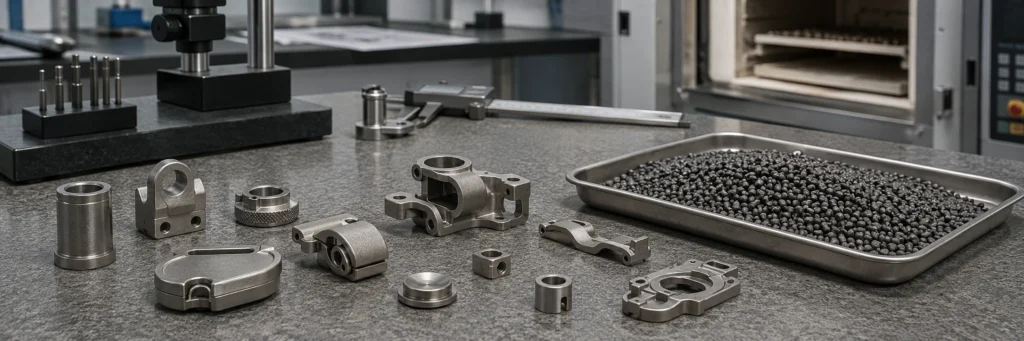
MIM Drawing & DFM Questions Casting Drawing Tolerance Notes That Need MIM Review When an investment-casting-style drawing is reviewed for MIM, casting drawing tolerance notes should not be copied into an RFQ or tooling review without engineering confirmation. Quick answer: The casting drawing notes that usually need MIM review include tight local tolerances, datum-based GD&T …
MIM Drawing & DFM Questions
Casting Drawing Tolerance Notes That Need MIM Review
When an investment-casting-style drawing is reviewed for MIM, casting drawing tolerance notes should not be copied into an RFQ or tooling review without engineering confirmation.
Quick answer: The casting drawing notes that usually need MIM review include tight local tolerances, datum-based GD&T notes, flatness or parallelism requirements, concentricity or positional tolerances, machining allowance notes, inspection method notes, and dimensions marked as critical to function. These notes do not automatically make a part unsuitable for MIM, but they affect how the project should be reviewed before quotation, tooling, secondary operations, inspection planning, or supplier quote comparison.
Quote risk
A supplier may quote the same drawing differently if tolerance control, machining allowance, or inspection timing is not clarified.
Tooling risk
Local tolerances, datum systems, and feature relationships may affect shrinkage compensation, mold correction, and trial review.
Inspection risk
The drawing should define whether critical dimensions are measured as-sintered or after sizing, machining, heat treatment, or finishing.

Core conclusion: Casting drawing notes are useful starting points, but MIM review must confirm how each tolerance will be controlled, inspected, or finished.
Which Casting Drawing Tolerance Notes Need MIM Review?
Casting drawings often include tolerance notes written around casting shrinkage, post-casting machining, fixture inspection, or general foundry practice. When the same part is reviewed for MIM, the engineering team should separate notes that can remain as general design intent from notes that require MIM process review or secondary operation confirmation.
This drawing-level review is one support topic inside the broader MIM vs Investment Casting review. The goal is not to decide the process from one tolerance line alone. The goal is to identify which drawing requirements must be clarified before the project is treated as ready for MIM quotation or MIM design review before tooling.
Tight local tolerances
Local tolerances near thin walls, small holes, slots, bosses, undercuts, ribs, or narrow functional surfaces should be reviewed before quotation because they may be affected by molding, shrinkage, distortion, and inspection access.
Datum-based notes
A datum note may control multiple surfaces, holes, slots, or positions. If the datum was originally based on an as-cast or post-machined casting surface, the datum scheme may not transfer directly into MIM.
Inspection assumptions
Some notes assume a machined reference, casting fixture, or specific measurement condition. MIM review should confirm whether the final inspection happens after sintering, sizing, machining, heat treatment, or finishing.
Engineering review principle: A tight tolerance is not automatically impossible, and a loose tolerance is not automatically safe. The review should identify the feature function, the process step that controls it, and the inspection condition used for acceptance.

Core conclusion: The highest-risk drawing notes are often local, functional, datum-based, or inspection-related rather than simply the largest dimensions.
Why Casting Tolerance Notes Cannot Always Be Copied Into MIM
Investment casting and MIM can both produce complex metal parts, but their dimensional control mechanisms are different. A drawing note that worked for a casting process may not describe how the same feature should be controlled in MIM.
MIM uses molded feedstock, debinding, and sintering shrinkage. Dimensions are influenced by material behavior, tooling compensation, sintering support, part geometry, and secondary operations. A tolerance note should therefore be reviewed by asking which process step controls the dimension and how the final part will be verified.
MIM shrinkage compensation changes how dimensions are controlled
MIM parts shrink during sintering. Tooling must compensate for this shrinkage, and the shrinkage compensation approach may not be equally simple across every feature. A long dimension, a thin wall, a boss, a hole, and a local rib may respond differently depending on geometry, wall transition, mass distribution, and support condition.
The key question is not only “what is the tolerance?” The better question is: “Which process step controls this dimension, and how will it be verified?” For broader design tolerance context, the project team can also review MIM tolerances before finalizing the drawing.
Sintering distortion can affect flatness, straightness, and datum stability
Flatness, straightness, parallelism, and datum-related notes often need special attention. MIM parts can distort during debinding or sintering if the geometry has uneven wall thickness, unsupported flat areas, long spans, asymmetric mass distribution, or features that create stress during shrinkage.
This does not mean the drawing is unsuitable for MIM. It means the note should be reviewed before tooling so that part orientation, gate position, support strategy, tool compensation, or secondary operations can be considered early.
Secondary operations may be needed for selected critical surfaces
Some tolerance notes may be achievable only after secondary operations such as machining, sizing, grinding, tapping, polishing, heat treatment control, or surface finishing. The RFQ should identify which surfaces must be as-sintered and which surfaces must be finished after sintering. For cost and supplier-comparison context, it is also useful to review how secondary operations affect MIM RFQ cost.
| Review Question | Why It Matters | Possible Engineering Action |
|---|---|---|
| Is the tolerance controlled by molding, sintering, or a secondary operation? | Different process steps create different cost and inspection assumptions. | Clarify as-sintered control versus post-sintering finishing. |
| Is the tolerance local or part-wide? | Local features and long datum chains may behave differently during shrinkage. | Review feature geometry, wall transition, and datum relationship. |
| Is the requirement functional, cosmetic, or inherited from the casting drawing? | Not every legacy drawing note should drive MIM tooling or inspection cost. | Separate critical-to-function dimensions from non-critical notes. |

Core conclusion: A tolerance note should be reviewed by asking which process step controls the dimension and how the final part will be inspected.
Tolerance Note Review Table for Casting-to-MIM RFQs
The following table can be used as a first-pass review before submitting a casting-style drawing for MIM quotation. It does not replace engineering review, but it helps identify which notes should be clarified.
| Drawing Note Type | Why It Matters in MIM | Review Action | RFQ Input Needed |
|---|---|---|---|
| General dimensional tolerance block | May be acceptable as a starting point, but does not show which features are critical. | Confirm which dimensions are functional. | 2D drawing, 3D model, critical dimension list. |
| Tight local tolerance on small features | May be affected by molding, shrinkage, or inspection access. | Review feature size, location, and function. | Feature detail, tolerance reason, assembly requirement. |
| Datum-based positional tolerance | Datum stability may change after sintering or secondary operations. | Confirm datum surfaces and inspection condition. | Datum scheme, functional surfaces, measurement method. |
| Flatness or parallelism note | May be affected by sintering support, geometry, and final surface condition. | Review whether as-sintered control is acceptable. | Surface function, mating requirement, inspection method. |
| Concentricity or runout note | May require post-sintering machining depending on function. | Identify whether the feature is molded or finished. | Assembly function, shaft or hole relationship, tolerance priority. |
| Machining allowance note | Casting allowance may not match MIM process needs. | Confirm whether allowance is still required. | Machined surfaces, stock allowance target, post-process plan. |
| Surface finish note | MIM surface and casting surface assumptions may differ. | Review as-sintered versus finished surface requirement. | Surface function, cosmetic requirement, coating or finishing need. |
| Inspection method note | May assume a casting fixture or machined reference. | Confirm final inspection condition. | CMM, fixture, gauge, or functional inspection requirement. |
| Critical-to-function dimension | Drives process decision, supplier responsibility, and quote assumptions. | Prioritize in engineering review. | CTQ list, assembly interface, acceptance criteria. |
Supplier comparison note: If two suppliers quote the same drawing but make different assumptions about tolerance control, machining, and inspection, the prices may not be directly comparable. The review package should clarify which notes are mandatory acceptance requirements and which notes are open to engineering discussion.
Datum and Inspection Notes That Need Special Attention
Datum and inspection notes are often more sensitive than general size tolerances because they define how the part will be accepted. In a casting drawing, the datum scheme may have been developed around casting process limits, machining operations, or inspection fixtures. In a MIM review, that logic should be checked.
Datum systems based on as-cast reference surfaces
A datum based on an as-cast surface may not be the best datum for a MIM part. In MIM, the surface may be molded, sintered, supported, machined, or finished differently. If the datum is not stable or not functionally relevant, it may create unnecessary inspection disagreement.
Review the datum purpose
- Is it a true functional interface?
- Is it a legacy manufacturing reference?
- Is it only an inspection convenience?
- Will the surface be machined after sintering?
Review the inspection condition
- After sintering?
- After sizing or machining?
- After heat treatment?
- After surface finishing?
Critical-to-function dimensions should be separated from cosmetic notes
A common drawing review problem is that every tolerance looks equally important. In practice, some dimensions control assembly, sealing, rotation, alignment, or load transfer. Others only control appearance or legacy drawing format.
For MIM review, critical-to-function dimensions should be separated from cosmetic or non-critical dimensions. This helps the engineering team focus on requirements that affect tooling, processing, inspection, and cost.
Quality review boundary: Datum and inspection notes should be reviewed together with final part condition. A dimension measured after machining, sizing, or surface finishing may not represent the same process responsibility as a dimension measured directly after sintering.

Core conclusion: Datum and inspection notes affect how the finished MIM part is accepted, so they must be confirmed before RFQ and tooling review.
When a Tolerance Note May Change the Process Decision
A single tolerance note does not automatically decide whether MIM or investment casting is better. However, a pattern of tolerance notes can change the process review. Certain drawing requirements may indicate that MIM needs secondary operations, tooling risk review, or a different design approach.
| Tolerance Signal | MIM Review Implication | Possible Next Step |
|---|---|---|
| Very tight tolerances across long or thick sections | May be difficult to control only through molding and sintering. | Review geometry, support condition, secondary operation, or process route. |
| Large unsupported flat areas or long datum chains | May increase distortion or inspection disagreement risk. | Confirm datum scheme, functional surfaces, and inspection method. |
| Combined geometry, surface finish, and inspection requirements | May require secondary finishing or tighter process planning. | Separate functional requirements from cosmetic or legacy drawing notes. |
If the tolerance note points to a broader DFM issue, the drawing should be reviewed against a structured MIM DFM design checklist before quote comparison.
What to Send Before Asking for a MIM Review
A good MIM review depends on the information sent with the drawing. If the supplier receives only a PDF with tolerance notes but no 3D model, no critical dimension list, and no inspection priority, the review will be incomplete.
Before asking for a MIM review, prepare both the 2D drawing and 3D model. The 2D drawing shows tolerance notes, datums, critical dimensions, surface finish, and inspection requirements. The 3D model helps review geometry, wall thickness, transitions, undercuts, moldability, and shrinkage-related risks.
RFQ input checklist for tolerance note review
- 2D drawing and 3D model.
- Critical dimensions and functional surfaces.
- Expected annual volume.
- Target material or material family.
- Surface finish, coating, or heat treatment requirement.
- Post-sintering machining or sizing expectation.
- Inspection method or acceptance condition.
- Existing investment casting or machining assumptions.
For a structured preparation path, use the MIM RFQ preparation guide and the MIM tolerance and shrinkage checklist before requesting supplier pricing.
Good RFQ input
The supplier can identify critical dimensions, likely secondary operations, inspection timing, and quote assumptions before pricing the project.
Weak RFQ input
The supplier must guess whether tolerances are functional, inherited from casting, measured after machining, or open to engineering review.

Core conclusion: Better drawing review inputs reduce quote assumptions and make MIM supplier comparisons more reliable.
Composite Field Scenario for Engineering Training
A small metal component was originally designed for investment casting. The drawing included a general tolerance block, two tight local tolerances near small slots, a flatness note on a mating surface, and a datum reference based on an as-cast surface.
Before quoting the part for MIM, the engineering team separated the drawing notes into three groups. The general tolerance block was kept as a starting point. The slot tolerances and flatness note were marked for MIM review. The datum reference was questioned because the surface might not be the most stable inspection reference after sintering.
The review did not conclude that the part was unsuitable for MIM. Instead, it clarified which surfaces were functional, which dimensions should be inspected after final processing, and whether selected surfaces might need machining or sizing. That made the RFQ more useful and helped avoid comparing supplier quotes based on different hidden assumptions.
FAQ About Casting Drawing Tolerance Notes for MIM Review
Can investment casting tolerance notes be reused for MIM drawings?
Some notes can be used as a starting point, but they should not be copied into a MIM RFQ without review. MIM uses different tooling, shrinkage compensation, sintering, and inspection logic. Critical tolerances, datum notes, flatness requirements, and post-machining assumptions should be checked before quotation.
Which tolerance notes most often need MIM engineering review?
The notes most likely to need review include tight local tolerances, datum-based positional requirements, flatness or parallelism notes, concentricity or runout requirements, machining allowance notes, surface finish notes, and dimensions marked as critical to function.
Should I change the drawing before sending it for MIM review?
Do not change the drawing blindly before review. It is usually better to send the current 2D drawing, 3D model, critical dimension list, material requirement, expected volume, and inspection notes. The MIM engineering team can then identify which notes should remain, which need clarification, and which may require secondary operations.
Do datum notes affect MIM tooling and inspection planning?
Yes. Datum notes affect how the part is measured and accepted. If a datum is based on a surface that changes after sintering, machining, or finishing, the inspection result may not reflect the intended function. Datum notes should be reviewed together with functional surfaces and final inspection conditions.
When do tolerance notes lead to secondary operations in MIM?
Tolerance notes may lead to secondary operations when they control tight functional surfaces, precise holes, flat sealing faces, threaded features, bearing surfaces, or datum relationships that cannot be reliably controlled as-sintered. In these cases, machining, sizing, grinding, tapping, or additional inspection may be needed.
Technical References
The references below are provided for general engineering context on MIM design and datum systems. They do not replace project-specific DFM, tolerance, tooling, or inspection review.
-
Metal Powder Industries Federation / MIMA Design Center: Complex Designs with MIM
Used as background context for wall-thickness variation, non-uniform shrinkage, and dimensional control considerations in MIM design.
View MIMA design reference -
NIST: A Conceptual Data Model of Datum Systems
Used as background context for datum systems, datums, datum features, datum targets, and engineering interpretation of datum-related requirements.
View NIST datum systems reference
Need a MIM Review for a Casting-Style Drawing?
If your current drawing was created for investment casting and includes tight tolerance notes, datum references, machining allowance, or inspection requirements, send the 2D drawing, 3D model, critical dimension list, expected volume, material requirement, and inspection notes for MIM engineering review.
2D drawing
3D model
Critical dimensions
Material
Expected volume
Inspection notes