Commercially Pure Titanium MIM
CP Titanium, or commercially pure titanium, can be considered for metal injection molding when a project needs a pure titanium material system, corrosion stability, and small complex geometry rather than the highest possible titanium alloy strength.
Quick answer: CP Titanium MIM is most relevant for small corrosion-resistant, dental-related, wearable, and precision components where pure titanium material identity matters. The project should be reviewed by Grade 1–4 selection, oxygen pickup risk, powder and feedstock condition, debinding route, sintering atmosphere, distortion risk, surface requirement, and final inspection plan. If high strength is the main requirement, Ti-6Al-4V / TC4 should be reviewed instead of treating CP Titanium as a direct substitute.
Small complex titanium part, pure titanium requirement, corrosion stability, moderate strength, and production volume that can justify MIM tooling.
Oxygen, carbon, nitrogen, sintering atmosphere, and powder condition must be reviewed before the project relies on a CP Titanium grade name.
Provide the 2D drawing, 3D model, target grade, material specification, critical dimensions, surface requirement, inspection requirement, and annual volume.
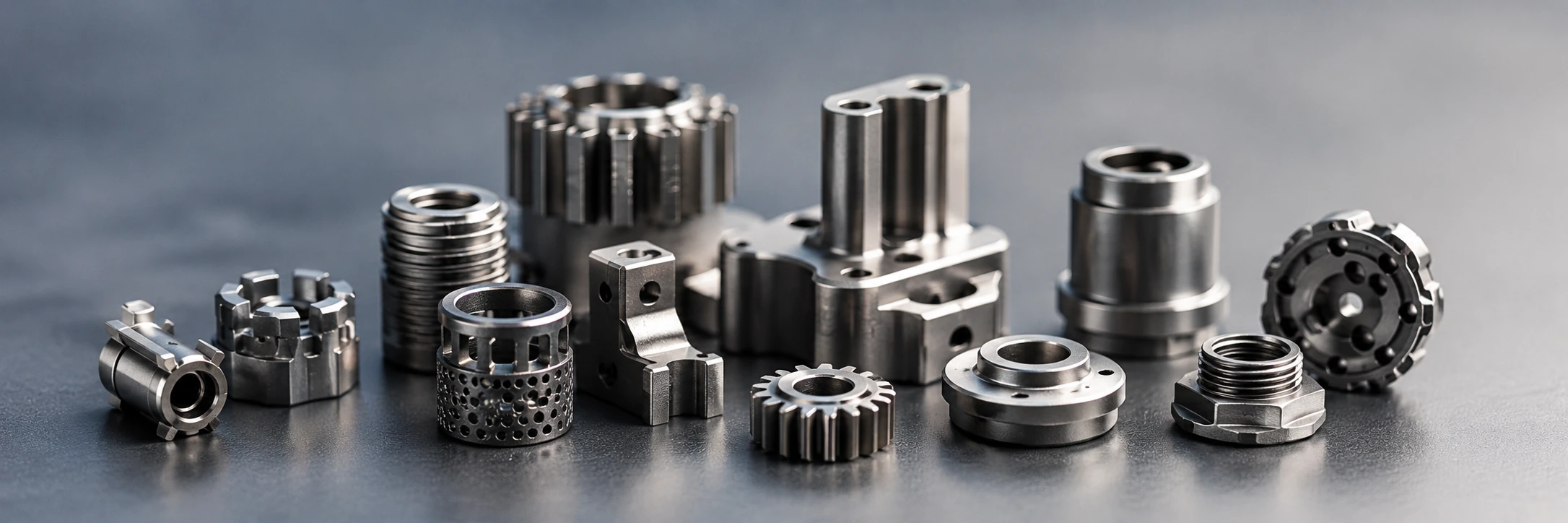
Core conclusion: CP Titanium MIM is most relevant when pure titanium material identity, corrosion stability, and small complex geometry matter more than maximum strength.
What Is CP Titanium in MIM?
CP Titanium, or commercially pure titanium, is a pure titanium material family used when the project team needs unalloyed titanium behavior rather than alloy-strengthened titanium performance. In MIM projects, the decision must connect material grade, powder and feedstock route, debinding, sintering atmosphere, oxygen pickup, surface condition, and final inspection requirements.
Commercially Pure Titanium vs Titanium Alloy
Commercially pure titanium is not the same material decision as titanium alloy. CP Titanium grades are usually reviewed when the drawing, application, or customer specification requires a pure titanium system. Titanium alloy pages, including the broader Titanium Alloys family page, should carry the wider alloy routing discussion.
For this page, CP Titanium means commercially pure titanium grades such as Grade 1, Grade 2, Grade 3, and Grade 4. These grades should not be mixed with Grade 5 / Ti-6Al-4V / TC4, because the material-selection reason is different.
Why Grades 1–4 Matter
Grades 1, 2, 3, and 4 are treated as commercially pure titanium grades. For MIM, the grade name alone is not enough. The supplier must review oxygen, carbon, nitrogen, powder condition, sintering route, surface condition, and whether the final part can satisfy the customer’s intended material requirement.
A drawing that only says “pure titanium” or “CP titanium” should trigger a material clarification step. The RFQ should identify the target grade, required standard or customer specification, and whether final chemistry or mechanical testing is expected.
Important boundary: A standard reference or a CP Titanium grade name does not mean a specific MIM part is automatically approved for medical, dental, implant, or regulated use. Any regulated application must be reviewed against customer-provided specifications, qualification requirements, and final inspection documents.
When CP Titanium Is a Good Fit for MIM Parts
CP Titanium can be a good fit when the part is small, complex, corrosion-sensitive, and suitable for near-net-shape molding. The strongest project logic is not “titanium is strong”; it is that the design benefits from a commercially pure titanium system, corrosion stability, and MIM geometry advantages.
Small Corrosion-Resistant Components
CP Titanium can be considered when stainless steel or low-alloy steel does not match the corrosion or material identity requirement. For broader material-property routing, the project can also be compared with Corrosion-Resistant MIM Materials.
Dental-Related and Medical Project Reviews
CP Titanium may appear in dental-related or medical-related project reviews, but the material name alone is not enough. For component routing, related application pages such as Medical Parts and Dental Parts can support application-level review.
Wearable and Precision Structures
Wearable devices may require small titanium parts with corrosion stability, clean surface condition, and moderate structural demand. CP Titanium should be reviewed when pure titanium identity matters more than maximum strength. Related industry routing can be found under Wearable Device Components.
| Project Signal | Why It Supports CP Titanium MIM | Review Before Tooling |
|---|---|---|
| Pure titanium material identity is required | CP Titanium may fit better than an alloy route when unalloyed titanium is part of the specification. | Confirm the target grade and material standard instead of using a generic titanium callout. |
| Corrosion stability matters more than maximum strength | CP Titanium may support small corrosion-sensitive components when moderate strength is acceptable. | Confirm exposure environment, surface finish, and inspection requirement. |
| Part has small complex geometry | MIM can reduce machining burden when holes, slots, thin walls, curves, or multiple features are molded near-net shape. | Review wall thickness, shrinkage, support, distortion, and secondary operations. |
| Application is medical-related, dental-related, or wearable | CP Titanium may be relevant as a material discussion, but approval depends on customer requirements. | Do not assume certification; clarify documentation, cleaning, and qualification expectations. |

Core conclusion: CP Titanium is useful for selected small complex parts where pure titanium and corrosion stability are more important than high strength.
Grade 1, Grade 2, Grade 3, and Grade 4 Titanium in MIM
Grade selection is one of the most important early decisions in a CP Titanium MIM project. The design team should not select a grade by name only. The supplier needs to understand the target standard, required mechanical direction, oxygen control expectation, corrosion environment, surface requirement, and inspection plan.
| CP Titanium Grade | General Project Direction | MIM Review Concern | RFQ Note |
|---|---|---|---|
| Grade 1 | Highest ductility direction, lower strength direction | Oxygen pickup may reduce the ductility advantage expected from the grade. | Confirm whether ductility is the main reason for choosing this grade. |
| Grade 2 | Balanced CP Titanium review direction | Often a practical starting point for commercially pure titanium MIM discussions. | Confirm drawing, target standard, oxygen concern, and application environment. |
| Grade 3 | Intermediate strength direction | Needs careful review of final chemistry and mechanical requirements. | Confirm whether Grade 2 or Grade 4 is actually intended. |
| Grade 4 | Higher strength direction within CP Titanium grades | More sensitive to interstitial control and final property verification. | Confirm strength requirement, oxygen limit, ductility expectation, and testing plan. |
Why Grade 2 Is Often the First Review Point
Grade 2 is often used as the first commercially pure titanium review direction because it balances material identity, moderate strength direction, and practical application logic. In a MIM project, however, Grade 2 should still be linked to the customer’s target standard, oxygen concern, and final inspection plan.
Why Grade 4 Requires More Care
Grade 4 may be considered when the project wants commercially pure titanium but needs a stronger CP Titanium direction. The review becomes more sensitive because higher interstitial content can influence the relationship between strength and ductility. The project should confirm whether CP Titanium Grade 4 or Ti-6Al-4V / TC4 is the correct path.
Use the grade table as an RFQ discussion guide, not as a guaranteed property table. Final material suitability depends on powder, feedstock, debinding, sintering, post-processing, and inspection. Specific chemistry, strength, elongation, or density values should only be used when confirmed by the customer specification or approved test plan.

Core conclusion: Grade 2 and Grade 4 titanium MIM should be reviewed by application requirement, chemistry control, and final part verification.
Oxygen Control Is the Critical Risk in CP Titanium MIM
Oxygen control is one of the most important engineering risks in CP Titanium MIM. Titanium is sensitive to oxygen and other interstitial elements. In a MIM route, oxygen can be influenced by powder condition, feedstock preparation, binder removal, furnace atmosphere, sintering temperature, sintering time, handling, and post-sintering operations.
Powder and Feedstock
Fine titanium powder has high surface area, so powder condition and storage matter. Feedstock must be reviewed as prepared pellets and should not be described as produced in-house unless that capability is specifically confirmed.
Debinding and Residue Control
Debinding must remove binder without introducing unacceptable contamination or damaging the green part. Thin walls, blind holes, and fragile features should be reviewed before tooling.
Sintering and Inspection
Sintering atmosphere, furnace cleanliness, loading, support, and high-temperature exposure can influence final part condition. Chemistry verification may be required when oxygen, carbon, or nitrogen limits are specified.
| Oxygen Risk Point | What Can Go Wrong | Engineering Review Action |
|---|---|---|
| Powder surface condition | High surface area titanium powder can carry higher oxygen risk before molding begins. | Review powder specification, feedstock supplier data, storage condition, and customer chemistry requirement. |
| Binder removal | Incomplete debinding or unsuitable conditions can leave residue or damage fragile green parts. | Review debinding route, wall thickness, blind holes, and fragile features before mold design. |
| Sintering atmosphere | High-temperature exposure can influence oxygen pickup, distortion, and final material condition. | Review furnace route, loading, support, atmosphere control, and final chemistry testing requirement. |
| Post-sintering handling | Machining, polishing, cleaning, or surface finishing may change surface condition or inspection needs. | Define surface finish, cleaning, passivation, inspection, and documentation requirements in the RFQ. |
Before tooling: Confirm the target CP Titanium grade, oxygen / carbon / nitrogen concern, material standard or customer specification, part geometry, critical tolerance, surface requirement, and final inspection documentation.

Core conclusion: Oxygen pickup is a critical risk because it can affect ductility, grade compliance, and final material suitability.
Confirm Oxygen and Grade Requirements Early
For CP Titanium MIM projects, oxygen, carbon, nitrogen, sintering route, and final inspection expectations should be discussed before mold design. Send the drawing and material requirement for an engineering feasibility review.
MIM Process Review for Commercially Pure Titanium
CP Titanium MIM should be reviewed as a complete process chain, not only as a material name. The process begins with prepared feedstock pellets made from fine titanium powder and binder, then continues through injection molding, green part handling, debinding, sintering, secondary operations, and final inspection.
| Process Area | What to Review | Why It Matters for CP Titanium | Possible Project Impact |
|---|---|---|---|
| Feedstock and powder | Powder condition, prepared pellet quality, injection stability | Fine titanium powder is sensitive to oxygen and contamination risk. | Material compliance, molding stability, final chemistry review |
| Injection molding | Thin walls, holes, slots, green part integrity, gate location | Small complex features must survive molding and handling before sintering. | Short shot, cracking, handling damage, tool correction cycles |
| Debinding | Binder removal route, residue risk, fragile feature support | Residual contamination or damage can affect final part quality. | Cracking, residue, distortion, delayed process validation |
| Sintering | Atmosphere, shrinkage, support, distortion, furnace cleanliness | Sintering controls densification, shape stability, and contamination exposure. | Distortion, dimensional shift, chemistry concern, inspection failure |
| Secondary operations | Machining, polishing, cleaning, surface finishing, inspection | Post-sintering steps affect datum control, surface condition, and final acceptance. | Cost increase, lead-time increase, datum mismatch, surface rejection |
What Can Go Wrong?
- Oxygen level or chemistry requirement is not clarified before tooling.
- The part has large thickness variation and distorts during sintering.
- A cosmetic or contact surface requires secondary finishing not planned in the mold review.
- Critical tolerances are assigned to surfaces that need post-sintering machining.
- The project expects high-strength titanium alloy behavior from a CP Titanium grade.
How to Reduce Risk Early
- Confirm the material grade and acceptance standard before mold design.
- Identify oxygen, carbon, nitrogen, surface, and cleaning requirements in the RFQ.
- Review wall thickness, holes, slots, thin edges, and unsupported features.
- Define inspection method, datum scheme, and documentation expectations.
- Separate CP Titanium projects from Ti-6Al-4V / TC4 strength-driven projects.
Capability boundary: XTMIM content may describe injection molding and debinding as in-house, and sintering review may include batch vacuum and continuous / belt furnace routes. It should not claim feedstock production in-house, all tooling manufactured in-house, guaranteed properties, exact equipment capacity, or full PPAP for all projects.
CP Titanium vs Ti-6Al-4V / TC4 for MIM Projects
CP Titanium and Ti-6Al-4V / TC4 answer different material questions. CP Titanium is reviewed when pure titanium, corrosion stability, and biocompatibility-related material logic matter more than maximum strength. Ti-6Al-4V / TC4 is reviewed when higher strength is the main design driver.
| Selection Question | CP Titanium Direction | Ti-6Al-4V / TC4 Direction |
|---|---|---|
| Main material reason | Pure titanium / unalloyed titanium system | Titanium alloy strength-to-weight direction |
| Strength priority | Moderate strength requirements | Higher strength requirements |
| Corrosion and surface stability | Important selection reason | Can be relevant, but not the CP Titanium reason |
| MIM risk focus | Oxygen pickup, grade compliance, ductility | Alloy control, strength verification, sintering route |
| RFQ decision | Use when pure titanium identity matters more than maximum strength | Use when mechanical strength is the main requirement |
If the project is primarily strength-driven, it should also be compared with High-Strength MIM Materials and the dedicated Ti-6Al-4V / TC4 material review. If the requirement is pure titanium material identity, corrosion stability, or a CP Titanium grade callout, the current page remains the correct review path.

Core conclusion: CP Titanium fits pure titanium and corrosion-stability needs, while Ti-6Al-4V / TC4 is reviewed when higher strength is the main requirement.
Design and Application Boundaries for CP Titanium MIM
CP Titanium MIM is most valuable when geometry and production volume justify the MIM route. A simple round part, large block, low-volume prototype, or part requiring heavy machining after sintering may not be a good fit.
Good Geometry Signals
- Small size with multiple features
- Thin walls, holes, slots, undercuts, or complex contours
- Near-net-shape value compared with machining
- Annual volume that can justify tooling
- Material requirement that supports CP Titanium instead of stainless steel or low-alloy steel
Warning Signals Before Tooling
- Large part size or heavy section mass
- Thick-to-thin section transitions
- Long unsupported features
- Extremely tight flatness or straightness
- Deep blind holes or heavy post-sintering machining
- Unclear grade, oxygen, or inspection requirement
| Boundary Question | If the Answer Is Yes | Recommended Action |
|---|---|---|
| Is the part too large or too simple? | MIM tooling may not be justified. | Compare CNC or another titanium process before RFQ finalization. |
| Is the main requirement high strength? | CP Titanium may not be the correct material route. | Review Ti-6Al-4V / TC4 as a separate strength-driven titanium alloy route. |
| Are oxygen or chemistry limits strict? | The project may need a tighter material and process validation plan. | Confirm chemistry testing, acceptance criteria, and documentation before tooling. |
| Does the part require extensive post-machining? | Near-net-shape value may be reduced. | Review machining allowance, datums, and total cost before selecting MIM. |
When another process may be better: CNC may be better for low-volume prototypes, simple geometries, or large parts. Ti-6Al-4V / TC4 may be better when high strength is the primary design requirement. Another titanium process may be better if the part is too large for MIM or requires a material condition that cannot be safely matched through a MIM route.
Material Standard and Acceptance Planning
CP Titanium MIM projects should separate material terminology from part approval. A customer may reference Grade 2, Grade 4, unalloyed titanium, ASTM, ISO, or an internal specification, but the final MIM part still needs an acceptance plan that matches the drawing, application, and qualification route.
Material Callout
The drawing should state whether the requirement is CP Titanium, Grade 2, Grade 4, or another customer-defined material. A generic “titanium” note is not enough for MIM quotation or tooling review.
Acceptance Criteria
The customer should clarify whether acceptance depends on chemistry, mechanical testing, surface condition, dimensional inspection, cleaning, or documentation. Without this, the supplier can only provide a preliminary feasibility review.
Regulated Application Boundary
If the part is medical-related, dental-related, or otherwise regulated, material feasibility and manufacturing feasibility are not the same as regulatory approval. Qualification expectations must be provided by the customer.
Do not assume approval from a material name. A reference to unalloyed titanium standards can support material discussion, but it does not certify a specific MIM part, supplier, or process route for medical, dental, implant, or regulated use.
RFQ Information Needed for CP Titanium MIM Parts
A CP Titanium MIM RFQ should include more than a 3D file. The supplier needs enough information to evaluate material route, tooling risk, sintering risk, secondary operations, and inspection requirements. For broader RFQ preparation, use the MIM RFQ Preparation Guide.
Material and Application Inputs
- Target CP Titanium grade, such as Grade 2 or Grade 4
- Required material standard or customer specification
- Application environment and corrosion exposure
- Oxygen, carbon, nitrogen, or mechanical test requirements if specified
- Medical, dental, wearable, or regulated application expectations if relevant
Drawing and Manufacturing Inputs
- 2D drawing and 3D CAD file
- Critical dimensions, datum requirements, and tolerance class
- Thin walls, holes, slots, threads, and functional surfaces
- Surface finish, cleaning, passivation, polishing, or coating requirement
- Expected annual volume and secondary operation requirements
| RFQ Input | Why It Is Needed | If Missing |
|---|---|---|
| Target grade and standard | Defines whether the project is Grade 2, Grade 4, or another CP Titanium requirement. | Quotation can only be preliminary. |
| 2D drawing with critical dimensions | Defines tolerance, datum, machining allowance, and inspection points. | Tooling and inspection risk cannot be reviewed accurately. |
| Application environment | Explains corrosion, contact, temperature, wear, or cleaning exposure. | Material selection may be incomplete. |
| Surface and cleaning requirement | Controls polishing, passivation, cosmetic, contact, or documentation needs. | Secondary operation cost may be underestimated. |
| Annual volume | Determines whether MIM tooling can be economically justified. | The project may be better suited to prototype machining or another route. |

Core conclusion: A clear RFQ package reduces material-selection uncertainty before CP Titanium MIM tooling begins.
FAQ About CP Titanium MIM
Can CP Titanium be used in metal injection molding?
Yes, CP Titanium can be reviewed for MIM when the part is small, complex, and suitable for a powder injection molding route. The key review points are grade selection, powder condition, oxygen control, debinding, sintering, geometry, and final inspection requirements.
Is Grade 2 titanium suitable for MIM?
Grade 2 titanium can be a practical starting point for commercially pure titanium MIM review. However, it should not be selected by name only. The project team should confirm the target standard, oxygen concern, application environment, critical dimensions, and testing requirements.
Is Grade 4 titanium stronger than Grade 2 in MIM projects?
Grade 4 is generally a higher strength direction within commercially pure titanium grades, but MIM suitability depends on final chemistry, oxygen control, sintering route, ductility expectation, and inspection requirements. If high strength is the main driver, Ti-6Al-4V / TC4 should also be reviewed.
Why is oxygen control important for pure titanium MIM?
Oxygen can affect the balance between strength and ductility in titanium. In MIM, oxygen pickup may be influenced by powder condition, binder removal, sintering atmosphere, and high-temperature exposure. For CP Titanium, oxygen control is one of the main risks for final grade compliance.
Should I choose CP Titanium or Ti-6Al-4V / TC4?
Choose CP Titanium when the project values a commercially pure titanium material system, corrosion stability, and biocompatibility-related material logic with moderate strength requirements. Choose Ti-6Al-4V / TC4 when higher strength is the main design requirement.
What should be included in a CP Titanium MIM RFQ?
A useful RFQ should include 2D drawings, 3D CAD files, target CP Titanium grade, material standard or customer specification, application environment, critical tolerances, surface requirements, inspection requirements, secondary operations, and expected annual volume.
Technical References
The following external references may help engineering and sourcing teams review unalloyed titanium terminology, grade context, and titanium MIM processing background. These references do not imply that XTMIM is certified, approved, endorsed, or qualified by these organizations.
- ISO 5832-2:2025, Implants for surgery — Metallic materials — Part 2: Unalloyed titanium — Useful for unalloyed titanium terminology and material-standard awareness.
- ASTM F67, Standard Specification for Unalloyed Titanium, for Surgical Implant Applications — Useful for public grade context around unalloyed titanium material forms.
- Metal Injection Moulding of Titanium and Titanium Alloys — Technical background for titanium MIM processing and oxygen-control discussion.
- Titanium Powder Sintering in a Graphite Furnace and Mechanical Properties of Sintered Titanium — Background reading for titanium powder sintering and atmosphere-related review.
Discuss a CP Titanium MIM Part
XTMIM can review small complex CP Titanium MIM parts from drawing, material grade, geometry, tolerance, surface, and inspection perspectives. Share your 2D drawing, 3D model, target grade, application environment, surface requirement, inspection expectation, and annual volume for a project review.