Soluble Binder Extraction, Drying Control, and Brown-Part Stability
Solvent debinding is one route within the complete MIM debinding process. It extracts the soluble binder phase from an injection-molded green part so internal pore channels can form before later thermal binder removal and sintering. This page focuses specifically on solvent compatibility, extraction paths, swelling, drying, residual solvent, brown-part handling, and the handoff to the next thermal stage. These risks become more important when a drawing includes thick sections, blind holes, deep slots, thin ribs, micro features, or tight dimensional and surface requirements.
Quick Answer: What Does Solvent Debinding Do?
Solvent debinding removes only the solvent-soluble binder phase. The engineering goal is to create a controlled pore network without swelling, cracking, distortion, trapped solvent, or loss of brown-part strength.
| User Question | Practical Answer |
|---|---|
| Is solvent debinding the final debinding step? | Usually no. It removes the soluble binder phase first, while the remaining backbone binder is removed later. |
| Does it affect final MIM quality? | Yes. Poor extraction or drying can create defects that become more visible during thermal removal, sintering, or final inspection. |
| What should engineers review first? | Binder system, wall thickness, extraction path, blind features, drying control, brown part handling, and sintering preparation. |
| When should a buyer ask more questions? | When the part has thick sections, enclosed features, fragile ribs, tight tolerances, or a supplier cannot clearly explain the debinding route. |
What Is Solvent Debinding in Metal Injection Molding?
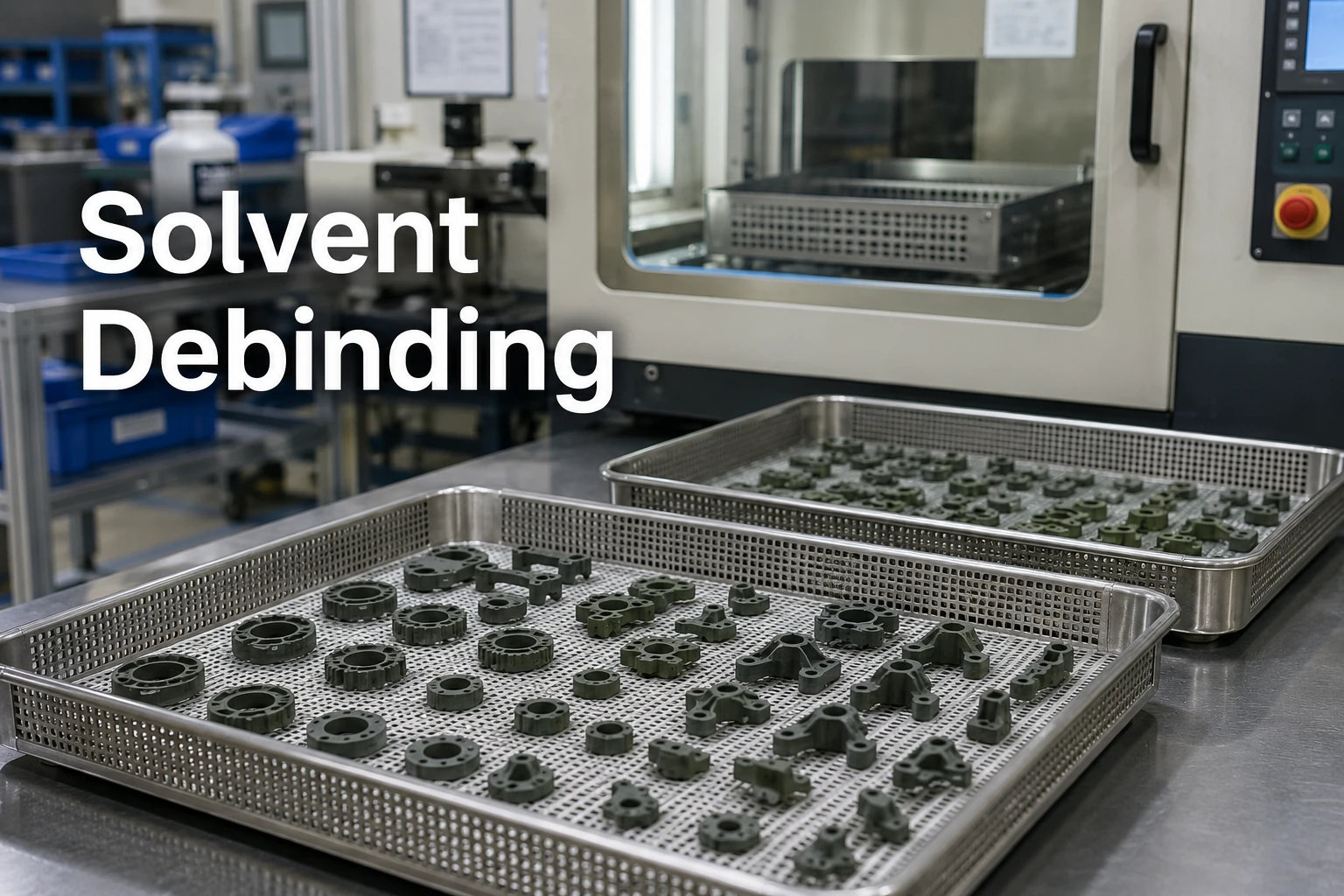
Solvent debinding is a first-stage binder extraction method used after MIM injection molding. It applies only when the feedstock contains a solvent-soluble binder phase. The soluble phase is extracted to create pore channels, while a backbone binder remains to preserve the powder structure for drying, handling, later thermal removal, and sintering. Unlike the parent MIM debinding page, this page does not compare every debinding route in depth; it focuses on solvent extraction, drying behavior, brown-part stability, and the geometry conditions that make this route more or less reliable.
Why solvent debinding is not just a cleaning step
A common mistake is to imagine solvent debinding as washing oil or contamination from the surface. That is not correct. The binder is distributed throughout the molded green part. Solvent debinding must extract a removable binder phase from inside the part without destroying the shape, collapsing thin features, or creating internal stress.
The challenge is that extraction does not happen instantly or uniformly in every geometry. Solvent must reach the binder phase, the dissolved binder must move out through the part, and the remaining structure must stay strong enough for handling.
What changes from green part to solvent-debound part
After solvent debinding, the part is no longer a fully bound green part. It becomes more porous and more fragile. The soluble binder phase has been removed to create pathways for later binder removal.
From a design review perspective, this transition is important because the part may look unchanged externally, but its internal condition has changed significantly. Brown part strength, drying condition, support method, and handling discipline all affect whether the part survives the next process stage.
Why a remaining backbone binder is still needed
Solvent debinding normally does not remove all binder. A remaining backbone binder is needed to hold the metal powder structure together before final binder removal and sintering. If too much binder is removed too aggressively, the part may lose shape stability. If too little is removed, later heating can generate internal pressure, blistering, residual carbon risk, or cracking.

Where Solvent Debinding Fits in the MIM Process Chain
Solvent debinding should be reviewed as one stage within the complete MIM debinding process, not as an isolated bath operation. Feedstock selection and green-part quality determine how extraction begins; drying and brown-part handling determine whether the part can safely enter later thermal binder removal and sintering.

From feedstock selection to injection molding
The solvent debinding route starts long before the part enters a solvent bath. It starts with the MIM feedstock. Powder loading, binder formulation, flow behavior, green strength, and injection molding stability all affect how the green part responds during debinding.
If the molded part contains internal voids, weld-line weakness, short shot areas, excessive molded-in stress, or uneven packing, those problems may become more visible during solvent extraction or drying.
From solvent extraction to drying and sintering preparation
During solvent extraction, the soluble binder phase is removed gradually. After extraction, drying becomes a critical control point. Trapped solvent, uneven drying, or rapid surface drying can create stress between the surface and interior of the part.
A solvent-debound part still needs later binder removal and MIM sintering preparation. The open pore network created during debinding helps the remaining binder escape during thermal processing.
When Is Solvent Debinding Suitable for MIM Parts?
Solvent debinding is suitable when the feedstock is designed with a removable soluble binder phase and the part geometry allows controlled extraction and drying. The decision should not be based only on the metal alloy name. Two parts made from the same MIM material may behave differently if their wall thickness, enclosed features, support conditions, or critical dimensions are different.
Feedstock and binder compatibility
The first question is whether the binder system is compatible with solvent extraction. If the feedstock is not designed for solvent debinding, forcing a solvent route can cause swelling, incomplete binder removal, surface attack, or poor brown part strength.
Before tooling, the real question is not “Can this metal be solvent debound?” but “Is this feedstock and binder system designed for this debinding route, and can this geometry be extracted and dried without unacceptable risk?”
Solvent chemistry, extraction time, temperature, and acceptable mass-loss trend should be confirmed through the selected feedstock system and the supplier’s validated process route. They should not be copied from a generic article or applied across different binder systems without process review.
Part geometry and wall thickness considerations
Solvent debinding becomes more difficult when the part has thick sections, sudden wall transitions, long extraction paths, blind holes, deep slots, or enclosed pockets. These features can slow binder extraction, trap solvent, or create uneven drying.
Thin ribs and micro features create a different risk. They may extract more quickly, but they can also become fragile after binder removal. A part can fail not because the solvent process is wrong, but because the geometry was not reviewed for brown part strength.
| Factor | More Suitable | Higher Risk |
|---|---|---|
| Binder system | Designed with removable soluble binder phase | Binder not intended for solvent extraction |
| Wall thickness | Moderate and relatively consistent | Thick sections or sudden thickness transitions |
| Geometry | Open access and stable support | Blind holes, deep slots, enclosed pockets |
| Feature strength | Robust enough after partial binder removal | Thin ribs, fragile posts, unsupported micro features |
| Drying path | Easy solvent release and uniform drying | Trapped solvent or uneven drying |
| Inspection need | Brown part check can be defined | Defect may remain hidden until later heating |
When solvent debinding should be questioned
Solvent debinding should be reviewed carefully when the binder system is unknown, the part has blocked extraction paths, the wall thickness is highly uneven, or the supplier cannot explain how brown part strength and drying are controlled. In those cases, the safer engineering step is to review the drawing, feedstock route, and process handoff before committing to tooling or production planning.
How Binder System Affects Solvent Debinding Results
The binder system controls whether solvent debinding can be used, how extraction progresses, and how strong the brown part remains after soluble binder removal. This page focuses on the solvent debinding effect; detailed binder chemistry and feedstock formulation belong to the MIM binder system discussion.
Soluble binder phase vs backbone binder
Many MIM binder systems include phases with different roles. The removable soluble phase helps create porosity during solvent debinding. The backbone binder helps maintain shape until later removal.
If the soluble phase is removed too unevenly, the part can develop internal gradients. If the backbone binder is insufficient or damaged, the part may deform or crack during handling.
Why binder compatibility affects extraction speed and brown part strength
Binder compatibility affects how fast the binder dissolves, how the dissolved binder moves through the part, and whether the part swells or loses dimensional stability. A solvent that works for one binder system may be unsuitable for another.
In practice, extraction speed is not always the main target. Stable and repeatable extraction is more important than aggressive binder removal. A fast process that creates cracks, swelling, or weak brown parts is not a stable production route.
What buyers should not assume from material name alone
Buyers sometimes assume that a material such as 316L, 17-4PH, or low-alloy steel determines the debinding route. This is incomplete. The metal material matters, but the feedstock supplier, binder system, powder loading, part geometry, and supplier process window also matter.
Solvent Debinding vs Thermal Debinding vs Catalytic Debinding
Solvent debinding is one of several MIM binder-removal routes. This short comparison only clarifies the selection boundary. For the complete relationship among solvent, thermal, catalytic, and aqueous routes, use the MIM debinding process guide. The correct method depends on binder chemistry, geometry, extraction or decomposition path, process control, safety, and production requirements—not on alloy name alone.
| Method | Main Role | Typical Strength | Main Risk |
|---|---|---|---|
| Solvent debinding | Removes a soluble binder phase | Creates pore channels before later heating | Swelling, cracking, incomplete extraction, drying defects |
| Thermal debinding | Removes binder through controlled heating | Broadly applicable depending on binder system | Cracking, blistering, residual binder, long cycle risk |
| Catalytic debinding | Removes specific binder systems through chemical reaction | Efficient for compatible feedstock systems | Feedstock-specific and process-specific controls required |
How method selection affects risk, not only cost
The lowest-cost or fastest debinding route is not always the safest route. A better question is: which route gives the part enough brown strength, stable extraction, controllable drying, and safe preparation for sintering? Method selection should be reviewed together with part geometry, expected production volume, inspection requirements, and tolerance sensitivity.
Part Geometry Risks During Solvent Debinding
Part geometry is one of the strongest risk drivers in solvent debinding. Two MIM parts using similar feedstock can behave differently because extraction and drying depend on wall thickness, feature access, support, and internal stress.

Thick sections and uneven wall thickness
Thick areas create longer extraction paths. If the surface region loses binder faster than the interior, internal stress can develop. Sudden thickness transitions can also create non-uniform shrinkage and stress during later processing.
From a DFM perspective, thick sections should be reviewed before tooling. The supplier should evaluate whether the wall thickness is suitable for the selected feedstock and debinding route.
Blind holes, deep slots, and trapped solvent paths
Blind holes and deep slots may restrict solvent movement and slow drying. If solvent remains trapped, later heating may cause blistering or cracking. Enclosed pockets are especially risky because they can hide incomplete extraction or drying problems.
Thin walls, fragile ribs, and unsupported features
Thin walls and ribs may debind quickly, but they can become fragile after soluble binder removal. A thin feature that survives injection molding may still fail during brown part handling if it lacks support or if the tray loading method is poor.
Why green part defects can become debinding defects
Debinding does not create every defect from nothing. Sometimes it reveals defects that started during injection molding. Internal voids, weld-line weakness, short shots, excessive molded-in stress, or poor gate-related filling can become cracks or deformation during extraction and drying.
Process Control Points That Affect Brown Part Quality
A supplier’s solvent debinding capability should be evaluated by its process controls, not by a simple statement that “we do debinding.” The key issue is whether the supplier can control extraction, drying, support, inspection, and handoff to the next process stage.

| Control Point | Why It Matters | Risk If Poorly Controlled |
|---|---|---|
| Solvent compatibility | Determines whether the soluble binder phase can be removed safely | Incomplete extraction, swelling, or surface damage |
| Bath condition | Affects extraction consistency across batches | Batch-to-batch variation |
| Time and temperature | Controls extraction rate and internal gradient | Surface damage, internal residue, cracking |
| Part spacing | Allows solvent access around each part | Uneven debinding |
| Support method | Maintains shape during fragile brown stage | Deformation or feature collapse |
| Drying control | Removes solvent before later heating | Cracking, blistering, residual defects |
| Weight loss trend | Helps confirm extraction progress | Hidden binder variation |
| Visual and handling check | Identifies damage before thermal stage | Defects carried into sintering |
Practical brown part handoff checks
Before a solvent-debound part moves to later thermal removal or sintering preparation, the team should confirm whether extraction progress is consistent, whether drying is complete enough for the next stage, whether the part can be handled without feature damage, and whether any cracking, swelling, deformation, or surface abnormality has already appeared.
A practical handoff review should combine visual condition, handling feedback, tray support, drying status, and any defined weight-loss trend. Questionable parts should be held for engineering review before thermal processing instead of being passed forward only because the surface looks acceptable.
- Check whether weight-loss trend and visual condition are consistent with the process plan.
- Review thick sections, blind features, and deep slots for incomplete drying risk.
- Confirm tray support and spacing for fragile brown parts.
- Hold questionable parts for engineering review before thermal processing.
Common Solvent Debinding Defects and Root Causes
Solvent debinding defects are often linked to feedstock compatibility, geometry, extraction rate, drying, and handling. The corrective action should address the real system cause, not only the visible symptom.
| Defect | Possible Cause | Engineering Prevention |
|---|---|---|
| Cracking | Fast extraction, uneven drying, weak green part | Review binder route, wall thickness, drying control, and green part quality |
| Swelling | Solvent-binder incompatibility or excessive exposure | Confirm feedstock compatibility and process window |
| Deformation | Poor support or fragile brown part | Improve tray support, handling rules, and feature orientation |
| Blistering during later heating | Residual binder or trapped solvent | Improve extraction and drying before thermal stage |
| Incomplete debinding | Thick sections or blocked access | Review extraction path and geometry before tooling |
| Residual carbon risk | Binder not properly removed before sintering | Connect debinding control with thermal removal and sintering review |
Representative Engineering Scenario: Cracking After Drying
This representative scenario combines common solvent-debinding failure mechanisms for engineering explanation. It does not identify a specific customer project, order, or measured production result.
- What problem occurred
- A small MIM component with one thick boss and thin side features developed visible cracks after solvent debinding and drying.
- Why it happened
- The thin areas dried quickly, while the thicker section retained solvent and binder longer. The part developed internal stress during drying.
- What the real system cause was
- The issue was not only drying speed. The real cause was a combination of uneven wall thickness, long extraction path, insufficient geometry review, and weak brown part support.
- How it was corrected
- The geometry was reviewed for wall transition, tray support was improved, and the debinding/drying sequence was adjusted within the supplier’s validated process window.
- How to prevent recurrence
- Review thick-to-thin transitions before tooling and confirm whether solvent extraction and drying can remain stable for the selected feedstock and geometry.
Representative Engineering Scenario: Blistering During Later Heating
This representative scenario combines common solvent-debinding failure mechanisms for engineering explanation. It does not identify a specific customer project, order, or measured production result.
- What problem occurred
- A part looked acceptable after solvent debinding but developed blister-like defects during later thermal processing.
- Why it happened
- Solvent extraction and drying were incomplete in deep features. Residual binder or trapped solvent created pressure during heating.
- What the real system cause was
- The supplier checked the part surface but did not adequately evaluate hidden extraction paths and drying risk.
- How it was corrected
- The part was reviewed for blind feature access, drying verification was improved, and the handoff criteria before thermal processing were tightened.
- How to prevent recurrence
- Do not rely only on surface appearance. Review blind holes, slots, pockets, and drying-sensitive features during DFM and process planning.
How Solvent Debinding Influences Sintering Preparation
Solvent debinding does not produce the final metal part. It prepares the part for later binder removal and sintering. If this preparation is poor, sintering may amplify the defect rather than correct it.
Why open porosity helps later binder removal
The pore channels created during solvent debinding allow the remaining binder to escape more safely during later heating. Without adequate pore formation, internal gases or decomposition products may become trapped.
Why debinding problems cannot be fully fixed by sintering
A common production misunderstanding is that sintering can “heal” earlier debinding problems. It cannot reliably fix cracks, severe distortion, residual binder problems, or internal defects created before the furnace stage.
How poor debinding can affect shrinkage, distortion, and surface condition
Poor debinding can influence shrinkage consistency, distortion risk, surface condition, and final inspection results. However, full shrinkage control and distortion analysis belong to the sintering stage, not the solvent debinding page.
What Buyers Should Ask a MIM Supplier About Solvent Debinding
For sourcing teams, solvent debinding is not just a technical detail. It is a supplier evaluation topic. A capable supplier should be able to explain how part geometry, feedstock, binder system, brown part handling, drying, and sintering preparation are reviewed before production risk becomes visible.
Questions about feedstock and binder route
- Is the selected feedstock designed for solvent debinding?
- Which binder phase is expected to be removed first?
- How is brown part strength maintained after extraction?
- Does the feedstock route change with material or part geometry?
Questions about geometry risk review
- Are thick sections, blind holes, deep slots, or enclosed pockets risky for this debinding route?
- Does the part need support during solvent debinding or drying?
- Are thin ribs, small posts, or micro features fragile after extraction?
- Should any feature be modified before tooling?
Questions about brown part inspection and drying
- How do you check whether extraction is sufficient?
- How do you control drying before thermal removal or sintering?
- What happens if the part shows cracking, swelling, or deformation after solvent debinding?
- How are fragile brown parts handled between process stages?
Questions about how debinding links to sintering quality
- How does debinding control affect sintering preparation?
- Can residual binder or trapped solvent cause later blistering or distortion?
- How are debinding findings communicated to sintering and inspection teams?
Drawing Review Checklist for Solvent Debinding Risk
Before tooling or production planning, buyers should provide enough information for the supplier to review debinding risk. A simple material name is not enough.
| Information to Provide | Why It Helps |
|---|---|
| 2D drawing and 3D CAD | Allows geometry, wall thickness, and feature access review |
| Material requirement | Helps evaluate feedstock and binder route |
| Critical dimensions | Identifies features sensitive to distortion or shrinkage |
| Wall thickness and blind features | Helps evaluate extraction and drying risk |
| Surface requirement | Identifies later handling or finishing concerns |
| Estimated annual volume | Helps judge production route, tooling value, tray loading strategy, batch consistency, and process validation effort |
| Application background | Helps evaluate mechanical, corrosion, magnetic, or inspection needs |
When to request engineering review before tooling
Request engineering review before tooling if the part has thick sections, uneven wall transitions, blind holes, deep slots, enclosed pockets, thin ribs, micro features, or high cosmetic and dimensional requirements. These features do not automatically make MIM impossible, but they do require process review.
- Confirm whether the feedstock and binder route are suitable.
- Review whether solvent extraction can reach critical areas.
- Check whether drying may create cracks or trapped solvent.
- Confirm whether brown part handling needs support.
- Review whether sintering shrinkage or distortion risk should be considered together.
- Identify whether a design adjustment could reduce production risk before tooling.
Send Your Drawing for Debinding and Sintering Risk Review
If your MIM part has thick sections, blind holes, deep slots, thin ribs, micro features, tight dimensions, or cosmetic surface requirements, request an engineering review before tooling. Send your 2D drawing, 3D CAD file, material requirement, critical tolerances, surface requirement, estimated annual volume, and application background.
XTMIM can review whether the part geometry, feedstock direction, debinding route, brown part handling, drying risk, and sintering preparation need attention before production planning. The goal is not to promise a universal process route, but to identify avoidable cracking, deformation, residual binder, and sintering-related risks early.
FAQ About MIM Solvent Debinding
Is solvent debinding required for every MIM part?
No. Solvent debinding depends on the feedstock and binder system. Some MIM routes use solvent debinding as a first-stage binder removal process, while others may rely on thermal or catalytic debinding. The correct route should be confirmed through feedstock selection, part geometry, and supplier process review.
What is removed during solvent debinding?
Solvent debinding removes the soluble binder phase from the molded green part. It usually does not remove all binder. A remaining backbone binder helps the part keep its shape before later thermal removal and sintering.
Is a solvent-debound part ready for sintering?
Not always. A solvent-debound part is usually a brown or partially debound part that still needs later binder removal and sintering preparation. The exact sequence depends on the binder system and supplier process route.
Can solvent debinding cause cracks or swelling?
Yes. Cracking, swelling, deformation, or surface damage can occur if the solvent is not compatible with the binder system, extraction is too aggressive, drying is uneven, or the part geometry creates long or blocked extraction paths.
How does wall thickness affect solvent debinding?
Thicker sections increase the extraction path and can make binder removal and drying less uniform. Sudden wall thickness changes can also create stress during extraction, drying, and later thermal processing. Wall thickness should be reviewed before tooling.
What should a supplier confirm before using solvent debinding?
A supplier should confirm that the feedstock is designed for solvent debinding, the part geometry has a workable extraction and drying path, brown part handling is controlled, and the handoff to thermal removal or sintering preparation is defined. The supplier should also explain how questionable parts are reviewed before moving forward.
What information should I send for solvent debinding risk review?
Send 2D drawings, 3D CAD files, material requirements, critical tolerances, wall thickness details, surface requirements, estimated annual volume, and application background. These inputs help the supplier review binder route, geometry risk, drying sensitivity, and sintering preparation.
Should buyers ask suppliers about debinding during RFQ?
Yes. Debinding affects brown part quality, later sintering stability, and defect risk. Buyers should ask how the supplier reviews feedstock compatibility, geometry risk, drying control, brown part handling, and defect prevention before production.
Standards and Technical References
Solvent debinding is a process-specific topic, so standards should be used carefully. Material standards and association resources can support material specification, MIM process understanding, and buyer-supplier communication, but they do not define a universal solvent chemistry, extraction time, drying condition, mass-loss trend, or process window for every feedstock and geometry.
- MIMA Process Overview — relevant for understanding where first-stage binder removal fits within the MIM process and why the debinding method depends on the feedstock route.
- EPMA Metal Injection Moulding Overview — relevant for MIM process context, brown part porosity, shrinkage sensitivity, and the need to control shape before sintering.
- ASTM B883 — relevant for ferrous MIM material specification and buyer-supplier material communication, not for selecting solvent debinding parameters.
- ISO 22068:2012 — relevant for chemical, mechanical, and physical requirements of sintered MIM materials, not for replacing project-level process review.
- MPIF Standard 35-MIM — relevant for common MIM material standards, explanatory notes, and definitions used in technical communication.