MIM Process · Post-Sintering Engineering Review
Quick Answer
Hot isostatic pressing, or HIP, uses elevated temperature together with isostatic gas pressure to reduce internal porosity and increase the density of a metallic component. For a metal injection molded part, HIP should normally be considered as an optional post-sintering operation, not as a mandatory stage in every MIM production route. The primary MIM densification step still occurs during sintering; HIP becomes relevant when the final density, internal pore condition, mechanical-property requirement, polishing response, or another performance criterion justifies an additional densification step.
The useful engineering question is not simply, “Can this MIM part be HIPed?” A better question is: What requirement cannot be satisfied reliably in the as-sintered condition, and will HIP actually address that requirement?
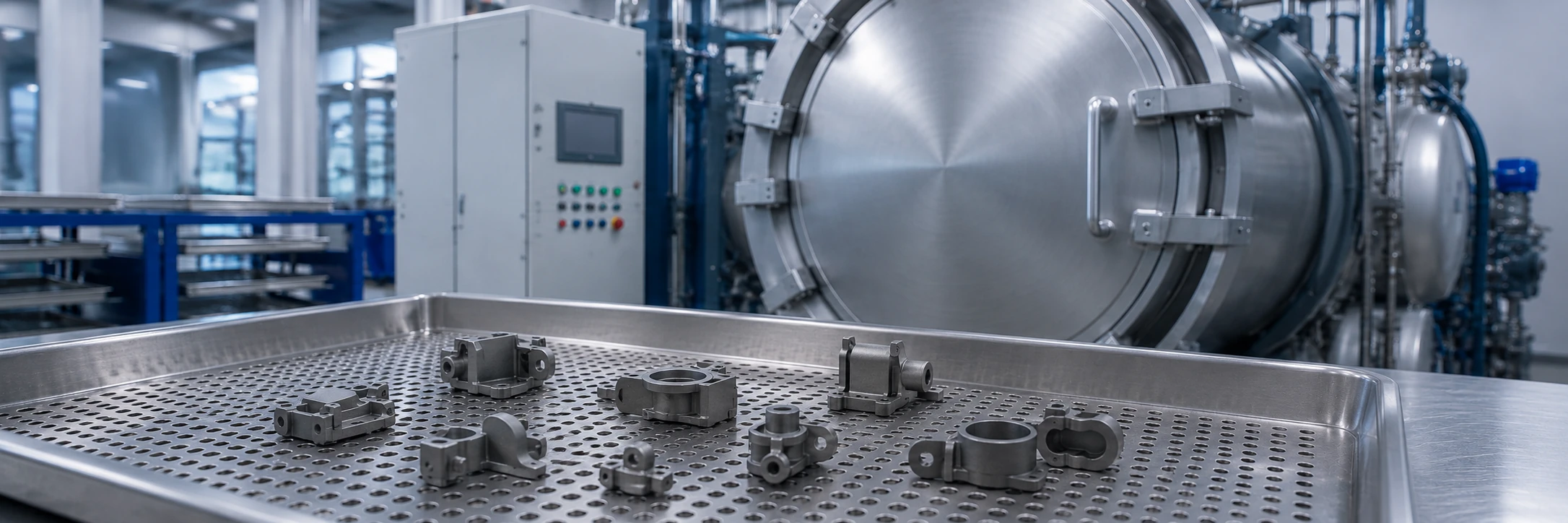
Image note: This is a representative HIP process illustration for engineering context; the pressure-vessel equipment shown does not depict XTMIM in-house HIP equipment.
What Is Hot Isostatic Pressing?
Hot isostatic pressing combines heat and gas pressure inside a pressure vessel. Unlike a mechanical press that loads a component mainly from defined contact directions, the pressurized gas applies pressure around the exposed part surfaces. At an appropriate temperature, the material can respond through creep, plastic deformation, and diffusion mechanisms, allowing suitable internal pores to shrink or close.
The Metal Powder Industries Federation (MPIF) describes elevated temperature and isostatic gas pressure as the two basic elements of HIP and identifies porosity reduction and increased density as central purposes of the process. HIP is used across several metal-processing routes, including powder metallurgy applications.
How Heat and Isostatic Gas Pressure Work
Pressure alone is not the whole mechanism. Elevated temperature lowers the material’s resistance to deformation and activates diffusion mechanisms, while the applied pressure supplies a driving force against internal void surfaces.
For a MIM project, the exact response depends on:
- alloy system;
- starting density;
- pore morphology;
- whether pores are isolated or connected to the exterior;
- part geometry;
- thermal and pressure cycle;
- previous sintering condition; and
- required final material condition.
This is one reason a HIP requirement should not be copied from another component or another alloy without checking whether the same engineering need exists.
How HIP Reduces Internal Porosity
A useful simplified sequence is: sintered material with isolated internal pores → elevated temperature and gas pressure → pore contraction and bonding of opposing internal surfaces → increased density.
The important term is internal. A pore that is sealed inside the metallic structure behaves differently from a pore or passage that remains connected to the external surface. That distinction becomes critical when deciding whether HIP is an appropriate performance-enhancement route.
Where Does HIP Fit in the MIM Process?
MIM produces the component shape before HIP is considered. The normal route first includes feedstock molding, green-part handling, debinding, and MIM sintering. Sintering performs the major metallurgical bonding and dimensional shrinkage that convert the debound part into a dense metallic component.
HIP is therefore best viewed as a post-sintering engineering decision. It belongs within the wider MIM secondary operations review rather than replacing the core MIM sintering stage.

Sintering Comes Before HIP
During normal MIM sintering, the component already undergoes substantial densification. The process must therefore first be capable of producing an acceptable as-sintered part.
Before HIP is specified, the project team should ask:
- Is the actual as-sintered density insufficient?
- Is internal porosity controlling a required property?
- Is the required property achievable through material or sintering optimization instead?
- Is a dimensional problem being mistaken for a density problem?
- Is the customer specification explicitly calling for HIP?
- Is HIP only being considered as one possible route to a final property target?
If the as-sintered component already meets the drawing and property requirements, an additional HIP cycle may add processing cost and validation work without creating meaningful project value.
MIM Sintering vs HIP
| Engineering Item | MIM Sintering | HIP |
|---|---|---|
| Role | Core MIM manufacturing stage | Optional secondary densification route |
| Main function | Metallurgical bonding, densification, and final MIM shrinkage | Further reduction of suitable internal porosity |
| Required for a conventional MIM part | Yes | No |
| Main dimensional concern | Major predictable sintering shrinkage and distortion | Additional dimensional response still requires review |
| Selection basis | Fundamental production route | Final performance and pore-condition requirement |
| Cost position | Core process cost | Additional post-sintering cost |
What Does HIP Do to a Sintered MIM Part?
The most direct function of HIP is additional densification through reduction of suitable internal porosity. Greater density may then influence other properties, but those downstream effects should not be presented as universal guarantees.
Further Densification
If a sintered component contains suitable isolated internal pores, HIP can reduce that residual pore population. For an engineer, however, density should not be treated as an isolated marketing number. The project should define why additional density matters.
- fatigue-sensitive loading;
- fracture-sensitive behavior;
- sealing or pressure-related requirements;
- local material removal that may expose subsurface pores;
- demanding polishing;
- a customer-specified density requirement; or
- another property demonstrably affected by residual porosity.
Potential Mechanical-Property Effects
Reducing internal porosity can potentially improve the effective load-bearing cross-section and reduce pore-related stress concentrators. This can be relevant to fatigue, ductility, or other mechanical performance depending on the alloy and starting condition.
What HIP Does Not Automatically Improve
HIP is not a universal finishing process. It does not automatically solve:
- a bore that needs a tighter final tolerance;
- a thread that needs machining;
- a datum face that needs controlled material removal;
- a flatness requirement that is better handled by sizing;
- a hardness target that actually requires material-specific heat treatment;
- surface roughness that requires polishing or finishing;
- coating appearance; or
- a geometric distortion caused by poor design or sintering support.
Which Types of Porosity Can HIP Address?
This is one of the most important limitations to understand before specifying HIP. The pressure applied during HIP acts through the external gas environment. A pore that is fully enclosed inside the material can experience an effective pressure differential across its surrounding material. A pore that remains directly connected to the outside atmosphere does not behave in the same way.

Engineering takeaway: HIP is most relevant to suitable isolated internal porosity; pore condition and connectivity should be verified rather than assumed.
Internal Closed Porosity
Internal closed pores are the primary type of porosity that makes HIP technically relevant. Before a project team assumes HIP will solve a density or pore-related requirement, it should determine whether the pore population is sufficiently isolated from the external surface.
Surface-Connected Porosity
Surface-connected porosity is fundamentally different. If a pore has a continuous route to the exterior, external pressurized gas can communicate with that pore. The expected pressure differential needed to collapse it may therefore not develop in the same way as for a sealed internal pore.
As a cross-process supporting reference only, ASTM B998-17(2024) distinguishes internal non-surface-connected porosity from surface-connected porosity in aluminum alloy castings. That distinction is useful for explaining pore connectivity, but ASTM B998 is not a MIM or MIM-HIP processing specification and should not be used to define a HIP cycle for a MIM part.
Why Pore Condition Matters Before HIP
| Pore / Condition | HIP Relevance | Engineering Review |
|---|---|---|
| Isolated internal pore | High potential relevance | Review material, pore size/distribution, and required final properties. |
| Surface-connected porosity | Low / limited direct relevance | Determine the root cause and whether another process change is required. |
| Inclusion | HIP is not a general removal method | Identify contamination or material-control root cause. |
| Geometric void caused by molding defect | Do not assume HIP is the solution | Return to molding, tooling, or process review. |
| Distortion without meaningful porosity problem | Usually not a HIP problem | Review sintering, support, sizing, or machining. |
HIP should address the correct defect mechanism rather than being added after the fact as a generic corrective operation.
When Should—and Shouldn’t—a MIM Part Use HIP?
The best HIP decision starts from the final requirement, not from the process name. A practical review separates three questions: Is HIP mandatory in the specification? If not, is residual internal porosity actually limiting the required performance? And if porosity is the issue, is the pore condition suitable for HIP without creating an unacceptable dimensional, material, or downstream-processing trade-off?

Engineering takeaway: Specify HIP because a defined density, porosity, or performance requirement requires it—not because it is perceived as a premium process.
Conditions That Can Justify HIP
HIP becomes more relevant when:
- the required final density exceeds what the selected conventional route is expected to provide consistently;
- internal residual porosity is known to influence a critical performance requirement;
- fatigue-sensitive or structurally demanding behavior makes internal pore control important;
- substantial polishing or material removal may make subsurface porosity significant;
- a customer drawing or technical specification explicitly requires HIP; or
- a material-specific validation program identifies HIP as part of the required final condition.
When Standard MIM Sintering Is Enough
Automatic use of HIP is unnecessary for a standard MIM part. If properly controlled sintering already satisfies density, mechanical properties, dimensions, surface requirements, inspection criteria, and expected service conditions, the additional HIP step may add cost and validation work without a clear engineering benefit.
When HIP Adds Cost Without Solving the Actual Requirement
| Actual Requirement | HIP Fit | Better First Review |
|---|---|---|
| Residual internal porosity affects final performance | Potentially strong | HIP feasibility |
| Hardness target | Depends | Material plus heat treatment |
| Tight bore tolerance | Weak | Post-sintering machining |
| Flatness / profile correction | Weak | Sizing / calibration review |
| Cosmetic finish | Weak | Surface finishing review |
| Thread accuracy | Weak | Machining / tapping |
| Sintering distortion | Usually indirect | Design, support, and sintering control |
| Surface-connected pore / opening | Limited | Root-cause process review |
| As-sintered part already meets specification | Usually unnecessary | Keep the process route as simple as practical |
Representative Engineering Scenario
Consider a small structural MIM component that meets dimensional requirements after sintering but is being reviewed for a more fatigue-sensitive service condition. The key question is whether residual internal porosity is actually limiting the required performance.
| Review Step | Engineering Question | Recommended Handling |
|---|---|---|
| Problem | Higher fatigue demand is being added to an existing MIM route. | Define the final performance and acceptance requirement before selecting another process. |
| Possible cause | Residual internal porosity may be contributing to stress concentration, but this has not yet been demonstrated. | Review as-sintered density, pore condition, material state, and available inspection evidence. |
| Handling | If suitable internal porosity is the actual limiting factor, HIP may be technically relevant. | Evaluate the HIP route together with dimensional response, heat treatment, machining, and verification requirements. |
| Prevention | A blanket “HIP required” note can lock the project into cost without proving value. | Use a performance-based requirement where the specification allows it, and define how acceptance will be verified. |
This type of review helps separate a genuine densification requirement from a material-selection, heat-treatment, dimensional, or inspection problem that should be solved elsewhere in the route.
HIP vs Other MIM Secondary Operations
A MIM component may require several post-sintering operations, but each process should have a clear function. HIP, heat treatment, sizing, and machining should not be treated as interchangeable.
HIP vs Heat Treatment
HIP focuses primarily on densification and internal pore reduction. Heat treatment primarily changes the material condition or microstructure to obtain required properties such as hardness, strength, wear response, or other material-specific behavior.
The two may appear in the same production route, but the requirement for one does not automatically create a requirement for the other.
HIP vs Sizing
MIM sizing and calibration are primarily dimensional operations. If a component requires improved flatness, local dimensional correction, roundness correction, profile stabilization, or assembly fit adjustment, sizing may be the more relevant operation.
A need for tighter dimensions alone is better handled as a dimensional-control problem rather than as a reason to add HIP.
HIP vs Post-Sintering Machining
Machining is used when selected features require controlled material removal. Typical examples include functional bores, threads, datum faces, sealing surfaces, and precision mating features. HIP can change the material condition before machining, but it cannot replace the cutting operation when the final dimension itself must be generated by machining.
| Requirement | Most Relevant First Route |
|---|---|
| Internal closed porosity / further densification | HIP |
| Hardness / material condition | Heat treatment |
| Flatness / dimensional calibration | Sizing |
| Bore / thread / datum accuracy | Machining |
| Appearance / roughness / coating preparation | Surface finishing |
| General MIM density and shrinkage | Sintering process control |
Material and Part Considerations for HIP
Material response to HIP is alloy- and condition-dependent. A cycle that is appropriate for one alloy should not be copied directly to another material without reviewing temperature sensitivity, phase condition, grain response, the starting sintered condition, and the required final properties.
Material Response
For MIM projects using stainless steels, low-alloy steels, titanium alloys, or other higher-performance alloys, the engineering team should confirm:
- starting sintered density;
- material specification;
- required final mechanical condition;
- whether separate heat treatment follows HIP;
- whether HIP temperature affects the intended microstructure;
- whether grain growth or other thermal effects are relevant; and
- what post-HIP testing will confirm acceptance.
Exact HIP temperature, pressure, hold time, cooling strategy, final density, and property response should therefore be established from material-specific process data and the applicable project specification rather than generalized across all MIM alloys.
Geometry and Dimensional Considerations
Uniform gas pressure does not make dimensional response geometry-independent. Critical dimensions should be reviewed against the part's starting density, geometry, material condition, expected additional densification, downstream heat treatment, and any machining allowance after HIP. Dimensional change should be treated as a validation item rather than assumed to be negligible or automatically beneficial.
Post-HIP Processing Requirements
The route after HIP may include:
- heat treatment;
- sizing;
- machining;
- polishing;
- surface finishing;
- dimensional inspection;
- density verification; and
- metallography or other material evaluation when required.
This sequence should be defined before production so that HIP does not create an unexpected conflict with subsequent operations.
Engineering Risks, Control Points and Inspection After HIP
Adding HIP introduces an additional thermal and pressure cycle, so the decision should include both the expected densification benefit and the controls needed to protect material condition, critical dimensions, and downstream processing.
Dimensional Change and Distortion
Dimensional response after HIP is project-specific. Additional densification, alloy response, part geometry, and the selected thermal-pressure cycle can all affect the final result. If the underlying issue is warpage or deformation created during the core sintering stage, review MIM sintering distortion separately rather than treating HIP as the primary corrective route. Critical dimensions should therefore be identified before the route is finalized and verified at the stage where the part reaches its final material condition.
- Which dimensions must be controlled after HIP?
- Will machining occur before or after HIP?
- Is sufficient machining allowance available?
- Does the part contain thin unsupported features?
- Will final sizing be required?
- At which stage should final dimensional inspection take place?
Material and Process Response
HIP affects more than a density value. Temperature, pressure, time, and cooling history can interact with the alloy's final material condition, so the HIP cycle and any downstream heat-treatment route should be reviewed as one process sequence.
A drawing note of “HIP required” is not, by itself, a complete acceptance definition; the final material condition and the method used to verify it should also be clear.
Inspection Before and After HIP
The inspection plan should follow the reason HIP was selected. If HIP is intended to reduce internal porosity, the project team should determine how that condition will be verified and align the acceptance plan with the relevant MIM inspection and testing methods.
Depending on the specification and application, the review may include:
- density measurement;
- metallographic evaluation;
- dimensional inspection;
- mechanical testing;
- nondestructive examination when specified; and
- surface inspection after machining or polishing.
The method should be selected according to the actual acceptance requirement rather than added as a generic inspection package.
| Requirement Being Controlled | Possible Verification Route | Engineering Note |
|---|---|---|
| Final density | Density measurement using the project-specified method | Define the method and acceptance criterion before comparing pre- and post-HIP conditions. |
| Internal pore condition | Metallography or specified nondestructive examination | The method must match the pore size, location, and acceptance logic being controlled. |
| Critical dimensions | Dimensional inspection after the final thermal / sizing / machining sequence | Do not inspect too early if later operations can change the final geometry. |
| Mechanical performance | Specified mechanical test where required | Use a material- and application-relevant test rather than assuming density alone proves performance. |
| Surface exposed by machining or polishing | Surface inspection after the relevant material-removal step | Subsurface pore exposure can become visible only after later processing. |
Cost and Lead-Time Trade-Offs
For XTMIM projects, HIP is separate from the standard in-house MIM route and may require specialist external processing. The added route can affect batch scheduling, transportation, documentation, post-HIP heat treatment, dimensional verification, final inspection, cost, and total lead time.
For sourcing and project review, confirm:
- whether HIP is mandatory or one technical option;
- lot size, annual volume, and external-processing logistics;
- required process records or customer documentation;
- post-HIP heat treatment, sizing, machining, and final inspection; and
- the total lead-time and rework impact of the added route.
What to Review Before Specifying HIP in a MIM RFQ
A useful RFQ defines the required final condition rather than relying only on the process note “HIP required.” It should explain what the final part must achieve and how acceptance will be verified. This distinction matters because a process-mandated requirement should be followed as written, while a performance-based requirement may allow the engineering team to compare HIP with material selection, sintering optimization, heat treatment, sizing, machining, or another route.
Engineering takeaway: Define the final requirement and acceptance method first, then determine whether HIP or another secondary operation is necessary.
| RFQ Information | Why It Matters |
|---|---|
| 2D drawing | Defines dimensions, tolerances, and inspection requirements. |
| 3D model | Supports geometry and manufacturability review. |
| Material grade | Determines sintering, HIP, and heat-treatment compatibility. |
| Required final material condition | Clarifies whether HIP and/or heat treatment are necessary. |
| Density requirement | Establishes whether additional densification needs evaluation. |
| Porosity requirement | Helps distinguish internal-pore control from other quality issues. |
| Mechanical-property requirement | Shows whether residual porosity is performance-critical. |
| Fatigue / cyclic-loading requirement | May increase sensitivity to internal defects. |
| Critical dimensions | Identifies post-HIP sizing or machining needs. |
| Surface requirement | Clarifies whether polishing, finishing, or coating is required. |
| Inspection / acceptance method | Defines how the final requirement will be verified. |
| Annual volume | Affects the economics of the added process route. |
| Customer specification | Confirms whether HIP is mandatory or only one possible manufacturing route. |
Frequently Asked Questions About Hot Isostatic Pressing
What does hot isostatic pressing do to a MIM part?
For a sintered MIM part, HIP can provide additional densification by reducing suitable internal residual porosity. Whether this creates a meaningful improvement depends on the alloy, starting pore condition, geometry, and final performance requirement.
Does every MIM part need HIP?
No. HIP should normally be considered only when the as-sintered condition cannot adequately meet a density, pore-related, mechanical-performance, or specification requirement. If conventional MIM already meets the requirement, adding HIP may be unnecessary.
Can HIP eliminate all porosity in MIM parts?
It should not be described that way. Pore connectivity matters. Internal closed pores are much more relevant to HIP than porosity that remains connected to the exterior, and other defects such as inclusions or molding-related voids require separate root-cause review.
What is the difference between hot and cold isostatic pressing?
Both use pressure applied from multiple directions, but they serve different manufacturing roles. Cold isostatic pressing compacts powder without the elevated-temperature densification mechanism used in HIP. HIP combines heat and gas pressure and can be used for densification of suitable metallic materials or components.
Standards and Technical Reference Note
MPIF is used here as the primary general HIP process reference. ASTM B998 is retained only as cross-process supporting context for pore connectivity; its formal scope is aluminum alloy castings, not MIM, and it is not a MIM HIP processing specification.
Technical References
MPIF supports the general HIP process definition used on this page. ASTM B998 is listed only as secondary cross-process context for pore connectivity. Neither replaces material-specific process development or customer specifications.
- MPIF — Isostatic Pressing — Industry reference for the basic HIP / CIP process concepts, elevated temperature and isostatic pressure, porosity reduction, and density increase.
- ASTM B998-17(2024) — Standard Guide for Hot Isostatic Pressing of Aluminum Alloy Castings — Cross-process supporting reference only for the distinction between internal non-surface-connected and surface-connected porosity; it is not a MIM HIP specification.
Review the Final Requirement Before Adding HIP
HIP is appropriate only when the final drawing or specification establishes a real densification or pore-related need. If your project is considering HIP after MIM sintering, provide the drawing, material, final density or mechanical-property targets, critical dimensions, and inspection requirements so the post-sintering route can be reviewed against the actual acceptance criteria.