MIM Material Comparison
Kovar vs Invar Alloys for MIM Components
Kovar and Invar are both controlled expansion alloys, but they are selected for different engineering reasons in metal injection molding projects. This page helps engineers and sourcing teams compare when Kovar is more relevant for expansion-matching assemblies, when Invar is more relevant for low-expansion dimensional stability, and what must be reviewed before quoting a small complex MIM part.
Quick answer: Choose Kovar when the project needs controlled expansion behavior for glass, ceramic, or package-related assemblies. Choose Invar when the main requirement is low thermal expansion and dimensional stability under temperature change.
- Kovar direction: expansion-matching review for specific mating materials or package-related assemblies.
- Invar direction: low-expansion dimensional stability for precision frames, spacers, carriers, or alignment-related parts.
- MIM review: geometry, wall thickness, shrinkage, distortion, secondary operations, and inspection points must still be checked before tooling.
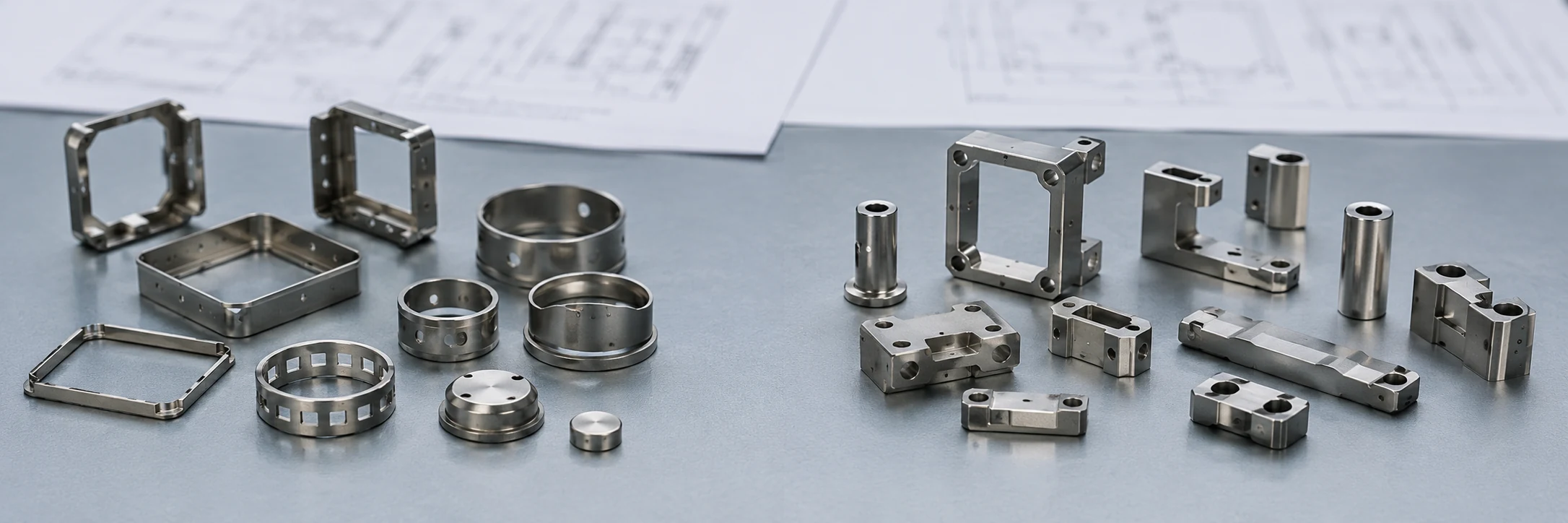
Image disclosure: Representative engineering illustration for Kovar–Invar material selection and MIM review context; not a photograph of a specific XTMIM customer project, production lot, or inspection record.
Kovar and Invar should be compared by assembly function, thermal behavior, geometry, and MIM manufacturability rather than by material name alone.
Kovar vs Invar at a Glance
Kovar and Invar are both controlled expansion alloys, but they solve different engineering problems. Kovar alloys for MIM are generally reviewed when an assembly needs expansion compatibility with glass, ceramic, or another mating material. Invar alloys for MIM are generally reviewed when low thermal expansion and dimensional stability are the primary requirements.
| Comparison Factor | Kovar | Invar | Engineering Meaning |
|---|---|---|---|
| Alloy family | Iron-nickel-cobalt controlled expansion alloy. | Iron-nickel low-expansion alloy. | They are different alloy systems and should not be treated as interchangeable. |
| Primary design goal | Expansion matching with a specific mating material or assembly. | Low dimensional change as temperature varies. | Start with the required function, not the material name. |
| Typical application direction | Glass, ceramic, electronic package, cap, sleeve, or sealing-related interfaces. | Precision frames, spacers, carriers, supports, and alignment-related parts. | The assembly interface usually determines the first material direction. |
| Thermal behavior to validate | Expansion compatibility across the relevant assembly temperature range. | Dimensional stability across the defined operating temperature range. | The required temperature range and test condition must be stated before approval. |
| Common specification direction | Kovar or ASTM F15-type material direction. | Invar 36 or Fe-36Ni-type material direction. | The final grade and acceptance criteria must follow the approved project specification. |
| Main validation risk | Thermal mismatch, interface stress, surface condition, or sealing-related incompatibility. | Assuming low expansion alone will satisfy flatness, datum, or tolerance requirements. | Material behavior and drawing acceptance must be validated together. |
| MIM-specific concern | Feedstock route, density, sintering condition, surface state, and critical interface control. | Shrinkage compensation, distortion, datum control, and critical dimension inspection. | Wrought-alloy data should not be copied directly into MIM part acceptance limits. |
These are screening directions, not final acceptance limits. Exact composition, coefficient of thermal expansion, heat treatment condition, density, and performance requirements should be verified against the approved material specification and the intended temperature range.
Three Questions Before Choosing the Alloy
| Review Question | Why It Matters | What to Provide |
|---|---|---|
| Does the assembly need expansion matching or minimum expansion? | This separates the Kovar direction from the Invar direction. | Mating material, operating temperature range, and functional requirement. |
| Which dimensions or interfaces are critical after sintering? | Critical surfaces may require tooling compensation, dedicated inspection, or secondary control. | 2D drawing, 3D model, datum scheme, tolerances, and inspection method. |
| Can the geometry tolerate the MIM process route? | Thin frames, abrupt transitions, uneven mass, and unsupported features can increase molding and sintering risk. | Wall thickness, cross-sections, annual volume, functional surfaces, and validation plan. |
Carpenter Technology describes Kovar as a low-expansion glass and ceramic sealing alloy and Invar 36 as a nickel-iron alloy used where temperature-related dimensional change must be minimized. These references support the material-selection direction, but project-specific MIM properties and acceptance requirements still need validation. Review Kovar material information and Invar 36 material information.
Material names alone are not enough for a reliable RFQ. The review should connect the thermal function with the mating material, geometry, sintering behavior, critical dimensions, surface condition, and final inspection requirements.
MIM Manufacturing Considerations for Kovar and Invar
Material selection and MIM feasibility are separate decisions. A Kovar or Invar project must be reviewed through feedstock availability, injection molding, green-part handling, debinding, sintering, shrinkage compensation, secondary operations, and final inspection. PIM International includes Invar Fe-36Ni and Kovar / F15 Fe-29Ni-17Co among representative MIM alloy directions and notes that final properties can vary with impurity level, grain size, porosity, and post-sintering condition. Review MIM material options and representative MIM alloy data.
Feedstock and Process Route
Controlled expansion alloys should not be quoted like common stainless steel grades without checking the available feedstock route. Powder supply, binder compatibility, molding behavior, debinding response, sintering condition, and final density can affect whether the project is practical and how validation should be planned.
Molding, Debinding, and Sintering Stability
Thin walls, small holes, sleeves, frames, flanges, and delicate reference features may be suitable for MIM, but the green part must survive ejection and handling before debinding. Uneven wall thickness, abrupt mass transitions, and unsupported features can increase filling, cracking, deformation, or sintering-distortion risk.
Shrinkage and Dimensional Control
Tooling is compensated for expected MIM shrinkage, but final geometry can still be influenced by alloy behavior, density, wall-thickness balance, furnace route, and sintering support. Tight flatness, roundness, alignment, or datum relationships should therefore be identified before tooling and connected to a defined inspection method.
Where thermal behavior is critical, verification should also reflect the final density, sintering or heat-treatment condition, surface state, and agreed test method. Property values from wrought stock or general datasheets should be treated as reference information rather than automatic acceptance limits for a sintered MIM component.
What XTMIM Reviews Before Recommending a Route
| Review Area | Why It Matters | Review Output |
|---|---|---|
| Material function | Confirms whether the project needs expansion matching, low expansion, or another property. | Kovar direction, Invar direction, alternative review, or additional information required. |
| Geometry and wall thickness | Identifies filling, handling, debinding, support, and distortion risks. | DFM notes for wall balance, transitions, support, and critical features. |
| Tolerances and datums | Separates realistic as-sintered control from dimensions that may need secondary operations. | Critical-dimension and inspection recommendations. |
| Validation route | Special-alloy projects may require focused sampling and material verification. | Quotation assumptions, trial priorities, and validation inputs. |

Image disclosure: Representative engineering illustration for Kovar–Invar material selection and MIM review context; not a photograph of a specific XTMIM customer project, production lot, or inspection record.
Controlled expansion alloy selection should be confirmed together with feedstock, geometry, sintering, dimensional control, and final inspection.
Geometry and Tolerance Factors Before Choosing Kovar or Invar
A part may be a reasonable material candidate but a poor MIM candidate if wall thickness is unbalanced, long thin features cannot be supported, or the drawing applies tight tolerances without identifying the dimensions that control function.
Wall Thickness and Distortion Risk
Thin walls, narrow bridges, sharp internal corners, isolated bosses, abrupt transitions, and uneven mass distribution should be reviewed for filling, green strength, debinding flow, and sintering distortion. Long frames, flat covers, and asymmetric parts may also require a defined support strategy.
Critical Surfaces and Secondary Control
Flatness, roundness, parallelism, alignment, and datum-related requirements should be separated from general reference dimensions. MIM can form most of the complex geometry, while machining, sizing, polishing, or finishing can be reserved for the interfaces that truly control assembly function.
This selective-control approach is especially important for controlled expansion parts because a tight drawing requirement may relate to thermal function, assembly contact, or measurement datum rather than every molded surface.
Inspection Priorities Before RFQ
The drawing should state which dimensions, surfaces, and thermal functions require verification after sintering or final processing. Clear acceptance priorities allow the supplier to review tooling compensation, inspection method, secondary operations, cost, and validation risk before quotation.
- Mark functional dimensions, datums, flatness, roundness, and alignment requirements.
- Separate as-sintered features from surfaces that may need secondary control.
- Review thin sections, sharp transitions, unsupported features, and uneven mass.
- State which dimensions relate to expansion matching, dimensional stability, or assembly fit.
- Confirm the inspection method and any machining, polishing, coating, cleaning, or handling requirement.

Image disclosure: Representative engineering illustration for Kovar–Invar material selection and MIM review context; not a photograph of a specific XTMIM customer project, production lot, or inspection record.
Alloy choice should be reviewed together with wall thickness, support strategy, datum structure, critical dimensions, and inspection requirements.
RFQ Information Needed for Kovar or Invar MIM Parts
A useful RFQ should explain both the requested alloy and the engineering reason behind it. This allows the supplier to evaluate material availability, geometry, tolerances, production route, validation scope, and tooling economics instead of quoting from a material name alone.

Image disclosure: Representative engineering illustration for Kovar–Invar material selection and MIM review context; not a photograph of a specific XTMIM customer project, production lot, or inspection record.
Reliable quotation starts with clear drawing data, material function, critical tolerances, application conditions, and validation requirements.
Drawing and Geometry
Send the latest 2D drawing and 3D model with critical dimensions, datum references, tolerances, functional surfaces, wall thickness, and any known issue from the current manufacturing route.
Material and Thermal Function
State whether Kovar, Invar, or both are under review and explain whether the requirement is expansion matching, low expansion, or another property. Include the mating material and operating temperature range where relevant.
Surface, Inspection, and Secondary Operations
Identify interfaces that require machining, sizing, polishing, coating, cleaning, or special inspection. Separating critical from non-critical surfaces helps avoid unnecessary cost and unclear acceptance criteria.
Volume and Validation Plan
Provide prototype quantity, annual volume, production timing, and validation expectations. Tooling and special-alloy development should be justified by the repeat-production requirement and the planned approval route.
- 2D drawing and 3D model.
- Target alloy, approved specification, or candidate material list.
- Reason for choosing Kovar, Invar, or both.
- Mating material, temperature range, and assembly environment.
- Critical dimensions, datums, surface condition, and inspection method.
- Required machining, sizing, finishing, coating, or cleaning.
- Prototype quantity, validation plan, annual volume, and production timing.
- Known issues from CNC, stamping, casting, or previous production.
Representative Engineering Scenario
This representative scenario illustrates a common material-selection review pattern and does not describe a specific customer project.
A small precision frame is specified as “Kovar or Invar” for a temperature-sensitive assembly, but the RFQ does not explain the function. Drawing review shows that one interface needs expansion compatibility with a mating material, while the main frame must maintain stable dimensions during temperature variation.
The review should separate these two requirements before selecting an alloy, then confirm whether the geometry can be supported during sintering and whether critical interfaces need secondary machining or dedicated inspection. This avoids quoting from the material name alone and reduces the risk of selecting the wrong alloy or discovering tolerance and finishing requirements after tooling.
FAQ About Kovar vs Invar Alloys in MIM
Is Kovar the same as Invar?
No. Kovar and Invar are both controlled expansion alloys, but they are used for different design reasons. Kovar is usually reviewed when expansion matching with another material is important. Invar is usually reviewed when low thermal expansion and dimensional stability are the main design goals.
Can Kovar and Invar both be processed by MIM?
They may be considered for MIM projects, but each project needs engineering review. The team should confirm feedstock route, part geometry, debinding and sintering behavior, critical dimensions, and secondary operation requirements before tooling.
When should a MIM project choose Kovar instead of Invar?
Kovar is more likely to be considered when the part needs controlled expansion behavior for a mating material or package-related assembly. The project should still confirm geometry, surface requirements, and validation needs before quotation.
When should a MIM project choose Invar instead of Kovar?
Invar is more likely to be considered when the main requirement is low thermal expansion and dimensional stability. This can matter for precision frames, spacers, carriers, or alignment-related components, but the part still needs MIM feasibility review.
What information is needed before quoting a Kovar or Invar MIM part?
Send a 2D drawing, 3D model, target alloy, application environment, mating material, critical tolerances, surface requirements, inspection points, prototype quantity, and annual volume. If the alloy choice is not final, explain the functional requirement so the engineering team can review both options.
Engineering Review Note
Technical References
The following external references are provided to support material terminology, controlled expansion alloy background, and general MIM material option review. They do not replace project-specific drawing review, customer specifications, material validation, or production approval.
- Carpenter Technology: Kovar Supports Kovar terminology as an iron-nickel-cobalt low expansion glass and ceramic sealing alloy.
- Carpenter Technology: Invar 36 Supports Invar 36 background as a nickel-iron alloy used when dimensional changes due to temperature variation must be minimized.
- PIM International: MIM Material Options and Component Properties Supports the inclusion of specialty ferrous alloys such as Invar and Kovar among MIM material options.
- PIM International: Tensile Properties of Representative MIM Alloys Provides representative MIM alloy data that includes Invar Fe-36Ni and Kovar / F15 Fe-29Ni-17Co, with notes on process-related property variation.
Review Your Kovar or Invar MIM Part Before Tooling
If your project is comparing Kovar and Invar for a small complex MIM component, send the drawing, 3D model, material target, application environment, and critical tolerance notes for engineering review. XTMIM can review whether the part is better suited to a Kovar route, an Invar route, or a different material direction before tooling decisions are made.