
Fe-3%Si is an iron-silicon soft magnetic material direction for compact three-dimensional electromagnetic components such as small cores, armatures, pole pieces, relay parts, yokes and flux guides. It is most relevant when MIM geometry is needed and flat laminations, simple PM pressing or extensive machining are poor fits. Final suitability cannot be determined from the alloy name alone: air gap, density, residual stress, heat treatment, coating, operating condition and the agreed magnetic test method can all affect the finished assembly.
Before tooling or RFQ review, provide the drawing, 3D model, magnetic function, critical magnetic-path features, operating frequency or duty cycle, heat-treatment expectation and acceptance method. Use the soft magnetic MIM materials parent page to compare Fe-3%Si with Fe-50Ni and Fe-50Co, or the MIM materials overview for broader material-family selection.
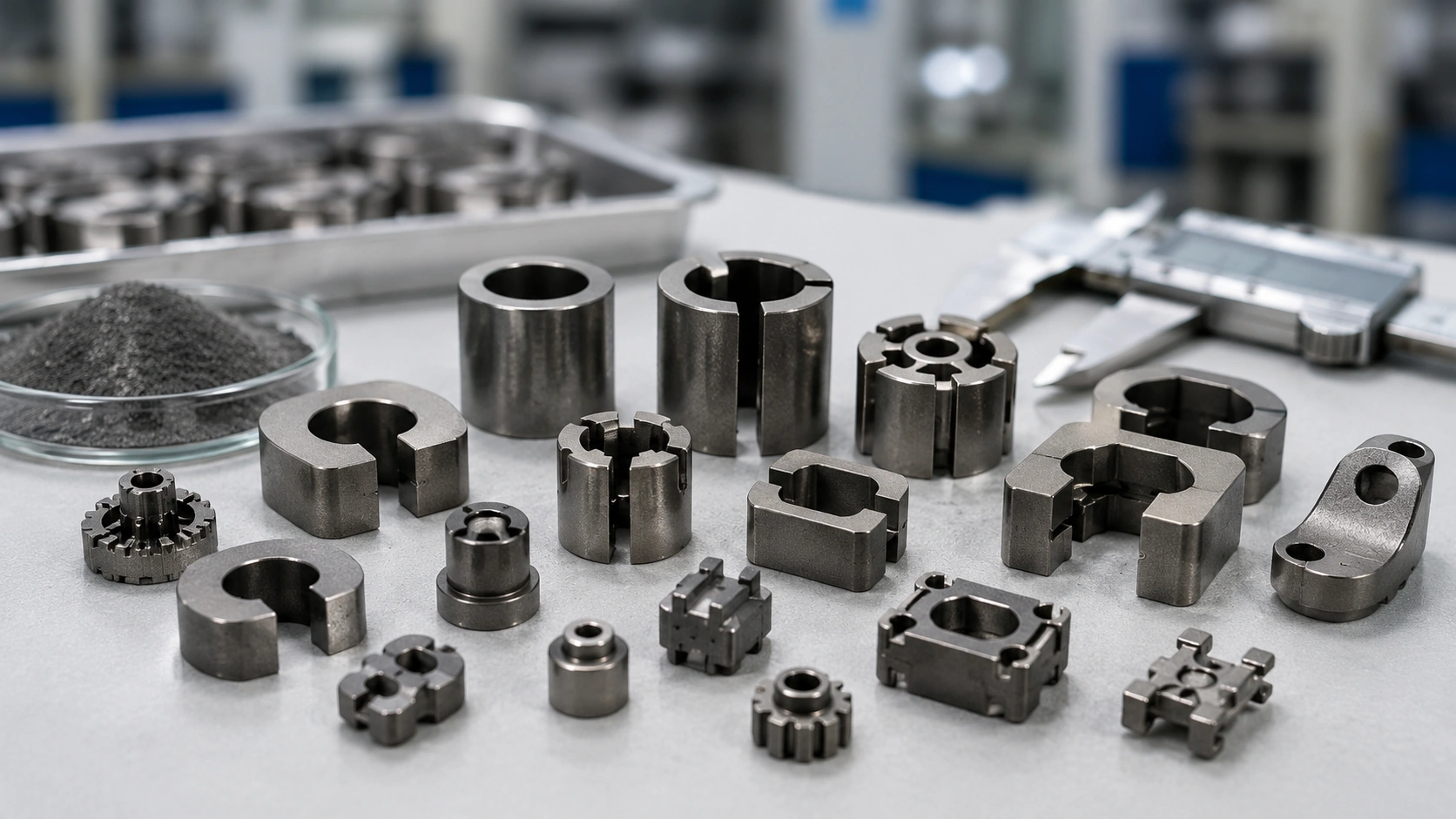
This image illustrates compact soft magnetic component forms for material review. It is not presented as a named customer project, documented production result or verified photograph of XTMIM-manufactured Fe-3%Si parts.
Engineering Summary: Where Fe-3%Si Fits in a MIM Project
Fe-3%Si is a strong candidate when compact 3D geometry and an Fe-Si soft magnetic direction are both required. The first review should decide whether the part belongs on this route, which features control the magnetic path, and how the finished component will be accepted.
| Decision point | Practical engineering interpretation |
|---|---|
| Best-fit use | Compact, three-dimensional soft magnetic components where MIM geometry and repeatability are more important than flat sheet construction. |
| High-risk use | Large motor cores, transformer cores, simple regular parts, or projects where the magnetic function is not defined. |
| Main review risk | Assuming the alloy name alone defines permeability, coercivity, saturation behavior or finished-part response. |
| Before tooling | Confirm the air gap, magnetic path, critical surfaces, expected heat treatment, surface finish and inspection method. |
| RFQ readiness | Submit 2D drawings, 3D CAD, target material, magnetic function, annual volume, operating condition and test requirements. |
Fe-3%Si Reference Data and Verification Conditions
The values below separate three different evidence types: an ISO material designation, a powder-supplier chemistry reference and supplier-published MIM part data. They are useful for screening and specification discussion, but they are not interchangeable and are not automatic XTMIM production guarantees.
| Reference item | Published reference | Condition and limitation | Source |
|---|---|---|---|
| ISO designation | MIM-Fe3Si-55 | ISO 22068 explains this designation as an Fe-Si MIM alloy with 3% silicon and a normative maximum-permeability value of 5,500. The code identifies a standard property class; it does not guarantee the response of every finished geometry. | ISO 22068:2012 |
| Nominal powder chemistry | Fe balance; Si 3.0%; C ≤0.03%; Mn ≤0.3%; P ≤0.03%; S ≤0.03% | Sandvik Osprey Fe3Si atomized powder reference. These are powder chemistry values, not finished-part magnetic or mechanical acceptance values. | Sandvik Osprey Fe3Si |
| Supplier MIM chemistry range | C <0.05%; Si 2.5–3.5%; Fe balance | Ecrimesa’s published FeSi3 / MIM-Fe3Si-55 route. Use only as a supplier-specific reference until the actual project feedstock specification is confirmed. | Ecrimesa MIM technical information |
| As-sintered density | >7.45 g/cm³ | Supplier-published FeSi3 as-sintered reference. Finished-part density can vary with geometry, debinding, sintering cycle, furnace loading and measurement method. | Ecrimesa supplier route |
| As-sintered mechanical reference | Rm 530 MPa; Rp0.2 390 MPa; elongation 24%; hardness 80 HRB | Supplier-published values for its FeSi3 route. They support material discussion but should not be treated as universal minimums for XTMIM parts without a confirmed specification and test plan. | Ecrimesa supplier route |
| Supplier magnetic reference | Permeability >6,000; B25 >14 kG | Supplier-published reference for its FeSi3 route. Confirm specimen shape, magnetic circuit, heat-treatment condition and test method before comparison with a finished component or assembly. | Ecrimesa supplier route |
Naming and Specification Cross-Reference
| Name | Practical interpretation | Required engineering action |
|---|---|---|
| Fe-3%Si / Fe-3Si | Practical iron-silicon alloy wording with approximately 3% silicon. | Confirm that the request concerns a soft magnetic MIM route rather than another Fe-Si product form. |
| MIM-Fe-3%Si | MIM-specific naming used in ASTM-style and supplier material tables. | Confirm chemistry limits, density condition, heat treatment and acceptance properties. |
| MIM-Fe3Si-55 | ISO 22068 designation in which “55” refers to the normative maximum-permeability value multiplied by 0.01. | Confirm the current standard edition and the complete property table before using the designation on a drawing. |
| Fe3Si | A broad term also used in intermetallic, thin-film and academic contexts. | Do not assume that a search result or research paper refers to the same MIM feedstock, process condition or finished-part requirement. |
What Is Fe-3%Si in Metal Injection Molding?
Fe-3%Si is an iron-silicon soft magnetic material direction containing approximately 3% silicon. In MIM, the material is molded as a powder-and-binder feedstock, debound and sintered into a dense metal component. The MIM route makes the material relevant to compact three-dimensional magnetic parts, but the final response still depends on density, impurities, heat treatment, residual stress, geometry and the magnetic test method.
MIMA identifies magnetic alloys as an established MIM material family and directs designers to MPIF Standard 35 for material-specification discussions. These references define the material framework; project approval still requires a drawing, process condition and agreed finished-part validation plan.

This image explains the injection stage in the MIM route. It is not presented as verified XTMIM factory evidence or as a photograph of equipment used for a named Fe-3%Si customer project.
For the connected manufacturing stages, review MIM feedstock, together with the debinding and sintering considerations explained below.
Why Fe-3%Si Is Used for Soft Magnetic MIM Components
Fe-3%Si is reviewed for soft magnetic MIM components because silicon in iron-based soft magnetic materials can support useful electrical and magnetic behavior, while MIM allows small and complex three-dimensional geometries that are difficult to achieve through flat lamination, stamping or extensive machining. For compact electromagnetic assemblies, the shape of the magnetic path can be as important as the material name.
Electrical and magnetic review
Fe-Si soft magnetic materials are often considered when electrical resistivity and magnetic response need to be reviewed together.
Compact 3D geometry
MIM can support small, complex, near-net-shape components that are difficult to make from flat laminations or extensive machining.
Process-sensitive performance
Density, impurities, heat treatment, stress and inspection method can affect the finished part’s magnetic behavior.
In practice, Fe-3%Si may be considered when the part needs a compact Fe-Si soft magnetic material direction, small three-dimensional magnetic geometry, near-net-shape production rather than extensive machining, repeatable response after sintering and heat treatment, and functional review of the air gap, magnetic path and assembly condition.
For broader selection logic and alternatives outside the Fe-Si route, use the MIM material selection guide.
Best-Fit Applications for Fe-3%Si MIM Review
Fe-3%Si should be reviewed where the part combines soft magnetic function with small, complex geometry. The strongest candidates are not large magnetic cores, but compact components where geometry, assembly space, air gap control and magnetic response are connected.
| Application direction | Why Fe-3%Si may be reviewed | What must be confirmed before RFQ |
|---|---|---|
| Compact solenoid cores | Soft magnetic response with compact geometry | Air gap, duty cycle, temperature and magnetic test method |
| Small armatures | Magnetic response with moving or mating surfaces | Clearance, surface condition, residual stress and wear areas |
| Relay magnetic components | Repeatable switching behavior | Coercivity target, heat treatment condition and inspection method |
| Pole pieces | Local flux guidance in small assemblies | Density, geometry, coating thickness and mating features |
| Yokes and flux guides | Complex three-dimensional magnetic path | Magnetic path, tolerance stack-up and assembly condition |
| Sensor-related magnetic parts | Stable response in compact packages | Magnetic target, surface finish, assembly position and operating environment |
The real selection question is not “Can Fe-3%Si be molded?” but “Can the final molded and sintered part meet the magnetic function in the assembly?” A small geometry change, coating thickness, residual stress from machining, or a poorly defined air gap can change the actual performance. For part examples and application-side review, visit soft magnetic MIM parts.
When Fe-3%Si May Not Be the Right Material or Process Route
A credible Fe-3%Si material page should explain where this material or process route may not fit. This helps engineers avoid late-stage tooling changes and helps sourcing teams avoid incomplete RFQs that cannot be evaluated beyond basic geometry.
| Situation | Why Fe-3%Si MIM may not fit | Better review direction |
|---|---|---|
| Large motor core or transformer core | Laminated electrical steel is often the established route for large flat cores. | Lamination or electrical steel route |
| Simple regular geometry | MIM tooling and feedstock cost may not be justified if the part can be pressed, stamped or machined efficiently. | PM pressing, stamping or machining review |
| Very high permeability / very low coercivity is dominant | Fe-3%Si may not be the strongest material direction for this target. | Fe-50Ni review |
| High saturation magnetic performance is dominant | A cobalt-iron direction may be more relevant. | Fe-50Co review |
| Corrosive operating environment | Fe-3%Si should not be treated as stainless steel. | Coating, ferritic stainless or alternate material review |
| Magnetic function is not defined | Material name alone cannot define performance or acceptance criteria. | RFQ clarification and engineering review |
If the part is a simple pressable shape or a cost-sensitive PM candidate, compare process fit through MIM vs powder metallurgy before tooling decisions.
Representative Engineering Scenario: Material Specified Without a Magnetic Function
This representative scenario illustrates a common engineering review problem. It is not presented as a named customer project or a documented XTMIM production result.
What problem occurred: A compact actuator component was specified as Fe-3Si, but the drawing did not define magnetic response, air gap, heat treatment condition or inspection method.
Why it happened: The design team treated the alloy name as the complete requirement.
What the real system cause was: The supplier could quote the geometry, but could not validate whether the finished part would meet the assembly’s switching response.
How it was corrected: The engineering review added the magnetic function, air gap, duty cycle, operating temperature, mating surface condition and test expectation to the RFQ package.
How to prevent recurrence: For Fe-3%Si MIM parts, the drawing package should define both the material direction and the functional magnetic requirement before tooling review.
MIM Process Factors That Affect Fe-3%Si Magnetic Performance
Fe-3%Si magnetic performance depends on powder and feedstock control, binder removal, sintering density, impurity control, stress condition, heat treatment and the finished-part test method. Each stage should be connected to the magnetic-path features identified on the drawing.

This diagram summarizes the Fe-3%Si MIM process route for engineering review. It is an explanatory illustration, not a production record or evidence of a named customer batch.
Powder and feedstock consistency
MIM begins with fine metal powder and binder. The powder chemistry, particle size distribution, particle shape and binder system influence feedstock flow, molding consistency, debinding behavior and sintering response. For Fe-3%Si soft magnetic parts, inconsistent feedstock can lead to dimensional variation, density variation or performance inconsistency after sintering.
This does not mean every project requires a new feedstock. It means the material route should be reviewed before the design is locked. If the part has thin sections, long flow paths, small holes or tight magnetic path features, feedstock behavior becomes part of the manufacturability discussion.
Debinding cleanliness
Debinding removes the binder from the molded green part before sintering. For Fe-3%Si, incomplete or poorly controlled debinding can leave residual carbon or create defects that later affect density, surface condition or magnetic response. The risk is not only cosmetic. A part can look acceptable but still show inconsistent performance if the debinding and sintering route is not controlled.
For process background, see MIM debinding.
Sintered density and residual porosity
Sintered density is one of the most important review items for soft magnetic MIM parts. Residual porosity can interrupt magnetic continuity and affect mechanical stability. MIM can produce high-density small components, but the final density depends on feedstock, debinding, sintering cycle, part geometry and furnace control.

This image illustrates vacuum-sintering equipment relevant to MIM process discussion. It is not presented as verified XTMIM factory evidence or as the furnace record for a named Fe-3%Si project.
For RFQ review, the user should define whether the magnetic performance target applies to a material coupon, a sample part, or the final assembled component. These are not always equivalent. For additional process details, review MIM sintering.
Carbon, oxygen and nitrogen control
Carbon, oxygen and nitrogen are not minor details in soft magnetic MIM work. They can affect microstructure, magnetic behavior and lot-to-lot consistency. A drawing that only states “Fe-3Si” may not be enough if the application is sensitive to coercivity, permeability or response stability.
From a supplier quality perspective, it is better to define the required inspection logic early than to discover after sampling that the magnetic response is inconsistent.
Heat treatment or magnetic annealing
Heat treatment, stress relief or magnetic annealing may be required depending on the function. The need for heat treatment depends on the alloy route, sintering condition, part geometry and final magnetic requirement. It should not be added casually as a generic post-process step.
A common mistake is to validate only dimensional appearance after sintering and then treat heat treatment as a minor finishing operation. For soft magnetic parts, heat treatment may be part of the functional performance plan.
Machining, grinding and residual stress
Secondary machining, grinding, polishing or sizing may be required for critical surfaces. However, these operations can introduce residual stress near the magnetic path or air gap. For some Fe-3%Si parts, the most important surface is not the most visible surface; it is the functional mating surface or the magnetic gap control area.
If machining is required, the drawing should identify critical dimensions, functional surfaces and inspection requirements. The supplier can then review whether the feature should be molded, machined, ground or controlled through a combined process route. For drawing-level review, see DFM for MIM and MIM tolerances.
Finished-part testing vs coupon testing
Coupon data is useful for material discussion, but it may not represent the finished part. A real Fe-3%Si MIM component has geometry, surface condition, local density variation, heat treatment history, coating thickness and assembly constraints. For critical soft magnetic applications, the customer and supplier should agree whether testing is performed on material specimens, sample parts, or finished assemblies.
Representative Engineering Scenario: Dimensions Passed but Functional Response Varied
This representative scenario illustrates a common engineering review problem. It is not presented as a named customer project or a documented XTMIM production result.
What problem occurred: Prototype Fe-3%Si MIM parts met basic dimensional inspection, but the assembled electromagnetic device showed inconsistent response.
Why it happened: The RFQ focused on external dimensions and material name, while the critical magnetic air gap, mating surface condition and heat treatment condition were not clearly defined.
What the real system cause was: The finished-part function depended on a combination of geometry, local surface condition, density and stress state. The drawing did not identify which features controlled the magnetic path.
How it was corrected: The project review separated general dimensions from magnetic-function dimensions. The critical air gap, mating surface, heat treatment requirement and functional testing plan were added before the next sampling round.
How to prevent recurrence: For Fe-3%Si MIM soft magnetic components, drawings should identify magnetic path features and inspection requirements before tooling approval.
Fe-3%Si vs Fe-50Ni vs Fe-50Co: Quick Material Direction Check
This section is only a quick material direction check. A full comparison should be handled on the soft magnetic MIM materials parent page, where Fe-3Si, Fe-50Ni, and Fe-50Co are compared as one material family before a specific grade route is selected.
| Material direction | Best review direction | Typical reason to choose |
|---|---|---|
| Fe-3%Si | Fe-Si soft magnetic direction | Electrical resistivity and loss-related review in compact parts |
| Fe-50Ni | High permeability / low coercivity direction | Sensitive magnetic response or sensor-related parts |
| Fe-50Co | High saturation direction | Compact high-flux electromagnetic components |
| Ferritic stainless direction | Magnetic response plus corrosion-related review | When corrosion resistance or stainless material requirement matters |
Fe-3%Si should not be selected only because it appears in a soft magnetic materials list. If the part requires very high permeability or very low coercivity, Fe-50Ni may need to be reviewed. If the key requirement is high saturation magnetic performance in a compact space, Fe-50Co may be more relevant. If the operating environment includes corrosion exposure, the project may need coating review, ferritic stainless review, or a different material strategy.
Design and RFQ Information Needed for Fe-3%Si MIM Review
For Fe-3%Si MIM parts, a complete RFQ should include more than drawing geometry. The magnetic function and inspection method are often as important as the alloy designation. When these details are missing, a supplier may be able to estimate tooling and part cost, but not confirm whether the finished part can meet the assembly-level function.
| RFQ information | Why XTMIM needs it |
|---|---|
| 2D drawing | Defines dimensions, tolerances, datum strategy and critical features. |
| 3D CAD file | Supports moldability, shrinkage, flow path and geometry review. |
| Target material | Confirms Fe-3%Si or alternate soft magnetic material direction. |
| Magnetic function | Explains what the part must do in the assembly. |
| Air gap and magnetic path | Helps review the functional geometry, not only external size. |
| Permeability / coercivity / saturation target if available | Supports material and testing discussion. |
| Duty cycle and operating frequency | Helps evaluate heat and magnetic performance expectations. |
| Operating temperature | Affects material, heat treatment and coating discussion. |
| Surface finish or coating | May affect air gap, corrosion behavior and assembly fit. |
| Critical dimensions | Identifies where tolerance control matters most. |
| Annual volume | Helps review tooling, process route and production suitability. |
| Existing manufacturing route | Helps compare MIM against machining, PM, stamping or assembly alternatives. |
| Required test method | Clarifies whether material coupon, sample part or finished-part testing is needed. |
Representative Engineering Scenario: RFQ Included Only the Material Name
This representative scenario illustrates a common engineering review problem. It is not presented as a named customer project or a documented XTMIM production result.
What problem occurred: The sourcing team requested a quote for a Fe-3%Si part but only provided a PDF drawing and annual volume.
Why it happened: The RFQ treated the part as a normal metal component instead of a magnetic-function component.
What the real system cause was: The supplier needed to know the magnetic function, air gap, operating condition, heat treatment expectation and test method before confirming material suitability.
How it was corrected: The RFQ package was updated with 3D CAD, magnetic function, critical air gap, operating condition, surface finish, annual volume and test requirement.
How to prevent recurrence: For Fe-3%Si MIM projects, include functional magnetic information together with geometry and purchasing data from the first RFQ.
Quality and Inspection Considerations for Fe-3%Si MIM Parts
Quality review for Fe-3%Si should cover both conventional MIM quality control and magnetic-function validation. Dimensional inspection alone is not enough when the part controls magnetic response in an assembly. The acceptance plan should identify which checks are for geometry, which are for material condition, and which are for functional magnetic performance.

This image illustrates dimensional inspection of small MIM parts. It is not presented as a verified inspection record, a named customer part or proof that the pictured component is Fe-3%Si.
| Inspection item | What it helps confirm |
|---|---|
| Chemical composition review | Confirms the intended Fe-Si material direction. |
| Sintered density | Supports mechanical and magnetic consistency review. |
| Dimensional inspection | Confirms fit, air gap and assembly-related features. |
| Surface condition | Helps evaluate mating surfaces, coating areas and magnetic gap control. |
| Heat treatment condition | Confirms whether the intended post-sinter condition was applied. |
| Magnetic property testing | Supports functional material evaluation where required. |
| Lot-to-lot consistency | Helps reduce variation in production. |
| Finished-part or assembly testing | Confirms whether the real component meets functional expectations. |
For supplier quality engineers, the key is to define acceptance logic before production. If the drawing only defines dimensions, the supplier may inspect the part as a precision metal component. If the application depends on magnetic response, the RFQ and drawing package should define the relevant magnetic acceptance requirement or at least the functional review target.
Standards and Technical Reference Note
MPIF Standard 35-MIM: Relevant because it covers common materials used in metal injection molding and provides explanatory notes and definitions for MIM material specification discussions. MPIF material standards support material communication, but they do not replace project-level validation. Reference: MPIF Standards.
MIMA Materials Range: Relevant because MIMA identifies magnetic alloys among the material families used in MIM and directs engineers to MPIF Standard 35 for material specification discussions. Reference: MIMA Materials Range.
ASTM B883: Relevant because it covers ferrous metal injection molded materials made through powder and binder mixing, injection molding, debinding and sintering, with or without subsequent heat treatment. It can support material specification discussion for ferrous MIM projects, but the applicable version and material designation must be confirmed for each customer requirement. Reference: ASTM B883.
ISO 22068: Relevant because it specifies requirements for chemical composition and mechanical / physical properties of sintered metal injection-moulded materials. Specific applicability to a Fe-3%Si project should be verified against the customer specification before production. Reference: ISO 22068.
Standards and datasheets should guide material discussion, but they should not replace project-specific review. For Fe-3%Si MIM parts, the final requirement should be confirmed through drawings, material specification, heat treatment condition, magnetic function, inspection method and supplier process capability.
FAQ: Fe-3%Si Soft Magnetic MIM Material
Is Fe-3%Si the same as Fe3Si?
Not exactly in practical manufacturing language. This page uses Fe-3%Si to describe an iron-silicon soft magnetic MIM material direction with approximately 3% silicon. The term Fe3Si can appear in academic or thin-film research contexts, so Fe-3%Si is clearer for MIM material specification and RFQ discussion.
What is the typical composition of MIM-Fe-3%Si?
MIM-Fe-3%Si is generally understood as an iron-silicon soft magnetic material direction with iron as the balance and approximately 3% silicon. Exact chemical limits should be confirmed from the applicable customer standard, material datasheet or supplier specification before they are used on a production drawing.
What is MIM-Fe3Si-55?
MIM-Fe3Si-55 is a standard or datasheet-style naming format that may appear in MIM material cross-reference tables. It should not be treated as automatically identical to every Fe-3%Si request until the applicable standard version, property table, heat treatment condition and inspection method are confirmed.
Are published Fe-3%Si magnetic properties guaranteed for production parts?
No. Published properties can support material discussion, but they are not automatic guarantees for every production part. Magnetic performance depends on feedstock route, debinding, sintering, density, impurities, heat treatment, part geometry, air gap, surface condition and the agreed test method.
When should Fe-3%Si be reviewed instead of Fe-50Ni?
Fe-3%Si should be reviewed when the project needs an Fe-Si soft magnetic material direction, compact geometry and possible loss-related or resistivity-related considerations. Fe-50Ni should be reviewed when high permeability or very low coercivity is the dominant requirement.
Can Fe-3%Si MIM replace laminated silicon steel?
Usually not as a direct replacement for large laminated motor cores or transformer cores. Fe-3%Si MIM is more relevant for small, complex, three-dimensional soft magnetic components where lamination, stamping or machining is not a good fit.
What affects Fe-3%Si magnetic performance in MIM?
Important factors include powder chemistry, feedstock consistency, debinding cleanliness, sintered density, residual porosity, carbon / oxygen / nitrogen control, heat treatment, residual stress, surface condition, air gap and test method.
Can XTMIM quote Fe-3%Si parts from only a drawing?
A drawing can support preliminary review, but Fe-3%Si soft magnetic MIM parts usually require more information. The RFQ should include 3D CAD, magnetic function, air gap, operating condition, heat treatment expectation, surface finish, annual volume and inspection requirement.
Is Fe-3%Si corrosion resistant?
Fe-3%Si should not be treated as a stainless steel material. If the part works in a corrosive environment, coating, ferritic stainless material, or another material direction should be reviewed.
Should magnetic properties be tested on a coupon or finished part?
Coupon data is useful for material discussion, but finished-part behavior may differ because geometry, air gap, surface condition, density, heat treatment and assembly condition can affect the actual response. For critical applications, the test method should be agreed before production.
Review Fe-3%Si MIM Material Suitability Before Tooling
If your project involves compact solenoid cores, armatures, pole pieces, relay components, flux guides or other small electromagnetic parts, XTMIM can review whether Fe-3%Si is a suitable MIM material direction.
Please send the 2D drawing, 3D CAD file, target material or current material, magnetic function, critical air gap or magnetic path, required magnetic property target if available, operating temperature, duty cycle, surface finish, critical dimensions, inspection method, estimated annual volume and current manufacturing process.
XTMIM’s engineering review can help check material suitability, MIM manufacturability, tooling risk, sintering-related distortion, tolerance strategy, secondary operation needs and inspection requirements before tooling or production planning.
Engineering Review Note
Reviewed by XTMIM Engineering Team
This page was prepared for engineers, sourcing teams and project managers evaluating Fe-3%Si soft magnetic MIM materials for compact electromagnetic components. The review focuses on material selection, MIM process suitability, feedstock and sintering considerations, magnetic-function risks, DFM review, tooling risk, tolerance control, heat treatment, inspection requirements and production feasibility.
The article does not replace a project-specific drawing review. Final material suitability depends on part geometry, magnetic function, air gap, application condition, heat treatment requirement, inspection method, annual volume and supplier process capability.