
MIM Soft Magnetic Material Review
Fe-50Ni is a nickel-iron soft magnetic material direction for compact MIM parts that need high magnetic permeability, low coercivity, or sensitive magnetic response in a small three-dimensional geometry.
The practical question for a product engineer is not simply “Can Fe-50Ni be molded?” The part must also be reviewed for magnetic air gap, pole face condition, sintered density, residual porosity, heat treatment condition, secondary machining stress, and final magnetic validation method. If the component is a small sensor core, relay part, solenoid core, pole piece, yoke, or flux guide, Fe-50Ni MIM may be worth reviewing before tooling. If the requirement is a large laminated core, wrought sheet, strip, wire, or magnetic shielding material, another material form is usually more appropriate.
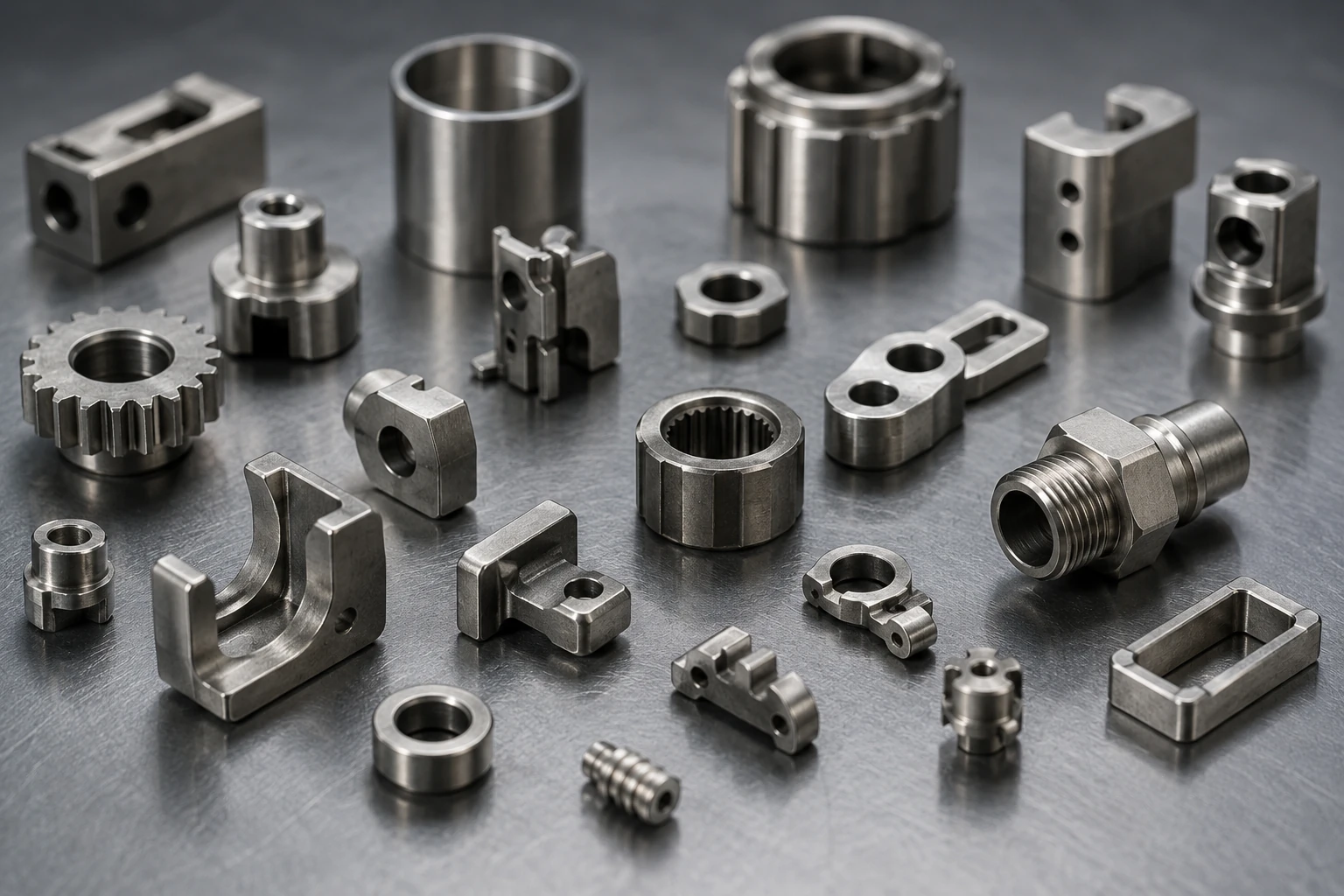
Quick Answer: When Fe-50Ni MIM Makes Sense
Fe-50Ni is worth reviewing when the project combines soft magnetic function with MIM-friendly geometry. The material name alone is not enough for approval. Before tooling, the team should connect the magnetic function to the drawing, air gap, pole face, sintering route, heat treatment expectation, post-processing sequence, and inspection method.
Start from the complete MIM materials overview if you are comparing several alloy families. For parent-level material-family comparison, review the soft magnetic MIM materials family page, where Fe-3Si, Fe-50Ni, and Fe-50Co are compared before selecting a specific Ni-Fe material route.
What Is Fe-50Ni Soft Magnetic Material in MIM?
Fe-50Ni, Fe-50%Ni, Fe50Ni, and FeNi50 are common naming styles for an iron-nickel soft magnetic material direction with approximately half nickel and balance iron. In MIM project discussions, the name should not be treated as a complete specification by itself. A drawing may call out “Fe-50Ni,” but the supplier still needs to confirm powder availability, feedstock behavior, sintering response, heat treatment expectation, and final magnetic validation method.
Fe-50Ni is sometimes discussed as a permalloy-type Ni-Fe soft magnetic direction, but project approval should depend on the specified composition, MIM process route, heat treatment condition, and agreed magnetic test requirement. The short alloy name is useful for early communication, but it does not replace finished-part validation.
From a design review perspective, Fe-50Ni is usually discussed when magnetic response is more important than general structural strength. It may be selected for high-permeability response, low coercivity direction, or stable magnetic switching behavior in compact electromagnetic assemblies. However, a finished MIM component is not a simple material coupon. Geometry, density, surface condition, air gap, and assembly position can change how the part performs in the real magnetic circuit.
Fe-50Ni, Fe-50%Ni, and FeNi50 Naming
These names usually refer to the same broad Fe-Ni soft magnetic direction, but engineering teams should avoid relying only on the short material name. In practice, a quote request should clarify whether the requirement is a target composition, a supplier material equivalent, a magnetic performance target, or a finished-part function. If the buyer only provides “Fe-50Ni” without magnetic targets or test conditions, the material review remains incomplete.
A better RFQ states the magnetic function, critical dimensions, air gap, mating surface, heat treatment expectation, and whether magnetic performance should be checked on a test coupon, the finished part, or the final assembly.
Why Fe-50Ni Is Reviewed for High Permeability
Fe-50Ni is usually reviewed when the component must respond efficiently to a magnetic field. This may matter in sensor cores, relay components, compact solenoid parts, magnetic pole pieces, or flux-guiding components. High permeability can help the material provide a useful magnetic path under the intended operating condition, while low coercivity can support easier magnetization and demagnetization.
The important point is that high permeability is not only a material label. It is affected by composition control, sintered density, residual porosity, grain structure, residual stress, heat treatment, and the way the final component is tested. For this reason, Fe-50Ni MIM projects should be reviewed as functional magnetic components, not only as small metal parts.
Why Finished-Part Performance Matters in MIM
In production, magnetic performance can be more sensitive than appearance or basic dimensional acceptance. A part can meet external dimensions but still perform poorly if density is inconsistent, the pole face is distorted, the air gap is not controlled, or secondary machining introduces stress near the magnetic path.
A common mistake is to approve Fe-50Ni based only on a material name and then discover late that the actual assembly response depends on air gap, surface finish, heat treatment, or a test method that was not defined before tooling. For Fe-50Ni MIM, the finished part should be reviewed together with the magnetic circuit, critical surfaces, and inspection plan.
Key Magnetic Properties to Confirm for Fe-50Ni MIM
Fe-50Ni MIM review should not rely on nominal alloy naming alone. Before tooling, the engineering team should confirm which magnetic indicators are function-critical, how they will be tested, and whether acceptance will be based on a material coupon, the finished part, or the final assembly.
| Property or Review Item | What to Confirm | Why It Matters for Fe-50Ni MIM |
|---|---|---|
| Material definition | Confirm whether Fe-50Ni means target chemistry, supplier equivalent, or a project-specific magnetic requirement. | The material name alone does not define powder route, heat treatment condition, or finished-part acceptance. |
| Magnetic permeability | Clarify whether permeability is a design target, a comparison target, or only a general material direction. | Permeability can be affected by density, residual stress, heat treatment, geometry, and test condition. |
| Coercivity | Confirm whether low coercivity is required and how it should be measured. | Coercivity may be sensitive to residual stress, contamination, microstructure, and post-processing sequence. |
| Saturation induction or flux density | Confirm whether saturation behavior is critical to the magnetic circuit. | If high saturation is the dominant requirement, Fe-50Co or another material direction may need comparison. |
| Sintered density and residual porosity | Define how density or porosity risk will be reviewed for the part geometry. | Porosity can interrupt magnetic continuity and create variation between finished parts. |
| Heat treatment condition | Confirm whether annealing or stress relief is required before final inspection. | Soft magnetic response can change after machining, grinding, cleaning, or heat treatment. |
| Test sample type | Decide whether testing should use a coupon, finished component, or assembly-level method. | A coupon may not represent air gap, pole face, thin wall, press-fit, or curved magnetic path behavior. |
| Acceptance method | Agree on the inspection method before mold release or trial production. | Late agreement on magnetic testing can cause schedule delay, tooling rework, or unclear pass/fail criteria. |
This property review belongs on the Fe-50Ni material page because it explains what must be confirmed for this specific material direction. Detailed geometry rules should still be handled through DFM review for MIM parts, MIM tolerance strategy, and MIM shrinkage compensation.
When to Consider Fe-50Ni for MIM Components
Fe-50Ni should be considered when the project combines soft magnetic function with geometry that benefits from metal injection molding. If the part is small, complex, three-dimensional, difficult to machine economically, or expected to run in repeat production after tooling, MIM may be a strong candidate. If the part is a simple flat strip, large laminated core, or basic pressable shape, Fe-50Ni MIM may not be the best route.
| Project Requirement | Fe-50Ni Relevance | Engineering Review Before Tooling |
|---|---|---|
| High permeability response | Strong candidate direction | Confirm target response, operating condition, and test method. |
| Low coercivity direction | Strong candidate direction | Review heat treatment, residual stress, and magnetic acceptance criteria. |
| Compact sensor or relay component | Possible fit | Check pole face, air gap, assembly position, and finished-part testing. |
| Small complex 3D geometry | MIM advantage | Review molding feasibility, debinding risk, shrinkage, sintering support, and distortion risk. |
| Tight magnetic air gap | Possible but sensitive | Confirm datum strategy, tolerance plan, secondary machining sequence, and inspection method. |
| Large laminated motor or transformer core | Usually not a MIM fit | Review lamination, wrought strip, or other magnetic core routes. |
| Very low-volume prototype | Often not ideal for MIM tooling | Review CNC, prototype machining, or other early-stage validation routes. |

If your team is still unsure whether Fe-50Ni is the correct material direction, start with the MIM material selection guide. If your main question is which small electromagnetic parts can be produced by MIM, review soft magnetic MIM parts instead.
Fe-50Ni vs Fe-3Si vs Fe-50Co: Which Soft Magnetic Direction Fits?
Fe-50Ni should not be selected only because the component is magnetic. In soft magnetic MIM projects, Fe-3Si, Fe-50Ni, and Fe-50Co can represent different material directions. The correct choice depends on whether the dominant requirement is permeability, low coercivity, saturation behavior, electrical loss concern, cost, processing risk, or magnetic response under the actual assembly condition.
| Material Direction | Main Selection Reason | Better Fit When | Be Careful When |
|---|---|---|---|
| Fe-3Si | Electrical resistivity and loss-related review | The project needs a soft magnetic Fe-Si direction and frequency-related behavior must be reviewed. | Frequency, heat generation, and loss requirements are not defined. |
| Fe-50Ni | High permeability and low coercivity direction | The component needs sensitive magnetic response in a compact geometry. | Air gap, residual stress, heat treatment, and test method are unclear. |
| Fe-50Co | High saturation direction | The project truly requires higher saturation magnetic behavior. | Cost, processing difficulty, and actual saturation requirement are not proven. |

From an engineering review perspective, Fe-50Ni is often a better discussion point when the magnetic circuit needs sensitive response rather than maximum saturation. Fe-50Co may be considered when high saturation is the main driver, while Fe-3Si may be reviewed when the project has electrical loss or resistivity concerns. For broader magnetic material selection, use the magnetic MIM materials guide.
Why MIM Processing Affects Fe-50Ni Magnetic Performance
Fe-50Ni MIM performance depends on more than nominal chemistry. The MIM route includes fine powder selection, binder-based feedstock preparation, injection molding, green part handling, debinding, sintering shrinkage, tooling compensation, possible heat treatment, secondary operations, and final inspection. Each stage can change density, residual porosity, contamination level, microstructure, surface condition, and stress state. These factors can affect magnetic response in the finished part.

Powder and Feedstock Consistency
MIM starts with fine metal powder mixed with binder into a moldable MIM feedstock. For Fe-50Ni, powder chemistry, particle characteristics, oxygen level, binder system, and feedstock uniformity matter because they influence injection consistency, debinding behavior, sintering densification, and final part repeatability.
If the feedstock is not uniform, the molded green part may show local density variation. After sintering, that variation can become distortion, uneven shrinkage, porosity differences, or inconsistent magnetic response. For functional magnetic parts, the issue is not only whether the part fills the mold; it is whether the final microstructure and density are stable enough for the magnetic function.
Sintered Density and Residual Porosity
Sintered density is one of the most important review points for Fe-50Ni MIM components. Residual porosity can interrupt the magnetic path, reduce repeatability, and create variation between parts. A dense and stable microstructure is usually more favorable for magnetic performance than a part with uncontrolled porosity.
This matters especially for small sensor cores, pole pieces, or yokes, where small dimensional and density changes can affect the magnetic circuit. Density review should not be separated from geometry review. Thin sections, heavy sections, sharp transitions, and unsupported features can sinter differently, so the tooling and support strategy must be reviewed before production.
Carbon, Oxygen, and Nitrogen Control
Carbon, oxygen, and nitrogen should not be treated as ordinary background impurities in Fe-50Ni magnetic applications. Interstitial elements can influence magnetic behavior and microstructure. In practice, contamination risk can come from powder condition, binder removal, sintering atmosphere, furnace control, or handling sequence.
The correct engineering question is not only “Can Fe-50Ni be molded?” It is also “Can the selected MIM route control chemistry, density, and heat treatment condition tightly enough for the required magnetic response?” If the application has strict magnetic acceptance criteria, these factors should be discussed before tooling.
Sintering Atmosphere, Temperature, and Time
MIM sintering controls densification, shrinkage, microstructure, and final part stability. For Fe-50Ni, sintering atmosphere, temperature, and time must be reviewed because they can affect both chemistry and magnetic behavior. The same nominal composition can show different finished-part performance if sintering conditions, density, or contamination levels are different.
From a production perspective, the risk is late discovery. A project may pass dimensional trial parts but fail functional magnetic testing if the sintering and heat treatment route was not aligned with the magnetic requirement. This is why Fe-50Ni projects should define magnetic acceptance early, not after the mold has already been completed.
Heat Treatment and Residual Stress
Soft magnetic performance can be sensitive to residual stress. Secondary machining, grinding, coining, press fitting, or aggressive surface finishing may introduce local stress near critical magnetic surfaces. Heat treatment or annealing may be required depending on the application and supplier process route, but it should be specified carefully.
A common mistake is to apply post-machining to improve a pole face or air gap and then ignore the possibility that the operation changed the magnetic response. If the part requires post-machined faces, the sequence of machining, heat treatment, cleaning, and final testing should be agreed before production.
Finished-Part Magnetic Testing
Coupon testing can help evaluate material capability, but it may not fully represent the finished component. A finished Fe-50Ni MIM part may include thin walls, curved magnetic paths, surface finish requirements, pole faces, assembly press fits, or air gaps that a simple coupon does not represent.
For RFQ review, the buyer should clarify whether the project requires material-level magnetic testing, finished-part testing, assembly-level response testing, or a combination. This decision affects manufacturing planning, inspection cost, and acceptance criteria.
Typical Fe-50Ni MIM Component Directions
Fe-50Ni MIM is most relevant when the component is small, three-dimensional, and magnetically functional. The following component directions may justify review, but final material selection still depends on the drawing, magnetic circuit, and validation method.
| Component Direction | Why Fe-50Ni May Be Reviewed | Key Review Point |
|---|---|---|
| Magnetic sensor cores | Sensitive magnetic response may be required. | Air gap, pole face, signal response, and test method. |
| Relay components | Low coercivity direction may support switching behavior. | Heat treatment, residual stress, and surface condition. |
| Compact solenoid cores | A controlled magnetic path may be needed in a small geometry. | Density, straightness, air gap, and dimensional repeatability. |
| Small armatures | Response under applied field may be important. | Clearance, wear surface, stress, and assembly condition. |
| Pole pieces | Magnetic flux concentration may depend on face geometry. | Pole face finish, flatness, and post-machining sequence. |
| Yokes and flux guides | Magnetic path control may require compact complex shape. | Assembly fit, magnetic path continuity, and density stability. |
This section is not a full product gallery. If the project is primarily about which soft magnetic component types can be produced by MIM, the soft magnetic MIM parts for solenoids and sensors page is the better next step.
Drawing and Design Factors That Affect Fe-50Ni Performance
Fe-50Ni performance can be affected by drawing decisions. This page should not become a complete MIM design guide, but several design factors must be reviewed because they directly influence magnetic function.
Air Gap and Pole Face Control
Air gap is often one of the most important dimensions in magnetic assemblies. A small change in the gap can change the magnetic response of the system. If the Fe-50Ni part has a pole face, mating surface, or contact surface, these areas should be clearly identified on the drawing.
The drawing should show which dimensions are function-critical and which are general manufacturing dimensions. Without this distinction, the supplier may control a cosmetic or non-critical feature tightly while missing the actual magnetic performance driver.
Surface Condition and Post-Machining Stress
Surface finish may matter when the pole face, sliding surface, or mating surface affects the magnetic path or assembly fit. However, post-machining can introduce residual stress. For soft magnetic parts, this can become a functional concern, not only a dimensional concern.
If a Fe-50Ni part requires grinding, lapping, machining, or polishing after sintering, the project should review whether stress relief or final magnetic testing is required after secondary operations.
Dimensional Tolerances and Shrinkage Risk
MIM includes significant shrinkage during sintering, so tolerance capability depends on material, geometry, tooling compensation, sintering support, and inspection method. For Fe-50Ni parts, dimensional stability is especially important when the magnetic circuit depends on air gap, concentricity, flatness, or pole alignment.
For deeper design review, use the dedicated pages for MIM tolerances, MIM shrinkage compensation, and DFM for MIM. Those pages own the detailed design rules; this Fe-50Ni page only highlights design factors that affect magnetic performance.
When Fe-50Ni MIM May Not Be the Best Route
Fe-50Ni MIM is not the correct answer for every soft magnetic requirement. It should be reviewed carefully when the application is actually better served by sheet, strip, lamination, bar, PM press-and-sinter, CNC prototype machining, or another magnetic material.
Fe-50Ni MIM is usually not the first choice for laminated AC cores or high-frequency magnetic circuits where eddy-current loss, lamination design, sheet thickness, insulation layers, and frequency-dependent behavior dominate the design. In those applications, the magnetic circuit and material form may matter more than three-dimensional MIM geometry.
Fe-50Ni MIM may not be the best route when:
- The part is a large motor core or transformer core.
- The design requires thin laminated stack behavior.
- The buyer needs wrought strip, sheet, wire, or magnetic shielding material.
- The geometry is simple enough for a lower-cost PM or machining route.
- The annual volume cannot justify MIM tooling.
- The magnetic acceptance method is not defined.
- The required function depends mostly on assembly-level magnetic circuit design, not the individual component material.
- The part needs only a general magnetic response and does not require Fe-50Ni-level review.
- The project is still in early prototype testing and material performance is not yet confirmed.
A careful supplier should be willing to say when Fe-50Ni MIM is not the most suitable route. This protects both tooling investment and project schedule.
Quality and Validation Checks for Fe-50Ni MIM Parts
Quality control for Fe-50Ni MIM parts should connect material condition, process stability, dimensional inspection, and magnetic validation. A simple dimensional inspection plan may not be enough for a functional magnetic component.

| Validation Area | Why It Matters | What to Confirm |
|---|---|---|
| Chemistry control | Magnetic behavior may be sensitive to interstitial elements and alloy balance. | Material control route and supplier confirmation. |
| Sintered density | Density affects magnetic path stability and repeatability. | Density target, inspection method, and acceptance logic. |
| Residual porosity | Porosity can interrupt magnetic continuity. | Process capability and section-thickness review. |
| Dimensional stability | Air gap, pole face, and alignment may affect performance. | Critical dimensions, datum plan, and inspection method. |
| Heat treatment condition | Soft magnetic response may depend on stress relief or annealing route. | Heat treatment sequence and final condition. |
| Surface condition | Pole face or mating surface may affect assembly behavior. | Surface finish, machining sequence, and burr control. |
| Material coupon testing | Useful for checking material-level magnetic capability. | Confirm whether coupon results are only for material reference or part acceptance. |
| Finished-part testing | Finished geometry may affect magnetic response differently from a coupon. | Confirm pole face, air gap, heat treatment condition, and final test sequence. |
| Assembly-level response testing | The magnetic function may depend on the complete device or magnetic circuit. | Confirm whether final acceptance depends on system-level response, not only part-level inspection. |
Composite Field Scenarios for Engineering Training
The following scenarios are composite engineering examples. They are not customer case studies and do not include confidential project data. Their purpose is to show how Fe-50Ni material selection can fail if drawing control, process sequence, or validation method is incomplete.
Air Gap Passed on Drawing, Magnetic Response Failed in Assembly
What problem occurred: A compact electromagnetic assembly used a small Fe-Ni soft magnetic core. The drawing specified tight outside dimensions, but the actual functional air gap was not clearly marked as a critical characteristic. Trial parts passed the basic dimensional inspection, but the assembly response varied between samples.
Why it happened: The supplier controlled the general dimensions but did not identify the pole face and air gap as the most important functional areas. Minor distortion after sintering and small differences in the pole face condition affected the actual magnetic circuit.
What the real system cause was: The system issue was not only material selection. It was an incomplete engineering definition: the drawing did not clearly identify the magnetic datum, pole face, air gap, surface finish requirement, or finished-part magnetic test method.
How it was corrected: The drawing was revised to mark the critical air gap, pole face, and datum structure. The inspection plan was updated to include function-critical dimensions. The team also reviewed whether post-sintering machining and final magnetic testing were required.
How to prevent recurrence: For Fe-50Ni MIM parts, define the magnetic function, critical surfaces, air gap, datum strategy, and test method before tooling. Do not assume that a general dimensional tolerance plan will protect magnetic performance.
Post-Machining Improved Flatness but Changed Magnetic Response
What problem occurred: A small pole piece required improved flatness after sintering. Post-machining improved the surface geometry, but the final magnetic response became less consistent than expected.
Why it happened: The machining sequence introduced local stress near the functional surface. The project had not defined whether stress relief, annealing, or magnetic testing should occur after secondary machining.
What the real system cause was: The issue was a process-sequence problem. The team treated machining as a purely dimensional correction step, but the component was a soft magnetic part where residual stress could affect magnetic behavior.
How it was corrected: The project team reviewed the machining sequence, heat treatment condition, cleaning process, and final magnetic validation method. The inspection plan was updated so that magnetic acceptance was checked after the final process condition, not before it.
How to prevent recurrence: For Fe-50Ni MIM parts, any post-machining operation on pole faces, mating surfaces, or magnetic path features should be reviewed together with stress relief and final magnetic testing requirements.
What to Provide for a Fe-50Ni MIM Material Review
A useful Fe-50Ni RFQ should provide more than a material name. The engineering team needs enough information to judge material suitability, MIM feasibility, tooling risk, sintering control, tolerance strategy, and magnetic validation. If the magnetic response depends on air gap, pole face, or assembly position, submit the drawing before final material selection.
Required for First Engineering Review
- 2D drawing with critical dimensions clearly marked
- 3D CAD file
- Target material or current material reference
- Magnetic function description
- Prototype, trial production, or mass production stage
- Estimated annual volume
Useful If Available for Magnetic Validation
- Target permeability, coercivity, saturation, or response requirement if available
- Critical air gap or magnetic path information
- Pole face, mating surface, or sliding surface requirements
- Surface finish requirement
- Heat treatment or annealing expectation
- Post-machining requirement
- Operating environment
- Assembly condition if magnetic response depends on the full system
- Magnetic testing method if already defined
- Current manufacturing process if the part is being converted from CNC, PM, casting, or another route
If magnetic performance is important, the RFQ should not stop at “Fe-50Ni material required.” The better starting point is: “Here is the drawing, magnetic function, critical air gap, target response, test method, and production volume. Please review whether Fe-50Ni MIM is suitable before tooling.”
Request a Fe-50Ni MIM Material Review
If your compact electromagnetic component requires high permeability, low coercivity direction, or stable magnetic response, send XTMIM your 2D drawing, 3D CAD file, target material, magnetic function, critical air gap, surface finish requirement, heat treatment expectation, test method, and estimated annual volume. Our engineering review can help check whether Fe-50Ni MIM is suitable, whether another soft magnetic direction should be compared, which dimensions affect magnetic performance, and what risks should be confirmed before tooling or production.
FAQ
Is Fe-50Ni the same as FeNi50 or Fe-50%Ni?
In many engineering discussions, Fe-50Ni, FeNi50, Fe50Ni, and Fe-50%Ni refer to the same broad iron-nickel soft magnetic material direction. However, the short name should not replace a project-specific material review. For MIM parts, the supplier still needs to confirm powder route, sintering behavior, heat treatment condition, magnetic testing method, and finished-part requirements.
Why is Fe-50Ni used for soft magnetic MIM parts?
Fe-50Ni is reviewed when a compact part needs high permeability, low coercivity direction, or sensitive magnetic response. It may be considered for small sensor cores, relay components, solenoid cores, pole pieces, yokes, and flux guides. The final decision depends on geometry, density, air gap, heat treatment, and validation method.
Can Fe-50Ni MIM parts replace laminated motor cores?
Usually no. MIM is better suited for compact three-dimensional components than large laminated magnetic cores. Motor laminations and transformer cores often need sheet or strip routes designed for lamination behavior and electrical loss control. Fe-50Ni MIM should be reviewed when the part geometry and magnetic function match the MIM process.
Is Fe-50Ni MIM suitable for AC or high-frequency magnetic applications?
Fe-50Ni MIM may be reviewed for some compact electromagnetic components, but it is usually not the first choice for laminated AC cores or high-frequency magnetic circuits where eddy-current loss, lamination design, sheet thickness, insulation layers, and frequency-dependent behavior dominate the design. The project should define the operating frequency, magnetic circuit, test method, and acceptable loss before selecting Fe-50Ni MIM.
Does MIM processing affect Fe-50Ni magnetic performance?
Yes. Fe-50Ni magnetic performance can be affected by powder quality, feedstock consistency, debinding, sintered density, residual porosity, carbon, oxygen, nitrogen, sintering atmosphere, heat treatment, residual stress, and final test method. This is why the finished part should be validated against the actual application requirement.
What information is needed for a Fe-50Ni MIM RFQ?
A useful RFQ should include 2D drawings, 3D CAD files, target material, magnetic function, critical air gap, pole face or mating surface requirements, surface finish, heat treatment expectation, post-machining needs, operating environment, magnetic test method, annual volume, and project stage.
Should Fe-50Ni be selected before or after DFM review?
Fe-50Ni can be used as an initial material direction, but final selection should be confirmed after DFM and material review. The engineering team should check geometry, shrinkage risk, sintering support, tolerance strategy, secondary operations, heat treatment, and magnetic validation before tooling.
What if the drawing only says “soft magnetic material”?
If the drawing does not specify Fe-50Ni, Fe-3Si, Fe-50Co, or a target magnetic requirement, the project should begin with a material selection review. The supplier needs to understand the magnetic function, operating condition, critical dimensions, and test method before recommending a MIM material direction.
Standards and Technical Reference Note
Fe-50Ni MIM projects should be evaluated using relevant MIM material standards, powder metallurgy references, supplier material data, and project-specific testing requirements. MPIF Standard 35-MIM is relevant because it covers common materials used in metal injection molding, with explanatory notes and definitions. The MPIF metal injection molding overview is also useful for understanding the MIM process route from fine metal powder and binder feedstock through molding, binder removal, and sintering.
MIMA material guidance is useful for understanding that MIM material selection depends on powder chemistry, particle characteristics, feedstock route, and supplier capability. ASTM A753 may be useful as a terminology reference for wrought nickel-iron soft magnetic alloys, but it should not be treated as a direct MIM powder metallurgy product specification or a finished-part compliance claim.
Fe-50Ni finished-part magnetic acceptance should be based on project-specific material definition, MIM process route, heat treatment condition, part geometry, and agreed testing method rather than nominal alloy name alone.
For general questions, use Contact Us. For engineering review, the most useful path is to submit your drawing, CAD file, magnetic function, critical air gap, testing method, and estimated annual volume through Submit Drawing for Review.