MIM Material Comparison
This 17-4 PH stainless steel vs 316L comparison reviews both materials from a metal injection molding project perspective, with emphasis on corrosion resistance, strength, heat treatment, sintering behavior, secondary operations, inspection, and RFQ decision-making.
Quick answer: For MIM projects, 316L stainless steel is usually the better starting point when corrosion resistance, surface stability, and general stainless performance are more important than high strength. 17-4 PH stainless steel is usually the stronger candidate when the part needs higher strength, higher hardness, or a heat-treated mechanical performance target.
The final decision should not be made from material grade alone. A supplier should review the drawing, wall thickness, critical dimensions, service environment, heat treatment target, surface finish, annual volume, and inspection method before approving either material for tooling.
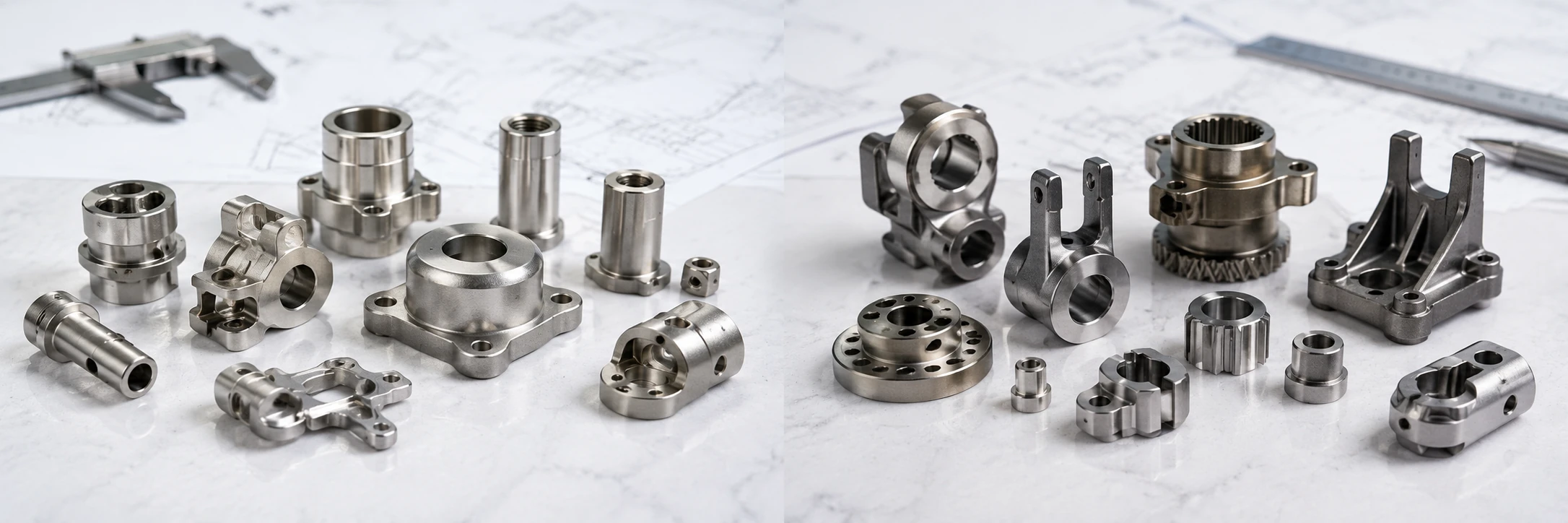
Core conclusion: The best stainless steel for a MIM part depends on whether corrosion resistance or heat-treated mechanical performance is the main design requirement.
316L vs 17-4 PH Stainless Steel: Quick MIM Selection Answer
A practical starting rule is simple: choose 316L first for corrosion-driven MIM parts, choose 17-4 PH first for strength-driven MIM parts, and request engineering review when the part needs both corrosion resistance and high mechanical performance.
When Corrosion or Surface Stability Leads
316L is commonly reviewed first when the part will work in a humid, cleaning, mildly corrosive, or appearance-sensitive environment. It is also a practical candidate when the design does not rely on heat treatment to reach high hardness or high strength.
When Strength or Hardness Leads
17-4 PH is commonly reviewed first when the part must carry load, resist deformation, hold higher hardness, or perform as a functional mechanical component after heat treatment.
When Both Requirements Matter
If the part needs corrosion resistance and higher strength at the same time, the decision should move from simple material comparison to drawing-level MIM review, including geometry, heat treatment, finishing, and final inspection.
For broader material routing, see the MIM Material Comparison page. For a full project-level material selection workflow, review the MIM material selection guide. This page focuses only on the 316L vs 17-4 PH decision for stainless steel MIM projects.
Material Selection Risk Map Before Tooling
The safest material decision is usually made before tooling, not after samples fail inspection. The following risk map helps identify whether the project should start with 316L, start with 17-4 PH, or require a deeper engineering review.
Environment First
Moisture, chloride, cleaning media, sweat, crevices, and cosmetic surface expectations usually push the first review toward 316L or another corrosion-focused route.
Load First
Bending load, latch retention, repeated engagement, local wear, and higher hardness requirements usually push the first review toward 17-4 PH.
MIM Route First
Feedstock, sintering stability, shrinkage compensation, support method, and part geometry can change the risk even when the material grade looks correct.
Final Check First
Critical dimensions, hardness testing, surface condition, passivation, and post-treatment inspection should be defined before quoting production parts.
Core Material Difference Between 316L and 17-4 PH
316L and 17-4 PH are both stainless steels, but they are selected for different engineering reasons. 316L is mainly used when corrosion resistance and general stainless performance are the key requirements. 17-4 PH is mainly used when strength, hardness, and precipitation-hardening response are more important. For a broader view of stainless grades used in metal injection molding, see stainless steel for MIM.
| Comparison Item | 316L Stainless Steel | 17-4 PH Stainless Steel | MIM Project Meaning |
|---|---|---|---|
| Main selection logic | Corrosion-focused stainless steel | Strength- and hardness-focused stainless steel | Start from the part’s service condition, not only the material name. |
| Material family | Austenitic stainless steel | Precipitation-hardening stainless steel | The strengthening route is different. |
| Heat treatment role | Not normally selected for precipitation-hardening strength | Often selected because heat treatment can improve strength and hardness | 17-4 PH needs more heat treatment review. |
| Corrosion direction | Usually stronger starting point for corrosion-driven parts | Moderate corrosion resistance, but condition and environment matter | Chloride, humidity, cleaning, and surface finish should be reviewed. |
| Strength / hardness direction | Lower strength than heat-treated 17-4 PH in many mechanical applications | Usually stronger after suitable heat treatment | Good for small load-bearing MIM components. |
| MIM review focus | Sintering, surface condition, corrosion exposure, finishing | Sintering, heat treatment, hardness, distortion, inspection | The process route changes the risk profile. |

Core conclusion: 316L and 17-4 PH solve different MIM project problems rather than competing as one universally better material.
316L: Austenitic Stainless Steel for Corrosion-Focused Parts
316L is usually selected when the project needs a stainless material with good corrosion resistance and stable performance in service environments where strength is not the only decision factor. For MIM parts, this can include small housings, exposed metal components, consumer product components, clean-environment parts, fluid-adjacent components, or parts where surface condition and corrosion resistance matter.
The key point is that 316L stainless steel is not selected because it is always the strongest stainless steel. It is selected because its corrosion-oriented profile often fits parts where environmental exposure is more important than high hardness.
17-4 PH: Precipitation-Hardening Stainless Steel for Strength-Focused Parts
17-4 PH is selected when the part needs a stronger mechanical profile than 316L can usually provide. Its value comes from precipitation hardening, so the heat treatment condition is part of the material decision.
In MIM projects, this means the engineering team should not approve 17-4 PH stainless steel based only on the material grade. They should also confirm heat treatment requirement, hardness target, dimensional sensitivity, and final inspection method.
What This Means for Small MIM Components
For small MIM components, the difference is practical. If the part is a corrosion-exposed cover, insert, connector, decorative structural part, or general stainless component, 316L may be the safer first review. If the part is a latch, locking element, mechanical link, actuator part, shaft-like feature, or small load-bearing structure, 17-4 PH may be the better first review.
Corrosion Resistance: Why 316L Is Often Safer, but Not Always Enough
When the main question is corrosion resistance, 316L is usually the safer starting point. This is especially true when the part may face moisture, cleaning media, chloride exposure, or an environment where surface staining, pitting, or crevice corrosion would create functional or cosmetic problems.
However, corrosion resistance is not a single fixed property. In MIM projects, it can be affected by material grade, sintering quality, density, surface condition, polishing, passivation, heat treatment, and the actual service environment. For this reason, the final material choice should be based on both the grade and the working condition.
If corrosion is the primary selection factor, the broader corrosion-resistant MIM materials route can also be reviewed. This page only compares 316L and 17-4 PH for the stainless steel decision.
| Corrosion Review Question | Why It Matters | Material Decision Impact |
|---|---|---|
| Will the part contact moisture, sweat, cleaning chemicals, or chloride? | Determines whether corrosion resistance is a primary requirement. | Often pushes first review toward 316L. |
| Is the part cosmetic, functional, or both? | Surface staining may be unacceptable even if strength is acceptable. | Surface finish and passivation should be confirmed early. |
| Will the part be passivated, polished, coated, or left as-sintered? | Surface condition affects final corrosion behavior. | The same material can behave differently after different finishing routes. |
| Are there crevices, blind holes, thin gaps, or trapped liquid areas? | Geometry can increase local corrosion risk. | Drawing review may be more important than material name alone. |
| Is the part under stress during service? | Stress and environment together may change the material risk. | 17-4 PH may need deeper review if both strength and exposure are critical. |

Core conclusion: 316L is often the safer corrosion-focused starting point, but final material approval still depends on the actual application environment.
Why 316L Is Commonly Chosen for Corrosion Exposure
316L is commonly preferred when corrosion risk is the leading concern. For a MIM component, this may include parts used near moisture, handled frequently, exposed to cleaning agents, or placed in environments where surface quality matters. If strength and hardness requirements are moderate, 316L can often reduce unnecessary heat treatment complexity.
Where 17-4 PH Corrosion Risk Needs Review
17-4 PH can offer useful corrosion resistance in many environments, but it is not normally selected as the first choice when corrosion resistance is the main requirement. The heat treatment condition, hardness level, surface condition, and stress state can all affect how the material should be reviewed.
Strength, Hardness, and Heat Treatment: Where 17-4 PH Wins
If the main design requirement is strength or hardness, 17-4 PH is usually the stronger candidate. A 316L MIM part may be suitable for many stainless applications, but it is not normally chosen when the design depends on precipitation hardening, high hardness, or high strength after heat treatment.
17-4 PH is often used when the part must resist bending, deformation, wear, or functional load. Examples may include locking components, mechanical connectors, miniature brackets, lever parts, structural inserts, and small precision parts where 316L may not provide enough mechanical margin.
For strength-driven stainless applications beyond this two-material comparison, review high-strength MIM materials and high-hardness MIM materials, then confirm whether the required strength, hardness, toughness, and inspection method are realistic for the part geometry.
| Heat Treatment Review Item | Why It Should Be Confirmed | What Can Go Wrong If Skipped |
|---|---|---|
| Required hardness or strength target | Determines whether 17-4 PH is necessary. | The project may pay for a harder material route without a defined performance need. |
| Heat treatment condition | Affects strength, hardness, toughness, and dimensional behavior. | Final properties may not match the intended load or wear requirement. |
| Critical dimensions after heat treatment | Prevents late-stage sizing or machining surprises. | Heat treatment distortion may shift datum relationships or mating dimensions. |
| Part geometry | Thin, long, or asymmetric shapes may be more sensitive to distortion. | Slender features, thin arms, or unbalanced sections may need support or post-processing review. |
| Inspection method | Hardness, dimensions, and surface condition may need final verification. | Small parts may lack suitable test surfaces unless the inspection plan is discussed early. |

Core conclusion: 17-4 PH is usually selected for strength-driven MIM parts, but its heat treatment route must be confirmed before final approval.
If heat treatment is part of the material decision, the project should also review the MIM heat treatment route and the related MIM sintering distortion risk before final material approval.
MIM Process Differences: Feedstock, Sintering, Shrinkage, and Stability
The biggest difference between a general stainless steel comparison and a MIM material comparison is the process route. MIM does not start from bar stock or sheet. It starts from prepared feedstock pellets, then moves through injection molding, debinding, sintering, and often secondary operations.
Feedstock Availability and Material Review
Both 316L and 17-4 PH are common stainless material families in MIM, but feedstock availability should still be confirmed before the project is quoted. The material grade should not be the only input. The customer should also provide the part drawing, expected annual volume, surface requirement, heat treatment requirement, and service environment. For the upstream process route, review MIM feedstock preparation.
Sintering Control and Density Expectations
MIM sintering affects final density, shrinkage, surface condition, and dimensional stability. 316L and 17-4 PH may both be processed by MIM, but they should not be treated as interchangeable materials in the furnace route without review.
| MIM Process Factor | 316L Review Focus | 17-4 PH Review Focus | Project Review Question |
|---|---|---|---|
| Feedstock | Availability and corrosion-focused stainless route | Availability and heat-treatment-compatible route | Is the required material route available for the expected volume and project schedule? |
| Sintering | Density, surface, corrosion-related quality | Density, strength route, later heat treatment planning | Does the part geometry create distortion or density-control risk? |
| Shrinkage | Dimensional compensation and surface quality | Dimensional compensation plus heat treatment distortion risk | Which dimensions must be held after sintering and secondary operations? |
| Geometry | Thin walls, holes, surface condition | Load-bearing features, stress areas, slender structures | Are there thin arms, local thick sections, deep holes, or unsupported features? |
| Secondary operations | Polishing, passivation, machining if needed | Heat treatment, sizing, machining, hardness confirmation | Which final operations happen before inspection and shipment? |

Core conclusion: A MIM material comparison must include process behavior, not only stainless steel grade names.
Shrinkage, Distortion, and Dimensional Risk
MIM parts shrink during sintering. The tool must compensate for MIM sintering shrinkage, and the actual risk depends on material, feedstock, part geometry, wall thickness transition, gate location, support method, and sintering conditions. For 17-4 PH, the process route must also be coordinated with later heat treatment. For 316L, corrosion-related surface quality and density may receive more attention.
Why Geometry Still Matters More Than Material Name Alone
A material that looks correct on paper can fail the project review if the geometry is not suitable for MIM. Long unsupported features, thick-to-thin transitions, deep blind holes, sharp internal corners, or extremely tight post-sintering tolerances can create risk in either material. Before final material approval, the drawing must be reviewed together with material choice.
Composite Engineering Scenarios for Material Review
The following examples are composite field scenarios for engineering training. They are not customer cases, test reports, or guaranteed outcomes. Their purpose is to show how material choice changes when the project priority changes.
Corrosion-Focused Small MIM Component
A small exposed stainless component has moderate load, visible surfaces, and possible contact with moisture or cleaning media. The design does not require high hardness after heat treatment. In this case, 316L is usually the safer first review because the main risk is surface stability and corrosion exposure.
Before approval, the supplier should still check surface finish, passivation requirement, crevice geometry, and whether any post-sintering machining changes the final surface condition.
Load-Bearing Locking or Structural Component
A small mechanical part has a latch feature, repeated engagement, local stress, and a defined hardness or strength target. Corrosion exposure is present but not the only requirement. In this case, 17-4 PH may be the stronger first review because the part needs heat-treated mechanical performance.
Before approval, the supplier should check heat treatment condition, distortion risk, hardness test location, critical dimensions after heat treatment, and whether sizing or machining is required.
Application Fit: Which MIM Parts Usually Favor 316L or 17-4 PH?
The best material choice depends on the part’s job. In MIM, a stainless part may be corrosion-driven, strength-driven, appearance-driven, inspection-driven, or cost-driven. The following selection matrix can help the first review.
| Part Requirement | Usually Review 316L First | Usually Review 17-4 PH First | Engineering Comment |
|---|---|---|---|
| Corrosion resistance is the main requirement | Yes | Maybe | 17-4 PH needs environment review. |
| High strength is the main requirement | Maybe | Yes | Heat treatment route must be confirmed. |
| High hardness is required | Usually no | Yes | Final hardness inspection may be needed. |
| Cosmetic stainless surface is important | Yes | Maybe | Surface finish and passivation should be reviewed. |
| Load-bearing miniature component | Maybe | Yes | Geometry and heat treatment distortion matter. |
| General stainless small part with moderate load | Yes | Maybe | 316L may be simpler if strength is not the main driver. |
| Both corrosion and strength are critical | Need review | Need review | The final choice depends on environment and performance target. |
Parts That Often Favor 316L
316L often fits parts where corrosion resistance, cleanliness, surface quality, and general stainless performance are more important than very high strength. This can include exposed small stainless parts, small housings, connector covers, appearance-related parts, and components that may face humidity or cleaning exposure.
Parts That Often Favor 17-4 PH
17-4 PH often fits parts where the design needs mechanical strength, hardness, or load-bearing capability. This can include small structural parts, locking parts, mechanical links, precision levers, actuator components, and parts that must keep shape under functional load.
Borderline Cases That Need Engineering Review
Some parts need both corrosion resistance and high strength. These cases should not be decided only by a material comparison table. The project team should review the service environment, stress level, heat treatment condition, surface treatment, inspection method, and whether a design change could reduce material risk.
Secondary Operations and Inspection Differences
Material selection can change the secondary operation plan. This is especially important in MIM because many functional requirements are confirmed after sintering and after any required finishing or heat treatment.
Machining and Sizing After Sintering
Both 316L and 17-4 PH MIM parts may require post-sintering machining or MIM sizing when critical dimensions cannot be held directly from the molded and sintered shape. The need depends on tolerance, datum structure, hole quality, mating surfaces, thread requirements, and assembly function.
Heat Treatment and Final Hardness Confirmation
17-4 PH should be reviewed with its heat treatment plan. If the project requires a hardness range, the inspection plan should confirm where and how hardness will be checked. Small MIM parts may have limited flat areas for hardness testing, so the drawing and inspection method should be discussed early.
Surface Finishing, Passivation, and Functional Inspection
316L projects may require passivation, polishing, tumbling, blasting, or other surface finishing depending on the application. 17-4 PH projects may also require finishing, but heat treatment and hardness confirmation often become more important.
- Define the final surface condition, not only the material grade.
- Confirm visible surface requirements if the part is cosmetic or exposed.
- Identify key dimensions after all secondary operations.
- Confirm hardness or strength requirements if 17-4 PH is selected.
- Define the inspection method and sampling expectation before RFQ approval.
- Confirm whether inspection occurs before or after heat treatment, polishing, passivation, or machining.
Decision Table: Choose 316L or 17-4 PH for MIM Parts
This table is a first screening tool, not final material approval. A practical RFQ should not simply say “quote 316L” or “quote 17-4 PH.” It should explain why the material is being considered and what performance must be achieved.
| If Your Main Requirement Is... | Better Starting Candidate | Why | Before Tooling, Confirm... |
|---|---|---|---|
| Corrosion resistance in a humid or cleaning environment | 316L | Better corrosion-oriented stainless profile. | Actual environment, surface finish, passivation, and crevice geometry. |
| High strength in a small mechanical part | 17-4 PH | Strength can be improved through precipitation hardening. | Heat treatment condition, load direction, distortion risk, and hardness inspection. |
| High hardness after final processing | 17-4 PH | Heat treatment can support hardness targets. | Hardness range, test location, and whether the part has enough test surface. |
| General stainless part with moderate load | 316L | Often simpler if strength is not the main driver. | Whether corrosion, appearance, or cost is the real priority. |
| Load-bearing part exposed to corrosion | Engineering review needed | Corrosion and strength targets may conflict. | Service environment, stress, surface finish, and allowable design change. |
| Tight dimensions after heat treatment | Engineering review needed | Heat treatment may affect distortion and final sizing. | Critical dimensions after all processing, not just after sintering. |
| Cosmetic surface plus corrosion resistance | 316L | Surface finish and passivation route may be easier to review. | Visible surfaces, polishing direction, passivation, and handling environment. |
| Wear or repeated mechanical engagement | 17-4 PH | Higher hardness and strength may be needed. | Contact area, wear pattern, hardness target, and inspection plan. |
If the project has both high corrosion and high strength requirements, do not rely only on a material name. Submit the drawing, working environment, load condition, surface requirement, and inspection target for review.
What to Check Before Switching From 316L to 17-4 PH or Back
Material switching can look simple when two stainless steels are compared on a list, but in MIM it can change tooling assumptions, sintering response, heat treatment route, secondary operations, inspection method, and final risk.
| Switching Direction | Main Reason | Risk to Review | Recommended Action |
|---|---|---|---|
| 316L to 17-4 PH | Need higher strength or hardness | Heat treatment, distortion, final hardness, and critical dimensions | Review drawing, load case, heat treatment target, and post-treatment inspection before change. |
| 17-4 PH to 316L | Need better corrosion-focused route or simpler processing | Strength, hardness, wear resistance, and load-bearing margin | Confirm whether 316L can still meet functional load and durability requirements. |
| Either direction | Cost, supply, or project simplification | Tooling compensation, shrinkage, secondary operations, and inspection plan | Do not switch after tooling without reviewing dimensional and process impact. |
Material switching should be treated as an engineering change, not only a purchasing change. If tooling has not started, the review is easier. If tooling has started or samples already exist, dimensional compensation and process route should be checked before approving the change.
What to Confirm Before Asking for a MIM Quote
Before asking for a MIM quote, the customer should send enough information for the supplier to review both material and process feasibility. A material name without the drawing is not enough.
Drawing and Geometry Inputs
Send 2D drawings and 3D files when available. The review should include overall size, wall thickness, critical dimensions, datum structure, holes, threads, undercuts, thin sections, thick-to-thin transitions, and functional surfaces.
Material and Performance Requirements
Explain whether the part is corrosion-driven, strength-driven, hardness-driven, appearance-driven, or cost-driven. If the current drawing lists 316L or 17-4 PH, explain whether that material is fixed or open to review.
Heat Treatment, Surface Finish, and Inspection Requirements
For 17-4 PH, confirm heat treatment condition, hardness target, and inspection method. For 316L, confirm surface condition, passivation requirement, polishing requirement, and corrosion exposure.
Annual Volume and Project Stage
MIM is usually more suitable when the part has repeat production demand and the geometry benefits from molding. Send the expected annual volume, project stage, prototype status, target launch schedule, and any current manufacturing method for comparison.
| Input Needed | Why It Matters | Useful Detail to Provide |
|---|---|---|
| 2D drawing | Confirms tolerances, datums, material notes, and inspection requirements. | Critical dimensions, datums, thread notes, surface finish, and inspection notes. |
| 3D model | Supports moldability and shrinkage review. | STEP or other usable 3D model format when available. |
| Expected annual volume | Helps assess whether MIM tooling is justified. | Prototype, pilot run, annual production, and expected project life. |
| Target material | Starts the 316L vs 17-4 PH review. | Whether the material is fixed, preferred, or open to engineering review. |
| Service environment | Determines corrosion and surface requirements. | Moisture, cleaning, chloride, temperature, handling, and exposure duration. |
| Strength or hardness target | Determines whether 17-4 PH is necessary. | Functional load, wear area, hardness range, or performance requirement. |
| Heat treatment requirement | Critical for 17-4 PH review. | Required condition, hardness target, and inspection after treatment. |
| Surface finish requirement | Important for corrosion, appearance, and assembly. | Passivation, polishing, tumbling, coating, or as-sintered acceptance. |
| Critical dimensions | Determines whether sizing or machining is needed. | Dimensions that must be controlled after sintering, heat treatment, or machining. |
| Current process or problem | Helps compare MIM against CNC, PM, casting, or stamping. | Current cost, machining difficulty, assembly issue, quality risk, or material concern. |

Core conclusion: The best material choice can only be confirmed after drawing-level MIM feasibility and RFQ input review.
For a more complete submission checklist, review the MIM RFQ Preparation Guide and the material selection checklist before sending drawings and material requirements.
Standards and Datasheets Are Starting Points, Not Final MIM Approval
Material standards and datasheets are useful for screening 316L and 17-4 PH, but they should not be treated as a guarantee for a finished MIM component. Final results depend on feedstock route, sintering, heat treatment, surface finish, part geometry, and inspection method.
Use Datasheets for Screening
Datasheets can help identify whether a material family is corrosion-oriented, strength-oriented, or heat-treatment-oriented. They help narrow the first choice but do not replace project review.
Use Drawings for Feasibility
Drawing-level review checks wall thickness, critical dimensions, datum structure, holes, thin features, secondary operations, and inspection points that datasheets cannot evaluate.
Use Inspection for Approval
Final approval should be based on agreed inspection requirements, such as dimensions, surface condition, hardness if required, and functional checks after all processing steps.
The technical references below support material terminology and MIM material context. They do not replace drawing-level review, project-specific process validation, or final inspection requirements for a finished MIM part.
Technical References
These references are provided to support material background and MIM material review context. XTMIM does not treat datasheet values as guaranteed final MIM part performance without drawing review, process routing, heat treatment confirmation, and inspection agreement.
| Reference | Why It Is Relevant | How to Use It in This Page |
|---|---|---|
| ATI 316 / 316L Technical Data Sheet | Supports 316L background as an austenitic stainless steel family commonly reviewed for corrosion-oriented stainless applications. | Use for material screening language, not as a guarantee of final MIM part properties. |
| ATI 17-4 Technical Data Sheet | Supports 17-4 PH background as a precipitation-hardening stainless steel where heat treatment condition affects the property route. | Use for strength and heat treatment terminology, not as a substitute for MIM heat treatment review. |
| MIMA Materials Range | Shows that 17-4 PH and 316L are common engineering alloy families used in metal injection molding. | Use to support MIM material context and avoid treating the comparison as a bar-stock-only decision. |
| PIM International: MIM 316L Stainless Steel Mechanical Properties | Supports the point that MIM 316L properties are influenced by sintering density, microstructure, and process-related factors. | Use to reinforce why MIM material approval requires process and inspection review, not datasheet comparison alone. |
External references support general material understanding. Final material approval for a MIM project should be based on the part drawing, service environment, feedstock route, sintering behavior, heat treatment condition, secondary operations, and final inspection requirements.
FAQ About 316L vs 17-4 PH Stainless Steel in MIM
These questions help clarify common misunderstandings before a stainless steel MIM material review.
Is 316L more corrosion resistant than 17-4 PH stainless steel?
316L is usually the better starting point when corrosion resistance is the main requirement. However, the final decision should still consider the real service environment, surface finish, passivation, density, and geometry.
Is 17-4 PH stronger than 316L for MIM parts?
17-4 PH is usually selected when higher strength or hardness is required, especially after heat treatment. The final mechanical performance depends on the heat treatment route, sintered quality, part geometry, and inspection requirements.
Does 17-4 PH always need heat treatment after MIM sintering?
17-4 PH is normally reviewed together with heat treatment because its main value is precipitation-hardening performance. The exact requirement should be confirmed based on strength, hardness, toughness, distortion risk, and final inspection needs.
Can 316L replace 17-4 PH if corrosion resistance is more important?
Sometimes yes, but only if the strength, hardness, and functional load requirements can still be met. If the part needs both corrosion resistance and high strength, engineering review is required before changing material.
Can I switch from 316L to 17-4 PH after tooling has started?
It should not be treated as a simple material substitution. In MIM, changing material may affect shrinkage compensation, sintering behavior, heat treatment route, distortion risk, and final inspection. The tooling and process impact should be reviewed before approving the change.
What information should I send before choosing between 316L and 17-4 PH for a MIM part?
Send the 2D drawing, 3D model, target material, annual volume, service environment, corrosion exposure, strength or hardness target, surface finish requirement, heat treatment requirement, and critical inspection dimensions.
Need to Choose Between 316L and 17-4 PH for a MIM Part?
Send your 2D drawing, 3D model, target material, annual volume, service environment, heat treatment requirement, surface finish, and critical dimensions. XTMIM can help review whether your project is more corrosion-driven, strength-driven, heat-treatment-driven, or geometry-driven before tooling decisions are made.