
MIM Material Comparison
17-4 PH vs MIM 4605 for MIM Material Selection
17-4 PH stainless steel and MIM 4605 low alloy steel are not two minor variations of the same material. They represent different MIM material routes, different corrosion assumptions, and different post-sintering review questions. This comparison helps engineering and sourcing teams decide which material direction should be reviewed before tooling, sampling, heat treatment, and inspection planning.
Quick answer: 17-4 PH is usually reviewed when a MIM part needs strength together with stainless corrosion behavior. MIM 4605 is usually reviewed when structural strength, hardness, wear behavior, and heat-treatment response matter more than stainless corrosion resistance. The right choice depends on the application environment, surface exposure, heat-treatment condition, critical dimensions, surface protection plan, and RFQ requirements.
If corrosion exposure or visible staining risk is uncontrolled, start with 17-4 PH; if protected mechanical strength, hardness, or wear is the main driver, review MIM 4605.
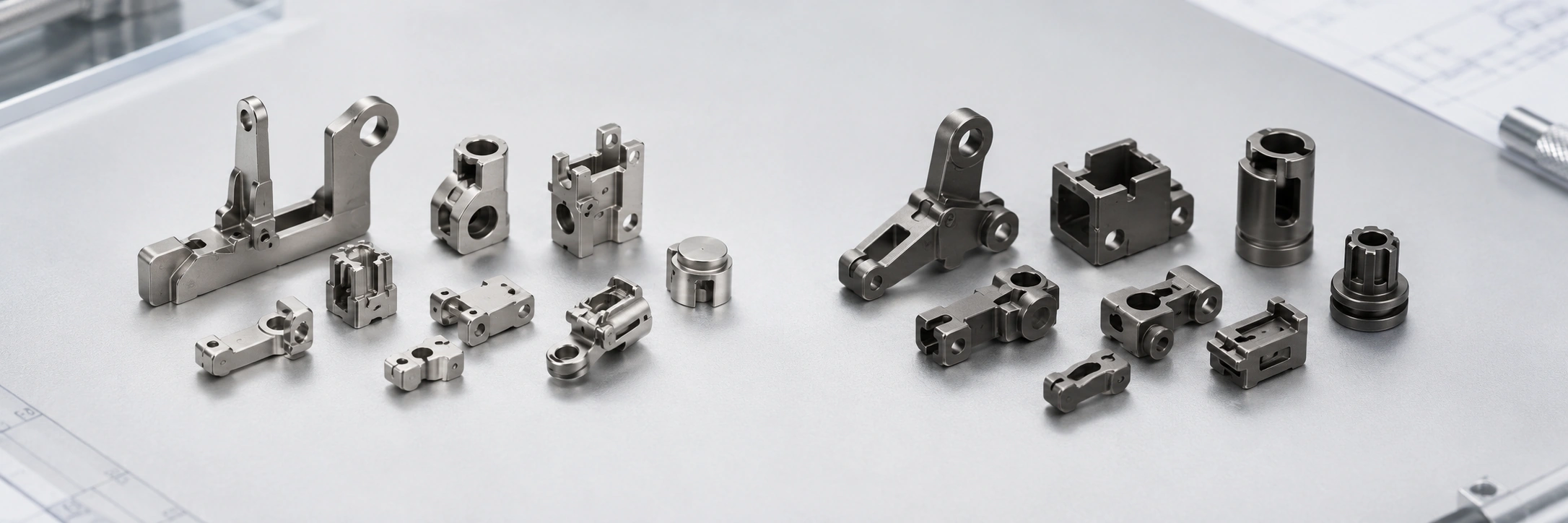
Core conclusion: The right material route depends on corrosion exposure, heat treatment, surface protection, and part function.
17-4 PH vs MIM 4605: The Short Engineering Answer
The core difference is not only stainless steel versus low-alloy steel. It is a project decision between stainless behavior, heat-treatable strength, surface exposure, and post-sintering control.
| Review Question | 17-4 PH Stainless Steel | MIM 4605 Low Alloy Steel |
|---|---|---|
| Is stainless behavior required? | Usually the stronger candidate. | Not stainless; exposure must be controlled. |
| Is the part internal and protected? | Possible, but may be more than needed. | Often worth review. |
| Is heat-treated strength important? | Yes, with aging condition review. | Yes, with quench, temper, or hardening route review. |
| Is appearance or staining risk important? | Usually safer. | Requires surface protection review. |
| Is wear or mechanical contact important? | Possible depending on design. | Often worth review when corrosion is controlled. |
| Is final tolerance tight after heat treatment? | Needs review. | Needs review. |
17-4 PH stainless steel is usually considered when the part needs a combination of strength and corrosion resistance. It is often reviewed for small MIM parts exposed to moisture, handling, cleaning, outdoor humidity, or visible surface requirements.
MIM 4605 low alloy steel is usually considered when corrosion exposure is controlled and the project is more focused on mechanical strength, hardness, wear contact, or heat-treated performance.
A common mistake is to ask which material is “stronger” without defining environment, heat treatment, critical dimensions, and corrosion risk. In production, this matters because the wrong material direction can affect tooling assumptions, heat-treatment distortion, secondary operation needs, inspection planning, and customer approval.
Project Review Workflow Before Choosing the Material
For broader material routing beyond this two-material comparison, review the MIM material selection guide before locking the drawing or RFQ requirement.
Material Family Difference: Stainless Steel vs Low-Alloy Steel
17-4 PH and MIM 4605 are not direct substitutes from the same material family. The page should be read as a MIM material route comparison, not a generic steel grade comparison.
ASTM B883-24 classifies MIM-4605 as a low-alloy steel material and MIM-17-4 PH as a precipitation-hardening stainless steel material. This supports treating them as separate MIM material routes rather than interchangeable steel grades.
What 17-4 PH Means in MIM
17-4 PH stainless steel belongs to the precipitation-hardening stainless steel direction. In MIM, this means the project team is usually reviewing a material that can combine stainless behavior with a heat-treatment route for higher strength.
The final condition still depends on the feedstock route, sintering, aging condition, section thickness, and inspection requirements. It should not be treated as the same corrosion route as every stainless grade, and it should not be approved without understanding the service environment.
What MIM 4605 Means in MIM
MIM 4605 low alloy steel is not selected for stainless corrosion behavior. It is usually reviewed for mechanical strength, hardness, wear resistance, and heat-treatment response in controlled environments.
If the part will be handled frequently, exposed to humidity, shipped without protection, or used where surface staining is unacceptable, the 4605 route needs a surface protection plan before it can be considered safe for the application.
This material family difference affects the RFQ review. If a drawing only says “steel” or “17-4 PH or 4605 acceptable,” the supplier cannot responsibly choose a route without understanding the use environment, load, hardness target, corrosion exposure, surface finish, and critical dimensions. The material name alone is not enough.
For broader material routing, review the MIM material comparison, stainless steel for MIM, and low alloy steel for MIM pages.
Engineering warning: MIM 4605 should not be approved just because the part is “steel,” and 17-4 PH should not be approved just because the part is “stainless.” The correct approval route depends on the environment, target final condition, post-sintering process, and inspection plan.

Core conclusion: Material family determines whether corrosion behavior or protected mechanical performance should drive the review.
Performance Trade-Offs in MIM Parts
Material selection should be reviewed through the actual function of the MIM part. For 17-4 PH vs MIM 4605, the most important trade-offs are corrosion behavior, strength direction, hardness, wear contact, heat-treatment response, dimensional stability, and surface protection.
| Trade-Off | 17-4 PH Direction | MIM 4605 Direction | RFQ Review Point |
|---|---|---|---|
| Strength and hardness | Strength with stainless behavior. | Low-alloy steel strength and hardness route. | Confirm final condition and inspection target. |
| Corrosion behavior | Usually safer when stainless behavior is needed. | Exposure must be controlled or protected. | Describe humidity, handling, cleaning, storage, and packaging. |
| Wear and contact | Possible when stainless behavior is also required. | Often worth review for internal protected contact parts. | Identify sliding, press-fit, or mating surfaces. |
| Heat treatment | Aging condition should be confirmed. | Hardening or quench / temper route may be reviewed. | Define required final condition before tooling. |
| Dimensional risk | Post-aging dimensions may need review. | Heat treatment may affect flatness, holes, or mating features. | Mark critical-to-function dimensions. |
| Surface protection | May still require finish review. | Often important if staining or rust risk exists. | Confirm coating, oiling, plating, PVD, or appearance expectations. |
Strength and Hardness Direction
Both materials can be reviewed for strength-oriented MIM parts, but the route is different. 17-4 PH is normally chosen when the project needs strength together with stainless behavior. MIM 4605 is normally reviewed when low-alloy steel strength, hardness, or wear behavior is more important than corrosion resistance.
If the drawing has a hardness requirement, load-bearing surface, press-fit area, or sliding contact, the project team should define the expected final condition before tooling. Related property topics can be reviewed through the MIM material properties, high-strength MIM materials, and high-hardness MIM materials pages.
Corrosion and Surface Protection
Corrosion exposure is often the first separation point. 17-4 PH should be reviewed first when the part is exposed to humidity, light corrosion, handling, customer-visible surfaces, or environments where staining would be unacceptable. MIM 4605 should not be treated as a stainless replacement.
If 4605 is used, the team should review whether oiling, coating, plating, black oxide, packaging, or controlled use conditions are needed. A low-alloy steel material can be acceptable in protected assemblies, but it becomes risky when the customer expects stainless behavior without stating it clearly. For related surface routes, review surface finishing for MIM parts and corrosion-resistant MIM materials.
Wear, Load, and Mechanical Contact
For internal mechanical contact, MIM 4605 may be a practical direction when corrosion is controlled and the design needs a hardened low-alloy steel response. Typical review areas include small latches, pivots, inserts, brackets, locking parts, and contact features where wear and strength are more important than appearance.
17-4 PH can also be used for mechanical parts, especially where stainless behavior is part of the requirement. The supplier should review part geometry, wall thickness, stress concentration, critical contact surfaces, and whether any features require post-sintering machining or sizing.
Dimensional Stability After Sintering and Heat Treatment
Both materials require dimensional review after sintering and heat treatment. MIM shrinkage, furnace route, support strategy, section thickness, sintering distortion, and post-sintering thermal treatment can all influence final dimensions.
For thin arms, flat parts, long slots, holes, mating surfaces, or tight tolerance locations, the project team should identify critical dimensions before quotation. The correct question is not only “17-4 PH or 4605,” but also “which features must be controlled after sintering, heat treatment, and secondary operations?”
What Can Go Wrong if the Material Is Selected Too Early?
| Early Assumption | Possible Project Risk | Better Review Action |
|---|---|---|
| “4605 is acceptable because the part is internal.” | Storage rust, handling stains, humidity exposure, or coating requirements may be missed. | Confirm real exposure during assembly, shipping, storage, and final use. |
| “17-4 PH is always safer because it is stainless.” | The project may pay for a stainless route when protected low-alloy steel could meet the function. | Separate corrosion requirement from strength, wear, and cost review. |
| “Heat treatment can be decided later.” | Hardness, flatness, hole position, or inspection scope may change after quoting. | Define final condition and critical-to-function dimensions before tooling. |
| “Surface finish is only cosmetic.” | Coating thickness, masking, wear surface changes, or appearance variation may affect assembly approval. | Confirm surface protection, visible areas, mating faces, and coating limits during RFQ. |

Core conclusion: A useful MIM material comparison connects material behavior to part function and inspection requirements.
When to Choose 17-4 PH for a MIM Project
17-4 PH is usually the first review direction when the part needs a stainless material route but cannot accept a soft or lower-strength stainless option.
Parts Exposed to Moisture or Mild Corrosion
If the component may contact humidity, sweat, cleaning residue, outdoor air, or customer handling, 17-4 PH is usually safer than 4605 from a corrosion behavior standpoint.
Strength Requirements With Stainless Behavior
17-4 PH becomes relevant when the part cannot be selected only for corrosion resistance. If the part also needs load capacity, stiffness, thread engagement, contact strength, or assembly durability, it may provide a more balanced review direction.
Appearance-Sensitive or Customer-Facing Components
If the part is visible after assembly, staining and surface appearance may become part of the material decision. In these cases, 17-4 PH is often easier to justify than a low-alloy steel route.
Approval Checklist Before Choosing 17-4 PH
| Check Item | Why It Matters | What to Confirm |
|---|---|---|
| Corrosion environment | 17-4 PH is stainless, but not a universal corrosion solution. | Humidity, sweat, cleaning, chloride exposure, storage, and visible staining risk. |
| Aging / final condition | Final performance depends on the agreed heat-treatment condition. | Required condition, hardness target if any, and inspection method. |
| Critical dimensions | Post-aging or post-sintering processes may affect functional dimensions. | Holes, flatness, mating datums, press-fit areas, and sliding surfaces. |
| Surface appearance | Customer-facing parts may need finish control beyond material choice. | Blasting, polishing, passivation expectation, PVD, or visible surface criteria. |
17-4 PH should not be positioned as a universal corrosion solution. Strong chloride exposure, aggressive chemicals, or special cleaning requirements still require a separate material and surface review.
When to Choose MIM 4605 Low Alloy Steel
MIM 4605 should be reviewed when the project is focused on structural performance, hardness, wear behavior, and heat-treatment response in an environment where stainless corrosion resistance is not required.
Internal Mechanical Parts With Controlled Corrosion Exposure
4605 can be a practical direction for internal parts inside protected assemblies, including small brackets, mechanical inserts, retaining parts, locking features, internal linkages, and functional components that are not exposed to visible or aggressive corrosion conditions.
Heat-Treated Strength and Wear-Oriented Components
When the part needs hardness, wear resistance, or load-bearing contact, 4605 may deserve review. The project team should define whether the part is expected to be supplied as-sintered, heat treated, hardened, tempered, coated, or machined after sintering.
Parts Where Coating, Oil, or Surface Protection Is Acceptable
MIM 4605 may be suitable when the customer accepts surface protection. Possible review directions include oiling, plating, black oxide, coating, or controlled packaging, depending on part geometry and final use.
Approval Checklist Before Choosing MIM 4605
| Check Item | Why It Matters | What to Confirm |
|---|---|---|
| Real corrosion exposure | 4605 is not stainless and may need protection. | Assembly exposure, transport storage, humidity, handling, packaging, and final use. |
| Heat-treatment route | Mechanical behavior depends on final condition. | Hardness target, tempering route, distortion risk, and inspection method. |
| Surface protection plan | Protection may affect appearance, dimension, and mating surfaces. | Oiling, coating, plating, black oxide, masking, thickness limits, and visual criteria. |
| Functional surfaces | Wear and contact areas may need special control. | Sliding faces, press-fit areas, holes, datum surfaces, and any post-sintering machining. |
MIM 4605 should not be positioned as a direct stainless replacement. If the application cannot accept coating thickness variation, edge buildup, masking risk, appearance variation, or post-treatment handling marks, the 4605 route may become less attractive.
Heat Treatment and Post-Sintering Review
Heat treatment is one of the main reasons this comparison cannot be reduced to a simple material name. Both 17-4 PH and MIM 4605 can involve post-sintering thermal processing, but the purpose and review logic are different.
ASTM B883-24 describes MIM materials as being fabricated by mixing metal powders with binders, injection molding, debinding, and sintering, with or without subsequent heat treatment. For this reason, the final material condition should be confirmed before tooling approval, not treated as a later detail.
17-4 PH Aging Condition Should Be Confirmed
17-4 PH is a precipitation-hardening stainless steel, so the final condition depends strongly on aging and project requirements. Before tooling, the customer and supplier should confirm whether the part needs a specific condition, hardness range, strength direction, corrosion expectation, or post-aging dimensional inspection.
MIM 4605 Quench and Temper Review
MIM 4605 low alloy steel is often reviewed for heat-treated mechanical performance. The project team should confirm whether the part requires hardening, tempering, case-related review, or another final condition.
Distortion and Critical Dimension Risk
Heat treatment can affect flatness, roundness, hole position, and mating dimensions. For critical holes, sliding surfaces, press-fit areas, thread locations, or assembly datums, post-sintering machining, MIM sizing, or additional inspection may be needed.
For broader secondary operation context, review MIM heat treatment and post-sintering machining.
From a production review perspective, the material decision should be connected to the full MIM route: feedstock selection, injection molding, debinding, sintering shrinkage, heat treatment, possible sizing or machining, surface treatment, and final inspection. A drawing that defines only the grade but not the final condition can still leave the supplier with unclear cost and quality assumptions.

Core conclusion: Final material approval should include heat-treatment condition, critical dimensions, and inspection strategy.
Application Comparison for MIM Parts
The practical choice between 17-4 PH and MIM 4605 depends on the part’s job in the assembly. A part that looks similar in CAD may require a different material when the environment, load, surface contact, and appearance expectations are reviewed.
| Part Situation | Usually Review 17-4 PH When | Usually Review MIM 4605 When |
|---|---|---|
| Small structural components | Strength and stainless behavior must be balanced. | The part is internal, protected, and focused on mechanical strength. |
| Wear or contact components | Contact feature also needs stainless behavior or surface stability. | Corrosion is controlled and low-alloy hardness / wear response is important. |
| Corrosion-exposed components | The part faces humidity, handling, or staining risk. | Only when exposure is controlled or surface protection is acceptable. |
| Decorative or appearance-sensitive components | Visible staining risk needs to be reduced. | Only when a clear surface protection strategy is acceptable. |
Composite Field Scenario for Engineering Training
A small locking insert is being reviewed for a MIM project. The part has a compact geometry, a sliding contact surface, and two holes that affect assembly position. It will be used inside a protected mechanism, but it may be handled during assembly and stored before final installation.
If corrosion exposure is truly controlled and surface protection is acceptable, MIM 4605 may be reviewed for heat-treated strength and wear behavior. If visible staining, humidity exposure, or customer appearance risk cannot be controlled, 17-4 PH becomes the safer first review direction. The final decision should be made after reviewing the drawing, heat-treatment target, surface exposure, and inspection points.
RFQ Checklist Before Selecting 17-4 PH or MIM 4605
A reliable material recommendation requires more than a material name. Before asking for a quotation, the project team should prepare the following information.
| RFQ Item | Why It Matters |
|---|---|
| 2D drawing and 3D model | Confirms geometry, tolerances, and critical features. |
| Application environment | Separates stainless need from protected low-alloy steel use. |
| Load and wear condition | Supports strength and hardness review. |
| Heat-treatment expectation | Affects final performance, distortion risk, and inspection. |
| Surface protection requirement | Especially important for MIM 4605. |
| Appearance requirement | Helps decide whether stainless behavior is needed. |
| Annual volume | Affects tooling and unit cost review. |
| Critical dimensions | Helps plan machining, sizing, and inspection. |
| Inspection expectation | Clarifies whether hardness, appearance, dimensional, or surface checks must be included. |
| Allowed secondary operations | Helps compare machining, sizing, coating, polishing, PVD, or other finishing routes. |
For a broader quotation package, use the MIM RFQ preparation guide before sending files for engineering review.

Core conclusion: RFQ quality improves when the material comparison is tied to real part function and exposure conditions.
FAQ About 17-4 PH vs MIM 4605
Can MIM 4605 replace 17-4 PH stainless steel?
MIM 4605 should not be treated as a direct replacement for 17-4 PH. It may be considered when corrosion exposure is controlled and the part mainly needs low-alloy steel strength, hardness, or wear behavior. If stainless corrosion behavior, appearance stability, or staining resistance is required, 17-4 PH is usually the safer review direction.
Is 17-4 PH always better than MIM 4605?
No. 17-4 PH and MIM 4605 serve different engineering needs. 17-4 PH is usually reviewed for strength plus stainless behavior. MIM 4605 is usually reviewed for protected mechanical parts where heat-treated low-alloy steel performance is more important than stainless corrosion resistance.
Which material is better for corrosion resistance?
17-4 PH is usually the stronger candidate when stainless behavior is required. MIM 4605 is a low-alloy steel and normally needs controlled exposure or surface protection if corrosion is a concern. For aggressive corrosion environments, the project may need a separate stainless or special alloy review.
Which material is better for hardened mechanical parts?
Both materials may be reviewed for heat-treated mechanical parts, but the logic is different. 17-4 PH uses a precipitation-hardening stainless route. MIM 4605 uses a low-alloy steel route and may be attractive for internal mechanical parts where hardness, wear, and protected use conditions are important.
What information should I send before choosing between 17-4 PH and MIM 4605?
Send the 2D drawing, 3D model, application environment, load condition, hardness target, heat-treatment expectation, surface finish requirement, critical dimensions, inspection expectation, and annual volume. Without these details, the material comparison is only a rough direction, not a reliable project recommendation.
Technical Note
17-4 PH and MIM 4605 should be reviewed as different MIM material families. Published MIM material standards and industry references can help engineering teams verify terminology, material family classification, and heat-treatment-related review requirements. Final project approval should still be based on the drawing, application environment, supplier process route, agreed secondary operations, and inspection criteria.
Technical References
The following external references may help engineering and sourcing teams review material terminology, MIM material standards, and material specification background. These links do not imply endorsement, certification, or project approval.
- ASTM B883-24 — Standard Specification for Metal Injection Molded (MIM) Materials — Used as a standards reference for MIM material terminology, material family classification, and specification background.
- MPIF Standards — Used as an industry standards reference for powder metallurgy and MIM material specification context.
- Materials Standards for Metal Injection Molded Parts — 2025 Edition — Used as an MPIF / MIMA standards update reference for MIM material standards context.
Review 17-4 PH or MIM 4605 Before Tooling
Send your drawing, 3D model, application environment, material target, heat-treatment expectation, surface requirement, critical dimensions, inspection expectations, and annual volume. XTMIM can help review whether 17-4 PH or MIM 4605 is the more suitable material direction for your MIM part.