
MIM Low Alloy Steel Materials for Metal Injection Molding Parts
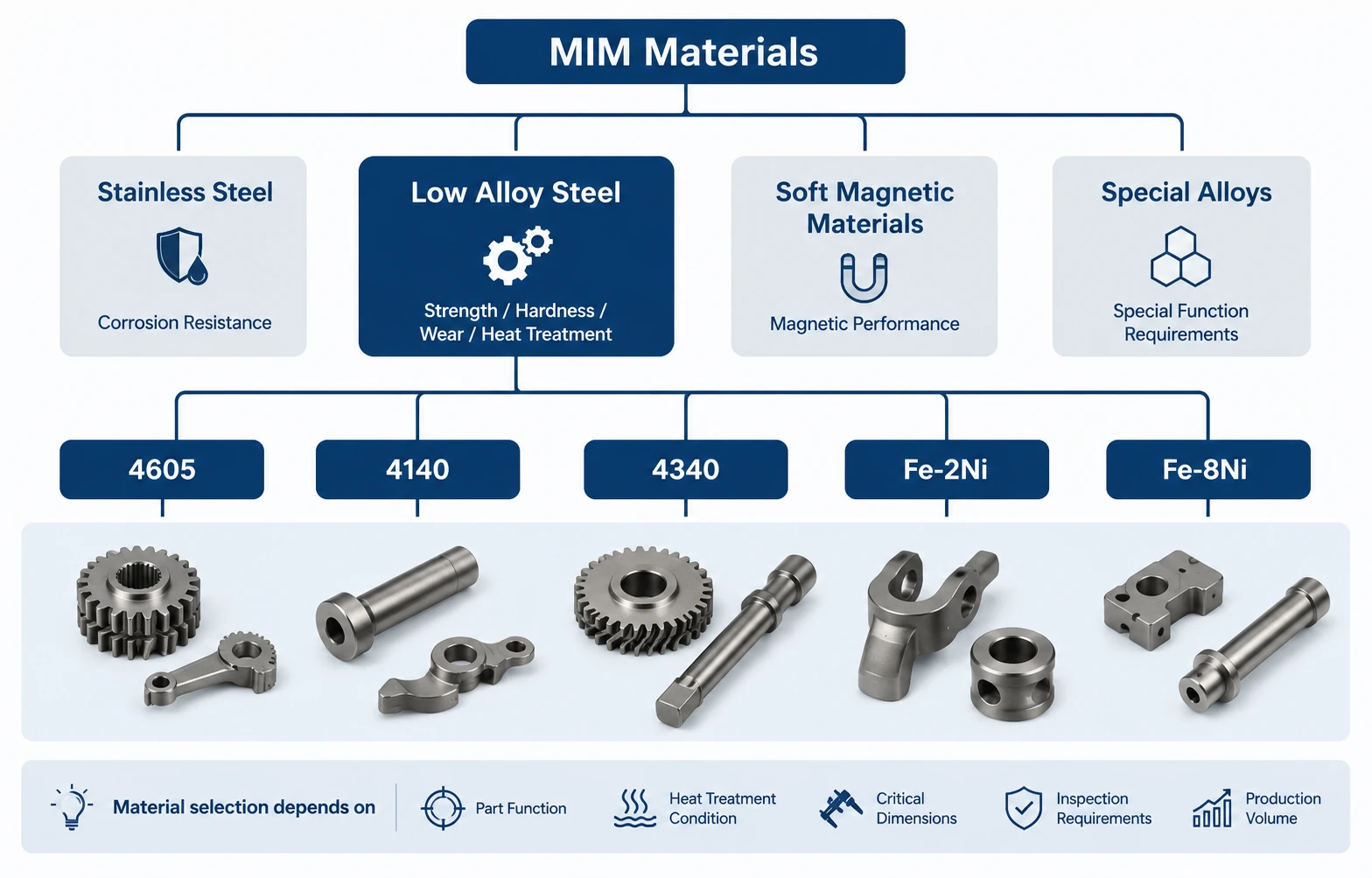
MIM low alloy steel is a practical material family for small, complex parts that need strength, hardness, wear resistance, or a defined heat-treatment response. This family page helps engineers decide whether low alloy steel is the right starting point and routes grade-specific review to MIM 4605, 4140, 4340, Fe-2Ni, Fe-4Ni, or Fe-8Ni. Selection should be based on the required final material condition, critical dimensions after sintering or heat treatment, wear surfaces, and inspection timing—not on the grade name alone. When corrosion resistance, soft magnetic response, biocompatibility, or extreme-temperature performance is the primary requirement, another MIM material family should be reviewed first.
When Low Alloy Steel Is the Right MIM Material
Low alloy steel is a strong MIM candidate when a compact part must carry load, resist repeated contact, or reach a defined hardness after heat treatment. Suitability depends on the complete production route—geometry, tooling compensation, sintering support, treatment condition, and final inspection—not simply on whether the alloy can be molded.
Start with low alloy steel when the part has:
- compact, complex geometry with functional mechanical loading;
- gears, teeth, hooks, latches, locking faces, shafts, pins, or rotating features;
- hardness, strength, or wear requirements that depend on heat treatment;
- critical contact surfaces that can be inspected after final processing;
- production volume sufficient to justify MIM tooling;
- geometry that would require substantial CNC machining from bar stock.
Review another route first when:
- corrosion resistance is the dominant material requirement;
- the part is exposed to marine, food-contact, chemical, or medical environments;
- soft magnetic response or biocompatibility is the main performance target;
- the component is large, simple, and not geometry-driven;
- low annual volume cannot justify tooling;
- CNC machining, casting, forging, stamping, or PM pressing offers a more direct route.
Where Low Alloy Steel Fits in MIM Material Selection
Low alloy steels occupy the structural, heat-treatable part of the MIM material system. They differ from MIM stainless steels, which are normally selected when corrosion resistance is central; from soft magnetic MIM materials, which are selected for magnetic response; and from titanium, cobalt-chromium, controlled-expansion, and other special MIM alloys, which address more specialized performance requirements.
Industry MIM material references include low alloy steel routes such as 4140, 4340, 4605, and Fe-Ni compositions. For chromium-bearing routes such as 4140 and 4340, see how chromium affects MIM low-alloy steel to understand the role of chromium in hardenability and heat-treatment response. A listed alloy name does not by itself confirm project suitability: feedstock availability, sintered condition, heat-treatment route, geometry, and the required test method still need to be confirmed for the specific RFQ.
Corrosion-driven parts
Start with MIM stainless steel materials and then select the grade according to corrosion, strength, and hardness requirements.
Magnetic-function parts
Review soft magnetic MIM materials such as Fe-3Si, Fe-50Ni, or Fe-50Co rather than treating them as low alloy structural steels.
Special-performance parts
Review special MIM alloys when weight, biocompatibility, controlled thermal expansion, high-temperature resistance, or extreme wear dominates the decision.
Because iron–nickel terminology also covers soft-magnetic Fe-50Ni and controlled-expansion Invar or Kovar routes, review iron–nickel alloys in MIM when the drawing does not clearly distinguish structural strength from magnetic or thermal-expansion requirements.
Family-Level MIM Low Alloy Steel Grade Routing Matrix
Use the matrix below to identify the first grade page worth reviewing. It combines the former grade selector and function-based review table into one family-level decision path. The linked grade pages own detailed chemistry, property ranges, heat-treatment conditions, and grade-specific acceptance guidance.

| Grade Route | Use as the First Review When the Part Mainly Needs | Family-Level Reason | Confirm Before Selection |
|---|---|---|---|
| MIM 4605 | High-strength structural performance, hardness, and wear resistance in compact functional parts. | A common starting route for heat-treated MIM structural components. | Heat-treatment condition, hardness target, distortion risk, and post-treatment critical dimensions. |
| MIM 4140 | A familiar Cr-Mo strength-and-toughness material logic. | Useful when the design team already works with 4140-type engineering requirements. | MIM feedstock availability, MIM-specific acceptance values, density, and final material condition. |
| MIM 4340 | Higher hardenability or a more demanding strength-and-toughness balance. | A more specialized starting point for load-bearing and toughness-driven review. | Property target, treatment route, section thickness, distortion control, and testing method. |
| Fe-2Ni | Moderate structural strength with an Fe-Ni ductility balance. | A lower-nickel Fe-Ni route when Cr-Mo steel is not the preferred starting point. | As-sintered or heat-treated condition, density, toughness expectation, and feedstock availability. |
| Fe-4Ni | An intermediate Fe-Ni option between lower- and higher-nickel routes. | Useful for project-specific comparison of strength, ductility, chemistry, and availability. | Exact feedstock chemistry, supplier data, sintering route, and project-specific test requirements. |
| Fe-8Ni | A higher-nickel Fe-Ni structural route with a different strength-and-ductility balance. | Useful when the project needs a direct comparison with Fe-2Ni, Fe-4Ni, or 4605-type materials. | Functional requirement, material condition, dimensional stability, and current feedstock availability. |
| Project-specific or equivalent grade | A drawing specifies a conventional designation, customer standard, or equivalent-property target. | The closest MIM route cannot be chosen from the name alone. | Submit the drawing for material review, including final condition, critical dimensions, test method, and annual volume. |
Material Availability, Feedstock, and Project-Specific Confirmation
MIM material selection is not the same as selecting conventional wrought steel from a catalog. The required alloy must be available as a suitable pelletized MIM feedstock and then validated through injection molding, green-part handling, debinding, sintering, and any required post-sintering heat treatment or finishing.
Before specifying a low alloy steel for MIM, confirm:
- whether the requested grade or an acceptable equivalent feedstock is currently available;
- whether the geometry supports injection molding and controlled sintering shrinkage;
- whether mechanical requirements apply in the as-sintered or heat-treated condition;
- whether critical dimensions are inspected after sintering, heat treatment, sizing, or machining;
- whether secondary machining, surface treatment, or finishing is required;
- whether the inspection method reflects the functional use of the part.
Material Condition and Acceptance Items for MIM Low Alloy Steel
For low alloy steel MIM parts, the final specification should define the material condition, not only the grade name. A part used in as-sintered condition, quenched and tempered condition, or case-hardened condition may require different acceptance items, inspection timing, and dimensional review. This is one of the most important points to clarify before tooling.
| Material Condition | What Changes | What to Specify | Inspection Risk |
|---|---|---|---|
| As-sintered | Properties depend mainly on material chemistry, sintered density, carbon control, and sintering atmosphere. | Grade, density expectation, critical dimensions, mechanical requirement, and surface condition. | Do not assume wrought steel values. Confirm the property range using MIM-specific material data and sample validation. |
| Quenched and tempered | Hardness, strength, and wear resistance may improve, but dimensional shift and distortion risk may increase. | Hardness target, tempering condition, critical dimensions after heat treatment, and final inspection sequence. | Dimensions that are functional after assembly should usually be verified after heat treatment, not only after sintering. |
| Case-hardened or surface-hardened | Surface wear resistance may improve while the core behavior remains different from through-hardened material. | Wear surface location, target case depth if required, surface hardness, mating material, and distortion allowance. | Thin walls, sharp edges, holes, and asymmetric geometry should be reviewed carefully before applying surface hardening. |
| Post-sintering machined | Critical holes, threads, sealing faces, or datum surfaces may be corrected after sintering or after heat treatment. | Machining allowance, datum strategy, inspection datum, and which features remain as-molded. | Unclear machining timing can create mismatch between drawing tolerances, heat treatment distortion, and final assembly fit. |
Why Heat Treatment Condition Matters More Than the Grade Name
For many MIM low alloy steel parts, the final engineering performance depends heavily on heat treatment. The same grade name can represent different performance levels depending on whether the part is used in as-sintered condition, quenched and tempered condition, or another project-specific treatment condition.

From a production perspective, heat treatment can improve hardness, strength, and wear resistance, but it may also introduce distortion, dimensional change, surface condition changes, or new inspection requirements. For small precision MIM parts, the key issue is not only whether the material can be hardened, but whether the part can still meet functional dimensions after heat treatment.
Review before tooling
- hardness target and acceptable hardness range;
- toughness or impact requirement;
- wear surface location;
- critical dimensions after heat treatment;
- risk of warpage or distortion.
Review after samples
- hardness check method and location;
- flatness, roundness, and functional fit;
- surface condition after heat treatment;
- whether post-heat-treatment machining is required;
- fit with mating components.
For high-strength MIM low alloy steel parts, heat treatment should be discussed before tooling, not after samples fail to meet the application requirement. Related property-driven pages include high-strength MIM materials, heat-treatable MIM materials, and high-hardness MIM materials.
Applications Best Suited to MIM Low Alloy Steel
Low alloy steel is most useful when the part is both mechanically functional and geometrically suitable for MIM. The strongest applications are not defined only by industry, but by the function of the part.

| Application Type | Why Low Alloy Steel May Fit | Key Review Point |
|---|---|---|
| Small gears and transmission parts | Need wear resistance, strength, and stable tooth geometry. | Tooth geometry, shrinkage control, hardness, and post-sintering inspection. |
| Locking parts and latches | Require repeated engagement, load-bearing faces, and edge durability. | Contact faces, local stress, wear marks, and heat treatment condition. |
| Shafts, pins, and levers | Need a balance of strength, toughness, and dimensional consistency. | Straightness, roundness, critical diameters, and secondary finishing. |
| Hinges and rotating parts | Require wear resistance and stable movement after assembly. | Hole accuracy, mating surfaces, friction, and surface finish. |
| Structural brackets and carriers | Need strength in compact geometry. | Wall thickness, ribs, fillets, sintering support, and flatness. |
| Industrial mechanism parts | Need functional performance at production volume. | Load direction, assembly fit, failure mode, and inspection plan. |
Low alloy steel is not automatically suitable for every structural part. Large, simple, low-complexity parts may be better made by CNC machining, forging, casting, PM pressing, or stamping. MIM is strongest when geometry, miniaturization, part consolidation, and production volume justify the tooling route.
DFM and Manufacturing Risks to Review Before Tooling
Low alloy steel MIM projects should be reviewed early because strength-driven parts often have tight functional requirements. A drawing may look simple, but the combination of high hardness, small features, shrinkage, and post-treatment dimensions can create production risk.
| Risk Area | Why It Matters | What to Review Before Tooling |
|---|---|---|
| Carbon control | Affects hardness, strength, and heat treatment response. | Material specification, sintering atmosphere, and final test method. |
| Sintering distortion | Load-bearing parts often have functional geometry. | Wall thickness balance, support strategy, flatness, and symmetry. |
| Heat treatment distortion | Quench and temper processes can change dimensions. | Critical dimensions after heat treatment and inspection sequence. |
| Density and residual porosity | Influence mechanical performance and fatigue behavior. | Density requirement, test samples, acceptance criteria, and risk areas. |
| Wear surface performance | Contact surfaces may need hardness or finishing control. | Surface finish, hardness requirement, and mating material. |
| Secondary machining | Some holes, threads, sealing faces, or datum surfaces may still require machining. | Machining allowance, datum strategy, and cost impact. |
| Surface oxidation or decarburization | Can affect appearance and performance. | Furnace atmosphere, cleaning, coating, and surface inspection. |
| Assembly fit | Strong parts still fail if mating geometry is unstable. | Mating part tolerance, functional gauge, and sample validation. |
The best time to identify these risks is before mold design. Once tooling is built, changes to shrinkage compensation, parting line, gate position, support strategy, or heat-treatment allowance become more expensive. Related process pages include MIM sintering and MIM secondary operations.
Scenario disclosure: This representative scenario combines common heat-treatment, dimensional-control, and inspection conditions. It is not a named customer project or a report of project-specific production data.
Heat-Treated Locking Part With Dimensional Shift
Problem: a compact locking part reached the target hardness after heat treatment, but the relationship between a functional slot and pin hole shifted enough to create assembly friction.
Cause: the early review focused on grade and hardness while post-heat-treatment datum, dimensional acceptance, and functional gauging were not defined before tooling. Geometry asymmetry and treatment distortion therefore affected assembly performance.
Engineering handling: the affected dimensions were reclassified as post-heat-treatment requirements, the fixture and inspection sequence were revised, and selected contact areas were reviewed for sizing or secondary-finishing allowance.
Prevention: before tooling, define the hardness range, treatment route, final datum system, inspection timing, mating-part tolerance, functional gauge, and any post-treatment machining or sizing requirement.
When Another MIM Material Family May Be Better
Low alloy steel is an important MIM material family, but it is not the default answer for every metal part. In many projects, another material family should be reviewed first.
| Primary Requirement | Better Material Path to Review |
|---|---|
| Corrosion resistance | Review MIM stainless steel materials. Grades such as 304, 316L, 420, or 440C may be considered according to corrosion and hardness requirements; 17-4 PH stainless steel is especially relevant when both strength and corrosion resistance are required. |
| Strength plus corrosion resistance | 17-4 PH stainless steel may be more relevant than low alloy steel. |
| Soft magnetic response | Review soft magnetic MIM materials. Fe-3Si, Fe-50Ni, and Fe-50Co may be compared according to magnetic response, strength, and application conditions. |
| Biocompatibility | Titanium alloys or cobalt-chromium alloys under special MIM alloys. |
| Controlled thermal expansion | Kovar, Invar, or other controlled expansion alloys. |
| Extreme wear resistance | Tool steel, cemented carbide, or other specialized materials. |
| Simple large geometry | CNC machining, casting, forging, stamping, or PM pressing may be more economical. |
For a direct strength-versus-corrosion decision, review 17-4 PH vs MIM 4605. Detailed comparisons among 4605, 4140, 4340, and Fe-Ni routes should remain on the relevant grade or comparison pages rather than being expanded into this family-level guide.
What to Provide for Low Alloy Steel Material Selection Review
For a useful material review, a supplier needs more than a part name and a target grade. The more complete the project information, the more accurately the engineering team can judge whether low alloy steel, stainless steel, or another MIM material is the better path.

Recommended technical files
- 2D drawing with tolerances;
- 3D model if available;
- target material or equivalent material;
- required hardness, strength, or wear performance;
- heat treatment requirement;
- critical dimensions and functional surfaces.
Recommended project background
- surface finish, coating, or appearance requirement;
- mating parts and assembly function;
- load direction, wear condition, or failure concern;
- estimated annual volume;
- prototype and production schedule;
- customer documentation, inspection, or approval requirements, if applicable.
For early projects, the material does not need to be finalized before contacting XTMIM. A practical approach is to submit the drawing and explain the application environment, then review whether 4605, 4140, 4340, Fe-Ni steel, stainless steel, or another MIM material family is more appropriate.
Need to Confirm Whether Low Alloy Steel Is Suitable for Your MIM Part?
If your part requires high strength, hardness, wear resistance, or heat-treatment response, send your drawing, 3D CAD file if available, target material, tolerance requirements, critical dimensions, surface requirement, application load, and estimated annual volume to XTMIM for material and DFM review. Please identify whether critical dimensions and hardness targets apply before or after heat treatment.
Our engineering team can review whether MIM low alloy steel is suitable, which grade should be evaluated first, and what tooling, injection molding, debinding, sintering, heat treatment, secondary operation, or inspection risks should be confirmed before production.
FAQ About MIM Low Alloy Steel Materials
What is MIM low alloy steel used for?
MIM low alloy steel is used for small, complex metal parts that need strength, hardness, wear resistance, or heat-treatment response. Typical examples include small gears, locking parts, shafts, pins, levers, hinges, rotating parts, and compact load-bearing mechanism components.
Can MIM low alloy steel be heat treated?
Many MIM low alloy steel parts can be reviewed for heat treatment, depending on the grade, chemistry, density, sintering condition, and application requirement. Heat treatment can improve hardness and strength, but it may also introduce distortion or require post-treatment inspection.
How do I choose between MIM 4605, 4140, and 4340?
Start from the part function. MIM 4605 is often reviewed for high-strength structural and wear-related parts. MIM 4140 is useful when a Cr-Mo engineering steel family is preferred. MIM 4340 may be reviewed when higher hardenability or tougher load-bearing performance is needed. The final choice should be confirmed through drawing review, heat treatment condition, and testing requirements.
What is the difference between as-sintered and heat-treated MIM low alloy steel?
As-sintered MIM low alloy steel is evaluated after sintering without an additional hardening step. Heat-treated material is processed further to improve hardness, strength, or wear resistance, but heat treatment may also change dimensions or increase distortion risk. The drawing should state whether hardness and critical dimensions apply before or after heat treatment.
Should I choose MIM 4605 or 17-4 PH stainless steel?
Choose MIM 4605 when strength, hardness, wear resistance, and heat-treatment response are the main requirements and corrosion resistance is not the primary concern. Review 17-4 PH stainless steel when the part needs a combination of strength and better corrosion resistance. The final decision should be based on application environment, heat treatment, dimensions, and inspection requirements.
Is low alloy steel better than stainless steel for MIM?
Not always. Low alloy steel is usually selected for strength, hardness, wear resistance, or heat-treatment response. Stainless steel is normally better when corrosion resistance is the primary requirement. If the part needs both strength and corrosion resistance, 17-4 PH stainless steel may be worth reviewing.
Is MIM 4605 the same as conventional 4605 steel?
No. The grade name may be similar, but MIM 4605 is produced through the metal injection molding route using pelletized feedstock, followed by injection molding, debinding, sintering, and possible heat treatment. Properties and acceptance criteria should be specified for the MIM process route, not assumed directly from wrought or machined steel data.
What information should I provide before choosing a low alloy steel grade?
Provide the drawing, 3D model if available, target material, hardness or strength requirement, heat treatment requirement, critical dimensions, surface requirement, application load, mating part information, and estimated annual volume. This allows the supplier to review material suitability before tooling.
Standards and Technical Reference Note
Material names, property expectations, and acceptance criteria for MIM low alloy steel parts should be confirmed using the current project specification, applicable supplier data, and standards relevant to the required material condition and test method.
The MIMA Materials Range provides a general reference for MIM material families and emphasizes supplier confirmation of material availability.
MPIF Standard 35-MIM covers commonly used MIM materials and associated explanatory information. MPIF released the 2025 edition of its MIM material standards; project teams should identify the edition used in purchasing or acceptance documents rather than referring to “Standard 35” without an edition.
ASTM B883-24 is the active ASTM specification for metal injection molded materials. Its scope includes ferrous MIM materials produced by molding, debinding, and sintering, with or without subsequent heat treatment, including specified low alloy steel compositions.
ISO 22068:2012 specifies chemical-composition and mechanical or physical-property requirements for sintered metal injection-moulded materials. ISO states that this edition was reviewed and confirmed in 2023 and remains current. It applies to MIM components rather than wrought steel or other PM routes.
These references support material discussion but do not replace grade-specific supplier data, drawing review, sample validation, heat-treatment definition, or the inspection agreement for the actual part.