MIM Material Selection Notes Iron–nickel alloys used in metal injection molding cover several distinct engineering routes. The correct choice depends on whether the part is structural, soft magnetic, dimensionally stable across temperature, or designed to match another material during thermal cycling. Quick Answer Iron–nickel alloys in MIM are not one interchangeable material group. Fe-2Ni, Fe-4Ni …
MIM Material Selection Notes
Iron–nickel alloys used in metal injection molding cover several distinct engineering routes. The correct choice depends on whether the part is structural, soft magnetic, dimensionally stable across temperature, or designed to match another material during thermal cycling.
Quick Answer
Iron–nickel alloys in MIM are not one interchangeable material group. Fe-2Ni, Fe-4Ni and Fe-8Ni are normally reviewed as structural low-alloy steel directions. Fe-50Ni belongs to a soft-magnetic route, where density, annealing and the agreed magnetic test method may matter more than ordinary structural strength. FeNi36 or Invar-type alloys are selected when low thermal expansion and dimensional stability are the main requirements. Kovar belongs to a related iron–nickel–cobalt route used for controlled expansion and compatibility with selected glass or ceramic systems. Nickel-base alloys such as IN718 solve a different high-temperature or corrosion-related problem. Before tooling, define the component function, operating environment, geometry, feedstock availability, thermal treatment and acceptance method—not only the nickel percentage.
For a broader starting point, review the MIM Material Selection Guide.
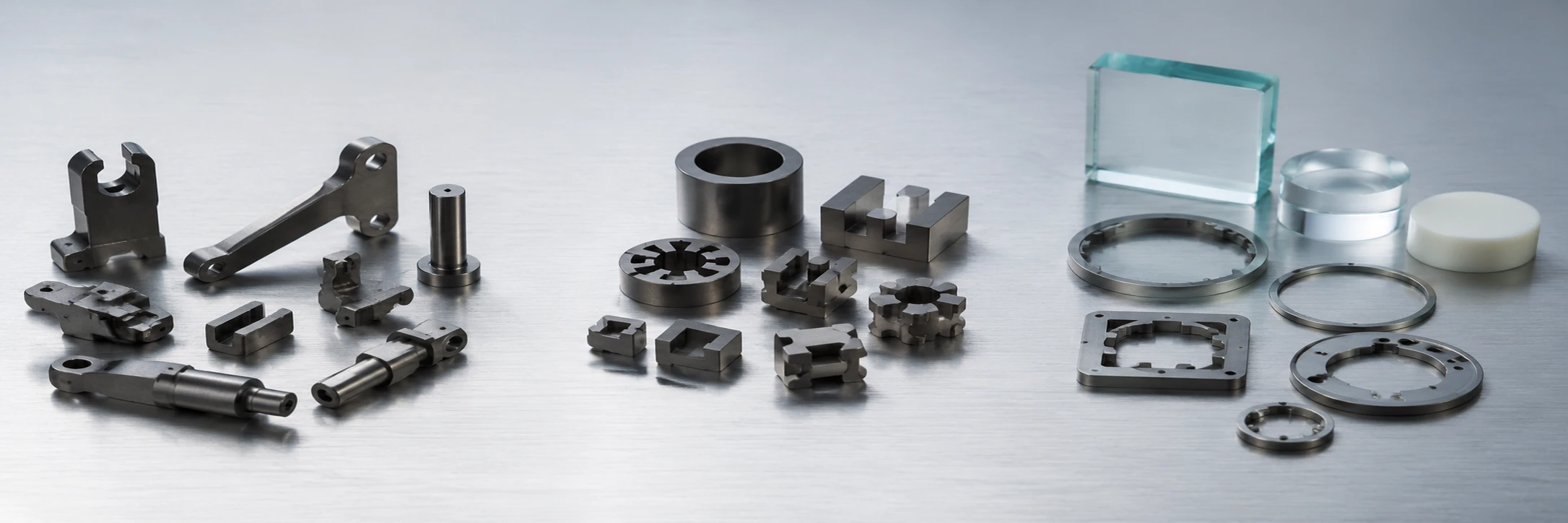
Engineering takeaway: Iron–nickel alloys must be selected by component function, not by nickel percentage alone.
Functional Routing
Which Iron–Nickel Alloy Route Fits Your MIM Part?
A drawing that only states “Fe-Ni alloy” is not specific enough for a reliable material decision. The engineering team first needs to identify what the nickel-containing alloy is expected to do.
Structural Load and Heat Treatment
Start with the MIM low-alloy steel family when the part primarily carries load, transmits motion, resists local contact stress or requires a heat-treated structural condition.
Fe-2Ni, Fe-4Ni and Fe-8Ni are candidate directions, but they are not a simple performance ladder. Required condition, heat treatment, geometry, distortion sensitivity, inspection stage and feedstock availability still control the decision.
Soft-Magnetic Function
Move to the soft-magnetic MIM material route when the component must guide, concentrate, switch or respond to a magnetic field.
Fe-50Ni should be specified around the required magnetic function, density, annealed condition, geometry and agreed test method—not as a higher-strength version of a low-nickel structural steel.
Low Expansion or Expansion Matching
Move to the controlled-expansion alloy family when temperature-related dimensional change is the main concern.
Invar-type alloys support low dimensional change, while Kovar-type Fe-Ni-Co alloys support expansion compatibility with selected glass or ceramic systems.
Key engineering point: Select the required function first, then the alloy family, then the grade and final production condition.
Decision Support
Iron–Nickel Alloy Selection Matrix for MIM
Use this matrix for early material-family screening. It is not a substitute for a grade datasheet, test plan or supplier feasibility review.
There is no single universal “iron–nickel alloy composition.” Chemistry must be tied to the required function, the exact material specification and the final MIM production condition.
| Engineering Requirement | First Route to Review | Representative Direction | Why It May Fit | Main Risk or Trade-Off | Confirm Before Tooling |
|---|---|---|---|---|---|
| Structural load and heat-treatment response | Fe-Ni low-alloy steel | Fe-2Ni, Fe-4Ni, Fe-8Ni | Supports a structural and heat-treatment-oriented review | Distortion, surface protection and final condition may control the project | Load case, heat treatment, target condition, critical dimensions and inspection stage |
| Soft-magnetic response | Soft-magnetic Fe-Ni | Fe-50Ni | Intended for magnetic rather than ordinary structural function | Magnetic behavior depends on density, thermal treatment, geometry and test method | Permeability or coercivity target, operating field, frequency and annealed condition |
| Low thermal expansion | Controlled-expansion Fe-Ni | FeNi36 / Invar-type alloy | Supports dimensional stability across a defined temperature range | Expansion behavior varies with composition, condition and temperature interval | Required CTE range, operating temperature, datum strategy and dimensional acceptance |
| Expansion matching with another material | Fe-Ni-Co controlled-expansion alloy | Kovar-type alloy | Can be reviewed where metal-to-glass or metal-to-ceramic compatibility matters | Joining, surface condition and thermal cycling may matter more than low CTE alone | Mating material, joining process, thermal cycle, sealing surface and interface acceptance |
| High-temperature strength or aggressive corrosion resistance | Nickel-base alloy route | IN718, 625 or another nickel-base family | Designed around a different combination of nickel, chromium and alloying elements | Higher material and processing complexity; not the same Fe-Ni selection problem | Service temperature, corrosion environment, oxidation requirement and validated alloy availability |
| Requirement is still unclear | General material-selection review | No grade selected yet | Prevents an unsuitable material from being locked too early | Quotation remains unreliable until the function is defined | Drawing, CAD, function, environment, annual volume and acceptance criteria |
Minimum Evidence Before a Grade Is Selected
The alloy family can be screened from the component function, but the grade should remain provisional until the project has enough evidence to define production and acceptance. The required evidence changes with the material route.
| Material Route | Functional Requirement | Production Condition to Define | Acceptance Evidence | Tooling Hold Condition |
|---|---|---|---|---|
| Structural Fe-Ni steel | Load case, target mechanical condition and service environment | Sintered or heat-treated condition, surface protection and secondary operations | Agreed mechanical requirement plus dimensions checked at the correct process stage | The drawing states only Fe-2Ni, Fe-4Ni or Fe-8Ni without the required final condition |
| Fe-50Ni soft-magnetic | Magnetic function, operating field, frequency and component role | Density target, stress-relief or magnetic annealing condition and machining sequence | Defined specimen or finished-part test method with agreed magnetic parameters | The specification says only “soft magnetic” or “high permeability” without a test condition |
| Invar-type low expansion | Required dimensional stability across a stated temperature interval | Final thermal condition, datum strategy and post-treatment dimensional state | CTE or dimensional-change method tied to the actual operating temperature range | No upper and lower temperature limits or no critical dimensional reference is defined |
| Kovar-type expansion matching | Compatibility with a specific glass, ceramic or joined material system | Surface preparation, joining route, pre-oxidation if applicable and thermal cycle | Interface, seal or assembly acceptance based on the actual mating material and process | The mating material or joining cycle is unknown |
Pre-tooling hold gate: do not lock the alloy merely because a nominal chemistry appears on the drawing. The material function, production condition and acceptance method must describe the same final component state.
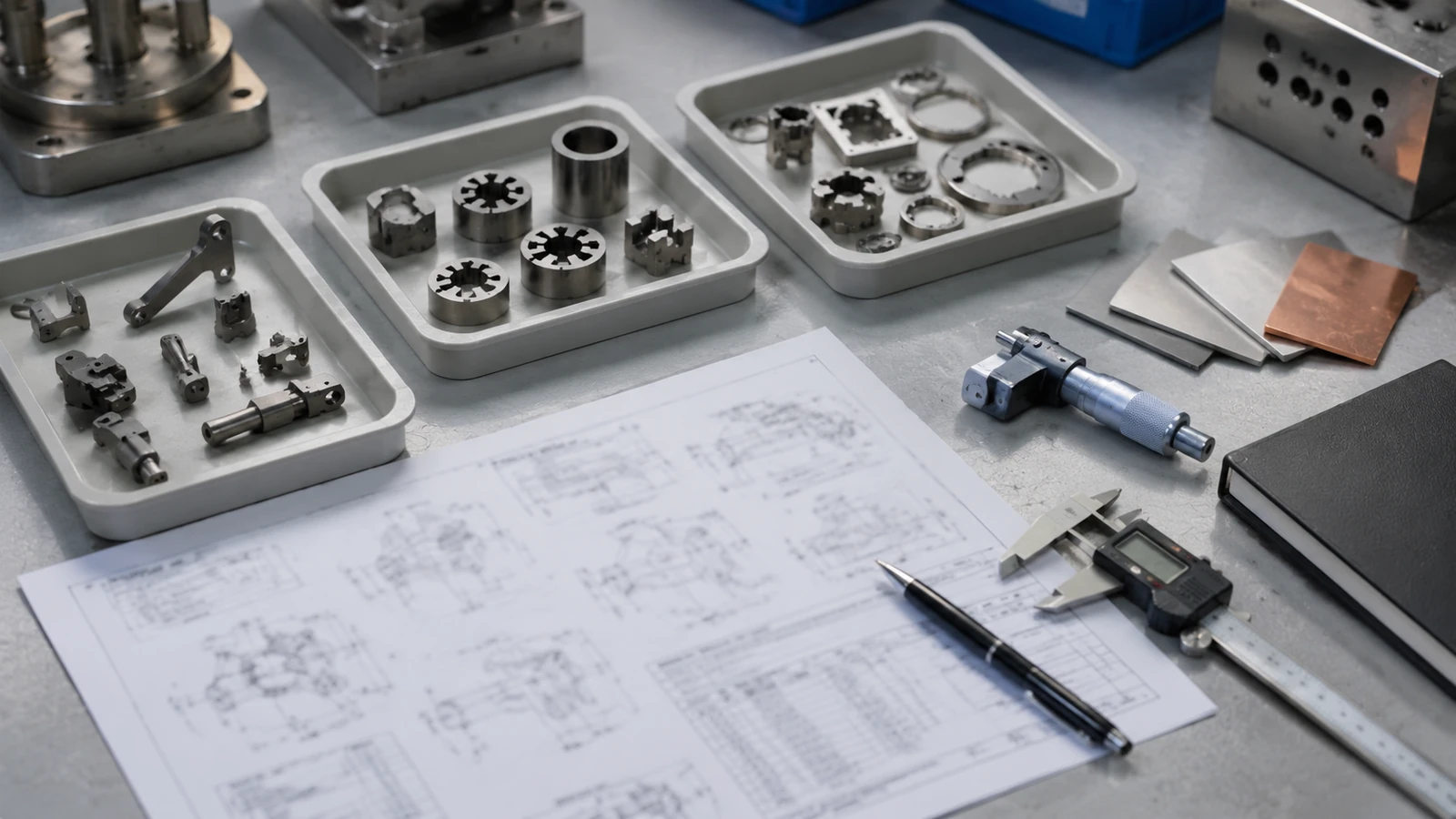
Engineering takeaway: The first decision is whether the component is structural, magnetic or thermally controlled.
Structural Route
Structural Fe-Ni Low-Alloy Steels for MIM Parts
Structural Fe-Ni grades should be reviewed when the component primarily needs mechanical performance rather than a controlled magnetic or thermal-expansion function.
In this guide, Fe-2Ni, Fe-4Ni and Fe-8Ni refer to structural MIM low-alloy grade directions. Exact carbon content, chemistry, material specification and final condition must be confirmed for the individual project.
Fe-2Ni as an Entry Structural Route
Fe-2Ni MIM low-alloy steel can be reviewed when a project needs a structural Fe-Ni direction but does not require a specialized magnetic or controlled-expansion material. The project still needs a defined mechanical condition, heat treatment, surface protection strategy and inspection plan.
Fe-4Ni for a Different Structural Balance
Fe-4Ni MIM low-alloy steel may be reviewed as another structural direction when the drawing, target condition and available production route support it. It should not be presented as an automatic upgrade from Fe-2Ni. Chemistry, final condition, distortion allowance and acceptance requirements must be agreed.
Fe-8Ni When a Higher-Nickel Structural Direction Is Required
Fe-8Ni MIM low-alloy steel remains part of the structural route in this guide. It should not be grouped with Fe-50Ni merely because both contain iron and nickel. Required properties, heat treatment, sintered density, geometry-related distortion and post-treatment inspection remain project-specific.
- Confirm whether corrosion resistance or structural performance is the primary need.
- Define which dimensions are controlled after sintering, heat treatment or secondary operations.
- Review thick-to-thin transitions and unsupported features for distortion sensitivity.
- Do not use nickel content alone as the material-ranking method.
When this route is not the right starting point: move away from structural Fe-Ni low-alloy steel when controlled magnetic behavior, low thermal expansion, expansion matching or primary corrosion resistance is the real design requirement. Keeping the wrong material family in the RFQ can produce a technically detailed quote for the wrong engineering function.
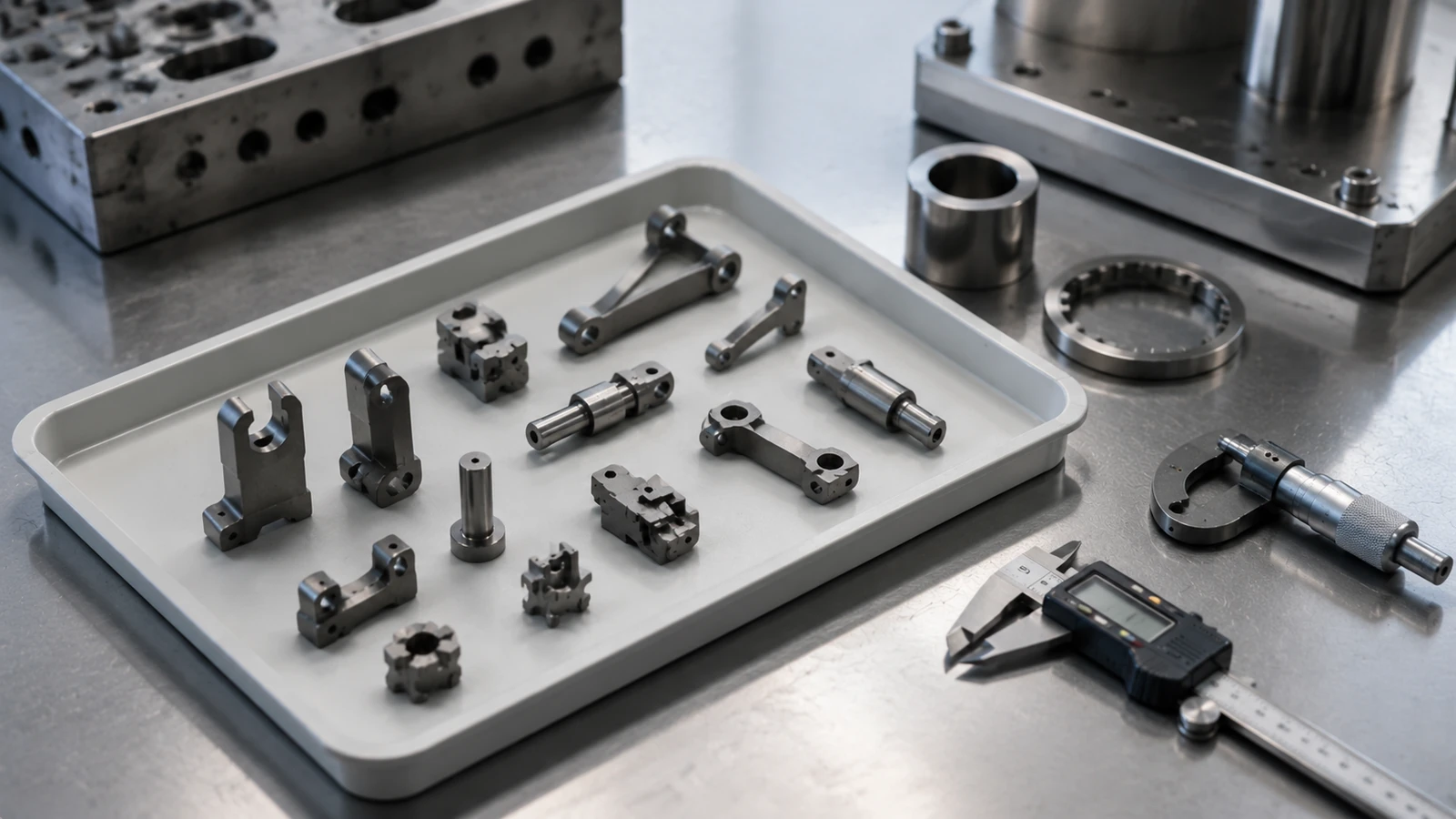
Engineering takeaway: Fe-2Ni, Fe-4Ni and Fe-8Ni should be assessed by mechanical condition, heat treatment and dimensional stability—not as a simple nickel-content ranking.
Magnetic Route
When Fe-50Ni Is a Soft-Magnetic Material, Not a Structural Upgrade
Fe-50Ni belongs to a magnetic material route. The acceptance discussion therefore shifts from ordinary structural properties toward magnetic performance, density, thermal treatment, geometry and test conditions.
For grade-level review, see Fe-50Ni MIM material.
Magnetic Performance Must Be Defined by the Application
“Good magnetic properties” is not a usable specification. The project should identify which characteristic affects the assembly, such as permeability, coercivity, saturation behavior, magnetic flux path, operating field, test frequency or shielding function.
Density and Thermal Treatment Affect the Result
Nominal chemistry alone does not establish finished magnetic performance. Residual porosity, sintered density, carbon and oxygen control, sintering atmosphere, residual stress and magnetic annealing can influence the result.
This is one reason the same alloy name can produce different results in MIM parts.
Magnetic Inspection Must Be Agreed Before Quotation
The RFQ should identify whether magnetic performance will be evaluated through a material coupon, standard specimen, finished component, magnetic circuit, customer fixture, supplier method or independent laboratory. Geometry can affect the measured result, so a target copied from bulk material literature may not translate directly to the finished part.
| Specification Item | Define in the RFQ | Why It Matters | Common Under-Specification Risk |
|---|---|---|---|
| Magnetic function | Field guiding, shielding, switching, sensing or actuator function | Different functions prioritize different magnetic characteristics | The requirement says only “magnetic material” |
| Test object | Coupon, ring, finished component or complete magnetic circuit | Part geometry and demagnetizing effects can change the measured result | A bulk-material value is applied directly to the finished geometry |
| Final condition | As-sintered, machined, stress-relieved or magnetically annealed | Residual stress and thermal history can influence magnetic behavior | The drawing omits when annealing occurs relative to machining |
| Measurement conditions | Field strength, frequency, temperature, fixture and acceptance limit | Results are not comparable when the test conditions are different | Supplier and customer use different methods but compare the numbers directly |
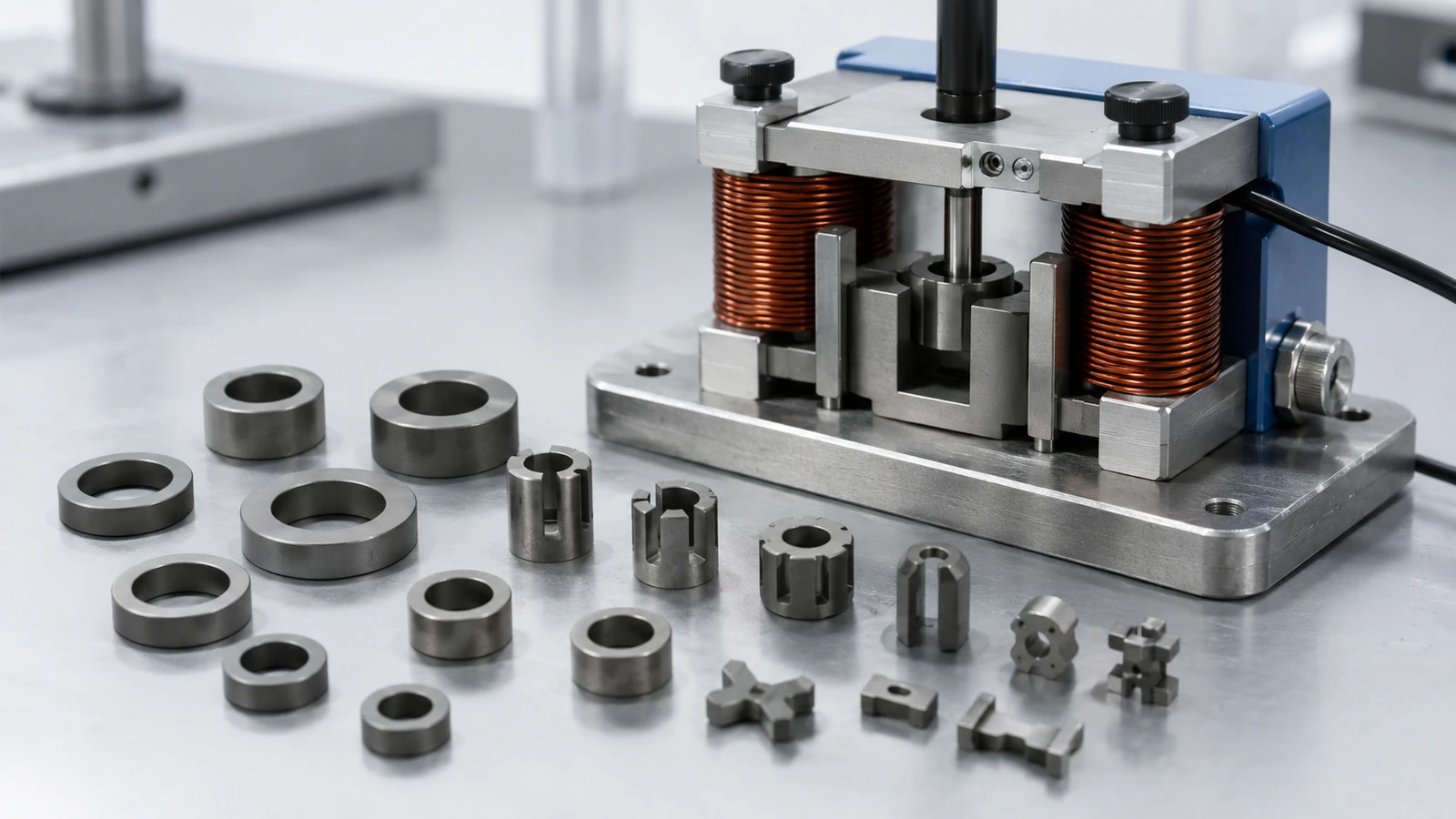
Engineering takeaway: Fe-50Ni is selected around magnetic performance, density, annealing and test conditions rather than ordinary structural strength.
Thermal-Expansion Route
Invar and Kovar Serve Different Thermal-Expansion Problems
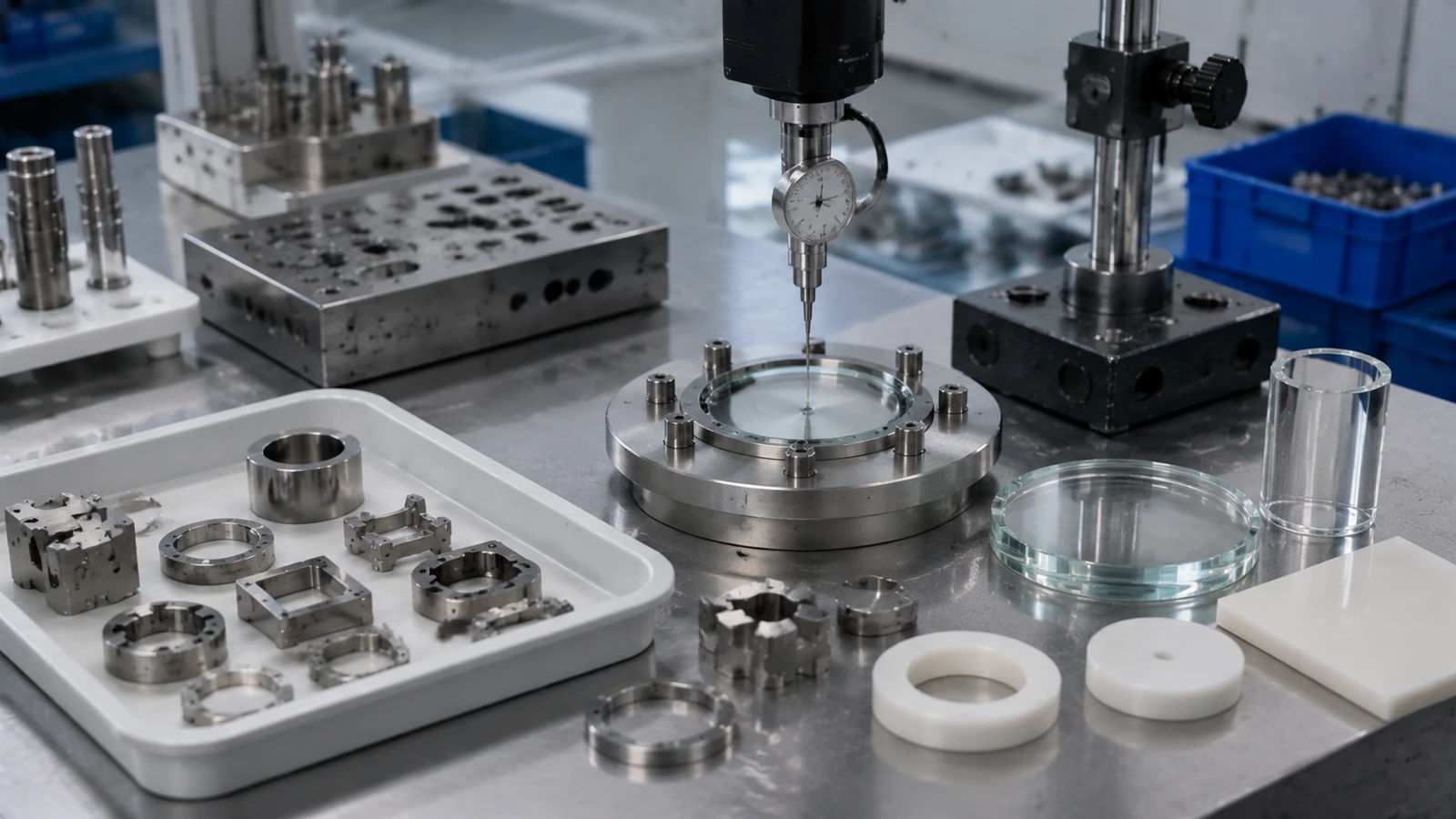
Invar and Kovar both appear in controlled-expansion discussions, but their primary engineering roles are different. The first question is whether the component needs low dimensional change or compatibility with another material during thermal cycling.
For a dedicated comparison, review Kovar vs Invar alloys.
Invar for Low Thermal Expansion and Dimensional Stability
Invar alloys for MIM, commonly associated with FeNi36-type compositions, are reviewed for low thermal expansion over defined temperature ranges. This route may be relevant when the design depends on stable positioning, precision alignment, controlled datum movement or limited dimensional change.
The actual temperature interval must be specified. A generic “low CTE” requirement is incomplete because expansion behavior depends on composition, material condition and the upper and lower temperatures used for measurement.
Kovar for Expansion Matching in Joined Assemblies
Kovar alloys for MIM are reviewed when the metal must be compatible with selected glass or ceramic materials during temperature change. The assembly may depend on the expansion behavior of both materials, joining temperature, interface geometry, surface preparation, thermal cycling and residual stress.
Why Kovar Is an Fe-Ni-Co Alloy
Kovar should not be described as a simple binary iron–nickel alloy. It is an iron–nickel–cobalt controlled-expansion alloy. This distinction matters because broad Fe-Ni searches often combine Kovar, Invar, Fe-50Ni and structural Fe-Ni grades even though they solve different problems.
Carpenter Technology separates low-expansion and glass- or ceramic-sealing alloys within its controlled-expansion guidance. That distinction supports treating low dimensional change and expansion matching as different design tasks. Review the official controlled-expansion alloy guide.
Low-Expansion Decision
Primary objective: minimize dimensional movement over a defined temperature interval.
Required inputs: temperature range, critical datum, dimensional limit, final thermal condition and measurement method.
Risk if omitted: “low CTE” is specified without defining the interval in which the dimension must remain stable.
Expansion-Matching Decision
Primary objective: maintain interface compatibility with another material during joining and service.
Required inputs: mating material, interface geometry, surface preparation, joining cycle and acceptance method.
Risk if omitted: the alloy is selected from its low-expansion reputation without checking the actual glass, ceramic or assembly cycle.
Engineering takeaway: Invar is reviewed for low dimensional change, while Kovar is reviewed for compatibility with another material during thermal cycling.
MIM Feasibility
How MIM Processing Changes Iron–Nickel Alloy Selection
A conventional alloy datasheet cannot confirm whether a specific iron–nickel composition is ready for a MIM production project. Material selection must be reviewed together with feedstock, molding, debinding, sintering, thermal treatment and inspection.
The Metal Injection Molding Association lists low-alloy steels, magnetic alloys, controlled-expansion alloys and nickel-based alloys as separate MIM material families, and it advises users to confirm whether a specific alloy or substitute is available from the supplier. Review the MIMA materials range.
Prepared Feedstock Availability
For XTMIM project review, prepared feedstock is sourced as pellets. Raw powder availability alone does not prove that a stable production feedstock is commercially and technically available for the required chemistry, volume, molding behavior and sintering route.
Review why feedstock availability matters before choosing a MIM material before locking a special composition into the drawing.
Debinding and Sintering Stability
Different Fe-Ni routes may require different control of binder removal, carbon balance, oxygen exposure, sintering atmosphere, temperature profile, support strategy and furnace compatibility. A wrought datasheet does not establish a stable MIM process window.
Density, Chemistry and Thermal Treatment
Structural grades may prioritize heat-treated condition and dimensional stability. Magnetic grades may prioritize density, annealed condition and magnetic repeatability. Controlled-expansion grades may prioritize chemistry, stress condition and expansion behavior over a defined temperature range.
Geometry, Shrinkage and Inspection Stage
Risk increases with long unsupported spans, uneven section thickness, thick-to-thin transitions, deep blind holes, thin ribs, tight concentricity, thermally sensitive datums and critical interface surfaces. The project team should identify whether each dimension is controlled after sintering, heat treatment, magnetic annealing, sizing, machining or finishing.
Tooling Hold Gates for Special Fe-Ni Projects
No Confirmed Feedstock Route
Hold tooling when only raw powder or a wrought alloy designation is available and no prepared feedstock, substitute route or production quantity has been confirmed.
No Measurable Functional Requirement
Hold material lock when the specification says only “strong,” “magnetic,” “low expansion” or “glass sealing” without a measurable acceptance condition.
Final Thermal Condition Is Undefined
Hold the tolerance and test plan when heat treatment, magnetic annealing, stress relief or joining thermal cycles have not been placed in the process sequence.
Critical Dimensions Are Checked at the Wrong Stage
Hold tooling compensation when the drawing does not state whether dimensions are accepted after sintering, thermal treatment, sizing, machining or final assembly.
Engineering review principle: a special alloy project is ready for tooling only when material availability, geometry, final condition and acceptance evidence are connected in one process plan.
Scope Clarification
Iron–Nickel Alloy Topics This Guide Does Not Cover
Broad Fe-Ni searches include several material systems and product forms that do not belong to this MIM component-selection guide.
Special Metals describes INCONEL alloy 718 as a high-strength, corrosion-resistant nickel-chromium material. That is a different material objective from structural low-alloy Fe-Ni steels, Fe-50Ni magnetic alloys and controlled-expansion grades. Review the official Alloy 718 bulletin.
Covered Here
- Structural Fe-Ni low-alloy steel directions
- Fe-50Ni soft-magnetic selection
- Invar-type low-expansion selection
- Kovar-type expansion-matching selection
- MIM feedstock and process feasibility
- Drawing and RFQ preparation
Outside This Guide
- Nickel-base superalloy selection
- W-Ni-Fe tungsten heavy alloys
- Fe-Cr-Ni stainless and heat-resistant alloys
- Raw powder, sheet, strip, foil and wire
- Coatings, plating and thin films
- Academic phase-diagram or nanoparticle research
| Similar-Looking Topic | Why It Is Outside This Guide | Better Direction |
|---|---|---|
| IN718, IN625 and other nickel-base alloys | These are nickel-base systems designed around high-temperature, corrosion or specialized mechanical requirements | Review the MIM nickel-alloy route |
| W-Ni-Fe tungsten heavy alloys | Nickel and iron act within a tungsten-rich high-density system | Review tungsten-alloy selection separately |
| Fe-Cr-Ni alloys | Chromium changes the material family toward stainless, heat-resistant or corrosion-oriented alloys | Review stainless steel or nickel-alloy routes |
| Fe-Ni sheet, strip, foil or wire | These are wrought product-form searches rather than finished MIM component selection | Use a wrought-alloy supplier |
| Fe-Ni powder sold as laboratory material | Raw powder availability does not confirm a prepared, processable MIM feedstock | Confirm feedstock and supplier feasibility |
| Fe-Ni coating, plating or thin film | These belong to surface engineering or deposition processes | Use a coating or thin-film technical source |
Engineering Review Example
Representative Engineering Scenario — The Drawing Only Says “Fe-Ni Alloy”
A product engineer submits a small, complex component for quotation. The drawing includes “Fe-Ni alloy,” but it does not explain why nickel is required.
Structural Interpretation
If the part carries load or transmits motion, Fe-2Ni, Fe-4Ni or Fe-8Ni may be relevant starting directions. The team still needs the required condition, load case, heat treatment and critical dimensions.
Magnetic Interpretation
If the component forms part of a magnetic circuit, Fe-50Ni may be relevant, but magnetic targets, annealed condition and the agreed test method must be defined.
Thermal Interpretation
If the component needs low dimensional change, an Invar-type alloy may be reviewed. If it joins glass or ceramic, a Kovar-type route may be more relevant.
Problem, Cause, Handling and Prevention
| Review Step | Engineering Finding | Required Action |
|---|---|---|
| Problem | The drawing states “Fe-Ni alloy,” but does not define the function or acceptance condition. | Do not select a grade or release a tooling quotation from the alloy note alone. |
| Likely cause | The note may have been copied from a legacy drawing, supplier catalogue, wrought specification or incomplete concept design. | Trace the requirement back to the component function and assembly condition. |
| Handling | Classify the requirement as structural, magnetic, low expansion or expansion matching, then define the production and test condition. | Keep the final grade provisional until feedstock availability and MIM feasibility are confirmed. |
| Prevention | Future drawings should state the required function, final condition, test method and permitted material alternatives. | Use an RFQ checklist and drawing review before tooling approval. |
Review outcome: the material family should remain open until the customer confirms the component function, operating temperature, mating materials, load or magnetic requirement, critical dimensions, inspection method and annual volume.
This is a representative engineering scenario, not a customer case.
RFQ Preparation
RFQ Inputs for an Iron–Nickel MIM Material Review
Send enough information to define both the material function and the manufacturing route. A broad alloy name by itself is rarely sufficient for a reliable quotation.
Drawing and Geometry
- 2D drawing and 3D CAD
- Part weight and overall dimensions
- Critical walls, holes, ribs and thin features
- Datum structure and non-adjustable dimensions
- Machining or grinding allowances
Material Function
- Preferred alloy or customer specification
- Structural, magnetic or controlled-expansion function
- Reason nickel is required
- Current material and permitted substitutes
- Required final material condition
Operating Conditions
- Service temperature and thermal cycles
- Corrosion or humidity exposure
- Load type or magnetic operating conditions
- Mating metal, glass or ceramic
- Joining or sealing method
Inspection and Commercial Inputs
- Dimensional, mechanical, magnetic or thermal test method
- Sample qualification expectations
- Estimated annual volume
- Current project stage
- Expected validation and production schedule
Material Review Ready
- The component function is measurable.
- The final thermal or magnetic condition is defined.
- The test object and acceptance method are identified.
- Critical dimensions are tied to a process stage.
- Annual volume and project timing are available.
Keep the Grade Provisional
- The drawing provides only a broad alloy family.
- The required feedstock route is unconfirmed.
- The mating material or operating temperature is unknown.
- The acceptance value has no test method.
- The design cannot tolerate post-treatment dimensional change.
Submit Your Iron–Nickel Part for Engineering Review
Send the drawing, CAD model, required component function, operating environment, critical dimensions, annual volume and acceptance method. The review can identify the most relevant material family, the missing RFQ information and the main MIM feasibility risks before tooling.
Common Questions
Frequently Asked Questions About Iron–Nickel Alloys in MIM
Are all iron–nickel alloys soft magnetic?
No. Fe-Ni terminology covers structural low-alloy steels, soft-magnetic materials and controlled-expansion alloys. Fe-2Ni, Fe-4Ni and Fe-8Ni are reviewed here as structural directions, while Fe-50Ni is reviewed primarily as a soft-magnetic direction. Invar and Kovar solve thermal-expansion problems.
Is Fe-50Ni a higher-strength version of Fe-8Ni?
No. Fe-50Ni should not be treated as the next structural step above Fe-8Ni. It belongs to a magnetic material route, and its acceptance may depend on density, annealing, geometry and magnetic testing.
What is the difference between Invar and Kovar for MIM projects?
Invar-type FeNi36 alloys are primarily reviewed for low thermal expansion and dimensional stability. Kovar is an Fe-Ni-Co alloy primarily reviewed for expansion matching with selected glass or ceramic materials. The correct choice depends on the assembly and temperature cycle.
Can all Fe-Ni alloys be produced by MIM?
No blanket assumption should be made. Actual feasibility depends on powder and prepared feedstock availability, molding behavior, debinding, sintering, geometry, thermal treatment, production volume and inspection requirements.
Can I use a wrought Fe-Ni datasheet to specify a MIM part?
Use the datasheet as a reference, not as an automatic production guarantee. The MIM supplier should confirm whether the required chemistry, condition, density, geometry, thermal treatment and testing can be supported through the selected MIM process route.
Is IN718 part of the same iron–nickel selection route?
No. IN718 is a nickel-base nickel-chromium alloy system with additional alloying elements and a different performance objective. It should be reviewed under nickel-base alloys rather than grouped with Fe-2Ni, Fe-50Ni, Invar or Kovar.
Technical Sources
References for Engineering Review
These sources support the material-family boundaries and controlled-expansion terminology used in this guide. Typical published values should not be treated as guaranteed MIM component properties.
- Metal Injection Molding Association — MIM Materials Range — Overview of MIM alloy families and the need to confirm specific alloy or substitute availability with the supplier.
- MPIF Standard 35-MIM — Materials Standards for Metal Injection Molded Parts — Provides current MIM material specification guidance, explanatory notes and definitions for discussions between designers and fabricators.
- Carpenter Technology — Kovar Alloy — Describes Kovar as an iron–nickel–cobalt low-expansion alloy used for glass and ceramic sealing applications.
- Carpenter Technology — Controlled-Expansion Alloys — Supports the distinction between low-expansion alloys and expansion-matching alloy systems.
- Special Metals — INCONEL Technical Bulletins — Identifies INCONEL 718 within the nickel-base INCONEL alloy family rather than the ordinary structural or controlled-expansion Fe-Ni route.