For a new metal part project, PM is usually the lower-cost route when the part is simple, pressable, high-volume, and does not need complex side features or high-density geometry. MIM becomes worth evaluating when the part is small, complex, difficult to compact, or currently requires repeated machining, assembly, welding, or multiple secondary operations. For sourcing …
For a new metal part project, PM is usually the lower-cost route when the part is simple, pressable, high-volume, and does not need complex side features or high-density geometry. MIM becomes worth evaluating when the part is small, complex, difficult to compact, or currently requires repeated machining, assembly, welding, or multiple secondary operations. For sourcing and project teams, the practical question is not “Is MIM cheaper than PM?” but “Which route gives the lower total manufacturing cost for this drawing, material, tolerance, volume, and application?” A useful comparison must include tooling, powder or feedstock cost, forming risk, sintering behavior, secondary operations, inspection burden, yield risk, and annual volume. Continue reading if your team is preparing a new RFQ and needs to decide whether MIM, PM, or another manufacturing route deserves engineering review before tooling.
This page focuses on cost-driver and RFQ decision logic. For the broader process-level selection framework, see the full MIM vs PM process selection guide and the main MIM comparison section.
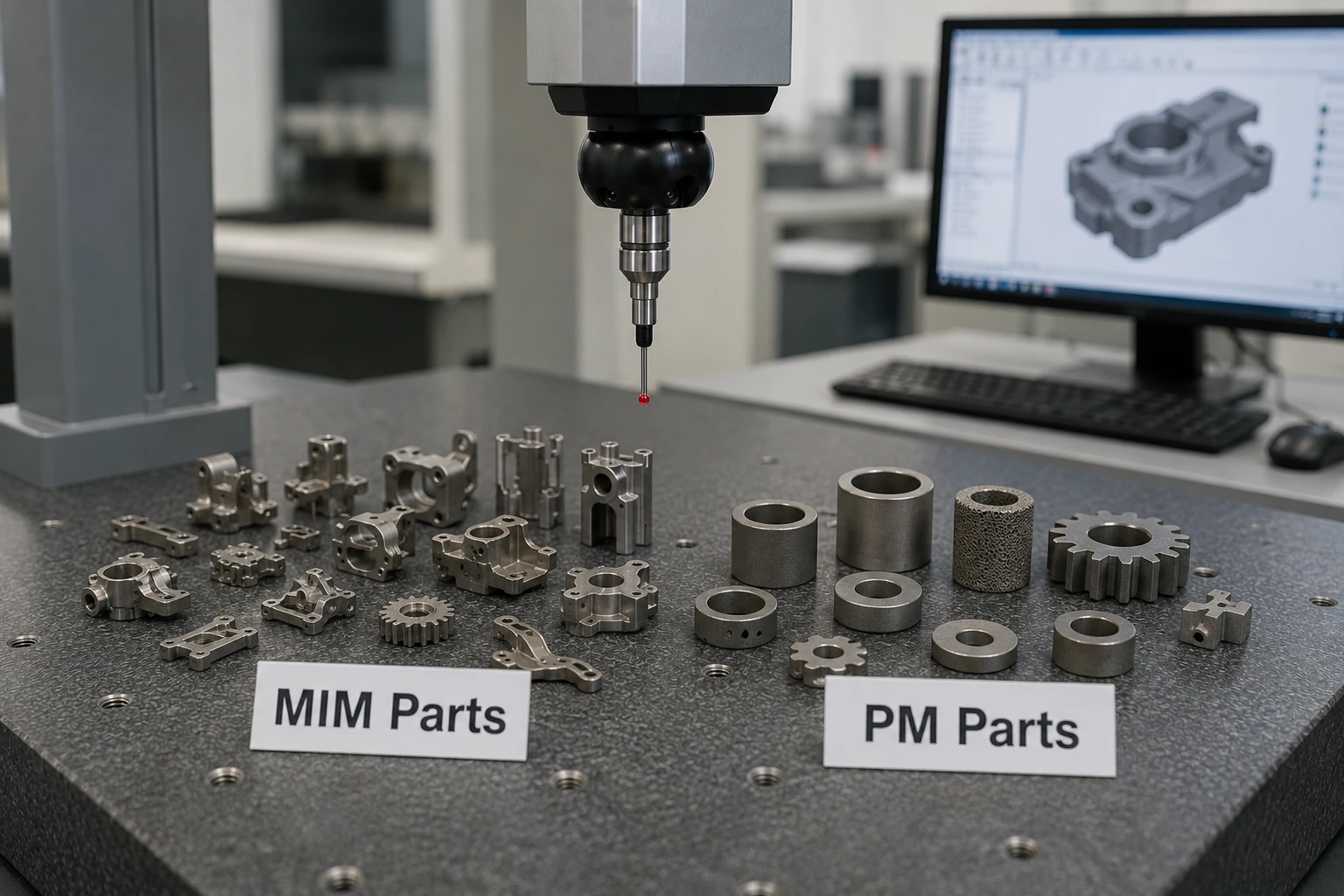
Core conclusion: A drawing-based review helps prevent a low initial unit price from hiding secondary operations, inspection burden, or tooling changes.
Quick answer: PM usually has the lower forming cost for simple, pressable, high-volume parts, while MIM can become the lower total-cost route when small complex geometry reduces machining, assembly, tooling changes, or difficult inspection. A reliable MIM vs PM cost comparison should not judge unit price alone. It should review tooling, powder or feedstock route, geometry, density or porosity requirements, tolerances, secondary operations, annual volume, and RFQ risk before tooling.
Quick Answer: Is MIM or PM Usually Cheaper?
PM is usually cheaper for simple, pressable, high-volume parts. MIM may become more cost-effective when small complex geometry removes machining, assembly, or difficult secondary operations. For a production RFQ, the cost comparison should review tooling, material route, density or porosity requirements, tolerance targets, inspection burden, annual volume, and secondary operations instead of comparing unit price alone.
PM and MIM are both powder-based metal manufacturing routes, but they do not form parts in the same way. Conventional PM uses powder compaction, green compact handling, sintering, and sometimes sizing, coining, repressing, machining, impregnation, or other secondary operations. MIM uses fine metal powder mixed with binder as feedstock, injection molding, green part handling, debinding, sintering shrinkage, and final inspection. The cost structure follows the process route.
PM usually wins when the part is simple, pressable and very high volume
PM often has the cost advantage when the part can be compacted in a die without complex side features, severe undercuts, unsupported thin walls, or difficult ejection. Typical examples include relatively regular gears, bushings, spacers, bearings, porous parts, and some soft magnetic components.
In these cases, PM can be highly efficient because the part geometry matches the press-and-sinter route. If the required porosity is functional, such as in an oil-impregnated bushing or porous component, PM may not only be cheaper; it may also be the more technically correct process.
MIM may win when complexity replaces machining or assembly
MIM may have a total cost advantage when a part is small, complex, and expensive to machine repeatedly. This is especially relevant when the design includes fine features, thin walls, small bosses, side features, complex contours, internal details, or part consolidation opportunities.
From a design review perspective, MIM is not selected because its raw material or tooling is cheap. It is selected when a molded near-net-shape route can reduce downstream work. If a PM part would require drilling, milling, slotting, deburring, sizing, inspection fixtures, and assembly, the initial PM unit price may not represent the real project cost.
The real question is not price, but cost drivers
Before tooling, the key question is whether each route can meet the drawing with a stable process chain. A serious RFQ comparison should check whether the geometry can be formed directly, whether secondary machining is required, whether MIM can mold the complexity without excessive sintering risk, whether the material is suitable, whether the tolerances are realistic, and whether annual volume is stable enough to amortize tooling.
Why Unit Price Alone Misleads New Part Projects
A low unit price can be misleading when the quote does not include the full manufacturing route. For a new part project, the early price comparison often hides development assumptions. A supplier may quote only the basic forming cost, while the actual part later requires machining, heat treatment, surface finishing, inspection fixtures, sorting, or design changes.
The real issue is not only the first quote. It is whether the quoted process can repeatably meet the required function after tooling, sampling, inspection, and production. For MIM-specific cost structure, see the metal injection molding cost guide. For design choices that can reduce avoidable cost before tooling, see MIM design for cost.
Use the table below before RFQ to understand why two suppliers may recommend different routes for the same drawing.
| Cost Driver | MIM Cost Impact | PM Cost Impact | What to Review Before RFQ | Risk If Ignored |
|---|---|---|---|---|
| Geometry complexity | MIM can justify higher tooling when small complex geometry reduces machining or assembly. | PM is efficient when the shape is pressable along a practical compaction direction. | Side holes, undercuts, thin walls, bosses, slots, internal features, and part consolidation potential. | The chosen process may look cheap at first but require repeated secondary operations. |
| Tooling and design stability | MIM tooling must consider gate, cavity, ejector, shrinkage compensation, and sintering behavior. | PM tooling must consider punches, die, core rods, density distribution, green strength, and ejection. | Whether the design is frozen, which dimensions are critical, and what features may need tooling changes. | Late drawing changes can increase tooling revision cost and delay sampling. |
| Material and powder route | Fine metal powder plus binder/feedstock affects flow, shrinkage, density, surface condition, and sintering response. | Pressable powder selection affects compaction behavior, density, porosity, and sintered properties. | Material grade, corrosion, strength, wear, magnetic behavior, density, porosity, and post-treatment needs. | A material name alone may not define the correct process route or acceptance requirement. |
| Secondary operations | MIM may reduce CNC work, but some projects still need machining, tapping, polishing, heat treatment, coating, or inspection. | PM may need sizing, coining, repressing, machining, oil impregnation, finishing, or inspection. | Which features must be formed directly, which surfaces can remain as-sintered, and which need post-processing. | The lowest forming price may not be the lowest total project cost. |
| Tolerance and inspection | MIM tolerance review depends on shrinkage compensation, sintering support, geometry, and inspection method. | PM tolerance review depends on compaction, sintering, density distribution, sizing, and functional surfaces. | Critical-to-function dimensions, datums, inspection method, sampling level, and acceptance criteria. | Over-tight general tolerances can force avoidable machining, sorting, or fixture inspection. |
| Annual volume and production life | MIM may become more reasonable when complexity and stable volume support mold investment. | PM is strong when simple pressable parts are produced in stable high volume. | Prototype quantity, first batch, annual volume, expected product life, and demand uncertainty. | Unrealistic volume assumptions can make tooling amortization and unit cost comparisons unreliable. |
Before RFQ: If the part has side holes, undercuts, thin walls, strict density requirements, controlled porosity requirements, or many critical dimensions, a drawing-based review should happen before tooling. You can submit drawings for engineering review before asking suppliers to confirm final process cost.
In practice, the lower-cost route is the route that can meet drawing requirements with fewer avoidable operations, fewer quality surprises, and lower production uncertainty.
MIM Cost Drivers in a New Part RFQ
MIM cost should be reviewed from the complete process route: feedstock, injection molding, green part handling, debinding, sintering, secondary operations, inspection, and yield stability. These cost drivers are connected. A geometry decision can affect mold complexity, green part strength, sintering support, tolerance strategy, and final inspection.
Fine powder feedstock and material selection
MIM uses fine metal powder mixed with binder to form moldable feedstock. This feedstock is not the same as ordinary pressable PM powder. The material system affects flow behavior, shrinkage, sintering response, density, surface condition, heat treatment, corrosion behavior, magnetic properties, and inspection planning.
For cost review, material selection should not begin with price alone. It should begin with corrosion resistance, strength or hardness, magnetic performance, wear resistance, dimensional stability, post-treatment needs, and customer acceptance requirements. For material-level research, continue to MIM materials.
Injection mold complexity and cavity layout
MIM tooling cost depends on more than part size. The mold must support feedstock flow, gate location, parting line strategy, ejection, cavity balance, shrinkage compensation, and sometimes side actions or inserts. A small part can still have high tooling risk if it includes undercuts, thin walls, sharp transitions, cosmetic surfaces, deep holes, or fragile features.
From a design review perspective, the mold should not be quoted only from a 3D shape. The supplier should understand which surfaces are functional, which areas are cosmetic, which dimensions are critical, and which features can accept normal process variation. See MIM tooling support for the project review route.
Debinding, sintering shrinkage and dimensional risk
MIM parts pass through debinding and sintering after injection molding. During sintering, the part densifies and shrinks. This is one of the reasons MIM can produce dense metal components, but it is also why tooling compensation, sintering support, wall thickness balance, and dimensional control matter.
A common mistake is to think of MIM as only “metal injection molding.” In production, MIM is a full route. A part that molds well can still deform during debinding or sintering if the geometry, support strategy, or mass distribution is not suitable. For the full manufacturing route, review the MIM process overview.
Secondary operations and inspection cost
MIM can reduce machining in suitable parts, but it does not remove every secondary operation. Some projects still need machining, tapping, polishing, heat treatment, passivation, coating, plating, tumbling, or precision inspection. These operations should be reviewed before quoting.
If the drawing includes many tight tolerances or customer-specific inspection requirements, measurement cost may become part of the real unit cost. A quote that ignores inspection method, functional datums, or acceptance requirements may be incomplete. For supplier evaluation, see inspection and testing.
PM Cost Drivers in a New Part RFQ
PM cost should be reviewed around powder compaction, green compact stability, sintering, sizing or coining, repressing, machining, impregnation, porosity control, and final inspection. PM is strong when the part geometry fits the compaction route. It becomes more expensive when the design forces extra operations that the basic pressing route cannot handle.
For process background that is not focused on cost, see the powder metallurgy process background.
Pressable geometry and compaction direction
The first PM cost question is not “What is the part weight?” The first question is whether the shape can be compacted and ejected reliably. PM compaction usually favors geometry that can be formed along a pressing direction. Side holes, undercuts, cross features, internal channels, complex 3D surfaces, and severe thickness changes can create cost or feasibility problems.
Compaction tooling: punches, dies, core rods and ejection
PM tooling cost depends on the die set, punches, core rods, tooling levels, density target, ejection method, and part complexity. A simple cylindrical bushing may be efficient. A part with multiple levels, delicate sections, side features, or difficult ejection may require more tooling consideration.
Sintering, sizing, coining and repressing
After compaction, PM parts are sintered. Depending on the part requirements, the project may also need sizing, coining, repressing, machining, oil impregnation, heat treatment, surface finishing, or inspection. These operations are not automatically negative. In many PM projects, sizing or coining is a normal way to improve dimensional consistency or functional surfaces.
Porosity can reduce or increase cost depending on function
Porosity is one of the biggest differences between PM and MIM cost logic. If the project needs controlled porosity, PM may be the correct route. If the project needs high density, high strength, sealing behavior, corrosion resistance, or fine detail, porosity may become a limitation.
Tooling Cost: MIM Mold vs PM Compaction Tooling
Tooling is one of the most misunderstood cost drivers in MIM vs PM projects. Both processes require dedicated tooling, but the tooling logic is different.
MIM tooling is closer to an injection mold system. It must consider feedstock flow, gate location, runners, cavities, parting line, ejector marks, shrinkage compensation, slides, and part handling. PM tooling is based on powder compaction and must consider die filling, pressing direction, punches, core rods, green compact strength, density distribution, and ejection.
| Tooling Area | MIM | PM | Cost Meaning |
|---|---|---|---|
| Forming method | Injection molding of feedstock | Powder compaction in a die | Cost comparison starts from different forming principles. |
| Key tooling elements | Cavity, gate, runner, ejector, possible slides, shrinkage compensation | Die, punches, core rods, tooling levels, ejection system | Tooling cost depends on geometry, not only part size. |
| Geometry risk | Thin walls, undercuts, gate marks, fragile green parts, sintering distortion | Pressing direction, density gradient, side features, ejection cracks | Geometry risk can become tooling revision or secondary operation cost. |
| Engineering review focus | DFM, gate strategy, shrinkage, sintering support, critical dimensions | Compaction direction, green strength, density distribution, sizing needs | Reliable RFQ needs drawing-based review before tooling. |

Core conclusion: MIM mold review focuses on gate, cavity, shrinkage, and ejection. PM tooling review focuses on punch, die, compaction direction, density, and ejection stability.
The important point is not that one tool is always more expensive. The important point is that tooling cost should match the part geometry and production plan. If the design is still changing, both MIM and PM tooling decisions are risky.
Annual Volume and Tooling Amortization
Annual volume affects both MIM and PM, but it affects them differently depending on tooling cost, process stability, batch size, and part complexity. For new projects, volume should be discussed as a range, not as a single optimistic number.
A practical RFQ should separate prototype or sample quantity, first production batch, estimated annual volume, expected production life, expected design stability, and future volume uncertainty.
| Project Situation | PM Cost Logic | MIM Cost Logic | Practical Review |
|---|---|---|---|
| Prototype-only or very low volume | Tooling may be difficult to justify unless PM tooling is simple and project needs it. | Usually not cost-driven unless no alternative can make the geometry. | Consider CNC, metal 3D printing, or prototype route first. |
| Low-to-medium volume | PM may work if tooling and secondary operations are limited. | MIM needs clear complexity or assembly-reduction value. | Compare full process chain, not only quote price. |
| Stable high volume | PM is strong for simple pressable parts. | MIM can be justified for complex small parts. | Review tooling amortization and production repeatability. |
| Long production life | PM tooling investment may be efficient. | MIM mold investment may become more reasonable. | Confirm design freeze and acceptance criteria before tooling. |
Secondary Operations Can Change the Cost Winner
Secondary operations often decide whether PM or MIM is more economical. The forming route may look inexpensive, but post-processing can change the total cost.
When PM loses cost advantage because of machining
PM may lose its cost advantage when a part needs features that are difficult or impossible to press directly. Examples include cross holes, side slots, internal undercuts, precision threads, tight datum surfaces, sealing surfaces, complex grooves, non-pressing-direction details, and tight positional requirements.
When MIM loses cost advantage because of post-processing
MIM can also lose its advantage. A part may be moldable but still become expensive if the design requires excessive polishing, very tight tolerances on many dimensions, unnecessary cosmetic surfaces, multiple secondary machining operations, heat treatment plus coating, or 100% inspection.
The right comparison is process chain cost
Possible PM route: powder selection → compaction → green compact handling → sintering → sizing/coining → machining → impregnation or finishing → inspection
Possible MIM route: feedstock selection → injection molding → green part handling → debinding → sintering → secondary operation → inspection

Core conclusion: The cost winner is decided by the full process chain, not the basic forming step alone.
The lower-cost route is the one that reaches the required function with fewer avoidable operations, fewer quality risks, and a realistic production plan.
Material, Density and Porosity Requirements Affect Cost
Material requirements can shift the cost balance. If the project needs high density, strength, corrosion resistance, magnetic behavior, wear resistance, or cosmetic surface quality, the material and process route must be reviewed together.
MIM is often considered when dense, small, complex metal components are needed. PM is often preferred when the part can use controlled porosity or when the geometry is suitable for economical compaction. Neither rule is universal.

Core conclusion: Porosity is not always a defect. In some PM parts, controlled porosity is part of the function.
The key question is whether porosity is a functional feature, an acceptable condition, or a defect for this part. If the answer is “functional,” PM may be more suitable. If the answer is “defect,” MIM may deserve evaluation. If the answer is unclear, the buyer should not request a quote based only on material name. The application environment should be provided.
Tolerance and Inspection Cost in MIM vs PM Projects
Tolerance is not only a quality requirement. It is also a cost driver. The tighter the tolerance, the more the supplier must consider tooling, process capability, secondary operations, inspection method, and production control.
For MIM, tolerance review is connected to shrinkage compensation, sintering support, part geometry, critical surfaces, machining allowance, and inspection planning. For PM, tolerance review is connected to compaction, density distribution, sintering, sizing, coining, repressing, and functional surface requirements.
Not every dimension should be treated as critical. A good RFQ separates critical-to-function dimensions, general fit dimensions, reference dimensions, cosmetic requirements, functional datums, surfaces that can remain as-sintered, surfaces that require machining or finishing, and dimensions requiring 100% inspection or special fixtures.
For tolerance-specific design guidance, continue to MIM tolerances.
When PM Usually Has the Cost Advantage
PM usually has the cost advantage when the design fits the compaction route and does not require many downstream operations. For sourcing teams, this matters because choosing MIM for a part that is already ideal for PM may increase cost without improving function.
- The shape is relatively regular.
- The geometry is pressable along a practical compaction direction.
- Side features are minimal.
- Controlled porosity is useful or acceptable.
- The part is cost-sensitive and high-volume.
- Sizing or coining can meet functional dimensions.
- The application fits bushings, bearings, simple gears, spacers, porous parts, or some soft magnetic components.
PM should not be dismissed as a lower-grade process. In the right application, it can be the better engineering and cost decision.
When MIM May Have the Total Cost Advantage
MIM may have the total cost advantage when geometry complexity creates cost in PM, CNC machining, stamping, casting, or assembly. This usually happens when the part is small, complex, and produced in stable volume.
- The part has complex 3D geometry.
- Axial powder compaction is difficult.
- Side holes, undercuts, or fine features would require PM secondary machining.
- High density is required.
- Current CNC machining cost is high.
- Several parts can be consolidated into one molded component.
- The project has stable production volume.
- Design review can be completed before tooling.
MIM is not a solution for every metal component. It should be selected when the design, material, tolerance, and annual volume make the process route practical. For application-level guidance, see metal injection molding applications.
RFQ Checklist: What to Send Before Comparing MIM and PM Cost
A reliable MIM vs PM cost comparison requires more than a part name and annual quantity. The supplier needs enough information to understand geometry, function, material, tolerances, tooling risk, secondary operations, and inspection requirements.

Core conclusion: Accurate MIM vs PM cost review requires drawings, CAD data, material, tolerances, volume, and application context.
| RFQ Information | Why It Affects MIM vs PM Cost |
|---|---|
| 2D drawing | Shows tolerances, critical dimensions, datums, surface finish, and inspection requirements. |
| 3D CAD file | Helps review geometry, forming direction, tool access, shrinkage, support, and secondary machining risk. |
| Material requirement | Affects feedstock or powder selection, sintering behavior, heat treatment, corrosion, strength, and cost. |
| Critical dimensions | Determines whether as-sintered dimensions are acceptable or whether sizing, coining, machining, or inspection fixtures are needed. |
| Annual volume | Determines tooling amortization, cavity planning, batch production logic, and quote reliability. |
| Surface finish | Affects polishing, coating, passivation, plating, tumbling, or cosmetic inspection. |
| Application environment | Helps determine whether porosity, corrosion, wear, magnetism, strength, or sealing behavior is critical. |
| Current manufacturing route | Helps identify whether the project is trying to reduce CNC, PM, casting, stamping, assembly, or other process cost. |
| Quality or inspection requirement | Affects measurement method, sample approval, sorting, documentation, and production control. |
A quote without these inputs may still be useful for early screening, but it should not be treated as a final production quotation. For preparation details, review the RFQ preparation guide.
Composite Field Scenario: Why the Lower Unit Price Was Not the Lower Project Cost
Composite field scenario for engineering training: complex small part quoted as PM
What problem occurred: A sourcing team compared PM and MIM for a small metal locking component. The first PM quote looked lower because the basic compacted shape was inexpensive.
Why it happened: The initial PM review did not fully include side holes, a small locking feature, secondary deburring, and inspection for functional alignment.
What the real system cause was: The part was not only a simple compacted shape. Several features did not align well with the PM compaction direction and would require repeated secondary machining after sintering.
How it was corrected: The team compared the complete process chain. PM remained possible, but the quote was revised to include machining and inspection. MIM was reviewed as a near-net-shape option.
How to prevent recurrence: Compare MIM and PM with actual 2D drawing, 3D CAD file, critical features, inspection requirements, and annual volume.
Composite field scenario for engineering training: porous bushing incorrectly considered for MIM
What problem occurred: A project team considered MIM for a small bushing because they believed higher density would automatically mean better quality.
Why it happened: The team did not first clarify whether porosity was a defect or a functional requirement.
What the real system cause was: The application benefited from controlled porosity and oil impregnation. PM was not only lower cost; it matched the functional requirement better than a dense MIM part.
How it was corrected: The project was reviewed based on application function, not only material density. PM remained the preferred route.
How to prevent recurrence: Before comparing MIM and PM, define whether porosity is required, acceptable, or unacceptable.
How XTMIM Reviews MIM vs PM Cost Before RFQ
A practical cost review starts from the part, not from a generic process preference. XTMIM reviews MIM vs PM cost by checking whether the geometry, material, tolerance, volume, and application point toward MIM, PM, CNC machining, casting, stamping, or another route.
For a MIM vs PM cost review, the engineering team evaluates part geometry and forming feasibility, compaction direction or injection mold strategy, material and density requirements, porosity requirements or restrictions, critical tolerances, inspection method, secondary operations, tooling risk, sintering or compaction-related quality risks, annual volume, production life, and current manufacturing cost pain points.
The goal is not to force every project into MIM. The goal is to identify whether MIM offers a practical total cost advantage, whether PM remains the better route, or whether the part should be redesigned before tooling.
Request a Drawing-Based MIM vs PM Cost Review
Contact XTMIM when your team is comparing MIM, PM, CNC machining, casting, stamping, or another manufacturing route and needs a drawing-based cost and manufacturability review. Please provide the 2D drawing, 3D CAD file, material requirement, critical tolerances, surface finish, estimated annual volume, current manufacturing route, and application background.
XTMIM can review whether the part geometry is more suitable for MIM or PM, which features may create tooling or compaction risk, whether secondary machining may change the cost model, how density or porosity requirements affect process selection, and what should be clarified before tooling, sampling, or production planning.
FAQ: MIM vs PM Cost Drivers
Is PM always cheaper than MIM?
No. PM is often cheaper for simple, pressable, high-volume parts, but it is not always the lower total-cost route. If a PM part needs repeated machining, deburring, sizing, special inspection, or assembly because the geometry does not fit the compaction route, MIM may deserve review.
When can MIM reduce total project cost even if tooling is higher?
MIM can reduce total project cost when a small complex part can be molded near-net shape and avoids repeated CNC machining, multiple assembled components, difficult side features, or excessive manual finishing. This depends on geometry, material, tolerance, annual volume, and sintering risk.
Why does annual volume matter in MIM vs PM cost?
Annual volume affects tooling amortization, production planning, cavity strategy, batch stability, and quote reliability. A process that looks expensive at low volume may become reasonable at stable production volume, while an optimistic volume estimate can create unrealistic cost expectations.
Can PM replace MIM for complex parts?
Sometimes, but only if the geometry can be compacted, ejected, sintered, and finished economically. If PM requires extensive machining for side holes, undercuts, slots, or functional surfaces, the total cost may rise. In those cases, MIM may deserve review.
Can MIM replace PM for bushings or bearings?
Not always. If the part requires controlled porosity or oil impregnation, PM may be the more suitable process. A dense MIM part is not automatically better if the application depends on porous behavior.
What information should I send for a MIM vs PM cost review?
Send a 2D drawing, 3D CAD file, material requirement, critical tolerances, surface finish, estimated annual volume, current manufacturing route, and application background. If porosity, sealing, corrosion resistance, wear, magnetism, or cosmetic surfaces matter, state those requirements clearly.
What is the biggest mistake when comparing MIM and PM cost?
The biggest mistake is comparing only unit price. A reliable comparison should include tooling, material, geometry, secondary operations, inspection, yield risk, production volume, and whether the selected process actually matches the part function.
Standards and Technical References Note
Standards and association resources can help frame the evaluation of MIM and PM projects, but they should not replace part-specific DFM review, supplier process review, or drawing-based quotation. They should also not be treated as fixed cost standards.
- MIMA Process Overview: MIM is relevant because it explains the MIM route, including molding, binder removal, and sintering. It supports the distinction between MIM feedstock/injection molding and PM compaction.
- MPIF Metal Injection Molding is relevant because it explains MIM molding, binder extraction, sintering, and shape capability. It supports geometry and process selection discussion.
- MPIF Conventional Powder Metallurgy is relevant because it explains conventional PM as press-and-sinter, including powder mixing and die compaction. It supports PM compaction and cost-driver discussion.
When specific material grades, acceptance values, or customer inspection standards are required, they should be confirmed at project level rather than copied into a general cost comparison page.