MIM vs Die Casting Process Selection Part Size and Weight Triggers Before Choosing MIM or Die Casting Part size and weight are not fixed universal limits when comparing MIM vs die casting. They are early engineering review triggers that must be checked together with wall thickness, projected area, local mass, material route, annual volume, critical …
MIM vs Die Casting Process Selection
Part Size and Weight Triggers Before Choosing MIM or Die Casting
Part size and weight are not fixed universal limits when comparing MIM vs die casting. They are early engineering review triggers that must be checked together with wall thickness, projected area, local mass, material route, annual volume, critical dimensions, and secondary operations.
Quick answer: A small, dense, complex metal component may justify MIM review, especially when the drawing includes fine features, undercuts, tight local geometry, or stainless steel requirements. A larger housing, broad projected area, thick local section, or lightweight aluminum or zinc structure may point toward die casting or another route. The process choice should not be made from outer dimensions alone; it should come from a drawing-based review before tooling assumptions are fixed.
Part size
Part weight
Wall thickness
Projected area
Material route
Annual volume
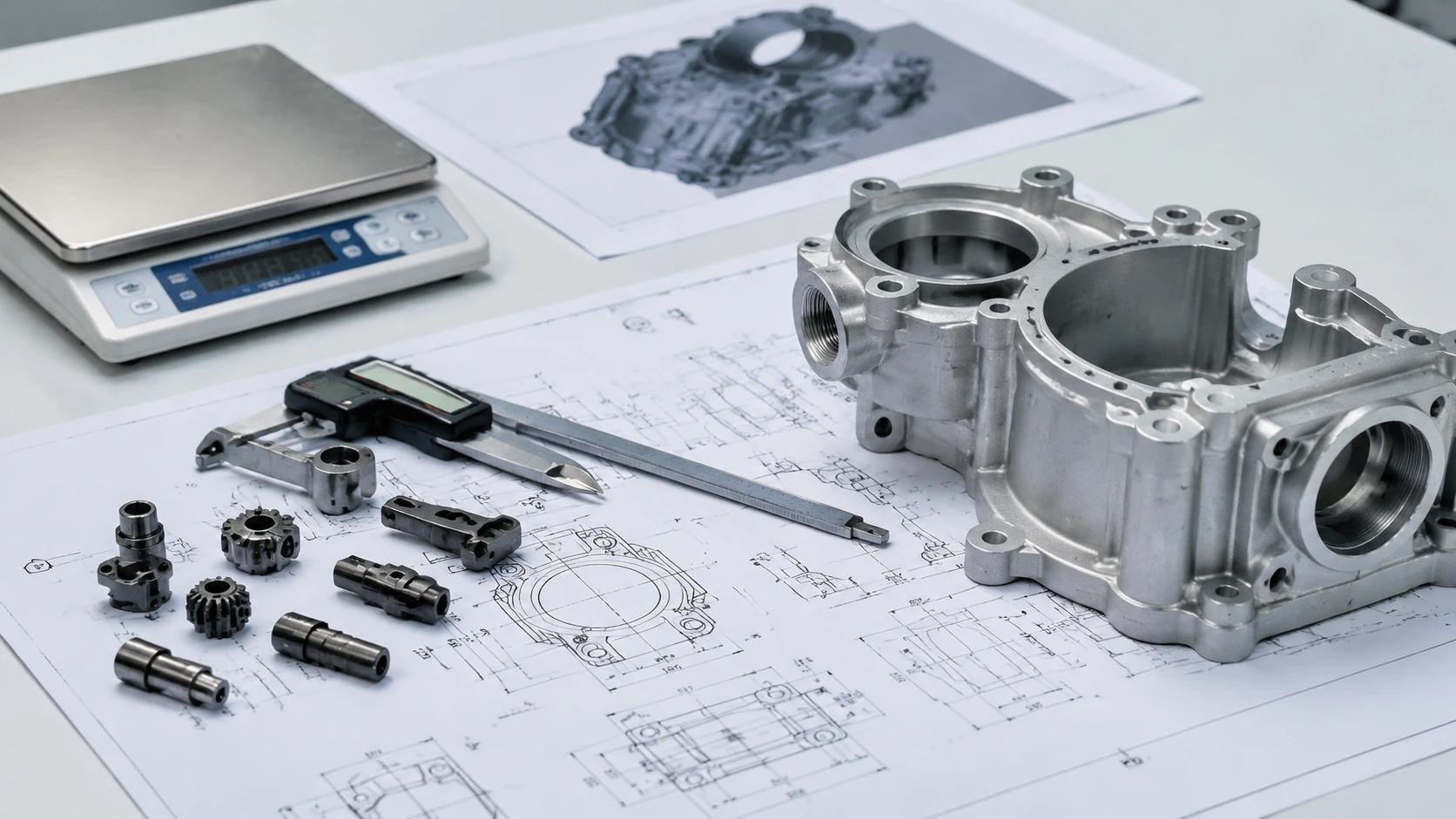
Core conclusion: Part size and weight are review triggers, not fixed universal limits for process selection.
Why Part Size and Weight Should Trigger a Process Review
Part size and weight matter because they influence mold filling, tooling layout, material consumption, shrinkage control, part handling, and final inspection strategy. In MIM vs die casting decisions, these factors should be treated as process review signals rather than fixed pass-or-fail limits.
A common mistake is to ask for a single maximum MIM size or a single minimum die casting size. In real project review, the answer depends on the whole part. A small part with simple geometry may not justify MIM if machining, stamping, or another process is easier. A larger part may not automatically belong to die casting if the material, features, tolerances, and annual volume do not support that route.
From a design review perspective, size and weight become useful only when they are connected to the drawing. A compact part with high feature density may require a different review path from a flat housing with broad projected area. A part with acceptable outer dimensions may still be difficult if it has heavy local sections, abrupt wall transitions, or critical features located near thick-to-thin geometry changes.
Size Is Not a Single Limit
Envelope size alone does not decide the process. A compact part with fine features, thin sections, and dense metal requirements may be a strong MIM review candidate. A part with the same outer dimensions but simple geometry, loose tolerances, and easy machining access may not need MIM.
Weight Changes Assumptions
Part weight affects unit cost, handling, tooling assumptions, sintering review, and casting review. A compact dense component should be reviewed differently from a large lightweight housing, even if the two parts appear similar in a rough cost comparison.
Early Review Prevents Misleading Quotes
If size and weight are reviewed too late, suppliers may quote from incomplete assumptions. Drawing review helps compare MIM, die casting, machining, and other routes with a clearer understanding of geometry and post-processing requirements.
Engineering takeaway: Size and weight only become meaningful when reviewed with geometry, material, wall thickness, projected area, critical dimensions, annual volume, and secondary operation requirements.
Size and Weight Trigger Table for MIM vs Die Casting
The following table should not be used as an absolute rule. It is a practical early review tool. If several triggers appear on the same drawing, the project should be reviewed before asking suppliers for final tooling and unit price assumptions.
| Trigger on Drawing or RFQ | Why It Matters | Review Direction |
|---|---|---|
| Small metal part with fine features | Geometry may benefit from molded detail and reduced feature-by-feature machining. | Review MIM |
| Dense stainless steel or low-alloy component | Material route may favor MIM if the shape, wall thickness, and production volume fit. | Review MIM |
| Small part with undercuts, micro features, or complex local geometry | Machining or casting may struggle with feature access, repeatability, or local detail control. | Review MIM |
| Large housing-like part | Broad projected area and lightweight structure may fit casting assumptions better than MIM assumptions. | Review die casting or another process |
| Aluminum or zinc housing requirement | Material route often points toward die casting review when the geometry is shell-like and casting-friendly. | Review die casting |
| Thick local boss or heavy section | Local mass may affect binder removal, sintering behavior, casting fill, cooling, or inspection planning. | Engineering review required |
| Sudden wall thickness transition | Distortion, shrinkage, filling imbalance, or dimensional drift risk may increase near section changes. | Engineering review required |
| Tight critical dimensions on only a few features | Secondary machining, sizing, datum strategy, or inspection method may influence the process plan. | Review process plus secondary operations |
| High annual volume with stable design | Tooling investment may be easier to justify if the design is stable and repeat demand is realistic. | Compare tooling and unit cost |
| Low or uncertain volume | Tooling cost may dominate the decision even when the geometry appears technically feasible. | Review cost before tooling |

Core conclusion: A trigger table is useful only when size and weight are reviewed with geometry, material, and critical features.
Triggers That Usually Support MIM Review
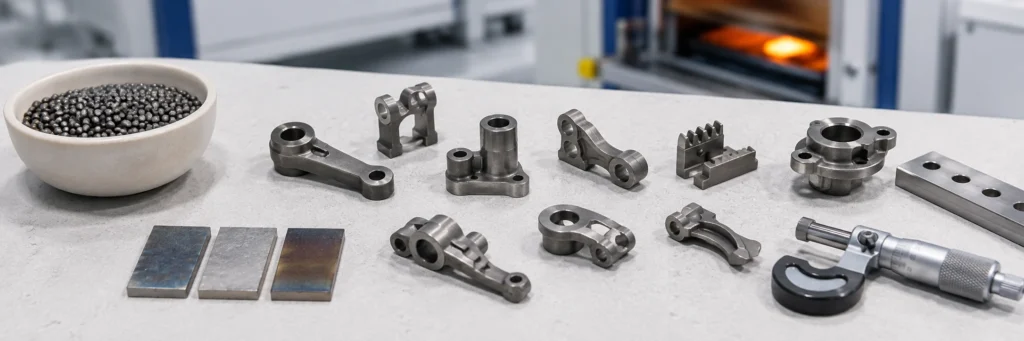
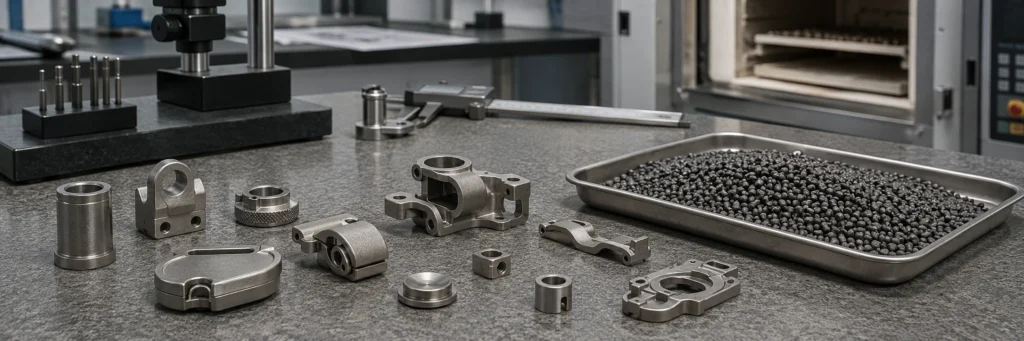
MIM review is often reasonable when the part is small, metallic, complex, and difficult to machine economically at volume. Fine features, thin walls, internal details, small bosses, slots, and dense metal requirements can make MIM attractive if the design can be molded, handled, debound, sintered, and inspected consistently.
Triggers That Usually Support Die Casting Review
Die casting review is often more relevant for larger housing-type parts, lightweight aluminum or zinc components, broad projected areas, and shapes where casting, draft, ribs, bosses, and wall thickness can be designed around the process.
Triggers That Require Engineering Confirmation
Some drawings sit between the two routes. The right next step is not to force a process choice, but to review material, annual volume, tolerance, local mass, datum strategy, and secondary operation requirements.
When Smaller Parts May Favor MIM Review
Smaller parts may favor MIM review when the project requires metal properties, complex geometry, fine details, and repeatable production. MIM can be attractive when the design includes small features that would be expensive to machine one by one, or when several features can be molded near-net shape before sintering and final inspection.
Small Size Alone Is Not Enough
A small part with simple geometry may be better suited to CNC machining, stamping, PM, or another route. MIM becomes more relevant when the part is not only small, but also complex enough to justify tooling and process control. Before selecting MIM, the team should ask whether molded geometry will reduce secondary machining, whether the volume supports tooling, and whether the final tolerance package is realistic for the process route.
For a broader suitability view, review what parts are suitable for metal injection molding. For a more focused small-part discussion, review metal injection molding for small complex parts.
Dense Metal Features and Fine Details
Small dense components often create a different review path than large lightweight housings. Stainless steel, low-alloy steel, and soft magnetic materials may lead the team toward MIM review when the part has fine details and production volume. However, the material name alone does not decide the process. The drawing must still be checked for moldability, wall distribution, sintering support, and inspection requirements.
Undercuts, Micro Features, and Tooling Access
Undercuts, micro features, narrow slots, internal profiles, and small bosses can make process selection more complex. MIM may help form certain features near-net shape, but tooling access, parting line, gate location, ejection, and sintering support still need review. Before tooling starts, compare the drawing against the principles in MIM design review before tooling.
When Larger or Broader Parts Usually Point Away from MIM
Larger parts do not automatically fail MIM review, but they often raise more questions. A broad projected area, large housing shape, thick wall section, or lightweight aluminum structure may point away from MIM and toward die casting or another process route.
Broad Projected Area and Mold Filling Risk
Broad projected area changes tooling and filling assumptions. A part that spreads across a large surface may be difficult to treat like a compact MIM component. The mold layout, gate position, filling balance, support during thermal processing, and handling requirements may become less favorable.
For die casting, broad shapes may be more natural when the material, draft, ribs, wall thickness, ejection direction, and tolerance expectations fit the process. For MIM, a broad shape must be reviewed carefully because shrinkage, support, and dimensional control may become more difficult as the part spreads away from a compact geometry.
Heavy Sections and Sintering Control
A heavy local section can be more important than total part size. In MIM, local mass affects debinding and sintering behavior. Thick sections may increase the risk of uneven shrinkage, distortion, or internal process difficulty. In die casting, thick sections can also create local quality concerns if the design is not balanced.
This is why the engineering review should look at wall distribution rather than total part weight alone. A moderate-weight component with one thick boss may be more difficult than a heavier part with more uniform geometry.
Housing-Like Shapes and Die Casting Fit
Housing-like parts often include large faces, ribs, bosses, screw columns, and enclosure features. If the required material is aluminum or zinc and the design can follow die casting rules, die casting may be a more natural review direction. If the housing includes small high-precision metal features, demanding local geometry, or stainless steel requirements, the process choice may need a deeper engineering review.
For the complete process comparison, refer back to the MIM vs Die Casting comparison.
Wall Thickness and Section Changes Are Often More Important Than Overall Size
Wall thickness is often a stronger trigger than outer dimensions. A part with a moderate envelope size but uneven section transitions may be more difficult than a smaller part with stable walls. Both MIM and die casting respond strongly to local thickness changes, but the risk mechanisms are different.
During early review, the engineering team should identify thin walls, thick bosses, rib intersections, mounting pads, screw columns, and abrupt section changes. These local features influence how the part fills, shrinks, cools, supports itself, and holds dimensions after secondary operations.

Core conclusion: Local wall thickness and mass distribution often matter more than envelope size.
Thin Walls and Fine Features
Thin walls can support compact design, but they also create mold filling and handling questions. In MIM, thin features must survive injection, green part handling, debinding, sintering, and inspection. In die casting, thin walls must be compatible with flow, draft, ejection, and casting quality.
Thick Sections and Local Mass
Thick sections can create local mass concentration. In MIM, this may affect binder removal, sintering behavior, and dimensional consistency. In die casting, thick sections may affect fill, cooling, and local quality. In both routes, local mass is often more important than total part weight.
Sudden Section Transitions
Sudden transitions from thin walls to thick bosses, ribs, or mounting features often deserve early review. These transitions can create distortion risk, dimensional drift, or inspection challenges. A drawing with several abrupt changes may require design adjustment before either MIM or die casting can be evaluated fairly.
If the critical dimension is located near a section transition, the review should also consider datum strategy, secondary machining, sizing, and inspection method. Without that step, the quoted process may look feasible but fail to meet the functional requirement consistently. For a deeper dimensional-quality discussion, review how part dimensions affect final MIM part quality.
How Material Route Changes the Size and Weight Decision
Material changes the meaning of size and weight. A compact stainless steel component and a larger aluminum housing may have very different process logic even if they look similar in CAD. The engineering team should review material route before comparing tooling and unit price.
Stainless Steel and Dense Metal Components
Stainless steel, low-alloy steel, and some soft magnetic materials often enter MIM review when the part is compact, complex, and suitable for powder-based processing. In these projects, the part may be small but relatively dense. Weight alone should not reject the part. Instead, the team should check whether the shape, wall thickness, volume, and tolerance package fit MIM.
Aluminum or Zinc Housing-Type Parts
Aluminum or zinc housing-type parts often point toward die casting review, especially when the design has broad surfaces, ribs, bosses, and lightweight structural requirements. If the project is primarily about a lightweight enclosure rather than a compact dense precision component, die casting may be a more natural starting point.
Material Choice Before Quote Comparison
MIM and die casting quotes are not comparable if the material route is unclear. A stainless steel MIM quote and an aluminum die casting quote may represent different performance assumptions. Before comparing cost, the team should confirm whether the target material, strength, corrosion needs, magnetic behavior, surface finish, and secondary operations are truly equivalent.
If two suppliers quote different materials, different finishing routes, or different secondary machining assumptions, the comparison is no longer only MIM vs die casting. It becomes a review of performance assumptions, tolerance expectations, and final part requirements.
Drawing Details to Send Before Choosing the Process
A reliable MIM vs die casting review needs more than a part name and a rough size. The project team should send enough information for the supplier to check geometry, material, tooling risk, and post-processing requirements.
The goal is not only to ask whether the part is “small enough” or “too heavy.” The goal is to make the quote assumptions visible: material route, annual volume, wall thickness distribution, critical dimensions, datum requirements, surface finishing, machining, and inspection method.

Core conclusion: Complete drawing inputs help suppliers review process fit before tooling assumptions are made.
Dimensions, Weight Target, and Critical Features
Send the 2D drawing, 3D model, envelope dimensions, target weight if available, and critical dimensions. Mark the features that control assembly, sealing, movement, alignment, or inspection. If only a few dimensions are tight, secondary sizing or machining may become part of the process plan.
Material, Surface, and Volume Requirements
Confirm the target material, acceptable alternatives, surface finish needs, coating or plating expectations, corrosion requirements, magnetic requirements, estimated annual volume, and any post-sintering or post-casting treatment. Do not compare MIM and die casting only by shape if the material routes are different.
Practical Review Package
- 2D drawing with tolerances
- 3D model
- Target material or material alternatives
- Estimated annual volume
- Target part weight if available
- Critical dimensions and inspection requirements
- Wall thickness concerns
- Surface finish or coating requirements
- Secondary machining or assembly requirements
- Current process, if the part already exists
For a broader RFQ input list, review what to send for a MIM RFQ.
Composite field scenario for engineering training
A Size-Based Decision Can Still Be Misleading
A project team compares two metal components before quoting. The first part is a compact stainless steel component with fine grooves, small bosses, and several critical local dimensions. The second part is a larger aluminum housing with broad faces, ribs, and mounting columns.
If the team only compares outer dimensions, the decision may look simple. The compact part appears small enough for MIM, and the housing appears better for die casting. But the real review must go deeper. The compact part still needs moldability, wall thickness, sintering support, and inspection review. The housing still needs draft, wall uniformity, projected area, and secondary machining review.
This scenario shows why part size and weight should trigger engineering review instead of replacing it. The process decision becomes reliable only when the drawing, material route, local geometry, annual volume, and final inspection requirements are reviewed together.

Core conclusion: The safest next step is an engineering review before selecting tooling direction.
Quick Decision Checklist Before Requesting a Review
Use this checklist before selecting a process or asking for a tooling quote. The checklist does not replace supplier review, but it helps identify when the drawing should be evaluated before tooling direction is fixed. If the decision depends heavily on production volume, review annual volume and MIM tooling amortization before comparing tooling and unit price assumptions.
Review MIM If...
- The part is compact and metallic.
- The part has fine features or complex local geometry.
- Dense metal material is required.
- Machining each feature would be costly at production volume.
- The design may benefit from near-net-shape molding.
- Annual volume can support tooling review.
- Critical dimensions can be reviewed for sizing, machining, or inspection.
Review Die Casting If...
- The part is a larger housing or structural shell.
- Aluminum or zinc is the target material.
- The part has broad projected area and casting-friendly wall design.
- Lightweight structure is more important than dense small-part geometry.
- Ribs, bosses, and draft can be designed around the process.
- The design fits casting and secondary machining assumptions.
Ask for Engineering Review If...
- The part has both thin walls and thick local mass.
- Material route is not yet fixed.
- The part has tight local tolerances.
- Secondary operations may control the final cost.
- The drawing has abrupt section transitions.
- The current quote comparison uses different materials or assumptions.
- The part looks suitable for more than one process.
Next step: Send the drawing, 3D model, material target, expected volume, and critical dimensions for review before tooling direction is selected.
FAQ: Part Size and Weight in MIM vs Die Casting Review
Is there a fixed size limit for MIM compared with die casting?
No. There is no universal size limit that automatically decides MIM vs die casting. Part size should be reviewed together with material, wall thickness, local mass, projected area, annual volume, critical dimensions, and secondary operations. Published size limits should be treated as supplier-specific review guidance, not as universal process rules.
Are small parts always better for MIM?
No. Small size alone does not make a part suitable for MIM. MIM review becomes more relevant when small size combines with metal material, fine features, complex geometry, production volume, and suitable tooling assumptions.
Do heavy parts usually fit MIM or die casting better?
It depends on how the weight is distributed. A compact dense metal part may justify MIM review, while a larger housing-like part may point toward die casting. Local thick sections, wall transitions, and material route should be checked before choosing the process.
Why does wall thickness matter before choosing MIM or die casting?
Wall thickness affects filling, local mass, shrinkage behavior, distortion risk, tooling assumptions, and inspection planning. Sudden transitions from thin walls to thick bosses should be reviewed early.
What should I send for a MIM vs die casting process review?
Send a 2D drawing, 3D model, target material, expected annual volume, target weight if available, critical dimensions, wall thickness concerns, surface requirements, and any secondary operation needs.
Technical Note
This article does not use fixed universal size or weight limits because process suitability depends on the complete drawing, material route, wall thickness distribution, tooling assumptions, annual volume, and inspection requirements. Any numeric limit used in a final project review should come from confirmed supplier capability, material data, process validation, or customer-approved drawing requirements.
Technical References
The following external references are provided for general process context. They should not be treated as project-specific size, weight, tolerance, or material approval limits.
Review the Drawing Before Selecting MIM or Die Casting
Part size and weight should trigger process review, not replace it. If your part has small complex features, thick local sections, broad projected area, or uncertain material route, XTMIM can review the drawing and help identify whether MIM, die casting, machining, or another route should be evaluated first.